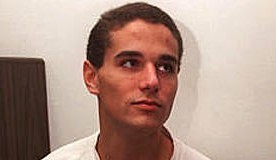
Samuel Sheinbein, 19, fled to Israel
shortly after the dismembered body of Alfredo Enrique
Tello was found in the US state of Maryland in September
1997.
Sheinbein had never lived in Israel
but claimed citizenship because his father had been born
in 1944 in what was then British-ruled Palestine.
The sentence brings to an end a case
that had threatened to sour relations between Israel and
its ally, the US, and led some legislators to threaten
to cut aid to the Jewish state.
The 24-year term came as no surprise
for Sheinbein as his lawyers and the Israeli prosecution
had arrived at a plea bargain in August. He will be
eligible for parole after 16 years and weekend release
after four years.
'Harsh' sentence
State prosecutors in Maryland, where
Sheinbein would have faced possible life imprisonment
without parole, had earlier called the plea bargain
arrangement in Israel an "absolute outrage".
Sheinbein's defence lawyer, David
Libai, a former justice minister, said the teenager had
"received one of the most harsh sentences ever imposed
on a minor convicted of murder in Israel".
Sheinbein stood with his hands behind
his back during sentencing and showed no emotion.
Judge Uri Goren said the sentence,
which will include the time Sheinbein has already served
since 1997, was "meaningful". He ordered Sheinbein to
undergo psychiatric treatment while in prison.
Refuge
Sheinbein bludgeoned Alfredo Tello to
death on 16 September, 1997, cut up his body with an
electric saw and hid the body parts in a nearby garage.
Aaron Needle, who US authorities also
believe was involved in the murder, hanged himself while
in detention in Maryland.
Sheinbein successfully sought refuge
in Israel under a law that prevented the extradition of
Israeli citizens to foreign courts, and a court
recognised his right to be tried there.
When Israel's attorney-general failed
in an attempt to appeal against the decision, the state
started proceedings against Sheinbein.
'It's unfair'
Israel's refusal to extradite the
teenager outraged US authorities and prompted protests
from senior officials.
The dispute was smoothed over when
Israel changed its law, which now requires proof of
residency before Israelis can claim immunity from
extradition.
Prosecutors in the US had said they
would not pursue a capital case, but noted nonetheless
that Sheinbein would have received a harsher sentence
had he been tried there.
Maryland authorities say they will
continue to pursue a case against Sheinbein should he
ever leave Israel.
Before the sentencing. Sheinbein's
mother Victoria said: "It's unfair. It couldn't have
happened to a better kid."
Sheinbein's 'Recipe for Murder'
By Katherine Shaver -
Washington Post Staff Writer
Thursday, September 2, 1999
The agreement calls for Samuel
Sheinbein to stand before three Israeli judges today and
plead guilty to one of Montgomery County's most gruesome
slayings, admitting only to 10 brief facts in a legal
document written in Hebrew.
Although the teenager's lawyers say
he will be sentenced at a later hearing, today's
proceeding effectively will close the case without a
jury or the public getting a full account of what
investigators believe happened before Alfredo Enrique
Tello Jr.'s charred and dismembered body was wrapped in
trash bags and dumped in a Wheaton garage.
Montgomery County prosecutors, who
spent almost two years preparing for what they assumed
would someday be a trial, agreed to open their files and
give a detailed account of the brutal story beneath the
facts that Sheinbein will admit.
Sheinbein's plea, however, may leave
unanswered perhaps the biggest question about the case:
What prompted two middle-class suburban teenagers to
kill a friend (or at least an acquaintance) in such a
cruel manner that the real estate agent who discovered
the mutilated body in a vacant garage initially thought
it was the carcass of a deer?
Eitan Maoz, one of Sheinbein's
Israeli lawyers, said yesterday that he still could not
comment on the teenagers' reasons, saying only, "Any
explanation that will be given should be given to the
court, not to the press."
Even John McCarthy, the deputy
Montgomery state's attorney who can easily recount the
opening argument he will never give, said he might never
be sure: "In the annals of Montgomery County, it's about
as horrible a case as you get in terms of gruesomeness
and what they did to the body. . . . I think they were
damaged kids, but I don't know if we have a good
explanation."
*****
Tello and Aaron Needle had known each
other about a year but began to hang out together more
often in the summer of 1997. It was a loose friendship
that seemed to benefit both.
Tello, who drove an old beat-up car,
liked to drive Needle's gold 1989 Honda Accord around
the Silver Spring and Wheaton neighborhoods, where they
both lived. Friends told police that Needle thought
Tello could get him marijuana or cocaine or at least
introduce him to people who could.
Tello, who at 19 was working at a
Rockville fish store, once referred to Needle as "friending"
for drugs.
Needle, 17, meanwhile, spoke
frequently of "my friend, Sam."
Sheinbein, also 17 and a high school
senior at the time, had his own problems. A young woman
he was friends with--and on whom he had developed a
crush--had begun to date someone else. Sheinbein offered
a friend $5,000 to kill the young woman's new boyfriend
or $1,000 to lure him into a car, where Sheinbein would
have altered the locks so his victim couldn't get out,
McCarthy said. The friend refused, later telling friends
he thought Sheinbein was joking.
Others weren't so sure. One young
woman told police that the same teenager Sheinbein
allegedly had solicited to commit murder had told her
about another conversation with Sheinbein.
Sheinbein had asked, "Do you want to
rape a girl?" and then suggested that the other teenager
try to twist the inside knob of his bedroom door. It
wouldn't open.
"It doesn't open, so she can't get
out," Sheinbein told him.
Sheinbein also showed that friend
what prosecutors now call his "Recipe for Murder." On a
single sheet of notebook paper, was written "Zap, pepper,
metal restraints, rainsuits . . . X-acto hobby knife,
plastic bags" and other items. It listed the Dujitsu
2000 knife and had a check mark next to "recommended by
Consumer Reports."
It also listed size 14 shoes.
Sheinbein and Needle both wore about a size 10, McCarthy
said.
"If they don't fit, u must acquit,"
the note said, echoing lawyer Johnnie Cochran's line to
the jury about the glove fitting too snuggly on O.J.
Simpson's hand.
In September 1997, McCarthy said,
while Sheinbein was looking for someone else to kill as
"practice" for eliminating his romantic rival, Needle
and Tello got into an argument, and Tello punched Needle
in front of a fellow Montgomery Community College
student on whom Needle had a crush.
Sheinbein wanted a victim, according
to prosecutors, and, suddenly, Needle had one for him,
McCarthy said.
Hannah Choi, the object of Needle's
affections, later told police she met Needle for the
first time on Sept. 9, 1997, and he had told her she was
the "hottest" woman in their broadcasting class at
Montgomery College. She told police that she didn't
return his attention.
The next day, she told police, she
joined Needle, Tello, and two other women in Needle's
car to look for cigarettes.
During the trip, Tello and Needle
began to exchange racial slurs about Tello's being
Latino and Needle's being Jewish. Suddenly, Tello turned
around and punched Needle, then got out of the car and
punched him some more. The women giggled.
Needle got "really quiet," Choi told
police, and, looking embarrassed, dialed his cell phone.
She said he laughed into the phone as if to shrug off
the fact that he had just been punched in front of her.
When she asked Needle to whom he was
talking, he answered, "My friend, Sam."
On Sept. 16, 1997, Choi told police,
she paged Tello. He called back about 4:50 p.m. as he
was finishing up work at the fish store. Tello said he
had talked to Needle, who had told him that Sheinbein
had the house to himself. Sheinbein's parents were out
of town, Tello told her, and they could all go over
there to drink.
At 6:30 p.m., Tello spoke on his cell
phone with one of Choi's friends.
"He said he was with two friends,"
McCarthy said. "And that he'd meet her at 7 p.m. at the
[Plaza] del Mercado," a shopping center in Wheaton.
He never showed.
Tello's co-workers would have
testified that both Sheinbein and Needle showed up at
the fish store, McCarthy said.
"We have some plans," one of the two
told Tello. "We've gotta go now."
McCarthy says he and fellow
prosecutor James Trusty don't know for certain when and
where Tello was killed.
Sheinbein told his older brother,
Robert, that he, Tello and Needle had stopped at a
7-Eleven store in Wheaton. Sheinbein said he and Tello
stayed in the car while Needle went inside. When Needle
returned, Sheinbein said, Tello tried to rob him, and
Sheinbein, protecting his friend, strangled Tello while
Needle punched him.
But McCarthy says that's an unlikely
scenario. He said Tello probably was disabled or killed
sometime before 7 p.m., the time he was supposed to meet
his friends. If such an altercation had occurred in the
parking lot of a convenience store near one of
Montgomery's busiest intersections, someone would have
seen it, McCarthy said.
He said Tello was probably disabled
with a stun gun and then strangled with a rope while in
Needle's Honda, but he apparently was beaten in the head
with the butt of a sawed off shotgun and cut on the
chest somewhere else. Neither Needle's Honda nor
Sheinbein's Pontiac Firebird showed any traces of blood.
There also was relatively little
blood found in either the Sheinbein's garage, where
prosecutors believe Tello's body was cut up and burned,
or in the garage of the vacant home where it was dumped
beneath black, plastic Hefty bags.
A police dog specially trained in
sniffing out bodies picked up a scent in the Sheinbein's
garage and sniffed down the driveway and along a gutter
before losing the scent at a drainage ditch, McCarthy
said.
McCarthy's theory: Sheinbein and
Needle hosed off the garage, and the dog picked up the
lingering scent of the blood that would have washed down
the driveway, perhaps at night while the neighbors slept.
At 10:15 a.m. on Sept. 19, a real
estate agent, checking on a house with a "Sold" sign in
front noticed that the front door lock had been tampered
with. When he got inside, McCarthy said, a foul stench
led straight to the garage.
He drew back the black, plastic
garbage bags just enough to catch a glimpse. Montgomery
patrol officers responded to a call for a "suspicious
situation" in a vacant house.
Police photographs show a blackened
form that is difficult to identify as human. Tello's
limbs were never found. They were probably dumped in
neighbors' garbage cans, McCarthy said.
By 8 that night, McCarthy said,
police detectives were sitting in the Sheinbeins' living
room, talking to Sol and Victoria Sheinbein about their
son and his friend, Aaron Needle. Neither teenager could
be located.
Two days later, both surfaced in New
York City. They called their parents, saying they were
in trouble and needed money to go to Israel, McCarthy
said.
Needle's parents got him enough money
for an Amtrak ticket to Union Station. Sheinbein's
parents and brother, however, drove to Manhattan, met
Samuel at an Exxon station and then drove him to John F.
Kennedy airport with a plane ticket and a passport.
Needle committed suicide last year,
hanging himself in his Montgomery County jail cell on
the eve of his trial. Sheinbein, of course, never
returned.
Israeli authorities found a two-page
note in a Tel Aviv hotel room, where Sheinbein and his
brother spent Samuel's last day of freedom. His brother
had hired him a prostitute and bought him his first
bottle of wine, McCarthy said.
Sheinbein's missive was widely
believed to a suicide note. It stated that he had gone "beyond
the lengths necessary" to protect himself.