Murderpedia has thousands of hours of work behind it. To keep creating
new content, we kindly appreciate any donation you can give to help
the Murderpedia project stay alive. We have many
plans and enthusiasm
to keep expanding and making Murderpedia a better site, but we really
need your help for this. Thank you very much in advance.
Georges-Alexandre SARRET
A.K.A.: "The French Acid Bath Murderer"
Real name: Giorgio Sarrejani
Classification:
Serial killer
Characteristics: Dissolved two bodies in sulphuric acid -
To
collect insurance money
Number of victims: 4 +
Date of murders: 1925 - 1931
Date of arrest: 1931
Date of birth:
September 23,
1878
Victims profile: Louis
Chambon-Duverger,
and his mistress,
Noémie Ballandraux / Elderly men
Method of murder:
Shooting
/ Starvation /
Poisoning
Location: France
Status:
Executed by guillotine at
Aix-en-Provence on
April 10,
1934
Death of Sarret
Time.com
Monday, Apr. 23, 1934
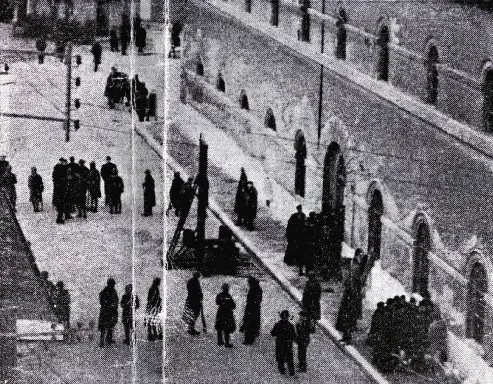
In sunny Aix-en-Provence,
the morbid were up at dawn one day last week, hurrying to the square in
front of the ancient Hotel de Ville. Squads of blue-clad soldiers were
already there, keeping the crowds as far as possible from an open space
in the square's centre. Soon a rattling wagon drove up, loaded with red-painted
timbers, ropes, boards. Trained like circus roustabouts, a crew of
workmen sprang into action. In three-quarters of an hour uprights and
braces were screwed together, the pulley strung, platform, trip lever
and block slipped into place. A bale of fresh dry straw was ripped open,
a zinc-lined wicker casket was unloaded, and Mme Guillotine raised high
her thin red arms in the pale Provençal light.
All this time a busy little old man in a derby hat
was rushing officiously about. Craning their necks behind rows of police,
onlookers whispered that it was "Monsieur de Paris," traditional name
for France's executioner, otherwise Anatole Joseph Deibler, 76.*
Immediately another closed van rattled into the square and out jumped
the assistant executioners, a priest, and a scowling, square-jawed man
in shirtsleeves. Again the whisper went round: "C'est lui! C'est Sarret!"
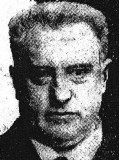
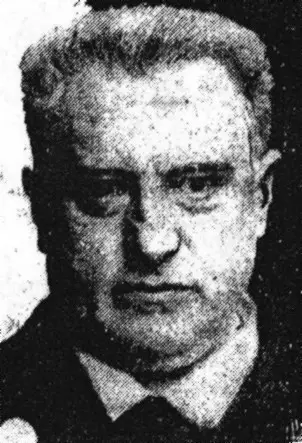
Georges Alexander Sarrejani, alias Sarret, was a
Trieste-born Greek who three years ago succeeded the late infamous Henri
Desire Landru as France's most spectacular murderer when a M. Poncel
returned from a vacation in Italy to his villa near Marseilles.
M. Poncel found the dining room floor ruined by
strange stains, a heap of acid-eaten rags near the garden hedge, and a
horrid stinking mess in a corner of the garden.
Georges Sarret had prepared carefully for his chosen
profession of insurance murderer by studying medicine, chemistry and law
at Marseilles. He also needed confederates. These he found in the
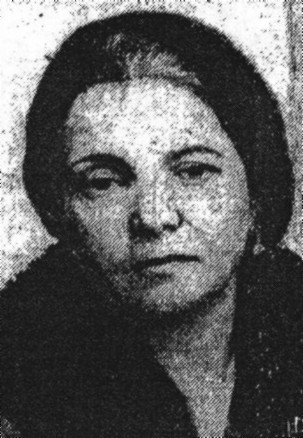
persons of the Bavarian sisters Philomena and Catherine Schmidt who had
been unofficially accused as German agents during the War.
Methodical M. Sarret found the Schmidt sisters
elderly, invalid husbands and insured them. The husbands promptly died
and Georges Sarret pocketed most of the insurance money on threat of
turning the Schmidt sisters over to the police as poisoners and War
spies. From then on the business prospered.
Sarret, Schmidt & Cie. made its first mistake when
healthy Catherine Schmidt insured herself for a million francs as Mageli
Herbin, and the real Mageli Herbin promptly died of pneumonia. Insurance
companies became suspicious. Detectives investigated and found a series
of mysterious facts but no direct evidence of crime.
Sarret. Schmidt & Cie. were in the habit of renting
various small villas as "nursing homes." Under a boulder in the garden
of Sarret's house in Marseilles, detectives found a great mass of bones—rat
bones, cat bones, assorted dog bones up to the skeleton of a St. Bernard,
all more or less decomposed by acid.
Soon thereafter Georges Sarret rented M. Poncel's
villa L'Hermitage and got into difficulties with another of his
underlings, an unfrocked priest named Louis Chambon and the latter's
mistress, a Mile Ballandreaux. When M. Poncel returned, found the horrid
mess in his garden and the stains on the floor, French detectives at
once remembered M. Sarret's garden and its pile of acid-eaten animal
bones. The Schmidt sisters were questioned for hours. Finally Catherine
Schmidt confessed.
Louis Chambon, the unfrocked priest, had threatened
to peach on Georges Sarret. Chambon was lured with his mistress to the
house, and while Catherine Schmidt kept a motorcycle engine roaring in
the cypress shaded courtyard to drown all noise, Georges Sarret shot
priest & mistress from behind a screen. They drove into Marseilles where
Murderer Sarret purchased a bathtub, then sent the terrified Schmidt
sisters back to wander for three nights about the house with its two
reeking corpses.
On the fourth day Georges Sarret returned with 26
gallons of sulphuric acid in the back of his car. The bodies were
crushed in the bubbling vat until even the bones and teeth had dissolved,
then the thick sludge that had once been Louis
Chambon & friend was dumped by pailfulls in the garden. Next morning
Georges Sarret poked about with a stick and carefully picked out a few
gold fillings, one gold crown, six flattened bullets.
Thanks to Georges
Sarret's legal knowledge, the trial dragged on month after month.
Finally last October he was condemned to death, the Schmidt sisters to
ten years at hard labor.
And so last week he
went to meet Mme Guillotine before the Town Hall of Aix-en-Provence. The
end of drama was not yet. Strapped quickly to the board, he was pushed
beneath the knife. The executioner tripped the lever, the triangular
blade crashed down—and jammed, half way down. "Imbeciles!" bellowed
Murderer Sarret. "Be quick can't you!" For ten minutes he lay with his
head on the block while perspiring, embarrassed workmen argued and
tinkered. Executioner Deibler clutched at his weak heart. Then up went
the knife to crash down again, successfully this time. Guillotine and
crowds were gone and the square hosed and washed before breakfast.
* Seventy-six-year-old M. Deibler has officiated
at exactly 300 executions. He has long talked of retiring to the
country, wants to raise chickens.