Murderpedia has thousands of hours of work behind it. To keep creating
new content, we kindly appreciate any donation you can give to help
the Murderpedia project stay alive. We have many
plans and enthusiasm
to keep expanding and making Murderpedia a better site, but we really
need your help for this. Thank you very much in advance.
Gary
Lee SAMPSON
Classification: Murderer
Characteristics: Carjacking
Number of victims: 3
Date of murders: July 24-30,
2001
Date
of arrest:July 31, 2001 (surrenders)
Date of birth: 1959
Victims profile: Philip McCloskey,
69 / Jonathan Rizzo, 19 /
Robert Whitney,
58 (helpless people)
Method of murder: Stabbing
with knife
/ Strangulation
Location: Massachusetts/New Hampshire, USA
Status: Sentenced to death in Massachusetts on
December 23,
2003
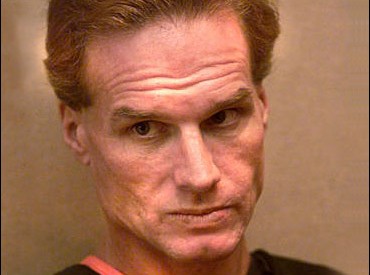
Gary Lee Sampson
(born 1959) is a convicted murderer in Massachusetts, United States. He
was raised in Abington, Massachusetts.
Before Sampson's conviction for murder he had served
eight years imprisonment for robbing banks and had a criminal record
some 25 years long.
Offences
In July 2001 Sampson "carjacked" and murdered three
helpless people: Philip McCloskey (aged 69 of Taunton, Massachusetts),
Jonathan Rizzo (aged 19 of Kingston, Massachusetts), and Robert Whitney
(of Concord, New Hampshire). The murders took place over the course of a
week.
Sampson told police that, after McCloskey picked him
up hitchhiking, he forced him at knifepoint to drive to a secluded area,
where he tied him up with his belt and stabbed him 24 times. He also
forced Rizzo to a secluded area, tied him to a tree, gagged him, and
killed him.
Arguments raised in mitigation
Whilst Sampson's offences were particularly brutal,
matters were raised in mitigation.
The day before the first murder he attempted to
surrender to police. Telephone records confirmed that Sampson had called
the FBI. As a fugitive who was facing charges in North Carolina, Sampson
could have been taken into custody. The call was accidentally
disconnected by an FBI clerk, and no action was taken.
After the murders, Sampson surrendered in Vermont and
confessed. He subsequently pleaded guilty.
Federal Case
Sampson was charged in a federal court in Boston,
Massachusetts, found guilty and on 23 December 2003 he was sentenced to
death.
The jury deliberated for ten hours after hearing six
weeks of evidence. Sampson had pleaded guilty, so the jury did not need
to decide whether he killed McCloskey and Rizzo. But the jury heard the
murders described in graphic detail during the sentencing phase of the
trial. Prosecutors portrayed Sampson as a ruthless, calculating killer
who preyed on Good Samaritans.
Massachusetts does not have the death penalty.
Massachusetts abolished capital punishment in 1984. The last time the
State used the penalty was in 1973. It is the first time anyone in
Massachusetts has been sentenced to die under the federal death penalty
law.
Federal law was changed in 1994 to allow prosecutors
to seek the death penalty when a murder is committed during a
carjacking.
Place of Planned Execution
Massachusetts had no-where to execute Sampson so U.S.
District Judge Mark L. Wolf ordered Sampson to be imprisoned in a
federal penitentiary in Indiana. He ordered that he be executed in New
Hampshire, which has the death penalty. New Hampshire has no one on
death row and has not executed anyone since 1939.
New Hampshire officials were caught off guard as to
the execution order because a lethal injection bed had not even been
installed. The gallows which New Hampshire only uses if lethal injection
cannot be administered, had been turned into an office.
States' Rights Protests
Death penalty opponents criticised the sentence,
saying federal officials had ignored the will of Massachusetts' voters.
State lawmakers have defeated attempts to reinstate the state death
penalty.
Protesters outside the courtroom were holding "No
Death Penalty in Massachusetts" signs and one girl said that the Federal
government had "stepped all over a State which has consistently refused
the death penalty."
Appeal
Sampson’s lawyer, David Ruhnke, said he would appeal.
"I respect the verdict, but I disagree with it. These
are terrible crimes; the victims have suffered terribly," he said. "Those
are very difficult circumstances for any jury to look beyond."
It is expected that it could be six or seven years
before Sampson exhausts all his appeals. As of July 2006 Sampson remains
on death row.
Autobiography
Sampson has worked on an autobiography with writer
and evangelical minister, Deborah Murphy. The working title is The DNA
of a Killer: Society's Child, Gary Lee Sampson.
Murphy says the book is a warning to those with early
mental illness of the warning signs.
Murphy hopes that the book may sway the families of
the victims to forgive Sampson and perhaps even speak out against his
execution. Relatives have not so far indictated that this is likely.
Scott McCloskey said:
"I will never forgive him, ... As far as I'm
concerned, Gary Sampson is an evil man. And as far as the death penalty
goes, he deserves it and I will be there when it happens."
Wikipedia.org
Gary Sampson’s life of crime and punishment
Taunton Daily Gazette
August 30, 2010
Chronology of Gary Sampson’s criminal record, his
three-day rampage in 2001, his 2003 trial in U.S. District Court in
Boston and subsequent developments.
1974: Arrested on a breaking and
entering charge in Abington.
1976: Charged with trying to steal
gasoline and with motor vehicle offenses.
1978: Acquitted of a charge that he
raped a 15-year-old girl in Weymouth.
1979: Charged with trespassing, drug
possession in Abington. 1980: Charged with armed robbery, stealing a car
in Abington. Served time in the Plymouth County jail.
1981: Briefly escaped from the jail
by sawing through a gate.
1982: Three-year suspended sentence
for breaking into a gas station in Tamworth, N.H.
1982: Convicted of violating
probation.
1984: Pleaded guilty to burglarizing
a home in Tamworth, N.H. Sentenced to up to seven years.
1984: Escaped from prison, sentenced
to one to three years.
1987: Convicted of parole violation.
Sentenced to nearly four years.
1996: Fined $60 for speeding in New
Hampshire.
1997: Fined $500 for possession of
marijuana.
1997: Pleaded guilty to assault and
making threats in New Hampshire.
1997: Pleaded guilty to making
threats, served about five months.
1997: Fined $100 for transporting
alcohol.
1998: Convicted of threatening a
woman in New Hampshire. Sentenced to a year in jail with six months
deferred and two years probation.
1999: Accused of violating probation
by not showing up for an arraignment on burglary charges in New
Hampshire.
1999: Newark, N.J., police charged
him with probation violation. Police said he was using several aliases,
including women’s names.
2001: Accused of five bank robberies
in North Carolina.
July 23, 2001: Sampson calls the FBI office in
Boston from a pay phone in Abington to surrender for tjhe bank robberies
in North Carolina. An FBI clerk inadvertently disconnects the call, and
no one shows up to arrest Sampson.
July 24: Former Quincy resident Philip
McCloskey, 69, is stabbed to death in a secluded area of Marshfield
after buying flowers for a friend. Sampson later tells police he was
hitchhiking in Weymouth when McCloskey picked him up.
July 26: McCloskey’s body is found in woods
between Main Street and Old Main Street Extension in Marshfield.
July 27: Jonathan Rizzo, 19, of Kingston
encounters Sampson on the Plymouth waterfront after leaving work at 9
p.m. and gives him a ride.
July 28: Sampson heads for New Hampshire,
where his family had once lived. Rizzo’s family files a missing-person
report with police.
July 30: Robert Whitney, 58, a former city
councilor in Concord, N.H., is found strangled in a cottage on Lake
Winnipesaukee in Meredith, N.H. Rizzo’s car is parked outside. Friends
and family organize a massive search for Rizzo.
July 31: Rizzo’s body is found tied to a tree
behind the Abington Ale House. In Vermont, William Gregory, 41, picks up
Sampson on the side of a road. Sampson puts a knife to his throat, but
Gregory escapes by skidding the car onto the shoulder and jumping from
the car while it is still in drive. Sampson ditches the car, breaks into
a ski chalet and calls 911. He surrenders to police without a fight.
Sampson’s trial in U.S. District Court in
Boston
Sept. 9, 2003 – Sampson pleads
guilty to the carjacking murders of McCloskey and Rizzo, capital
offenses under federal law.
Nov. 5-6 – After six weeks of jury selection, testimony
begins in the punishment phase of the trial. The only choices are death
by lethal injection and life in prison without parole.
Nov. 10-13 – Witnesses tell of
casual encounters with Sampson in Marshfield, Bourne and Plymouth in the
days between the McCloskey and Rizzo murders.
Nov. 17-20 – In a taped interview
with a Vermont state trooper, Sampson says his three victims would still
be alive if FBI agents had not bungled his attempt to turn himself in.
Plymouth County jail officers testify that Sampson threatened to harm
anyone who caused him problems in prison.
Death for Sampson
Verdict makes him state's first since 1947 to face
execution
By Shelley Murphy - The Boston Globe
December 24, 2003
A federal jury yesterday recommended the execution of
Gary Lee Sampson, a drifter who confessed to carjacking and killing two
men during a weeklong murder spree, marking the first time a verdict for
the death penalty has been issued in a federal case in Massachusetts.
The verdict means that Sampson, a 44-year-old from
Abington, would become the first person to be executed for a crime in
Massachusetts since 1947, unless his sentence is overturned on appeal.
The jury of nine women and three men unanimously
rejected Sampson's claim that he was mentally ill when he killed
Jonathan Rizzo, 19, of Kingston, and Philip McCloskey, 69, of Taunton.
Sampson had confessed that after being picked up by the men on separate
days while he was hitchhiking in July 2001, he forced them at knifepoint
to drive to secluded areas, where he tied them up and repeatedly stabbed
them.
"There was no question, no doubt about it," said jury
forewoman Mary E. Dever, who lives south of Boston. "We all,
individually, concluded the same thing."
"I can sleep at night with the decision we've made.
The only thing that will cause any problems with sleep will be trying to
get out of my head the pain the [victims] must have felt when their
lives were being taken." A lawyer for Sampson immediately said he would
appeal.
The reading of the verdict, which jurors reached
after 11 hours of deliberations, set off emotion in the mostly hushed
courtroom. Mary Rizzo, mother of one of Sampson's victims, cried as she
caressed a picture of her son. Sampson, who showed no emotion throughout
the two-month trial, wiped tears from his cheeks.
In a press conference in the lobby of the federal
courthouse in Boston, US Attorney Michael J. Sullivan said, "A sentence
of death is the only appropriate punishment for the crimes that Mr.
Sampson has committed."
When asked what broader message the death sentence
sends, Sullivan said: "There is no political message here. This message
really is about the lives of Philip McCloskey and Jonathan Rizzo."
Sampson's series of murders, which spanned three New
England states, jangled nerves of vacationers and residents with its
randomness and extreme violence.
Almost all murder cases are tried in state courts.
But Sullivan charged Sampson under the federal Death Penalty Act, which
was enacted in 1988 and expanded in 1994 to allow federal prosecutors to
seek the death penalty for some 60 offenses, including carjacking
resulting in murder.
It was only the second time prosecutors in
Massachusetts have sought the federal death penalty. In the earlier
case, a nurse convicted in 2001 of killing four patients in a
Northampton veterans' hospital was sentenced to life in prison after
jurors couldn't reach a unanimous verdict.
Critics of the federal death penalty accuse Attorney
General John D. Ashcroft of using the law to target defendants in states
like Massachusetts that lack a capital punishment statute, as part of a
bid to nationalize the death penalty. In September, federal prosecutors
in Boston announced they would seek the death penalty for two Dorchester
gang members charged with murdering a rival at the city's Caribbean
carnival two years ago. Massachusetts abolished the death penalty in
1984.
Sampson was the first defendant nationwide in a
federal death penalty case to plead guilty and leave his fate to a jury.
He pleaded guilty in September to carjacking and killing McCloskey and
Rizzo. He faces state charges in New Hampshire for breaking into a home
during the same crime spree and killing Robert "Eli" Whitney, 59, of
Penacook, N.H.
US District Judge Mark L. Wolf, who scheduled
sentencing for Jan. 29, told jurors that since they voted for death, "I
will impose that sentence not only because the law requires it but
because of my respect for each of you."
Wolf said defense lawyers will be filing motions
seeking to reverse the verdict, and he tentatively set a hearing for Jan.
26 to consider their arguments. However, that hearing is expected to be
a formality. If Wolf sentences Sampson to death as expected, Sampson
would be sent to the federal penitentiary at Terre Haute, Ind.
If he loses his appeal, Sampson will die by lethal
injection at the Indiana prison. The appeal process is expected to take
years.
Legal analysts have said that Sampson's lawyers faced
a difficult challenge in preparing a defense, given the evidence, which
included Sampson's matter-of-fact confessions and descriptions of the
gruesome slayings.
"These are terrible crimes and the victims have
suffered terribly," Sampson attorney David Ruhnke said. "They are very
difficult circumstances to look beyond."
Family members of the victims expressed satisfaction
with the verdict, though they said it does not erase the pain of their
loss.
"We're very happy about this verdict -- there's no
question about that -- but we're not going out and celebrating anything
here. . . . Our son is still dead, and we will live with that for the
rest of our lives," said Jonathan Rizzo's father, Michael.
McCloskey's son, Scott, said that he was relieved by
the verdict, but that the chair his father always sat in when the family
gathered at Scott's house on Christmas Eve will remain empty tonight.
Unmoved by Sampson's tears yesterday, Scott McCloskey said: "It's all
about him. He didn't show any remorse for my father or Jonathan or Mr.
Whitney. But when it came down to him thinking that he was going to be
sentenced to death, now he's sad."
Jurors reported on the verdict forms that none of
them believed Sampson was significantly impaired at the time of the
slayings or suffered from mental illness.
Only five jurors concluded that Sampson had accepted
responsibility for his crimes, and none of them believed he was
remorseful.
Jurors, who saw graphic crime scene photos and
videos, were unanimous in their agreement that the murders were
especially cruel and heinous because of the physical abuse Sampson had
inflicted on his victims. Both were stabbed repeatedly and their throats
slashed.
Sampson was picked up hitchhiking in Weymouth on July
24, 2001, by McCloskey and forced the elderly man at knifepoint to drive
him to Marshfield, where he marched him into the woods, tied him up, and
stabbed him 24 times. But Sampson said he was unable to steal
McCloskey's van because it had a kill switch. Three days later, Sampson
was hitchhiking in Plymouth when Rizzo gave him a ride. Sampson admitted
he forced the college freshman to drive him to Abington, where he walked
him into the woods, tied him to a tree, and stabbed him 15 times.
Sampson stole Rizzo's Jetta and drove it to New Hampshire, where he
strangled Whitney on July 30, 2001.
Sampson called police and surrendered the next day
after breaking into a ski chalet in Plymouth, VT., and setting off a
burglar alarm.
Assistant US Attorney Frank Gaziano, who prosecuted
the case along with George Vien and John Wortmann, said, "We're just
very happy that justice was served for the victims' families."
Her voice barely audible because she woke up
yesterday with laryngitis, Mary Rizzo later told reporters, "I just want
to publicly thank the jurors. Every single night I've prayed for them
and I will continue to pray that the horrible pictures of Jonathan,
Philip, and Mr. Whitney will go out of their heads and they'll remember
the beautiful pictures."
Federal jury: Death for Mass.
men’s killer
By Martin Finucane
Associated Press
BOSTON - Gary Lee Sampson, a drifter who confessed to
carjacking and killing two Massachusetts men during a weeklong crime
spree, was sentenced to death Tuesday by a federal jury in a state that
has no death penalty and hasn’t executed anyone in more than half a
century.
It is believed to be the first time anyone in
Massachusetts has been sentenced to die under the federal death penalty
law. Massachusetts abolished its state capital punishment statute in
1984; the last time a state court sentenced someone to die was in 1973.
Sampson, 44, sat motionless in U.S. District Court as
the sentences were read for the carjacking murders of Philip McCloskey,
69, of Taunton, and Jonathan Rizzo, 19, of Kingston. The jury
deliberated for 10 hours after hearing six weeks of testimony.
Sampson, a drifter who grew up in Abington, pleaded
guilty in September to killing McCloskey and Rizzo several days apart in
July 2001, after each man picked him up hitchhiking. He also confessed
to killing a third man - Robert "Eli" Whitney, 58, in Meredith, N.H. -
in the same week, and faces separate state charges in New Hampshire for
that crime.
The families of Rizzo and McCloskey whispered in
approval as the sentence was announced; family members wept and hugged
each other as they left the courtroom.
"It’s been a very long, hard couple of years," said
McCloskey’s son, Scott. "It’s not over, still. I feel like the boulder
on my shoulder has been chipped down to a rock."
Sampson’s lawyer, David Ruhnke, said he would appeal.
"I respect the verdict, but I disagree with it. These
are terrible crimes; the victims have suffered terribly," he said. "Those
are very difficult circumstances for any jury to look beyond."
U.S. Attorney Michael Sullivan praised the jurors for
reaching a "fair" verdict under "intense emotional pressure."
"Gary Lee Sampson has robbed families and our
communities of special and precious people," he said.
It was the second case in which federal prosecutors
have sought the death penalty in Massachusetts. Kristen Gilbert, a nurse
who was convicted in 2001 for killing four patients at a Northampton
veterans hospital, was sentenced to life in prison.
Federal law was changed in 1994 to allow prosecutors
to seek the death penalty when a murder is committed during a carjacking.
Death penalty opponents decried the sentence, saying
federal officials had ignored the will of Massachusetts voters. State
lawmakers have repeatedly defeated attempts to reinstate the state death
penalty.
The decision to try Sampson in federal court "was
made by a handful of federal officials who have sought to impose the
death penalty in states like Massachusetts that historically have
declined to impose this punishment," said Carol Rose, executive director
of the American Civil Liberties Union of Massachusetts.
Since the federal death penalty was reinstated in
1988, 124 defendants have been tried on capital charges, but only three
have been executed, according to the federal Bureau of Prisons. There
are 24 currently on federal death row.
Dick Burr, a Houston attorney who has worked with the
Federal Death Penalty Resource Council, which advises defendants in such
cases, said it could be six or seven years before Sampson exhausts all
his appeals.
Because Sampson pleaded guilty, the jury was never
asked to decide whether he killed McCloskey and Rizzo. But the jury
heard the murders described in graphic detail during the sentencing
phase of the trial.
Prosecutors portrayed Sampson as a ruthless,
calculating killer who preyed on Good Samaritans.
In his confession, Sampson told police that, after
McCloskey picked him up hitchhiking, he forced him at knifepoint to
drive to a secluded area, where he tied him up with his belt and stabbed
him 24 times.
Is killer's life story best left untold?
Victims' families resent concept of Sampson book
By Douglas Belkin - The Boston Globe
October 27, 2005
While he sat in his 12-by-7-foot cell on death row,
Gary Lee Sampson has had time to gain 50 pounds and take 30 off. Time to
watch his red hair go gray. And time to reflect on a bloody week in
which he killed three men in cold blood.
And now, fours years after the murders, Sampson wants
people to know what he's been thinking.
For the past 11 months, he has been working with a
writer and evangelical minister on his biography. The working title: ''The
DNA of a Killer: Society's Child, Gary Lee Sampson." The book, said
biographer Deborah Murphy, is a cautionary tale that both she and
Sampson hope will save others from following the same path by describing
the warning signs of mental illness, and drug and alcohol abuse.
''Gary wants a book written before he gets executed
because he wants to tell his story, his side, the true version of
everything that happened," said Murphy, who first met Sampson 26 years
ago when the two were growing up on the South Shore. ''He noticed
certain signs of depression that led to alcohol and drugs and that's how
you get into big trouble. He hopes telling his story can help young
people. . . . He's trying to spare lives."
Relatives of Sampson's victims don't buy that story
line.
''The idea that Gary Sampson wants to help other
children makes me nauseous," said Mary Rizzo, mother of Jonathan Rizzo,
one of Sampson's victims. ''If someone wants to write a book to help
children they should write about Jonathan and Philip and Robert, they
all led good lives."
In July 2001, Sampson carjacked Philip McCloskey, 69,
of Taunton, and stabbed him to death. A few days later, he did the same
to Rizzo, a 19-year-old college sophomore from Kingston. Four days after
that, he strangled Robert Whitney, 58, of Penacook, N.H.
Sampson, who is from Abington, was tried in federal
court and found guilty of the murders; he became the first person in
Massachusetts sentenced to die under the federal death penalty. He is on
death row at the Federal Correctional Institution in Terre Haute, Ind.,
where he is confined to his cell 23 hours day, said Trey Adams, a
spokesman for the prison complex.
Sampson's case is notable for its brutality, but also
for his short-circuited attempt to turn himself in the day before his
killing rampage began. Telephone records confirmed that Sampson called
the FBI from a pay phone that day; a fugitive facing charges in North
Carolina, Sampson said he was trying to surrender. But the call was
accidentally disconnected by an FBI clerk, and no action was taken.
After the murders, Sampson surrendered in Vermont and confessed.
Those two facts -- the call to the FBI and his
surrender -- were raised at the trial, but did not convince jurors that
he should be spared from capital punishment.
Nor do they generate sympathy in the McCloskey family.
Scott McCloskey, son of Philip McCloskey, shares Mary
Rizzo's distaste for Sampson's book venture. ''A biography about a
murderer, that's usually the case, right?" he said. The killer ''goes
out and kills and they find him and they do movies about him, they put
these guys on a pedestal."
In a rambling, three-page typed letter laden with
spelling errors, Sampson said he is deeply remorseful for the murders.
''At times the anguish is overwhelming," he wrote in the letter, mailed
in response to a query from The Boston Globe.
Still, Sampson has told Murphy that he hopes the
death penalty will be overturned. In the letter, he questions the social
prudence of state-sanctioned execution, and cites Henry Ford's arguments
against it. He also writes that although surrounded by ''abject drudgery,"
he is finding ''comfort and faith" in ''God and the religious
instruction I am receiving.
''In my actions and in my deeds I strive to show
remorse."
Murphy, who grew up in Rockland not far from Sampson,
is also outspoken against the death penalty. ''Jesus said turn the other
cheek," she said. ''And my own personal, emotional feeling is two wrongs
don't make a right."
Murphy and Sampson first met briefly at house party
in 1979. They did not keep in touch. Two years later she was paralyzed
in a car accident, and several years after that she became a born-again
Christian and later an evangelical minister. In 1989 she published a
memoir, ''Tho I Walkest Through the Fire."
Murphy, 48, lives in Tampa and serves as a minister
through a church called New Beginnings. She began corresponding with
Sampson in August 2004, and signed an agreement to write his biography
last November.
To facilitate the process, Murphy's husband, a
general contractor, bought and refurbished a house near the Terre Haute
prison. Murphy has been staying there, interviewing Sampson four times a
month for several hours at a time, she said.
Because of the Son of Sam law that prohibits
convicted murderers from profiting from their crimes, Sampson will not
be entitled to any proceeds from the book. Murphy said she has not
started shopping for a publisher.
She describes Sampson, who recently turned 46, as
charismatic, creative, and remorseful. ''He has had nightmares about the
crimes," she said. ''He has a conscience."
But Murphy also said she understands the pain a
biography could cause the family members of Sampson's victims. Tragedy
in her own life helps qualify her to write the book, she said.
In the same car accident that left her paralyzed,
Murphy's brother was killed. Thirteen years earlier, in a hit-and-run in
Boston that was never solved, Murphy's sister was killed. And in 2000
Murphy's niece was shot to death in Arizona and left on the street. That
case has never been solved.
''I can understand how they feel," Murphy said,
referring to the grieving relatives. ''But I am giving them a chance to
know why, and that's something my family would certainly like to have."
In his letter to the Globe, Sampson is opaque about
what motivated his murder spree. He writes ''many of the 'why questions'
weigh excruciatingly heavy and our [sic] indelible upon my soul and have
to [sic] earthly obtainable answers." A followup request for further
details went unanswered.
Despite Sampson's professed discomfort, Murphy said,
he has adjusted well to prison life. His arrest record dates back more
than 25 years; before his conviction on the murder charges, he had
served eight years for robbing banks. Still, Sampson has complained
about the quality of the health care and the food, Murphy said.
The guards consider Sampson a ''neat freak" who
immediately paints his cell every time he is transferred into a new one.
Recently he was moved into a brand new facility ''which he is thrilled
about," Murphy said. He spends most of his time in his cell watching
nature shows on a 12-inch black and white television.
His cell is painted gray, lighted by a single
fluorescent bulb, and equipped with a toilet, shower, writing table,
sink, and bed. A single 6-inch-wide window looks out onto the prison
grounds, said prison spokesman Adams.
Sampson has received dozens of letters of support
from around the country, as well as a handful of romantic inquiries and
a few cash gifts, Murphy said.
David Ruhnke, Sampson's lawyer, said ''there will be
numerous grounds presented on appeal," but declined to elaborate what
they will be.
Murphy, meanwhile, expresses hope that the book may
sway the families of the victims to forgive Sampson and perhaps even
speak out against his execution.
Scott McCloskey said that day will never come.
''I will never forgive him," McCloskey said.
''As far as I'm concerned, Gary Sampson is an evil
man. And as far as the death penalty goes, he deserves it and I will be
there when it happens."