Murderpedia has thousands of hours of work behind it. To keep creating
new content, we kindly appreciate any donation you can give to help
the Murderpedia project stay alive. We have many
plans and enthusiasm
to keep expanding and making Murderpedia a better site, but we really
need your help for this. Thank you very much in advance.
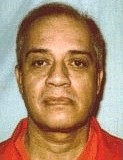
Ignacio Alberto
ORTIZ
Classification: Murderer
Characteristics: Jealousy
- Arson
Number of victims: 1
Date of murder: December 21,
1978
Date of birth:
December 21,
1941
Victim profile: Manuelita McCormack
(his ex-lover and the mother of
his godson)
Method of murder: Stabbing with knife
Location: Pima County, Arizona, USA
Status: Executed
by lethal injection in Arizona on October 27,
1999
Ignacio Ortiz had
been involved in an affair with Manuelita McCormack, the mother of
his 3-year-old godson. When Mrs. McCormack reconciled with her
husband, Ortiz attempted to rekindle the affair.
On the evening of
December 21, 1978, Ortiz went to the McCormack home while Mr.
McCormack was away. After strangling and stabbing Mrs. McCormack, he
also stabbed her 9-year-old and 8-year-old daughters.
Ortiz then poured
gasoline throughout the house and over the body of Mrs. McCormack,
and placed a delayed ignition device at the foot of the 3-year-old's
bed. Before igniting the gasoline, Ortiz instructed the children to
stay in the house until the fire department arrived.
The children
survived, but Mrs. McCormack did not. These events occurred in Pima
County.
While incarcerated in the state
prison system before his trial, Ortiz also was convicted of
attempted first-degree murder and conspiracy for attempting to kill
the other members of the McCormack family. He solicited a jailmate
to escape and carry out the acts, but no action was taken.
Ortiz claimed that he had been at home sleeping
at the time of the slaying. But he was in possession of the hunting
knife and gas can used in the attack, and a matchbook used to start
the blaze had his fingerprints on it. A neighbor also testified that
Ortiz's truck was parked behind the family's home on the night of
the murder.
When asked by Corrections Director Terry L
Stewart if he had any last words, inmate Ortiz replied "Yes I do.
Jesus Christ is the Lord." He then repeated the words in Spanish.
Finally, he said, "Heavenly Father, into your hands I commit my
spirit." Ortiz did not look at the family members of his victim who
were in the witness room and offered no apology to them. Only one of
the daughters witnessed the execution.
Ortiz spent 21 years on death row before his
execution.
2 Fried eggs, 4 oz. Pace hot sauce; 4 strips
bacon; 1 12oz sirloin steak; 10oz french fries; 3oz ketchup; 1 pint
vanilla ice cream; 1 pint milk; 1 cup hot coffee
Ignacio Alberto Ortiz, 57, 99-10-27, Arizona
Ignacio Alberto Ortiz was executed by injection Wednesday for the
murder of his ex-lover, more than 2 decades after he stabbed her to
death and tried to kill her 3 young children.
When asked by Department of Corrections Director Terry Stewart if he
had any last words, Ortiz said, "Jesus Christ is the Lord.
Heavenly Father, into your hands I commend my
spirit. Thank you."
Ortiz, a Catholic, then repeated the prayer in Spanish. His eyes
were closed.
His chest heaved upward twice and his head tilted slightly
toward the witness room as the lethal flow began at 3:04 p.m. He was
declared dead at 3:05 p.m.
The 29 witnesses included Ortiz's elderly mother from Tucson, Isabel
M. Rodriguez, and his lead attorney, Sean Bruner.
Also present were McCormack's husband, Charles McCormack Jr., and
children Patricia McCormack Ramirez and Charles McCormack III. A 2nd
daughter did not attend.
Ortiz, 57, was convicted of murdering Manuelita McCormack at her
Tucson home on Dec. 21, 1978. He tried to kill her 3 children that
night to eliminate witnesses and later plotted to have them killed
by a jail cellmate.
According to trial testimony, Ortiz had an affair with Mrs.
McCormack while she was estranged from her husband. Ortiz killed Mrs.
McCormack after she reconciled with her husband and told him she did
not want to see him anymore.
Ortiz fatally stabbed Mrs. McCormack at the family home and then
stabbed her 2 daughters, ages 8 and 9. The children fled the house
after Ortiz sloshed gasoline on and around their mother's body and
set it on fire.
Before the execution, son Charles and daughter Patricia, both of
Tucson, had said that Ortiz's execution would end years of fear.
"I have grown up knowing I had to be careful what I did and who I
talked to," said 23-year-old Charles, who was 3 when his mother died.
The execution should have taken place years ago, said Ramirez, 28. "We
would have grown up without that fear."
Ortiz becomes the 7th condemned inmate to be put to death this year
in Arizona, and the 19th overall since the state resumed capital
punishment in 1992.
(sources: Arizona Republic & Rick Halperin)
149 F.3d 923
Ignacio Alberto ORTIZ, Petitioner-Appellant, v.
Terry STEWART, Respondent-Appellee.
No. 96-99024.
United States
Court of Appeals, Ninth Circuit.
Argued March
9, 1998.
Decided July 1, 1998.
Appeal from the United States
District Court for the District of Arizona William D. Browning,
District Judge, Presiding. D.C. No. CV-84-00955-WDB.
Before: D.W. NELSON, BRUNETTI, and
HAWKINS, Circuit Judges.
D.W. NELSON, Circuit Judge:
Arizona state prisoner Ignacio
Alberto Ortiz appeals the district court's denial of summary
judgment on his petition for a writ of habeas corpus under 28
U.S.C. § 2254. We have jurisdiction pursuant to 28 U.S.C. §§
1291 and 2253, and we affirm.
FACTUAL AND PROCEDURAL BACKGROUND
The relevant underlying facts
in this case are not in dispute. Ignacio Alberto Ortiz and his
wife, Mary Ortiz, were the godparents of Manuelita and Charles
McCormack, Jr.'s youngest child, Charles McCormack III ("Baby
Charlie"). The McCormacks also had two daughters, Patricia and
Bernice. At the time of the charged crimes, Patricia was nine-years-old,
Bernice was eight, and Baby Charlie was three.
Charles and Manuelita
McCormack experienced marital difficulties in 1977-78. They
eventually separated and were considering filing for a divorce.
During those two years, Ortiz helped Manuelita with the children,
and there is some suggestion in the record that they had an
affair.
Manuelita and Charles eventually reconciled, and Charles
moved back into the McCormack residence. Ortiz continued to
visit Manuelita when Charles was not at home, although Manuelita
apparently tried to discourage his visits and phone calls.
On December 21, 1978, the
McCormack children went to bed in Patricia's room at about 9:00
p.m., and at around 10:00 p.m., Charles McCormack, Jr. left for
work. During the night, Baby Charlie awoke and asked Bernice to
bring him a glass of water.
When Bernice went to get the water,
she saw Ortiz (whom she calls "Nacho") with his hands around her
mother's neck. Bernice returned to the bedroom, awoke Patricia,
and told her what she had seen.
Shortly thereafter, Ortiz
entered Patricia's bedroom and told the children that he was
going to call an ambulance for their mother. Ortiz left the room,
and the children remained awake. An ambulance never arrived, but
Ortiz returned to Patricia's bedroom and told Patricia that her
mother wanted to see her. When Patricia entered the living room,
Ortiz grabbed her from behind and stabbed her twice in the chest
with a knife. Patricia, screaming, ran into her mother's bedroom
and collapsed on the bed.
On hearing Patricia's screams,
Bernice ran into her mother's bedroom. Ortiz grabbed Bernice
from behind and stabbed her in the chest. Bernice ran back to
Patricia's bedroom, where Baby Charlie was playing.
Ortiz had brought a can of
gasoline with him to the McCormack residence, and he poured the
gasoline on the unconscious Manuelita and over the bedroom exits.
He also placed a delayed ignition device on a pile of clothes at
the foot of Baby Charlie's bed. On his way out of the house,
Ortiz told the children not to leave until the fire department
arrived. Then he ignited the gasoline and departed.
When Bernice smelled the fire,
she helped Patricia and Baby Charlie out of the house. Bernice
and Baby Charlie struggled to a neighbor's house. Patricia
collapsed on the sidewalk, and was near death when the
paramedics found her.
By the time the firefighters
arrived, Manuelita's body had been badly charred. The
pathologist found stab wounds in her neck and, judging from the
pool of blood discovered under her body, deduced that she also
had been stabbed in the chest. Her chest was too burned to find
any stab wounds, however. Although he found the cause of death
to be stabbing, the pathologist testified that Manuelita may
have been alive when the fire started.
The next day, Ortiz was
arrested and jailed. While awaiting trial, he shared a cell with
Jose Alvarez, who was in jail pending trial on numerous robbery
charges. Alvarez had a history of drug abuse and had tried to
escape from prison in the past.
While in the jail hospital for
knee surgery, Alvarez contacted the Pima County Attorney's
office, and informed prosecutors that Ortiz had offered him
$10,000 to kill the three children, their father, their father's
girlfriend, and Manuelita's sister (with whom the children were
staying). Alvarez apparently was supposed to commit these
murders after his escape from the hospital. Alvarez also told
prosecutors that Ortiz had confessed in detail to Manuelita's
murder.
Alvarez agreed to help
prosecutors with further investigation, which led to Ortiz and
his wife being indicted for conspiracy to commit first-degree
murder. In exchange for a favorable plea agreement, Alvarez
testified against Ortiz regarding the murder and conspiracy
charges.
In a single two-and-a-half
week long trial, Ortiz was tried on both the murder and
conspiracy charges. Ortiz raised an alibi defense to the murder-related
charges; his defense to the conspiracy charge was that Alvarez
had coerced his help in the conspiracy through threats of
physical force.
On July 2, 1979, a Pima County
jury found Ortiz guilty of one count of first-degree murder,
three counts of attempted first-degree murder, two counts of
aggravated assault, one count of arson of an occupied structure,
one count of first-degree burglary, and one count of conspiracy
to commit first-degree murder.
Following an aggravation-mitigation
hearing, Judge Ben C. Birdsall imposed the death penalty for the
first-degree murder conviction, life imprisonment for the
conspiracy conviction, and the maximum sentence on each of the
other charges.
On December 19, 1979, with new
counsel, Ortiz filed a motion to vacate the judgment based on
newly discovered evidence and ineffective assistance of trial
counsel. On April 2, 1980, after an evidentiary hearing, the
state trial court denied Ortiz's motion to vacate.
On November 23, 1981, the
Arizona Supreme Court affirmed the judgments of guilt and
sentences. See State v. Ortiz, 131 Ariz. 195, 639 P.2d 1020
(1981). The United States Supreme Court denied a petition for
certiorari. See Ortiz v. Arizona, 456 U.S. 984, 102 S.Ct. 2259,
72 L.Ed.2d 863 (1982). In July 1983, Ortiz brought his first
state post-conviction relief petition under Arizona Rule of
Criminal Procedure 32, which was denied by the state trial court.
The Arizona Supreme Court denied Ortiz's petition for review on
October 10, 1984.
On December 7, 1984, Ortiz
filed a petition for writ of habeas corpus pursuant to 28 U.S.C.
§ 2254 in federal district court in Arizona. On December 10, the
district court stayed Ortiz's execution, which originally had
been scheduled for December 19, 1984. On August 23, 1985, upon
Ortiz's request, the district court stayed the proceedings to
allow Ortiz to return to the state court to raise an unexhausted
issue.
On September 11, 1985, Ortiz
filed his second petition for post-conviction relief, which was
summarily denied by the state trial court. The state court
denied Ortiz's petition for rehearing in a minute order issued
on February 28, 1986. On June 10, 1986, the Arizona Supreme
Court denied review without comment.
On December 5, 1986, Ortiz
filed an amended petition for writ of habeas corpus. On March
11, 1988, the district court stayed the matter, citing Ortiz's
failure to exhaust state remedies.
On April 22, 1988, Ortiz filed
a comprehensive third Rule 32 post-conviction relief petition.
The trial court denied relief except as to the allegation that a
state informant, Jose Alvarez, had perjured himself. On
September 9, 1991, the state trial court conducted an
evidentiary hearing on the perjury claim, and ultimately denied
relief. The Arizona Supreme Court denied review without comment,
and the United States Supreme Court denied certiorari. See Ortiz
v. Arizona, 506 U.S. 978, 113 S.Ct. 474, 121 L.Ed.2d 380 (1992).
On April 19, 1993, Ortiz again
filed an amended petition, which raised many of the claims from
his third Rule 32 petition that had been denied as procedurally
barred by the state court. On August 6, 1993, the state filed a
motion for summary judgment.
On November 14, 1995, the
federal district court granted partial summary judgment for the
state on 36 of Ortiz's claims, all on grounds of procedural
default. On November 7, 1996, the federal district court entered
final judgment addressing the merits of the remaining claims,
and denying Ortiz's habeas petition. Ortiz now appeals.
STANDARD OF REVIEW
A district court's decision to
grant summary judgment in favor of the state respondent in a
federal habeas petition is subject to de novo review. See
Gretzler v. Stewart, 112 F.3d 992, 998 (9th Cir.1997), cert.
denied, --- U.S. ----, 118 S.Ct. 865, 139 L.Ed.2d 763 (1998).
ANALYSIS
I. Procedural Default
The State contends that review
of many of Ortiz's claims is barred because Ortiz procedurally
defaulted on one set of claims (95.4, 95.5, 95.6, 95.9, 95.13,
95.14, 96.2, 96.3, 96.4, 96.6, 97.1, 97.2, 98.1, 98.2, 98.3,
100.3, 102, 103, 105, 114.5, 114.6, 114.7, 119, 130 in part,
132, 133, 135, 136, 139, and 140) by presenting them to the
state trial court for the first time in his third post-conviction
petition, and on another set of claims (107, 111, 112 in part,
127 in part, 137, and 141) by never raising them before any
state court.
Rule 32.2 of the Arizona Rules
of Criminal Procedure states that a defendant is precluded from
relief upon any ground "[t]hat has been waived at trial, on
appeal, or in any previous collateral proceeding." Ariz. R.Crim.
P. 32.2(a). Where a state court has declined to address a
prisoner's federal claims because the prisoner has failed to
meet a state procedural requirement, there is a general bar
against a federal habeas action. See Coleman v. Thompson, 501
U.S. 722, 729-30, 111 S.Ct. 2546, 115 L.Ed.2d 640 (1991).
In view of the state court's
finding that the first set of claims was barred by Rule 32.2,
the district court below held that the state court's ruling
precluded federal habeas review absent a showing of cause and
prejudice. With respect to the second set of claims, the
district court determined that because Ortiz would be prevented
by Rule 32.2 from now raising these claims in state court, the
claims were procedurally barred absent a showing of cause and
prejudice. Ortiz offers five different arguments in support of
his position that the district court erred in holding that the
above constitutional claims were procedurally barred. We
consider each argument in turn.
First, Ortiz maintains that
Chapter 154 of the Anti-Terrorism and Effective Death Penalty
Act of 1996 ("AEDPA"), 28 U.S.C. §§ 2261-2266 (1997), excuses
his procedural default. Ortiz's contention finds no support in
the law of this circuit. Until 1996, the law of procedural
default was exclusively a matter of federal common law. Chapter
154 of AEDPA codified a new default rule, applicable only to
states that establish "a mechanism for the appointment,
compensation, and payment of reasonable litigation expenses of
competent counsel in State post-conviction proceedings brought
by indigent prisoners whose capital convictions and sentences
have ... become final for State law purposes." 28 U.S.C. §
2261(b) (1997).
Because Arizona has not finalized its procedures
with respect to the appointment and compensation of counsel in
post-conviction relief proceedings, the district court correctly
determined that AEDPA Chapter 154 does not affect Ortiz's
petition. Contrary to what Ortiz argues, Chapter 154 does not in
any way suggest that in passing AEDPA, Congress intended to
abolish pre-AEDPA procedural default law or affect its
applicability with regard to states not governed by Chapter 154.
Second, Ortiz argues that the
district court erred by retroactively applying the 1992 version
of Arizona Rule of Criminal Procedure 32.2, which was not in
effect when Ortiz filed his first Rule 32 petition in 1983.
Until 1992, Rule 32.2(a)(3) stated that a defendant must "knowingly,
voluntarily and intelligently" decide not to raise an issue at
trial, on appeal, or in a previous collateral proceeding in
order for the issue to be precluded. Ariz. R.Crim. P. 32.2
comment (1997). The current version of the rule simply
conditions preclusion on whether an issue has been waived at
trial, on appeal, or in a collateral proceeding. See Ariz.
R.Crim. P. 32.2(a)(3) (1997).
We reject Ortiz's contention
that the district court retroactively applied the 1992 version
of Rule 32.2 to Ortiz's petition. In analyzing the status of
claims that had never been raised in state court, the district
court simply determined that under the current rule, Ortiz would
now be precluded from presenting certain claims in state court.
Citing Supreme Court precedent, the district court properly
decided that it was its role to determine whether a state remedy
would presently be available to Ortiz if he were to bring his
claims in state court. See Harris v. Reed, 489 U.S. 255, 269-70,
109 S.Ct. 1038, 103 L.Ed.2d 308 (1989) (O'Connor, J., concurring);
Teague v. Lane, 489 U.S. 288, 299, 109 S.Ct. 1060, 103 L.Ed.2d
334 (1989).
In fact, we have explicitly held that in cases where
a claim has not previously been brought in state court, the
district court must consider whether the claim could be "pursued
by any presently available state remedy." Matias v. Oshiro, 683
F.2d 318, 321 (9th Cir.1982) (emphasis added). Ortiz's claim
that the district court retroactively applied the current
version of Rule 32.2 therefore is without merit.
In his third attempt to
challenge the district court's procedural default ruling, Ortiz
argues that Arizona Rule of Criminal Procedure 32 cannot bar
federal habeas review because it has not been "strictly or
regularly followed" by Arizona courts. See Johnson v.
Mississippi, 486 U.S. 578, 587-89, 108 S.Ct. 1981, 100 L.Ed.2d
575 (1988) (holding that state procedural rule must be
consistently or regularly applied in order to preclude federal
review). We have rejected identical challenges to Arizona's
application of procedural default rules. See Poland v. Stewart,
117 F.3d 1094, 1106 (9th Cir.1997); Martinez-Villareal v. Lewis,
80 F.3d 1301, 1306 (9th Cir.1996); Carriger v. Lewis, 971 F.2d
329, 333 (9th Cir.1992). Ortiz has not pointed to any Arizona
decisions after our Poland opinion that demonstrate that Arizona
has become inconsistent and irregular in its reliance on
procedural default.
Fourth, Ortiz contends that
Arizona was judicially estopped from arguing that many of
Ortiz's claims were procedurally barred because the State
previously had argued that Ortiz's state remedies had not been
exhausted. Ortiz cites to Russell v. Rolfs, 893 F.2d 1033 (9th
Cir.1990), where we held that the state was estopped from
arguing in federal court that petitioner's claims were
procedurally barred. See id. at 1038-39.
The Russell court
explained, "Having persuaded the district court to deny
appellant federal review on the ground that he had an 'adequate
and available' state remedy, the state cannot now be permitted
to oppose appellant's petition for relief on the theory he was
actually procedurally barred in state court." Id. at 1038.
Russell, however, is readily distinguished from the present case
because here, the State never argued that Ortiz had an "adequate
and available" state remedy, or even that he would receive a
state hearing on the merits of his claims. Because the State in
this case consistently has taken the position that Ortiz failed
to exhaust his state remedies by not presenting his claims to
the state court in a timely manner, Ortiz's judicial estoppel
argument fails.
Finally, Ortiz contends that
the district court erred in holding that many of his claims were
procedurally barred because he has succeeded in showing cause
for the default. We may address the merits of a procedurally
defaulted claim if the petitioner can demonstrate cause for the
default and actual prejudice as a result of the alleged
violation of federal law, or demonstrate that failure to
consider the claims will result in a fundamental miscarriage of
justice. See Coleman, 501 U.S. at 750, 111 S.Ct. 2546; Bonin v.
Calderon, 77 F.3d 1155, 1158 (9th Cir.1996).
According to Ortiz,
his procedural default was caused by ineffective representation
at his post-conviction proceeding. While ineffective assistance
can constitute "cause" for procedural default, see Murray v.
Carrier, 477 U.S. 478, 488, 106 S.Ct. 2639, 91 L.Ed.2d 397
(1986), it will only constitute cause if it amounts to an
independent constitutional violation, see Bonin, 77 F.3d at
1158. Because there is no constitutional right to an attorney in
a state or federal habeas proceeding, see Moran v. McDaniel, 80
F.3d 1261, 1271 (9th Cir.1996), it follows that there can be no
deprivation of effective assistance in such proceedings, see
Coleman, 501 U.S. at 752, 111 S.Ct. 2546. Accordingly, we hold
that there is no basis for Ortiz's claim that his procedural
default was caused by ineffective assistance of counsel at his
post-conviction proceeding.
II. Ineffective Assistance
Ortiz argues that he was
denied his constitutional right to effective assistance of
counsel at numerous stages of the litigation. In Strickland v.
Washington, 466 U.S. 668, 687, 104 S.Ct. 2052, 80 L.Ed.2d 674
(1984), the Supreme Court established a two-part test for
evaluating ineffective assistance of counsel claims.
In order to
demonstrate that counsel was constitutionally ineffective, Ortiz
must show that his counsel's performance was so deficient that
it fell below an "objective standard of reasonableness." Id. at
688, 104 S.Ct. 2052. We have explained that "[r]eview of
counsel's performance is highly deferential and there is a
strong presumption that counsel's conduct fell within the wide
range of reasonable representation." Hensley v. Crist, 67 F.3d
181, 184 (9th Cir.1995) (internal quotations and citations
omitted).
In addition to demonstrating that counsel's
performance fell outside the "wide range of reasonable
representation," Ortiz must also show that "there is a
reasonable probability that, but for counsel's unprofessional
errors, the result of the proceeding would have been different."
Strickland, 466 U.S. at 694, 104 S.Ct. 2052.
A. Ineffective Assistance at
Trial
Only two of Ortiz's
ineffective assistance of trial counsel claims are not
procedurally barred. The first claim criticizes trial counsel's
experience. Ortiz points out that his counsel had never handled
either a murder or an arson case, and that his counsel had only
been in practice approximately four years before taking on his
case, two of which were spent serving as a justice of the peace.
Ortiz's position finds no support in the law. It is well
established that an ineffective assistance claim cannot be based
solely on counsel's inexperience.
In United States v. Cronic,
466 U.S. 648, 104 S.Ct. 2039, 80 L.Ed.2d 657 (1984), a case
involving a mail fraud conviction, the Supreme Court rejected an
ineffective assistance claim based on allegations that the
appointed trial attorney was young, that his principal practice
was in real estate, and that this was his first jury trial. Id.
at 665, 104 S.Ct. 2039.
The Cronic Court explained, "Every
experienced criminal defense attorney once tried his first
criminal case.... The character of a particular lawyer's
experience may shed light in an evaluation of his actual
performance, but it does not justify a presumption of
ineffectiveness in the absence of such an evaluation." Id.; see
also LaGrand v. Stewart, 133 F.3d 1253, 1275 (9th Cir.1998) ("In
considering a claim of ineffective assistance of counsel, it is
not the experience of the attorney that is evaluated, but rather,
his performance.").
In his second claim, Ortiz
argues that trial counsel failed to cross-examine either Bernice
McCormack or the pathologist vigorously on the issue of Ortiz's
strangulation of Manuelita McCormack. Ortiz fails, however, to
indicate how he was prejudiced by counsel's failure to probe the
strangulation issue. The record does not at all suggest that
evidence of strangulation was significant to the outcome of the
trial. We are convinced that even if Ortiz's attorney had
succeeded in disproving all evidence of strangulation, the
result of the proceeding would not have been different. See
Strickland, 466 U.S. at 694, 104 S.Ct. 2052.
B. Ineffective Assistance at
Sentencing
Ortiz procedurally defaulted
on all but two claims regarding ineffective assistance at
sentencing: First, that counsel failed to prepare properly for
sentencing; and second, that counsel failed to investigate
information contained in the presentence report that Ortiz
became "introverted, irritable, and aggressive" after suffering
a head injury as a child. Ortiz argues in his federal habeas
petition that the information found in the presentence report
could have been used as mitigation evidence at sentencing.
We agree with the district
court that both of Ortiz's claims of ineffective assistance at
sentencing lack merit. The district court properly rejected the
first claim based on Ortiz's failure to explain what counsel
should have done to prepare fully for sentencing, or how his
insufficient preparation prejudiced the sentencing proceeding.
With respect to the second claim, the district court correctly
concluded that Ortiz failed to specify what further
investigation would have uncovered from the presentence report.
In addition, Ortiz has not shown a reasonable probability that
counsel's failure to investigate the presentence report affected
his sentence. See Strickland, 466 U.S. at 694, 104 S.Ct. 2052.
C. Ineffective Assistance on
Appeal
The district court did not
review the merits of Ortiz's claim of ineffective assistance of
counsel on appeal because the state court found that the claim
was procedurally barred by Arizona Rule of Criminal Procedure
32.2(a)(3). Ortiz argues that because the same attorney
represented him on appeal and during his first state post-conviction
proceeding, his procedural default with respect to the
ineffective assistance on appeal claim should be excused for
cause. See Bonin, 77 F.3d at 1158 (procedural bar is lifted if
petitioner can show cause and actual prejudice).
Ortiz insists
that his attorney was prevented from raising his own
ineffectiveness due to a clear conflict of interest. This
precise argument has been repeatedly rejected by this circuit.
See Nevius v. Sumner, 105 F.3d 453, 460 (9th Cir.1996); Bonin,
77 F.3d at 1159.III. Evidentiary Hearing on Ineffective
Assistance
Next, Ortiz argues that the
district court abused its discretion in not granting an
evidentiary hearing on his ineffective assistance of counsel
claims. The district court must grant a petitioner's motion to
hold an evidentiary hearing "[u]nless the motion and the files
and records of the case conclusively show that the prisoner is
entitled to no relief." 28 U.S.C. § 2255. "To earn the right to
a hearing, therefore, Appellant [is] required to allege specific
facts which, if true, would entitle him to relief." United
States v. McMullen, 98 F.3d 1155, 1159 (9th Cir.1996), cert.
denied, --- U.S. ----, 117 S.Ct. 2444, 138 L.Ed.2d 203 (1997).
We must accord the district court below "wide latitude" on its
decision to deny an evidentiary hearing on an ineffective
assistance of counsel claim. See id. ("Under the abuse of
discretion standard, an appellate court may not simply
substitute its judgment for that of the lower court."). In the
instant case, we agree with the district court that Ortiz has
failed to allege facts that, if true, would entitle him to
relief on his ineffective assistance of counsel claims.
IV. Prosecutorial Misconduct
Ortiz maintains that three
discrete acts of prosecutorial misconduct deprived him of a fair
trial: First, the prosecutor's improper questioning of eight-year-old
Bernice McCormack elicited "inflammatory testimony." Second, the
government failed to disclose Brady material that may have been
used to impeach a key witness for the prosecution, Jose Alvarez.
Third, the prosecutor presented Alvarez's testimony while
knowing that it was perjured. For the reasons stated below, we
find that all three claims of prosecutorial misconduct lack
merit.
A. Improper Questioning
Ortiz contends that the
prosecutor committed misconduct at trial in asking eight-year-old
Bernice McCormack a series of questions on redirect examination
regarding whether she was afraid of Ortiz. See State v. Ortiz,
131 Ariz. 195, 639 P.2d 1020, 1029 (1981). Bernice ultimately
admitted on the stand that she was scared of Ortiz and began to
cry. See id.
Trial counsel moved for a mistrial on the ground
that the dialogue was "too inflammatory," and the trial court
denied the motion. See id. The Arizona Supreme Court affirmed
the denial of the mistrial motion, reasoning that "the questions
and answers were proper to rehabilitate the witness" in light of
the fact that Bernice had been having difficulty remembering the
events surrounding the crime. Id. Ortiz now argues that the
questioning was improper and constituted prosecutorial
misconduct warranting reversal.
A determination that the
prosecutor's questioning was improper is insufficient in and of
itself to warrant reversal. As the Supreme Court explained in
Darden v. Wainwright, 477 U.S. 168, 106 S.Ct. 2464, 91 L.Ed.2d
144 (1986), "The relevant question is whether the prosecutors'
comments so infected the trial with unfairness as to make the
resulting conviction a denial of due process." Id. at 181, 106
S.Ct. 2464 (internal quotations omitted). In the instant case,
it is clear that the prosecutor's questioning of Bernice did not
"so infect the trial with unfairness" as to deprive Ortiz of a
fair trial.
Viewing Bernice's testimony as
a whole, it is evident that her admission of fear was
insignificant and unremarkable. On direct examination, Bernice "related
how appellant murdered her mother, stabbed her sister, stabbed
her, and then tried to burn down the house while she and her
siblings were still inside." Ortiz, 639 P.2d at 1029. The
Arizona Supreme Court, after considering Bernice's overall
testimony, found "little prejudice in her also testifying that
she was afraid of appellant." Id.
We agree with the Arizona
Supreme Court that Bernice's admission of fear had little impact
on her testimony, or on the trial as a whole. Where an allegedly
improper question is an isolated or one-time incident, this
Court consistently has refused to find a due process violation.
See, e.g., Hall v. Whitley, 935 F.2d 164, 165-66 (9th Cir.1991)
(upholding conviction where prosecutor's allegedly improper
comments were "isolated moments in a three day trial"); United
States v. Sanchez-Robles, 927 F.2d 1070, 1077 (9th Cir.1991)
(holding that because the alleged misconduct was "isolated,
consisting of one improper question," it did not constitute
ground for reversal). In sum, we hold that the allegedly
improper questioning, viewed in the larger context of the trial,
did not render the proceedings fundamentally unfair.
B. Failure to Disclose Brady
Material
Ortiz next contends that the
government improperly withheld information about Jose Alvarez, a
key government witness, in violation of Brady v. Maryland, 373
U.S. 83, 83 S.Ct. 1194, 10 L.Ed.2d 215 (1963). Ortiz's Brady
claim is two-fold: first, that the prosecutor suppressed
evidence regarding Alvarez's plea agreement; and second, that
the prosecutor suppressed evidence that Alvarez had become a "professional
witness for the state."
In Brady, the Supreme Court
held that "the suppression by the prosecution of evidence
favorable to an accused upon request violates due process where
the evidence is material either to guilt or to punishment,
irrespective of the good faith or bad faith of the prosecution."
373 U.S. at 87.
Evidence is considered material "only if there
is a reasonable probability that, had the evidence been
disclosed to the defense, the result of the proceeding would
have been different. A 'reasonable probability' is a probability
sufficient to undermine confidence in the outcome." United
States v. Bagley, 473 U.S. 667, 682, 105 S.Ct. 3375, 87 L.Ed.2d
481 (1985); see also Kyles v. Whitley, 514 U.S. 419, 434, 115
S.Ct. 1555, 131 L.Ed.2d 490 (1995) ("The question is not whether
the defendant would more likely than not have received a
different verdict with the evidence, but whether in its absence
he received a fair trial, understood as a trial resulting in a
verdict worthy of confidence."). The Brady rule governs both
impeachment evidence and exculpatory evidence. See Bagley, 473
U.S. at 676, 105 S.Ct. 3375.
In his first Brady argument,
Ortiz maintains that the State suppressed evidence that Alvarez
ultimately would receive a plea bargain that was more lenient
than the one originally negotiated and presented to the jury at
Ortiz's trial. Rejecting Ortiz's Brady claim in its ruling on
Ortiz's first state post-conviction petition, the state court
found that Alvarez's plea agreement was modified more than a
year after Ortiz's conviction.
The state court noted that the
new agreement was negotiated by a deputy attorney not in any way
associated with Ortiz's case. The state court also found that
the bargain most likely was modified due to its original
illegality, and due to the fact that "Alvarez agreed to furnish
additional information to the State concerning other matters."
On the whole, the state court found no evidence of suppression
by the prosecution.
Pursuant to 28 U.S.C. §
2254(d), state-court findings of fact "shall be presumed to be
correct" in a federal habeas proceeding unless one of eight
enumerated exceptions applies. 28 U.S.C. § 2254(d); see also
Miller v. Fenton, 474 U.S. 104, 105, 106 S.Ct. 445, 88 L.Ed.2d
405 (1985). Ortiz has not argued that any of the eight statutory
exceptions are applicable to his case. Indeed, Ortiz has failed
to offer any proof that at the time of trial, the prosecution
failed to disclose to the defense all information it had
regarding Alvarez's plea agreement.
Moreover, as the district
court noted, even if the jury had known that Alvarez ultimately
would receive a sentence two years shorter than the one
disclosed at trial, there is no "reasonable probability" that
the result of Ortiz's trial would have been different. See
Bagley, 473 U.S. at 682, 105 S.Ct. 3375. We believe that Harris
v. Vasquez, 949 F.2d 1497 (9th Cir.1990), sheds light on the
case at bar.
In Harris, appellant argued that the prosecution
concealed information regarding the sentencing aspects of a
jailhouse informant's plea bargain. The Harris court rejected
appellant's Brady claim, agreeing with the district court's
finding that "even if the jury did not have the complete details
of [the informant's] plea agreement ... [t]here is nothing ...
that undermines this court's confidence in the outcome of
Harris' trial." Id. at 1528 (internal quotations omitted) (alteration
in original). As in Harris, there is no record indication in
this case that had the eventual plea agreement been disclosed to
the jury, the result of Ortiz's trial would have been different.
Ortiz's second Brady claim,
that the prosecution failed to disclose evidence that Alvarez
was planning to testify against other defendants and in essence
had become a "professional witness for the state," is equally
without merit. As the district court determined, there is no
evidence in the record proving "that Alvarez is a professional
jailhouse informant or that the prosecutors knew or should have
known at the time of trial that Alvarez was to testify in four
other cases."
Moreover, even if evidence of Alvarez's other
informant commitments had been available for Ortiz's impeachment
use, the evidence most likely would not have affected the
outcome of the trial given that Ortiz's jury was told that
Alvarez had tried to obtain a plea agreement on a separate case
involving multiple homicide.
The instant case is similar to
United States v. Vgeri, 51 F.3d 876 (9th Cir.1995), where the
appellant alleged that the government failed to disclose an
informant's prior relationship with law enforcement officials.
We held in Vgeri that because the informant had testified at
trial about her present cooperation with the government, "[t]he
disputed information concerning [the informant's] alleged prior
cooperation with law enforcement would not have been the
difference between conviction and acquittal." Id. at 880 (emphasis
added). Likewise, in the present case, Alvarez's subsequent
cooperation with the government was insignificant in light of
the jury's knowledge of his past cooperation.
We therefore hold that Ortiz
has failed to show not only that the prosecution suppressed any
evidence in violation of Brady, but also that, if the evidence
had been disclosed to the defense, its cumulative impact would
have affected the outcome of his trial. See United States v.
Sarno, 73 F.3d 1470, 1505 (9th Cir.1995) ("We determine the
existence of a 'reasonable probability' based upon the
cumulative impact of all the evidence suppressed in violation of
Brady.").
C. Presentation of Perjured
Testimony
Finally, Ortiz argues that the
prosecutor committed misconduct by "supplying" Alvarez with the
details of his testimony, thereby suborning perjury. If a
prosecutor knowingly uses perjured testimony or knowingly fails
to disclose that testimony is false, the conviction must be set
aside if there is any reasonable likelihood that the false
testimony could have affected the jury verdict. See Bonin v.
Calderon, 59 F.3d 815, 844 (9th Cir.1995) (internal quotations
and citation omitted).
Ortiz first raised the
subornation of perjury issue in his third state petition for
post-conviction relief. The state court held an evidentiary
hearing on the issue, during which six witnesses testified. The
state court considered allegations that Alvarez had admitted to
a cell mate "that he was going to testify falsely against Mr.
Ortiz by saying on the stand whatever prosecutors told him to
say." After careful review of these allegations, however, the
court ultimately found that "[t]here was no credible evidence
... that the testimony given by Jose Alvarez at the original
trial of this action was perjured."
We presume the correctness of
credibility determinations made at the trial court level. See 28
U.S.C. § 2254(d)(8) (1994) (providing that a factual
determination by the state court "shall be presumed to be
correct" unless the federal court "concludes that such factual
determination is not fairly supported by the record"); see also
Tomlin v. Myers, 30 F.3d 1235, 1242 (9th Cir.1994) ("The state
court concluded her testimony at the evidentiary hearing was not
credible, and we accord this determination a presumption of
correctness."). As the Supreme Court declared in Marshall v.
Lonberger, 459 U.S. 422, 103 S.Ct. 843, 74 L.Ed.2d 646 (1983),
"28 U.S.C. § 2254(d) gives federal habeas courts no license to
redetermine credibility of witnesses whose demeanor has been
observed by the state trial court, but not by them." Id. at 434,
103 S.Ct. 843.
Ortiz has failed to present
any evidence rebutting the presumption of correctness that
attaches to state court credibility determinations in habeas
cases. More to the point, even if Alvarez's testimony was
perjured, there is no record evidence indicating that the
prosecution knew that this was the case. In the words of the
state court, "There is more than adequate evidence in the trial
record to convict Ortiz even if Alvarez had never testified."
In sum, after thoroughly
examining each of Ortiz's claims of prosecutorial misconduct, we
find that none of the alleged incidents, taken together or
separately, warrants reversal. See Turner v. Marshall, 63 F.3d
807, 818 (9th Cir.1995) (reviewing both individual and
cumulative impact of alleged instances of prosecutorial
misconduct).
V. Due Process at the Sentencing Hearing
According to Ortiz, he was
denied due process at sentencing in four different ways: He was
not permitted to confront a witness whose testimony was
considered at sentencing; he was sentenced by the same judge who
presided over his wife's trial; he was not notified of the
statute under which he would be sentenced; and he was not given
sufficient notice of the aggravating circumstances on which the
prosecution relied in seeking the death penalty. We will address
the merits of each claim in turn.
A. Right to Confrontation
Ortiz first claims that he was
deprived of his constitutional right to confront a witness
during the sentencing proceeding because the sentencing judge
considered testimony that Ortiz's wife gave at her own
conspiracy trial. Mrs. Ortiz's testimony was used to rebut the
mitigation evidence proffered by Ortiz, establishing that he was
of good character, had been a good father, and had no prior
criminal record. His wife had testified at her own trial that
Ortiz had beaten her a dozen times, had pointed a gun at her,
and had had an affair with Manuelita McCormack.
The Arizona
Supreme Court decided that under Arizona law, the transcript was
admissible as rebuttal evidence at sentencing. The Court held
that "any relevant evidence may be used to rebut the defendant's
mitigating circumstances regardless of its admissibility at
trial." 639 P.2d at 1033.
On appeal, Ortiz claims that
admission of his wife's testimony violated his right to
confrontation under the Sixth Amendment. We reject this argument.
We hold that Ortiz's wife's testimony is admissible under
Williams v. New York, 337 U.S. 241, 69 S.Ct. 1079, 93 L.Ed. 1337
(1949), where the Supreme Court approved a sentencing judge's
use of information contained within a presentence report.
The
Williams Court explained that "most of the information now
relied upon by judges to guide them in the intelligent
imposition of sentences would be unavailable if information were
restricted to that given in open court by witnesses subject to
cross-examination." Id. at 250, 69 S.Ct. 1079. In Gardner v.
Florida, 430 U.S. 349, 97 S.Ct. 1197, 51 L.Ed.2d 393 (1977), the
Supreme Court distinguished Williams, holding that a sentencing
court cannot impose a death sentence on the basis of information
that was not disclosed to the defense in advance of the
sentencing proceeding. See id. at 362, 97 S.Ct. 1197.
Ortiz maintains that Gardner questioned the continued validity of
Williams. Ortiz's position, however, is flatly contradicted by
the law of this circuit. See Creech v. Arave, 947 F.2d 873, 880
n. 7 (9th Cir.1991) ("Although Gardner stated that standards of
procedural fairness had evolved since Williams was decided, it
distinguished rather than overruled Williams 's holding."),
rev'd on other grounds, 507 U.S. 463, 113 S.Ct. 1534, 123 L.Ed.2d
188 (1993).
In fact, this Court regularly cites Williams for the
proposition that a sentencing judge can rely on information
provided by witnesses that the defendant has not had the chance
to cross-examine, as long as the defendant has had the
opportunity to rebut, deny, or explain the information used. See,
e.g., Creech, 947 F.2d at 880 ("Because Creech had the
opportunity to rebut, deny or explain the information contained
in the presentence report, this case is distinguishable from
Gardner v. Florida ... and is in line with Williams v. New
York."); United States v. Wondrack, 578 F.2d 808, 809 n. 1 (9th
Cir.1978) ("By carefully distinguishing Williams v. New York ...
the plurality made it clear that the vice in Gardner was the
confidential nature of the information rather than its possible
hearsay nature.").
As the district court below
correctly observed, Ortiz could have called witnesses at his
sentencing hearing to rebut Mrs. Ortiz's testimony, and also
could have called Mrs. Ortiz herself. By Ortiz's counsel's own
admission at oral argument, defense counsel in this case did
nothing to secure Mrs. Ortiz's attendance at the sentencing
hearing. The State, however, did subpoena Mrs. Ortiz and, after
a defense motion for a continuance of the hearing was granted,
requested that the subpoena remain in full force. Despite the
State's efforts to secure Mrs. Ortiz's presence, she did not
appear at the sentencing hearing.
B. Bias of Sentencing Judge
Next, Ortiz argues that he was
deprived of his right to due process of law at sentencing
because Judge Birdsall, who also presided over Mrs. Ortiz's
conspiracy trial, was biased against him. In the middle of Mrs.
Ortiz's trial, the State moved to dismiss the charges against
her, explaining that it had a reasonable doubt as to her guilt.
Judge Birdsall agreed with the State, stating that he, too, had
a reasonable doubt as to Mrs. Ortiz's guilt.
At Ortiz's
sentencing, Judge Birdsall informed the parties that he intended
to consider Mrs. Ortiz's testimony in rebuttal of proffered
mitigating circumstances. Ortiz subsequently filed a motion to
disqualify Judge Birdsall. A hearing on the disqualification
motion was held by a different state judge, who found no
evidence of bias. The Arizona Supreme Court agreed. See Ortiz,
639 P.2d at 1034. After an independent review of the record, the
district court determined that Judge Birdsall was not biased.
We accord a presumption of
correctness to state court findings of fact. See 28 U.S.C. §
2254(d); Villafuerte v. Stewart, 111 F.3d 616, 632 (9th
Cir.1997) (holding that state court finding of absence of bias
is entitled to a presumption of correctness). Moreover, we abide
by the general presumption that judges are unbiased and honest.
See Withrow v. Larkin, 421 U.S. 35, 47, 95 S.Ct. 1456, 43 L.Ed.2d
712 (1975); Stivers v. Pierce, 71 F.3d 732, 741 (9th Cir.1995).
In addition, we have specifically held that the mere fact that a
judge presided over the separate trial of a codefendant does not
constitute reasonable grounds for questioning his or her
impartiality. See Paradis v. Arave, 20 F.3d 950, 958 (9th
Cir.1994).
In Paradis, we reasoned that "simple exposure to
facts presented at the trial of a different person" does not
amount to bias, which has been defined by the Supreme Court as a
"direct personal interest in the outcome of a proceeding." Id. (citing
Ungar v. Sarafite, 376 U.S. 575, 584, 84 S.Ct. 841, 11 L.Ed.2d
921 (1964)). Ortiz's argument that Judge Birdsall was biased at
sentencing merely because he presided over Ortiz's wife's trial
has no merit in light of our decision in Paradis.
Ortiz further argues that bias
is evident in the instant case because Judge Birdsall granted
the State's motion to dismiss the charges against Mrs. Ortiz,
agreeing with the State that there was a reasonable doubt as to
her guilt. We disagree with Ortiz's claim. The fact that Judge
Birdsall granted the dismissal motion does not in any way
suggest that he believed every word of Mrs. Ortiz's testimony.
Moreover, by Ortiz's logic, Judge Birdsall would only have been
able to display a lack of bias by finding Mrs. Ortiz guilty on
the conspiracy charges. There is clearly no sense to this
argument. Accordingly, we affirm the district court's
determination that there is no evidence of bias at sentencing.
C. Failure to Notify as to
Sentencing Statute
Ortiz next contends that he
was denied due process because he was not notified of the
statute under which he would be sentenced. In May 1979,
approximately six months after Ortiz committed the offense, the
Arizona death penalty statute was amended to conform with the
Arizona Supreme Court's holding in State v. Watson, 120 Ariz.
441, 586 P.2d 1253 (1978).
The 1979 amendment enlarged the scope
of admissible mitigating factors to include "any factors
proffered by the defendant or the state which are relevant in
determining whether to impose a sentence less than death,
including any aspect of the defendant's character, propensities
or record and any of the circumstances of the offense."
Ariz.Rev.Stat. § 13-703(G).
At Ortiz's sentencing, the state
trial court indicated that the sentencing procedure would be
identical under either statute, without specifying which statute
it used. The Arizona Supreme Court agreed that Ortiz "faced the
same penalty and procedure under either statute," but clarified
that Ortiz had been sentenced under the amended statute. 639
P.2d at 1032.
In the first place, as the
district court correctly found, the record reflects that Ortiz
in fact was given clear notice by the trial court of the statute
under which he would be sentenced. On July 10, 1979,
approximately eight months prior to sentencing, the state trial
court issued a minute entry indicating that it would sentence
Ortiz pursuant to Ariz.Rev.Stat. § 13-703, "as amended, and
effective May 1, 1979."
Although at sentencing, the judge's
language was less explicit and straightforward than in the
minute entry, the court did state that it was relying on the
Arizona Supreme Court's decision in Watson, "that being the same,
so far as the Court is concerned, as the new statute ... which I
thought gave the defendant every possibility of presenting any
mitigating circumstances." Together, the court's minute entry
and the court's arguably opaque reference at sentencing to its
use of the amended statute, afforded Ortiz adequate notice of
the statute under which he would be sentenced.
D. Insufficient Notice of
Aggravating Circumstances
Finally, Ortiz maintains that
the state failed to give adequate notice of the aggravating
factors on which it intended to rely in seeking the death
penalty. We find no support in the record for this position. On
September 10, 1979, over a month before the sentencing hearing,
the State filed a statement indicating that it intended to
present at sentencing evidence regarding aggravating factors
listed in Ariz.Rev.Stat. § 13-703(F)(3) and (6).
On October 2,
1979, thirteen days before the sentencing hearing (which was
continued from its original date of October 5), the State filed
a supplemental statement indicating that it would introduce
evidence of Ortiz's conviction for conspiracy to commit first-degree
murder in order to establish an aggravating circumstance under §
13-703(F)(1). We hold that thirteen days gave Ortiz an "effective
opportunity to defend" against the use of his concurrent
conspiracy conviction as a prior conviction under Ariz.Rev.Stat.
§ 13-703(F)(1). See Goldberg v. Kelly, 397 U.S. 254, 268, 90
S.Ct. 1011, 25 L.Ed.2d 287 (1970) (explaining that due process
requires adequate notice so as to provide "an effective
opportunity to defend by confronting any adverse witnesses and
by presenting ... arguments and evidence orally").
VI. Bias of Post-Conviction Relief Judge
Ortiz argues that the post-conviction
relief judge's failure to appoint him counsel in his second
post-conviction proceeding is evidence that the judge was biased
against him. Although the judge's refusal to appoint counsel
might constitute a violation of Arizona law, see Ariz. R.Crim.
P. 32.4(c) (mandating appointment of counsel for indigent
petitioners in post-conviction proceedings), it does not
constitute ground for a federal habeas claim. There is simply no
constitutional right to an attorney in a state post-conviction
proceeding. See Coleman, 501 U.S. at 752, 111 S.Ct. 2546; Moran,
80 F.3d at 1271. Moreover, this court has specifically stated
that federal habeas relief is not available to redress alleged
procedural errors in state post-conviction proceedings. See
Carriger v. Stewart, 95 F.3d 755, 763 (9th Cir.1996), vacated on
other grounds, 132 F.3d 463 (1997); Franzen v. Brinkman, 877
F.2d 26, 26 (9th Cir.1989). The post-conviction relief judge's
refusal to appoint counsel for Ortiz therefore cannot form the
basis for federal habeas relief.
Ortiz argues in the
alternative that the language in the post-conviction judge's
minute entry denying his motion for counsel manifests
unconstitutional bias. The problematic section of the minute
entry reads as follows:
THE COURT FURTHER FINDS that
this argument and claim is another corollary of Zeno's paradox....
The game here is first, to accuse trial counsel of ineffective
assistance, when that fails accuse appellate counsel of being
ineffective for not showing trial counsel ineffective; then when
that fails, (you presumably) accuse Rule 32 counsel of
ineffective assistance for not showing that appellate counsel
was ineffective for not showing trial counsel was ineffective
... ad infinitum, ad nauseum. Meanwhile, the trial court should,
one supposes, with knee-jerk regularity, appoint good, diligent
counsel to carefully research the constantly burgeoning record
for any semblance of error in each of these infinitely discreet
[sic] games. Well perhaps--but not here!
The Supreme Court has held
that "judicial rulings alone almost never constitute a valid
basis for a bias or partiality motion." Liteky v. United States,
510 U.S. 540, 555, 114 S.Ct. 1147, 127 L.Ed.2d 474 (1994); see
also United States v. Bauer, 84 F.3d 1549, 1560 (9th Cir.1996) (noting
that a "judge's views on legal issues may not serve as the basis
for motions to disqualify"). The Liteky Court's words resonate
well in view of the circumstances in the present case:
The judge who presides at a
trial may, upon completion of the evidence, be exceedingly ill
disposed towards the defendant, who has been shown to be a
thoroughly reprehensible person. But the judge is not thereby
recusable for bias or prejudice, since his knowledge and the
opinion it produced were properly and necessarily acquired in
the course of the proceedings....
Id. at 550-51, 114 S.Ct. 1147.
The Liteky Court concluded that "opinions formed by the judge on
the basis of facts introduced or events occurring in the course
of the current proceedings ... do not constitute a basis for a
bias or partiality motion unless they display a deep-seated
favoritism or antagonism that would make fair judgment
impossible." Id. at 555, 114 S.Ct. 1147.
Here, there is no
suggestion of "deep-seated favoritism or antagonism that would
make fair judgment impossible." The state judge was simply
responding to a legal claim that is frequently raised by
petitioners in post-conviction proceedings. The present case is
analogous to Noli v. Commissioner, 860 F.2d 1521 (9th Cir.1988),
where we held that comments made by the judge after the court
had examined the pleadings and stipulations "simply reflect[ed]
that the judge was appropriately upset with petitioners' conduct
aimed at further stalling the trial." Id. at 1528.
Here, too,
the comments made by the judge simply reflect the judge's
frustration with the number of petitioners who attempt to
manipulate the criminal justice system to serve their own ends.
Accordingly, we conclude that Ortiz cannot base his claim of
unconstitutional bias on either the post-conviction relief
judge's remarks or on his failure to appoint counsel for Ortiz
at the post-conviction proceeding.
VII. Aggravating Factors
Arizona law mandates the
imposition of a death sentence in cases in which (1) one or more
of six defined aggravating factors is found and (2) there are no
mitigating factors "sufficiently substantial to call for
leniency." Ariz.Rev.Stat. § 13-703(E)-(F). In the instant case,
the trial court found the following aggravating circumstances:
1. The defendant has been
convicted of another offense in the United States for which
under Arizona Law a sentence of life imprisonment or death was
imposable.
* * * * * *
3. In the commission of the offense the
defendant knowingly created a grave risk of death to another
person or persons in addition to the victim of the offense.
* * * * * *
6. The defendant committed the offense in an
especially heinous, cruel or depraved manner.
Ariz.Rev.Stat. § 13-454(E) (current
version at Ariz.Rev.Stat. § 13-703(F) (West Supp.1997)). Based
on these findings, and on its determination that Ortiz had
failed to offer mitigating evidence substantial enough to
warrant leniency, the sentencing court imposed the death
penalty. The Arizona Supreme Court subsequently invalidated two
of the aggravating factors, however, determining that the prior-conviction
factor and the cruelty prong of the "heinous, cruel, or depraved"
factor were inapplicable to the facts of Ortiz's case. Ortiz,
639 P.2d at 1035-36.
Ortiz now argues that the
remaining aggravating factors--that he created a grave risk of
death to others and that his offense was especially heinous and
depraved--also should be invalidated. The State responds that
Ortiz's first claim is procedurally barred and that the second
lacks merit. We agree.
A. The "Grave Risk to Others"
Factor
Ortiz argues that the
sentencing judge erred in applying the "grave risk to others"
factor to his case because the other persons whose lives were
placed at risk--Manuelita's three children--were Ortiz's
intended victims. Under current Arizona case law, Ortiz's
argument has considerable merit. See State v. Johnson, 147 Ariz.
395, 710 P.2d 1050, 1055 (1985); State v. McCall, 139 Ariz. 147,
677 P.2d 920, 934 (1983); State v. Tison, 129 Ariz. 526, 633
P.2d 335, 351 (1981). We nevertheless are procedurally barred
from considering it.
As we have observed, "federal
habeas relief isn't available to redress alleged errors in state
post-conviction proceedings." Carriger, 95 F.3d at 762; see also
Franzen, 877 F.2d at 26. Ortiz first raised this particular
challenge to the "grave risk" factor in his third state petition
for postconviction relief in 1988. In that petition, he argued
that legal developments subsequent to his conviction and appeals
mandated reversal of the sentencing court's "grave risk" finding.
In particular, he cited the Arizona Supreme Court's decisions in
Johnson and McCall, which were rendered after his sentencing.
The Arizona trial court dismissed this claim, determining that
the Arizona Supreme Court already had ruled adversely to Ortiz
on the "grave risk" factor. The court found that Ortiz
consequently was barred from pursuing the claim further,
pursuant to Arizona Rule of Criminal Procedure 32.2(a)(2) and
Section 13-4232 of the Arizona Revised Statute.
On this appeal, Ortiz argues
that the Arizona trial court erred in dismissing his claim. He
claims that the court ignored Arizona Rules of Criminal
Procedure 32.1(g) and 32.2. Read together, those rules permit a
trial court in a post-conviction proceeding to decide the merits
of an otherwise precluded claim when there has been a
substantive change in the law that would likely overturn the
defendant's sentence. Ortiz therefore is arguing, in essence,
that the Arizona trial court misapplied state procedural rules.
The district court correctly
determined that this claim is not cognizable in a federal habeas
corpus proceeding. Because the error alleged here--a state
court's failure to follow state procedural rules--is collateral
to Ortiz's detention, Ortiz cannot challenge it through federal
habeas review. See Franzen, 877 F.2d at 26. Accordingly, we
affirm the district court's decision to reject this claim.
B. The "Heinous or Depraved"
Factor
In Walton v. Arizona, 497 U.S.
639, 110 S.Ct. 3047, 111 L.Ed.2d 511 (1990), the United States
Supreme Court held that Arizona's "heinous, cruel or depraved"
aggravating factor was facially vague. Id. at 654-55, 110 S.Ct.
3047. The Court nevertheless upheld the factor, reasoning that
the Arizona Supreme Court had construed the terms "heinous,
cruel and depraved" narrowly enough to limit and guide the
discretion of sentencers. Id. On this appeal, Ortiz argues that
Arizona courts improperly applied that narrow construction to
the facts of his case. Ortiz therefore challenges Arizona courts'
application of Arizona law.
As a general matter, however,
a state court's errors in applying state law do not give rise to
federal habeas corpus relief. See Estelle v. McGuire, 502 U.S.
62, 71-72, 112 S.Ct. 475, 116 L.Ed.2d 385 (1991). A federal
court is limited on habeas review to determining "whether the
state court's [application of state law] was so arbitrary or
capricious as to constitute an independent due process or Eighth
Amendment violation." Lewis v. Jeffers, 497 U.S. 764, 780, 110
S.Ct. 3092, 111 L.Ed.2d 606 (1990). In making that determination,
the court must inquire " 'whether, after viewing the evidence in
the light most favorable to the prosecution, any rational trier
of fact could have found the essential elements of the crime
beyond a reasonable doubt.' " Id. at 781, 110 S.Ct. 3092 (quoting
Jackson v. Virginia, 443 U.S. 307, 319, 99 S.Ct. 2781, 61 L.Ed.2d
560 (1979)).
The Supreme Court of Arizona
has construed the "heinous and depraved" provision to require
the existence of one or more of following factors: (1) the
killer's apparent relishing of the murder; (2) the infliction of
gratuitous violence on the victim; (3) the needless mutilation
of the victim; (4) the senselessness of the crime; and (5) the
helplessness of the victim. See State v. Gretzler, 135 Ariz. 42,
659 P.2d 1, 10-11 (1983).1
In the instant case, the federal district court found Ortiz's
offense to be senseless and to involve both gratuitous violence
and needless mutilation. We agree that Ortiz's actions fall
within Arizona's narrowing construction of the "heinous and
depraved" factor.
First, in view of the fact
that Ortiz intended for Baby Charlie, a defenseless infant who
was incapable of testifying against Ortiz, to perish in the
burning house, a factfinder could rationally have concluded that
Ortiz's actions were senseless. See Tison, 633 P.2d at 352 (finding
murder of two-year-old child "who posed no threat to the captors"
to be senseless). Second, the record before us amply supports a
finding that Ortiz needlessly mutilated his victim. Not only did
he repeatedly stab Manuelita McCormack in the chest and neck, he
also set fire to her body. See State v. Spencer, 176 Ariz. 36,
859 P.2d 146, 154 (1993) (finding needless mutilation where
defendant set victim on fire after raping and stabbing her).
Because we conclude that the "heinous and depraved" factor was
properly applied to Ortiz's case on grounds of senselessness and
needless mutilation, we need not decide whether Ortiz's actions
also involved gratuitous violence.
C. Alleged Non-Statutory
Aggravating Factors
Ortiz argues that the
sentencing judge improperly relied on non-statutory aggravating
factors, such as the murder victim's gender, the age of the
victim's children, Ortiz's refusal to admit guilt, and the
allegations that he was an adulterer, wife-beater, and liar. The
record indicates, however, that the sentencing court did not
treat these factors as independent aggravating circumstances.
The court's finding that Ortiz was an adulterer, wife-beater,
and liar was simply used to rebut the mitigation evidence
proffered by Ortiz. We see nothing objectionable about this use
of the evidence. See Creech v. Arave, 947 F.2d 873, 880 (9th
Cir.1991) ("The trial judge at sentencing may appropriately
conduct a broad inquiry largely unlimited as to the kind of
information to be considered or the source of such information."),
rev'd on other grounds, 507 U.S. 463, 113 S.Ct. 1534, 123 L.Ed.2d
188 (1993).
Moreover, the court considered the age of the
children and the gender of the victim only as support for its
finding that the murder was heinous and depraved. As we have
noted under similar circumstances, our concern is not whether
these individual factors constitute separate aggravating
circumstances but, rather, "whether a rational factfinder could
find depravity given the facts of this case." Martinez-Villareal,
80 F.3d at 1308. As discussed above, we conclude that one could.
VIII. Alleged Failure to
Weigh Aggravating and Mitigating Circumstances
Ortiz contends that the
Arizona Supreme Court committed constitutional error in failing
to reweigh the remaining aggravating circumstances against the
mitigating circumstances. He also argues that the court should
have remanded his case for resentencing rather than reweighing
the circumstances itself. We reject both of these claims.
If a trial court has based a
sentence of death in part on aggravating circumstances deemed
later to be invalid, the remaining aggravating and mitigating
circumstances must be reweighed against each other. See Clemons
v. Mississippi, 494 U.S. 738, 751-53, 110 S.Ct. 1441, 108 L.Ed.2d
725 (1990). As we have acknowledged, recent Arizona cases
indicate that it is generally preferable to remand to the
sentencing court for reweighing. See Poland v. Stewart, 117 F.3d
1094, 1101 (9th Cir.1997) (citing State v. Bible, 175 Ariz. 549,
858 P.2d 1152 (1993) (en banc)).
We nevertheless have made clear
that a state appellate court may also perform the reweighing
function. See Jeffers v. Lewis, 38 F.3d 411, 414 (9th Cir.1994).
Thus, there is no merit to Ortiz's contention that the Arizona
Supreme Court erred in undertaking to reweigh the aggravating
and mitigating factors itself.
We are satisfied, moreover,
that the Arizona Supreme Court adequately reweighed the factors.
After invalidating two of the aggravating circumstances (prior
felony conviction and cruel state of mind), the court concluded,
"Our reading of the trial court's verdict indicates that
whatever mitigation evidence [Ortiz] offered, it was not
sufficiently substantial to call for leniency. We have
independently reviewed the evidence in a painstaking manner, and
we agree." Ortiz, 639 P.2d at 1035.
Although the court's
discussion of its reweighing analysis is cursory, we presume
that "state courts follow the law, even when they fail to so
indicate." Jeffers, 38 F.3d at 415. Moreover, as we observed in
Poland, "It is sufficient that a sentencing court state that it
found no mitigating circumstances that outweigh the aggravating
circumstances." 117 F.3d at 1101 (citing Parker v. Dugger, 498
U.S. 308, 318, 111 S.Ct. 731, 112 L.Ed.2d 812 (1991)).
Accordingly, we reject Ortiz's claim that the Arizona Supreme
Court's reweighing analysis was deficient.
IX. Mitigating Circumstances
Ortiz contends that the
sentencing court committed constitutional error in failing to
consider any mitigating evidence before sentencing him to death.
At the conclusion of Ortiz's sentencing hearing, the court
observed that evidence presented at Ortiz's trial and at his
wife's trial for conspiracy indicated that Ortiz was "an
adulterer, a violent wife beater, and a liar."
Based on that
evidence, the court concluded that "it would be incongruous ...
to find mitigating circumstances because of the outward
appearance of the defendant's personal and family life with
knowledge that the defendant was actually a mean, violent,
unfaithful, and false person." According to Ortiz, these words
suggest that the court failed to consider mitigating evidence,
as required by the Supreme Court's decisions in Lockett v. Ohio,
438 U.S. 586, 98 S.Ct. 2954, 57 L.Ed.2d 973 (1978), and Eddings
v. Oklahoma, 455 U.S. 104, 102 S.Ct. 869, 71 L.Ed.2d 1 (1982).
Ortiz misconstrues both the
applicable law and the record in his case. While it is true that
a sentencer may not "refuse to consider, as a matter of law, any
relevant mitigating evidence," Eddings, 455 U.S. at 114, 102
S.Ct. 869, a sentencer is free to assess how much weight to
assign to such evidence, see id. at 115, 102 S.Ct. 869.
In the
instant case, the district court below found that the sentencing
judge considered all of the mitigating evidence proffered by
Ortiz. There is no indication that the district court erred in
that determination: The sentencing judge reviewed each potential
mitigating factor addressed in the presentence report
individually, both at the aggravation-mitigation hearing and at
trial. The court found that "after considering all of these
factors there are no mitigating circumstances sufficiently
substantial to call for leniency."
Thus, the sentencing court
did not refuse to consider mitigating evidence; it considered
the evidence and found it inadequate to justify leniency. That
assessment did not violate the Constitution. See id. at 114, 102
S.Ct. 869.
Ortiz also claims that the
sentencing judge improperly failed to give mitigating weight to
the cumulative effect of all of the mitigating factors. The
record indicates, however, that the sentencing judge considered
all relevant mitigating evidence proffered by Ortiz. We have
determined that a sentencing court need not specifically discuss
each individual item of mitigating evidence so long as it
appears to have considered all relevant evidence. See Jeffers,
38 F.3d at 418.
Under the same logic, if there is a finding that
the sentencing court gave due consideration to all mitigating
evidence, we conclude that it is unnecessary for the court
specifically to discuss the cumulative weight of the evidence.
See Gerlaugh v. Lewis, 898 F.Supp. 1388, 1428 (D.Ariz.1995).
X. Eighth Amendment Claims
Ortiz brings a number of
Eighth Amendment challenges to his death sentence. We consider
each claim in turn.
First, Ortiz argues that it is
"cruel and unusual" to execute a defendant who has "clearly
demonstrated rehabilitation and socialization skills" during his
time in prison. As the district court observed, however, Ortiz
is unable to cite a single case that holds that good behavior
after sentencing in and of itself entitles a petitioner to
resentencing if his sentence is otherwise constitutional.
Second, Ortiz brings a "Lackey
" claim, arguing that it is cruel and unusual punishment to
incarcerate someone under a sentence of death for the length of
time that Ortiz has been incarcerated. See generally Lackey v.
Texas, 514 U.S. 1045, 115 S.Ct. 1421, 131 L.Ed.2d 304 (1995) (Stevens,
J., dissenting from denial of certiorari). The district court
below rejected Ortiz's Lackey claim on the merits. Although the
district court relied on this court's en banc opinion in
McKenzie v. Day, 57 F.3d 1493 (9th Cir.1995), we affirm on the
ground that Ortiz's Lackey claim is barred by AEDPA.
Ortiz is barred from pursuing
this claim by AEDPA. AEDPA provides that a prisoner seeking
habeas corpus relief must enumerate all of the grounds for such
relief in his first petition in federal court, unless his claim
fits within one of several statutory exceptions. See 28 U.S.C. §
2244(b)(2).
This Court recently decided that Lackey claims do
not fit into any of these statutory exceptions and that they
consequently are barred by AEDPA. See Ceja v. Stewart, 134 F.3d
1368, 1368 (9th Cir.1998). Because Ortiz did not raise his
Lackey claim in his first habeas petition, which was filed, as
amended, in 1986, we are compelled by Ceja to reject it.
Third, Ortiz contends that
Arizona applies the death penalty in an arbitrary, irrational,
and disproportionate fashion. He objects in particular to the
standard applied by Arizona courts in evaluating whether the
mitigating evidence outweighs the aggravating circumstances, i.e.,
whether the mitigation is "sufficiently substantial to call for
leniency." See Ariz.Rev.Stat. § 13-703(E)-(F).
Ortiz asserts
that this standard is unconstitutionally vague. We disagree.
Although the Constitution requires that the states devise
procedures to guide a sentencer's discretion, the absence of
specific standards instructing the sentencer how to weigh the
aggravating and mitigating factors does not render a death
penalty statute unconstitutional. See Zant v. Stephens, 462 U.S.
862, 880, 103 S.Ct. 2733, 77 L.Ed.2d 235 (1983).
Finally, Ortiz argues that the
Arizona Supreme Court erred in "double counting" his offenses
against the three children, using them as a basis both for the
attempted murder charges and as an aggravating circumstance
during sentencing proceedings. Because Ortiz did not present his
"double counting" argument in either Arizona courts or the
federal district court below, he must show cause and actual
prejudice for his failure to raise the argument in a timely
manner. See Engle v. Isaac, 456 U.S. 107, 129, 102 S.Ct. 1558,
71 L.Ed.2d 783 (1982).
Ortiz does not, however, offer any
explanation for his failure to raise the argument earlier.
Instead, he merely asserts that the alleged "double counting" is
one way in which his death sentence was imposed in an arbitrary
and capricious manner. We are unconvinced by Ortiz's position.
The issue of "double counting" involves a distinct and well-developed
body of law that neither the state courts nor the federal
district court have had the opportunity to address in this case.
As such, Ortiz's failure to show cause and prejudice for his
default precludes us from considering the issue on this appeal.
CONCLUSION
Because we find no merit to any of Ortiz's
arguments, the district court's decision to grant summary
judgment in favor of the State is AFFIRMED.
The fourth and fifth factors are not
regarded as sufficient to support a finding of heinousness
or depravity unless they are accompanied by one or more of
the other three factors. See Gretzler, 659 P.2d at 11-12;
State v. Brewer, 170 Ariz. 486, 826 P.2d 783, 799 (1992)