Murderpedia has thousands of hours of work behind it. To keep creating
new content, we kindly appreciate any donation you can give to help
the Murderpedia project stay alive. We have many
plans and enthusiasm
to keep expanding and making Murderpedia a better site, but we really
need your help for this. Thank you very much in advance.
Duncan Peder McKENZIE
Jr.
Classification: Murderer
Characteristics:
Rape
- Torture
Number of victims: 1
Date of murder:
January 21,
1974
Date of arrest:
Next day
Date of birth:
October 5,
1951
Victim profile: Lana Harding,
23(schoolteacher)
Method of murder: Strangulation
/
Beating
Location: Pondera County, Montana, USA
Status:
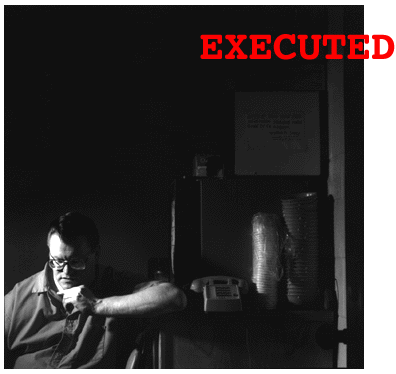
Executed
by lethal injection in Montana on May 10,
1995
Duncan Peder
McKenzie Jr. (October 5, 1951
– May 10, 1995) was convicted of the murder of Conrad,
Montana schoolteacher Lana Harding on January 21, 1974.
Born in Chicago, Illinois, McKenzie was executed in 1995
by the State of Montana by lethal injection at Montana
State Prison in Deer Lodge, Montana. He became the first
person to be executed in Montana since 1976 when the
death penalty was reinstated.
Duncan Peder McKenzie Jr.
In 1975, a
jury convicted Duncan Peder McKenzie, Jr. of aggravated kidnapping
and deliberate homicide by means of torture. The Montana Supreme
Court affirmed his conviction and sentence and rejected his numerous
claims on appeal, including his assertion that the jury instructions
unconstitutionally shifted to him the burden of proving his state of
mind.
The United
States Supreme Court twice granted McKenzie's petitions for
certiorari and each time remanded the case to the Montana Supreme
Court for further consideration. In 1980--its fourth review of the
case on direct appeal--the Montana Supreme Court ruled that any
error regarding the jury instructions was harmless beyond a
reasonable doubt.
McKenzie
was then unsuccessful in each of his federal habeas petitions. While
litigating his first federal habeas corpus petition, McKenzie
discovered that a week after the jury verdict and a month before his
sentencing hearing, the trial prosecutor had a forty-five minute ex
parte meeting with the trial judge. He alleged in his second habeas
petition that this meeting violated his rights under Gardner v.
Florida.
After
holding a hearing on the claim, in 1992, the federal district court
ruled that there was no credible proof that the 1975 conference
could have influenced the sentencing decision, and the Ninth Circuit
later affirmed that judgment.
In a third
federal habeas petition filed on the eve of his execution, McKenzie
challenged his execution after his twenty-year stay on death row. He
claimed, on appeal from the district court's denial of his petition,
that the state should be held responsible for the almost fifteen-year
period in which no court proceeding was held to resolve the Gardner
claim.
Montana countered that it should be considered
responsible only for five years and nine months of his twenty-year
stay on death row because that was the time his case had spent on
direct appeal. The appellate panel dismissed the petition on
procedural grounds, and McKenzie was executed two days later.
Montana Executes Killer of a Teacher
The New York Times
May 11,
1995
With
country music playing in his ears, a man convicted of murdering a
schoolteacher more than two decades ago was executed by injection at
the state prison here early today.
The 43-year-old
prisoner, Duncan McKenzie Jr., was the first person put to death by
Montana since 1943. Mr. McKenzie had repeatedly asserted his
innocence, and various appeals had enabled him to avoid eight
previous dates with the executioner in his 20 years on death row.
A spokesman for Gov. Marc Racicot said officials had
granted one of Mr. McKenzie's last requests: to be allowed to listen
to music at his execution. The prison provided the tape player, and
the tape was Mr. McKenzie's. It was a Marty Robbins album.
Duncan P. McKenzie
EXECUTION ON: A federal appeals court denied a stay
of execution for a Montana man who has been on death row for 20
years. On Monday, the 9th U.S. Circuit Court of Appeals voted 2-1 in
Pasadena, Calif., against another delay in the execution of Duncan
P. McKenzie, 43, convicted of the torture-murder of a rural Montana
schoolteacher in 1974.
McKenzie is to be executed by lethal injection
Wednesday. McKenzie had previously won eight stays of execution. His
lawyer says McKenzie has been on death row longer than any other
inmate in the country and argued that the delay constituted cruel
and unusual punishment in violation of the Constitution.
Duncan
Peder McKenzie, Jr.
No A013790
Montana State
Prison
Deer Lodge, Montana
PRIVATE
...Year
of Birth
1953
...Marital
Status
widowed
...Children
three
...Date
of offense
January 21,
1974
...Sentenced
to death
March 3, 1975
...Status
Executed
may 10, 1995,
by lethal injection
The murder
of 23 year old Lana Harding, a teacher in a rural area near Conrad,
Montana, was the crime that brought Duncan McKenzie, Jr., to death
row. McKenzie had kidnapped Harding from her home at the Pioneer
School, raped & then strangled her near to death, & finally beaten
her until she died. McKenzie had served a previous prison sentence
for assault & had only recently moved into the area. He was arrested
after police learned that his truck had been seen at the school on
the evening of the crime.
McKenzie
spent over 20 years appealing his sentence before he was executed in
1995. Among those to witness his death was Harding's mother, Ethel,
who had by then been elected to the state senate.
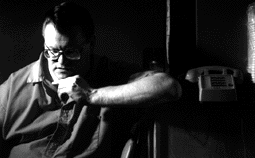
The weather
that week turned ugly. We drove from Helena through pea-soup fog &
horizontal snow. We were put through the compulsory ceremony of
logging our equipment through security, then we were taken out to
the prison courtyard. As we carried our photographic & recording
equipment across the yard, we unexpectedly bumped into McKenzie, who
was being escorted to maximum security. After all the negotiations
over whether we could be in the same room witf him, there we were,
side by side in the open air. No one even acknowledged anyone else.
Though I knew it was almost certainly against the rules, I grabbed
Duncan's right hand, which was cuffed tohis waist. When we reached
the inner sanctum, they separated us.
At the time
we met, McKenzie had beaten the devil, maneuvering through 8
execution dates & myriad postconviction appeals-the 2nd longest time
under the death sentence of anyone in the United States.
"Well,
I'll either be executed Wednesday morning sometime or I will have my
sentence commuted to life without parole which, being alive, has a
lot of benefits to it but but being alive in a place like this has a
lot of drawbacks to it so...
I've got
kids out there that I haven't seen in years & some that don't want
to see me...."
One of my
assistants, Courtney Bent, nervously tried to coax a bit of
background out of McKenzie. He told us that in his youth, he had
driven his father to rodeos long before he earned a driver's
license. He had nursed his father's frequent hangovers. In exchange,
his father had taught him to be an auto mechanic.
Then
McKenzie broached the subject of death.
"Someone
who I had a great deal of trust in at the time, & who's died since,
told me that death should not be feared. That each night when we go
to sleep we dream for a certain period of time. Sometimes our
subconscious & our conscience will remember the dream or a portion
of it. When we're not dreaming, there's a void. It's just emptiness.
We don't know it's there. It's just part of the nights as it goes
by. It's a little slice of death & yet...we don't fear going to
sleep....
We fear
only what we don't know or fear itself."
Courtney
kept probing & Duncan went on.
"The way
I look at it-death-it's something we have to accept whether we want
to or not because from the day we're born to the day of our death,
we're dying. All of us..."
He went on
as if time meant nothing. He talked at his feet. Ne excess motion,
no flamboyant gestures, except to wince at the pain in his back. He
had rehearsed the things he said, at least in his mind; I had read
some of the same comments in the newspapers. His words were
dispassionate. Maybe as someone in his last hours his mind was on
automatic pilot. Maybe he was tired & had given up. It was the 5th
of May & he had 5 days left to live.
Finally he
touched on his victim, Lana Harding.
"I've
heard nothing but wonderful things about Lana Harding as long as
I've been here. So, I can't say anything bad about her or her mother
for that matter. I can understand her grief & her anger because she
sustained a terrible loss. Our first daughter died a crib death at 6
months & what made it even more bizarre was that the day that she
died, we had taken her for her 6 month checkup & the doctor...if all
the kids were as healthy as she was, he'd be out of business."
As we
listened to McKenzie, the guards made derisive remarks about his
veracity. This had been a fairly common occurrence during our
sessions at various institutions.
The next day
we were invited to the clemency hearing. Deer Lodge is a small town
where the modern & the old-fashioned clash. TV cameras & anchor
persons faced an audience of weathered faces topped by baseball caps
& cowboy hats. A mounted moose head on the back wall, & children ran
loose. On the left side of the courtroom sat those who were against
the death penalty; on the right, friends of the victim's mother.
Walking
through the prison that evening, I caught sight of McKenzie talking
through a partition to his family & his lawyers. They were bringing
him the news that the hearing had gone badly. I waved through the
glass. Four days to go.
Lethal
injection is now the method of execution in Montana. The state's
death chamber is actually an RV. Witnesses to the execution sit at
the feet of the condemned.
For a brief
period Duncan was the most famous man in the state-front page. He
was the first man to be executed since FDR was in office.
Fotojones.com
449 U.S. 1050
101 S.Ct. 626
66 L.Ed.2d 507
Duncan Peder McKENZIE, Jr. v.
State of MONTANA
No. 80-5123
Supreme Court of the United States
December 8, 1980
On petition for
writ of certiorari to the Supreme Court of Montana.
The petition for a writ of
certiorari is denied.
Justice MARSHALL, with whom
Justice BRENNAN joins, dissenting.
On two prior occasions, this
Court has vacated decisions of the Supreme Court of Montana in
this death penalty case and remanded the case for further
consideration. McKenzie v. Montana, 443 U.S. 903, 99 S.Ct.
3094, 61 L.Ed.2d 871 (1979); McKenzie v. Montana, 433
U.S. 905, 97 S.Ct. 2968, 53 L.Ed.2d 1089 (1977).
In both instances, we directed
the Supreme Court of Montana to reconsider the case in light of
intervening decisions of this Court establishing that due
process forbids a State to place on a defendant the burden to
disprove an element of the offense charged. McKenzie v.
Montana, 443 U.S. 903, 99 S.Ct. 3094, 61 L.Ed.2d 871 (1979)
(directing reconsideration in light of Sandstrom v. Montana,
442 U.S. 510, 99 S.Ct. 2450, 61 L.Ed.2d 39 (1979)); McKenzie
v. Montana, 433 U.S. 905, 97 S.Ct. 2968, 53 L.Ed.2d 1089
(1977) (directing reconsideration in light of Patterson v.
New York, 432 U.S. 197, 97 S.Ct. 2319, 53 L.Ed.2d 281
(1977)).
On each remand, the state
court reaffirmed the conviction and reinstated the death
penalty. Mont., 608 P.2d 428 (1980); 177 Mont. 280, 581 P.2d
1205 (1978). In its most recent decision in this case, the State
Supreme Court conceded that the jury instructions
unconstitutionally shifted to petitioner the burden to disprove
that he had the criminal intent necessary to support conviction.
608 P.2d, at 457-458. The court nonetheless avoided granting
petitioner a new trial by deeming this constitutional violation
"harmless error." 608 P.2d, at 458-459. A state court's analysis
of harmless error in a typical case may not present a question
worthy of full review by this Court, yet, where, as here, the
death penalty is the result, close scrutiny is required. Because
I find the court's analysis of harmless error lacking of
evenhanded treatment, I dissent from this Court's denial of
certiorari.
Petitioner was charged with
two counts of deliberate homicide, two counts of aggravated
kidnaping, one count of sexual intercourse without consent, and
two counts of aggravated assault, all arising from the death of
one woman. A major element in petitioner's defense was that he
was incapable of "knowingly" or "purposely" committing the
homicide.
Petitioner and the prosecutor
produced conflicting psychiatric and psychological testimony at
trial concerning petitioner's ability to understand the criminal
nature of his conduct and to conform his conduct to the
requirements of law. Although petitioner's capacity to form the
required criminal intent was thus put directly in issue, over
petitioner's specific objection, the judge repeatedly directed
the jury that "the law also presumes that a person intends the
ordinary consequences of his voluntary act" and that "an
unlawful act was done with an unlawful intent."1
The trial court essentially
instructed the jury that it could presume the necessary criminal
intent if it found petitioner had committed the acts charged.
Petitioner was convicted of deliberate homicide and aggravated
kidnaping, and sentenced to death.
In Sandstrom v. Montana,
supra, we explicitly held that instructions of the kind
challenged by petitioner violate due process because they shift
to the defendant the burden to persuade the jury that he lacked
the requisite criminal intent. On remand of the instant case in
light of Sandstrom, the Montana court agreed that the
challenged instructions unconstitutionally shifted the burden of
proving the intent element of the crime from the State to the
defendant. 608 P.2d, at 457.
The court, however, reasoned
that not all such constitutional errors are prejudicial2
and concluded that this Court has never mandated which of three
possible standards for evaluating the harmlessness of a
constitutional error3
must be used. The court then selected the standard that permits
a court to sustain the conviction despite the constitutional
error where there is "overwhelming evidence" of guilt. 608 P.2d,
at 458. Finally, the court found such overwhelming evidence was
present in this case.
But what evidence did the
court find sufficient to overcome the constitutional error of
directing the jury to presume the presence of the requisite
criminal intent from the nature of the acts committed? The
Montana court itself relied solely on "the vicious manner in
which the crimes were committed" in concluding that petitioner "purposely
and knowingly intended" to commit the crimes. 608 P.2d, at 459.
I cannot help but be shocked that in taking this approach, the
Montana court simply applied the forbidden presumption. In so
doing, the court neglected to perform its task on review: it
failed to examine whether the disapproved instructions could
have infected the jury verdict. Instead, the court served as
another factfinder, again impermissibly placing the burden on
petitioner to disprove that the nature of his acts established
the requisite criminal intent. It surely cannot be that a
verdict following an unconstitutional instruction permitting the
jury to presume criminal intent can be immunized from reversal
because the reviewing court also impermissibly presumes criminal
intent.
This result was perhaps
inevitable once the state court selected the "overwhelming
evidence" of guilt standard to analyze whether the
constitutional error was harmless. For whatever value that
standard may have in reviewing a verdict following introduction
of evidence obtained in violation of constitutional guarantees,
see, e. g., Milton v. Wainwright, 407 U.S. 371, 92 S.Ct.
2174, 33 L.Ed.2d 1 (1972), use of the standard actually
precludes effective review of the prejudicial impact of
unconstitutional jury instructions.4
Where isolated, tainted evidence is at issue, the reviewing
court may exclude that evidence from its assessment of whether
the remaining evidence supports the conviction. But where the
constitutional error occurred in the jury instructions, no
isolated portion of the record can be eliminated from the
judicial assessment. Nor can the effect of the instructions be
evaluated by examining the evidence alone, and ignoring the
unconstitutional instructions. For the precise issue in such
cases is the manner in which the jury could have assessed the
evidence as a whole, not the importance of any particular piece
of evidence to sustain the verdict. In selecting the "overwhelming
evidence" standard on the theory that "an appellate court should
view the case as a whole in assessing harmless or prejudicial
error," 608 P.2d, at 458, the state court neglected to review
the possible effect of the unconstitutional instructions on the
jury's verdict.
The possibility that a
constitutional error in jury instructions was harmless must be
evaluated on the premise that the jury acted lawfully and
reasonably followed the erroneous instruction.5
Then the court must ask whether the defective instruction may
have contributed to the jury verdict.6
And, before finding the error harmless, the reviewing court must
be convinced beyond a reasonable doubt that the error did not so
contribute. Chapman v. California, 386 U.S. 18, 87 S.Ct.
824, 17 L.Ed.2d 705 (1967). Indeed, on remand in State v.
Sandstrom, Mont., 603 P.2d 244, 245 (1979), the Supreme
Court of Montana followed just this analysis. We had remanded
Sandstrom for consideration of questions such as whether the
use of the disapproved instruction was harmless error in that
case, and whether such error could ever be harmless.
Sandstrom v. Montana, 442 U.S., at 526-527, 99 S.Ct., at
2460-2461. In response, the State Supreme Court correctly
applied Chapman in reasoning that it could find harmless
error only upon concluding:
"[T]he offensive instruction
could not reasonably have contributed to the jury verdict. In
considering the instruction, and the fact that intent was the
main issue in the District Court trial, we cannot make that
assertion. The erroneous instruction goes to a vital element of
the proof of the crime, namely the intent of the defendant
Sandstrom in committing the homicide. If the jury followed the
instruction, it could have presumed the intent without proof
beyond a reasonable doubt." 603 P.2d, at 245.
Therefore, the court ordered a
new trial for Sandstrom. The Montana court subsequently applied
the same reasoning in State v. Hamilton, 605 P.2d 1121,
1132 (1980) (appellate court must determine impact of
instruction upon a reasonable jury).
It appears that only in
petitioner's case is the Montana court unwilling to apply this
analysis.7
This seems to be yet another case in which a court sanctions "egregious
violations of the constitutional rights of criminal defendants
by blandly reciting the formula 'harmless error.' " Briggs v.
Connecticut, 447 U.S. 912, 915, 100 S.Ct. 3000, 3002, 64
L.Ed.2d 862 (1980) (MARSHALL, J., joined by BRENNAN, J.,
dissenting). However unpleasant the facts of this or other cases
may be, the courts are obligated to protect the constitutional
rights of the defendant. Due to concern that petitioner's rights
have not been preserved, this Court has already remanded this
case twice. I can understand the Court's reluctance to entertain
this case yet again, for we presume that the lower courts adhere
to the purposes of remands from this Court. Yet the Montana
court has failed to fulfill its obligation to carry out the
mandate of our decisions.8
Therefore, I would grant certiorari and set the case for plenary
consideration.
I also adhere to my view that
the death penalty is, under all circumstances, a cruel and
unusual punishment prohibited by the Eighth and Fourteenth
Amendments, Furman v. Georgia, 408 U.S. 238, 314-371, 92
S.Ct. 2726, 2764-2793, 33 L.Ed.2d 346 (1972) (MARSHALL, J.,
concurring); Gregg v. Georgia, 428 U.S. 153, 231-241, 96
S.Ct. 2971, 2973-2977, 49 L.Ed.2d 859 (1976) (MARSHALL, J.,
dissenting); Lockett v. Ohio, 438 U.S. 586, 619-621, 98
S.Ct. 2954, 2972-2973, 57 L.Ed.2d 973 (1978) (MARSHALL, J.,
concurring in judgment), and on that basis alone I would grant
certiorari and vacate the death sentence in this case.
Instruction 31 gave general directions on
methods of proof about mental state. It stated that "the law
expressly directs the jury to reason: That an unlawful act
was done with an unlawful intent and also that a person is
presumed to intend the ordinary consequences of his
voluntary act," but Instruction 32 noted that a "particular
purpose" may be inferred but not assumed. App. to Pet. for
Cert. 20g-21g. Instruction 33 concerned the method of proof
applicable to the offense of deliberate homicide. That
instruction directed that if the jury found that petitioner
committed an illegal act on the victim, "the law presumes
that an unlawful act was done with an unlawful intent; that
is, the law expressly directs you to reason from such
unlawful act that the defendant acted with an unlawful
intent, or purpose." Id., at 22g. Instruction 35
described the method of proof applicable to kidnaping. It
provided that because no particular purpose was required as
an element of the offense, the requisite mental state could
be established presumptively. Thus, if the jury found that
petitioner restrained the victim "either by secreting her in
a place of isolation, or by using physical force, or by
threatening to use physical force to hold her, the law
presumes that he acted therein with unlawful intent, purpose
or knowledge, and expressly directs you to so reason." Id.,
at 26g-27g. Instruction 37 provided that proof of the mental
state requisite for sexual intercourse without consent "can
be made by presumption." Id., at 28g. Similarly,
Instruction 38 specified that the
mental state necessary for aggravated
assault could be proved by the presumption that " '[a]n
unlawful act was done with an unlawful intent, and the legal
presumption that a person is presumed to intend the ordinary
consequences of his voluntary act' can be used to prove the
mental state of knowingly." Id., at 30g.
This Court has not decided whether it can
ever be harmless to instruct a jury that it may presume
criminal intent from the fact of the criminal act. See
Sandstrom v. Montana, 442 U.S. 510, 526-527, 99 S.Ct.
2450, 2460, 2461, 61 L.Ed.2d 39 (1979) (remanding on that
issue).
"At least three definable approaches
appear in the United States Supreme Court cases: (1)
Focusing on the erroneously admitted evidence or other
constitutional error to determine whether it might have
contributed to the conviction[,] e. g., Fahy v.
Connecticut (1963), 375 U.S. 85 [84 S.Ct. 229, 11 L.Ed.2d
171] . . .; (2) excluding the constitutional infirmity where
overwhelming evidence supports the conviction[,] e. g.,
Milton v. Wainwright (1972), 407 U.S. 371 [92 S.Ct.
2174, 33 L.Ed.2d 1] . . .; (3) determining whether the
tainted evidence is merely cumulative or duplicates properly
admitted evidence[,] e. g., Harrington v. California
(1969), 395 U.S. 250 [89 S.Ct. 1726, 23 L.Ed.2d 284]. . . ."
608 P.2d, at 458.
The Montana court acknowledged "criticism
of this standard by textwriters and legal commentators." 608
P.2d, at 458. See, e. g., Field, Assessing the
Harmlessness of Federal Constitutional Error—A Process in
Need of a Rationale, 125 U.Pa.L.Rev. 15, 32-36 (1976).
Before this Court, Montana argues that
even if petitioner's conviction for deliberate homicide
resulted from the unconstitutional presumption of intent,
his conviction for aggravated kidnaping is untainted by the
error. Montana claims that because this is the case, the
death penalty can stand, as only one sentence was imposed,
despite petitioner's conviction on both the homicide and
kidnaping counts. This argument, which was never adopted by
the state court, is fatally flawed because instructions on
the kidnaping charge also included the disapproved
presumption of criminal intent. As Montana itself
acknowledges, "the jury was then informed that they could
employ the Sandstrom presumption to find that [kidnaping]
was done 'purposely' or 'knowingly.' " Brief in Opposition
7. Montana argues that any error from this instruction was
cured by the additional instructions on aggravated kidnaping.
These instructions directed that after finding that
petitioner committed the kidnaping, the jury could infer,
but not presume, he also had particular criminal purposes to
inflict bodily injury, to terrorize, or to facilitate the
commission of other crimes. These additional requirements
could not, however, eliminate the role of the forbidden
instruction in the initial finding of a kidnaping.
Petitioner is also the only person on
whom Montana imposed the death sentence under a statute
enacted in 1973 before it was amended to provide different
procedures for deliberate homicide and aggravated kidnaping,
the offenses relevant here. See Mont.Rev.Codes Ann. §
94-5-304 (Supp.1974), Mont.Code Ann. §§ 45-2-101(52),
46-18-101, 46-18-111 to 46-18-112 (1979).
For this reason, this case seems a
particularly apt one for seeking federal habeas corpus
relief. The dissenting judge in the Montana court found the
majority's decision unsupportable. 608 P.2d, at 459, 462,
465 (Shea, J., dissenting).
842 F.2d 1525
McKenzie v. Risley
United States Court of Appeals for the
Ninth Circuit
March 10, 1988
Appeal
from the United States
District Court for the
District of Montana.
Before
WALLACE, FLETCHER, FARRIS,
PREGERSON, ALARCON, CANBY,
NORRIS, WIGGINS, BRUNETTI,
KOZINSKI and O'SCANNLAIN,
Circuit Judges.
OPINION
KOZINSKI,
Circuit Judge:
Appellant Duncan Peder
McKenzie, Jr., convicted of murder and
sentenced to death by the State of Montana,
appeals from the district court's dismissal
of his petition for writ of habeas corpus. A
panel of this court affirmed the dismissal
in McKenzie v. Risley, 801 F.2d 1519 (9th
Cir.1986), but McKenzie's suggestion for
rehearing en banc was subsequently granted.
815 F.2d 1323 (9th Cir.1987). We now affirm.
I. BACKGROUND
The Montana Supreme Court
described the facts as follows:
The victim in this case
was Lana Harding, a 23 year old rural school
teacher in Pondera County, Montana. On
Tuesday morning, January 22, 1974, she
failed to appear at school. At the Pioneer
School teacherage where she lived the bed
was found in a disheveled condition. The
sheriff of Pondera County was called and
officers were dispatched to the school
arriving there midmorning.
Investigation that day
revealed (1) a red tennis shoe belonging to
Lana Harding just outside the school, (2) a
drag trail from the teacherage to a nearby
road, (3) blood near the end of the drag
trail (later identified as Lana's type and
RH factor) and (4) a wrist watch belonging
to Lana in the same area as the blood. Lana
Harding was last seen in Conrad, Montana, 13
miles from the teacherage on Monday, January
21, at about 5:00 p.m.
Defendant had recently
moved into the community and was working for
the K & K Wholesale Seed Company, located
approximately three miles from the Pioneer
School teacherage. A day or so before
January 21 he made arrangements to buy a
1948 black Dodge pickup, recognizable to
most inhabitants of the area because it had
belonged to one local owner for a long
period of time.
On January 21 defendant had
worked on the pickup after work. He was seen
leaving K & K Wholesale Seed Company at
approximately 6:45 p.m. in his black pickup
headed toward his place of residence not far
from the teacherage. The pickup was seen
about 7:00 p.m. about a mile from the
teacherage.
Approximately an hour
later, around 8:00 p.m., defendant knocked
on the door of the Pearson farm residence
located across the road from the teacherage.
He asked for assistance in starting his
pickup. It was later determined his pickup
was parked in the road at a point where the
drag trail ended and where the blood and
watch were found the following day.
At the
Pearson residence defendant asked directions
to his own residence and called his wife to
say he was coming home. Don Pearson pulled
the pickup, got it started and noted
defendant did not drive on towards his place
of residence. Shortly thereafter, the pickup
was seen being driven toward the drill where
Lana's body was found the following day.
Her body was found clothed
only in a shirt[,] sweater and bra. It was
draped over the tongue of a grain drill. She
had been severely beaten about the head and
body. The forensic pathologist who examined
the body testified the death blow had been
delivered to the head and laid open the
right side. A rope was tied around her neck;
there was evidence she had been strangled;
however pressure had been released so she
did not die of strangulation. A coil of wire
was entangled in her hair, later shown to
have come from a roll of wire found in the
back of defendant's pickup.
During the search for the
body and the investigation of the homicide
three additional items were found: (1) A
pair of gloves worn by defendant at work
were found in a field not far from where the
body was discovered with human blood on
them, (2) overshoes with Lana's type blood
and brain tissue on them were found about a
quarter of a mile away, and impressions from
the soles matched the heels of boots later
taken from defendant's home; and (3) Lana's
purse was found near the place where the
overshoes were covered.
As a result of the
investigation by the sheriff and his
deputies, the county attorney, on Tuesday
afternoon, January 22, filed a complaint
charging defendant with assault before the
justice of the peace. The county attorney
also obtained a warrant for the arrest of
defendant and a search warrant.
Defendant was thereafter
arrested at his home. The black Dodge pickup
was seized and impounded and blood was found
in the bed of the pickup and on the springs;
the back end of the pickup had been recently
sprayed with black paint; the spray paint
was later identified by FBI experts as
identical to paint brand-named "Weekend"
which was not available in the
Conrad-Pondera County, Montana area. A can
of the black spray paint was found in the
cab of the pickup and another was later
found at defendant's home.
The following items were
found in the back of the pickup: (1) a coil
of wire later identified as having been the
source of wire found in the victim's hair,
(2) an exhaust manifold that had been
painted black, and (3) human blood of the
same kind and RH factor as Lana's and brain
and corticle tissue were found on the
manifold. Dr. John Pfaff, who examined the
victim's body and the manifold, testified
that the manifold could have inflicted the
fatal blow.
At the drill site where
the body was located, a piece of brass from
a water pump was found. The prior owner of
the Dodge pickup testified this piece of
brass was in [the] back of the pickup when
defendant took possession of the pickup on
January 19.
Several co-workers at the
K & K Wholesale Seed Co. testified at trial
that defendant had said on January 21 that
he broke in every new vehicle by engaging in
sexual intercourse in [it]. Several days
before defendant had remarked that he had
had intercourse with country school
teachers; and that they were naive, he could
teach them, and they were easy to get.
Subsequently defendant was
charged with several crimes to which he
entered pleas of not guilty. Following
trial, he was convicted by a jury of the
crimes of deliberate homicide by means of
torture and aggravated kidnapping. Judgment
was entered thereon and a death sentence
imposed. Defendant appealed.
State v. McKenzie, 186
Mont. 481, 608 P.2d 428, 434-36 (1980)
(McKenzie III ).
The panel opinion
summarized the extensive procedural history
of the case:
The Montana Supreme Court affirmed the
convictions and the sentence. State v.
McKenzie (I), 557 P.2d 1023, 171 Mont. 278
(1976). The Montana Supreme Court rejected
McKenzie's claim, inter alia, that the trial
court's jury instructions on presumptions
and the Montana death penalty statute
violated the Constitution. The United States
Supreme Court granted certiorari, vacated
the judgment, and remanded for further
consideration in light of Patterson v. New
York, 432 U.S. 197, 97 S.Ct. 2319, 53
L.Ed.2d 281 (1977). McKenzie v. Montana, 433
U.S. 905, 97 S.Ct. 2968, 53 L.Ed.2d 1089
(1977).
On remand, the Montana
Supreme Court, after reexamining all of the
issues raised by McKenzie, adhered to its
original decision. State v. McKenzie (II),
581 P.2d 1205, 177 Mont. 280 (1978). The
Montana Court held that the jury
instructions did not erroneously shift the
burden of proof on the issue of intent, but
even if they did, such an error would not
have affected the jury's verdict because the
evidence of intent was overwhelming. 581
P.2d at 1223-24.
Following the Montana
Supreme Court's affirmance of the
convictions and the sentence in McKenzie II,
McKenzie sought relief through the Sentence
Review Division of the Montana [Supreme]
Court. His petition for review was denied.
His attempted appeal of that decision to the
Montana Supreme Court was also denied
because there was no appeal from a decision
of the Sentence Review Division.
McKenzie again petitioned
for certiorari to the United States Supreme
Court. Certiorari was granted, the judgment
was vacated, and the case was remanded for
further consideration in light of Sandstrom
v. Montana, 442 U.S. 510, 99 S.Ct. 2450, 61
L.Ed.2d 39 (1979). McKenzie v. Montana, 443
U.S. 903, 99 S.Ct. 3094, 61 L.Ed.2d 871
(1979). The Montana Supreme Court once again
affirmed the convictions and the sentence.
State v. McKenzie (III), 608 P.2d 428, 186
Mont. 481 (1980). This time, however, the
Montana Court conceded that some of the jury
instructions unconstitutionally shifted the
burden of proof to McKenzie to disprove that
he had the criminal intent necessary to
support his conviction. 608 P.2d at 457-58.
His conviction was nevertheless reaffirmed
because the court found the unconstitutional
jury instructions harmless beyond a
reasonable doubt in light of the
overwhelming evidence of intent. 608 P.2d at
459.
McKenzie once again sought
certiorari from the United States Supreme
Court. This time certiorari was denied.
McKenzie v. Montana, 449 U.S. 1050, 101
S.Ct. 626, 66 L.Ed.2d 507 (1980) (Justices
Marshall and Brennan dissenting). McKenzie
then filed a petition for post-conviction
relief or habeas corpus in the Montana state
district court. The petition was denied. The
denial was affirmed by the Montana Supreme
Court. McKenzie v. Osborne (McKenzie IV),
640 P.2d 368, 195 Mont. 26 (1981).
McKenzie then filed a
petition for a writ of habeas corpus in
federal district court. The district court
dismissed the petition and it is from that
dismissal that McKenzie timely appeals to
this court.
801 F.2d at 1522-23.
The panel rejected all of
McKenzie's arguments and affirmed. McKenzie
petitioned for rehearing of three questions
resolved by the panel: (1) whether the
Sandstrom errors in the jury instructions
were harmless; (2) whether the trial judge's
decision to sentence McKenzie to death after
he had approved a plea agreement calling for
a prison sentence violated United States v.
Jackson, 390 U.S. 570, 88 S.Ct. 1209, 20
L.Ed.2d 138 (1968); and (3) whether the
statutory scheme under which McKenzie was
sentenced was constitutional. Except as
otherwise indicated below, we address only
the issues raised by McKenzie on rehearing.
II. DISCUSSION
A. Sandstrom Error
1. In re Winship, 397 U.S.
358, 364, 90 S.Ct. 1068, 1072, 25 L.Ed.2d
368 (1970), held that "the Due Process
Clause protects the accused against
conviction except upon proof beyond a
reasonable doubt of every fact necessary to
constitute the crime with which he is
charged." The Court has since interpreted
Winship to preclude a state from shifting to
the defendant the burden of proof on any
element of the crime charged. Patterson v.
New York, 432 U.S. 197, 215-16, 97 S.Ct.
2319, 2329-30, 53 L.Ed.2d 281 (1977);
Mullaney v. Wilbur, 421 U.S. 684, 697-701,
95 S.Ct. 1881, 1888-1891, 44 L.Ed.2d 508
(1975). In Sandstrom v. Montana, 442 U.S.
510, 99 S.Ct. 2450, 61 L.Ed.2d 39 (1979),
the Supreme Court applied Mullaney and
Winship to hold unconstitutional a Montana
jury instruction which stated that "[t]he
law presumes that a person intends the
ordinary consequences of his voluntary
acts." Id. at 513, 99 S.Ct. at 2453. The
Court held that this instruction may have
been interpreted by the jury as shifting the
burden of proof on intent--an element of the
crime1--to
the defendant, undermining his
constitutional right to be presumed
innocent. Id. at 524, 99 S.Ct. at 2459.
The parties agree that
some of the jury instructions given in this
case violated Sandstrom.2
Specifically, the jury was instructed that:
[T]he law presumes, that is, the law
expressly directs the jury to reason: That
an unlawful act was done with an unlawful
intent and also that a person is presumed to
intend the ordinary consequences of his
voluntary act.
....
Further, unless you are
otherwise instructed with regard to a
particular presumption, all presumptions are
rebuttable; that is, they may be
controverted and overcome by other evidence.
Add'l Instr. No. 31, App.
at C-21 [at 1563].3
Similar instructions were given on the
elements of various offenses.4
While these instructions did not require the
jury to conclusively presume intent, they
did permit a rational juror to believe that
intent could be found without proof by the
prosecution, thereby shifting the burden of
proof on this issue to the defense.5
The state does not deny
that the instructions contained multiple
Sandstrom errors. It argues instead--and
every court considering the issue has
found--that, because of the unique
circumstances of McKenzie's trial, the
errors were harmless beyond a reasonable
doubt.
Until recently, the
question of whether Sandstrom errors could
be harmless had not been authoritatively
resolved. In Rose v. Clark, 478 U.S. 570,
106 S.Ct. 3101, 3108-09, 92 L.Ed.2d 460
(1986), however, the Supreme Court held that
the harmless error standard of Chapman v.
California, 386 U.S. 18, 87 S.Ct. 824, 17
L.Ed.2d 705 (1967), applied to such errors.
In Pope v. Illinois, --- U.S. ----, 107
S.Ct. 1918, 95 L.Ed.2d 435 (1987), the Court
further explicated the proper role of an
appellate court in applying Clark 's
harmless error analysis. In Pope the Court
articulated the test as follows: whether
"the facts found by the jury were such that
it is clear beyond a reasonable doubt that
if the jury had never heard the
impermissible instruction its verdict would
have been the same."6
107 S.Ct. at 1922 n. 6. Significantly, the
Court held that even if the jury did in fact
have "the impermissible presumption in mind
when it considered the [relevant] element"
of the crime, the error would be harmless
"if the facts that the jury necessarily
found established guilt beyond a reasonable
doubt." Id. at 1922.7
Once an error of
constitutional magnitude is shown, the state
has the burden of establishing beyond a
reasonable doubt that the error was
harmless. Chapman, 386 U.S. at 24, 87 S.Ct.
at 828. The Montana Supreme Court and the
district court considering McKenzie's habeas
corpus petition both concluded that the
state had met its burden. McKenzie III, 608
P.2d at 459; Mem. op. at 19 (D.Mont. Aug.
16, 1985), E.R. 58 at 19. In cases involving
petitions for habeas corpus we review a
district court's determinations de novo.
Herd v. Kincheloe, 800 F.2d 1526, 1528 (9th
Cir.1986). Moreover, the ultimate
determination of whether Sandstrom error was
harmless is also subject to de novo review
as a question of federal constitutional law.
Herd, 800 F.2d at 1528; see also Rushen v.
Spain, 464 U.S. 114, 120, 104 S.Ct. 453,
456, 78 L.Ed.2d 267 (1983) (per curiam).
However, the factual findings underlying the
state court's determination of harmless
error are entitled to a presumption of
correctness under 28 U.S.C. Sec. 2254(d)
(1982). Rushen, 464 U.S. at 120, 104 S.Ct.
at 456. We must defer to such state court
factual findings "in the absence of
'convincing evidence' to the contrary," id.,
and may set them aside only if they "lac[k]
even 'fair support' in the record." Marshall
v. Lonberger, 459 U.S. 422, 432, 103 S.Ct.
843, 850, 74 L.Ed.2d 646 (1983).8
2. In the case before us,
the jury found beyond a reasonable doubt,
without relying on any unconstitutional
presumptions, that McKenzie kidnaped,
tortured and killed Lana Harding. Thus, the
determinative issue is whether the facts
found by the jury compel the conclusion that
McKenzie acted with the requisite criminal
intent in committing these acts.
McKenzie offered no
evidence bearing directly on his intent.
Instead, "[t]he 'defense at trial focused
entirely on the issue of mental competence,
relying on the traditional insanity defense
as well as the defense of diminished
capacity.' " Appellant's Petition for
Rehearing at 1 (quoting McKenzie v. Risley,
801 F.2d 1519, 1525 (9th Cir.1986)).9
With respect to mental capacity, Dr.
Wetzler, the defense psychiatrist, testified
that McKenzie was incapable of forming the
requisite intent because he lacked mental
capacity. From this McKenzie concludes that
the Sandstrom errors could not possibly have
been harmless beyond a reasonable doubt,
because in order to reach such a conclusion
a reviewing court would be required to weigh
the credibility of the respective expert
witnesses. See, e.g., Bowen v. Kemp, 832
F.2d 546, 551 (11th Cir.1987) (en banc)
(where there is substantial evidence that
defendant may have lacked requisite intent,
Sandstrom error cannot be harmless on the
ground that the evidence of intent is
overwhelming).
We have given this
argument careful consideration but remain
unpersuaded. That a defendant contested
intent does not automatically render the
Sandstrom error prejudicial. Rose v. Clark
is precisely on point. Defendant there
raised the defenses of insanity and lack of
mental capacity, and introduced expert and
other testimony to show that he was insane,
that he suffered from amnesia and could not
remember the events of the crime, and that
he had been drinking heavily before the
alleged criminal activity. 106 S.Ct. at
3104. The trial court's instruction placed
on the defendant the burden of disproving
"malice," which was defined as "an intent to
do any injury to another." Id. The Supreme
Court stated:
The [Court of Appeals] concluded that a
Sandstrom error could never be harmless
where a defendant contests intent.... But
our harmless error cases do not turn on
whether the defendant conceded the factual
issue on which the error bore. Rather, we
have held that "Chapman mandates
consideration of the entire record prior to
reversing a conviction for constitutional
errors that may be harmless." United States
v. Hasting, 461 U.S., at 509, n. 7, 103
S.Ct., at 1981, n. 7. The question is
whether, "on the whole record ... the error
... [is] harmless beyond a reasonable
doubt." Id., at 510, 103 S.Ct., at 1981.
There are a variety of
ways in which a jury can develop a
reasonable doubt about whether a defendant
had the requisite intent. One possibility is
for the jury to conclude that the defendant
lacked the mental capacity to form intent
or, more precisely, that there is reasonable
doubt on that issue. Alternatively, the jury
might find intent lacking because of some
other circumstance, for example, that
defendant was acting as a result of mistake
or accident, or in the heat of passion, or
(as to specific intent) under the influence
of alcohol or drugs. Our function under
Clark is to determine whether the jury in
McKenzie's case could have developed a
reasonable doubt about intent on any of
these theories, had it "never heard the
impermissible instruction[s]." Pope, 107
S.Ct. at 1922 n. 6.
a. Because McKenzie
specifically raised diminished capacity as a
defense, we consider that issue first.
Defendant's evidence that he lacked capacity
to form the requisite intent consisted
solely of the testimony of Dr. Wetzler, a
forensic psychiatrist. Dr. Wetzler
repeatedly testified that McKenzie, at the
time he committed the acts in question,
lacked the capacity to form the states of
mind that were elements of the offenses
charged. R.T. at 2255, 2268-69, 2581.11
An examination of the jury instructions
reveals that the jury necessarily rejected
this testimony beyond a reasonable doubt in
reaching its verdict.12
Although numerous
instructions informed the jury that it could
presume intent from conduct, one clear and
explicit exception was made to this general
rule. The crimes of aggravated kidnaping and
deliberate homicide by means of torture
were, as defined for the jury, essentially
specific intent crimes. Each required the
jury to find that the defendant purposely
committed the underlying criminal acts and
did so for some further "particular
purpose."13
] And, with respect to those "particular
purposes," the jury was instructed that it
could not rely on any presumptions in
finding that the defendant acted with the
requisite mental state; rather, it was
required to reason by inference from the
established facts.14
The jury found that McKenzie committed both
of these specific intent crimes, and we must
presume that it followed the applicable
instructions in doing so. Francis, 471 U.S.
at 324-25 n. 9, 105 S.Ct. at 1976-77 n. 9;
Parker v. Randolph, 442 U.S. 62, 73, 99
S.Ct. 2132, 2139, 60 L.Ed.2d 713 (1979)
(opinion of Rehnquist, J.). Accordingly, the
jury must have found, without relying on the
unconstitutional presumptions,15
that McKenzie acted with the requisite
"particular purposes" in mind when he
committed his crimes.16
In reaching this conclusion the jury
necessarily found that McKenzie was capable
of forming specific criminal intent.
Dr. Wetzler never
differentiated between specific and general
intent. Rather, he stated categorically that
McKenzie lacked the capacity to form any of
the requisite mental states. Thus, there
would have been no basis on which the jury
could rationally find that McKenzie
possessed the mental capacity to form, and
act upon, a "particular purpose," yet at the
same time lacked the capacity to act
"purposely or knowingly."17
In finding that McKenzie had the capacity to
form the requisite specific intent, the jury
necessarily rejected Dr. Wetzler's testimony
on this point,18
and instead accepted the testimony of the
prosecution's witnesses that McKenzie was
capable of forming general and specific
criminal intent.19
In response to this line
of reasoning, which was adopted by the
district court, McKenzie argues that the
jury was in fact told it could presume his
mental capacity to form criminal intent. He
points to Additional Instruction 30, which
states:
The knowledge or purpose
with which an act is done is manifested by
the circumstances connected with the offense
and the sound mind of the accused. All
persons are of sound mind who are not
afflicted with a disease or defect of the
mind which excludes responsibility for their
conduct.
Upon the trial of the
issues raised by the pleas of "Not Guilty"
to the charges made in the Information, the
defendant is presumed to have been free from
any disease or defect of the mind which
excludes responsibility for his conduct at
the time the offenses are alleged to have
been committed and to be [free from any
disease or defect of the mind which excludes
his responsibility] now.20
App. at 1562. McKenzie
contends that, by creating a presumption
that "[a]ll persons are of sound mind," this
instruction permitted the jury to presume
not merely that the defendant was sane but
that he possessed the mental capacity to
form intent as well.
Additional Instruction 30
cannot be read so broadly. Taken in context,
it is clear that the presumption applies
solely to defendant's "responsibility for
his conduct," Montana's formulation of legal
sanity. The jury was carefully instructed
that the insanity defense is an affirmative
defense that "goes only to the mental
responsibility and control of the
defendant," Add'l Instr. No. 53, App. at
1571, and that a defendant's criminal
responsibility is presumed. The only
reference in the instructions to mental
capacity occurs at the end of Instruction
53:If you find beyond a reasonable doubt
that the defendant did do [the acts charged]
or any of them you must then consider
whether or not the defendant has overcome
the presumption of accountability and
whether or not he has created a reasonable
doubt in your minds as to his mental
accountability and responsibility for any of
the acts you may find he committed, and
whether or not he could have had the
requisite mental state for the act or acts
which you have found he committed.
Id. (emphasis added).
This instruction makes
clear that the defendant's capacity to form
the requisite mental state is an issue
distinct from his legal sanity or
"responsibility." The jury was elsewhere
instructed that the prosecution bore the
burden of proving each element of the crime
beyond a reasonable doubt. Instr. No. 6,
App. at 1567; Add'l Instr. No. 39, App. at
1558. The jury properly resolved the issue
of mental capacity without the benefit of
any presumptions.
b. Once we have determined
that the jury must have rejected McKenzie's
diminished capacity defense, we have little
difficulty concluding it could not have
developed a reasonable doubt as to intent on
any other basis. The largely undisputed
facts presented at trial provide no support
for any other result. There is no
possibility, for example, that the jury
might have found that McKenzie's acts were
committed accidentally, by mistake, in the
heat of passion or under the influence of
drugs or alcohol, and defendant never
attempted to raise any of these defenses.
McKenzie kidnaped Lana
Harding from the teacherage and dragged her
to his truck. McKenzie III, 608 P.2d at 435;
R.T. at 594-95, 1401-03, 1661-63, 1992-93,
2118-20, 2175-82. He strangled her by
tightening and loosening a rope around her
neck. R.T. at 585-90. He beat her severely
and repeatedly on the head, inflicting
several wounds that fractured and partially
crushed her skull and penetrated to her
brain. R.T. at 562-67, 570, 577-79, 581-82.
The most severe of these blows exposed
"multiple pieces of bone and brain" tissue,
R.T. at 577-78, and she died within minutes
of receiving this injury, R.T. at 564, some
30 to 45 minutes after she was strangled.
R.T. at 586, 606. These criminal acts took
place over a relatively long period of time
and at different locations; they involved a
variety of actions wholly inconsistent with
any state of mind other than intentional
conduct. The sophisticated and complex
nature of the crime, the multiple and varied
forms of criminal acts committed, and the
duration of the activity foreclose any
alternative explanations.21
No reasonable juror, after
being presented with this uncontroverted
evidence, and after finding that McKenzie
was sane and possessed the requisite mental
capacity, could have failed to find that he
acted with intent when he committed the
brutal assault on Ms. Harding. See Sturgis
v. Goldsmith, 796 F.2d 1103, 1107 (9th
Cir.1986) (Sandstrom error harmless where
defendant announced his intention to kill
and "accomplished this aim gradually over a
one and a half hour period, using strangling
when stabbing appeared to be ineffective and
later returning to the stabbing technique");
Hagler, 764 F.2d at 715-16 (Sandstrom error
harmless where "victim was shot three times,
twice in the head, and one of the shots was
fired at point-blank range"); McGuinn v.
Crist, 657 F.2d 1107, 1108 (9th Cir.1981)
(Sandstrom error harmless where victim "was
shot four times in the head at close range
firmly negating any reasonable possibility
that the killing occurred as a result of
recklessness or negligence"), cert. denied,
455 U.S. 990, 102 S.Ct. 1614, 71 L.Ed.2d 850
(1982). We " 'find that the record developed
at trial established guilt beyond a
reasonable doubt....' " Pope v. Illinois,
107 S.Ct. at 1922 (quoting Rose v. Clark,
106 S.Ct. at 3107). We therefore hold that
the Sandstrom errors were harmless.
B. Imposition of Death
Sentence After Approval of Plea Bargain
On Sunday, December 22,
1974, approximately two and one-half weeks
before McKenzie's trial was scheduled to
begin, the prosecution and defense counsel
reached a tentative agreement permitting
McKenzie to plead guilty to two of the
charged offenses in exchange for receiving a
fifty-year sentence. On the following day,
counsel for McKenzie and the state met with
the trial judge who reluctantly approved the
proposal and set December 30 as the date to
receive the plea. On the evening of December
23, the attorneys met again and defense
counsel left the meeting believing that a
final binding agreement had been reached.
The prosecutors, on the other hand, had the
impression that the plea agreement was
contingent on obtaining the approval of the
victim's family. That contingency was not
satisfied and on December 28 the prosecution
advised defense counsel that there would be
no deal. The defendant later offered on the
record to plead guilty as contemplated by
the plea agreement, but the state objected
and, accordingly, no guilty plea was
entered.22
McKenzie contends that the
principle of United States v. Jackson, 390
U.S. 570, 88 S.Ct. 1209, 20 L.Ed.2d 138
(1968), applied by this court in United
States v. Stockwell, 472 F.2d 1186 (9th
Cir.), cert. denied, 411 U.S. 948, 93 S.Ct.
1924, 36 L.Ed.2d 409 (1973), renders
unconstitutional the imposition of a
sentence of death on a defendant who would
have received a prison sentence had he pled
guilty. We are unpersuaded.
Jackson struck down the
death penalty portion of the Federal
Kidnaping Act, 18 U.S.C. Sec. 1201(a). That
statute, as construed by the Supreme Court,
gave the jury discretion to sentence to
death any defendant convicted of violating
its provisions, but provided for a maximum
sentence of life imprisonment in the event a
defendant pled guilty or waived his right to
a jury trial. 390 U.S. at 581, 88 S.Ct. at
1216. The Court held that this statute
created an unconstitutional burden on a
defendant's "Fifth Amendment right not to
plead guilty and ... Sixth Amendment right
to demand a jury trial," id. (footnote
omitted), and therefore was unconstitutional
because it unfairly coerced guilty pleas and
jury waivers. Id. at 583, 88 S.Ct. at 1217.
McKenzie's situation is
precisely the converse. He would have us
hold constitutionally infirm a process that
discouraged a guilty plea and jury waiver
and encourage him to exercise his
constitutional rights. Defendants have no
constitutional right to plead guilty to
lesser crimes than those charged, see Mabry
v. Johnson, 467 U.S. 504, 507-08 & n. 5, 104
S.Ct. 2543, 2546-47 & n. 5, 81 L.Ed.2d 437
(1984), or to avoid trial. Therefore, none
of McKenzie's constitutional rights were
burdened when the state refused to go
through with the proposed plea agreement.
Moreover, the statutory scheme under which
McKenzie was convicted did not provide for
differing treatment for those who pled
guilty and those who exercised their right
to a jury trial. In either case, the full
range of sentencing options was available to
the sentencing judge. Jackson simply does
not apply.23
McKenzie's reliance on
Stockwell is equally misplaced. An
examination of the reasoning in Stockwell
illustrates how inapplicable Jackson is to
McKenzie's situation. In Stockwell, the
trial court told the defendant that he would
receive one sentence if he agreed to plead
guilty and another, longer, sentence if he
was convicted after a trial. Defendant
elected to go to trial and, after
conviction, the judge gave him the promised
longer sentence. On appeal, this court
explained the application of Jackson:
[O]nce it appears in the record that the
court has taken a hand in plea bargaining,
that a tentative sentence has been
discussed, and that a harsher sentence has
followed a breakdown in negotiations, the
record must show that no improper weight was
given the failure to plead guilty. In such a
case, the record must affirmatively show
that the court sentenced the defendant
solely upon the facts of his case and his
personal history, and not as punishment for
his refusal to plead guilty.
472 F.2d at 1187-88
(emphasis added). McKenzie did not refuse to
plead guilty; instead, he made an offer on
the record to do so. It is therefore
impossible to see in what sense the trial
court might have desired to "punish" him in
violation of Jackson. The record discloses
without contradiction that the judge
sentenced McKenzie based on the facts of the
case and his personal history. See pp.
1541-42 infra.
It is no doubt true that a
sentence of death must "be, and appear to
be, based on reason rather than caprice or
emotion." Gardner v. Florida, 430 U.S. 349,
358, 97 S.Ct. 1197, 1204, 51 L.Ed.2d 393
(1977) (plurality opinion). That the
sentence imposed after trial is more severe
than one the judge would have been willing
to impose as part of a plea bargain does
not, however, impeach the legitimacy of the
sentence. In the first place, the judge
could well have approved a settlement
calling for a sentence lighter than he
himself would have chosen to impose.
Moreover, in the interval between the plea
negotiations and the sentencing proceedings,
the trial judge had numerous opportunities
to gain additional information upon which to
base his sentencing decision. He presided
over McKenzie's sixteen-day-long trial;
heard the testimony of fifty prosecution
witnesses, including witnesses who testified
in great detail about the brutality of the
crime, McKenzie's apparent premeditation and
other aggravating factors; read the
presentence investigation report; and, most
important, received a unanimous jury verdict
finding the defendant guilty beyond a
reasonable doubt of two of the most heinous
crimes punishable under Montana law.24
These facts sufficiently
explain the trial judge's decision, and his
written findings set out with compelling
force the rationale for the sentence he
imposed. McKenzie points to no evidence
tending to show an alternative, improper,
basis for the sentence, and we find no basis
for his objections in that regard.25
C. Constitutionality of
the Montana Death Penalty Statutes
McKenzie challenges the
constitutionality of the Montana statutes
under which he was sentenced to death.26
This challenge presents a question of
federal constitutional law that we review de
novo. LaDuke v. Nelson, 762 F.2d 1318, 1322
(9th Cir.1985); United States v. McConney,
728 F.2d 1195, 1202-03 (9th Cir.) (en banc),
cert. denied, 469 U.S. 824, 105 S.Ct. 101,
83 L.Ed.2d 46 (1984).
Procedures for imposing
the death penalty must conform to certain
guidelines. First, and most fundamentally,
the discretion of the sentencer "must be
suitably directed and limited so as to
minimize the risk of wholly arbitrary and
capricious action." Gregg v. Georgia, 428
U.S. 153, 189, 96 S.Ct. 2909, 2932, 49
L.Ed.2d 859 (1976) (plurality opinion); see
also Furman v. Georgia, 408 U.S. 238, 92
S.Ct. 2726, 33 L.Ed.2d 346 (1972).
Initially, at the stage of legislative
definition, the state must carefully delimit
by statute the classes of crimes for which
the death penalty is a permissible
punishment. Zant v. Stephens, 462 U.S. 862,
877-78, 103 S.Ct. 2733, 2742-43, 77 L.Ed.2d
235 (1983). Thereafter, at the sentence
selection stage, each defendant convicted of
a capital offense must have a full
opportunity to present the sentencer with
evidence in mitigation of his crime. Eddings
v. Oklahoma, 455 U.S. 104, 110, 112, 102
S.Ct. 869, 874, 875, 71 L.Ed.2d 1 (1982);
Lockett v. Ohio, 438 U.S. 586, 604, 98 S.Ct.
2954, 2964, 57 L.Ed.2d 973 (1978) (opinion
of Burger, C.J.). This permits the requisite
individualized determination of the
appropriate sentence in light of all factors
relevant to the particular case and
defendant. Zant v. Stephens, 462 U.S. at
879, 103 S.Ct. at 2744.
The second requirement is
that there be review of the sentence by a
court of statewide jurisdiction to ensure
that the sentence has not been imposed in an
arbitrary manner and is not disproportionate
to the underlying crime.27
See, e.g., Zant, 462 U.S. at 876, 103 S.Ct.
at 2742; Proffitt v. Florida, 427 U.S. 242,
253, 96 S.Ct. 2960, 2967, 49 L.Ed.2d 913
(1976) (plurality opinion); Gregg, 428 U.S.
at 198, 96 S.Ct. at 2937.
McKenzie raises three
arguments in support of his contention that
the statutes under which he was sentenced
are unconstitutional. First, he asserts that
they fail to guide sufficiently the
discretion of the sentencer because they do
not adequately narrow the class of
capital-eligible defendants. Next, he claims
that the sentencing procedures employed in
his case were ad hoc and judge-created,
lacking the constitutionally required
safeguards against arbitrariness in the
imposition of death sentences. Finally, he
challenges Montana's sentencing review
system, at least insofar as it was applied
to him.
1. Sentencing Discretion
Under Montana law at the
time of Lana Harding's death, the crime of
deliberate homicide was punishable by death
or imprisonment for a term of years.
However, the death penalty was reserved for
a specifically enumerated subclass of
deliberate homicides.28
In addition, the death penalty could be
imposed for aggravated kidnaping, but only
if the victim died as a result of the
defendant's criminal conduct.29
The jury found that McKenzie committed
deliberate homicide "by means of torture,"
one of the six types of homicide punishable
by death, and that he also committed
aggravated kidnaping. The jury further found
that Lana Harding died as a result of the
aggravated kidnaping.
McKenzie contends that
these statutes are unconstitutional under
Gregg and Furman because they do not
contain, in addition to a description of the
basic elements of the crime, a list of
aggravating circumstances that must be found
before death may be imposed in an individual
case. This is not so. Under Montana law at
the time of McKenzie's crime, there was a
large class of deliberate homicides and
aggravated kidnapings punishable by
imprisonment and only a much narrower class
punishable by death. The applicable statutes
precisely specified the elements that had to
be found in addition to mere deliberate
homicide or aggravated kidnaping in order to
justify imposition of the death penalty.
McKenzie points out that
the information charging him described each
crime in a way that essentially included the
additional factors as elements of the crime
to be considered at the guilt phase of the
trial rather than as distinct aggravating
factors to be considered at the sentencing
phase. This is not constitutionally
significant. As the Supreme Court held
recently,
The use of "aggravating
circumstances," is not an end in itself, but
a means of genuinely narrowing the class of
death-eligible persons and thereby
channeling the jury's discretion. We see no
reason why this narrowing function may not
be performed by jury findings at either the
sentencing phase of the trial or the guilt
phase. Our opinion in Jurek v. Texas, 428
U.S. 262, 96 S.Ct. 2950, 49 L.Ed.2d 929
(1976), establishes this point.
Lowenfield v. Phelps, ---
U.S. ----, 108 S.Ct. 546, 554, 98 L.Ed.2d
568 (1988). Just as in Lowenfield and Jurek,
the findings required by the Montana
statutes--that McKenzie tortured and caused
the death of Lana Harding--were adequate to
place his crimes within the narrow class of
offenses for which the death penalty may be
appropriate.30
McKenzie also argues that
the actual aggravating circumstances found
in his case do not "genuinely narrow the
class of persons eligible for the death
penalty [or] reasonably justify the
imposition of a more severe sentence on the
defendant compared to others found guilty of
murder." Zant, 462 U.S. at 877, 103 S.Ct. at
2742. With respect to the circumstance of
torture, he relies on Godfrey v. Georgia,
446 U.S. 420, 100 S.Ct. 1759, 64 L.Ed.2d 398
(1980), which involved a statute that
provided for imposition of the death penalty
if the murder "was outrageously or wantonly
vile, horrible or inhuman in that it
involved torture, depravity of mind, or an
aggravated battery to the victim." Id. at
422, 100 S.Ct. at 1762. This aggravating
circumstance was held not unconstitutional
on its face in Gregg v. Georgia, 428 U.S. at
201, 96 S.Ct. at 2938. The Gregg Court
stated that an overly broad reading of that
language might not pass constitutional
muster, but that a construction that limited
it to "torture-murder" would be
constitutionally permissible. Id.
In Godfrey, the Georgia
Supreme Court upheld a death sentence based
solely on this aggravating circumstance.
However, the trial judge in Godfrey
explicitly found that the victims had not
been tortured, and the prosecutor told the
jury that no allegations of "torture" or
"aggravated battery" were being made. 446
U.S. at 426, 100 S.Ct. at 1763. The Supreme
Court vacated the sentence on the ground
that the remaining language--"outrageously
or wantonly vile, horrible or
inhuman"--insufficiently narrowed the class
of murderers to whom the death penalty could
be applied. Id. at 428-29, 432-33, 100 S.Ct.
at 1764-65, 1766-67. Godfrey therefore does
not deal at all with torture as an
aggravating circumstance and Gregg 's
general approval of this type of statute
controls.
The homicide statute under
which McKenzie was sentenced required a
finding that the victim's death was caused
"by means of torture." The trial court
defined this crime to the jury in clear and
explicit terms,31
and the Montana Supreme Court approved this
definition on appeal. McKenzie III, 608 P.2d
at 445. Far from reading torture out of the
statute, as was the case in Godfrey, the
Montana courts have defined the term in a
manner that narrows the class of murderers
qualifying for the death penalty and guides
the jury in its selection of those persons
who fit within that class. Cf. Barclay v.
Florida, 463 U.S. 939, 968, 103 S.Ct. 3418,
3434, 77 L.Ed.2d 1134 (1983) (Stevens, J.,
concurring in the judgment) (approving
application of aggravating circumstance that
crime was "especially heinous, atrocious, or
cruel" to case where victim "was knocked to
the ground and repeatedly stabbed by [the
defendant] as he writhed in pain begging for
mercy").
McKenzie's argument as to
aggravated kidnaping is no more availing.
Under the applicable Montana statute, the
jury was required to find that McKenzie
kidnaped Lana Harding with specific intent
to commit one of five further wrongful acts,
and the death penalty could be imposed only
if the jury found--as it did--that Ms.
Harding died as a result of his criminal
conduct. R.C.M. Secs. 94-5-303, -304.
McKenzie contends that this crime is nothing
more than felony murder, and thus is not
sufficiently narrow to permit consideration
of the death penalty for all persons who are
found guilty of committing it. He points to
the numerous death sentences for felony
murder that were struck down in Furman and
its companion cases as support for his
contention.
McKenzie's reliance on
Furman and its companion cases is misplaced.
None of the statutes at issue there provided
for the full panoply of protections against
arbitrariness in sentencing that the Supreme
Court has held constitutionally required.
Moreover, the Supreme Court has upheld the
constitutionality of the death sentence for
felony murder where the defendant killed,
attempted to kill or intended that lethal
force be used.32
See, e.g., Cabana v. Bullock, 106 S.Ct. at
696-97, 700 (permitting imposition of death
sentence if state court first made required
findings of culpability in robbery felony
murder case); Jurek v. Texas, 428 U.S. at
268, 270, 96 S.Ct. at 2955 (kidnaping-rape
felony murder); Gregg v. Georgia, 428 U.S.
at 160-61, 96 S.Ct. at 2919 (aggravating
circumstances found were that murders were
committed in course of robbery and for the
purpose of furthering robbery). Whether
denominated felony murder or aggravated
kidnaping resulting in death, the crime of
which McKenzie was convicted was narrowly
defined, and its distinguishing
characteristics sufficiently justified
imposition of the death penalty.
2. Sentencing Procedures
In convicting McKenzie,
the jury returned written findings of two
statutory aggravating circumstances. The
sentencing judge approved these findings,
concluding that McKenzie committed a
"brutal, conscienceless, torture, rape and
deliberate killing of a human being," that
the murder was committed during the
commission of a felony, that the defendant
had a prior conviction for a violent crime
and was both "dangerous and potentially
dangerous," and that rehabilitation of the
defendant was impossible.33
Findings, Conclusions, Sentence and Order of
Montana District Court, E.R. 33 (App. V) at
7-9 [hereinafter State Court Findings].
As the plurality noted in
Jurek,
a sentencing system that allowed the jury
to consider only aggravating circumstances
would almost certainly fall short of
providing the individualized sentencing
determination that we today have held in
Woodson v. North Carolina, [428 U.S. 280,
303-05, 96 S.Ct. 2978, 2990-92, 49 L.Ed.2d
944 (1976),] to be required by the Eighth
and Fourteenth Amendments.... A jury must be
allowed to consider on the basis of all
relevant evidence not only why a death
sentence should be imposed, but also why it
should not be imposed.
428 U.S. at 271, 96 S.Ct.
at 2956.
Sections 94-5-105 and
94-5-304 of the Montana Code satisfied this
requirement at the time Lana Harding was
killed. Both sections provided that, upon a
defendant's conviction of a capital offense,
the "court shall impose [a] sentence of
death ... unless there are mitigating
circumstances." McKenzie does not deny that
the statutes required consideration of
mitigating circumstances, or that he was
given a full opportunity to present evidence
on this issue to the sentencing judge.
Instead, he complains that the death penalty
statutes themselves did not contain explicit
procedural mechanisms for fulfilling this
requirement.
Before passing sentence on
McKenzie, the trial court ordered and
considered a presentence investigation
report, as required by R.C.M. Sec. 95-2203
(1947). By statute such reports must include
"the characteristics, circumstances, needs,
and potentialities of the defendant; his
criminal record and social history; [and]
the circumstances of the offense." Id. Sec.
95-2204. The Montana Supreme Court construed
these provisions together to find that
Montana law required trial courts to
consider all mitigating circumstances
contained in the presentence report or
offered by the defendant. McKenzie III, 608
P.2d at 450.
The trial court followed
this procedure, offering McKenzie a
presentence hearing on mitigating facts and
circumstances. State Court Findings at 5-6.
McKenzie declined to offer any evidence in
mitigation at or before sentencing, but he
did file a post-trial Petition and Motion in
Mitigation in which he raised several
potentially mitigating factors, inter alia,
his mental condition, age, upbringing,
social relations and family ties. E.R. 5,
H.Exh. 37, Rec. 14 at 3-4. After considering
the evidence presented at trial and the
presentence investigation report, the trial
judge rejected defendant's arguments and
found that there were no mitigating
circumstances. State Court Findings at 7.
McKenzie argues that,
since Montana's death penalty statutes did
not expressly call for a second hearing on
mitigating circumstances, the Montana
courts' after-the-fact reading of the law to
require such an approach is constitutionally
inadequate.34
He relies on United States v. Harper, 729
F.2d 1216 (9th Cir.1984), which struck down
the death penalty provision of the Espionage
Act, 18 U.S.C. Sec. 794 (1982), despite the
district judge's willingness to supply the
restrictions on sentencing discretion that
were wholly absent from the statute itself.
Harper held that judicial construction could
not save the statute because Furman, Gregg
and their progeny require sentencing
guidelines to be formulated by the
legislature at the definitional stage, not
by courts at the sentencing stage. Id. at
1225-26.
Harper is clearly
distinguishable. The Montana statutes do
channel the discretion of the sentencer,
first by delineating narrow subclasses of
deliberate homicide and aggravated kidnaping
for which the death penalty may be
considered, and second by requiring
consideration of mitigating circumstances
before a sentence of death may be imposed.
That the death penalty statutes do not
themselves explicitly set out the process by
which mitigating circumstances are to be
considered is of no consequence. The Montana
Supreme Court construed state law to require
presentation and consideration of all
mitigating factors, including all such
evidence contained in the presentence
report, and the trial judge provided
McKenzie a full opportunity to present such
evidence.
In Jurek v. Texas the
Supreme Court approved a sentencing statute
that did not expressly provide for full
consideration of mitigating circumstances.
428 U.S. at 272-76, 96 S.Ct. at 2956-58.
Instead, the Texas statutes required a
post-conviction hearing where the jury
determined, inter alia, whether the
defendant was likely to commit violent
criminal acts in the future. Because the
Texas appellate courts interpreted the
statute to require consideration of all
mitigating circumstances at this hearing,
the Supreme Court found the statutory scheme
constitutional as construed by the Texas
courts. If a death penalty statute that
fails to provide explicitly for
consideration of mitigating circumstances
can be saved by judicial construction, a
fortiori the Montana Supreme Court's
interpretation of Montana sentencing
procedures suffices to remedy any defects
that may have existed on the face of the
statute.35
3. Sentence Review
McKenzie also argues that
Montana's sentencing scheme failed to
provide adequate opportunity for appellate
review of death sentences, and that the
review he received in the Sentence Review
Division of the Montana Supreme Court (SRD)
was ad hoc, standardless, improvised and
fashioned solely for his case. This is not
so.
All persons convicted of
crimes under Montana law are entitled to
direct review by the Montana Supreme Court.
R.C.M. Secs. 95-2401, -2404, -2405(a)
(1947). The filing of a notice of appeal
automatically stays execution of a sentence
of death pending final resolution of the
appeal. Id. Sec. 95-2406(a). The state
supreme court receives the full record on
appeal,36
id. Sec. 95-2408, and has full power to set
aside or modify the judgment or sentence of
the trial court. Id. Sec. 95-2426. The
supreme court itself reviews all legal
issues relating to the trial and the
sentence imposed, while the SRD reviews the
appropriateness of the sentence. McKenzie
III, 608 P.2d at 450.
The Montana Supreme Court
exhaustively considered and rejected
McKenzie's claims of error on four separate
occasions. On McKenzie's first appeal, the
supreme court also reviewed the full record
in his case to determine whether the
sentence was influenced by passion,
prejudice or other arbitrary factors,
whether the finding of aggravating
circumstances was supported by the evidence,
and whether the sentence was proportionate
to those imposed in similar cases. McKenzie
I, 557 P.2d at 1034. Subsequently, after
McKenzie II was decided, McKenzie was
permitted to have his sentence reviewed by
the SRD to determine whether it was
appropriate in light of all the
circumstances. It is this latter review that
is the primary focus of McKenzie's
objections.
Far from being an ad hoc,
extraordinary form of review, appeal to the
SRD was clearly available to McKenzie under
the law of Montana: "Every sentence shall be
subject to review in accordance with chapter
25 [establishing the SRD]." R.C.M. Sec.
95-2211 (1947) (emphasis added) (repealed
1977); see also id. Sec. 95-2502. This
procedure had been invoked several hundred
times by defendants before McKenzie. See
State v. Henrich, 162 Mont. 114, 509 P.2d
288, 291 (1973). In reviewing sentences, the
SRD is empowered to receive copies of
presentence reports and other relevant
documents, a power exercised in reviewing
McKenzie's sentence. R.C.M. Sec. 95-2503
(1947); Decision of the SRD, E.R. 33
(App.U). The Montana Supreme Court has
interpreted the SRD's primary function to be
"determin[ing] the appropriateness of the
sentence with respect to the individual
offender and particular offense." McKenzie
II, 581 P.2d at 1229.37
The SRD fulfilled this function in
McKenzie's case. In short, McKenzie received
a full and fair review of his sentence and
conviction, as required by Montana law and
the eighth and fourteenth amendments.38
Montana's death penalty
sentencing scheme required a finding of
aggravating circumstances before the death
penalty could be considered for a particular
crime, and required consideration of
mitigating circumstances before it could be
imposed. It provided procedures by which
evidence relating to these issues could be
presented to the sentencing authority, and
mandated two forms of review by courts of
statewide jurisdiction. The Constitution
requires no more.
CONCLUSION
The district court's
dismissal of McKenzie's petition for writ of
habeas corpus is AFFIRMED. Parts II.A. and
II.C. of the panel opinion in this case are
VACATED.
*****
FLETCHER, PREGERSON, CANBY
and NORRIS, Circuit Judges, dissenting:
The thrust of the
majority's opinion is (1) to stress the
hideousness of the crimes; (2) to stress the
few instructions that standing alone would
withstand constitutional muster; and (3) to
weave a tortured path through the
instructions that the jury might have
followed to find a verdict untainted by the
numerous instructions1
that concededly placed an unconstitutional
burden of proof on the defendant and served
to confuse rather than instruct the jury.
The dissent disagrees on
two principal bases. First, the instructions
were so flawed that the defendant could not
have had a fair trial. Harmless error
analysis is simply inappropriate in such a
case. The instructions in this case are so
bad that even the prosecution at trial
objected to their use and requested that
alternatives be read in their place. They
are instructions that the counsel for the
State at the en banc oral argument admitted
were in some respects the worst he had ever
seen. Justice Shea of the Montana Supreme
Court called the instructions "the most
confusing and inconsistent set of
instructions I have ever seen." McKenzie v.
Osborne, 195 Mont. 56, 640 P.2d 368, 411
(1981) (Shea, J., dissenting). Because only
a complete reading of the instructions will
illustrate fully the extent to which they
deviate from fair and comprehensible
instructions, we append the full text to the
end of this dissent. We suggest that the
readers of this opinion turn first to the
instructions in order to appreciate the
dissent's profound disagreement with the
approach the majority embraces.
Second, however, if the
majority must be met on its own terms, the
errors were not harmless.
BACKGROUND
McKenzie was convicted of
one count of deliberate homicide "by means
of torture" and one count of aggravated
kidnapping. Both offenses require the jury
to find that the defendant acted "knowingly
and purposely,"2
and that he acted with a particular purpose.
Repeatedly, the jury instructions given at
his trial directed the jury to presume that
he had the mental states of acting
"knowingly or purposefully," upon finding
that the defendant performed the physical
acts. As conceded by the State and the
majority, because the instructions shifted
the burden of proof to the defendant, they
violated the due process clause of the
fourteenth amendment. Sandstrom v. Montana,
442 U.S. 510, 99 S.Ct. 2450, 61 L.Ed.2d 39
(1979).
No one challenges the fact
that McKenzie committed the dreadful acts.
His intent was the issue at trial. His
defense was mental incapacity--an inability
to form the requisite criminal intent. The
concepts that the jury needed to understand
in order to determine whether McKenzie had
the requisite criminal intent are subtle and
difficult. Those trained in the law find
them confusing; laypersons must find them
doubly so. Insanity and diminished capacity
are distinct conditions, similar but
different. The defendant who asserts
insanity as a defense has the burden to
establish it by a preponderance of the
evidence. If defendant's claim, however, is
diminished capacity that precludes him from
forming the requisite criminal intent, once
he has raised a genuine issue in this
regard, the state must prove that he had the
mental capacity to form the requisite intent
beyond a reasonable doubt. To convict
McKenzie, the jury had to find not only
that, beyond a reasonable doubt, he had the
general criminal intent to commit the
criminal acts (that he did them "knowingly
or purposefully,") but that he acted with
particular purposes in mind. The jury needed
to understand that general and specific
intent are distinct and different, and that
a defendant could possess one without the
other. It needed to understand that although
it could infer intent from the evidence, it
could not presume it, and that although it
could presume sanity, it could not presume
intent. Obviously, it needed to understand
the meaning of "infer" and "presume."
Adequate jury instructions would have to
convey these concepts in a manner that a
reasonably intelligent jury could
comprehend.
FUNDAMENTAL FAIRNESS
McKenzie's due process
right to be convicted upon proof established
beyond a reasonable doubt, and his sixth
amendment right to a trial by jury have been
violated. Upon the facts of this case,
harmless error analysis is wholly improper.
The purpose of the
requirement of proof beyond a reasonable
doubt is to ensure that only the truly
guilty are convicted. It reflects an age-old
tradition that it is better that a guilty
person go free than that an innocent one be
punished. Rose v. Clark, 478 U.S. 570, 106
S.Ct. 3101, 3107, 92 L.Ed.2d 460 (1986). The
Supreme Court has suggested that the
requirement is so fundamental to our notion
of fairness that the failure to instruct the
jury that the state must prove its case
beyond a reasonable doubt can never be
harmless. Id. 106 S.Ct. at 3107 n. 8 (citing
Jackson v. Virginia, 443 U.S. 307, 320 n.
14, 99 S.Ct. 2781, 2790 n. 14, 61 L.Ed.2d
560 (1979)).
Also central to our system
of criminal justice is the right to a trial
by jury. See generally id. at 3114
(Blackmun, J., dissenting). The jury's
fact-finding role is protected from all
interference. Id. Accordingly, when a trial
error has affected the jury's deliberative
processes, a court may apply a harmless
error analysis only where the error had no
effect on the outcome. Id. at 3108 n. 11;
Delaware v. Van Arsdall, 475 U.S. 673, 106
S.Ct. 1431, 1436, 89 L.Ed.2d 674 (1986)
(constitutional errors may be harmless "in
terms of their effect on the factfinding
process at trial"). Thus, a directed verdict
on an element of the offense in favor of the
state can never be harmless. See Connecticut
v. Johnson, 460 U.S. 73, 84, 103 S.Ct. 969,
976, 74 L.Ed.2d 823 (1983) (plurality
opinion); United States v. Martin Linen
Supply Co., 430 U.S. 564, 572-73, 97 S.Ct.
1349, 1355-56, 51 L.Ed.2d 642 (1977). But
Sandstrom error, or an incorrect statement
of what standard against which to judge
predicate facts, Pope v. Illinois, --- U.S.
----, 107 S.Ct. 1918, 95 L.Ed.2d 439 (1987),
may be harmless because such instructions do
not necessarily remove the issue from the
jury.3
Before we may apply the
harmless error analysis, we must decide
whether "placed in context," Rose, 106 S.Ct.
at 3107, the instructions in the case were
so egregious as to render the trial
"fundamentally unfair," Pope, 107 S.Ct. at
1922, by preventing the jury from performing
its constitutionally mandated function of
determining guilt beyond a reasonable doubt.
We conclude the trial was fundamentally
unfair.
This is not a case
involving an isolated instruction tainted by
Sandstrom error. The unconstitutional
instructions were "multiple" (as the
majority notes), restated in a variety of
formulations, and mutually reinforcing.
The following excerpts
from the jury instructions are
representative of those containing Sandstrom
error.4
Instruction 31 ("Mental
State--Methods of Proof") describes the
differences between inferences and
presumptions. It states:
The knowledge or purpose
with which an act is committed being a
mental state, is incapable of being proved
by direct evidence, and proof thereof is
permitted by indirect or circumstantial
evidence, which means proof by rules of law,
denominated inferences and presumptions.
....
A presumption is a
deduction or reasoning which the law
expressly directs a jury make from proved
fact or facts; while an inference is a
deduction or reasoning which the law permits
or allows the jury to draw from the fact or
facts proved.
Presumptions expressly
direct you to reason from proved facts.
Inferences permit you to
reason from proved facts.
(Emphasis added.) To
illustrate the use of presumptions, the
instruction goes on to offer the following
example:
2. Proof by Presumption of
Law (Deductions which the law expressly
directs to be made from particular facts):
The witness heard a cry
for help. He immediately looked out of a
window and saw only two men; "A" holding a
board and standing over the body of "B" who
was unconscious on the ground and with his
head bleeding. Other evidence was introduced
to show that the board then held by "A" had
blood on it which was the same type as "B's"
blood and evidence was introduced that "B"
had been struck on the head three times by
the board to show that the striking was not
accidental. No evidence was introduced as to
a motive for "A's" striking "B" and no
evidence of threats by "A" against "B" was
introduced.
If the jury believes the
witness and the other evidence introduced
they are permitted to deduce or reason that
"A" struck "B" over the head with the board
intentionally and for the purpose of
injuring him but in addition thereto the law
presumes, that is, the law expressly directs
the jury to reason: That an unlawful act was
done with an unlawful intent and also that a
person is presumed to intend the ordinary
consequences of his voluntary act.
Having found that "A"
struck "B" over the head with a board three
times, intentionally (absent any evidence
that the act was in self defense by "A"),
"A's" act was unlawful and the jury is
expressly directed to reason that "A" struck
"B" with an unlawful intent; that is,
knowingly or purposely and is further
expressly directed to reason that he
intended to inflict the injuries that
ordinarily result from such an act.
There are other legal
presumptions besides those referred to in
the foregoing illustration and you will be
instructed with particularity as to the use
of inferences and presumptions as they may
have application to each Count with which
the defendant is charged.
Further, unless you are
otherwise instructed with regard to a
particular presumption, all presumptions are
rebuttable; that is, they may be
controverted and overcome by other evidence.
(Emphasis added.)
The Sandstrom errors
continue in Instructions 33 ("Method of
Proof Applicable to the Offense of
Deliberate Homicide"), 35 ("Method of Proof
Applicable--Kidnapping"), 37 ("Methods of
Proof Applicable to Sexual Intercourse
Without Consent"), and 38 ("Methods of Proof
Applicable to the Offenses of Aggravated
Assault"). Instruction 33 states:
(1) If you find beyond a reasonable doubt
that the defendant, on or about January 21,
1974, in Pondera County, Montana,
voluntarily committed an illegal act on Lana
Harding, such as assaulting or injuring her,
the law presumes that an unlawful act was
done with an unlawful intent; that is, the
law expressly directs you to reason from
such unlawful act that the defendant acted
with an unlawful intent, or purpose.
This is a rebuttable
presumption, which means it may be
controverted and overcome by other evidence,
but whether or not a presumption, once it
has come into effect is overcome, is for the
jury to determine.
(2) The law also presumes
that a person intends the ordinary
consequence of his voluntary act.
Therefore, if you find
beyond a reasonable doubt that the
defendant, on or about January 21, 1974, in
Pondera County, Montana, voluntarily and
unlawfully assaulted or injured Lana
Harding, and if you further find beyond a
reasonable doubt that the death would result
as the ordinary consequence of such an
assault or injury, the law presumes that,
and expressly directs you to reason
therefrom that the defendant intended to
cause said death regardless of whether or
not he actually had such an intent or
purpose.
This also is a rebuttable
presumption capable of being controverted
and overcome, but once it has come into
effect it is for the jury to determine
whether or not it has been rebutted.
....
(Emphasis added.)
Instruction 35 states:
....
If you find beyond a
reasonable doubt that the defendant, on or
about January 21, 1974, in Pondera County,
Montana, without lawful authority,
restrained Lana Harding, either by secreting
her in a place of isolation, or by using
physical force, or by threatening to use
physical force to hold her, the law presumes
that he acted therein with an unlawful
intent, purpose or knowledge, and expressly
directs you to so reason.
This presumption in law
that an unlawful act was done with an
unlawful intent is as you have heretofore
been instructed, a rebuttable presumption
subject to being controverted and overcome
by other evidence as you may find the
evidence to be.
(Emphasis added.)
Instruction 37 states:
....
Since the offense of
sexual intercourse without consent does not
require that the act be done purposefully or
for a particular purpose and may be proved
by showing the act was knowingly done, proof
of such mental state can be made by
presumption.
Therefore, since the law
presumes that an unlawful act was done with
an unlawful intent if you reason from facts
proved beyond a reasonable doubt that the
defendant ... had sexual intercourse with
Lana Harding who was not his wife, and
without her consent, you are expressly
directed to reason therefrom, that he did so
knowingly, and you may find therefrom beyond
a reasonable doubt that he committed said
offense as charged.
This presumption that an
unlawful act was done with an unlawful
intent is a rebuttable presumption subject
to being controverted and overcome as you
may find the evidence to be.
(Emphasis added).
Finally, Instruction 38
states:
....
Since the offense of
aggravated assault may be committed either
knowingly or purposely, the offense may be
proved by showing the act was knowingly
done, and the legal presumptions that: "An
unlawful act was done with an unlawful
intent, and the legal presumption that a
person is presumed to intend the ordinary
consequences of his voluntary act," can be
used to prove the mental state of knowingly.
Therefore, if you reason
from facts proved in the evidence beyond a
reasonable doubt that the defendant on or
about the 21st day of January, 1974, in
Pondera County, Montana, unlawfully caused
Lana Harding bodily injury either with or
without a weapon, the law expressly directs
you to reason therefrom that he acted with
unlawful intent that is purposely; and if
you further reason from facts proved beyond
a reasonable doubt that the harm inflicted
by him was such as ordinarily results from
an act such as defendant's, the law
expressly directs you to reason that he
intended the consequences of his act.
These presumptions "that
an unlawful act was done with an unlawful
intent" and "A person is presumed to intend
the ordinary consequences of his voluntary
act", are both rebuttable presumptions, each
being subject to being controverted and
overcome by other evidence as you may find
the evidence to be.
(Emphasis added).
The majority attempts to
downplay the egregiousness of the Sandstrom
errors by suggesting that reading all of the
instructions together makes it plain the
presumptions were rebuttable. Ante at
1529-30 n. 4. But stating that a presumption
is rebuttable does not cure the error. The
presumption still impermissibly shifts the
burden of proof to the defendant. See
Francis v. Franklin, 471 U.S. 307, 105 S.Ct.
1965, 1972, 85 L.Ed.2d 344 (1985).
Further, the instructions
as a whole were long (forty-eight pages),
convoluted, confusing, and contradictory.
See United States v. Patel, 762 F.2d 784,
790 (9th Cir.1985) ("Instructions in a
criminal case must be unmistakably
clear...."). For example, McKenzie was
initially charged with seven counts, each of
which could result in a finding of guilt
through myriad alternatives. "All told,
defendant is charged with committing the
crimes in at least seventeen alternative
ways." State v. McKenzie, 608 P.2d 428, 470
(1980) (Shea, J., dissenting).5
The jury was told that an unsound mind could
be established both upon a reasonable doubt
and upon a preponderance of the evidence.
The examples are nearly endless. For
example, Instruction 33 begins:
The mental state
accompanying the voluntary act required for
the offense of deliberate homicide being
either knowingly or purposely and not
requiring in addition thereto that the act
be committed for a particular purpose, proof
of the mental state may be made by the use
of either inferences or presumptions, or by
the use of both inference and presumptions.
With regard to "particular
purposes" the jury was first instructed that
"[w]hen a particular purpose is an element
of an offense, the element is established
although such purpose is conditional, unless
the condition negatives the harm or evil
sought to be prevented by the law defining
the offense." Instr. 7. Later the jury was
instructed:
In offenses which require
proof of a particular purpose the particular
purpose required may never be proved by
means of legal presumptions, but must be
proved by means of inferences only. In this
case, the offenses of: Deliberate Homicide
by Means of Torture and Aggravated
Kidnapping all require proof that the
defendant committed the particular act
charged for a particular purpose, in
addition to proof that he committed said act
either knowingly or purposely.
Instr. 32. Defense counsel
aptly characterized the nature of these
instructions when he wrote: "The premise
that the 'presumptions' played no part in
[the jury's implicit findings of 'particular
purposes'] ... credits the jury with a
superhuman ability to parse out the
confusing and conflicting instructions in
this case and apply a law professor's
precision to the use of the words 'presume'
and 'infer.' "
The instructions were so
confusing that the jury had no clear
direction as to how to distinguish the
different intents it must find, the burdens
of proof involved, or the distinction
between sanity and mental capacity.
Instruction 30 advised the jury that "the
defendant is presumed to have been free from
any disease or defect of the mind which
excludes responsibility for his conduct...."
Instr. 30. It drew no distinction between
insanity and diminished capacity, nor did it
define the limits of "mental
accountability," nor did it specify what
showing by the defendant would overcome this
presumption. It said simply that a defendant
is presumed free from any disease or defect.
Since some of the particular purposes could
have been viewed by the jury as involving an
intent requirement, instruction 30 could
have had an impact on the particular purpose
instructions. See Francis v. Franklin, 105
S.Ct. 1965, 1972-77 (1985) (involving a
similar "sound mind" instruction).
The majority suggests that
instruction 30 "[t]aken in context," refers
only to the defendant's responsibility for
his conduct. The "context" the majority has
in mind is instruction 53, which the
majority insists makes clear that the
defendant's capacity to form a mental state
is distinct from his legal responsibility.
To say the least, this reading is strained.
Instruction 53, though it speaks generally
to mental accountability, says nothing
specific about diminished capacity, the
difference between it and insanity, or--most
important--the vastly different burdens of
proof attaching to each. The only
elaboration of mental capacity the majority
could identify appears in the last sentence
of instruction 53:
"If you find beyond a reasonable doubt
that the defendant did do said acts ... you
must then consider whether or not the
defendant has overcome the presumption of
accountability and whether or not he has
created a reasonable doubt in your minds as
to his mental accountability and
responsibility for any of the acts you may
find he committed, and whether or not he
could have had the requisite mental state
for the act...."
Instr. 53. The
"presumption" referred to is defined in the
previous paragraph of the instruction as
being rebuttable "by a preponderance of the
evidence." The "mental state," the jury had
been told at least eight times, it could
presume. The use of the conjunction "and"
between the mention of accountability and
mental state perhaps has persuaded the
majority that the two issues could be
separated in the jurors' minds. This seems
doubtful.
It is hard to share the
majority's certitude that instruction 53
adequately narrowed instruction 30 so that
the latter applied only to responsibility
and that the jury would so understand it.
Instruction 53 nowhere refers to instruction
30, and nowhere clarifies the distinction
between insanity and diminished capacity.
The majority opinion supposes that the jury
not only managed the unlikely logical link
between instructions 30 and 53, but also
succeeded in divining from instruction 53's
Byzantine locution the oblique legal nuances
that separate insanity from capacity. At the
same time, the majority confidently assures
us that no reasonable juror would have
followed so "tortured" a chain of thought as
to pay attention to one improper instruction
(Instr. 36) over another (Instr. 37)
immediately adjacent to it and flatly
contradicted by it.
Nor were the many
unconstitutional errors mitigated by a clear
instruction that the jury must find every
element of an offense beyond a reasonable
doubt. Rose, 106 S.Ct. at 3107. Although
such an instruction was given, it was read
to the jury only at the beginning of the
trial. Further, it authorized a finding of
guilt upon "an abiding conviction to a moral
certainty," language that has been condemned
for suggesting a jury may rely on emotion
rather than the facts in rendering a
decision. See United States v. Drake, 673
F.2d 15, 21 (1st Cir.1982) (condemning
language, but finding instructions as a
whole to have fairly apprised the jury of
reasonable doubt standard). It also did not
include an explanation of "doubt" that may
arise from the lack of evidence supporting
the charges. Only passing references to the
prosecution's burden of proof were contained
in the instructions given following the
trial. See United States v. Ruppel, 666 F.2d
261, 274 (5th Cir.) (citing ABA Advisory
Committed on the Criminal Trial, Trial by
Jury 116-18 (1968)); 8A Moore's Federal
Practice p 30.02 at 30-5 (2d ed. 1981)
(district judge should have repeated
presumption of innocence instruction at end
of trial, although finding harmless error),
cert. denied, 458 U.S. 1107, 102 S.Ct. 3487,
73 L.Ed.2d 1369 (1982). Instead, the
instructions given after the evidence was
presented, including the many directing the
use of presumptions, tended to emphasize the
defendant's guilt over his innocence.
The instructions were
inflammatory. The use of presumption and
inference was illustrated by examples
replete with violence and blood. The judge
read the information to the jury without a
cautionary instruction. See United States v.
Long, 706 F.2d 1044, 1056 (9th Cir.1983)
(finding no error because jury was
cautioned). He referred repeatedly to the
specific allegations against the defendant.
In one instruction, he chose to use the
word, "kill," rather than the statutory
phrase, "cause the death of," over the
objection of the defendant. Instr. 34.
This is not a case like
Sandstrom, Francis, Rose or Pope, each of
which involved only one unconstitutional
instruction.6
Here, the violations were scattered
throughout 48 pages of instructions. Many of
the jury instructions contained more than
one violation. The effect was a constant
drumbeat that directed the jury to presume
criminal intent.7
The errors raise grave doubt about the
jury's ability to perform a fair
fact-finding function. Unlike cases
containing a single tainted instruction, the
instructions in this case do not provide the
possibility to a reviewing court to excise
and isolate the bad and find that the jury
would have returned a verdict of guilty even
if the jury had never heard the bad
instructions. The whole process was
infected. See Chapman v. California, 386
U.S. 18, 22-23, 87 S.Ct. 824, 827-28, 17
L.Ed.2d 705 (1967). The application of the
harmless error test to a case such as this
is in a very real sense unprecedented.8
A criminal defendant is
entitled to a fair trial, not a perfect
trial. Delaware v. Van Arsdall, 175 U.S.
673, 106 S.Ct. 1431, 1436, 89 L.Ed.2d 674
(1986). This defendant had neither. While
the court may and, indeed, should ignore
minor, non-substantive errors, which may be
inevitable in a long or complicated trial,
"[o]ur duty to search for constitutional
error with painstaking care is never more
exacting than in a capital case." Burger v.
Kemp, --- U.S. ----, 107 S.Ct. 3114, 3121,
97 L.Ed.2d 638 (1987). Reviewing the
circumstances of Duncan McKenzie's trial,
one Justice of the Montana Supreme Court
called the trial a "mockery" and a
"travesty." McKenzie v. Osborne, 640 P.2d
368, 436 (Mont.1981) (Morrison, J.,
dissenting). Another stated: "Never in the
annals of criminal law history in this State
has a defendant ever been the victim of such
a consistent and wholesale denial of
fundamental rights." Id. at 434 (Shea, J.,
dissenting).
Everyone agrees that the
trial court's instructions to the jury were
riddled with Sandstrom errors. These errors
occurred in the context of confusing and
incoherent instructions--instructions that
provide a mass of information with no
apparent structure. The errors touched every
question asked the jury and every route it
might have taken to answer them. To permit
these convictions and this sentence to stand
in the face of these instructions, would be
a fundamental miscarriage of justice.
HARMLESS ERROR ANALYSIS
Even if harmless error
analysis were appropriate in this case, we
vigorously disagree with the majority's
assertion that beyond a reasonable doubt the
verdict was unaffected by the numerous
unconstitutional instructions.
The majority approaches
its harmless error analysis in a manner
different from that employed in Pope and
Rose. Although it acknowledges the Pope-Rose
approach, in essence, the majority advances
the argument that, in fact, the jury did not
rely on the improper instructions. It
asserts that the jury found that McKenzie
committed the underlying acts with
particular purposes in mind without relying
on any presumptions, but rather relying on
the instructions that required that they
infer the particular purposes. The jury, it
asserts, would then necessarily have found
general intent without needing to rely on
the unconstitutional presumptions. Under
Rose and Pope, by contrast, we must
disregard what the jury actually did and,
instead, consider whether the jury, if it
had never heard the erroneous instructions,
nonetheless, beyond a reasonable doubt,
would have convicted the defendant.
We feel constrained first
to challenge the majority's assertion that,
beyond a reasonable doubt, the jury in fact
did not rely on the constitutionally infirm
instructions in reaching its verdict.
Second, using the analysis mandated by Rose
and Pope, we make clear why our court, as
the reviewing court, cannot determine beyond
a reasonable doubt that the jury would have
convicted McKenzie even if it had never
heard the flawed instructions.
What the jury had to
decide was whether McKenzie had the mental
capacity to form the requisite criminal
intent and to perform the acts with the
particular purposes in mind. The fact that
McKenzie committed the predicate acts was
never in doubt, so the question before the
jury was whether he had the various intents.
The crucial evidence to be considered by the
jury was the testimony of both sides'
experts in psychology and psychiatry. We
summarize the testimony.
Dr. Wetzler, the defense
psychiatrist, testified that, based on his
interviews with McKenzie, his experience,
and his knowledge, he had concluded that
McKenzie was incapable of forming the mental
states that are elements of the crimes
charged. The State produced a psychiatrist
and a psychologist who found that McKenzie
suffered from a personality disorder, but
disagreed that he could not have formed the
requisite mental states.
Dr. Wetzler heads the
Spokane Psychiatric Clinic and is Chief of
Staff of a psychiatric hospital in Spokane.
After five years in an accredited residency
program, he became Board certified in
psychiatry and neurology. During World War
II, Dr. Wetzler worked in a five-hundred bed
neurological and psychiatric unit, in which
he treated primarily soldiers returning from
overseas. In addition to being a Fellow of
the North Pacific Branch of the American
Psychiatric Association, he was President of
the Eastern Washington State District Branch
of the American Psychiatric Association. Dr.
Wetzler teaches forensic psychiatry at
Gonzaga Law School and consults for such
agencies as the Department of Labor and
Industries, the Selective Service, and the
Social and Health Services. He is one of the
founders of the Spokane County Medical
Health Center. On cross-examination, Dr.
Wetzler admitted that his wife is a first
cousin of McKenzie's trial counsel.
Dr. Wetzler testified that
his evaluation was based on eight hours of
tapes and two interviews with the defendant,
one lasting six hours and the other between
four and six hours. During the interviews,
he listened to McKenzie's complaints and his
background and observed his body language.
He did not administer psychological tests or
an electroencephalogram, because he did not
feel they were necessary. He did not ask
about the incident for which McKenzie was
charged, but testified he would not change
his diagnosis upon learning how the
defendant allegedly acted during and
immediately after it.9
Dr. Wetzler's diagnosis
was that McKenzie had a personality trait
disturbance, specifically a schizoid
personality. Dr. Wetzler concluded that
because of his mental defect, McKenzie was
incapable of forming the requisite mental
states.
Dr. Garcia, testifying for
the State, is a staff psychiatrist at the
Warm Springs State Hospital and is Director
of a continuing treatment service clinic.
After a one-year internship from 1955 to
1956, he worked in a number of hospitals,
and participated in seminars and symposiums,
until coming to Warm Springs in 1961. He was
Clinic Director of the Warm Springs Hospital
for about ten years and Director of the
Mental Hygiene Clinic in Butte, Montana for
two years. A member of the Montana committee
for the care of the elderly, he wrote the
committee's published report that was
submitted to the Governor. He has also
written a number of papers in psychiatry.
For ten years, Dr. Garcia has worked with
juveniles as a Psychiatric Consultant to the
Third Judicial District Court. He
acknowledged that he failed the foreign
graduates medical test, which Montana has
since required for licensing.
Dr. Garcia spent about one
hour formally interviewing McKenzie. In
addition, he observed McKenzie about once a
week for five weeks, and received 24-hour
reports from attendants and nurses while
McKenzie was at Warm Springs. He testified
that because McKenzie would not talk about
the incident, he could not complete his
evaluation. He also acknowledged that he
could have made a better evaluation if he
had pursued questions about McKenzie's
sexuality, but that McKenzie had not wanted
to discuss it. Dr. Garcia looked to
McKenzie's background, family, verbal
communication, thinking processes, ideas,
and feelings in drawing his conclusion.
Dr. Garcia found that
McKenzie had a passive-aggressive
personality, was socially maladjusted, drank
excessively and had been dependent on drugs.
Like Dr. Wetzler, he found that McKenzie
lacked a father figure and felt extreme
hostility toward his sister.
According to Dr. Garcia,
McKenzie's insight was mildly to moderately
impaired, his judgment moderately impaired,
and his grasp of his own life and life plan
was impaired. At one point, Dr. Garcia
testified that McKenzie had poor control
over his energy level, particularly his
aggressive drive, which would suddenly come
out in a "very unacceptable manner," but
later testified that he did not have an
inability to repress hostile feelings. He
found only minimal daydreaming, and only
some oversensitivity and difficulty making
friends
Dr. Garcia disagreed that
McKenzie had a schizoid personality. Rather,
he found some element of antisocial
behavior, which he characterized as a
personality disorder rather than a mental
disorder. He also disagreed with Dr.
Wetzler's conclusion that McKenzie could not
establish the requisite states of mind, but
he acknowledged that whether McKenzie "had
the ability to commit a crime" was a "matter
of opinion."The State's second witness, Dr.
Edward Shubat, is a clinical psychologist
with the Great Falls Clinic Department of
Psychology. He received his Ph.D. in 1969,
having interned in 1968 and 1969 at the Palo
Alto Veterans Hospital. He is a member of
various psychological associations and is an
accepted candidate for a diploma by the
American Board of Professional
Psychologists.
He interviewed McKenzie
the Saturday before trial. During the
interview he administered four psychological
tests and took McKenzie's background. He
acknowledged that psychological tests are
designed to confirm or augment other
diagnostic methods. He claimed that severe
mental disease would show up on the tests,
but Dr. Wetzler disagreed that they could
necessarily reflect a schizoid type
disturbance.
Dr. Shubat was able to
give only a "diagnostic impression" because
McKenzie did not provide him with all of the
facts. Dr. Shubat found an antisocial
personality. McKenzie had difficulty
relating to other people, had little or no
regard for them, and exhibited compulsive
and self-defeating behavior. He had
difficulty with anger and aggression. His
"diagnostic impression" was that McKenzie
could have established the requisite states
of mind.
The evidence seems quite
balanced--certainly not conclusive for
either side. Yet the majority concludes that
the jury, on the instructions given, in
fact, beyond a reasonable doubt, could and
did reach a guilty verdict without relying
on the impermissible presumptions. It
reasoned that the fact that the jury was
instructed not to use a presumption in
making its determination that McKenzie acted
with a particular purpose indicates that the
jury properly found the particular purpose
element.10
Having found that McKenzie did act with a
particular purpose, the jury necessarily
rejected the defense psychiatrist's, Dr.
Wetzler's, testimony that McKenzie was
incapable of acting knowingly or
purposefully. The jury therefore, if
properly instructed, would have found that
McKenzie acted knowingly or purposefully.11
This argument is seriously flawed.
To support this argument,
the majority adopts the state's view that
the jury must have considered the
"particular purpose" element before the
"knowingly and purposely" element. This, the
majority and the State reason, is the only
way a rational juror could have reconciled
the two conflicting applicable instructions:
(1) that the jury could use a presumption in
determining the knowingly or purposefully
element, with (2) the instruction that it
could use only an inference in determining
the particular purpose. However, we find no
basis to assume that no rational juror could
have considered the knowingly or
purposefully element first. The instructions
required each juror to parse and recombine
numerous directives, a task, if undertaken
at all, that could lead to two paths of
analysis--to determine the knowingly or
purposefully element first and then the
particular purpose, or to reverse the order.
Further, the State's argument ignores the
instructions that strongly suggest that the
jury consider the knowingly or purposefully
element first. See, e.g., Instr. 36;12
see generally McKenzie, 608 P.2d at 484-86
(Shea, J., dissenting). When jury
instructions are inconsistent, we cannot
assume that the jury chose the
constitutional path. Francis, 105 S.Ct. at
1975-76. Because a rational juror could have
considered first the knowingly and
purposefully element, the unconstitutional
presumption could well have tainted a
juror's consideration of the particular
purpose element, thereby impermissibly
providing a building block from which to use
the inference. Having found--although
improperly--that McKenzie acted knowingly or
purposefully, it is but a small step to
choose among possible objectives McKenzie's
alleged particular purpose.
Even if we were to agree
that the jury, through an uncanny ability to
make sense of these instructions, determined
first McKenzie's particular purpose, it
cannot be determined beyond a reasonable
doubt that the jury rejected Dr. Wetzler's
testimony concerning diminished capacity
even though finding a particular purpose.
Although twice referring to the particular
purpose element as a mental state, see
Instrs. 34, 36, the trial judge nowhere
defined the element as an intent requirement
nor explained what is necessary to reach a
finding that the element was present.13
Further, one of the particular purposes, "to
satisfy some [ ] untoward propensity of the
assailant" does not invite consideration of
Dr. Wetzler's testimony at all.
Some of the particular
purposes arguably could have been viewed by
the jury as involving an intent requirement.
Nonetheless, these instructions are also
tainted by the unconstitutional presumption.
Instruction 30 directs the jury to presume
that McKenzie is of sound mind. The trial
court directed the jury to read all of the
instructions together with all of the other
instructions. Implicitly, then, instruction
30 must have had an impact on the particular
purpose instructions or, at least, there is
a high likelihood that it did. See Francis,
105 S.Ct. at 1972-77 (involving a similar
"sound mind" instruction). In addition,
several of the particular purposes permit
consideration of the underlying felonies.
Elsewhere, the trial judge directed the jury
to use the unconstitutional presumptions in
finding these underlying felonies. See
Instr. 37 (sexual intercourse without
consent); Instr. 38 (assault). The
majority's answer is that the trial judge
directed the jury "never" to use a
presumption in determining a particular
purpose. In actuality, that instruction is
inconsistent with the other instructions and
only adds to the confusion. It is not clear
beyond a reasonable doubt that it was the
only instruction a rational juror would
follow. Francis, 105 S.Ct. at 1975-76. We
simply cannot agree with the majority that
the jury, in fact, beyond a reasonable
doubt, did not rely on the unconstitutional
presumptions.
Nor are we persuaded by
applying the Rose-Pope analysis that "the
facts found by the jury were such that it is
clear beyond a reasonable doubt that if the
jury had never heard the impermissible
instruction its verdict would have been the
same." Pope, 107 S.Ct. at 1922 n. 6. Looking
at the record as a whole, we must determine
whether " 'the evidence was so dispositive
on intent that ... beyond a reasonable doubt
... the jury would have found it unnecessary
to rely on the presumption.' " Rose, 106
S.Ct. at 3109 (quoting Connecticut v.
Johnson, 460 U.S. 73, 97 & n. 5, 103 S.Ct.
969, 983 & n. 5, 74 L.Ed.2d 823 (1983)
(Powell, J., dissenting)).
We are confronted
essentially with the conflicting evidence of
the State's and the defendant's expert
psychiatrists as to the capacity of the
defendant to form criminal intent. It
appears fairly evenly balanced. Our role is
not to judge the credibility of the
witnesses, but rather to determine whether
any juror could have had a reasonable doubt
as to the defendant's capacity to form a
criminal intent.
Because of the conflicting
testimony of qualified experts, directed to
the critical issue of mental capacity, who
can say beyond a reasonable doubt how the
jury, unburdened from the wrong and
confusing instructions, would have decided
whether McKenzie had the requisite intents?
We simply can't know and certainly we cannot
know beyond a reasonable doubt. Even if we
were to accept that the jury's findings of
"particular purposes" were properly made,
the "particular purposes" are a strange
assortment of goals, not all of which are
clearly matters of intent. The finding of
"particular purposes" does not make it clear
beyond a reasonable doubt that the jury, if
properly instructed, would have found an
intent to kill or kidnap. The capacity to
have a particular purpose does not
necessarily encompass the capacity to
entertain a rather different kind of intent.
Nor can we assume that the
jury, in finding that McKenzie entertained a
particular purpose, necessarily rejected all
of Dr. Wetzler's testimony. The jury was not
required to accept or reject that testimony
in its entirety; it could have accepted
portions of it and drawn its own conclusions
regarding McKenzie's ability to entertain
particular kinds of intent.
When intent is at issue, a
Sandstrom error ordinarily cannot be
harmless. See Bowen v. Kemp, 832 F.2d 546
(11th Cir.1987) (en banc). The evidence of
intent must be overwhelming to make the
error harmless. Id. at 551. The evidence of
McKenzie's capacity to form the requisite
intents was far from overwhelming.
CONCLUSION
Duncan McKenzie was
accused of heinous and violent crimes. But
the nature of the crimes does not excuse the
State of Montana from affording him a fair
trial. The errors in instructions were many
and monstrous, intertwined and confusing.
They obscured the only issue: whether
McKenzie had the capacity to form the
requisite criminal intent. The effect was to
deny Duncan McKenzie a fair trial.14
The district court's decision dismissing the
writ of habeas corpus should be reversed.
*****
APPENDIX TO DISSENT
The State of Montana, Plaintiff,
v.
Duncan Peder McKenzie, Jr., Defendant.
Criminal Case No. 6593A
IN THE DISTRICT COURT OF THE EIGHTH
JUDICIAL DISTRICT OF THE STATE OF MONTANA, IN AND FOR THE COUNTY
OF CASCADE.
Filed Feb. 1, 1975
PRELIMINARY INSTRUCTIONS
LADIES AND GENTLEMEN OF THE
JURY:
The following are
preliminary written instructions of the law
in this case, and at the conclusion of the
trial additional instructions may be
necessary, and, if so, they will be given to
you. These instructions are given to you at
this time to assist you throughout the trial
of the case.
1. It is the duty of the
Judge to instruct the jury on the law
applicable to this case, and it is your duty
as jurors to follow the law as I shall state
it to you.
2. The function of the
jury is to try the issues of fact that are
presented by the allegations in the
information filed in this Court and the
defendant's pleas of "Not Guilty". This duty
you should perform uninfluenced by passion
or prejudice. You must not suffer yourselves
to be biased against a defendant because of
the fact that he has been arrested for these
offenses, or because an information has been
filed against him, or because he has been
brought before the Court to stand trial.
None of these facts is evidence of his guilt
and you are not permitted to infer or to
speculate from any or all of them that he is
more likely to be guilty than innocent.
3. By no remark made by
the Court during the trial nor by these
instructions does the Court express any
opinion as to the facts in this case or what
verdict you should return.
4. You should take the law
in this case from the Court's instructions
alone. You should not give any weight to
statements of counsel or of anyone else as
to what the law is, nor should you allow
yourselves to decide this case contrary to
these instructions, even though you might
believe that the law ought to be otherwise.
Counsel, however, are privileged to comment
and argue to the jury upon the law as given
in these instructions. If, in these
instructions, any rule, direction or idea be
stated in varying ways, no emphasis thereon
is intended by me, and none must be inferred
by you; neither are you to single out any
certain sentence, or any individual point or
instruction, and ignore the others, but you
are to consider all of the instructions as a
whole, and are to regard each in the light
of all the others. The order in which the
instructions are given has no significance
as to their relative importance.
5. You are to be governed
solely by the evidence introduced in this
trial and the law as stated to you by me.
The law forbids you to be governed by mere
sentiment, conjecture, sympathy, passion,
prejudice, public opinion or public feeling.
Both the State and the defendant have a
right to demand, and they do demand and
expect that you will conscientiously and
dispassionately consider and weigh the
evidence and apply the law to the case and
that you will reach a just verdict.
6. STATEMENT OF THE CASE
The defendant, DUNCAN
PEDER McKENZIE, JR., is accused in the
information filed against him of the
following offenses: Deliberate Homicide--two
counts; Aggravated Kidnapping--two counts;
Sexual Intercourse Without Consent--one
count; Aggravated Assault--two counts. The
offenses are charged as follows:
"That Duncan Peder
McKenzie, Jr., late of the County of
Pondera, on or about the 21st day of
January, A.D. 1974 at the County of Pondera
in the State of Montana, committed the
crimes charged in the following counts, all
at locations in Pondera County Montana."
COUNT I: That DUNCAN PEDER
McKENZIE, JR., committed the crime of
DELIBERATE HOMICIDE, a felony, by purposely
or knowingly causing the death of LANA
HARDING, a human being, in violation of
Section 94-5-101 and Section 94-5-102
R.C.M.1947.
COUNT II: That DUNCAN
PEDER McKENZIE, JR., committed the crime of
DELIBERATE HOMICIDE, a felony, by purposely
or knowingly causing the death of LANA
HARDING, a human being, while the said
DUNCAN PEDER McKENZIE, JR., was engaged in
the commission of, or in an attempt to
commit, or flight after committing or
attempting to commit:
1. SEXUAL INTERCOURSE WITHOUT CONSENT, a
felony, by knowingly having sexual
intercourse with the said LANA HARDING, a
female not his spouse, without consent, the
said DUNCAN PEDER McKENZIE, JR., being a
male person; or
2. AGGRAVATED ASSAULT, a felony involving
the use or threat of physical force or
violence against the said LANA HARDING, by
purposely or knowingly causing:
(a) Serious bodily injury
to the said LANA HARDING; or
(b) bodily injury to the
said LANA HARDING with a weapon, namely:
(1) a rope, by placing
said rope around the neck of the said LANA
HARDING; or
(2) a heavy object, by
striking the said LANA HARDING upon her head
with said heavy object; or
that the said DUNCAN PEDER McKENZIE, JR.,
committed the crime of DELIBERATE HOMICIDE,
a felony, as above alleged, by purposely or
knowingly causing the death of the said LANA
HARDING:
1. by mean of torture; or
2. by lying in wait or
ambush;in violation of Section 94-5-101,
94-5-102, 94-5-503 and 94-5-202, R.C.M.1947.
COUNT 3: That DUNCAN PEDER
McKENZIE, JR., committed the crime of
AGGRAVATED KIDNAPPING, a felony, by
knowingly or purposely and without lawful
authority restraining LANA HARDING by either
secreting or holding the said LANA HARDING
in a place of isolation, or by using or
threatening to use physical force with the
purpose of facilitating the commission, or
flight thereafter, of the felony:
1. SEXUAL INTERCOURSE WITHOUT CONSENT, by
knowingly having sexual intercourse with the
said LANA HARDING, a female not his spouse,
without consent, the said DUNCAN PEDER
McKENZIE, JR., being a male person; or
2. AGGRAVATED ASSAULT, by purposely or
knowingly causing:
(a) serious bodily injury
to the said LANA HARDING; or
(b) bodily injury to the
said LANA HARDING with a weapon namely:
1. a rope, by placing said
rope around the neck of the said LANA
HARDING; or
2. a heavy object, by
striking the said LANA HARDING upon her head
with said heavy object;
in violation of Sections 94-5-303,
94-5-503 and 94-5-202, R.C.M.1947, the said
LANA HARDING having died as a result of said
criminal conduct.
COUNT 4: That DUNCAN PEDER
McKENZIE, JR., committed the crime of
AGGRAVATED KIDNAPPING, a felony, knowingly
or purposely and without lawful authority
restraining LANA HARDING by either secreting
or holding the said LANA HARDING in a place
of isolation, or by using or threatening to
use physical force, with the purpose of
inflicting bodily injury on the said LANA
HARDING or terrorizing the said LANA
HARDING, in violation of Section 94-5-303,
R.C.M.1947, the said LANA HARDING having
died as a result of said criminal conduct.
COUNT 5: That DUNCAN PEDER
McKENZIE, JR., a male person, committed the
crime of SEXUAL INTERCOURSE WITHOUT CONSENT,
a felony, by knowingly having sexual
intercourse with LANA HARDING, a female not
his spouse, without consent, in violation of
Section 94-5-503, R.C.M.1947.
COUNT 6: That DUNCAN PEDER
McKENZIE, JR., committed the crime of
AGGRAVATED ASSAULT, a felony, by purposely
or knowingly causing serious bodily injury
to LANA HARDING, in violation of Section
94-5-202, R.C.M.1947.
COUNT 7: That DUNCAN PEDER
McKENZIE, JR., committed the crime of
AGGRAVATED ASSAULT, a felony, by purposely
or knowingly causing bodily injury to LANA
HARDING with a weapon, namely
1. a rope, by placing said rope around
the neck of the said LANA HARDING; or
2. a heavy object, by striking the said
LANA HARDING upon her head with said heavy
object;
in violation of Section 94-5-202, R.C.M.
Although the Defendant is
charged with two counts in each of the
offenses of Deliberate Homicide, Aggravated
Kidnapping and Aggravated Assault, only one
offense of Deliberate Homicide and one
offense of Aggravated Kidnapping and one
offense of Aggravated Assault are involved
in this case. Leave was granted the State of
Montana to charge in this manner, and to
also charge the offense of Sexual
Intercourse Without Consent, in order to
meet the problems in proof that arise when
an offense or offenses can be committed in
different ways, or by different means, or
for different purposes.
The Defendant can be
convicted or acquitted on any or all of said
offenses as you may find the allegations in
each of said counts proved or not proved,
but in no event may be sentenced for more
than one offense of Deliberate Homicide and
more than one offense of Aggravated
Kidnapping and more than one offense of
Aggravated Assault even though you may find
both of the counts with which he is charged
in each of said offenses to have been proved
beyond a reasonable doubt.
Sentencing, if any, will
depend upon the verdict or verdicts which
you may return, and under Montana law the
matter of sentencing is vested solely in the
Court so you are not to concern yourselves
therewith.
In arriving at your
verdict or verdicts in this case, the
subject of penalties or possible punishment
is not to be discussed or considered by you
and must not in any way be allowed to affect
your decisions as to the innocence or guilt
of the defendant of the offenses charged.
To each of the seven
counts contained in the Information the
Court, under the law of this State, ordered
a plea of "Not Guilty" to be entered on
behalf of the defendant, when under his
legal right he stood mute and refused to
plead to the counts contained in the
Information. Under such pleas of "Not
Guilty" every material allegation contained
in each of said seven counts is denied.
In order to convict the
defendant of the offense charged in any of
said counts all of the material allegations
contained in that particular count must be
proved beyond a reasonable doubt. All of the
allegations contained in each Count are
material to the charge contained in that
count.
7. PRESUMPTION OF INNOCENCE--DEFINITION
OF REASONABLE DOUBT
You are instructed that a
defendant in a criminal action is presumed
to be innocent until the contrary is proved,
and in case of a reasonable doubt whether
his guilt is satisfactorily shown, he is
entitled to an acquittal. The effect of this
presumption places upon the State the burden
of proving the defendant guilty beyond a
reasonable doubt.
Reasonable doubt is defined as
follows:
It is not a mere possible
doubt, because everything relating to human
affairs and depending upon evidence is open
to some possible or imaginary doubt. It is
that state of the case which, after the
entire comparison and consideration of all
the evidence, leaves the minds of the jurors
in that condition that they cannot say they
feel an abiding conviction to a moral
certainty of the truth of the charge.
8. MAY NOT CONVICT ON CONJECTURE OR SURMISE
A person may not be
convicted on possibilities or on mere
conjecture or surmises, however shrewd, but
only on evidence establishing his guilt
beyond a reasonable doubt; that is, on
evidence which establishes an abiding
conviction to a moral certainty of the truth
of the charge.
9. EXCLUDING ALL POSSIBILITY OF ERROR AND
PROOF TO ABSOLUTECERTAINTY NOT REQUIRED
You are instructed that
the law does not require demonstration or
that degree of proof which, excluding all
possibility of error, produces absolute
certainty, for such degree of proof is
rarely possible. That degree of proof is
necessary which convinces the mind and
directs and satisfies the conscience of
those who are bound to act conscientiously
upon it; that is, to a moral certainty of
the truth of the charge, no more and no
less.
10. PURPOSELY DEFINED:
A person acts purposely
with respect to a result or to conduct
described by a statute defining an offense
if it is his conscious object to engage in
that conduct or cause that result. When a
particular purpose is an element of an
offense, the element is established although
such purpose is conditional, unless the
condition negatives the harm or evil sought
to be prevented by the law defining the
offense. Equivalent terms such as "purpose"
and "with the purpose" have the same
meaning.11. KNOWINGLY DEFINED:
A person acts knowingly
with respect to conduct or to a circumstance
described by a statute defining an offense
when he is aware of his conduct or that the
circumstance exists. When knowledge of the
existence of a particular fact is an element
of an offense, such knowledge is established
if a person is aware of a high probability
of its existence. Equivalent terms such as
"knowing" or "with knowledge" have the same
meaning.
12. INTENT DEFINED:
Intent is a state of the
mind importing conscious purpose, aim or
decision.
13. FELONY DEFINED:
"Felony" means an offense
in which the sentence imposed upon
conviction is death or imprisonment in the
state prison for any term exceeding one (1)
year.
14. FORCIBLE FELONY DEFINED:
"Forcible felony" means
any felony which involves the use or threat
of physical force or violence against any
individual.
15. THREAT DEFINED:
"Threat means a menace,
however communicated to
(a) inflict physical harm
on the person threatened or any other person
or on property; or
(b) subject any person to
physical confinement or restraint; or
(c) commit any criminal
offense.
16. ACTS DEFINED:
"Acts" has its usual and
ordinary grammatical meaning and includes
any bodily movement, any form of
communication, and where relevant, includes
a failure or omission to take action.
17. VOLUNTARY ACT DEFINED:
A "voluntary act" is any
act that is the product of the effort or
determination of the actor, either conscious
or habitual.
18. BODILY INJURY DEFINED:
"Bodily injury" means
physical pain, illness or any impairment of
physical condition and includes mental
illness or impairment.
19. SERIOUS BODILY INJURY DEFINED:
"Serious bodily injury"
means bodily injury which creates a
substantial risk of death or which causes
serious permanent disfigurement, or
protracted loss or impairment of the
function or process of any bodily member or
organ and includes serious mental illness or
impairment.
20. SEXUAL INTERCOURSE DEFINED:
"Sexual intercourse" means
penetration of the vulva, anus or mouth of
one person by the penis of another person,
or penetration of the vulva or anus of one
person by any body member of another person
or penetration of the vulva, or anus of one
person by any foreign instrument or object
manipulated by another person for the
purpose of arousing or gratifying the sexual
desire of either party. Any penetration,
however slight, is sufficient.
21. HUMAN BEING DEFINED:
"Human being" means a
person who has been born and is alive.
22. DELIBERATE HOMICIDE DEFINED:
In this case, insofar as
we are concerned with the offense of
deliberate homicide, you are instructed:
Deliberate homicide is one
kind of criminal homicide. Homicide is
deliberate homicide if:
(a) it is committed either
purposely or knowingly,
(b) it is committed while
the offender is engaged in or is an
accomplice in the commission of, or an
attempt to commit kidnapping, or any other
felony which involves the use or threat of
physical force or violence against the
individual.
Proof that the defendant
acted both purposely and knowingly is not
required. Proof of either of said mental
states is sufficient.
23. DELIBERATE HOMICIDE BY MEANS OF
TORTURE DEFINED:
Deliberate Homicide by
Means of Torture insofar as we are concerned
with the definition thereof in this case is:
Whoever purposely assaults
another physically for the purpose of
inflicting cruel suffering upon the person
so assaulted for the particular purpose of
enabling the assailant to either:
(a) extort anything from
such person;
(b) or to persuade such
person against his or her will, or
(c) to satisfy some other
untoward propensity of the assailant,
and in so doing the
assailant causes the death of the person he
assails, in the law is guilty of the offense
of Deliberate Homicide by Means of Torture,
whether or not it was the purpose or
intention of the assailant to cause such
death.
"Untoward Propensity"
means any perverse, wrong, bad or corrupt
inclination or tendency.
24. DELIBERATE HOMICIDE BY MEANS OF LYING
IN WAIT OR AMBUSH DEFINED:
Deliberate Homicide by
means of lying in Wait or Ambush, insofar as
we are concerned with the definition thereof
in this case is:
Whoever conceals himself,
and watches and waits for another with the
particular purpose of taking such person
unawares, and killing him, and he does kill
him is Guilty of Deliberate Homicide by
means of lying in wait or ambush.
25. KIDNAPPING AND AGGRAVATED KIDNAPPING
DEFINED:
Insofar as we are
concerned with the offense of Kidnapping in
this case you are instructed:
Kidnapping:
A person commits the
offense of kidnapping if he either knowingly
or purposely and without lawful authority
restrains another person by either secreting
or holding him in a place of isolation, or
by either using or threatening to use
physical force to hold said person.
Aggravated Kidnapping:
A person commits the
offense of aggravated kidnapping if he
either knowingly or purposely restrains
another person by either secreting or
holding him in a place of isolation or by
using or threatening to use physical force
to hold said person for any of the following
particular purposes:
(a) to facilitate the
commission of any felony,
(b) to inflict bodily
injury on the victim, or
(c) to terrorize the
victim.
26. SEXUAL INTERCOURSE WITHOUT CONSENT
DEFINED:
A male person who
knowingly has sexual intercourse without
consent, with a female, not his spouse,
commits the offense of sexual intercourse
without consent.
"Without Consent" means
the victim is compelled to submit by force,
or by threat of imminent death, bodily
injury or kidnapping, or that the victim is
incapable of consent because she is
physically helpless.
"Physically helpless"
means that a person is unconscious or
otherwise physically unable to communicate
an unwillingness to act.
27. AGGRAVATED ASSAULT DEFINED:
A person commits the
offense of Aggravated Assault if he either
purposely or knowingly causes either:
(a) Serious bodily injury
to another, or
(b) Bodily injury to
another with a weapon.
"Weapon" means any
instrument or article, or substance which,
regardless of its primary function, is
really capable of being used to produce
death or serious bodily injury.
28. COURT ADMONITION TO JURY:
It is your duty not to
converse among yourselves or with anyone
else, or to suffer yourselves to be
addressed by any person on any subject
connected with this trial, or to form or
express any opinion thereon until the case
is finally submitted to you. If anyone
should attempt to talk to you about the
case, you will advise them that you have
been selected as a juror in the case and
that you are not permitted to talk about it.
If they continue to talk to you, it will be
your duty to immediately report the same to
the Court.
The State of Montana, Plaintiff,
vs.
Duncan Peder McKenzie, Jr., Defendant.
Criminal Case No. 6593-A
IN THE DISTRICT COURT OF THE EIGHTH
JUDICIAL DISTRICT OF THE STATE OF MONTANA, IN AND FOR THE COUNTY
OF CASCADE
Filed Feb. 1, 1975
ADDITIONAL INSTRUCTIONS
LADIES AND GENTLEMEN OF THE
JURY:
29. REQUIREMENT OF VOLUNTARY ACT WITH A
MENTAL STATE.
A person to be guilty of
any of the offenses charged in any of the
seven counts charged in the Information must
have committed the act or acts charged
voluntarily, while having with regard to
each element contained in the law defining
the offense one of the mental states
contained in the said definition.
I.
The offense of Deliberate
Homicide requires that the voluntary act
(the Killing) have been committed by the
defendant either knowingly or purposely or
that it was committed in the commission of a
forcible felony.
II.
The offense of Deliberate
Homicide by Means of Torture requires that
the voluntary act (the physical infliction
of cruel suffering) be done purposely and in
addition thereto that it was done for the
particular purpose of enabling the assailant
either:
(a) to extort something
from the person assailed; or,
(b) to persuade the
assailed against his or her will; or
(c) to satisfy some other
untoward propensity of the assailant.
III. [Omitted by Court]
IV.
The Offense of Kidnapping
requires that the voluntary act (the
secreting or holding of a victim in a place
of isolation without lawful authority, or
the holding of said person by physical force
or threats thereof) be done either knowingly
or purposely.
V.
The Offense of Aggravated
Kidnapping requires that the voluntary act
(the secreting or holding the victim without
lawful authority in a place of isolation, or
the holding of said person by physical force
or threats thereof), be done either
knowingly or purposely, and in addition
thereto that it be done for one of the
following particular purposes: either
(a) to facilitate the
commission of any felony (in this case
sexual intercourse without consent of the
victim, or an aggravated assault upon the
victim), or
(b) to inflict bodily
injury on the victim, or
(c) to terrorize the
victim.
VI.
The Offense of Sexual
Intercourse Without Consent requires that
the voluntary act (sexual intercourse
without consent) be done knowingly.
VII.
The Offense of Aggravated
Assault requires that the voluntary act (the
infliction of serious bodily injury either
with or without a weapon, or the infliction
of bodily injury with a weapon) be done
either knowingly or purposely.
30. MENTAL STATE--KNOWLEDGE OR
PURPOSE--HOW MANIFESTED
The knowledge or purpose
with which an act is done is manifested by
the circumstance connected with the offense
and the sound mind of the accused. All
persons are of sound mind who are not
afflicted with a disease or defect of the
mind which excludes responsibility for their
conduct.
Upon the trial of the
issues raised by the pleas of "Not Guilty"
to the charges made in the Information, the
defendant is presumed to have been free from
any disease or defect of the mind which
excludes responsibility for his conduct at
the time the offenses are alleged to have
been committed and to be sane now.
31. MENTAL STATE--METHODS OF PROOF
The knowledge or purpose
with which an act is committed being a
mental state, is incapable of being proved
by direct evidence, and proof thereof is
permitted by indirect or circumstantial
evidence, which means proof by rules of law,
denominated inferences and presumptions.
In considering the
question of mental state (either knowledge
or purpose) it is necessary that you
understand the difference between direct and
indirect or circumstantial evidence and the
legal distinction between inferences and
presumptions, so that you use and apply the
correct rule in evaluating the evidence, and
in your determination of the questions of
knowledge or purpose.
Direct evidence is
evidence obtained through the use of any of
the five senses, and which proves the fact
in question without the use of either
inferences or presumptions.
Direct evidence, if found
to be true, is conclusive proof of the facts
testified to.
Indirect evidence, also
known as circumstantial evidence, does not
prove the fact in question directly. Rather
the fact in question is deduced, that is
reasoned, from a proved fact, or facts.
Indirect evidence is of two kinds; namely
presumptions and inferences.
A presumption is a
deduction or reasoning which the law
expressly directs a jury make from proved
fact or facts; while an inference is a
deduction or reasoning which the law permits
or allows the jury to draw from the fact or
facts proved.
Presumptions expressly
direct you to reason from proved facts.
Inferences permit you to
reason from proved facts.
It is not necessary that
facts be proved by direct evidence. They may
be proved also by indirect evidence or by a
combination of both direct and indirect
evidence. Both direct evidence and indirect
evidence are acceptable as a means of proof.
Neither is entitled to any greater weight
than the other.
By way of example only,
and to illustrate the difference between
direct and indirect evidence and the
difference between inferences and
presumptions of law, you are instructed:
I.
Proof by Direct Evidence
(Testimony obtained through the use of any
of the five senses, and which prove the fact
in question without the use of either
inferences or presumptions and which, if
found true, conclusively prove such fact):
The witness actually saw
"A" pick up a board and hit "B" over the
head with it knocking "B" to the ground with
a bleeding head. He testified only as to
what he saw: "A" picking up the board,
hitting "B" over the head with it and "B"
being knocked to the ground with a bleeding
head. If the jury believes the witness it
conclusively proves without the use of
inference or presumption only that "A"
picked up a board and struck "B" over the
head with it and "B" was injured thereby.
"A's" mental state--did he hit "B" over the
head knowingly and purposely to injure
"B"--has to be reasoned from the fact "A"
picked up the board and from the manner and
way he used it in striking "B", and from any
other facts and circumstances proved in
connection with the matter, that is proved
by indirect or circumstantial evidence
(inference or presumption).
II.
Proof by Indirect or Circumstantial
Evidence.
(Deduction or reasoning
which the jury makes from facts proved):
1. Proof by Inference
(Deduction which the reason of the jury
makes from facts proved without an express
direction of the law to that effect).
The witness heard a cry
for help, he immediately looked out of the
window and saw only two men: "A" holding a
board, was standing over the body of "B" who
was unconscious on the ground bleeding from
a wound in his head. He did not see "A"
strike "B" and testified only as to what he
saw and heard. Other evidence was introduced
to show that the board then held by "A" had
blood on it which was the same type as "B's"
blood, and that "A" had a motive for
striking "B" and had made threats against
"B".
If the jury believes the
witness and the other evidence which was
introduced they are permitted to deduce;
that is, reason therefrom that "A" struck
"B" with the board and that he did so
intentionally; that is knowingly or
purposely.
2. Proof by Presumption of
Law (Deductions which the law expressly
directs to be made from particular facts):
The witness heard a cry
for help. He immediately looked out of a
window and saw only two men; "A" holding a
board and standing over the body of "B" who
was unconscious on the ground and with his
head bleeding. Other evidence was introduced
to show that the board then held by "A" had
blood on it which was the same type as "B's"
blood and evidence was introduced that "B"
had been struck on the head three times by
the board to show that the striking was not
accidental. No evidence was introduced as to
a motive for "A's" striking "B" and no
evidence of threats by "A" against "B" was
introduced.
If the jury believes the
witness and the other evidence introduced
they are permitted to deduce or reason that
"A" struck "B" over the head with the board
intentionally and for the purpose of
injuring him but in addition thereto the law
presumes, that is, the law expressly directs
the jury to reason: That an unlawful act was
done with an unlawful intent and also that a
person is presumed to intend the ordinary
consequences of his voluntary act.
Having found that "A"
struck "B" over the head with a board three
times, intentionally (absent any evidence
that the act was in self defense by "A"),
"A's" act was unlawful and the jury is
expressly directed to reason that "A" struck
"B" with an unlawful intent; that is,
knowingly or purposely and is further
expressly directed to reason that he
intended to inflict the injuries that
ordinarily result from such an act.
There are other legal
presumptions besides those referred to in
the foregoing illustration and you will be
instructed with particularity as to the use
of inferences and presumptions as they may
have application to each Count with which
the defendant is charged.
Further, unless you are
otherwise instructed with regard to a
particular presumption, all presumptions are
rebuttable; that is, they may be
controverted and overcome by other evidence.
32. PARTICULAR PURPOSE NEVER TO BE PRESUMED
In offenses which require
proof of a particular purpose the particular
purpose required may never be proved by
means of legal presumptions, but must be
proved by means of inferences only. In this
case the offenses of: Deliberate Homicide by
Means of Torture and Aggravated Kidnapping
all require proof that the defendant
committed the particular act charged for a
particular purpose, in addition to proof
that he committed said act either knowingly
or purposely.
33. METHOD OF PROOF APPLICABLE TO THE
OFFENSE OF DELIBERATE HOMICIDE
The mental state
accompanying the voluntary act required for
the offense of deliberate homicide being
either knowingly or purposely and not
requiring in addition thereto that the act
be committed for a particular purpose, proof
of the mental state may be made by the use
of either inferences or presumptions, or by
the use of both inferences and presumptions.
I. Proof of Mental State by
Inference
If you find from the
evidence beyond a reasonable doubt that the
defendant, on or about January 21, 1974, in
Pondera County, Montana, in the commission
of a voluntary act, caused the death of Lana
Harding, you are permitted from that fact
alone to deduce or reason that he did so
either knowingly or purposely, if no
circumstances of mitigation, excuse or
justification appear in the evidence.
You will be instructed on
mitigation, excuse and justification if such
instructions are needed.
In addition to the fact of
death being voluntarily caused by the
accused, you may, and are instructed to also
consider all of the facts and circumstances
connected with said death, that have been
proved in the evidence in determining
whether or not the defendant acted either
knowingly or purposely.
II. Proof of Mental State
by Presumptions.
(1) If you find beyond a
reasonable doubt that the defendant, on or
about January 21, 1974, in Pondera County,
Montana, voluntarily committed an illegal
act on Lana Harding, such as assaulting or
injuring her, the law presumes that an
unlawful act was done with an unlawful
intent; that is, the law expressly directs
you to reason from such unlawful act that
the defendant acted with an unlawful intent,
or purpose.
This is a rebuttable
presumption, which means it may be
controverted and overcome by other evidence,
but whether or not a presumption, once it
has come into effect is overcome, is for the
jury to determine.
(2) The law also presumes
that a person intends the ordinary
consequence of his voluntary act.
Therefore, if you find
beyond a reasonable doubt that the
defendant, on or about January 21, 1974, in
Pondera County, Montana, voluntarily and
unlawfully assaulted or injured Lana
Harding, and if you further find beyond a
reasonable doubt that the death would result
as the ordinary consequence of such an
assault or injury, the law presumes that,
and expressly directs you to reason
therefrom that the defendant intended to
cause said death regardless of whether or
not he actually had such an intent or
purpose.
This also is a rebuttable
presumption capable of being controverted
and overcome, but once it has come into
effect it is for the jury to determine
whether or not it has been rebutted.
III. Proof of Deliberate
Homicide by Commission of a Forcible Felony
Under subdivision (b) in
the definition of deliberate homicide you
have been instructed a homicide is
deliberate homicide if it is committed while
the offender is engaged in the commission
of, or an attempt to commit sexual
intercourse without consent, kidnapping or
any other felony which involves the threat
of any physical force or violence against
any individual.
Sexual Intercourse without
consent, Kidnapping and Aggravated
Kidnapping and Aggravated Assault have been
defined for you. All of these offenses are
felonies which involve the threat of
physical force or violence against an
individual.
Therefore, if you find
from the evidence beyond a reasonable doubt
that the defendant, on or about January 21,
1974, in Pondera County, Montana, while
engaged in: --the offense of Sexual
intercourse without consent, or in the
offense of kidnapping, or in the offense of
aggravated kidnapping, or in the offense of
aggravated assault,--caused the death of
Lana Harding, the law has declared that he
has committed the offense of deliberate
homicide, regardless of whether or not it
was his purpose or intent to cause such
death.
34. METHODS OF PROOF APPLICABLE TO
DELIBERATE HOMICIDE BY MEANS OF TORTURE
The mental state of
purposely assaulting another physically to
inflict cruel suffering upon that person for
a particular purpose cannot be proved by
using the legal presumptions you have been
directed to use in the proof of deliberate
homicide, and must be proved by the use of
inferences alone.
Therefore, if you find
from the evidence beyond a reasonable doubt
that the defendant, on or about January 21,
1974, in Pondera County, Montana, purposely
assaulted Lana Harding physically and
inflicted cruel suffering upon her and in so
doing caused her death, you are permitted to
infer, that is, deduce or reason from the
facts and circumstances which are proved in
connection therewith, that he did so for one
or more of the particular purposes charged;
either,
(a) to extort something
from her, or
(b) to persuade her to do
something against her will, or
(c) to satisfy some other
untoward propensity of the defendant.
And if you find one or
more of said particular purposes to have
been proved beyond a reasonable doubt and
that the defendant killed her while
purposely so inflicting cruel suffering upon
her, he has committed the offense of
Deliberate Homicide by means of Torture,
whether it was or was not his purpose or
intention to kill her.
35. METHOD OF PROOF APPLICABLE--KIDNAPPING
The offense of kidnapping
is a lesser offense included in the charges
of Aggravated Kidnapping made in Counts 3
and 4 of the Information.
The charge of kidnapping
requires that the defendant need only to
have either knowingly or purposely, without
unlawful authority, restrained Lana Harding
by secreting or holding her in a place of
isolation, or by using or threatening to use
physical force to hold her.
It does not require, as
does the offense of Aggravated Kidnapping,
that the defendant have had in addition to
such unlawful restraining a particular
purpose in mind, such as the purpose to
commit sexual intercourse without her
consent, or to inflict bodily injury on her,
or to terrorize her.
Therefore, the mental
state of either knowingly or purposely
restraining Lana Harding may be proved by
way of inferences or presumptions of law or
by the use of both inferences and
presumptions of law.
I. Proof by Inference
If you find beyond a
reasonable doubt that the defendant, on or
about January 21, 1974, in Pondera County,
Montana, without lawful authority,
voluntarily restrained Lana Harding, either
by secreting her in a place of isolation, or
by using physical force, or by threatening
to use physical force to hold her, you are
permitted to reason therefrom and from all
other facts and circumstances connected
therewith that he did so either knowingly or
purposely.
II. Proof by Presumption
If you find beyond a
reasonable doubt that the defendant, on or
about January 21, 1974, in Pondera County,
Montana, without lawful authority,
restrained Lana Harding, either by secreting
her in a place of isolation, or by using
physical force, or by threatening to use
physical force to hold her, the law presumes
that he acted therein with an unlawful
intent, purpose or knowledge, and expressly
directs you to so reason.
This presumption in law
that an unlawful act was done with an
unlawful intent is as you have heretofore
been instructed, a rebuttable presumption
subject to being controverted and overcome
by other evidence as you may find the
evidence to be.
36. METHOD OF PROOF--AGGRAVATED KIDNAPPING
The offense of Aggravated
Kidnapping, in addition to the proof
required to prove the offense of kidnapping,
requires proof that the kidnapping was
committed for a particular purpose.
In this case Count 4
requires proof that the Kidnapping was for a
particular purpose either to inflict bodily
injury on Lana Harding, or to terrorize her
and Count 3 requires that the kidnapping
have been for the particular purpose of
facilitating the commission of a felony:
either sexual intercourse with Lana Harding
without her consent, or to commit an
Aggravated Assault on her.
Therefore, if you find
beyond a reasonable doubt that the
defendant, on or about January 21, 1974, in
Pondera County, Montana, did kidnap Lana
Harding, before he can be found guilty of
the offense of aggravated kidnapping as
charged in the Information, you must further
find beyond a reasonable doubt that he acted
while having at least one of the particular
purposes charged.
Since a particular purpose
may never be presumed in law, the mental
state of either knowingly or purposely
secreting or holding for a particular
purpose must be proved by inference only
without the use of any presumptions of law.
This means if you find
beyond a reasonable doubt that the defendant
did kidnap Lana Harding, you are permitted
to deduce or reason from any and all facts
and circumstances proved in connection
therewith that he did so with one or more of
the particular purposes charged in Counts 3
and 4, and to find beyond a reasonable doubt
that he committed the offense as charged.
37. METHODS OF PROOF APPLICABLE TO SEXUAL
INTERCOURSE WITHOUT CONSENT
I. Proof by Inference
You are permitted to
deduce, that is reason, from facts proved
beyond a reasonable doubt: That the
defendant on or about the 21st day of
January, 1974, in Pondera County, Montana,
without the consent of Lana Harding, who was
not his wife, knowingly had sexual
intercourse with her, and to find beyond a
reasonable doubt, that he committed the
offense of sexual intercourse without
consent as charged.
II. Proof by Presumption
Since the offense of
sexual intercourse without consent does not
require that the act be done purposely or
for a particular purpose and may be proved
by showing the act was knowingly done, proof
of such mental state can be made by
presumption.
Therefore, since the law
presumes that an unlawful act was done with
an unlawful intent if you reason from facts
proved beyond a reasonable doubt that the
defendant on or about January 21st, 1974, in
Pondera County, Montana, had sexual
intercourse with Lana Harding who was not
his wife, and without her consent, you are
expressly directed to reason therefrom, that
he did so knowingly, and you may find
therefrom beyond a reasonable doubt that he
committed said offense as charged.
This presumption that an
unlawful act was done with an unlawful
intent is a rebuttable presumption subject
to being controverted and overcome as you
may find the evidence to be.
38. METHODS OF PROOF APPLICABLE TO THE
OFFENSE OF AGGRAVATED ASSAULT
I. Proof by Inference
You are permitted to
reason from facts proved beyond a reasonable
doubt:(a) That the defendant on or about the
21st day of January, 1974, in Pondera
County, Montana, either knowingly or
purposely caused Lana Harding serious bodily
harm (as distinguished from just bodily
harm) without the use of a weapon, and/or
(b) That on or about the
21st day of January, 1974, in Pondera
County, Montana, the defendant either
knowingly or purposely with a weapon,
inflicted bodily harm (as distinguished from
serious bodily harm) on Lana Harding, and to
find beyond a reasonable doubt that the
defendant committed the offense as charged.
II. Proof by Presumptions
Since the offense of
aggravated assault may be committed either
knowingly or purposely, the offense may be
proved by showing the act was knowingly
done, and the legal presumptions that: "An
unlawful act was done with an unlawful
intent, and the legal presumption that a
person is presumed to intend the ordinary
consequences of his voluntary act," can be
used to prove the mental state of knowingly.
Therefore, if you reason
from facts proved in the evidence beyond a
reasonable doubt that the defendant on or
about the 21st day of January, 1974, in
Pondera County, Montana, unlawfully caused
Lana Harding bodily injury either with or
without a weapon, the law expressly directs
you to reason therefrom that he acted with
unlawful intent that is purposely; and if
you further reason from facts proved beyond
a reasonable doubt that the harm inflicted
by him was such as ordinarily results from
an act such as defendant's, the law
expressly directs you to reason that he
intended the consequences of his act.
These presumptions "that
an unlawful act was done with an unlawful
intent", and "A person is presumed to intend
the ordinary consequences of his voluntary
act", are both rebuttable presumptions, each
being subject to being controverted and
overcome by other evidence as you may find
the evidence to be.
39. CIRCUMSTANTIAL EVIDENCE--TEST OF
SUFFICIENCY
You are instructed when
the proof of any allegation required to
prove a criminal offense against a defendant
rests entirely on indirect or circumstantial
evidence, the defendant may not be found
guilty of the offense unless:
1. Each fact or
circumstance which is presented to complete
a chain of circumstances that will establish
guilt must be proved beyond a reasonable
doubt, and
2. Such proved facts and
circumstances must be consistent only with a
hypothesis of guilt and inconsistent with
any other rational conclusion.
This does not mean that
each proved fact or circumstance considered
alone must be consistent only with a
hypothesis of guilt, but that each fact or
circumstance from which guilt may be deduced
or reasoned must be proved beyond a
reasonable doubt and that all of the proved
facts and circumstances when considered
together and as a whole give rise to the
deduction or reasoning that the defendant is
guilty. The doctrine of reasonable doubt
applies only to the proof of guilt and not
to proving that each link in a chain of
evidence used to show guilt is consistent
only with guilt. Any proved fact or
circumstance when considered by itself may
give rise to an inference which is as
equally consistent with innocence as it is
with guilt, but all of the proved facts and
circumstances when considered together must
be consistent only with a hypothesis or
inference of guilt and inconsistent with any
other rational inference or deduction.
40.
If the evidence in this
case as to any particular charge is
susceptible of two constructions or
interpretations, each of which appears to
you to be reasonable, and one of which
points to the guilt of the defendant, and
the other to his innocence, it is your duty,
under the law, to adopt that interpretation
which will admit of the defendant's
innocence, and reject that which points to
his guilt.
You will notice that this
rule applies only when both of the two
possible opposing conclusions appear to you
to be reasonable. If, on the other hand, one
of the possible conclusions should appear to
you to be reasonable and the other to be
unreasonable, it would be your duty to
adhere to the reasonable deduction and to
reject the unreasonable, bearing in mind,
however, that even if the reasonable
deduction points to defendant's guilt, the
entire proof must carry the convincing force
required by law to support a verdict of
guilt.
41. PRODUCTION OF ALL EVIDENCE NOT REQUIRED
Neither the prosecution
nor the defense is required to call as
witnesses all persons who are shown to have
been present at any of the events involved
in the evidence or who may appear to have
some knowledge of the matters in question in
this trial; nor is the prosecution or
defense required to produce as exhibits all
objects or documents that have been referred
to in the testimony, or the existence of
which may have been suggested by the
evidence.
42. DIRECT AND CIRCUMSTANTIAL EVIDENCE
EQUALLY ENTITLED TO CONSIDERATION
Two classes of evidence
are recognized and admitted in courts of
justice, upon either or both of which,
juries lawfully may base their findings,
whether favorable to the State of Montana or
to the defendant, provided, however, that to
support a verdict of guilt the evidence,
whether of one kind or the other or a
combination of both, must carry the
convincing quality required by law.
One type of evidence is
known as direct and the other as
circumstantial. The law makes no distinction
between the two classes as to the degree of
proof required for conviction or as to their
effectiveness in defendant's favor, but
respects each for such convincing force as
it may carry and accepts each as a
reasonable method of proof.
43. REGARDING FAILURE OF DEFENDANT TO
TESTIFY
It is a Constitutional
right of a defendant in a criminal trial
that a defendant may not be compelled to
testify.
In deciding whether or not
to testify, the defendant may choose to rely
on the state of the evidence, and upon the
failure, if any, of the prosecution to prove
every essential element of the particular
charges against him. No lack of testimony on
the defendant's part will supply a failure
of proof by the prosecution so as to support
by itself a finding against him on any
essential element of a particular charge or
charges.
If the defendant chooses
not to testify you are not to consider his
choice in any manner as evidence against him
nor to allow it to prejudice your
deliberations in any way.
44. CREDIBILITY OF WITNESSES AND
PRESUMPTION OF TRUTH
The jury are the sole and
exclusive judges of the effect and value of
evidence addressed to them and of the
credibility of the witnesses who have
testified in the case. The term "witness"
includes every person whose testimony under
oath has been received as evidence, whether
by examination here in court or through
deposition.
The character of the
witnesses, as shown by the evidence, should
be taken into consideration for the purpose
of determining their credibility, that is
whether or not they have spoken the truth.
The jury may scrutinize the manner of
witnesses while on the stand, and may
consider their relation to the case, if any,
and also their degree of intelligence. A
witness is assumed to speak the truth. This
assumption, however, may be repelled by the
manner in which he testifies; his interest
in the case, if any, or his bias or
prejudice, if any, for or against one or any
of the parties; by the character of his
testimony, or by contradictory evidence. A
witness may be impeached also by evidence
that at other times he has made statements
inconsistent with his present testimony as
to any matter material to the cause on
trial.
A witness wilfully false
in one material part of his or her testimony
is to be distrusted in others. The jury may
reject the whole of the testimony of a
witness who has wilfully sworn falsely as to
a material point. If you are convinced that
a witness has stated what was untrue as to a
material point, not as a result of mistake
or inadvertence, but wilfully and with the
design to deceive, then you may treat all of
his or her testimony with distrust and
suspicion, and reject all unless you shall
be convinced that he or she has in other
particulars sworn to the truth.
45. IMPEACHMENT BY CONTRADICTORY STATEMENTS
In respect to any attempt
to impeach a witness by showing that on some
former occasion he made a statement or
statements that are contradictory of his
testimony here, you are instructed that the
evidence of any such contradictory statement
is not received for the purpose of proving
the truth of what then was said, but only
for the purpose of testing the credibility
of the witness; you are permitted to
consider such evidence only for that
purpose, and you are the exclusive judges of
the effect of such evidence on the witness's
credibility.
46. REGARDING EXPERT TESTIMONY
Duly qualified experts may
give their opinions on questions in
controversy at a trial. To assist you in
deciding such questions, you may consider
the opinion with the reasons stated
therefor, if any, by the expert who gives
the opinion. You are not bound to accept the
opinion of an expert as conclusive, but you
should give to it the weight to which you
shall find it to be entitled. You may
disregard any such opinion, if you find it
to be unreasonable.
47. REGARDING EVIDENCE ADMITTED FOR A
LIMITED PURPOSE
At times throughout the
trial of this case evidence was admitted for
a limited purpose or purposes. You are to
consider the evidence admitted for a limited
purpose or purposes for that purpose or
those purposes only.
48. DIRECT EVIDENCE OF ONE WITNESS
SUFFICIENT
The direct evidence of one
witness who is entitled to full credit is
sufficient for proof of any fact in this
case.
49. DISTRUST OF WITNESS FOUND WILFULLY FALSE
A witness wilfully false
in one material part of his testimony is to
be distrusted in other parts thereof.
50. REGARDING COURT RULINGS ON EVIDENCE
At times throughout the
trial, the Court will be called upon to pass
on the question whether or not certain
offered evidence may properly be admitted.
You are not to be concerned with the reason
for the rulings and are not to draw any
inferences from them. Whether offered
evidence is admissible is purely a question
of law. In admitting evidence to which an
objection is made the Court does not
determine what weight should be given such
evidence; nor does it pass on the
credibility of the witness. As to any offer
of evidence that has been rejected, or any
evidence that has been ordered stricken out
by the Court, you, of course, must not
consider the same; as to any questions as to
which an objection was sustained, you must
not conjecture as to what the answer might
have been, or as to the reason for the
objections, nor may you draw any inferences
from the question itself.
51. DO
NOT SPECULATE OR MAKE UNWARRANTED INFERENCES
Do not
speculate, conjecture, or make unwarranted
inferences as to what the facts might be,
and do not assume the existence of any facts
unless there is evidence to justify the
conclusion. Nor can you act upon any
information, other than the evidence given
to you in court; that is, stipulations of
counsel, exhibits admitted into evidence and
witnesses whose sworn testimony is given and
admitted in court. You should consider all
of the evidence bearing either way on the
question presented to you, regardless of
which side has produced it.
You are
not bound to decide in conformity with the
testimony of a number of witnesses which
does not produce conviction in your mind as
against the declarations of a lesser number,
or a presumption or other evidence which
appeals to your mind with more convincing
force.
This rule
of law does not mean that you are at liberty
to disregard the testimony of the greater
number of witnesses merely from caprice or
prejudice, or from a desire to favor one
side as against the other. It does mean that
you are not to decide an issue by the simple
process of counting the number of witnesses
who have testified on the opposing sides. It
means that the final test is not in the
relative number of witnesses, but in the
relative convincing force of the evidence.
52.
CHARGE OF DELIBERATE HOMICIDE BY LYING IN
WAIT OR AMBUSH DISMISSED
The charge
of Deliberate Homicide By Lying in Wait or
Ambush has been dismissed by the Court and
you are not to concern yourselves with this
charge, contained in Count II of the
Information filed against the defendant.
53.
DEFENSE OF MENTAL DISEASE OR DEFECT
EXCLUDING RESPONSIBILITY
I.
The
defendant has served notice on the Court
that he suffers from a mental disease or
defect which excludes his responsibility for
the acts charged against him by the State of
Montana and that he intended to introduce
evidence in support of this defense.
By this
notice and defense the defendant does not
admit that he committed the acts charged
against him, but in effect says if you find
beyond a reasonable doubt that I did do said
acts or any of them, that because of a
disease or defect of the mind from which I
suffered I was unable at that time to
appreciate that said acts were criminal, or
in the alternative, if I did appreciate the
criminality of the acts I was unable because
of said mental disease or defect to avoid
the commission of said acts.
II.
Mental Disease or
Defect Excluding Responsibility--Definition
A person
is not responsible for criminal conduct, if
at the time of such conduct, as a result of
a mental disease or defect he is unable
either to appreciate the criminality of his
conduct or to conform his conduct to the
requirements of law.
The term
"mental disease or defect" does not include
an abnormality or subnormality of the mind
manifested only by repeated criminal or
otherwise antisocial conduct, but does
include any mental abnormality or
subnormality that has reached the degree
that a person affected thereby is unable to
appreciate that an act is criminal; that is,
that the act is wrong and is punishable by
the law, and it also includes such persons
who may know that acts are wrong and are
subject to punishment, but are unable to
avoid the commission of the prohibited acts,
because of some mental abnormality or
subnormality.
In the
degree of their individual physical
attributes and abilities people differ, and,
likewise, they differ individually in their
degrees of intellect, their ability to
understand and appreciate, their knowledge,
their learning, their morality and in the
degree that each is able to resist doing
that which he or she knows to be wrong and
punishable by law.
The law in
order to protect the individual person and
his or her rights recognizes that these
mental differences exist, but in order to
protect society the law does not measure and
it does not even attempt to measure mental
differences in individuals until and unless
the differences in question have reached the
point that the differences can be truly
termed a mental disease or defect which
precludes the power of thought and reason
and either renders the afflicted person
incapable of appreciating that an act is
criminal, or is unable to resist doing the
criminal act because of said mental disease
or defect if he does appreciate the
criminality thereof.
When the
defense of mental disease or defect
excluding responsibility for criminal
conduct has been interposed the jury must
determine under the definition thereof given
by the Court and from all the evidence in
the case whether or not the defendant
suffered from such a disease or defect of
the mind that it excludes his responsibility
for the conduct charged against him.
III.
Burden of Proof--Mental
Disease or Defect Excluding Responsibility
for Conduct
Mental
disease or defect excluding responsibility
for criminal conduct is an affirmative
defense, which means that the defendant must
give advance notice thereof and prove this
defense by a preponderance of the evidence.
By a
preponderance of the evidence is meant such
evidence as when weighed with that opposed
to it has the more convincing force and the
greater probability of truth.
The law
has placed this burden on defendants in
criminal cases because in law all persons
are presumed to be free from mental diseases
and defects which exclude their
responsibility for conduct and to be
accountable for their conduct (that is the
law expressly directs the jury to so reason).
This presumption that all persons are free
from mental diseases and defects and are
accountable for their conduct is a
rebuttable presumption which the defendant
has the burden of controverting and
overcoming.
Therefore,
if you find beyond a reasonable doubt that
the defendant did do the act or any of the
acts charged against him you are expressly
directed by the law to deduce or reason that
at the time of such conduct he was able to
appreciate the criminality of his conduct
and to conform his conduct to the
requirements of law.
To
overcome this express direction of the law
the defendant must prove by a preponderance
of the evidence, that he suffered from such
an abnormality or subnormality of the mind
at the time of such conduct that the jury
cannot say that it does not have a
reasonable doubt as to his responsibility
for such conduct.
Since the
defendant, by the interposing of the defense
of disease or defect of the mind which
excludes responsibility for conduct, does
not admit any of the acts charged against
him, and since the defense goes only to the
mental responsibility and control of the
defendant, you should first determine from
the evidence in the case beyond a reasonable
doubt whether the defendant did do the acts
charged against him in the Information. If
you find beyond a reasonable doubt that the
defendant did do said acts or any of them
you must then consider whether or not the
defendant has overcome the presumption of
accountability and whether or not he has
created a reasonable doubt in your minds as
to his mental accountability and
responsibility for any of the acts you may
find he committed, and whether or not he
could have had the requisite mental state
for the act or acts which you have found he
committed.
54.
VERDICT FORMS AND INSTRUCTIONS AS TO THEIR
USE
Upon
retiring to your jury room you will select
one of the jurors to act as foreman, who
will preside over your deliberations, and
who will date and sign the verdict or
verdicts and which you agree
In order
to return a verdict, all twelve jurors must
agree to the decision, including the
additional findings you are asked to make on
the Guilty of Deliberate Homicide verdict
form and on the Guilty of Aggravated
Kidnapping verdict form.
I.
Verdict Form--Mental
Disease or Defect Excluding Responsibility
for Conduct
If after
considering all of the charges made against
the defendant you have found that the
defendant committed the acts charged, or did
commit any of the acts charged, and have
further determined that he suffered from a
mental disease or defect which excludes his
responsibility for said act or acts, you are
furnished with a form upon which to return
such a verdict, to wit: Not Guilty of any of
the offenses charged against him because of
a mental disease or defect which excludes
responsibility for his conduct.
If you
reach this verdict have your foreman date
and sign this verdict form and return with
it to the courtroom.
If, of
course, you do not find that the defendant
committed any of the acts charged, you will
not need to use this form, but instead will
return a verdict of Not Guilty of any of the
offenses charged against him on a verdict
form furnished you for such a verdict.
II.
Verdict Forms--Deliberate
Homicide
You are to
consider each and all of the charges
remaining against the defendant, and even
though you may find more than one or all of
said charges to have been proved beyond a
reasonable doubt, as only one death is
alleged, only one Guilty of Deliberate
Homicide verdict form is required.
You are
also furnished with a Not Guilty of
Deliberate Homicide verdict form to use if
such is your verdict.
If you
adopt the Guilty of Deliberate Homicide
verdict form you are asked to find on that
form whether the Deliberate Homicide was or
was not By Means of Torture as this is the
most serious of the remaining charges of
Deliberate Homicide made against the
defendant.
After you
have reached a verdict on the charges of
Deliberate Homicide, whether Guilty or Not
Guilty, you are still required to return a
verdict on the charges of Aggravated
Kidnapping. Have your foreman date and sign
the verdict form upon which you agree on the
charges of Deliberate Homicide and take up
the Charges of Aggravated Kidnapping.
III.
Verdict Forms--Aggravated
Kidnapping
Since only
one Aggravated Kidnapping is alleged, though
in different ways and for different purposes,
you are to consider all of the charges of
Aggravated Kidnapping made against the
defendant and even though you may find more
than one or all of the charges of Aggravated
Kidnapping to have been proved beyond a
reasonable doubt you are furnished with only
one verdict form upon which to return a
verdict of Guilty of Aggravated Kidnapping.
You are
also furnished with a Not Guilty of
Aggravated Kidnapping verdict form to use if
such is your verdict.
If you
adopt the Guilty of Aggravated Kidnapping
form you will be required to find on that
form whether Lana Harding did or did not die
as a result of said Aggravated Kidnapping
After you
have reached a verdict on the Charges of
Deliberate Homicide and a verdict on the
charges of Aggravated Kidnapping, if you
have found him Guilty of Deliberate Homicide
or Guilty of Aggravated Kidnapping or Guilty
of both of said offenses, have your foreman
date and sign the verdict forms and return
with them to the Court, for if you have
found him guilty of either or both
Deliberate Homicide and/or Aggravated
Kidnapping the remaining charges of Sexual
Intercourse without Consent, Aggravated
Assault and Kidnapping are all lesser
offenses which are included in the charges
of Deliberate Homicide, and Aggravated
Kidnapping in this case.
If you
have found the defendant Not Guilty of
Deliberate Homicide and Not Guilty of
Aggravated Assault you are required then to
return a verdict on the charge of Sexual
Intercourse Without Consent which is the
most serious of the remaining charges.
IV.
Verdict Forms--Sexual
Intercourse Without Consent
If you
have adopted the Not Guilty of Deliberate
Homicide verdict form and have adopted the
Not Guilty of Aggravated Kidnapping verdict
form, you have been furnished with a verdict
form for Guilty of Sexual Intercourse
Without Consent and a verdict form for Not
Guilty of Sexual Intercourse Without Consent.
Use the form which you find to be
appropriate.
If you
adopt the Guilty of Sexual Intercourse
Without Consent Verdict Form, have your
Foreman date and sign the form and return
with it to the Courtroom.
If you
adopt the Not Guilty of Sexual Intercourse
Without Consent you are then required to
take up the charges of Aggravated Assault.
V.
Verdict Forms--Aggravated
Assault
If you
have found the defendant Not Guilty of
Deliberate Homicide, and Not Guilty of
Aggravated Kidnapping and Not Guilty of
Sexual Intercourse Without Consent, you are
to consider all of the charges of Aggravated
Assault made against the defendant and even
though you may find more than one or all of
said charges of Aggravated Assault to have
been proved beyond a reasonable doubt, only
one Guilty of Aggravated Assault verdict
form is furnished upon which to return such
a verdict.
You are
also furnished with a Not Guilty of
Aggravated Assault verdict form if such is
your verdict.
If you
adopt the Guilty of Aggravated Assault
verdict form, have your foreman date and
sign the form and return with it to the
Courtroom.
If you
adopt the Not Guilty of Aggravated Assault
verdict form, you are required to reach a
verdict on the remaining charge of
kidnapping.
VI.
Verdict Forms--Kidnapping
If you
have adopted the verdict form Not Guilty of
Deliberate Homicide and the verdict form not
guilty of Aggravated Kidnapping and the
verdict form Not Guilty of Sexual
Intercourse Without Consent and the verdict
form Not Guilty of Aggravated Assault, you
have been furnished with a verdict form upon
which to return a verdict of Guilty of
Kidnapping and a verdict form upon which to
return a verdict of Not Guilty of Kidnapping.
If you
adopt the Guilty of Kidnapping verdict form,
have your foreman date and sign it and
return with it to the Courtroom.
If you
adopt the Not Guilty of Kidnapping verdict
form you will have acquitted the defendant
of all charges made against him, and rather
than returning separate and multiple Not
Guilty verdict forms, you have been
furnished with a verdict form for Not Guilty
of Any of the Offenses charged against him.
Have your foreman date and sign this verdict
and return with it to the Courtroom if this
is your verdict.
VII.
Verdict Form--Not
Guilty of any of the Offenses Charged.
This form
is for your use if you find that the
defendant is not guilty of any of the
offenses charged against him, and have not
adopted the verdict form of Not Guilty of
any of the Offenses charged because of a
Mental Disease or Defect which excludes
responsibility for conduct.
Sandstrom was charged
with committing deliberate homicide in
violation of Revised Code of Montana (R.C.M.)
Sec. 94-5-102(1)(a), which required a
finding that he "purposely or knowingly"
killed his victim
The dissent goes
further, claiming that the instructions
were internally inconsistent, ambiguous
and incoherent. Post at 1543-44,
1548-49, 1549-50, 1554. While Sandstrom
rendered the instructions partially
invalid, they accurately reflected the
state of the law when given. Moreover,
they were not confusing, contradictory
or incoherent. Except for the Sandstrom
errors, the instructions were entirely
adequate,and provided the jurors with an
appropriate and understandable framework
to guide their deliberations. Indeed,
the instructions on the two crimes for
which McKenzie was ultimately convicted--deliberate
homicide by means of torture and
aggravated kidnapping--were free from
Sandstrom error, clearly and
unambiguously permitting the jury to
find intent through inferences while
forbidding it to rely on presumptions.
See Add'l Instrs. 34, 36, Appendix to
Dissent (App.) at 1565-1566
The dissent makes
much of the condemnatory language used
by the two dissenting justices in
McKenzie IV. Post at 1549-50. But these
justices' disagreements with the
majority were based largely on issues
not before us, including questions of
state law as to which we must accept the
five-member majority's determination.
Since these critical statements were not
made solely or even primarily in
reference to the Sandstrom errors, we
question their relevance to the case
before us.
The trial judge gave
a number of general jury instructions
before any evidence was presented, and
gave further instructions orally after
the close of the defendant's case. These
will be cited respectively as "Instrs."
and "Add'l Instrs." Written copies of
both sets of instructions were given to
the jury for use during its
deliberations. State Trial Transcript (R.T.)
at 2601
With respect to
deliberate homicide, the jury was told:
If you find beyond a
reasonable doubt that the defendant ...
voluntarily committed an illegal act on
Lana Harding, such as assaulting or
injuring her, the law presumes that an
unlawful act was done with an unlawful
intent; that is, the law expressly
directs you to reason from such unlawful
act that the defendant acted with an
unlawful intent, or purpose.
This is a rebuttable
presumption, which means it may be
controverted and overcome by other
evidence....
The law also presumes
that a person intends the ordinary
consequences of his voluntary act.
Therefore, if you
find beyond a reasonable doubt that the
defendant ... voluntarily and unlawfully
assaulted or injured Lana Harding, and
if you further find beyond a reasonable
doubt that the death would result as the
ordinary consequence of such an assault
or injury, the law presumes that, and
expressly directs you to reason
therefrom that the defendant intended to
cause said death regardless of whether
or not he actually had such an intent or
purpose.
Add'l Instr. No. 33,
App. at 1564. Similarly, with respect to
kidnapping, the jury was instructed:
If you find beyond a
reasonable doubt that the defendant ...
without lawful authority, restrained
Lana Harding ... the law presumes that
he acted therein with an unlawful
intent, purpose or knowledge, and
expressly directs you to so reason.
This ... is ... a
rebuttable presumption subject to being
controverted and overcome by other
evidence....
Add'l Instr. No. 35,
App. at 1565 to 66. In all, McKenzie
asserts that 14 instructions violated
Sandstrom.
McKenzie argues that
the jury could have interpreted
Additional Instruction 30 as calling for
a conclusive presumption of intent once
it determined that McKenzie was sane
when he committed the crimes charged.
See Add'l Instr. No. 30, App. at 1562.
However, the jury was charged that all
presumptions were rebuttable unless
otherwise indicated. Reading these
instructions together, as we must, we
find no irrebuttable presumptions. See
Francis v. Franklin, 471 U.S. 307,
318-19, 322-23 n. 8, 105 S.Ct. 1965,
1973-74, 1975-76 n. 8, 85 L.Ed.2d 344
(1985) (ambiguity in one instruction may
be cured by sufficiently clear language
in other portions of jury charge); Cupp
v. Naughten, 414 U.S. 141, 146-47, 94
S.Ct. 396, 400-01, 38 L.Ed.2d 368 (1973)
("a single instruction to a jury may not
be judged in artificial isolation, but
must be viewed in the context of the
overall charge"). Of course, the fact
that the presumption was rebuttable does
not render it any less erroneous
The dissent contends
that we disregard this test, examining
instead whether the jury in fact relied
on the improper instructions. See post
at 1550-51. This is simply not so. As we
demonstrate below, the facts found by
the jury without reliance on the tainted
instructions demonstrate beyond a
reasonable doubt that the jury could not
have reached a different conclusion on
the issue of intent even if it had been
properly instructed. Thus, even if the
jury did rely on the improper
instructions, the error was harmless
McKenzie and the
dissent attempt to distinguish Clark by
noting that it involved only one
erroneous instruction, whereas multiple
errors were committed at McKenzie's
trial. This distinction is irrelevant.
While the presence of multiple erroneous
instructions may make it more likely
that the unconstitutional presumption
played a material role in the jury's
decision, it has no bearing on whether
the result would have been the same even
absent the Sandstrom errors. Since even
one Sandstrom instruction requires a
reviewing court to assume that the jury
in fact relied on the improper
presumption in reaching its verdict,
multiple Sandstrom instructions cannot
compound the error. We reject the
dissent's apparent suggestion that the
nature of our inquiry varies with the
number of erroneous instructions
The Montana Supreme
Court found that the evidence proved
beyond a reasonable doubt that McKenzie
acted purposely or knowingly when he
kidnaped, tortured and killed Lana
Harding, McKenzie II, 581 P.2d at 1224,
and that no reasonable juror could have
found otherwise, McKenzie III, 608 P.2d
at 459. It is clear that the presumption
of correctness applies to state
appellate court findings of intent.
Cabana v. Bullock, 474 U.S. 376, 106
S.Ct. 689, 697-98 & n. 5, 88 L.Ed.2d 704
(1986), overruled in part on other
grounds, Pope v. Illinois, --- U.S.
----, 107 S.Ct. 1918, 1922 n. 7, 95 L.Ed.2d
439 (1987)
McKenzie also
attempted to raise a reasonable doubt in
the jurors' minds as to the identity of
the perpetrator of the crime. However,
the jury indisputably found beyond a
reasonable doubt that McKenzie committed
the acts at issue
Clark implicitly
overrules our cases holding that
harmless error analysis is inapplicable
where the defendant contests intent. See,
e.g., Church v. Kincheloe, 767 F.2d 639,
642 (9th Cir.1985), cert. denied, ---
U.S. ----, 106 S.Ct. 3339, 92 L.Ed.2d
743 (1986); Hagler v. Callahan, 764 F.2d
711, 714 (9th Cir.1985); In re Hamilton,
721 F.2d 1189, 1191 (9th Cir.1983). We
explicitly overrule them today. Bowen v.
Kemp, 832 F.2d 546 (11th Cir.1987), is
not to the contrary. In that case the
court held that "[w]hen intent is at
issue, ... we cannot infer overwhelming
evidence of intent directly from the
physical sequence that resulted in the
victim's death. We must also look at the
evidence of defendant's state of mind."
Id. at 551. Although the Bowen court
found that the evidence of mental
incapacity in that particular case was
sufficiently substantial to preclude a
finding of harmless error, this is
necessarily a fact-bound inquiry, and
the result will vary depending on the
particular circumstances of each case.
The Bowen court, moreover, recognized
that the defendant's conduct was
ambiguous, id., thereby casting further
doubt on defendant's intent. Bowen does
not attempt to fashion a per se rule of
the type created by In re Hamilton, 721
F.2d at 1191, and explicitly disapproved
by the Supreme Court in Clark
Dr. Wetzler expressed
related concepts elsewhere in his
testimony. R.T. at 2261 ("[McKenzie] has
no behavior control.... He didn't know
what he was doing"); id. at 2299 ("I
don't feel [McKenzie] appreciated he
knew [sic] what he was doing"); see also
id. at 2304
The jury also
rejected Dr. Wetzler's testimony that
McKenzie was insane. We draw no
inferences from this fact, however,
because the burden of proof as to
insanity was on the defendant under a
preponderance of the evidence standard.
The jury therefore need not have found
beyond a reasonable doubt that McKenzie
was sane
In order to convict
McKenzie of aggravated kidnaping, the
jury was told it had to find that he
committed the kidnaping "for the
particular purpose of facilitating the
commission of a felony: either sexual
intercourse with Lana Harding without
her consent, or to commit an Aggravated
Assault on her." Add'l Instr. No. 36,
App. at 1566 (emphasis added). On the
charge of deliberate homicide by means
of torture, the jury had to find that
McKenzie
purposely assaulted
Lana Harding physically and inflicted
cruel suffering upon her and in so doing
caused her death ... for one or more of
the particular purposes charged; either,
(a) to extort something from her, or (b)
to persuade her to do something against
her will, or (c) to satisfy some other
untoward propensity of the defendant.
Add'l Instr. No. 34,
App. at 1565 (emphasis added). "Purpose"
was defined for the jury as a "conscious
object to engage in [certain] conduct or
to cause [a certain] result." Instr. No.
10, App. at 1558.
Additional
Instruction 32 stated: "In offenses
which require proof of a particular
purpose the particular purpose required
may never be proved by means of legal
presumptions, but must be proved by
means of inferences only." App. at
1563-64. Similarly, Additional
Instruction 34 stated: "The mental state
of purposely assaulting another
physically ... cannot be proved by using
the legal presumptions you have been
directed to use in the proof of
deliberate homicide, and must be proved
by the use of inferences alone." App. at
1565. See also Add'l Instr. No. 36, App.
at 1566 (aggravated kidnaping)
McKenzie argues that
the instructions were ambiguous, and
that the jury might have believed it
could rely on the improper presumptions
in finding "particular purposes." We
cannot agree. The judge's instructions
on this point were crystal clear and we
do not see how any rational juror could
have misinterpreted them. McKenzie
relies on the fact that one of the
"particular purposes" that could have
justified a finding of aggravated
kidnaping involved "facilitating the
commission of a felony," Add'l Instr.
No. 36, App. at 1566, and that the jury
was elsewhere instructed that it could
rely on the unconstitutional
presumptions in finding that the
defendant committed either of the
applicable underlying felonies. No
reasonable juror would have followed
this tortured chain of reasoning to
conclude that the presumptions could be
applied in finding the particular
purposes when the judge had expressly
and unambiguously stated to the contrary.
In any event, no similar objection can
be raised to the implicit finding of
mental capacity underlying the
conviction for deliberate homicide by
means of torture
The dissent concludes
from this analysis that "the majority
adopts the state's view that the jury
must have considered the 'particular
purpose' element before the 'knowingly
and purposely' element." Post at 1554.
We disavow this characterization. The
order in which the jury considered these
two elements is irrelevant. The point is
that the instructions unambiguously
prohibited reliance on the presumption
in finding the "particular purposes,"
and thus we know that the jury found
these purposes, and the capacity to form
them, without reliance on the
unconstitutional presumption. The
dissent's argument--that the finding
that McKenzie acted "knowingly and
purposely" somehow "tainted" the finding
that he acted in furtherance of
"particular purposes"--is inconsistent
with our responsibility to presume that
the jury followed its instructions
A finding of capacity
to form specific intent necessarily
encompasses a finding of capacity to
form general intent, since the former
requires the higher degree of mental
awareness and cognitive ability. It is
for this reason that certain factors,
such as intoxication, can affect a
defendant's capacity to form specific
intent while leaving intact his capacity
to form general intent. See, e.g., State
v. Lukus, 149 Mont. 45, 423 P.2d 49, 55
(1967) (intoxication is a defense to
crimes requiring specific intent or
"particular purpose," but not to general
intent crimes)
McKenzie points to
the following testimony of Dr. Wetzler
as support for his assertion that the
jury could have found mental capacity to
form specific intent without rejecting
Dr. Wetzler's testimony as to capacity
to form general intent:
Q [Mr. Reagan,
defense counsel] And the Court provided
you with certain definitions that it has
heretofore given to the jury?
A I presume so, yes.
I have a copy of it[sic].
Q And among those are
purposely and knowingly?
A Yes; purposely
defined on page 8 [App. at C-9, at
1558].
Q Starts on page 8?
A Yes.
Q And describes [knowingly]
there, and part of this definition is
when knowledge of the particular act [is
an] element of [the] offence [sic], such
knowledge is established, if a person is
aware of [a] high probability of its
existence. Is this defendant capable of
[a] high probability of knowledge?
A No.
Q Existence of that
type of fact in that type of situation?
A Which one are you
reading, Mr. Reagan?
Q Top of page 9 [App.
at 1559 (KNOWINGLY Defined) ]
....
A I do not feel that
he was aware of what he was doing.
R.T. at 2578.
We fail to understand
how this unadorned reference to the
definition of "knowingly" supports
McKenzie's argument.
The fact that the
jury rejected the only evidence of
mental incapacity distinguishes this
case from the Eleventh Circuit's ruling
in Bowen v. Kemp, 832 F.2d 546, where
there was substantial evidence to
support a finding of mental incapacity
and the jury had no occasion to resolve
the issue
The instructions as
read to the jury contained the bracketed
language indicated in the second
paragraph of Instruction 30. R.T. of
Tape of Instructions at 2; cf. R.T. at
2601. The written instructions contained,
in place of this language, the word
"sane." Regardless of which alternative
the jury actually relied on, our
analysis remains the same
In his federal habeas
petition, McKenzie claimed that his
right to a fair trial was violated when
the trial court declined to enforce the
plea agreement despite alleged prejudice
to the defendant by virtue of the
revelation of certain information to the
prosecutors in the course of plea
negotiations. This contention was
rejected by the district court and by
the panel that heard the appeal
initially. 801 F.2d at 1527-28. While
McKenzie did not raise this point in his
petition for rehearing, we approve of
the panel's resolution of this issue
In Corbitt v. New
Jersey, 439 U.S. 212, 99 S.Ct. 492, 58
L.Ed.2d 466 (1978), the Court upheld a
sentencing scheme mandating life
sentences upon conviction of defendants
who might have received lesser sentences
by pleading nolo contendere to the same
charge, and distinguished Jackson on the
ground, inter alia, that Jackson
involved the death penalty, a punishment
" 'unique in its severity and
irrevocability.' " Id. at 217, 99 S.Ct.
at 496 (quoting Gregg v. Georgia, 428
U.S. 153, 187, 96 S.Ct. 2909, 2931, 49
L.Ed.2d 859 (1976)). McKenzie argues
that Corbitt supports his position by
requiring additional safeguards for
defendants who have been sentenced to
death. While it is true that this case,
like Jackson, involves the death
penalty, it is also true--and
dispositive--that McKenzie's rights not
to plead guilty and to have a jury trial
were not in any way burdened. The rule
in Jackson depends on more than the fact
that the death penalty was imposed on a
defendant who might have escaped that
penalty through a plea agreement. Only
when the exercise of constitutional
rights is made unduly burdensome does
Jackson apply
The trial transcript,
excluding voir dire, is over 2,000 pages
long. This fact alone belies appellant's
claim that the trial judge "was aware of
the facts of Duncan McKenzie's crime
well before the hour long meeting where
he agreed to impose a prison sentence on
his plea." Amended Supplemental Brief of
Appellant on Rehearing En Banc at 36-37.
As support for this counterintuitive
assertion, McKenzie relies solely on a
portion of the transcript of the
pretrial proceedings indicating that the
judge had seen two photographs of Lana
Harding's savagely beaten body. Id. (citing
R.T. at 23-24). This does not come close
to raising an inference of
capriciousness or vindictiveness in
sentencing
In his final brief on
rehearing, appellant argues that the
trial court violated the principle of
Booth v. Maryland, --- U.S. ----, 107
S.Ct. 2529, 96 L.Ed.2d 440 (1987), by
permitting the wishes of the victim's
family "to control Duncan McKenzie's
fate." Second Supplemental Brief of
Appellant on Rehearing En Banc at 18.
Although there is no evidence that the
trial judge improperly considered the
impact of the crime on the victim's
family in making his sentence
determination, McKenzie contends that
merely letting the family influence the
decision to bring him to trial
introduced an impermissible element of
arbitrariness
The Montana state
district court, like trial courts
elsewhere, had no power to control the
prosecutor's decision whether to plea
bargain. To the extent the victim's
family's wishes were given any
consideration, it was in the decision to
take the case to trial, not in
sentencing. We see no impropriety in
that.
McKenzie was
sentenced pursuant to R.C.M. Secs.
94-5-105 and 94-5-304 (1947), which at
the time of Lana Harding's death
provided:
94-5-105. Sentence Of
Death For Deliberate Homicide. (1) When
a defendant is convicted of the offense
of deliberate homicide the court shall
impose a sentence of death in the
following circumstances, unless there
are mitigating circumstances:
(a) The deliberate
homicide was committed by a person
serving a sentence of imprisonment in
the state prison; or
(b) The defendant was
previously convicted of another
deliberate homicide; or
(c) The victim of the
deliberate homicide was a peace officer
killed while performing his duty; or
(d) The deliberate
homicide was committed by means of
torture; or
(e) The deliberate
homicide was committed by a person lying
in wait or ambush; or
(f) The deliberate
homicide was committed as a part of a
scheme or operation which, if completed,
would result in the death of more than
one person.
94-5-304. Sentence Of
Death For Aggravated Kidnapping. A court
shall impose the sentence of death
following conviction of aggravated
kidnapping if it finds that the victim
is dead as the result of the criminal
conduct unless there are mitigating
circumstances.
The Constitution does
not require that state court review of
death sentences include a comparison of
sentences imposed in similar cases.
Pulley v. Harris, 465 U.S. 37, 43-51,
104 S.Ct. 871, 875-80, 79 L.Ed.2d 29
(1984). Such "comparative
proportionality review" is merely one
additional safeguard against
arbitrariness in sentencing. Id. at 51,
104 S.Ct. at 880
McKenzie relies on
Collins v. Lockhart, 754 F.2d 258 (8th
Cir.), cert. denied, 474 U.S. 1013, 106
S.Ct. 546, 88 L.Ed.2d 475 (1985), for
the proposition that an aggravating
circumstance which is an element of the
crime cannot be said to narrow
adequately the class of persons who may
be sentenced to death. We read Collins
as grounded in the peculiar statutory
scheme employed by Arkansas to define
capital murder. In any event, we note
that Collins did not discuss Jurek and
was decided prior to Lowenfield. We must,
of course, resolve any conflict in favor
of Lowenfield and Jurek
Whoever purposely
assaults another physically for the
purpose of inflicting cruel suffering
upon the person so assaulted for the
particular purpose of enabling the
assailant to either:
(a) extort anything
from such person;
(b) or to persuade
such person against his or her will, or
(c) to satisfy some
other untoward propensity of the
assailant,
and in so doing the
assailant causes the death of the person
he assails, in the law is guilty of the
offense of Deliberate Homicide by Means
of Torture, whether or not it was the
purpose or intention of the assailant to
cause such death.
"Untoward Propensity"
means any perverse, wrong, bad or
corrupt inclination or tendency.
Instr. No. 23, App.
at 1559-60; see also Add'l Instr. No.
34, App. at 1565.
As indicated above,
the Montana Supreme Court found beyond a
reasonable doubt that McKenzie purposely
or knowingly killed Lana Harding. See
note 8 supra
McKenzie objects to
the sentencing judge's consideration of
non-statutory aggravating factors. The
Montana Supreme Court approved this
procedure, however, and it does not
violate the Constitution. Reliance on
non-statutory aggravating circumstances
is permissible so long as the statutory
sentencing scheme requires that at least
one statutory aggravating circumstance
be found before a death sentence may be
imposed. Barclay, 463 U.S. at 956-58, id.
at 966-67 103 S.Ct. at 3428-29; id. at
3433-34 (Stevens, J., concurring in the
judgment); Zant, 462 U.S. at 878-79, 103
S.Ct. at 2743-44. Montana's sentencing
procedures met this requirement. See pp.
1539-41 supra
At the sentencing
stage, McKenzie's counsel had no doubts
about whether Montana law permitted
defendants an opportunity to present
mitigating factors to the sentencer.
McKenzie's Motion in Mitigation states:
"It is generally understood that any
person has the right to present matters
in mitigation of sentence.... The Court
herein has advised Defendant that it is
receptive to, and will hear, any matter
in mitigation...." E.R. 5, H. Exh. 37,
Rec. 14 at 2. The motion requested that
a lesser sentence be imposed based on
the alleged mitigating circumstances. Id.
at 5
Harper correctly
notes that the Supreme Court has
explicitly required statutory
aggravating circumstances in a death
sentencing scheme. McKenzie apparently
reads Harper as requiring similar
explicit statutory provisions for
consideration of mitigating
circumstances, including detailed
procedures for implementing this review.
Such a reading of Harper would, of
course, conflict with Jurek. We
therefore decline to so interpret
Harper. See generally Campbell v.
Kincheloe, 829 F.2d 1453, 1464-65 & n. 7
(9th Cir.1987) (upholding
constitutionality of state death penalty
statute as construed by state supreme
court, despite defendant's claim that
judicial construction cannot cure
defective statute; Harper distinguished
on the ground that the Espionage Act "provided
no guidance to the sentencing authority
at all")
Indigent defendants
are entitled to have the state provide
them a transcript of the trial
proceedings for purposes of appeal.
R.C.M. Sec. 95-2428 (1947)
There need be no
express statutory description of the
type of review to be undertaken by the
appellate court. The Constitution
requires only that such review be
available, and that reviewing courts
consider the appropriateness of the
sentence in light of all the
circumstances. See Pulley, 465 U.S. at
53, 104 S.Ct. 880
In addition to direct
appeal to the supreme court and the SRD,
Montana law provides for collateral
review of convictions, a procedure of
which McKenzie also availed himself. See
R.C.M. Secs. 95-2601 et seq.; McKenzie
IV, 640 P.2d at 371
In the twenty-five "additional"
instructions read to the jury at the end
of trial--and immediately before its
deliberations--there were perhaps as
many as fourteen unconstitutional
presumptions
In fact, "Homicide By
Means of Torture" is not an actual
offense in Montana. Torture is not a
statutory element of any offense; rather,
it is relevant only to punishment.
McKenzie was actually charged with two
counts of deliberate homicide. One
required for a finding of guilt that he
caused death "knowingly or purposefully."
The other, a felony-murder provision,
did not. Neither included a particular
purpose requirement like the one used in
the judge's torture instructions. It is
unclear which count the jury used to
find McKenzie guilty. The jury verdict
merely states that McKenzie was guilty
of deliberate homicide. A box on the
verdict form stating "by means of
torture" was checked. Further, the judge
instructed the jury that for McKenzie to
be guilty of deliberate homicide by
means of torture, McKenzie did not need
to have the specific intent to cause
death, so long as he "knowingly or
purposefully" tortured for one of the
particular purposes. Instr. 23
Rose relies on the
fact that intent, unlike other elements
of a crime, may only be proved through
circumstantial evidence, which includes
predicate acts. Otherwise properly
instructed, the jury properly finds the
predicate acts. Unless the defendant
interposes a viable defense to the
intent element, an instruction on intent
is superfluous
Pope is somewhat
different. An obscenity case, Pope
relies on the fact that the jury
considered the element of the magazine's
"value," even though it judged the value
by reference to the wrong community's
standard. As in certain cases involving
Sandstrom error, in Pope, the jury may
have found predicate acts upon which the
reviewing court could build in finding
beyond a reasonable doubt that the jury
would have found guilt under the proper
standard. The same construct cannot be
built in reviewing an instruction to the
jury using an improper standard of
review. Jackson thus continues as sound
authority after Pope. Contrast Pope, 107
S.Ct. at 1922 n. 7.
A full explication of
the jury instructions is beyond the
scope of this dissent. For a thorough
explication, see Justice Shea's
thoughtful dissent in State v. McKenzie,
608 P.2d 428, 462-86 (1980). Also see
appendix to this opinion
This raises another
constitutional problem. The jury was
never specifically instructed that it
must reach a unanimous decision based on
a single path, rather it was told only
that "all twelve jurors must agree to
the decision, including the additional
findings you are asked to make." Instr.
54. These instructions violated
McKenzie's sixth amendment right to a
unanimous verdict. United States v.
Payseno, 782 F.2d 832, 834-37 (9th
Cir.1986)
Justice Shea of the
Montana Supreme Court concluded that
unconstitutional presumptions so "permeated"
the jury charge that for nearly every
count of the indictment, there was a
corresponding Sandstrom- violative
instruction. State v. McKenzie, 608 P.2d
428, 470 (Mont.1980) (Shea, J.,
dissenting)
Our court in a recent
case, in reversing a conviction, stated
"one consideration is whether as a whole
[the instructions] were misleading or
inadequate to guide the jury's
determination." United States v.
Washington, 819 F.2d 221, 226 (9th
Cir.1987). "[A] conviction should not
rest on ambiguous and equivocal jury
instructions on a basic issue." Id
The State asserts
that Dr. Wetzler's testimony is wholly
incredible because Dr. Wetzler did not
consider the acts McKenzie allegedly
committed during the incident with Lana
Harding. We disagree. Dr. Wetzler
asserted that such acts were irrelevant
to his diagnosis. We find it plausible
that Dr. Wetzler would have identified a
mental disease or defect that simply
would not vary with time and that
knowledge of the predicate acts was not
necessary to his diagnosis. Further,
these acts are consistent with Dr.
Wetzler's description of a schizoid
personality. Finally, we believe that it
is within the realm of the expert to
determine what facts are relevant to a
psychiatric diagnosis
Even this direction
to the jury was flawed. Instruction 36
does instruct that proof of particular
purpose is necessary in order to find
aggravated kidnapping, and cautions
jurors that such a purpose can never be
presumed. But one "particular purpose"
the jury was told it could find was
facilitating the commission of sexual
intercourse without consent. Aggravated
assault was another such purpose. In
other instructions, the trial judge
directed the jury to rely on the
unconstitutional presumptions in finding
these underlying felonies. Instr. 37
(sexual intercourse with consent);
Instr. 38 (aggravated assault)
The State also relied
on the fact that the physical acts
committed by McKenzie tended to show
McKenzie's mental capacity. But these
acts are equally, or, in fact, more
consistent with those of a madman than
with those of a sane one. The State and
the majority also argued that the jury's
rejection of McKenzie's insanity defense
indicates that it rejected Dr. Wetzler's
testimony. This argument, however,
ignores the critical difference of the
allocation of burden of proof in those
two defenses
Instruction 36 states:
"The offense of Aggravated Kidnapping in
addition to the proof required to prove
the offense of kidnapping, requires that
the kidnapping was committed for a
particular purpose.... Therefore, if you
find beyond a reasonable doubt that the
defendant ... did kidnap Lana Harding,
before he can be found guilty of the
offense of aggravated kidnapping ...,
you must further find beyond a
reasonable doubt that he acted while
having at least one of the particular
purposes charged." (Emphasis added.) See
also Instr. 34
In addition,
instructions 29 and 32 require that the
particular purpose be proved "in
addition to proof that he committed said
act either knowingly or purposefully." (Emphasis
added.)
We do not reach the
other issues addressed by the majority
915 F.2d 1396
Duncan Peder McKENZIE, Jr., Petitioner-Appellant, v.
Henry RISLEY, Warden of the Montana State Prison, Respondent-Appellee.
No. 88-3841.
United States Court of Appeals, Ninth Circuit.
Argued and Submitted Sept. 18, 1989.
Decided Oct. 9, 1990.
Appeal from the
United States District Court for the District of Montana.
Before WRIGHT, NORRIS and BEEZER,
Circuit Judges.
WILLIAM A. NORRIS, Circuit Judge:
Duncan McKenzie, a state
prisoner, appeals the denial of his petition for a writ of
habeas corpus. In his petition, McKenzie claimed that his death
sentence should be vacated due to an ex parte meeting between
the prosecutor and the trial judge prior to sentencing. The
district court granted the state's motion for summary judgment
and denied McKenzie's petition. Because we hold that the
district court applied an incorrect legal standard, we reverse
and remand for further proceedings.
* In 1975, a Montana state
court jury convicted McKenzie of aggravated kidnapping and
deliberate homicide. Judge R.J. Nelson sentenced McKenzie to
death.
This case involves the second
of two federal habeas petitions filed by McKenzie. After
exhausting state court remedies, McKenzie filed his first
petition for writ of habeas corpus in federal court.1
During discovery related to this petition, McKenzie's attorney
learned that the special prosecutor in the case, Douglas
Anderson, had met with Judge Nelson ex parte for about forty-five
minutes. The meeting occurred on February 7, 1975, about one
week after McKenzie's conviction and one month before sentencing.
In light of this information, McKenzie filed a habeas petition
in state court, asserting, in part, that his constitutional
rights were violated as a result of the ex parte meeting. The
Montana Supreme Court denied the petition, and McKenzie filed a
petition for a writ of habeas corpus in the district court below.
The state simultaneously
answered the petition and moved for summary judgment. In
connection with this motion, the district court received
testimony from special prosecutor Anderson.2
Anderson testified that he had met with Judge Nelson ex parte to
discuss the bill for his work as a special prosecutor. Anderson
stated that McKenzie's sentencing was not discussed. He admitted,
however, that his discussion with the judge may have touched on
the facts of the case in general, or as they related to the work
he had performed. According to the reconstructed record,3
Anderson testified in part as follows:
[O]n cross examination, Mr.
Anderson was asked specifically whether he discussed with Judge
Nelson a number of particular matters relating to the case and
the work he had done on it. These included the evidence that [the
murder victim] was raped, the evidence that the victim was
tortured, Mr. McKenzie's psychiatric defenses, the change of
venue and the sentiment of the local community about the case,
the brutality of the murder and discussions he had had with
witnesses who had viewed the scene, among other subjects. Mr.
Anderson testified that, although he did not specifically recall,
his discussions with the Judge may have included some of these
subjects, although they were not discussed with reference to
sentencing.
Order Certifying Record at 4.
The district court found that
McKenzie had "presented no evidence that sentencing was
discussed at the ex parte meeting," and concluded that
McKenzie's allegation that the meeting " 'involved and affected
the sentencing decision' " was unsupported. Excerpt of Record at
34. On this basis, the district court granted the state's motion
for summary judgment and denied McKenzie's petition. McKenzie
timely appeals.
II
We review de novo both the
denial of a petition for writ of habeas corpus, Carter v.
McCarthy, 806 F.2d 1373, 1375 (9th Cir.1986), cert. denied, 484
U.S. 870, 108 S.Ct. 198, 98 L.Ed.2d 149 (1987), and a grant of
summary judgment, Kruso v. Int'l Tel. & Tel. Corp., 872 F.2d
1416, 1421 (9th Cir.1989), cert. denied, --- U.S. ----, 110 S.Ct.
3217, 110 L.Ed.2d 664 (1990). In reviewing the district court's
grant of summary judgment, we must decide whether any genuine
issues of material fact exist and whether the moving party is
entitled to judgment as a matter of law. See Fed.R.Civ.P. 56(a),
(b); Baumann v. Arizona Dept. of Corrections, 754 F.2d 841, 843
(9th Cir.1985).
McKenzie contends that, in
granting the state's motion for summary judgment, the district
court improperly placed the burden on McKenzie to show that
sentencing was discussed at the ex parte meeting. McKenzie
argues that there is a strong presumption that ex parte
communications between judge and prosecutor are prejudicial, and
that, consequently, the burden must fall on the prosecution to
show that the contact was harmless.
We need not rule on whether
all ex parte communications are presumptively prejudicial
because we conclude that the district court applied a faulty
legal standard when it awarded the state summary judgment and
denied McKenzie's petition. The district court improperly
required McKenzie to prove that sentencing was in fact discussed
at the ex parte meeting. The correct inquiry is whether matters
were discussed that did or could have influenced the judge in
his sentencing decision. See, e.g., United States v. Reese, 775
F.2d 1066, 1077-78 (9th Cir.1985) (remanding for resentencing
because there was a "serious question" concerning the
possibility of reliance by the sentencing judge on ex parte
materials submitted by the prosecutor).
Applying the correct legal
standard, we find that the evidence shows that there was a
genuine issue of material fact as to whether Judge Nelson and
Mr. Anderson discussed matters related to the merits of the case
or potentially bearing on sentencing. McKenzie established that
an ex parte meeting occurred at which the case was discussed in
the context of the special prosecutor's fees. He presented
testimony in which Mr. Anderson conceded that his discussions
with the judge "may have included" conversation about the
brutality of the murder, evidence that the victim was raped,
McKenzie's psychiatric defenses, as well as other matters
directly related to the merits of the case. See Order Certifying
Record at 4. Contrary to the state's assertion, the fact that
Mr. Anderson further testified that these subjects "were not
discussed with reference to sentencing," id., does not cure any
possible constitutional infirmity. A pre-sentence discussion of
a brutal murder, even in the context of a fee discussion, may
well have had an impact on the thinking of the sentencing judge
at the proceedings to follow. Such a possibility raises a
genuine issue of material fact sufficient to defeat the state's
motion for summary judgment.
We therefore REVERSE the
summary judgment and REMAND to the district court to conduct an
evidentiary hearing, after allowing defense counsel appropriate
discovery, to make appropriate findings of fact, and for
resentencing should the district court decide that the ex parte
pre-sentencing discussion violated McKenzie's constitutional
rights.
This petition, which challenged the
constitutionality of McKenzie's conviction and sentence on a
variety of grounds, was ultimately denied. McKenzie v.
Risley, 842 F.2d 1525 (9th Cir.) (en banc), cert. denied,
488 U.S. 901, 109 S.Ct. 250, 102 L.Ed.2d 239 (1988)
Because the reporter's notes of the
hearing were lost, Judge Battin conducted proceedings
pursuant to Fed.R.App.P. 10(c) to certify a statement of the
record. See Order Certifying Record (Jan. 20, 1989)
27 F.3d
1415
Duncan Peder
Mckenzie, Jr., Petitioner-Appellant, v.
Jack Mccormick, Warden, Montana State
Prison, Respondent-Appellee.
No. 93-35142
Federal Circuits, 9th Cir.
June 24,
1999
Appeal
from the United States District Court
for the District of Montana.
Before: NORRIS,
BEEZER and KOZINSKI, Circuit Judges.
Opinion by Judge
KOZINSKI.
KOZINSKI, Circuit
Judge.
Nearly 20 years after
he was sentenced to death for the brutal
murder of Lana Harding, Duncan Peder
McKenzie, Jr., appeals the denial of his
second federal habeas petition, claiming
that a meeting between the special
prosecutor and the sentencing judge
denied him due process of law.
I. Background
While litigating his
first federal habeas petition,1
McKenzie discovered that Special
Prosecutor Douglas Anderson had met with
Judge Nelson, who presided over
McKenzie's trial, for 45 minutes on
February 7, 1975--a week after the
guilty verdict and a month before
sentencing. Asserting that this meeting
violated his right to due process at
sentencing under Gardner v. Florida, 430
U.S. 349, 97 S.Ct. 1197, 51 L.Ed.2d 393
(1977), McKenzie apparently exhausted
his state remedies2
and filed his second federal habeas
petition.3
The district court, Judge Battin
presiding, held an evidentiary hearing
where Anderson testified he met with
Judge Nelson to discuss payment for his
services as special prosecutor.4
Judge Battin granted summary judgment to
the State5
and denied McKenzie's petition because
McKenzie "presented no evidence that
sentencing was discussed" or that the
meeting "involved and affected the
sentencing decision." Memorandum and
Order of 3/3/87, CR 24 at 3-4.
On appeal, it was
discovered that the reporter's notes of
Anderson's examination were lost and,
three and a half years later, Judge
Battin reconstructed the record pursuant
to Fed.R.App.P. 10(c). According to
Judge Battin's recollection, Anderson
flatly denied discussing "anything that
would have a bearing on the sentencing
of McKenzie" during direct examination,
Order Certifying Record, ER 20, but
admitted during cross-examination that
his discussion "may have included"
certain aspects of the case, as they
related to work Anderson had performed,
id., ER 22.6
We reversed and
remanded, holding that Anderson's
reconstructed testimony raised a genuine
issue of material fact precluding
summary judgment and that the proper
inquiry was "whether matters were
discussed that did or could have
influenced the judge in his sentencing
decision." McKenzie v. Risley, 915 F.2d
1396, 1398 (9th Cir.1990). The case was
remanded to the District of Montana
where Judge Battin recused himself from
further proceedings and Chief Judge
Hatfield assigned the case to Judge
Lovell, who allowed additional discovery
and scheduled an evidentiary hearing.
Two days before the hearing, however,
petitioner challenged Judge Lovell's
impartiality on the ground that Judge
Lovell had practiced law in Montana and
may have had personal knowledge of the
characters and reputations of Anderson
and Judge Nelson. Judge Lovell recused
himself, and there being no other judge
available in the District of Montana,
the case was reassigned to Judge Ryan of
the District of Idaho.
Based on the evidence
presented to him and a review of the
record, Judge Ryan found that McKenzie
had presented "no credible proof that
there were any matters or issues or
subject matter discussed by Mr. Douglas
Anderson and Judge Robert J. Nelson
during their ex parte conversation on
February 7, 1975, which did or could
have influenced Judge Robert J. Nelson
in his sentencing decision." Order of
11/23/92, ER 106.
McKenzie appeals this
ruling, arguing that the district court
erred in allocating the burden of proof
and making various evidentiary rulings.
II. Burden of
Proof
On habeas review,
state court judgments of conviction and
sentence carry a presumption of finality
and legality, Brecht v. Abrahamson, ---
U.S. ----, ----, 113 S.Ct. 1710, 1719,
123 L.Ed.2d 353 (1993), and may be set
aside only when a state prisoner carries
his burden of "proving that [his]
detention violates the fundamental
liberties of the person, safeguarded
against state action by the Federal
Constitution." Townsend v. Sain, 372
U.S. 293, 312, 83 S.Ct. 745, 756, 9 L.Ed.2d
770 (1963), overruled on other grounds,
Keeney v. Tamayo-Reyes, --- U.S. ----,
112 S.Ct. 1715, 118 L.Ed.2d 318 (1992);
Miller v. Stagner, 757 F.2d 988, 992
(9th Cir.), amended, 768 F.2d 1090 (9th
Cir.1985); Bashor v. Risley, 730 F.2d
1228, 1232 (9th Cir.1984); see
Kealohapauole v. Shimoda, 800 F.2d 1463,
1465 (9th Cir.1986) ("burden is on the
petitioner ... to establish certain
defects to overcome [the] presumption [of
correctness]"). Petitioner must also
convince the district court "by a
preponderance of evidence" of the facts
underlying the alleged constitutional
error. Johnson v. Zerbst, 304 U.S. 458,
469, 58 S.Ct. 1019, 1025, 82 L.Ed. 1461
(1938); Bellew v. Gunn, 532 F.2d 1288,
1290 (9th Cir.1976).
Relying on Gardner v.
Florida, 430 U.S. 349, 97 S.Ct. 1197, 51
L.Ed.2d 393 (1977), McKenzie argues that
a showing that there was an off-the-record
contact between the prosecutor and the
sentencing judge is sufficient to shift
the burden to the State to prove that
matters relevant to sentencing were not
discussed and that the meeting did not
affect his sentence. Gardner does not
support this novel rule, and the
principles of federalism, comity and
finality undergirding federal habeas
jurisdiction counsel against it.
In Gardner, after the
jury retired to deliberate as to
sentencing in a death case, the state
trial judge announced he would order a
pre-sentence investigation report.
Although the jury found that mitigating
circumstances outweighed aggravating
circumstances and returned an advisory
sentence of life imprisonment, the trial
judge sentenced Gardner to death, basing
his decision in part on "the factual
information contained in said pre-sentence
investigation." Id. at 353, 97 S.Ct. at
1202 (quotations omitted). Portions of
that report were never disclosed to
defense counsel. Not surprisingly, the
Supreme Court concluded that "petitioner
was denied due process of law when the
death sentence was imposed, at least in
part, on the basis of information which
he had no opportunity to deny or explain."
Id. at 362, 97 S.Ct. at 1207.
Gardner's case thus
differs from McKenzie's in a crucial
respect: In Gardner, no one disputed
that the information the sentencing
judge read in the pre-sentence report
was highly relevant to sentencing; that,
after all, was the purpose of the report.
Nor was there any doubt the judge relied
on this information in making his
sentencing decision. Both facts--which
lie at the heart of the constitutional
error in Gardner--were taken for granted.
But what was assumed
in Gardner is hotly contested in
McKenzie; it's the very question we
ordered answered on remand: "[W]ere [matters]
discussed that did or could have
influenced the judge in his sentencing
decision"? 915 F.2d at 1398. Judge Ryan
answered with an unequivocal "no" after
considering Judge Battin's
reconstruction of Anderson's testimony,
numerous affidavits and depositions, and
the testimony of many witnesses. Order
of 11/23/92, ER 99-106. His finding,
grounded in a thorough review of the
record, is not clearly erroneous. See
Amadeo v. Zant, 486 U.S. 214, 223, 108
S.Ct. 1771, 1777, 100 L.Ed.2d 249
(1988); Wardley Int'l Bank, Inc. v.
Nasipit Bay Vessel, 841 F.2d 259, 261 n.
1 (9th Cir.1988) (clear error standard
applies as well when findings are based
on documentary evidence or inference).
Indeed, Judge Ryan's finding that there
was no evidence of anything "which did
or could have influenced Judge Robert J.
Nelson in his sentencing decision,"
Order of 11/23/92, ER 106, is perfectly
consistent with Judge Battin's earlier
finding that there was no evidence
supporting the allegation that the
meeting "involved and affected the
sentencing decision," Memorandum and
Order of 3/3/87, CR 24 at 4. See n. 5
supra. Because, as two district judges
have now found, no information relevant
to sentencing was communicated during
the course of the meeting, Judge Nelson
obviously couldn't have relied on it.
Thus, unlike Gardner, McKenzie never
made a threshold showing of
constitutional error, and the burden to
prove the harmlessness of that error
never shifted to the State.
We understand
McKenzie to be making the somewhat
related argument that the burden of
stating a constitutional violation did
not initially rest with him because the
fact of contact between the prosecutor
and the trial judge raised a presumption
of prejudice. Again, this might be an
appropriate rule where there's been ex
parte contact, i.e., where the
prosecutor was acting as an advocate for
the government. But it has no place
where there's been a finding of fact
that the prosecutor was simply inquiring
into his fees and nothing pertaining to
the substance of the case was discussed.7
Proof that there was
a contact between the judge and the
prosecutor does not satisfy petitioner's
burden nor does it overcome the
presumption of constitutional
correctness accorded final state
judgments of conviction and sentence;
only proof of an improper contact does.
Because McKenzie failed to present that
proof, Judge Ryan correctly left the
burden of proof on McKenzie, and his
finding that McKenzie had not satisfied
it was not clearly erroneous.8
III. Evidentiary
Rulings
McKenzie also alleges
that Judge Lovell and Judge Ryan made
erroneous evidentiary rulings. We review
for abuse of discretion. Morgan v.
Woessner, 997 F.2d 1244, 1260 (9th
Cir.1993).
A. Work Product
McKenzie first
alleges Judge Lovell erred in granting a
protective order covering four documents
prepared by the State's counsel in
anticipation of litigation. Three of the
documents were Assistant Attorneys
General's notes of interviews with
Anderson. The other was a memorandum
raising questions about the case, which
was shown to Anderson in preparation for
his deposition.
Judge Lovell
correctly ruled that the interview notes
were protected work product under
Hickman v. Taylor, 329 U.S. 495, 67 S.Ct.
385, 91 L.Ed. 451 (1947), and
Fed.R.Civ.P. 26(b). In Hickman, the
Court recognized that "forcing an
attorney to repeat or write out all that
witnesses have told him and to deliver
the account to his adversary gives rise
to grave dangers of inaccuracy and
untrustworthiness." 329 U.S. at 512-13,
67 S.Ct. at 394-95; see Upjohn Co. v.
United States, 449 U.S. 383, 399, 101
S.Ct. 677, 687, 66 L.Ed.2d 584 (1981) ("Forcing
an attorney to disclose notes and
memoranda of witnesses' oral statements
is particularly disfavored because it
tends to reveal the attorney's mental
processes....").
McKenzie failed to
make a showing of "substantial need" and
"undue hardship," much less the "far
greater showing of necessity and
unavailability by other means" required
for "opinion" work product. Upjohn, 449
U.S. at 401-02, 101 S.Ct. at 688-89. The
two Assistant Attorneys General were not
only available, but were deposed by
McKenzie. Moreover, Judge Lovell,
reviewing the documents in camera, found
them of no impeachment value, as they
did not contradict the information
provided by Anderson at his deposition
or in his affidavits. We have also
reviewed these documents and conclude
that Judge Lovell did not abuse his
discretion in granting the protective
order for the interview notes.
The memorandum
presents a closer question. McKenzie
argues that the State waived its
qualified privilege by showing it to
Anderson before his deposition. See
United States v. Nobles, 422 U.S. 225,
239-41, 95 S.Ct. 2160, 2170-72, 45 L.Ed.2d
141 (1975) (by calling private
investigator as witness, respondent
waived the work product privilege with
respect to portions of investigator's
report covered by his testimony). Even
if the use of this document to prepare
Anderson rendered it discoverable,
however, see James Julian, Inc. v.
Raytheon Co., 93 F.R.D. 138, 144-46 (D.Del.1982),
the district court was entitled to
exercise its discretion in deciding
whether discovery was "necessary in the
interests of justice." Fed.R.Evid. 612.
Judge Lovell viewed the memorandum in
camera and found that it "does not
suggest answers" and that withholding it
"is not inconsistent with the purpose of
the work product privilege." Order of
3/6/92, ER 24-25. Our independent review
of the memorandum leads us to conclude
Judge Lovell did not abuse his
discretion in protecting that document
from discovery.
B. Character and
Habit Evidence
McKenzie next objects
to the admission of testimony that Judge
Nelson often told time-consuming
anecdotes and that the judge and Douglas
Anderson were of good moral character
and would not engage in an ex parte
discussion regarding an ongoing case.
The district court admitted the story-telling
testimony as evidence of habit under
Fed.R.Evid. 406, and admitted the
character evidence under Fed.R.Evid.
404(a), reasoning that McKenzie had
placed Judge Nelson and Mr. Anderson's "character
for ethical conduct and professional
integrity ... squarely at issue."
Opinion and Order of 7/13/92, CR 168 at
4.
We need not address
the somewhat close question whether the
district court's rationale supports its
ruling because most of the evidence was
admissible under Fed.R.Evid. 404(b). See
United States v. Blake, 941 F.2d 334,
339 (5th Cir.1991) (admissibility of
evidence originally characterized as
character evidence upheld under
alternative basis in Rule 404(b)).
Evidence that Judge Nelson would not
engage in ex parte contact with
attorneys regarding an ongoing case and
that he regularly told time-consuming
stories to attorneys was admissible to
prove that Anderson had no opportunity
to discuss sentencing-related matters
with the judge during the 20 minutes or
so not otherwise accounted for in the
meeting.9
Under Fed.R.Evid. 404(a)(3) and 608(a),
evidence of Anderson's character for
truthfulness was admissible after
McKenzie attacked it. See RT 11/5/92 at
53-61, 223-24, 334-36, 338-39.
The single instance
of testimony regarding Anderson's
propensity to engage in ex parte contact
came from a state court judge, who, when
asked "whether Doug Anderson was the
kind of lawyer who engaged in ex parte
tactics, to get contested matters
resolved in his favor," answered, "Not
to that extent, no." Id. at 232. Even if
admission of this evidence--ambivalent
as it is--was error, it was obviously
harmless. In a bench trial such as this,
if admissible evidence is sufficient to
sustain the findings, we will not
reverse because improper evidence was
also admitted. United States v. Hudson,
479 F.2d 251, 255 (9th Cir.1972). Judge
Ryan made his findings of fact and
conclusions on law "after fully
considering the record before the court--the
excerpts from the record cited by
counsel, the submitted documentary
evidence, all submitted depositions, all
submitted or cited affidavits, together
with the testimony of all witnesses
testifying before the court at the
evidentiary hearing, and further, having
considered all documents and record
excerpts submitted by counsel." Order of
11/23/92, ER 106. If this lone answer
made any contribution at all to Judge
Ryan's findings, it was marginal, and
its admission does not constitute
reversible error. See United States v.
Diaz, 961 F.2d 1417, 1420 (9th
Cir.1992); Fed.R.Civ.P. 61.
C. Plea Agreement
McKenzie argues that
Judge Ryan erred by excluding additional
testimony about Judge Nelson's pretrial
willingness to impose a prison sentence
as part of a plea bargain. He contends
that Judge Nelson's initial willingness
to impose a prison sentence, the
prosecution's refusal to make a
recommendation at the sentencing hearing
and Judge Nelson's eventual imposition
of the death penalty provide strong
support for his theory that Anderson
must have lobbied Judge Nelson about the
sentence.
We find no abuse of
discretion in Judge Ryan's refusal to
admit additional testimony about the
pretrial negotiations, both because
Judge Ryan did consider these facts,
Order of 11/23/92, ER 105-06, and
because Judge Nelson's willingness to
impose a prison sentence as part of a
plea agreement was of minimal relevance
once the plea negotiations failed.
AFFIRMED.
*****
NORRIS, Circuit Judge,
dissenting:
In Gardner v.
Florida, 430 U.S. 349, 97 S.Ct. 1197, 51
L.Ed.2d 393 (1977), the Supreme Court
held that it was a denial of due process
for a trial judge to impose the death
penalty on the basis of information
which was not disclosed, and which the
defendant was given no opportunity to
deny or explain. In his habeas petition,
McKenzie claims that the pre-sentencing
ex parte discussion between the special
prosecutor and the sentencing judge
violated his due process rights under
Gardner.
Judge Ryan rejected
McKenzie's Gardner claim on the ground
that McKenzie had failed to carry his
burden of proving by a preponderance of
the evidence that matters were discussed
that did or could have influenced the
judge's sentencing decision. Order of
11/23/92, ER 106-07; see McKenzie v.
Risley, 915 F.2d 1396, 1398 (9th
Cir.1990). On appeal McKenzie contends
that Judge Ryan erred as a matter of law
in placing the burden of proof on him.
He argues that once he made a threshold
showing that the prosecutor and the
judge had a pre-sentencing meeting
concerning his case, the burden shifted
to the state to prove that the ex parte
contact was harmless. He reads Gardner
as treating "the sentencing Judge in a
capital sentencing proceeding much like
a juror," and argues that Remmer v.
United States, 347 U.S. 227, 74 S.Ct.
450, 98 L.Ed. 654 (1954), establishes
that "undisclosed ex parte
communications with trial jurors are
constitutionally prejudicial, unless
shown to be harmless beyond a reasonable
doubt." Appellant's Opening Br. at 44.
Thus reasoning by analogy, he argues
that the same "presumptively
prejudicial" standard the Supreme Court
applied to juror contacts in Remmer
should be applied to ex parte contacts
with sentencing judges in capital cases.
See Remmer, 347 U.S. at 229, 74 S.Ct. at
451 ("In a criminal case, any private
communication, contact, or tampering,
directly or indirectly, with a juror
during a trial about the matter pending
before the jury is, for obvious reasons,
deemed presumptively prejudicial.... The
presumption is not conclusive, but the
burden rests heavily upon the Government
to establish, after notice to and
hearing of the defendant, that such
contact with the juror was harmless to
the defendant.") (emphasis added); see
also United States v. Myers, 626 F.2d
365, 366 (4th Cir.1980).
I am persuaded by
McKenzie's argument that the Remmer "presumptively
prejudicial" standard logically should
apply to pre-sentencing contacts with
sentencing judges in capital cases as
well as to juror contacts in criminal
cases generally. Gardner 's strict
prohibition against undisclosed
communications to sentencing judges in
death cases is predicated on the reality
that "death is a different kind of
punishment from any other which may be
imposed in this country." 430 U.S. at
357, 97 S.Ct. at 1204. Accordingly, "[i]t
is of vital importance to the defendant
and to the community that any decision
to impose the death sentence be, and
appear to be, based on reason rather
than caprice and emotion." Id. at 358,
97 S.Ct. at 1204.
The application of
the Remmer standard in Gardner-type
cases satisfies this vitally important
purpose. In allocating the burden of
proof, we must look to the interests of
both the state and the defendant.
Mullaney v. Wilbur, 421 U.S. 684, 699,
95 S.Ct. 1881, 1889-90, 44 L.Ed.2d 508
(1975) (mandating "an analysis that
looks to the ... interests of both the
State and the defendant as affected by
the allocation of the burden of proof").
The state's interest at stake is in
avoiding a resentencing proceeding; the
defendant's interest is in avoiding
execution without due process. Shifting
the burden to the state when the
defendant makes a threshold showing that
his case was the subject of an ex parte
discussion between the prosecutor and
the sentencing judge strikes a
reasonable balance between these
competing interests.
This case illustrates
how onerous it can be for the defendant
to carry the burden of proving what was
said years earlier at a meeting between
a prosecutor and a sentencing judge.
McKenzie did not learn about the meeting
until well after he was sentenced to
death. By the time the first hearing was
held, 10 years after the meeting took
place, there was precious little
evidence available about what was said
at the meeting. The conversation was off
the record, the judge was unavailable as
a witness because of illness (and later
death), and the prosecutor had great
difficulty remembering what was said
other than that the purpose of the
meeting was to discuss his fee for
prosecuting McKenzie. To top matters
off, the prosecutor died prior to the
second hearing before Judge Ryan. The
only hard evidence is the prosecutor's
personal diary in which he logged 45
minutes for a meeting with the judge
about McKenzie's case, without any more
specific indication of the purpose of
the meeting or what was discussed.
I believe that
McKenzie has met his burden of showing,
as a threshold matter, that the
sentencing judge and the prosecutor
discussed the "matter pending" during
their pre-sentencing ex parte meeting.
In addition to the undisputed evidence
that the prosecutor logged 45 minutes
for the meeting in his personal diary,
it is also undisputed that the subject
of this ex parte meeting was McKenzie's
case. To be sure, the specific purpose
of the meeting was to discuss the
prosecutor's bill, but it certainly
would not be surprising for an attorney
to talk about the case when presenting
his request for fees. And, in fact, the
prosecutor here "conceded that his
discussions with the judge 'may have
included' conversation about the
brutality of the murder, evidence that
the victim was raped, McKenzie's
psychiatric defenses, as well as other
matters directly related to the merits
of the case. See Order Certifying Record
at 4." McKenzie, 915 F.2d at 1398. While
this evidence is plainly insufficient to
prove by a preponderance that they
discussed matters that "did or could
have influenced the judge in his
sentencing decision," id., it should be
sufficient to make a threshold showing
that the ex parte communication involved
"the matter pending," Remmer, 347 U.S.
at 229, 74 S.Ct. at 451, and to shift to
the state the burden of showing that the
communication was harmless. See Id.
Shifting the burden to the state once
McKenzie has made this threshold showing
would not unfairly burden the state
because the state bears the
responsibility for making the ex parte
contact in the first instance, and was
in a superior position to make a record
that the discussion did not involve
issues that might influence the judge in
sentencing. Indeed, the application of
the Remmer standard to a prosecutor's ex
parte contact with a sentencing judge
about the case would serve as a
reasonable inducement to prosecutors to
make written records of such
constitutionally sensitive contacts.
For its part, the
majority is unresponsive to McKenzie's
argument that the Remmer standard should
be applied to Gardner-type cases when a
prosecutor makes a presentencing ex
parte contact with the sentencing judge.
Indeed, the majority opinion fails to
even mention Remmer. The basis for the
majority's rejection of McKenzie's
Gardner claim is a tortuous chain of
reasoning. My colleagues say that
Gardner offers McKenzie no support for
his argument that the burden of proof
was misallocated by the district court.
See Majority Opinion at 1419. True
enough, but what the majority fails to
recognize is that nothing in Gardner
precludes McKenzie's burden-shifting
argument either. As the majority itself
notes, it was undisputed in Gardner that
the sentencing judge read and relied
upon facts relevant to sentencing that
Gardner had no opportunity to deny or
respond. See id. at 1419. As a result,
the Gardner Court had no reason to
address the question whether the Remmer
standard should apply in Gardner-type
cases. Here, in contrast, the facts of
the meeting are "hotly contested."
Majority Opinion at 1419.
The majority
effectively sidesteps McKenzie's Remmer
argument by accepting as not clearly
erroneous Judge Ryan's finding of fact
that "no information relevant to
sentencing was communicated during the
course of the meeting." Majority Opinion
at 1419. This is classic bootstrap
reasoning. The issue is not whether
Judge Ryan's finding was clearly
erroneous as the majority holds. Rather,
the issue is whether Judge Ryan
committed legal error in predicating his
finding on McKenzie's failure to prove,
"by a preponderance of the evidence,
that [the prosecutor] and [the judge]
... discussed any matters that 'did or
could have influenced the judge in his
sentencing decision.' " Order of
11/23/92, ER 107 (quoting McKenzie, 915
F.2d at 1398).
In sum, the majority
rejects McKenzie's appeal on the basis
of a finding of fact that McKenzie
claims is fatally defective because it
is the product of the very legal error
that lies at the heart of his appeal. In
disposing of the appeal on the strength
of this circular logic, the majority
fails to come to grips with the merits
of McKenzie's legal argument that Judge
Ryan erred in finding that McKenzie did
not prove by a preponderance of the
evidence that anything was said at the
meeting that could have been
prejudicial. In other words, the
majority never decides whether the
Remmer "presumptively prejudicial"
standard applies to ex parte contacts
between the prosecutor and the
sentencing judge in death cases, thereby
leaving untouched McKenzie's appellate
claim that Judge Ryan committed legal
error in failing to shift to the state
the burden of proving that the ex parte
meeting between judge and prosecutor was
harmless. Thus, the majority rejects
McKenzie's appeal by relying on a
finding of fact that would be fatally
defective if McKenzie were to prevail on
his Remmer argument--the argument that
the majority fails to decide.1
I dissent.
*****
1
We affirmed the denial of this petition
in McKenzie v. Risley, 842 F.2d 1525
(9th Cir.1988) (en banc). For a more
complete recitation of the factual and
procedural history of this case, see id.
at 1526-29
2
The record is unclear as to whether
McKenzie fully and fairly presented this
issue to the state courts. Nonetheless,
our earlier ruling in this case is
premised on a determination that there
was exhaustion, and that ruling is the
law of the case for purposes of this
appeal. See McKenzie v. Risley, 915 F.2d
1396, 1397 (9th Cir.1990) (asserting
that Montana Supreme Court denied second
petition); Petition for Writ of Habeas
Corpus, ER 3 p 11 (same)
3
The State stipulated it would not argue
that the second petition was an abuse of
the writ under McCleskey v. Zant, 499
U.S. 467, 111 S.Ct. 1454, 113 L.Ed.2d
517 (1991). Findings of Fact,
Conclusions of Law & Order of 11/23/92,
ER 92 n. 2 ("Order of 11/23/92")
4
Judge Nelson was unavailable as a
witness because of a debilitating injury
and, like Anderson, has since died
5
Though Judge Battin describes his order
as one for summary judgment, he in fact
conducted an evidentiary hearing,
calling Anderson as a live witness and
making findings of fact. Memorandum and
Order of 3/3/87, CR 24; Order Certifying
Record, ER 20
6
Paragraph 7 of the Order Certifying
Record states,
Also on cross
examination, Mr. Anderson was asked
specifically whether he discussed with
Judge Nelson a number of particular
matters relating to the case and the
work he had done on it. These included
the evidence that Lana Harding was raped,
the evidence that the victim was
tortured, Mr. McKenzie's psychiatric
defenses, the change of venue and the
sentiment of the local community about
the case, the brutality of the murder
and discussions he had had with
witnesses who had viewed the scene,
among other subjects. Mr. Anderson
testified that, although he did not
specifically recall, his discussions
with the Judge may have included some of
these subjects, although they were not
discussed with reference to sentencing.
ER 22.
Anderson disputed the
accuracy of this reconstruction:
This reconstruction
is totally incorrect....
....
I totally disagree
with that. I never said anything like
that and this reconstruction, which I
had no part in, I mean, it was
reconstructed by the Judge and,
apparently, a former law clerk, and
maybe somebody from the Attorney
General's Office, I wasn't there, I
don't know. That is totally incorrect....
I never said that my discussion with [Judge
Nelson] may have included some of these
subjects. They were never even discussed
with [Judge Nelson].
Anderson Dep., CR 213
at 106-08; see also id. at 126-27 (specifically
denying discussion of each issue raised
in paragraph 7).
7
McKenzie also points to three cases
where we ordered defendants resentenced
because of contact between a district
judge and prosecutor or case agent at
the time of the original sentencing. See
United States v. Reese, 775 F.2d 1066
(9th Cir.1985); United States v.
Alverson, 666 F.2d 341 (9th Cir.1982);
United States v. Wolfson, 634 F.2d 1217
(9th Cir.1980). These cases came to us
on direct appeal, and none involved a
due process claim. Moreover, these cases
all involved true ex parte meetings: The
prosecutor/case agent was acting in his
capacity as an advocate for the
government's position and--as in
Gardner--conveying information pertinent
to sentencing. See Reese, 775 F.2d at
1076-78; Alverson, 666 F.2d at 348-49;
Wolfson, 634 F.2d at 1221-22
8
Because the burden has not shifted to
the State to prove harmless error, we
have no occasion to decide whether the
Supreme Court's recent pronouncement
that the petitioner bears the burden of
proving "substantial and injurious
effect or influence" on collateral
review of trial-type error carries over
to the context of this case. See Brecht
v. Abrahamson, --- U.S. ----, ----, 113
S.Ct. 1710, 1718-22, 123 L.Ed.2d 353
(1993)
9
At his deposition, Anderson testified
that the 45-minute meeting consisted of
20 minutes waiting in Judge Nelson's
reception area, 5 minutes discussing
fees and 20 minutes listening to the
Judge's anecdotes. Anderson Dep., CR 213
at 88-95
1
As if to highlight the defects in their
reasoning, my colleagues stress that not
one, but two judges found that because
"no information relevant to sentencing
was communicated during the course of
the meeting, [the judge] couldn't have
relied on it." See Majority Opinion at
1419. In making this argument, they cite
Judge Battin's findings in the original
hearing, findings that we set aside
because Judge Battin applied the wrong
legal standard. See McKenzie, 915 F.2d
at 1398