Murderpedia has thousands of hours of work behind it. To keep creating
new content, we kindly appreciate any donation you can give to help
the Murderpedia project stay alive. We have many
plans and enthusiasm
to keep expanding and making Murderpedia a better site, but we really
need your help for this. Thank you very much in advance.
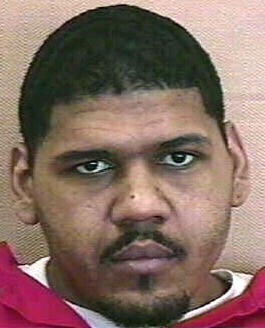
Robbie James LYONS
Classification: Murderer
Characteristics: Robbery
Number of victims: 1
Date of murder:
September 25,
1993
Date of arrest:
Next day
Date of birth: July
10,
1972
Victim profile: Stephen Wilson Stafford,
48 (store owner)
Method of murder:
Shooting
Location: Forsyth County, North Carolina, USA
Status: Executed
by lethal injection in North Carolina on December 5,
2003
Summary:
Stephen Wilson Stafford was the owner of a small Winston-Salem
market. Lyons entered the store, robbed Stafford and shot him to
death.
The day after the robbery, accomplice Derick Hall turned himself in
to police and later testified against Lyons, along with an
eyewitness who saw Lyons leave the store, gun in hand, immediately
after the shooting.
Lyons was improperly released from prison shortly before murdering
Stephen, who was shot to death in his store on September 25, 1993.
Lyons has a long criminal history. On April 16, 1993, Lyons was
convicted of numerous counts of injury to property, larceny and
issuing forged checks.
He was sentenced to more than 17 months in
prison. However, he was improperly released from prison on May 17,
1993, according to court documents.
Five weeks after his release, Lyons was arrested on armed robbery
charges under the alias of Robby James Johnson. Although authorities
knew his real name, Lyons received a plea bargain and three years
probation. He was released again on August 10, 1993. Authorities had
another chance to keep Lyons behind bars.
Lyons was arrested yet again for failing to appear in court for a
shoplifting charge in September 1993. He posted a $50 bond and was
released. Four days later, Lyons fatally shot Stafford during the
robbery.
Final Meal:
Pizza and lasagna, both with meat that was prepared in accordance
with Islamic law, and a Pepsi.
Final Words:
"If my death brings another person happiness, then I'm happy for
them."
ClarkProsecutor.org
North Carolina Department
of Corrections
Robbie James Lyons
DOC Number: 0252465
DOB: 07/10/1972
RACE: BLACK
SEX: MALE
DATE OF CONVICTION: 10/06/93
COUNTY OF CONVICTION: FORSYTH COUNTY
Chronology of Events
12/5/2003 - Lyons executed. Pronounced dead at
2:17 a.m.
12/3/2003 - Witnesses named for Lyons execution
10/22/2003 - Correction Secretary Theodis Beck
sets an execution date of December 5, 2003.
10/6/2003 - U.S. Supreme Court denies Lyons
petition for a writ of certiorari.
4/4/1996 - North Carolina Supreme Court affirms
Lyons' conviction and death sentence.
5/6/1994 - Robbie James Lyons sentenced to death
in Forsyth County Superior Court.
Witnesses selected for Robbie James Lyons
execution
RALEIGH- Witnesses have been named for the
execution of Robbie James Lyons, who is scheduled to die by lethal
injection Dec. 5 at 2 a.m. at Central Prison in Raleigh.
Official Witnesses
David L. Hall —Assistant District Attorney
Ramona Stafford—Victim’s Family Member
Stephanie Stafford—Victim’s Family Member
Dwayne Stafford—Victim’s Family Member
Clark Goldman—Victim’s Family Member
Robert Earl Stafford—Victim’s Family Member
Media Witnesses
Paul Garber—Winston-Salem Journal
Pam Saulsby—WRAL-TV (Raleigh)
Estes Thompson—Associated Press
Execution date set for Robbie James Lyons
RALEIGH - Correction Secretary Theodis Beck has
set Friday, Dec. 5, 2003 as the execution date for death row inmate
Robbie James Lyons. The execution is scheduled for 2 a.m. at Central
Prison in Raleigh. Lyons, 31, was sentenced to death on May 6, 1994
in Forsyth County Superior Court for the September 1993 murder of
Stephen Wilson Stafford. In addition, Lyons received a 30-year
sentence for armed robbery.
A media tour is scheduled at Central Prison on
Monday, Dec 1. Interested media representatives should arrive at
Central Prison’s visitor center promptly at 10 a.m. on the tour
date. Warden Marvin Polk will explain the execution procedures. The
session will last approximately one hour. This will be the only
opportunity to photograph the execution chamber and death watch area
before the execution.
Journalists who plan to attend the tour should
contact the Department of Correction Public Information Office at
919-716-3700.
Robbie James
Lyons (10 July 1972 – 5
December 2003) was convicted of the 1993 murder of
Stephen Wilson Stafford and in 2003 was executed at
Central Prison in Raleigh, North Carolina.
Prior arrests
A series of arrests and releases
in 1993 preceded the murder for which Lyons was
later executed. Convicted on 16 April 1993 on
multiple charges of larceny and forgery, Lyons was
sentenced to 17 months in prison; however, he served
only a month of this sentence and was released on 17
May 1993. He was arrested again a month later on
charges of armed robbery, for which he received
three years probation on a plea bargain; he used an
alias, and even though his real name was known, his
prior arrest and improper release were overlooked.
Finally, four days before the murder of Stephen
Stafford, Lyons was arrested a third time for
failure to appear in court, for which he was
released on a $50 bond.
Crime
The murder of Stephen Wilson
Stafford occurred on 25 September 1993, apparently
as part of an attempted robbery. Stafford was the
owner of a small store in Forsyth County, North
Carolina. According to the testimony of Derick Hall,
an alleged accomplice who was in the store with
Lyons at the time of the murder, Lyons chose to rob
the store on the spur of the moment because he was
out of money. Hall claimed not to have participated
directly in the robbery, but that he heard Lyons
fire five shots at Stafford and disappear; Hall
turned himself into police custody on the following
day. Victoria Lytle, a witness who had just left
Stafford's store, also claimed that she heard
gunshots and saw Lyons leave the store with a gun in
hand shortly afterwards.
Trial
Following Lyons' conviction on 6
May 1994, allegations arose of poor legal
representation; Lyons' trial attornies put forward
no evidence during the trial. Additionally, Lyons'
primary attorney was primarily a real estate lawyer
and had only met Lyons once before the trial. A
psychologist testified during deliberations on
Lyons' sentencing that he suffered from bipolar
disorder, antisocial personality disorder and had a
history of substance abuse from a very early age.
Lyon's mother provided an affidavit, which was not
presented at trial, testifying that Lyons was the
result of an unexpected teenage pregnancy and grew
up in a household where he was regularly abused and
beaten by his grandmother.
Lyons' extensive and violent
criminal history was also a factor brought forward
by those arguing against clemency. A month prior to
his execution, Lyons assaulted a prison guard and
prison authorities placed him in solitary
confinement for the final days of his incarceration.
After the U.S. Supreme Court
denied a petition for a writ of certiorari in Lyons'
case on 6 October 2003, the state of North Carolina
set an execution date of 5 December 2003. Lyons was
set to be the seventh convicted murderer executed by
North Carolina that year, making 2003 a peak for
executions in the state (exceeded only in recent
history by 1949, which saw 10 executions).
Execution
As was customary, North Carolina
governor Mike Easley reviewed pleas for clemency;
prior to the execution he met both with Lyon's
defense attorneys and members of Stafford's family.
Reverend Jesse Jackson also wrote to Mike Easley
just prior to Lyon's execution, also pleading for a
commutation of the death sentence. Easley declined
to commute Lyons' death sentence.
Lyons' final meal prior to his
execution was pizza and lasagna, both prepared in
accordance with Islamic dietary law, and a Pepsi.
His final words were: "It is from Allah that I come
and it is to Allah that I return. If my death brings
another person happiness, then I'm happy for them."
Lyons was pronounced dead at North Carolina's
Central Prison in Raleigh at 2:17 a.m. in the early
morning of 5 December 2003. His execution was the
885th carried out in the United States, and the 30th
in North Carolina, since the death penalty was
reinstated in 1976.
Wikipedia.org
ProDeathPenalty.com
Robbie Lyons was sentenced to die for a 1993
murder in Forsyth County. Robbie James Lyons, 31, is scheduled to
die by lethal injection at 2 a.m. at Central Prison in Raleigh.
Lyons in 1994 was sentenced in Forsyth County Superior Court to die
for the slaying of Stephen Wilson Stafford, the owner of a Winston-Salem
store. Lyons also received a 30-year sentence for armed robbery.
Lyons was improperly released from prison shortly
before murdering Stephen, who was shot to death in his store on
September 25, 1993. Lyons has a long criminal history. On April 16,
1993, Lyons was convicted of numerous counts of injury to property,
larceny and issuing forged checks.
He was sentenced to more than 17
months in prison. However, he was improperly released from prison on
May 17, 1993, according to court documents.
Five weeks after his
release, Lyons was arrested on armed robbery charges under the alias
of Robby James Johnson. Although authorities knew his real name,
Lyons received a plea bargain and three years probation.
He was
released again on August 10, 1993. Authorities had another chance to
keep Lyons behind bars. Lyons was arrested yet again for failing to
appear in court for a shoplifting charge in September 1993. He
posted a $50 bond and was released. Four days later, Lyons fatally
shot Stafford in a grocery store robbery.
The murder occurred at the market Stafford owned,
Sam's Curb Market. A woman, Victoria Lytle, witnessed the aftermath
of the shooting. In addition, an alleged accomplice testified
against Lyons.
Lytle said that after getting out of her car, she
noticed two men on the street. She went into the store to buy soda
and saw Derick Hall enter the store. She also noticed Lyons outside
the store. After Lytle left the store, she heard three gunshots.
She
saw Lyons run out of the store with gun in hand. Hall later
testified that he did not know Lyons planned to rob the store. Hall
said that Lyons carried a long barrel .22 caliber gun when entering
the store. Hall testified that as he and the Lyons approached the
store, Lyons told him that he needed money and that he was going to
rob the store.
Hall did not believe Lyons was serious, court
documents stated. After Victoria Lytle left the store, Lyons entered
and told the victim to freeze and turn around. Hall also claimed he
obeyed the command in order to demonstrate that he had no part in
the robbery.
Hall testified that he then heard five shots, and when
he turned around, the defendant was gone and the victim was lying on
the floor. Hall further testified that the victim was grunting in an
effort to speak and that the victim reached up and pushed the
burglar alarm before collapsing back on the floor.
The next day, Hall voluntarily turned himself in
to the police, court documented stated. Court documents indicate
that Lyon's lawyer did not offer any evidence during his client's
trial. At sentencing, a psychologist testified that Lyons' suffered
from bipolar disorder, antisocial personality disorder and substance
abuse.
No halt to death walk for killer: Lyons is
executed for 1993 slaying
By Andrea Weigl -
Raleigh News & Observer
Friday, December 5, 2003
RALEIGH -- Robbie James Lyons was executed early
this morning for the 1993 shooting death of a Winston-Salem
convenience store owner.
Late Thursday, Gov. Mike Easley denied Lyons'
clemency petition, which raised concerns that poor legal
representation and racial bias contributed to his death sentence.
The Rev. Jesse Jackson sent a letter asking Easley to commute Lyons'
sentence to life in prison, citing Lyons' childhood of violent
beatings and drug abuse. "I have the deepest sympathy for the
victims of violent crime and their families and loved ones left
behind -- but the death penalty is not the best way to acknowledge
their grief," Jackson wrote.
Lyons, 31, was sentenced to die by lethal
injection for the killing of Stephen Stafford, 48, during an armed
robbery at his store Sept. 25, 1993. Lyons was the seventh inmate on
death row executed this year, the most in one year in North Carolina
since 1949, when 10 people were put to death.
Forsyth County prosecutors dismissed the issues
raised by Lyons' defense lawyers. They portrayed Lyons as a violent
man who showed no remorse about the killing and had not changed his
ways. Their proof: Lyons was placed in solitary confinement last
month after assaulting a prison guard, disobeying an order and using
profanity. "Lyons remains an evil, violent person," said Ramona
Stafford, the victim's widow, who was scheduled to be among the
execution witnesses along with her two children, Stephanie and
Dwayne, and other relatives.
Stephen Stafford was a loving husband, a caring
father and someone who tried to help the community around his store,
his widow said. "He had more IOUs in his cash drawer than he did
cash," Ramona Stafford said.
For his last meal Thursday, Lyons drank
a Pepsi and ate a pizza and lasagna, both with meat that was
prepared in accordance with Islamic law. One of Lyons' lawyers, Kirk
Osborn of Chapel Hill, said prosecutors kept all but one black woman
from serving on the jury.
He also pointed to a study that shows that
black people are 3 1/2 times more likely to get the death penalty in
North Carolina if their victim is white and 2 1/2 times more likely
in Forsyth County. "A black murdering a white person is behind the
eight ball to begin with," Osborn said.
Lyons had one experienced lawyer, Osborn said,
but the lawyer who gave the opening argument and questioned all the
witnesses was a primarily a real estate lawyer who only met with
Lyons once before the trial. However, Forsyth Assistant District
Attorney David Hall insisted that Lyons' legal representation was "excellent."
One of Lyons' lawyers had previously handled nine death penalty
cases, all of which resulted in life sentences. The other, the real
estate lawyer, had prosecuted murder cases while in the military and
was an excellent trial attorney, Hall said.
Lyons waits for execution after governor denies
clemency
By Estes Thompson -
Wilmington Star-News
December 4, 2003
A death row
inmate prepared for execution early Friday after Gov. Mike Easley
refused to commute his sentence for the shooting death of a grocery
store worker a decade ago.
Easley said Thursday night he found no
reason to reduce the sentence of Robbie James Lyons to life in
prison, eliminating the prisoner's final chance to avoid the death
penalty. "Having carefully reviewed the facts and circumstances of
this crime and conviction, I find no convincing reason to grant
clemency and overturn the unanimous jury verdict affirmed by the
state and federal courts," Easley said in a news release.
Lyons, 31, was scheduled to be executed by
injection at 2 a.m. Friday for the pistol slaying of Stephen Wilson
Stafford. The victim was shot to death as Lyons attempted to rob
Stafford's store in Winston-Salem on Sept. 25, 1993. Lawyers for
Lyons said they were relying on a clemency petition filed with
Easley and wouldn't file court appeals.
The Rev. Jesse Jackson sent
Easley a letter urging clemency for Lyons. "I have the deepest
sympathy for the victims of violent crime and their families and
loved ones left behind - but the death penalty is not the best way
to acknowledge their grief," the letter said.
Jackson said Lyons suffered frequent beatings as
a youngster and at an early age was forced to drink alcohol, smoke
marijuana and use crack cocaine. "By granting clemency in this case
you would be setting an example of courage over cowardice, of
humanity over brutality," Jackson wrote, adding that two previous
commutations were in the best tradition of justice.
Relatives of the prisoner arrived late in the day
at Raleigh's Central Prison to begin visitation, the first and only
physical contact Lyons has had with them since he was sent to death
row in 1994.
He also met with his attorneys. Lyons had a last meal
Thursday of pizza and lasagna, both made to follow Muslim dietary
rules, and a Pepsi, the Correction Department said. Easley met with
lawyers for Lyons as well as prosecutors and Stafford's family on
Wednesday to hear arguments for and against clemency.
Lyons would be the seventh inmate executed this
year, the most in North Carolina since 1949 when 10 people were put
to death. Lyons confessed to shooting his victim with a .22-caliber
pistol, a shooting that a witness also saw and testified about.
Witnesses planning to watch Lyons die included Stafford's widow,
Ramona, and two children, Stephanie and Dwayne Stafford, 25, and two
other relatives. "I without a doubt believe he should be executed,"
said 24-year-old Stephanie Stafford. "Lyons took away happiness from
my family."
Ramona Stafford said Lyons showed no remorse over
shooting her husband with a .22-caliber pistol and that she would
mistrust any apology he might offer.
Lyons' two state-appointed lawyers, Kirk Osborn
and Ernest Conner, also planned to watch the execution. They have
argued that Lyons didn't have good legal representation when he was
charged and tried and that he has a mental defect. But Assistant
District Attorney David Hall, also a witness, said Lyons has an IQ
of 110 and was a violent individual, a fact he said was proven by
the 50 disciplinary infractions Lyons has had since coming to death
row.
In the latest infraction, said defense lawyer Conner, Lyons was
put in solitary confinement after hitting a guard in the eye. But
Conner said that happened when Lyons was upset after being informed
of his execution date and then a guard pushed him.
Three media witnesses also were scheduled to
watch the execution: Paul Garber of the Winston-Salem Journal, Pam
Saulsby of WRAL-TV in Raleigh and Estes Thompson of The Associated
Press.
National Coalition to Abolish
the Death Penalty
Robbie Lyons (NC) - Dec. 5, 2:00 AM EST
The state of North Carolina is scheduled to
execute Robbie Lyons, a black man, Dec. 5 for the 1993 murder of
Stephen Stafford in Forsyth County.
Mr. Lyons was raised in a shockingly abusive
household and was introduced to illegal substances at the age of
four. This case is an excellent example of how the state is
deficient in funding child protective services, and how such a
tragedy could have been prevented with timely intervention and
treatment.
In the sentencing phase of the trial, Lyons’s
psychologist, Dr. Hoover, testified that Lyons suffered from a mood
disorder characterized in part by explosiveness. He further
testified that Lyons suffered from bipolar disorder, anti-social
personality disorder, and substance abuse.
It was also found that
Lyons began drinking alcohol at age 4, smoking marijuana at age 7,
and used crack cocaine from the ages of 10-12. Dr. Hoover also
states that Lyons has “such a lengthy substance abuse history, that
my only conclusion is that his judgment has been impaired from an
early age.”
A mitigating factor that was not presented in
trial is found in the affidavit of Lyons’s mother stating that she
would have testified to the following: She was 18 years old when she
gave birth to Lyons; she did not know she was pregnant until her
ninth month; Lyons grew up in scarred by an abusive grandmother who
would beat him with broom sticks, wire hangers, and switches.
Lyons
was exposed to illicit drugs at an early age and his great aunt, one
of his primary care givers, regularly supplied Lyons with moonshine.
It has been proven time and time again that abuse
neglect and drug use in early childhood can cause violent behavior
later on in life. Dr. Robert L. Dupont talks about how drug abuse
can lead to violence. “The intoxicated brain is an impaired and a
‘selfish brain.’” This intoxicated impairment quite literally leads
people to commit impulsive, destructive crimes, including crimes of
violence. While Mr. Lyons should be held accountable for his crime,
he should not be killed. Please contact Governor Michael F. Easley
and urge him to commute Robbie Lyons’ sentence to life in prison.
N.C. Executes Man Who Killed Store Owner
DeathHouse.com
December 5, 2003
RALEIGH, N.C. - A man who was mistakenly released
from prison and later killed a store owner during a robbery was
executed by lethal injection at the state prison early Friday
morning. Robbie Lyons, 31, became the seveth convicted killer
executed in North Carolina in 2003. Lyons was concivcted of the 1993
murder of Stephen Wilson Stafford, who was shot to death in his
store in Winston Salem.
Lyons' last meal consisted of a pizza, lasagna
and a Pepsi. "If my death brings another person happiness, then I'm
happy for them," Lyons said just before the lethal drugs entered his
body. Lyons had entered the death chamber just after 2 a.m.
Boondoggles Result in Release
Lyons had a long criminal history. Court
documents state that boondoggles led to his mistaken release from
prison just before the murder. On April 16, 1993, Lyons was
convicted of numerous counts of injury to property, larceny and
issuing forged checks. He was sentenced to more than 17 months in
prison.
However, he was improperly released from prison on May 17,
1993, court documents stated. However, five weeks after his release,
Lyons was arrested on armed robbery charges under the alias of Robby
James Johnson.
Although authorities knew his real name, Lyons
received a plea bargain and three years probation. He was released
again on August 10, 1993.
Authorities had another chance to keep
Lyons behind bars. Lyons was arrested AGAIN for failing to appear in
court for a shoplifting charge in September 1993. He posted a $50
bond and was released. Four days later, Lyons fatally shot Stafford
in a grocery store robbery.
Robbery Leads To Murder
The murder occurred at the market Stafford owned,
Sam's Curb Market. A woman, Victoria Lytle, witnessed the aftermath
of the shooting. In addition, an alleged accomplice testified
against Lyons. Lytle said that after getting out of her car, she
noticed two men on the street.
She went into the store to buy soda
and saw Derick Hall enter the store. She also noticed Lyons outside
the store. After Lytle left the store, she heard three gunshots. She
saw Lyons run out of the store with gun in hand. Hall later
testified that he did not know Lyons planned to rob the store. Hall
said that Lyons carried a long barrel .22 caliber gun when entering
the store.
Friends Turns Himself In
Hall testified that as he and the Lyons
approached the store, Lyons told him that he needed money and that
he was going to rob the store. Hall did not believe Lyons was
serious, court documents stated. After Victoria Lytle left the
store, Lyons entered and told the victim to freeze and turn around.
Hall also claimed he obeyed the command in order to demonstrate that
he had no part in the robbery. Hall testified that he then heard
five shots, and when he turned around, Lyons was gone and the victim
was lying on the floor.
Hall further testified that the victim was
grunting in an effort to speak and that the victim reached up and
pushed the burglar alarm before collapsing back on the floor. The
next day, Hall voluntarily turned himself in to the police, court
documents stated.
Court documents indicate that Lyon's lawyer did
not offer any evidence during his client's trial. At sentencing, a
psychologist testified that Lyons' suffered from bipolar disorder,
antisocial personality disorder and substance abuse.
Murder Victim's Family Says Lyons Deserves To Be
Executed
Death-Row Inmate Scheduled To Die Friday
WRAL-TV.com
RALEIGH, N.C. -- The widow of a storekeeper shot
to death by Robbie James Lyons said Wednesday that the death-row
inmate deserves to die for the murder. Ramona Stafford said she
urged Gov. Mike Easley during a clemency hearing for Lyons, 31, to
uphold the execution by injection scheduled for 2 a.m. Friday.
Attorneys for Lyons said they are relying solely
on the governor for clemency and have no plans to file court appeals.
Easley has the authority to commute the death sentence to life in
prison. Lyons would be the seventh inmate executed this year, the
most in North Carolina since 1949, when 10 were put to death.
Stafford said she told the governor the death of
her husband, Stephen Wilson Stafford, on Sept. 25, 1993, took away a
good husband and father to her children. Lyons confessed to shooting
his victim with a .22-caliber pistol. Stafford's widow said she
talked to Easley about "the violence and evilness of Robbie Lyons.
"He has no remorse for what he did."
A prosecutor said defense arguments that Lyons
did not have good lawyers at his trial are incorrect. One lawyer had
been the defense in nine other death penalty cases and kept
defendants off death row, said Assistant District Attorney David
Hall. Arguments that Lyons was mentally defective also are not true,
Hall said, pointing to Lyons' IQ of 110. "He's an extremely bright
man," Hall said. "This is an extremely violent man. He's been
violent his entire life. He continues to be violent in prison."
Defense lawyer Ernest Conner said Lyons had 50
infractions against him at Central Prison in Raleigh. But he said
Lyons was not violent, although he would react if challenged. "He's
not stabbed anybody; He's not cut anybody," Conner said. In the
latest infraction, the lawyer said, Lyons was put in solitary
confinement after hitting a guard in the eye. But Conner said that
happened when Lyons was upset after being informed of his execution
date and then a guard pushed him.
Conner and co-counsel Kirk Osborn said the fact
that they did not file court appeals because rulings since 1996 have
made it more difficult to raise issues that were overlooked earlier
in a death case. Courts have "been tightening up since the 1990s,"
said Conner, who plans to watch the execution. "That makes clemency
more important."
Stafford's daughter, son and widow also plan to
watch the execution. "It's really not an execution anymore," Ramona
Stafford said. "They're sedated. He should die the way his victim
died."
N.C. man executed while victim's family watches
By Estes Thompson -
Greensboro News & Record
December 5, 2003
RALEIGH, N.C. (AP) — A North Carolina man was
executed by injection Friday while the widow and children of his
victim, a storekeeper murdered in 1993, watched him die. "If my
death brings another person happiness, then I'm happy for them,"
Robbie James Lyons, 31, said before lethal amounts of drugs hit his
system, putting him to sleep before stopping his heart.
Lyons was sentenced to death in 1994 by a Forsyth
County jury for the pistol slaying of Winston-Salem storekeeper
Stephen Wilson Stafford, who was killed about 2 p.m. on Sept. 25,
1993. He was the seventh inmate executed this year in North
Carolina, the most since 1949 when 10 people were put to death.
Prosecutors said Lyons came into the store and
fired four times with a .22-caliber pistol, hitting Stafford three
times, once in the back. The Stafford shooting was the third event
in a crime spree that included two armed robberies, said Assistant
District Attorney David Hall.
Defense lawyers said Lyons wasn't a
violent man, but suffered a personality defect and didn't have good
legal representation at his trial. Lawyer Kirk Osborn compared the
execution to state-sanctioned murder. But widow Ramona Stafford —
who watched Lyons die along with her daughter, son, brother-in-law
and current husband — said despite laws limiting death row appeals
she would like to see executions happen quicker.
A more streamlined
process would help families of victims cope with their loss. "I do
not have to be in court anymore," she said after the execution. "I
do not have to read briefs. I don't have to hear about the
defendant's rights."
Stafford said defense statements that her husband
wasn't killed intentionally were false. "When this individual came
barging into our store shooting a gun, all my husband had to defend
himself was his hands," she said. "The death that Lyons had tonight
was a painless one. I think of my husband's death and it certainly
was not painless."
Defense lawyers didn't file last-minute court
appeals, relying instead of a clemency petition to Gov. Mike Easley.
The governor rejected the clemency request, saying he found no
reason to reduce the sentence of Robbie James Lyons to life in
prison.
The Rev. Jesse Jackson had sent Easley a letter urging
clemency for Lyons. Jackson said Lyons suffered frequent beatings as
a youngster and at an early age was forced to drink alcohol, smoke
marijuana and use crack cocaine.
Easley met with lawyers for Lyons as well as
prosecutors and Stafford's family on Wednesday to hear arguments for
and against clemency. Lyons' last meal consisted of a pizza and
lasagna, prepared according to Muslim dietary rules, and a Pepsi.
316 F.3d 528
Robbie James
LYONS, Petitioner-Appellant, v.
R.C. LEE, Warden, Central Prison, Raleigh, North Carolina,
Respondent-Appellee.
Robbie James Lyons, Petitioner-Appellant,
v.
R.C. Lee, Warden, Central Prison, Raleigh, North Carolina,
Respondent-Appellee.
No. 02-13.
No. 02-14.
United States Court of Appeals,
Fourth Circuit.
Argued October 28, 2002.
Decided January 21, 2003.
Before LUTTIG, WILLIAMS, and
GREGORY, Circuit Judges.
Application for certificate of
appealability denied and appeal dismissed by published opinion.
Judge WILLIAMS wrote the majority opinion, in which Judge LUTTIG
joined. Judge GREGORY wrote a concurring opinion.
OPINION
WILLIAMS, Circuit Judge.
A North Carolina jury
convicted Robbie James Lyons of first-degree felony murder and
attempted robbery with a dangerous weapon (attempted armed
robbery). Following a capital sentencing proceeding, the jury
recommended, and the trial court imposed, a sentence of death on
the first-degree felony murder conviction.1
After exhausting all available state remedies, Lyons filed two
petitions in the United States District Court for the Middle
District of North Carolina for a writ of habeas corpus. See
28 U.S.C.A. § 2254 (West 1994 & Supp.2002). The first petition
challenges a separate 1993 state court conviction for common law
robbery. The second petition challenges the conviction and
sentence for first-degree murder. The district court ordered
that both petitions be denied and dismissed with prejudice.
Lyons seeks a certificate of
appealability (COA) granting permission to appeal the district
court's orders denying his habeas relief. We have consolidated
Lyons's two petitions for review in this court. For the reasons
that follow, we decline to grant a certificate of appealability
and dismiss the appeal.
I.
A.
On the afternoon of September
25, 1993, Stephen Stafford was shot and killed in his place of
business. Victoria Lytle witnessed the shooting.2
Stafford owned a small business known as Sam's Curb Market (Sam's)
in Winston-Salem, North Carolina. Lytle testified that on
September 25, 1993, she stopped at Sam's. She parked in front of
the store, and as she got out of her car, she noticed two men
across the street. Lytle entered the store; while she was in the
store, one of the men, Derick Hall, entered the store. While she
was waiting for Hall to pay for his items, Lytle noticed Lyons
standing outside and looking into the store. Lytle then paid for
her purchases and left the store.
As Lytle closed her car door,
she heard three gunshots. Upon hearing the shots, she looked up
and saw a flash. She heard Stafford moan and saw him fall
forward over the counter and then backward to the floor.
Immediately afterward, she saw Lyons run out of the store with a
gun in his hand.
Hall, Lyons's accomplice,
testified that, on the morning of September 25, Hall had a long-barreled
.22-caliber gun. When Hall and Lyons went to Sam's, Lyons had
possession of the gun. As they approached the store, Lyons told
Hall that he needed money and was going to rob the store. After
Lytle left Sam's, Lyons entered and told Stafford to freeze and
turn around.
Hall also obeyed the command
to demonstrate that he was playing no part in the robbery. Hall
heard five shots. When Hall turned around, Lyons was gone and
Stafford was lying on the floor. Stafford was grunting in an
effort to speak, and he reached up and pushed the burglar alarm
before collapsing back onto the floor.
The forensic pathologist
testified that one bullet entered Stafford's left hand and was
recovered from his wrist. This wound was consistent with
Stafford having grasped the gun and in itself would not have
been fatal. Two more bullet fragments were discovered in
Stafford's upper arm. This wound also would not have been fatal
in the short term. Stafford had also been shot in the back. That
bullet went into Stafford's chest through the lung and aorta and
caused Stafford to bleed to death. The firearms expert testified
that two of the bullets that were recovered were .22 caliber.
The other fragments recovered were too deformed to yield a
result.
B.
The jury returned a verdict
finding Lyons guilty of attempted armed robbery and first-degree
murder under the felony murder theory, with the attempted armed
robbery as the underlying felony. At the sentencing phase, the
court submitted and the jury found one aggravating circumstance:
that Lyons previously had been convicted of a felony involving
the use or threat of violence to the person. To support this
aggravating circumstance, the state submitted evidence that
Lyons had been convicted of two prior felonies involving the use
or threat of violence to the person, one of which was an armed
robbery,3 and
the other one of which was a common law robbery.4
The jury found two statutory
and four nonstatutory mitigating circumstances. The jury
unanimously found that the aggravating circumstance was
sufficiently substantial to call for the imposition of death
when considered with the mitigating factors. The jury
unanimously recommended, and the trial court imposed, a sentence
of death. See N.C. Gen.Stat. § 15A-2000(b) (2001).
Lyons appealed to the Supreme
Court of North Carolina, which found no error in Lyons's
conviction or death sentence. On October 7, 1996, the United
States Supreme Court denied Lyons's petition for a writ of
certiorari. Lyons did not challenge his common law robbery
conviction in either of these direct appeals.
On April 14, 1997, Lyons filed
a Motion for Appropriate Relief (MAR) from the 1993 common law
robbery conviction and a MAR from the first-degree murder
conviction in North Carolina state court. After holding two
evidentiary hearings, the state MAR court denied Lyons's
requested relief. On August 19, 1999, the Supreme Court of North
Carolina denied Lyons's petition for certiorari review. On
January 18, 2000, the United States Supreme Court denied
certiorari in both cases.
Lyons then filed two separate
petitions for habeas relief in the federal district court. One
challenges his common law robbery conviction, and the other
challenges his first-degree murder conviction. The petitions
were referred to a United States magistrate judge, see 28
U.S.C.A. § 636 (West 1993 & Supp.2002), who recommended that the
district court dismiss both petitions. After a de novo review,
the district court adopted the magistrate judge's
recommendations as to both petitions and dismissed Lyons's
petitions for habeas relief. The district court also declined to
issue COAs. Fed.R.App. P. 22(b)(1) ("If an applicant files a
notice of appeal, the district judge who rendered the judgment
must either issue a certificate of appealability or state why a
certificate should not issue.").
Lyons seeks to appeal four
issues: (1) whether he can challenge his common law robbery
conviction in its own right; (2) whether he can challenge his
enhanced sentence for first-degree murder on the ground that his
prior common law robbery conviction was unconstitutionally
obtained; (3) whether the jury instructions during the
sentencing phase of his first-degree murder conviction violated
his due process rights; and (4) whether North Carolina's short-form
indictment renders the first-degree murder conviction and death
sentence invalid pursuant to Apprendi v. New Jersey, 530
U.S. 466, 120 S.Ct. 2348, 147 L.Ed.2d 435 (2000). We address
each of Lyons's requests below.
II.
As the district court declined
to issue a COA, we must first grant a COA to entertain Lyons's
appeal. 28 U.S.C.A. § 2253(c)(1) (West Supp.2002); Slack v.
McDaniel, 529 U.S. 473, 485, 120 S.Ct. 1595, 146 L.Ed.2d 542
(2000). "Under AEDPA, a COA may not issue unless `the applicant
has made a substantial showing of the denial of a constitutional
right.'" Slack, 529 U.S. at 483, 120 S.Ct. 1595 (quoting
28 U.S.C.A. § 2253(c)). To make the required showing, the
petitioner must demonstrate that "reasonable jurists could
debate whether (or, for that matter, agree that) the petition
should have been resolved in a different manner or that the
issues presented were "`adequate to deserve encouragement to
proceed further.'"" Id. at 484, 120 S.Ct. 1595 (quoting
Barefoot v. Estelle, 463 U.S. 880, 893 n. 4, 103 S.Ct.
3383, 77 L.Ed.2d 1090 (1983)).
A. Challenge to the Common
Law Robbery Conviction In Its Own Right
The district court dismissed
Lyons's challenge to his common law robbery conviction in its
own right for lack of jurisdiction because Lyons was no longer
"in custody" with respect to this conviction. In Slack,
the Supreme Court clarified the showing required to satisfy §
2253(c) where the district court dismisses the petition based on
procedural grounds. See Slack, 529 U.S. at 484, 120 S.Ct.
1595.
Where the district court "denies
a habeas petition on procedural grounds without reaching the
prisoner's underlying claims, a COA should issue when the
prisoner shows, at least, that jurists of reason would find it
debatable whether the petition states a valid claim of the
denial of a constitutional right and that jurists of reason
would find it debatable whether the district court was correct
in its procedural ruling." Id. "Section 2253 mandates
that both showings be made before the court of appeals may
entertain the appeal." Id. at 485, 120 S.Ct. 1595. "Where
a plain procedural bar is present and the district court is
correct to invoke it to dispose of the case, a reasonable jurist
could not conclude either that the district court erred in
dismissing the petition or that the petitioner should be allowed
to proceed further." Id. at 484, 120 S.Ct. 1595.
As Lyons was not "in custody"
for the common law robbery conviction at the time he filed his
habeas petition, reasonable jurists could not find the district
court's procedural ruling debatable. Maleng v. Cook, 490
U.S. 488, 490-91, 109 S.Ct. 1923, 104 L.Ed.2d 540 (1989) (interpreting
28 U.S.C.A. § 2254(a) as requiring that the habeas petitioner be
"in custody" under the conviction or sentence under attack at
the time his petition is filed). Thus, we deny the application
for a COA on this claim.
B. Challenge to the First-Degree
Murder Sentence As Enhanced By the Common Law Robbery Conviction
Lyons also challenges his
first-degree murder sentence as enhanced by the common law
robbery conviction on the ground that the common law robbery
conviction was unconstitutionally obtained. The district court
applied the general rule articulated in Lackawanna County
Dist. Att'y v. Coss, 532 U.S. 394, 400, 121 S.Ct. 1567, 149
L.Ed.2d 608 (2001), that a petitioner may not challenge an
enhanced sentence on the ground that the prior conviction was
unconstitutionally obtained and accordingly dismissed the claim.
Because, as we discuss below, Lyons has not shown "that jurists
of reason would find it debatable whether the district court was
correct in its procedural ruling," Slack, 529 U.S. at
484, 120 S.Ct. 1595, we deny the application for a COA on this
claim.
Lyons first argues that
Lackawanna County Dist. Att'y v. Coss, 532 U.S. 394, 400,
121 S.Ct. 1567, 149 L.Ed.2d 608 (2001), does not apply to him
because his original conviction was void. This argument is
without merit. In the alternative, Lyons argues that he falls
into the exception to Coss for the failure to appoint
counsel and the exception articulated by the plurality in
Coss for claims of actual innocence. As Lyons was
represented by counsel in the common law robbery proceeding, the
exception for failure to appoint counsel does not apply. Even
assuming that the exception espoused by the plurality in Coss
exists, Lyons does not satisfy the exception because his claim
of actual innocence5
does not rest on evidence that could not have been discovered
earlier through the exercise of due diligence.
Thus, the general rule that
federal postconviction relief is unavailable when a prisoner
challenges a current sentence on the ground that it was enhanced
based on an allegedly unconstitutional prior conviction for
which the petitioner is no longer in custody applies on the
facts of this case. Because we cannot conclude that "reasonable
jurists" would find the district court's procedural ruling "debatable,"
Slack, 529 U.S. at 484, 120 S.Ct. 1595, we deny Lyons's
application for a COA on this claim.
C. Challenge to First-Degree
Murder Jury Instructions
Next, Lyons argues that the
jury was improperly instructed as to its consideration of
mitigating circumstances in violation of McKoy v. North
Carolina, 494 U.S. 433, 110 S.Ct. 1227, 108 L.Ed.2d 369
(1990). The district court found that this claim had no merit. "Where
a district court has rejected the [petitioner's] constitutional
claims on the merits, the showing required to satisfy § 2253(c)
is straightforward: The petitioner must demonstrate that
reasonable jurists would find the district court's assessment of
the constitutional claims debatable or wrong." Slack, 529 U.S.
at 484, 120 S. Ct. 1595.
Lyons has not shown that there
is a "reasonable likelihood that the jury ... applied the ...
instruction in a way that prevent[ed] the consideration of
constitutionally relevant evidence." Boyde v. California,
494 U.S. 370, 380, 110 S.Ct. 1190, 108 L.Ed.2d 316 (1990).6
Accordingly, reasonable jurists could not find the district
court's assessment of the constitutional claims debatable.
Lyons also argues that the
trial court's response to the jury's question was
unconstitutionally coercive.7
This claim has no merit.8
Because we cannot conclude "that reasonable jurists would find
the district court's assessment of the constitutional claim[]
debatable or wrong," Slack, 529 U.S. at 484, 120 S.Ct.
1595, we deny Lyons's application for a COA on this claim.
D. Challenge to North
Carolina's Short-Form Indictment
Lyons moved for leave to amend
his habeas petition to include a claim that the "short-form"
indictment rendered his conviction for first-degree murder
invalid because the indictment did not allege each element of
the crime of first-degree murder, in violation of Jones v.
United States, 526 U.S. 227, 119 S.Ct. 1215, 143 L.Ed.2d 311
(1999), and Apprendi v. New Jersey, 530 U.S. 466, 120
S.Ct. 2348, 147 L.Ed.2d 435 (2000). The district court denied
Lyons's motion to amend because "Apprendi cannot have
retroactive application to this case." (J.A. at 548.)
The district court recognized
that we have held that Apprendi and Jones state a
new rule of constitutional law that cannot be applied
retroactively to cases on collateral review. See United
States v. Sanders, 247 F.3d 139, 151 (4th Cir.), cert.
denied, 535 U.S. 1032, 122 S.Ct. 573, 151 L.Ed.2d 445
(2001); see also Hartman v. Lee, 283 F.3d 190, 192 n. 2
(4th Cir.2002). As Lyons has not shown that reasonable jurists
would debate whether the district court's procedural ruling was
correct, Slack, 529 U.S. at 484, 120 S.Ct. 1595, we deny
the application for a COA on this claim.
III.
For the reasons stated herein,
we deny Lyons's application for a COA and dismiss the appeal.
These facts are derived from the
statement of facts in the Supreme Court of North Carolina's
published opinion affirming Lyons's conviction and sentence
for first-degree felony murder on direct appealSee State
v. Lyons, 343 N.C. 1, 468 S.E.2d 204 (1996).
The common law robbery conviction stemmed
from a crime that took place on Stratford Road in
Winston-Salem. Lyons was originally charged with robbery
with a deadly weapon (armed robbery). On August 10, 1993,
Lyons entered a negotiated guilty plea to common law robbery
pursuant toNorth Carolina v. Alford, 400 U.S. 25, 91
S.Ct. 160, 27 L.Ed.2d 162 (1970). Lyons was sentenced to
probation and released. His probation was terminated in
October 1993.
Because Lyons entered an Alford plea, to
show "actual innocence," he must show that he was factually
innocent of both the common law robbery charge to which he
pleaded and the original charge of armed robberySee
Bousley v. United States, 523 U.S. 614, 624, 118 S.Ct.
1604, 140 L.Ed.2d 828 (1998) ("In cases where the Government
has forgone more serious charges in the course of plea
bargaining, petitioner's showing of actual innocence must
also extend to those charges.").
Lyons claims that he is
innocent of the original charge of armed robbery because the
pellet pistol was not functional. According to Lyons,
"Tracee Smith [the driver of the car] knew that the gun used
by [Lyons's co-defendant] to threaten the alleged victim was
a non-functional pellet gun belonging to her nephew."
(Appellant's Br. at 12-13.) There is no indication that such
testimony could not have been presented in 1993 through the
exercise of due diligence.
Moreover, Lyons does not
rebut the finding of the state habeas court that denied his
Motion for Appropriate Relief (the state MAR court) that
"the State had strong evidence of [Lyons's] guilt of armed
robbery pursuant to N.C.G.S. § 14-87." (J.A. at 455.)
The Supreme Court held inMcKoy
that the North Carolina jury instruction requiring a jury
unanimously to find the existence of mitigating
circumstances violated the Eighth Amendment. McKoy,
494 U.S. at 439, 110 S.Ct. 1227. In this case, the trial
court did not instruct the jury that it unanimously must
find the existence of mitigating circumstances. The jury was
instructed to resolve four issues in reaching its decision
at the sentencing phase of the trial: (1) whether the jury
unanimously found, beyond a reasonable doubt, the existence
of the aggravating circumstance; (2) whether one or more
members of the jury found one or more mitigating
circumstances; (3) whether the jury unanimously found,
beyond a reasonable doubt, that the mitigating circumstances
found by one or more jurors are insufficient to outweigh the
aggravating circumstance found unanimously by the jury; and
(4) whether the jury unanimously found, beyond a reasonable
doubt, that the aggravating circumstance, if found, is
sufficiently substantial to call for the imposition of the
death sentence when considered with the mitigating
circumstances found by one or more jurors. We have upheld
this portion of the instructions delivered by North Carolina
courts as not violative of McKoy on several occasions.
See Williams v. French, 146 F.3d 203, 215-16 (4th
Cir.1998); Noland v. French, 134 F.3d 208, 213-14
(4th Cir. 1998); Smith v. Dixon, 14 F.3d 956, 981 n.
15 (4th Cir.1994) (en banc); Lawson v. Dixon, 3 F.3d
743, 754 (4th Cir.1993); Maynard v. Dixon, 943 F.2d
407, 418-20 (4th Cir.1991).
After three hours of deliberation, the
jury asked "whether or not [its] decision [had] to be
unanimous on issue number four." (J.A. at 129.) The court
responded "your decision on issue number four does have to
be unanimous. If you're unanimous — if all twelve of you
find yes, then you would answer it yes. If all twelve of you
find no, then you would answer it no." (J.A. at 129.)
Issue Four on the verdict
sheet asked, "Do you unanimously find beyond a reasonable
doubt that the aggravating circumstance found unanimously by
you in Issue One is sufficiently substantial to call for the
imposition of the death penalty when considered with the
mitigating circumstance or circumstances found by one or
more of you?" (J.A. at 139.)
The response given by the judge was
consistent with the earlier instructions, which we have
found did not violateMcKoy. See also Green v. French,
143 F.3d 865, 889 (4th Cir. 1998) (rejecting similar claim
that requiring unanimity as to the sentence recommendation
violated McKoy), abrogated on other grounds by
Williams v. Taylor, 529 U.S. 362, 120 S.Ct. 1495, 146
L.Ed.2d 389 (2000).
Moreover, the lack of an
instruction regarding the consequences of a deadlock was not
unconstitutionally coercive. The United States Supreme Court
recently held that a trial court need not instruct the jury
as to the consequences should it fail to reach a unanimous
decision. Jones v. United States, 527 U.S. 373,
381-82, 119 S.Ct. 2090, 144 L.Ed.2d 370 (1999).
*****
GREGORY, Circuit Judge, concurring:
I concur with the majority's
finding that Lyons has failed to make a substantial showing of a
denial of a constitutional right on any of his claims. I write
separately, however, because I read Lackawanna Co. Dist.
Att'y v. Coss, 532 U.S. 394, 121 S.Ct. 1567, 149 L.Ed.2d 608
(2001), more broadly than does the majority.
In Coss, the Supreme Court
stated, "When an otherwise qualified § 2254 petitioner can
demonstrate that his current sentence was enhanced on the basis
of a prior conviction obtained where there was a failure to
appoint counsel in violation of the Sixth Amendment, the current
sentence cannot stand and habeas relief is appropriate." Id.
at 403-04, 121 S.Ct.1567. The majority finds that because "Lyons
was represented by counsel in the common law robbery proceeding,"
Coss does not afford him any relief. Ante, at 533.
I, however, do not read the
Coss rule quite so narrowly. As Justice O'Connor explained,
"[A] habeas petition directed at the enhanced sentence may
effectively be the first and only forum available for review
of the prior conviction." Coss, 532 U.S. at 406, 121 S.Ct.
1567 (O'Connor, J., concurring) (emphasis added). Coss applies,
therefore, not only to situations where there is an absolute
failure to appoint any counsel, but also to situations where
there is a Sixth Amendment violation so substantial that it is
as if a defendant never had the benefit of legal representation.
It is undisputed that Lyons had a court-appointed attorney in
the prior conviction: Mr. George R. "Pete" Clary. The question
in this case is whether Clary's advice — that Lyons enter an
Alford guilty plea in exchange for a sentence of probation —
was so incompetent, conflicted, or corrupt as to effectively
deny Lyons his Sixth Amendment right to counsel. Because Lyons
is unable to make a substantial showing that this litigation
strategy denied him his constitutional right to counsel, Lyons'
request for a COA is denied under either the majority's or my
application of Coss. Accordingly, I concur.