Murderpedia has thousands of hours of work behind it. To keep creating
new content, we kindly appreciate any donation you can give to help
the Murderpedia project stay alive. We have many
plans and enthusiasm
to keep expanding and making Murderpedia a better site, but we really
need your help for this. Thank you very much in advance.
Adolph
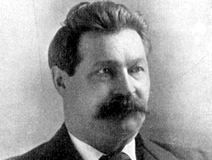
Louis LUETGERT
The Sausage Vat Murder
Classification: Murderer
Characteristics: Domestic violence - Dissolved the
body in acid in one of his sausage vats
Number of victims: 1
Date of murder:
May 1, 1897
Date of arrest:
6 days after
Date of birth:
December 27, 1845
Victim profile: Louise Luetgert (his wife)
Method of murder: Drowning? - Poisoning?
Location: Chicago, Illinois, USA
Status:
Sentenced to life in prison on February 9, 1898. Died in prison on
July 7, 1899
Adolph Louis Luetgert (December 27, 1845-July
7, 1899) was a German-American charged with murdering his wife and
dissolving her body in acid in one of his sausage vats at the A.L.
Luetgert Sausage & Packing Company in 1897.
Luetgert, born in Gütersloh, Westphalia (now
Germany), moved to Chicago, Illinois in the 1870s. He married his wife
Louisa Bicknese on January 18, 1878. Luetgert ran the successful A.L.
Luetgert Sausage & Packing Company and was considered the “sausage
king” of Chicago until being accused of murdering his wife and being
sentenced to life in prison on February 9, 1898 where he died about a
year and a half later.
After the news of the trial became public, rumors
spread that Luetgert had actually turned his wife into sausage and
sold the “sausage” to unknowing consumers. Although this has been
proven to be false as her body was dissolved and burned, the legend
persists to this day. Another common legend about the murder is that
the ghost of Louisa Luetgert haunts the old factory grounds and the
couple’s former home in Chicago.
Early life
Adolph Louis Luetgert, born on December 27, 1845,
was originally named Adolph Ludwig Lütgert. He was born in a town
called Gütersloh, located in the province Westphalia, which is now a
part of Germany.
His parents, Christian Heinrich Lütgert and
Margreta Sophia Severin, had ten other children besides Adolph; eight
other sons and two daughters. Adolph was the third born in the family,
and he also had a twin named Heinrich Friedrich "Fritz" Luetgert, who
died before Adolph around 1894 or 1895. While Adolph was growing up,
his father dealt with animal hides and tallow wool as well a dabbling
into real estate a bit.
Adolph’s schooling lasted from about the age of
seven until the age of fourteen and after those seven years of
schooling, Adolph became an apprentice for Ferdinand Knabel whom
taught him about the tanning business. During the time of the
apprenticeship, Adolph continued to live in Westphalia however as an
apprentice he lived with his boss instead of his family. After working
for Knabel for two and a half years, Luetgert began to travel around
Germany, working wherever he could. At the age of nineteen, Luetgert
traveled to London, England where he stayed for about six months but
left because he was unable to find a job other than scrubbing
restaurant floors.
Life in America
Adolph Luetgert came to New York in around 1865 or
1866 when he was about twenty years old. Like many others, he had
heard that thousands of his countrymen were going to America with very
little money. With about thirty dollars to his name, Luetgert boarded
a ship bound for the United States.
Luetgert arrived in New York and after a short time
there he went to Quincy, Illinois to meet up with some friends of his
brother who were living there. He stayed in Quincy for about four
months before moving to Chicago in search of a job at a tannery. He
found a job at Union Hide and Leather Company. He did not have a
steady job or constant pay at the tannery, so he began to also take on
random jobs such as moving houses. From 1867 to 1868, Luetgert got a
job at another tannery called Engle, Crossley & Co. He then worked at
another tannery called Craig, Clark & Company, but later returned to
work at the Engle Brother’s Tannery until 1872.
Luetgert then started his own business with the
four thousand dollars he had saved. Initially, he went into the liquor
business before starting his sausage company in 1879.
He married his first wife, Caroline Roepke,
sometime between 1870 and 1872. She died on November 17, 1877. He
married his second wife Louise Bicknese, two months after Caroline’s
death, on January 18, 1878. Luetgert had six children—two with
Caroline and four with Louise. Only three of his children survived
past the age of 2.
Murder and police investigation
Louisa disappeared on May 1, 1897. Adolph told his
children that their mother had gone to visit her sister on the
previous night but never came back. After a few days, Louisa’s brother,
Diedrich Bicknese went to the police to report her disappearance.
Luetgert then claimed to the police that she ran away with another man.
During their investigation, the police came to know
that the couple had a history of domestic violence and that the couple
fought on a regular basis. According to a source, Luetgert had
financial difficulties so he started courting a rich widow who he
planned to marry once he got rid of his wife. The police continued
their investigation and discovered that on the night of May 1, 1897,
the night Louisa disappeared, she was seen entering the factory with
her husband at 10:30pm. A watchman from the sausage plant confirmed
the story, saying that Mr. Luetgert gave him an errand to run and told
him that he could take the rest of the night off.
The police also made a shocking discovery; they
came across bills that stated that Luetgert bought arsenic and potash
the day before the murder. Due to all the accumulated evidence the
detective was convinced that Luetgert had killed his wife, boiled her
in acid and then disposed of her in a factory furnace.
The officers then started searching in the furnace
where they found burned foul sausages and human residue. There, they
also found two of Louisa’s rings, including one that had the initials
“LL” engraved on it. Bone fragments identified by a forensic
anthropologist included metatarsal bones, toe phalanx, rib and head of
a human female. Due to the overwhelming evidence, Luetgert, still
claiming his innocence, was arrested and put on trial.
Trial
Adolph Luetgert’s murder trial began in the end of
August in 1897 and took place in the Cook County Courthouse. The Judge
was Richard Tuthill. Luetgert was defended by William Vincent.
Luetgert was prosecuted by Charles Deneen, who would later be elected
Governor of Illinois and a U.S. Senator for Illinois. The trial
revolved around the disappearance of Louise Luetgert, Adolph’s wife,
on May 1, 1897.
The prosecution had used bones and a ring found in
one of the grinders in Luetgert’s sausage factory as its main evidence.
The ring was inscribed with the initials L.L., presumably standing for
Louise Luetgert. The defense argued Louise Luetgert had left her house
on May 1, 1897 and also cited many claims of people that they had seen
her around the United States following the beginning of the trial.
During the trial, observers thought that Luetgert seemed unconcerned
and overly confident that he would be found innocent. The jury was
unable to reach a unanimous verdict, so the case was retried.
Luetgert’s second trial began in January 1898 at
the same courthouse. The prosecution then used George Amos Dorsey, an
anthropologist at the Field Columbian Museum in Chicago, to prove that
the bones found were human bones. This time, the jury came to a
unanimous decision, that Luetgert was guilty. Luetgert was convicted
and sentenced life in prison. Luetgert died in prison on July 7, 1899.
This case was one of the first trials widely
covered by the media. Newspapers from Chicago would report on it daily
and some of them would try to eavesdrop on the jury deliberation. At
the time, the case was called the celebrity case and is credited with
putting murder trials in the media. This case also was one of the
first to use forensic experts to solve a crime.
Myths about
Mrs. Luetgert
There were many “sightings” of Mrs. Luetgert after
the trial began. She was sighted in 12 different states but never
found. One of the most famous myths was that she was seen boarding a
ship in New York bound for Europe. When Adolph heard this he said that
he thought she was definitely fleeing the country. The sightings of
Louise Leutgert however, never became global.
The factory
Some claim that the Luetgert factory burned to the
ground in 1902, but the research of Robert Loerzel shows that the
factory still stands, although a fire actually occurred on June 26,
1904. The fire only burned the inside of the building, destroying
things such as the sausage vats, while leaving the external structure
still standing.
Today, the factory still stands on the south side
of the 1700 block of West Diversey Parkway; however, it has been
converted into condominiums similar to the other town homes and
condominiums which now are beside it.
Wikipedia.org
The Sausage Vat Murder
The ghost of Louisa Luetgert still walks the
neighborhood where her home once stood, or at least that’s what the
legends of northwest Chicago say. Louisa was the murdered wife of
“Sausage King” Adolph Luetgert, a German meat packer who came to the
city in the 1870’s. Killed by her own husband in one of the most
grisly ways imaginable, her ghost not only haunts the area around
Hermitage Avenue but the legends say that shehounded her treacherous
husband.... from Joliet Prison to the grave!
After finding that his German sausages were well-liked
in Chicago, Adolph Luetgert built a sausage plant at the southwest
corner of Hermitage and Diversey Parkway in 1894. He was so taken with
his own success that he also built a three-story frame house next door
to the factory, which he shared with his wife Louisa.
Louisa Bicknese was an attractive young woman who
was ten years younger than her husband. She was a former servant from
the Fox River Valley who met her new husband by chance. He was
immediately taken with her, entranced by her diminutive stature and
tiny frame. She was less than five feet tall and looked almost child-like
next to her burly husband. As a wedding gift, he gave her a unique,
heavy gold ring. Inside of it, he had gotten her new initials
inscribed, reading “L.L.”. Little did he know at the time that this
ring would prove to be his undoing.
According to friends and neighbors, Luetgert’s
fascination with his beautiful, young wife did not last long. The
couple was frequently heard to argue and their disagreements became so
heated that Luetgert eventually moved his bedroom from the house to a
small chamber inside of the factory. Luetgert soon became involved
with a girl named Mary Simerling, Louisa’s nice and a household
servant. This new scandal also got the attention of the people in the
neighborhood, who were already gossiping about the couple’s marital
woes.
Then, on May 1, 1897, Louisa disappeared. When
questioned by his sons, Luetgert told them that their mother had gone
out the previous evening to visit her sister. After several days
though, she did not come back. Finally, Diedrich Bicknese, Louisa’s
brother, went to the police. The investigation fell on Captain Herman
Schuettler, who author Richard Lindberg describes as “an honest but
occasionally brutal detective”.
The detective and his men began to immediately
search for Louisa. They questioned neighbors and relatives and soon
learned of the couple’s violent arguments. They also talked to Wilhelm
Fulpeck, an employee of the sausage factory, who recalled seeing
Louisa enter the factory around 10:30 in the evening on May 1. Frank
Bialk, a night watchman at the plant, confirmed his story. He also
added that he saw both Luetgert and Louisa at the plant together.
Apparently, Luetgert sent him out on an errand that evening and gave
him the rest of the night off.
Schuettler also made another disturbing and
suspicious discovery. Just a short time before Louisa’s disappearance,
the factory had been closed for ten weeks for reorganization. However,
the day before Louisa vanished, Luetgert ordered 378 pounds of crude
potash and fifty pounds of arsenic. The circumstantial evidence was
starting to add up and Schuettler began to theorize about the crime.
He became convinced that Luetgert had killed his wife, boiled her in
acid and then disposed of her in a factory furnace. With that in mind,
he and his men started another search of the sausage plant. They
narrowed the search to the basement and to a twelve-foot-long, five-foot-deep
vat that was located next to the furnaces that smoked the meat. The
officers drained the greasy paste from the vat and began poking
through the residue with sticks. Here, officer Walter Dean found a
small piece of a skull fragment and two gold rings. One of them was
engraved with the initials “L.L.”.
On May 7, Adolph Luetgert, proclaiming his
innocence, was arrested for the murder of his wife. No body was ever
found and there were no witnesses to the crime, but police officers
and prosecutors believed the evidence was overwhelming. Luetgert was
indicted for the crime a month later and details of the murder shocked
the city, especially those on the northwest side. Even though Luetgert
was charged with burning his wife’s body, local rumor had it that she
had been ground into sausage instead. Needless to say, sausage sales
declined substantially in 1897.
Luetgert went to trial but the proceedings ended in
a hung jury on October 21 after the jurors failed to agree on a
suitable punishment. Some argued for the death penalty, while others
voted for life in prison. Only one of the jury members thought that
Luetgert might be innocent. A second trial was held and on February 9,
1898, Luetgert was convicted and sentenced to life imprisonment at
Joliet.
Luetgert was taken away to prison, where he became
a shell of his former self. He babbled incoherently to the guards,
claiming that his dead wife was haunting him, intent on having her
revenge, even though he was innocent of her murder.
Luetgert, possibly insane by this time, died in
1900. And he was not the only one to suffer.... His attorney, Lawrence
Harmon, believed that his client was telling the truth and that he did
not kill his wife. He was sure that she had simply disappeared. In
fact, Harmon was so convinced of Luetgert’s innocence that she spent
over $2,000 of his own money and devoted the rest of his life to
finding Louisa. Eventually, he also went insane and he died in a
mental institution.
And Louisa, whether she was murdered by her husband
or not, reportedly did not rest in peace. Not long after her husband
was sent to prison, her ghost began to be seen inside of the Luetgert
house. Neighbors claimed to see a woman in a white dress leaning
against the mantel in the fireplace. Eventually, the house was rented
out but none of the tenants stayed there for long. The ghost was also
reported inside of the sausage factory but the place was later
abandoned and recently, portions of it were turned into condominiums.
As of this writing, no reports of the ghost in these new structures
have surfaced.
Legend still has it on the northwest side that
Louisa Luetgert still walks. If she does, she probably no longer
recognizes the neighborhood where she once lived as the factory is
long gone and the houses that once stood here have been replaced in
recent years with condos and new homes. They say though, that if you
happened to be in this area on May 1, the anniversary of Louisa’s
death, there is a chance that you might see her lonely specter still
roaming the area where she lived and died.
The former A.L. Luetgert Sausage and Packing
Company and the Luetgert residence was located on the southwest corner
of Hermitage Avenue and Diversey Parkway, just before Paulina Street
on Chicago’s North Side.