Murderpedia has thousands of hours of work behind it. To keep creating
new content, we kindly appreciate any donation you can give to help
the Murderpedia project stay alive. We have many
plans and enthusiasm
to keep expanding and making Murderpedia a better site, but we really
need your help for this. Thank you very much in advance.
Floyd LOVELESS
Classification:
Homicide
Characteristics: Juvenile (15) -
To
avoid arrest
Number of victims: 1
Date of murder: August 20,
1942
Date of birth: 1927
Victim profile: A.H.
Berning
(Elko
County constable)
Method of murder:
Shooting
Location: Elko County, Nevada, USA
Status:
Executed by
asphyxiation-gas on September 29,
1944. Loveless was 17 years old when he died, the youngest
person ever executed in Nevada
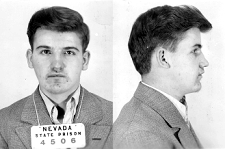
Floyd Loveless
was executed at the Nevada State Prison in Carson City on September 29,
1944. He was the youngest person ever to be executed at the Nevada State
Prison, he was 17 years old.
Loveless was convicted of killing Elko
County constable A.H. Berning on August 20, 1942. Loveless had escaped
from the Indiana Boy's Home in Plainville, Indiana on August 15, 1942.
He had been placed in the home in July after having committed over
twenty crimes including rape at gun point. He was only 15 when he
escaped and murdered Berning.
Loveless and another inmate in Indiana,
Dale Cline made their escape out of the Midwest and drove across
country. They stole many automobiles and burglarized several homes.
The
pair held up a service station in Nebraska. Cline and Loveless separated
in Nevada, Loveless stole a car and was stopped in Carlin, Nevada by Berning who was on the lookout for a stolen automobile.
Loveless shot Berning twice and abandoned his body in the desert. Even though there
were pleas to save his life because of his youth, Loveless was executed
before his eighteenth birthday.
He was 17 years old when Nevada
executed him
By Barry Smith - NevadaAppeal.com
Friday, March 4, 2005
If he were alive today, Floyd Loveless would be 78 years
old. He's not. Asphyxiated by gas at the State Prison in Carson City on
Sept. 29, 1944, Loveless was 17 years old when he died, the youngest
person ever executed in Nevada.
Loveless, known as Bert when he was in grade school in Indiana, is also
the only person put to death in Nevada under the age of 18. Now that the
U.S. Supreme Court has decided execution of juveniles is
unconstitutional, Floyd's place in history is secure.
It's not likely he would have survived 60 years in Nevada
State Prison. When he went there at age 15, the prison doctor found "an
apparently normally apprehensive, gregarious, introverted youth."
He was 5-foot-7, 148 pounds, big enough to be a pitcher
and third baseman on the prison baseball team.
It's obvious the other prisoners were going to miss him
when he went to the gas chamber. One hundred sixty-eight of them signed
a petition urging the governor not to kill Floyd.
"He has been extremely popular with all the inmates here
and with the prison personnel, has never given any of us trouble and has
been nothing but honest to all of us," they wrote.
Floyd probably learned a lot from the boys in prison. And
he probably liked the attention, which he didn't get back in Stockwell,
Ind.
"Life is a word with so
much meaning," Floyd wrote to a couple in Reno who had taken an interest
in his case. "I have a lot to learn yet."
Floyd had learned a few things in his short life. By the
age of 12, he'd learned how to steal a jar of pennies from a farmhouse
when nobody was home. He'd learned how to swipe a watch from the local
five-and-dime.
When he broke in
and somebody was home, he learned how to hit her over the head with a
milk bottle to get away. Then, 15 years old, he learned that when he
found a gun in a bedroom and waited for Mrs. Knoth to come in, he could
rape her while holding the gun in his left hand.
Those lessons weren't learned from his mother, who walked
in front of a train when Floyd was 3 years old. People in his hometown
assumed she did it on purpose.
His father? Dishonorably discharged from the Army for a brawl in which a
man was killed. One of Floyd's teachers, the one who knew him as Bert,
characterized his father as "feared by residents of Stockwell as a
desperate character."
After the
rape, Floyd was sent to juvenile hall, where he was to remain until he
was 21 years old. It wasn't a month before he escaped and headed west on
a crime spree.
He and a buddy
got as far as Nevada when a constable, A.H. Berning, spotted Floyd in a
stolen car near Carlin. Sorry, lad, the constable told him, but that
car's stolen and I'm going to have to haul you in.
When Constable Berning opened the car door, Floyd shot
him. Then Floyd shot him again. With the gravely injured constable
pleading with Floyd to take him to a hospital, the boy drove into the
desert and left him for dead.
Later, after he had been convicted of first-degree murder and sentenced
to die, Floyd explained it this way: "I shot him because I was
frightened. I did not intend to kill him and I did not plan to kill him.
At the time of the struggle I was fifteen years of age. I am sorry for
what happened and I did not mean to do what I did."
People from all over the country wrote to Gov. E.P
Carville to beg him not to execute a child. It was a barbaric, senseless
thing to do, they said.
One
writer, from California, had a better idea. Noting the nation was at war,
she pleaded: "Don't kill him. Let him and all like him kill the common
enemies of us all."
Floyd's
grade-school teacher, Lawrence Thompson, asked that his sentence be
commuted to life in prison. "He is dangerous and I would not plead that
he ever be turned loose on society again," Thompson wrote, but he did
still have potential to be "a useful member of the state prison
population."
Elko County
District Attorney George Wright argued that Floyd had his opportunities
to go straight. "We submit that defendant was in Indiana given a chance
for rehabilitation - first probation and then reformatory, but the
defendant was not amenable to correction - he escaped ...."
On Sept. 29, 1944, Floyd Loveless entered the death
chamber at Nevada State Prison at 6:22 p.m. Six minutes later, he was
administered a dose of lethal gas. Just before 7 p.m., they removed his
body from the chamber.
They
shipped Floyd back to Indiana to his family. His grandmother, Mrs. L.B.
Loveless, wrote to ask the warden if Floyd had ever mentioned where he
should be buried:
"Did Floyd
think we would have him brought home to be buried? We wanted to write
and tell him we would, but we hated to discourage him. Up until the last
day we didn't think any state could do a thing to so young a boy."
His father had visited him once, in 1942. He hadn't been
back because, he told the boy, he couldn't afford the gas and tires for
another trip to Nevada.
At the
prison on Carson City's east side, the inmates went back to their
routine. Autumn was moving in. The days were getting colder and shorter.
"No ball game today," Floyd had written a few days before
his execution. "I don't think we'll have any more games this year."