Murderpedia has thousands of hours of work behind it. To keep creating
new content, we kindly appreciate any donation you can give to help
the Murderpedia project stay alive. We have many
plans and enthusiasm
to keep expanding and making Murderpedia a better site, but we really
need your help for this. Thank you very much in advance.
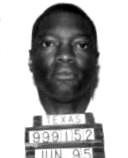
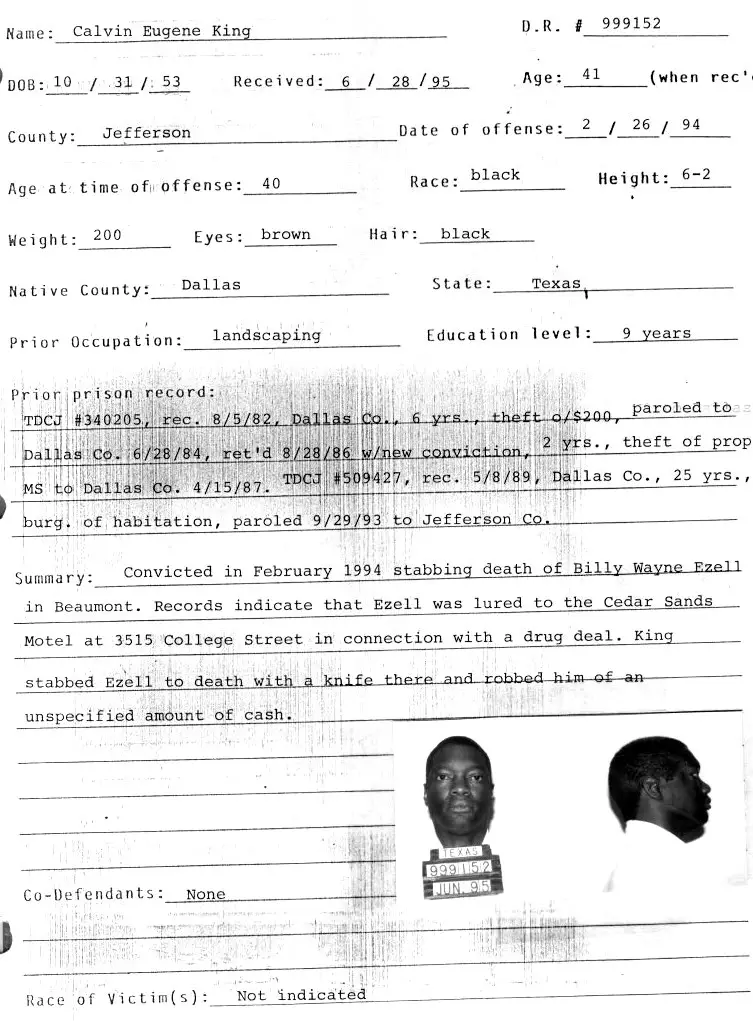
Calvin Eugene
KING
Classification: Murderer
Characteristics: Robbery
- Drugs
Number of victims: 1
Date of murder: February 26,
1994
Date
of arrest:
March
1994
Date
of arrest:
October 31,
1953
Victim profile: Billy Wayne Ezell
(male, 21)
Method of murder: Stabbing
with knife
Location: Jefferson County, Texas, USA
Status: Executed
by lethal injection in Texas on September 25,
2002
Summary:
On Feb. 25, 1994, at 10 p.m., Calvin King and friends met at Room 38
of the Cedar Sands Motel in Beaumont, Texas, which had been rented
earlier in the day by King.
They spent the evening smoking crack cocaine in the room. King was
also selling and buying crack throughout the course of the evening.
Billy Wayne Ezell came to the room several times to sell crack to
the occupants. Just before dawn, Ezell went to another room in the
hotel.
King then knocked on the door and asked Ezell to come
upstairs. Ezell left Goodwin's room for Room 38.
Ezell's body was discovered the next morning in Room 38 covered with
a blanket and nude from the waist down. The room was in disarray.
Ezell had sustained 37 major stab wounds and had extensive damage to
the head caused by a blunt object, described as "overkill" by the
pathologist.
The next morning, King arrived home with a roll of bloody money.
King then set about washing the blood off of the money and drying it
in the oven.
King made admissions to friends present that "I done kill and I'll
kill again." "I'm the one kill him (sic). I'm the one that hit him
over the head with a lamp, put a cord around his neck and slice
(sic) his throat."
Accomplice Leonard Johnson pled guilty and received a life prison
term. In 1989, King was convicted of burglary of a habitation and
sentenced as an habitual offender to 25 years imprisonment. He was
released after serving 4 years.
Final Meal:
Half of a fried chicken (cooked in garlic powder and red pepper),
French fries, one Dr. Pepper, and hot sauce
Final Words:
"I want to say God forgives as I forgive and God is the greatest.
Thank you."
Texas Attorney General Media
Advisory
MEDIA ADVISORY
Monday, Sept. 23, 2002
Calvin
King Scheduled to be Executed.
AUSTIN - Texas Attorney General John Cornyn
offers the following information on Calvin King, who is scheduled to
be executed after 6 p.m. on Wednesday, Sept. 25, 2002.
On June 23, 1995, Calvin King was sentenced to
death for the capital murder of 21-year-old Billy Wayne Ezell, while
in the course of committing or attempting to commit robbery, which
occurred in Beaumont, Texas, on Feb. 25, 1994.
A summary of the
evidence presented at trial follows:
FACTS OF THE CRIME
On Feb. 25, 1994, at 10 p.m., Calvin King,
Leonard Johnson, Danyell Williams (King's girlfriend), and Carlette
Gibbs met at Room 38 of the Cedar Sands Motel in Beaumont, Texas,
which had been rented earlier in the day by King.
King, Johnson,
Williams, and Gibbs, who was pregnant at the time, spent the evening
smoking crack cocaine in the room. King was also selling and buying
crack throughout the course of the evening.
After being called by either Johnson or King,
Billy Wayne Ezell came to the room several times to sell crack to
the occupants. Ezell took Johnson to the store to buy beer and
cigarettes and then returned to the room to sell the group crack.
When Ezell came to the room, he took a large roll of money out of
his pocket, which was seen by everyone in the room. Ezell then sold
King $60 worth of crack and left.
King and Johnson sent Williams and Gibbs home in
a cab at about 4 a.m., telling them that they were going to sell the
crack they had just bought and that the women needed to leave.
Kenneth Goodwin and Angelita Williams, friends of Ezell's, were
staying in Room 26 of the Cedar Sands Motel, below and adjacent to
Room 38. Goodwin was also a friend of Johnson and Gibbs, and he knew
King. Just before dawn, Ezell went to Goodwin's room. King then
knocked on the door and asked Ezell to come upstairs. Ezell left
Goodwin's room for Room 38.
Some time later, Goodwin noticed that Ezell's car
was still in the parking lot and he was curious why Ezell would
still be there.
Ezell's girlfriend called Goodwin's room about the
same time, asking Goodwin to tell Ezell to come home. Goodwin called
Ezell's pager, and after receiving no response, Goodwin went to Room
38 and knocked on the door, but no one responded.
Goodwin went back
downstairs and saw a woman from the front office checking the rooms,
walking in the direction of Room 38. After returning to his room,
Goodwin told Angelita that no one had responded in Room 38.
Ezell's body was found in Room 38 lying face down,
partially covered with a blanket and nude from the waist down. A
broken lamp lay next to him, and the cord from the lamp was wrapped
around his neck.
The room was in disarray, as though a fight had
occurred. Ezell had sustained multiple blunt force injuries to both
sides of his head, and stabbing and cutting wounds to his head, face,
throat, chest, and back, two of which severed his internal jugular
vein and pulmonary artery. His diaphragm was also punctured.
Additionally, both of his arms and hands had numerous defensive
wounds.
In all, Ezell suffered 37 major stab wounds and
sustained extensive damage to the head caused by a blunt object.
With regard to the quantity and severity of the injuries, Dr.
Elizabeth Peacock, who performed the autopsy on Ezell, stated that "this
is a case that we would commonly refer to as overkill."
When King and Johnson arrived at the home of
Williams and Gibbs that morning, King had blood on his shirt. King,
although not injured, appeared to have been in a fight, but Johnson
did not. After smoking crack with Williams, King and Johnson
produced a roll of money covered in blood.
King then set about
washing the blood off of the money and drying it in the oven.
Johnson woke up Gibbs, crying and telling her he "didn't do it."
Gibbs then went upstairs and observed that King was in possession of
a large amount of crack and that there was "money everywhere" drying.
According to Billy Hickman, who also lived in the
house with Danyell Williams, King and Johnson were watching a news
report about the killing at the Cedar Sands, and King stated, "I
done kill and I'll kill again." Later, King told Gibbs that he had
killed Ezell, stating, "I'm the one kill him (sic). I'm the one that
hit him over the head with a lamp, put a cord around his neck and
slice (sic) his throat."
PROCEDURAL HISTORY
On March 31, 1994, King was indicted in the
Criminal District Court of Jefferson County, Texas, for the capital
offense of murdering Billy Wayne Ezell while in the course of
committing and attempting to commit robbery.
After King pleaded not
guilty, a jury found him guilty of the capital offense on June 22,
1995. On June 23, 1995, after a separate punishment hearing, the
court assessed King's punishment at death.
King's conviction and sentence were automatically
appealed to the Texas Court of Criminal Appeals, which affirmed in a
published opinion on Sept. 24, 1997. King did not petition the
Supreme Court of the United States for writ of certiorari.
King then filed a state application for writ of
habeas corpus in the trial court on March 16, 1998. The trial court
subsequently entered findings of fact and conclusions of law
recommending that King's application be denied. The Court of
Criminal Appeals adopted the findings and conclusions of the trial
court and denied the application in an unpublished order on Feb. 17,
1999.
King then filed a federal habeas petition in the
United States District Court for the Eastern District of Texas,
Texarkana Division, on Oct. 15, 1999.
The federal district court denied habeas relief
on Feb. 6, 2001, and denied King permission to appeal on May 11,
2001.
King then sought permission to appeal from the
United States Court of Appeals for the Fifth Circuit. That court
denied King permission to appeal on Feb. 26, 2002.
King subsequently petitioned the United States
Supreme Court for certiorari review. The petition is currently
pending before the Court.
PRIOR CRIMINAL HISTORY
During trial, the State proved that King had
three prior convictions for theft and one for burglary of a
habitation, all in Dallas County, Texas.
On April 2, 1982, King received probation for his
first theft offense.
On July 30, 1982, King was convicted of his
second theft offense, his probation was revoked, and he was
sentenced to 6 years imprisonment.
Following his release on parole, King was
convicted of his third theft offense and, on Aug. 20, 1986, was
sentenced to 2 years imprisonment.
On March 22, 1989, King was convicted of burglary
of a habitation and sentenced as an habitual offender to 25 years
imprisonment.
ProDeathPenalty.com
Calvin Eugene King was sentenced to death for the
slaying of Billy Ezell in a Jefferson County motel room.
According to the evidence, Ezell was robbed and
stabbed to death during a drug transaction with King and another man
on February 26, 1994.
With at least four felony convictions already on
his record, parolee King was no stranger to the criminal justice
system when he went on trial for capital murder.
A Jefferson County jury wasted little time
returning him to prison, deliberating only 30 minutes before
deciding King was guilty and deliberating just an hour before voting
he should go to death row for the fatal stabbing of a Silsbee man
during a drug deal robbery in Beaumont in 1994.
King was on parole when he was arrested for
killing Billy Wayne Ezell, 21, of Silsbee, about 20 miles north of
Beaumont.
Relatives described Ezell as ignorant of the ways
of the city and making poor choices by choosing to sell crack
cocaine in Beaumont in the days before his death. "According to one
of his buddies and his mom, he was looking at this as an opportunity
to make some really good money, really quickly, because he thought
that would help him get back together with estranged wife," said
Ramon Rodriguez, the Jefferson County assistant district attorney
who prosecuted King. "He was just a country boy in over his head. "People
at the hotel said he was flashing cash. It was not surprising
somebody took advantage of him."
Evidence showed that was King, a landscaper who
had been on parole for about five months after serving only four
years of a 25-year prison term for burglary in Dallas County. Court
records indicated Ezell was lured to a Beaumont motel Feb. 26, 1994
where he was stabbed, beaten and robbed by King and a partner,
Leonard Johnson, also of Dallas. "It was a was a very brutal crime,"
Rodriguez said this week. "We're talking dozens of stab wounds, and
then being bludgeoned with a table lamp."
The lamp cord also was
wound around his neck. Johnson pleaded guilty and received a life
prison term. King got a death sentence. In urging the jury to choose
the death penalty, Rodriguez said he pointed out King did not need
to kill Ezell. "All they had to do was rob him," he said.
Testimony showed the pair took cash from Ezell
and were seen at home using an oven to dry money they had washed to
remove the victim's blood. King earlier had multiple convictions for
theft out of Dallas County in the 1980s before being released on
parole or mandatory supervision during a time when Texas prisons
were overcrowded and court orders required some inmates to be freed.
"That's how it was back then," Rodriguez said. "That was really
frustrating." King declined repeated requests for interviews with
reporters in the weeks preceding his scheduled punishment. In a
brief final statement before the execution, King muttered, "I want
to say God forgives as I forgive and God is the greatest. Thank you."
Texas Execution Information
Center by David Carson
Txexecutions.org
Calvin Eugene King, 48, was executed by lethal
injection on 25 September in Huntsville, Texas for the murder of a
man during a robbery.
In February 1994, Calvin King, then 40, rented
Room 38 of the Cedar Sands Motel in Beaumont. That evening, he and
three friends -- Leonard Johnson, Danyell Williams, and Carlette
Gibbs -- spent the evening smoking crack cocaine in the room.
King was also buying and selling crack throughout
the course of the evening. One of the group called Billy Wayne Ezell,
who came to the room to sell them some crack. King bought $60 worth
of crack from Ezell. While Ezell was in the room, he took a large
roll of money out of his pocket, which was seen by everyone in the
room. Ezell then left to visit some friends -- Kenneth Goodwin and
Angelita Williams -- who were staying in Room 26 of the same motel.
At about 4:00 a.m. the next morning, 26 February,
King and Johnson sent their girlfriends home in a cab, telling them
that they were going to sell the crack they had just bought. King
went downstairs and knocked on the door of Room 26. He asked Ezell
to come to Room 38, which he did.
Ezell's body was found later that morning in Room
38. He was lying face down, nude from the waist down and partially
covered with a blanket. A broken lamp lay next to him. The cord from
the lamp was wrapped around his neck. The room was in disarray, as
though a fight had occurred. Ezell had sustained multiple blows to
his head and stabbing and cutting wounds to his head, face, throat,
chest, and back. Additionally, both of his arms and hands had
numerous defensive wounds. In all, Ezell suffered 37 major stab
wounds and sustained extensive damage to the head.
King pleaded not guilty at his trial. Danyell
Williams, King's girlfriend, testified that King had blood on his
shirt when he and Johnson came home. She said that King appeared to
have been in a fight.
After the three smoked some crack, Williams
saw King and Johnson produce a roll of money covered in blood. King
then set about washing the money and drying it in the oven. Carlette
Gibbs, Johnson's girlfriend, testified that Johnson woke her up,
crying and telling her he "didn't do it." Gibbs then observed that
King was in possession of a large amount of crack and that there was
"money everywhere" drying. Later, King told her, "I'm the one kill
him [sic]. I'm the one that hit him over the head with a lamp, put a
cord around his neck, and slice his throat [sic]."
Billy Hickman,
who also lived in Danyell Williams' house, testified that he saw
King and Johnson watching a news report about the killing, and King
stated, "I done kill and I'll kill again."
King had five previous convictions. In April
1978, he was sentenced to 10 days in jail for assault. In April
1982, he received probation for his first theft offense. In August
1982, he received a 6-year sentence for a second theft conviction.
He was paroled in June 1984. In August 1986, he received another 2-year
sentence for a third theft conviction. He was paroled in April 1987.
In May 1989, he received a 25-year sentence for burglary of a
habitation. He was paroled after four years, in September 1993. (At
the time, early release was common in Texas because of strict prison
population caps imposed by U.S. District Judge William Wayne Justice.)
A jury convicted King of capital murder in June
1995 and sentenced him to death. The Texas Court of Criminal Appeals
affirmed the conviction and sentence in September 1997. All of his
subsequent appeals in state and federal court were denied.
According to one source, Leonard Johnson pleaded
guilty to murder and received a life sentence.
King declined requests for interviews from death
row. In a brief last statement at his execution, he said, "I want to
say God forgives as I forgive and god is the greatest. Thank you."
He was pronounced dead at 6:20 p.m.
Calvin King Executed for 1994 Murder
By Mark
Passwaters -
The Huntsville Item
September 25, 2002
Calvin King, sentenced to death for the 1994
stabbing death of a 21-year-old man in Beaumont, was executed
Wednesday night in the death chamber of the Huntsville "Walls" Unit.
King was the last of five people executed in Texas in September, and
the 28th put to death in the state this year.
Wearing a pair of glasses and a short beard, the
48-year-old King nodded at the witnesses he invited to view the
execution before making a brief final statement. King - a convert to
Islam - muttered, "Yes, I want to say God forgives as I forgive. God
is the greatest. Thank you." He made no statement of remorse or
acknowledgement of the wife, father and brother of his victim, Billy
Ezell, who were witnesses at the execution.
After completing his statement, King nodded again
at his witnesses as the fatal dose of chemicals began at 6:09 p.m.
He gurgled and gasped twice as he lost consciousness seconds later.
King was pronounced dead at 6:20 p.m.
Convicted of three previous burglary charges,
King had been out of jail less than six months when he killed Ezell
in the early morning hours of Feb. 26, 1994. Ezell, a drug dealer,
had come to King's room at Beaumont's Cedar Sands hotel late on the
night of Feb. 25 to sell crack cocaine to King and some friends.
While there, Ezell pulled out a large wad of money, which got the
attention of everyone in the room.
After most of his friends had left, King went to
the room in the same hotel where Ezell was staying and asked him to
return to his room, presumably to buy more drugs. Ezell never left
the room; an autopsy performed on his body - which was recovered
later on the morning of Feb. 26 - indicated he had been stabbed 37
times and his jugular vein, pulmonary artery and diaphragm had been
punctured. King left the hotel and went to his girlfriend's house,
where he pulled out the same wad of money witnesses had seen in
Ezell's possession the night before. However, the money was covered
in blood. King later washed money off of the blood and dried the
money in an oven.
When reports of Ezell's murder were shown on
television, one witness described King as saying, "I done kill and
I'll kill again." Later, a witness said King admitted to killing
Ezell, saying, "I'm the one (who) kill him. I'm the one that hit him
over the head with a lamp, put a cord around his neck and slice his
throat."
A Jefferson County jury found King guilty of
capital murder on July 22, 1995. He was sentenced to death one day
later.
Inmate Executed for Drug Murder; State's 28th
lethal injection of year
Houston Chronicle
September 25, 2002
HUNTSVILLE -- A Dallas man
with at least four other felony convictions was executed Wednesday
evening for a robbery-slaying in Beaumont during a drug deal while
he was on parole. Calvin Eugene King, 48, was the 28th Texas inmate
to receive lethal injection this year and the second in as many days.
In a brief final statement, King muttered, "I
want to say, God forgives as I forgive, and God is the greatest.
Thank you." As the drugs began flowing into his arms, he gurgled and
then gasped twice. He was pronounced dead 11 minutes later, at 6:20
p.m.
A Jefferson County jury deliberated only 30
minutes before deciding King was guilty and deliberated just an hour
before deciding he should go to death row for the fatal stabbing of
Billy Wayne Ezell, 21, more than eight years ago. The U.S. Supreme
Court refused Wednesday to review King's case. Two justices, John
Paul Stevens and Ruth Bader Ginsburg, favored granting a reprieve.
Relatives described Ezell, from Silsbee, about 20
miles north of Beaumont, as ignorant of the ways of the city and
making poor choices by choosing to sell crack cocaine in Beaumont in
the days before his death. "According to one of his buddies and his
mom, he was looking at this as an opportunity to make some really
good money, really quickly, because he thought that would help him
get back together with his estranged wife," said Ramon Rodriguez,
the Jefferson County assistant district attorney who prosecuted King.
"He was just a country boy in over his head. "People at the hotel
said he was flashing cash. It was not surprising somebody took
advantage of him."
Evidence showed that somebody was King, a
landscaper who had been on parole for about five months after
serving only four years of a 25-year prison term for burglary in
Dallas County. Court records indicated Ezell was lured to a Beaumont
motel Feb. 26, 1994, where he was stabbed, beaten and robbed by King
and a partner, Leonard Johnson, also of Dallas. "It was a very
brutal crime," Rodriguez said this week. "We're talking dozens of
stab wounds, and then being bludgeoned with a table lamp." The lamp
cord also was wound around his neck.
Johnson pleaded guilty and received a life prison
term. King got a death sentence.
In urging the jury to choose the death penalty,
Rodriguez said he pointed out that King did not need to kill Ezell.
"All they had to do was rob him," he said. Testimony showed the pair
took cash from Ezell and were seen at home using an oven to dry
money they had washed to remove the victim's blood.
King earlier had multiple convictions for theft
out of Dallas County in the 1980s before being released on parole or
mandatory supervision at a time when Texas prisons were overcrowded
and court orders required some inmates to be freed. "That's how it
was back then," Rodriguez said. "That was really frustrating."
From Crack Binge to Death House: Drug Dealer's
Killer Executed in Texas
TheDeathHouse.com
September 25, 2002
HUNTSVILLE, Tex. - Calvin King began his trip to
death house in 1994 during a crack cocaine binge at a Beaumont motel
that led to robbery and murder, a trek that has now ended eight
years later on an execution gurney. King was executed by lethal
injection at the Walls Unit Wednesday night, becoming the 28th
convicted killer put to death in the state - and the second in two
days.
King was convicted of the murder of Billy Wayne
Ezell, stabbing and beating him to death in a motel in order to
obtain a roll of money the crack-dealing Ezell was carrying. King,
48, was on parole at the time of the slaying. He had four prior
felony convictions and had been paroled after serving four years in
prison on a burglary conviction. He was pronounced dead at 6:20 p.m.
The murder occurred at the Cedar Sands Motel in
Beaumont on Feb. 25, 1994. King and three others -including a
pregnant woman - spent the evening smoking crack in their room.
Ezell, a crack dealer, was called to the room several times by King
or Johnson to sell the group more crack cocaine. In the room on the
crack binge were King, Leonard Johnson, Danyell Williams (King's
girlfriend) and Carlette Gibbs, who was pregnant, authorities said.
Prosecutors said that after King and Johnson saw
Ezell pull out a large roll of money, they sent the women home.
Hours later, a friend of Ezell wondered why Ezell’s car was still in
the motel parking lot. Calls to his room went unanswered. Ezell also
did not answer his pager.
Ezell's body was later found in a room at
the motel, face down, partially covered and nude from the waist down.
A broken lamp lay next to him, and the cord from the lamp was
wrapped around his neck. The room was in disarray, as though a fight
had occurred. Ezell had been struck on both sides of the head and
stabbed 37 times, testimony at King’s trial later revealed.
Prosecutors said that when King and Johnson
returned home from the crack binge, King had blood on his shirt and
appeared to have been in fight. King and Johnson also had a roll of
money "covered in blood."
A man who lived in the house with Danyell
Williams testified that while King and Johnson were watching a news
report about the killing at the Cedar Sands, King stated, "I done
kill and I'll kill again." Later, King told Gibbs that he had killed
Ezell. "I'm the one kill him (sic). I'm the one that hit him over
the head with a lamp, put a cord around his neck and slice (sic) his
throat," according to the testimony.
Johnson pleaded guilty and was sentenced to life
in prison.
Texas execution
Reporter-News.com
AP September 25, 2002
Mays made no eye contact with six members of his
victims' family, but turned to the warden and, concluding, said "let
me make parole and I'm ready to go home to the lord." He coughed
once and let out a long sputter as the lethal drugs began taking
effect. He was pronounced dead eight minutes later, at 6:19 p.m.
Nationally, Mays was the 800th prisoner executed
since the U.S. Supreme Court in 1976 allowed capital punishment to
resume. He was the 27th this year and 283rd overall in Texas, which
leads the nation by far in executions. Virginia's 86 is second.
In a confession, Mays said he used skills with a
knife he learned as a Marine to fatally stab and slash the girls.
The July 20, 1992 killings climaxed a day when the chronically
unemployed Mays, who occasionally performed as Uh-Oh the Clown and
also dressed as Santa Claus and the Easter Bunny, was fired from a
low-level job in a printing company warehouse. "The world will be
better off with him not being in it," said Lyn McClellan, the Harris
County assistant district attorney who prosecuted Mays.
No last-ditch appeals were filed to delay the
punishment. "As per his request," Mays lawyer, James Reed, said.
It took Harris County sheriff's detectives 19
months to get a confession from Mays, who was a suspect early in the
investigation but couldn't be charged because of lack of evidence.
Jeremy Wiley, the 14-year-old brother of one of the victims,
discovered the girls' mutilated bodies. Kynara was stabbed and
slashed 23 times and Kristin at least 18.
National Coalition to Abolish
the Death Penalty
Calvin King (TX) - Sept. 25, 2002
The state of Texas is scheduled to execute Calvin
King, a black man, Sept. 25 for his 1995 capital murder conviction.
A jury found King guilty of stabbing Billy Wayne Ezell to death on
February 26, 1994. Authorities claim the victim, involved in a drug
deal, entered Beaumont’s Cedar Sands Motel, where King allegedly
murdered him. The defendant claims unjust rulings at his trial
painted a false picture for the jury, which led to his conviction
and death sentence.
Police Officer Leslie Apple testified that a
woman at the crime scene, Angelita Williams, “stated…that a black
male that she knew as King...possibly killed Billy.” King appealed
the inclusion of this testimony on two grounds: first, that the
statement was hearsay, and second, that the statement was opinion
testimony with no factual basis.
First, the hearsay claim: King argued that the
statement by Williams was not based on her own personal knowledge.
The appellate courts ruled it admissible as an excited utterance – a
statement relating to the event made while Williams was under the
stress of excitement. They claimed that her statement should not be
excluded from testimony because she made it under emotional stress
caused by the discovery of Ezell’s body. Her statement, however, not
only deals with a different issue – the murder suspect, as opposed
to the discovery of the body – but it also should not qualify as an
excited utterance because it was made well after the discovery of
the body.
On the second part of this appeal, the opinion
testimony, King argued that Williams had no factual basis for her
comment to Officer Apple. She based her statement only on the facts
that she had seen King coming in and out of the motel throughout the
night and that she saw Ezell enter King’s room. These facts do not
justify including her statement as evidence in King’s trial. Since
Williams told Officer Apple this information at the motel – the
scene of the crime – it very likely had a strong impact on the
jury’s perspective of the murder. Without that statement, the jurors
may have perceived King differently and considered his case more on
factual evidence.
The defendant also filed several other appeals
concerning his trial, claiming the jury received an unclear picture
of the crime scene and his possible involvement. Lastly, he
challenged the constitutionality of the death penalty, pointing out
that the state of Texas administers capital punishment unequally due
to economic circumstances in particular regions. For instance,
Jefferson County, which has a larger tax base, can afford to seek
the death penalty quite often, while smaller and poorer counties
lack those available resources. This financial reality makes the
sentencing process unequal in Texas and all over the country.
Calvin King’s life is on the line, so these
matters – from the smallest details of his trial to the issues
dominating the national debate – deserve further consideration.
Please write or call the state of Texas to protest his Sept. 25
execution.