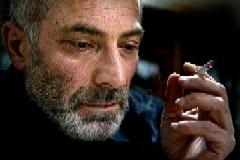
Yuri Kaloyev knew his brother was a broken man even
before he disappeared a week ago. Two years after his wife, son and
daughter, victims of a head-on plane collision over the Swiss-German
border, had been laid to rest amid the sombre rows of a cemetery in
their home town of Vladikavkaz, in southern Russia, his family's
ghosts still haunted his nights. "You could find my brother, even at
2am, at the cemetery crying on their gravestones," Yuri Kaloyev said.
"He suffered. He could not work. He locked himself away."
Yesterday, however, the desolate truth about his
brother began to emerge. Descriptions given by the Swiss police of a
man they have arrested for the savage stabbing to death on Tuesday of
the air traffic controller widely blamed for the plane crash closely
fit Mr Kaloyev.
He is 48. He lost his wife Svetlana, 10-year-old
son Konstantin and four-year-old daughter Diana in the disaster in
July 2002, when the Russian charter aircraft in which they were
travelling ploughed into a cargo plane in the night sky above Germany.
While the Russian foreign ministry have requested confirmation of the
arrested man's identity, the only other man who lost his entire family
in the crash, Vladimir Savchuck, has appeared on Russian TV, deploring
the killing.
Before arresting their suspect on Wednesday, Swiss
police admitted a relative of one of the victims of the crash might
have been responsible. Yesterday, however, as fresh details emerged,
it appeared that they were dealing with an unprecedented case - of
deliberate slow-burning revenge by a grief-crazed relative who had
nothing left to lose.
According to investigators, on Tuesday last week
Vitali Kaloyev phoned a Swiss travel company and asked the firm to
book him a hotel room close to Zurich airport. On Saturday Mr Kaloyev
arrived in Zurich, entirely legally, and checked into the Welcome-Inn
hotel in the suburb of Kloten.
Mr Kaloyev, however, chose it for another, darker
reason: the suburban hotel is a short taxi ride away from where Peter
Nielsen, the 36-year-old Danish air traffic controller widely blamed
for the catastrophic plane crash, lived with his wife and three
children.
According to hotel staff, in the two days before
the murder Mr Kaloyev did little to attract attention. "He was very
quiet," the hotel's manager, Simona Huonder, said yesterday. "We
hardly saw him during the time he stayed with us. He was on his own
the whole time, mostly up in his room." She added: "He didn't speak
very good English. My colleague who checked him in had to give him
information slowly."
At breakfast Mr Kaloyev ate alone, later flicking
through brochures offering city tours. "He seemed like any other
tourist," Ms Hounder said. On Tuesday afternoon, however, Mr Kaloyev
left his hotel room - No 316 - and set off for Peter Nielsen's house,
a half-hour's walk away. A female neighbour of Mr Nielsen spotted him.
She then asked him what he wanted. He waved a piece of paper with
Nielsen's name on it. The neighbour pointed to the air traffic
controller's front door, but instead of knocking on it, Mr Kaloyev sat
down in the front garden, near a bench.
Mr Nielsen, who had lived in Switzerland since
1995, had just returned home from a trip to Geneva. His wife had
picked him up from the airport. He spotted the intruder, went outside,
and asked him what he wanted. Swiss detectives say that the couple's
three children went into the garden as well; the controller's wife
then called them back, and was inside herself when she heard a "kind
of scream".
She rushed out to discover her husband lying in a
pool of blood. The victim and the killer who spoke "broken German" had
had a brief conversation; what they said, however, is unknown.
Mr Nielsen's wife watched her husband's assailant
run off; by the time the police arrived at 6.17pm it was too late. The
controller, who suffered multiple injuries, had bled to death.
Clues for detectives were numerous. They had
several good descriptions - of a burly, unshaven, dark-haired man in
his late 40s or early 50s who appeared to come from eastern Europe or
Russia. They had a murder weapon - a 22cm jackknife with a 14cm blade
that had been thrown away near the scene. And they had a name: the
chief suspect was a man who, police said, had "behaved strangely"
during the first anniversary of the crash last summer in the German
town of Überlingen. The man had allegedly threatened officials from
Skyguide - the firm for which Mr Nielsen worked - and described him as
"scum".
So far, however, the suspect has denied involvement
in the killing. Yesterday Mr Kaloyev's brother said that in the months
before the murder Vitali had slowly fallen apart, despite support from
his sisters, and the traditional, strong family ties of Caucasus
society. "His condition was terrible. Imagine what you feel when you
lose both your beloved children and wife," he said. "He disappeared a
week ago without telling anyone. And that is all I know."
It is a tragic end to Mr Kaloyev's seemingly
endless grief at the loss of his family. A native of Vladikavkaz, near
the border with Chechnya, he got a two-year contract to work as a
builder and architect on a project in Barcelona. Just as his contract
ended, in June 2002, he decided to prolong his stay in Spain, and
asked his family to fly out and join him for a month's holiday. He was
waiting for them at Barcelona airport when he learned of the crash.
Mr Kaloyev was one of the first relatives to arrive
at the scene, and discovered the body of his daughter, still intact,
almost two miles from where the accident happened. "Diana dreamed of
coming with her mother and brother to see me," he wrote on a website
commemorating the crash's 71 victims, most of whom were Russian
schoolchildren.
Remorse
Mr Nielsen was the only person on duty when the
disaster took place. He had wrongly instructed the Bashkirian airlines
plane to descend, even though its onboard warning equipment told it to
climb. The pilot followed the controller's instructions and ploughed
into a DHL cargo plane that was descending in accordance with its own
collision-avoiding equipment. Mr Nielsen expressed remorse at what had
happened, but in a statement issued after the tragedy pointed out that
he was not the only person responsible.
The apparent revenge killing, meanwhile, has
shocked all those involved in the still-unresolved fight to gain
justice for the crash victims. Yulia Fedotova, a lawyer representing
the families, who lost her own daughter Sofia, 15, in the crash said
she was "shocked" by the controller's murder. She added: "We still do
not have any official confirmation that the murderer was Kaloyev. Mr
Kaloyev's personal trauma, however, was clear to those around him."
Margarita, wife to his brother Yuri, told the
Izvestiya newspaper: "Vitali suffered everything alone. And after two
years, he was in such a state that I would not be surprised if he
would behave irrationally. Anyone can put himself in his place: in a
minute to lose all your family."
Mr Kaloyev's days in Vladikavkaz after the funeral
appear to have slipped by, marked by little more than visits to the
cemetery. According to Izvestiya, at the memorial service last year he
took the head of Skyguide, Alan Rossier, aside afterwards and asked
him "uncomfortable questions about who was to be blamed". Mr Kaloyev
agreed to come to the Skyguide office the following day, the newspaper
reported. According to the paper's sources, "Kaloyev asked several
times: do you think the air controller is to blame? He also asked to
meet him."
Yet his brother disputes the accounts. Yuri
Kaloyev, who travelled with him to Switzerland and Germany to collect
his family's bodies from the scene of the crash, reserves his own fury
for the air traffic control company Skyguide.
"All this talk and speculation in the newspapers
about his abnormal behaviour last year at the ceremony in Switzerland
is rubbish. He was fine. What is abnormal is the behaviour of Skyguide
who did not sack such an air controller and director as Alan Rossier."
The intensity of Mr Kaloyev's grief remains clear
in the internet eulogy he wrote for his son.
Of Konstantin, who learned to speak at 18 months,
read fairytales aged three, loved dinosaurs and at aged five played
computer games, he wrote: "He would have become a good, well-educated
person, useful to society, were it not for this tragedy, which I
cannot get over. I have no strength."