Murderpedia has thousands of hours of work behind it. To keep creating
new content, we kindly appreciate any donation you can give to help
the Murderpedia project stay alive. We have many
plans and enthusiasm
to keep expanding and making Murderpedia a better site, but we really
need your help for this. Thank you very much in advance.
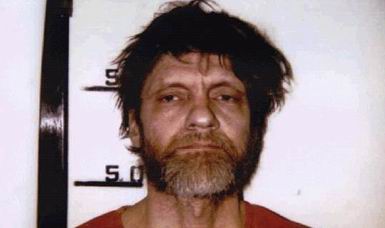
Theodore John KACZYNSKI
A.K.A.: "Unabomber"
Classification: Murderer
Characteristics: "Domestic terrorist" - Mail bombing spree that spanned nearly 20 years
Number of victims: 3
Date of murders: 1985 / 1994 / 1995
Date
of arrest:April 3,
1996
Date of birth:
May 22,1942
Victims profile: Hugh Scrutton, 38 (computer rental
store owner) / Thomas J. Mosser, 50 (advertising
executive) / Gilbert P. Murray (timber industry
lobbyist)
Method of murder: Explosives (homemade bombs)
Location: California/New Jersey, USA
Status:
Sentenced to four
life terms in prison
on May 5, 1998
Dr. Theodore John "Ted"
Kaczynski (born May 22, 1942), also
known as the Unabomber (University and Airline Bomber), is an
American mathematician and social critic, who engaged in a mail
bombing spree that spanned nearly 20 years, killing three people
and injuring 23 others.
He was born in Chicago, Illinois, where, as an
intellectual child prodigy, he excelled academically from an early
age. Kaczynski was accepted into Harvard University at the age of
16, where he earned an undergraduate degree, and later earned a
PhD in mathematics from the University of Michigan. He became an
assistant professor at the University of California, Berkeley at
age 25 but resigned two years later.
In 1971, he moved to a remote cabin without
electricity or running water, in Lincoln, Montana, where he lived
as a recluse while learning survival skills in an attempt to
become self-sufficient. He decided to start a bombing campaign
after watching the wilderness around his home being destroyed by
development.
From 1978 to 1995, Kaczynski
sent 16 bombs to targets including universities and airlines,
killing three people and injuring 23. Kaczynski sent a letter to
The New York Times on April 24, 1995 and promised "to desist from
terrorism" if the Times or The Washington Post published his
manifesto. In his Industrial Society and Its Future (also called
the "Unabomber Manifesto"), he argued that his bombings were
extreme but necessary to attract attention to the erosion of human
freedom necessitated by modern technologies requiring large-scale
organization.
The Unabomber was the target of one of the
Federal Bureau of Investigation's (FBI) most costly investigations.
Before Kaczynski's identity was known, the FBI used the handle "UNABOM"
("UNiversity and Airline BOMber") to refer to his case, which
resulted in the media calling him the Unabomber. Despite the FBI's
efforts, he was not caught as a result of this investigation.
Instead, his brother recognized Kaczynski's style of writing and
beliefs from the manifesto, and tipped off the FBI. Kaczynski's
lawyers were court appointed, but he eventually dismissed them
because they wanted to plead insanity in order to avoid the death
penalty, and Kaczynski did not believe he was insane. Once it was
sure that he would be defending himself on national television the
court entered a plea agreement, under which he pleaded guilty and
was sentenced to life in prison with no possibility of parole.
Theodore Kaczynski has been designated a "domestic terrorist" by
the FBI. Some anarchist authors, such as John Zerzan and John
Moore, have come to his defense, while holding some reservations
about his actions and ideas.
Early life
Kaczynski was born on May 22, 1942, in Chicago,
Illinois, to second-generation Polish Americans Wanda (née Dombek)
and Theodore Richard Kaczynski. At six-months of age, Ted's body
was covered in hives. He was placed in isolation in a hospital
where visitors were not allowed. Treatment continued for eight
months. His mother wrote in March 1943, "Baby home from hospital
and is healthy but quite unresponsive after his experience."
From grades one through four,
Kaczynski attended Sherman Elementary School in Chicago. He
attended grades five through eight at Evergreen Park Central
School. As a result of testing conducted in the fifth grade which
determined he had an IQ of 167, he was allowed to skip the sixth
grade and enroll in the seventh grade. Kaczynski described this as
a pivotal event in his life. He recalled not fitting in with the
older children and being subjected to their bullying. As a child,
Kaczynski had a fear of people and buildings, and played beside
other children rather than interacting with them. His mother was
so worried by his poor social development that she considered
entering him in a study for autistic children led by Bruno
Bettelheim.
He attended high school at Evergreen Park
Community High School. Kaczynski excelled academically, but found
the mathematics too simple during his sophomore year. During this
period of his life, Kaczynski became obsessed with mathematics,
spending prolonged hours locked in his room practicing
differential equations instead of socializing with his peers.
Throughout secondary schooling Kaczynski had far surpassed his
classmates, able to solve advanced Laplace Transforms before his
senior year. He was subsequently placed in a more advanced
mathematics class, yet still felt intellectually restricted.
Kaczynski soon mastered the material and skipped the eleventh
grade. With the help of a summer school course for English, he
completed his high school education when he was 15 years old. He
was encouraged to apply to Harvard University, and was
subsequently accepted as a student beginning in fall 1958 at the
age of 16. While at Harvard, Kaczynski was taught by famed
logician Willard Van Orman Quine, scoring at the top of Quine's
class with a 98.9% final grade.
He also participated in a
multiple-year personality study conducted by Dr. Henry Murray, an
expert on stress interviews. Students in Murray's Central
Intelligence Agency (CIA)-sponsored study were told they would be
debating personal philosophy with a fellow student. Instead they
were subjected to a "purposely brutalizing psychological
experiment" stress test, which was an extremely stressful,
personal, and prolonged psychological attack. During the test,
students were taken into a room, strapped into a chair and
connected to electrodes that monitored their physiological
reactions, while facing bright lights and a two-way mirror.
Each student had previously written an essay
detailing their personal beliefs and aspirations: the essays were
turned over to an anonymous attorney, who would enter the room and
individually belittle each strapped-down student based in part on
the disclosures they had made. This was filmed, and students'
expressions of impotent rage were played back to them several
times later in the study. According to author Alston Chase,
Kaczynski's records from that period suggest he was emotionally
stable when the study began.
Kaczynski's lawyers attributed some of his
emotional instability and dislike of mind control to his
participation in this study. Indeed, some have suggested that this
experience may have been instrumental in Kaczynski's future
actions.
Career
Kaczynski graduated from Harvard
University in 1962 and subsequently enrolled at the University of
Michigan, where he earned a PhD in mathematics. Kaczynski's
specialty was a branch of complex analysis known as geometric
function theory. His professors at Michigan were impressed with
his intellect and drive. "He was an unusual person. He was not
like the other graduate students," said Peter Duren, one of
Kaczynski's math professors at Michigan. "He was much more focused
about his work. He had a drive to discover mathematical truth." "It
is not enough to say he was smart," said George Piranian, another
of his Michigan math professors. In fact, Kaczynski earned his
Ph.D. with his thesis entitled "Boundary Functions" by solving a
problem so difficult that Piranian could not figure it out.
Maxwell Reade, a retired math professor who
served on Kaczynski's dissertation committee, also commented on
his thesis by noting, "I would guess that maybe 10 or 12 men in
the country understood or appreciated it."
In 1967, Kaczynski won the University of
Michigan's $100 Sumner B. Myers Prize, which recognized his
dissertation as the school's best in mathematics that year. While
a graduate student at Michigan, he held a National Science
Foundation fellowship and taught undergraduates for three years.
He also published two articles related to his dissertation in
mathematical journals, and four more after leaving Michigan later.
In the fall of 1967, Kaczynski became an
assistant professor of mathematics at the University of
California, Berkeley, where he taught undergraduate courses in
geometry and calculus. He was also noted as the youngest professor
ever hired by the university. This position proved short-lived,
however, as Kaczynski received numerous complaints and low ratings
from the undergraduates he taught. Many students noted that he
seemed quite uncomfortable in a teaching environment, often
stuttering and mumbling during lectures, becoming excessively
nervous in front of a class, and ignoring students during
designated office hours.
Without explanation, he resigned from his
position in 1969, at age 26. The chairman of the mathematics
department, J. W. Addison, called this a "sudden and unexpected"
resignation, while vice chairman Calvin Moore said that given
Kaczynski's "impressive" thesis and record of publications, "He
could have advanced up the ranks and been a senior member of the
faculty today."
Life in Montana
In summer 1971, Kaczynski moved
into his parents' small residence in Lombard, Illinois. Two years
later, he moved into a remote cabin he built himself just outside
Lincoln, Montana where he lived a simple life on very little money,
without electricity or running water. Kaczynski worked odd jobs
and received financial support from his family, which he used to
purchase his land and, without their knowledge, would later use to
fund his bombing campaign.
In 1978, he worked briefly with his father and
brother at a foam-rubber factory, where he was fired by his
brother, David, for harassing a female supervisor he had
previously dated.
Kaczynski's original goal was to move out to a
secluded place and become self-sufficient so that he could live
autonomously. He began to teach himself survival skills such as
tracking, edible plant identification, and how to construct
primitive technologies such as bow drills. However, he quickly
realized that it was not possible for him to live that way, as a
result of watching the wild land around him get destroyed by
development and industry.
He performed isolated acts of sabotage
initially, targeted at the developments near his cabin. The
ultimate catalyst which drove him to begin his campaign of
bombings was when he went out for a walk to one of his favorite
wild spots, only to find that it had been destroyed and replaced
with a road. About this, he said:
The best place, to me, was the largest
remnant of this plateau that dates from the tertiary age. It's
kind of rolling country, not flat, and when you get to the edge
of it you find these ravines that cut very steeply in to cliff-like
drop-offs and there was even a waterfall there. It was about a
two days hike from my cabin. That was the best spot until the
summer of 1983. That summer there were too many people around my
cabin so I decided I needed some peace. I went back to the
plateau and when I got there I found they had put a road right
through the middle of it" His voice trails off; he pauses, then
continues, "You just can't imagine how upset I was. It was from
that point on I decided that, rather than trying to acquire
further wilderness skills, I would work on getting back at the
system. Revenge."
—Ted Kaczynski,
He began dedicating himself to reading about
sociology and books on political philosophy, such as the works of
Jacques Ellul, and also stepped up his campaign of sabotage. He
soon came to the conclusion that more violent methods would be the
only solution to what he saw as the problem of industrial
civilization. He says that he lost faith in the idea of reform,
and saw violent collapse as the only way to bring down the techno-industrial
system. About the idea of a reformist means of taking it down, he
said:
I don't think it can be done. In part because
of the human tendency, for most people, there are exceptions, to
take the path of least resistance. They'll take the easy way
out, and giving up your car, your television set, your
electricity, is not the path of least resistance for most people.
As I see it, I don't think there is any controlled or planned
way in which we can dismantle the industrial system. I think
that the only way we will get rid of it is if it breaks down and
collapses ... The big problem is that people don't believe a
revolution is possible, and it is not possible precisely because
they do not believe it is possible. To a large extent I think
the eco-anarchist movement is accomplishing a great deal, but I
think they could do it better... The real revolutionaries should
separate themselves from the reformers… And I think that it
would be good if a conscious effort was being made to get as
many people as possible introduced to the wilderness. In a
general way, I think what has to be done is not to try and
convince or persuade the majority of people that we are right,
as much as try to increase tensions in society to the point
where things start to break down. To create a situation where
people get uncomfortable enough that they’re going to rebel. So
the question is how do you increase those tensions?
—Ted Kaczynski,
Bombings
Initial bombings
Kaczynski's activities came to
the attention of the FBI in 1978 with the explosion of his first,
primitive homemade bomb. Over the next 17 years, he mailed or hand
delivered a series of increasingly sophisticated explosive devices
that killed three people and injured 24 more.
The first mail bomb was sent in late May 1978
to materials engineering professor Buckley Crist at Northwestern
University. The package was found in a parking lot at the
University of Illinois at Chicago, with Crist's return address.
The package was "returned" to Crist. However, when Crist received
the package, he noticed that it was not addressed in his own
handwriting. Suspicious of a package he had not sent, he contacted
campus policeman Terry Marker, who opened the package, which
exploded immediately. Although Marker only received minimal
injuries, he required medical assistance at Evanston Hospital for
his left hand.
The bomb was made of metal that could have come
from a home workshop. The primary component was a piece of metal
pipe, about 1 inch (25 mm) in diameter and 9 inches (230 mm) long.
The bomb contained smokeless explosive powders, and the box and
the plugs that sealed the pipe ends were handcrafted from wood. In
comparison, most pipe bombs usually use threaded metal ends sold
in many hardware stores. Wooden ends lack the strength to allow
significant pressure to build within the pipe, explaining why the
bomb did not cause severe damage. The primitive trigger device
that the bomb employed was a nail, tensioned by rubber bands
designed to slam into six common match heads when the box was
opened. The match heads would immediately burst into flame and
ignite the explosive powders. However, when the trigger hit the
match heads, only three ignited. A more efficient technique, later
employed by Kaczynski, is to use batteries and heat filament wire
to ignite the explosives faster and more effectively.
The initial 1978 bombing was
followed by bombs sent to airline officials, and in 1979 a bomb
was placed in the cargo hold of American Airlines Flight 444, a
Boeing 727 flying from Chicago to Washington, D.C. The bomb began
smoking, forcing the pilot to make an emergency landing. Some
passengers were treated for smoke inhalation. Only a faulty timing
mechanism prevented the bomb from exploding. Authorities said it
had enough firepower to "obliterate the plane."
As bombing an airliner is a federal crime in
the United States, the FBI became involved after this incident and
derived the code name UNABOM (UNiversity and Airline BOMber). U.S.
Postal Inspectors, who initially had the case, called the suspect
the Junkyard Bomber because of the material used to make the mail
bombs.
In 1979, an FBI-led task force that included
the ATF and U.S. Postal Inspection Service was formed to
investigate the case. The task force would grow to more than 150
full-time investigators, analysts, and others. This team made
every possible forensic examination of recovered components of the
explosives and studied the lives of victims in minute detail.
These efforts proved of little use in identifying the suspect, who
built his bombs essentially from "scrap" materials available
almost anywhere. The victims, investigators later learned, were
chosen irregularly from library research.
In 1980, chief agent John Douglas, working with
agents in the FBI's Behavioral Sciences Unit, issued a
psychological profile of the unidentified bomber which described
the offender as a man with above-average intelligence with
connections to academia. This profile was later refined to
characterize the offender as a neo-Luddite holding an academic
degree in the hard sciences, but this psychologically based
profile was discarded in 1983 in favor of an alternative theory
developed by FBI analysts concentrating on the physical evidence
in recovered bomb fragments. In this rival profile, the bomber
suspect was characterized as a blue-collar airplane mechanic. A
1-800 hot line was set up by the UNABOM Task Force to take any
calls related to the Unabomber investigation, with a $1 million
reward for anyone who could provide information leading to the
Unabomber's capture.
Casualties
The first serious injury
occurred in 1985, when John Hauser, a graduate student and Captain
in the United States Air Force, lost four fingers and vision in
one eye. The bomb, like others of Kaczynski's, was handcrafted and
made with wooden parts.
Hugh Scrutton, a 38-year-old California
computer store owner, was killed in 1985 by a nail-and-splinter-loaded
bomb placed in the parking lot of his store. A similar attack
against a computer store occurred in Salt Lake City, Utah on
February 20, 1987. The bomb, which was disguised as a piece of
lumber, injured Gary Wright when he attempted to remove it from
the store's parking lot. The explosion severed nerves in Wright's
left arm and propelled more than 200 pieces of shrapnel into his
body.
Kaczynski's brother, David—who would play a
vital role in Ted's looming capture by alerting federal
authorities to the prospect of his brother being involved in the
Unabomber cases— sought out and became friends with Wright after
Ted was detained in 1996. David Kaczynski and Wright have remained
friends and occasionally speak together publicly about their
reconciliation.
After a six-year hiatus, Kaczynski struck again
in 1993, mailing a bomb to David Gelernter, a computer science
professor at Yale University. Though critically injured, Gelernter
eventually recovered. Another bomb mailed in the same weekend was
sent to the home of geneticist Charles Epstein from University of
California, San Francisco, who lost multiple fingers upon opening
it. Kaczynski then called Gelernter's brother, Joel Gelernter, a
behavioral geneticist, and told him, "You are next." Geneticist
Phillip Sharp at Massachusetts Institute of Technology also
received a threatening letter two years later.
Kaczynski wrote a letter to The
New York Times claiming that his "group", called FC, was
responsible for the attacks.
In 1994, Burson-Marsteller executive Thomas J.
Mosser was killed by a mail bomb sent to his North Caldwell, New
Jersey home. In another letter to The New York Times Kaczynski
claimed that FC "blew up Thomas Mosser because [...] Burston-Marsteller
[sic] helped Exxon clean up its public image after the Exxon
Valdez incident" and, more importantly, because "its business is
the development of techniques for manipulating people's attitudes."
This was followed by the 1995 murder of Gilbert Murray, president
of the timber industry lobbying group California Forestry
Association, by a mail bomb actually addressed to previous
president William Dennison, who had retired.
In all, 16 bombs—which injured 23 people and
killed three—were attributed to Kaczynski. While the devices
varied widely through the years, all but the first few contained
the initials "FC". Inside his bombs, certain parts carried the
inscription "FC", which Kaczynski later asserted stood for "Freedom
Club". Latent fingerprints on some of the devices did not match
the fingerprints found on letters attributed to Kaczynski. As
stated in the FBI affidavit:
203. Latent fingerprints attributable to
devices mailed and/or placed by the UNABOM subject were compared
to those found on the letters attributed to Theodore Kaczynski.
According to the FBI Laboratory no forensic correlation exists
between those samples.
One of Kaczynski's tactics was leaving false
clues in every bomb. He would make them hard to find so as to
purposely mislead investigators into thinking they had a clue. The
first clue was a metal plate stamped with the initials "FC" hidden
somewhere (usually in the pipe end cap) in every bomb. One false
clue he left was a note in a bomb that did not detonate which
reads "Wu—It works! I told you it would—RV". A more obvious clue
was the Eugene O'Neill $1 stamps used to send his boxes. One of
his bombs was sent embedded in a copy of Sloan Wilson’s novel Ice
Brothers.
The FBI theorized that Kaczynski had a theme of
nature, trees and wood in his crimes. He often included bits of
tree branch and bark in his bombs. Targets selected included Percy
Wood, Professor Leroy Wood Bearson and Thomas Mosser. Crime writer
Robert Graysmith noted "In the Unabomber's case a large factor was
his obsession with wood."
List of bombings
Date
Location
Victim(s)
Injuries
March 25-26, 1978
Northwestern
University, Evanston, Illinois
campus police
officer Terry Marker
minor
May 9, 1979
Northwestern
University
graduate student
John Harris
slight
November 15, 1979
Chicago, Illinois
12 American
Airlines passengers
smoke inhalation
June 10, 1980
Chicago, Illinois
United Airlines
President Percy Wood
cuts and burns
October 8, 1981
University of
Utah, Salt Lake City, Utah
none - bomb
defused
May 5, 1982
Vanderbilt
University, Nashville, Tennessee
university
secretary Janet Smith
minor
July 2, 1982
University of
California, Berkeley, California
Professor
Diogenes Angelakos
right hand and
face; near-complete recovery
May 15, 1985
University of
California, Berkeley
graduate student
John Hauser
partial loss of
vision in left eye, loss of four fingers on
right hand
June 13, 1985
Auburn,
Washington
none - bomb
defused
November 15, 1985
Ann Arbor,
Michigan
two injured
n/a
December 11, 1985
Sacramento,
California
computer rental
store owner Hugh Scrutton
first fatality
February 20, 1987
Salt Lake City,
Utah
computer store
owner
injured
June 22, 1993
Tiburon,
California
University of
California geneticist Charles Epstein
severe injuries
June 24, 1993
Yale University,
New Haven, Connecticut
computer science
Professor David Gelernter
right hand and
right eye
December 10, 1994
North Caldwell,
New Jersey
advertising
executive Thomas J. Mosser
second death
April 24, 1995
Sacramento,
California
timber industry
lobbyist Gilbert P. Murray
third and final
murder
Manifesto
In 1995 Kaczynski mailed several letters, including
some to his former victims and others to major media outlets,
outlining his goals and demanding that his 50-plus page, 35,000-word
essay Industrial Society and Its Future (also called the "Unabomber
Manifesto") be printed verbatim by a major newspaper or journal.
He stated that if this demand was met, he would
then end his bombing campaign. The document was a densely written
manifesto that called for a worldwide revolution against the
effects of modern society's "industrial-technological system."
There was a great deal of controversy as to whether the document
should be published. A further letter threatening to kill more
people was sent, and the United States Department of Justice,
along with FBI Director Louis Freeh and Attorney General Janet
Reno, recommended publication out of concern for public safety and
in hopes that a reader could identify the author. The pamphlet was
then published by The New York Times and The Washington Post on
September 19, 1995.
Prior to The New York Times' decision to
publish the manifesto, Bob Guccione of Penthouse volunteered to
publish it, but Kaczynski replied that, since Penthouse was less "respectable"
than the other publications, he would in that case "reserve the
right to plant one (and only one) bomb intended to kill, after our
manuscript has been published."
Throughout the manuscript, produced on a
typewriter without the capacity for italics, Kaczynski capitalizes
entire words in order to show emphasis. He always refers to
himself as either "we" or "FC" (Freedom Club), though he appears
to have acted alone.[citation needed] Donald Foster, who analyzed
the writing at the request of Kaczynski's defense, notes that the
manuscript contains instances of irregular spelling and
hyphenation, as well as other consistent linguistic idiosyncrasies
(which led him to conclude that it was indeed Kaczynski who wrote
it).
Industrial Society and Its
Future begins with Kaczynski's assertion that "the Industrial
Revolution and its consequences have been a disaster for the human
race." The first sections of the text are devoted to psychological
analysis of various groups—primarily leftists and scientists—and
of the psychological consequences for individual life within the
"industrial-technological system", which has robbed contemporary
humans of their autonomy, diminished their rapport with nature,
and forced them "to behave in ways that are increasingly remote
from the natural pattern of human behavior." The later sections
speculate about the future evolution of this system, argue that it
will inevitably lead to the end of human freedom, call for a "revolution
against technology", and attempt to indicate how that might be
accomplished.
Psychological analysis
In his opening and closing sections, Kaczynski
addresses Leftism as a movement and analyzes the psychology of
leftists, arguing that they are "True Believers in Eric Hoffer's
sense" who participate in a powerful social movement to compensate
for their lack of personal power. He further claims that leftism
as a movement is led by a particular minority of leftists whom he
calls "oversocialized":
The moral code of our society is so demanding
that no one can think, feel and act in a completely moral way.
[...] Some people are so highly socialized that the attempt to
think, feel and act morally imposes a severe burden on them. In
order to avoid feelings of guilt, they continually have to
deceive themselves about their own motives and find moral
explanations for feelings and actions that in reality have a
non-moral origin. We use the term "oversocialized" to describe
such people.
He goes on to explain how the nature of leftism
is determined by the psychological consequences of "oversocialization."
Kaczynski "attribute[s] the social and psychological problems of
modern society to the fact that society requires people to live
under conditions radically different from those under which the
human race evolved and to behave in ways that conflict with the
patterns of behavior that the human race developed while living
under the earlier conditions." He further specifies the primary
cause of a long list of social and psychological problems in
modern society as the disruption of the "power process", which he
defines as having four elements:
The three most clear-cut of
these we call goal, effort and attainment of goal. (Everyone
needs to have goals whose attainment requires effort, and needs
to succeed in attaining at least some of his goals.) The fourth
element is more difficult to define and may not be necessary for
everyone. We call it autonomy and will discuss it later. [...]
We divide human drives into three groups: (1) those drives that
can be satisfied with minimal effort; (2) those that can be
satisfied but only at the cost of serious effort; (3) those that
cannot be adequately satisfied no matter how much effort one
makes. The power process is the process of satisfying the drives
of the second group.
Kaczynski goes on to claim that "[i]n modern
industrial society natural human drives tend to be pushed into the
first and third groups, and the second group tends to consist
increasingly of artificially created drives." Among these drives
are "surrogate activities", activities "directed toward an
artificial goal that people set up for themselves merely in order
to have some goal to work toward, or let us say, merely for the
sake of the 'fulfillment' that they get from pursuing the goal".
He argues that these surrogate activities are not as satisfactory
as the attainment of "real goals" for "many, if not most people".
He claims that scientific research is a
surrogate activity for scientists, and that for this reason "science
marches on blindly, without regard to the real welfare of the
human race or to any other standard, obedient only to the
psychological needs of the scientists and of the government
officials and corporation executives who provide the funds for
research."
Analysis of control
methods
As mentioned above, the result
of the "disruption of the power process" is the primary cause of
various maladies in society (e.g. crime, depression, etc.).
Kaczynski maintains that rather than recognizing that humans
currently live in "conditions that make them terribly unhappy", "the
system" (i.e. industrial society) develops ways of controlling
human responses to the overly stressful environment they find
themselves in.
The following are current examples (according
to Kaczynski) of this trend:
Imagine a society that subjects people to
conditions that make them terribly unhappy, then gives them the
drugs to take away their unhappiness. Science fiction? It is
already happening to some extent in our own society. It is well
known that the rate of clinical depression had been greatly
increasing in recent decades. We believe that this is due to
disruption of the power process...
The entertainment industry serves as an
important psychological tool of the system, possibly even when
it is dishing out large amounts of sex and violence.
Entertainment provides modern man with an essential means of
escape. While absorbed in television, videos, etc., he can
forget stress, anxiety, frustration, dissatisfaction.
Sylvan Learning Centers, for example, have
had great success in motivating children to study, and
psychological techniques are also used with more or less success
in many conventional schools. "Parenting" techniques that are
taught to parents are designed to make children accept
fundamental values of the system and behave in ways that the
system finds desirable.
Historical analysis
In the last sections of the
manifesto, Kaczynski carefully defines what he means by freedom
and provides an argument that it would "be hopelessly difficult
[...] to reform the industrial system in such a way as to prevent
it from progressively narrowing our sphere of freedom".
He says that "in spite of all its technical
advances relating to human behavior the system to date has not
been impressively successful in controlling human beings" and
predicts that "[i]f the system succeeds in acquiring sufficient
control over human behavior quickly enough, it will probably
survive. Otherwise it will break down" and that "the issue will
most likely be resolved within the next several decades, say 40 to
100 years." He gives various dystopian possibilities for the type
of society which would evolve in the former case. He claims that
revolution, unlike reform, is possible, and calls on sympathetic
readers to initiate such revolution using two strategies: to "heighten
the social stresses within the system so as to increase the
likelihood that it will break down" and to "develop and propagate
an ideology that opposes technology". He gives various tactical
recommendations, including avoiding the assumption of political
power, avoiding all collaboration with leftists, and supporting
free trade agreements in order to bind the world economy into a
more fragile, unified whole.
He concludes by noting that his manifesto has "portrayed
leftism in its modern form as a phenomenon peculiar to our time
and as a symptom of the disruption of the power process" but that
he is "not in a position to assert confidently that no such
movements have existed prior to modern leftism" and says that "[t]his
is a significant question to which historians ought to give their
attention."
Related works
As a critique of technological
society, the manifesto echoed contemporary critics of technology
and industrialization, such as John Zerzan, Herbert Marcuse, Fredy
Perlman, Jacques Ellul (whose book The Technological Society was
referenced in an unnamed Kaczynski essay, written in 1971), Lewis
Mumford, and Neil Postman. Its idea of the "disruption of the
power process" similarly echoed social critics emphasizing the
lack of meaningful work as a primary cause of social problems,
including Mumford, Paul Goodman, and Eric Hoffer (whom Kaczynski
explicitly references). The general theme was also addressed by
Aldous Huxley in his dystopian novel Brave New World, which
Kaczynski references. The ideas of "oversocialization" and "surrogate
activities" recall Freud's Civilization and Its Discontents and
his theories of rationalization and sublimation (the latter term
being used three times in the manifesto, twice in quotes, to
describe surrogate activities).
In a Wired article on the dangers of technology,
titled "Why The Future Doesn't Need Us," Bill Joy, cofounder of
Sun Microsystems, quoted Ray Kurzweil's The Age of Spiritual
Machines, which quoted a passage by Kaczynski on types of society
that might develop if human labor were entirely replaced by
artificial intelligence. Joy wrote that, although Kaczynski's
actions were "murderous, and, in my view, criminally insane", that
"as difficult as it is for me to acknowledge, I saw some merit in
the reasoning in this single passage. I felt compelled to confront
it."
Search
Before the publication of the
manifesto, Theodore Kaczynski's brother, David Kaczynski, was
encouraged by his wife Linda to follow up on suspicions that Ted
was the Unabomber. David Kaczynski was at first dismissive, but
progressively began to take the likelihood more seriously after
reading the manifesto a week after it was published in September
1995. David Kaczynski browsed through old family papers and found
letters dating back to the 1970s written by Ted and sent to
newspapers protesting the abuses of technology and which contained
phrasing similar to what was found in the Unabomber Manifesto.
Prior to the publishing of the manifesto, the
FBI held numerous press conferences enlisting the help of the
public in identifying the Unabomber. They were convinced that the
bomber was from the Chicago area (where he began his bombings),
had worked or had some connection in Salt Lake City, and by the
1990s was associated with the San Francisco Bay Area. This
geographical information, as well as the wording in excerpts from
the manifesto that were released prior to the entire manifesto
being published, was what had persuaded David Kaczynski's wife,
Linda, to urge her husband to read the manifesto.
After the manifesto was published, the FBI
received over a thousand calls a day for months in response to the
offer of a $1 million reward for information leading to the
identity of the Unabomber. There were also large numbers of
letters mailed to the UNABOM Task Force that purported to be from
the Unabomber, and thousands of suspect leads were sifted through.
While the FBI was occupied with new leads, David Kaczynski first
hired private investigator Susan Swanson in Chicago to investigate
Ted's activities discreetly. The Kaczynski brothers had become
estranged in 1990, and David had not seen Ted for ten years. David
later hired Washington, D.C. attorney Tony Bisceglie to organize
evidence acquired by Swanson and make contact with the FBI, given
the likely difficulty in attracting the FBI's attention. He wanted
to protect his brother from the danger of an FBI raid, like Ruby
Ridge or the Waco Siege, since he knew Ted would not take kindly
to being contacted by the FBI and would likely react irrationally
or violently.
In early 1996, former FBI hostage negotiator
and criminal profiler Clinton R. Van Zandt was contacted by an
investigator working with Tony Bisceglie. Bisceglie asked Van
Zandt to compare the manifesto to typewritten copies of
handwritten letters David had received from his brother. Van
Zandt's initial analysis determined that there was better than a
60 percent chance that the same person had written the letters as
well as the manifesto, which had been in public circulation for
half a year. Van Zandt's second analytical team determined an even
higher likelihood that the letters and the manifesto were the
product of the same author. He recommended that Bisceglie's client
immediately contact the FBI.
In February 1996, Bisceglie provided a copy of
the 1971 essay written by Ted Kaczynski to the FBI. At the UNABOM
Task Force headquarters in San Francisco, Supervisory Special
Agent Joel Moss immediately recognized similarities in the
writings. Linguistic analysis determined that the author of the
essay papers and the manifesto were almost certainly the same.
When combined with facts gleaned from the bombings and Kaczynski’s
life, that analysis provided the basis for a search warrant.
David Kaczynski had attempted to remain
anonymous at the outset but he was swiftly identified, and within
a few days, an FBI agent team was dispatched to interview David
and his wife with their attorney in Washington, D.C. At this and
subsequent meetings with the team, David provided letters written
by his brother in their original envelopes, so the use of postmark
dates enabled the enhancement of the timeline of Ted Kaczynski's
activities being developed by the Task Force. David developed a
respectful relationship with the primary Task Force behavioral
analyst, Special Agent Kathleen M. Puckett, with whom he met many
times in Washington, D.C., Texas, Chicago, and Schenectady, New
York, over the nearly two months before the federal search warrant
was served on Theodore Kaczynski's cabin.
Arrest
Agents arrested Theodore Kaczynski on April 3,
1996 at his remote cabin outside Lincoln, Montana, where he was
found in an unkempt state. Combing his cabin, the investigators
found a wealth of bomb components, 40,000 handwritten journal
pages that included bomb-making experiments and descriptions of
the Unabomber crimes; and one live bomb, ready for mailing. They
also found what appeared to be the original typed manuscript of
the manifesto. By this point, the Unabomber had been the target of
one of the most expensive investigations in the FBI's history.
Paragraphs 204 and 205 of the FBI search and
arrest warrant for Kaczynski stated that "experts"—many of them
academics consulted by the FBI—believed the manifesto had been
written by "another individual, not Theodore Kaczynski". As stated
in the affidavit, only a handful of people believed Theodore
Kaczynski was the Unabomber before the search warrant revealed the
cornucopia of evidence in Kaczynski's isolated cabin. The search
warrant affidavit written by FBI Inspector Terry D. Turchie
reflects this conflict, and is striking evidence of the opposition
to Turchie and his small cadre of FBI agents that included Moss
and Puckett—who were convinced Theodore Kaczynski was the
Unabomber—from the rest of the UNABOM Task Force and the FBI in
general:
204. Your affiant is aware that other
individuals have conducted analyses of the UNABOM Manuscript __
determined that the Manuscript was written by another
individual, not Kaczynski, who had also been a suspect in the
investigation.
205. Numerous other opinions from experts
have been provided as to the identity of the unabomb subject.
None of those opinions named Theodore Kaczynski as a possible
author.
David Kaczynski had once admired and emulated
his elder brother, but had later decided to leave the survivalist
lifestyle behind. He had received assurances from the FBI that he
would remain anonymous and that his brother would not learn who
had turned him in, but his identity was leaked to CBS News in
early April 1996. CBS anchorman Dan Rather called FBI director
Louis Freeh, who requested 24 hours before CBS broke the story on
the evening news. The FBI scrambled to finish the search warrant
and have it issued by a federal judge in Montana; afterwards, an
internal leak investigation was conducted by the FBI, but the
source of the leak was never identified. David donated the reward
money, less his expenses, to families of his brother's victims.
After his arrest, Kaczynski was
briefly among the several individuals who have been considered
suspects of being the unidentified Zodiac Killer. However, he
lived in Illinois during most of the killings, and was eliminated
as a suspect.
Among the links that raise suspicion were the
fact that Kaczynski lived in the Bay Area from 1967 to 1969, the
same period that most of the Zodiac's confirmed killings occurred
in California, and both being highly intelligent with an interest
in bombs and codes. Robert Graysmith of San Francisco, author of
the book Zodiac in 1986, said the similarities are "fascinating"
but undoubtedly purely coincidental.
In 1996, a docudrama was produced titled "Unabomber:
The True Story", featuring actors Dean Stockwell as Ben Jeffries,
Robert Hays as David Kaczynski and Tobin Bell as Theodore
Kaczynski. In this film a determined postal inspector was followed
as he tracked down the suspect and also centered on Kaczynski's
brother, who played a key role in the investigation.
Court proceedings
Kaczynski's lawyers, headed by Montana federal
defender Michael Donahoe, attempted to enter an insanity defense
to save Kaczynski's life, but Kaczynski rejected this plea. A
court-appointed psychiatrist diagnosed Kaczynski as suffering from
paranoid schizophrenia, but declared him competent to stand trial.
Kaczynski's family said he would psychologically "shut down" when
pressured. In the book, Technological Slavery, Kaczynski recalls
two prison psychologists, Dr. James Watterson and Dr. Michael
Morrison, who visited him almost every day for a period of four
years, who told him that they saw no indication that he suffered
from any such serious mental illness, and that the diagnosis of
his being paranoid schizophrenic was "ridiculous" and a "political
diagnosis". Dr. Morrison made remarks to him about psychologists
and psychiatrists providing any desired diagnosis if they are well
paid for doing so.
A federal grand jury indicted
Kaczynski in April 1996, on 10 counts of illegally transporting,
mailing, and using bombs. He was also charged with killing
Scrutton, Mosser, and Murray. On January 7, 1998, Kaczynski
attempted to hang himself. Initially, the government prosecution
team indicated that it would seek the death penalty for Kaczynski
after it was authorized by United States Attorney General Janet
Reno. David Kaczynski's attorney asked the former FBI agent who
made the match between the Unabomber's manifesto and Kaczynski to
ask for leniency—he was horrified to think that turning his
brother in might result in his brother's death. Eventually,
Kaczynski was able to avoid the death penalty by pleading guilty
to all the government's charges, on January 22, 1998. Later,
Kaczynski attempted to withdraw his guilty plea, arguing it was
involuntary. Judge Garland Ellis Burrell Jr. denied his request.
The United States Court of Appeals for the Ninth Circuit upheld
that decision.
The early hunt for the Unabomber in the United
States portrayed a perpetrator far different from the eventual
suspect. The Unabomber Manifesto consistently uses "we" and "our"
throughout, and at one point in 1993 investigators sought an
individual whose first name was "Nathan", due to a fragment of a
note found in one of the bombs. However, when the case was finally
presented to the public, authorities denied that there was ever
anyone other than Kaczynski involved in the crimes. Explanations
were later presented as to why Kaczynski targeted some of the
victims he selected.
On August 10, 2006, Judge Garland Burrell Jr.
ordered that personal items seized in 1996 from Kaczynski's
Montana cabin should be sold at a "reasonably advertised Internet
auction." Items the government considers to be bomb-making
materials, such as writings that contain diagrams and "recipes"
for bombs, are excluded from the sale. The auctioneer will pay the
cost and will keep up to 10% of the sale price, and the rest of
the proceeds must be applied to the $15 million in restitution
that Burrell ordered Kaczynski to pay his victims.
Included among Kaczynski's holdings to be
auctioned are his original writings, journals, correspondences,
and other documents allegedly found in his cabin. The judge
ordered that all references in those documents that allude to any
of his victims must be removed before they are sold. Kaczynski has
challenged those ordered redactions in court on first amendment
grounds, arguing that any alteration of his writings is an
unconstitutional violation of his freedom of speech.
Life in prison
Kaczynski is serving a life
sentence without the possibility of parole as Federal Bureau of
Prisons register number 04475–046 in ADX Florence, the federal
Administrative Maximum Facility supermax near Florence, Colorado.
When asked if he was afraid of losing his mind in prison,
Kaczynski replied:
No, what worries me is that I might in a sense
adapt to this environment and come to be comfortable here and not
resent it anymore. And I am afraid that as the years go by that I
may forget, I may begin to lose my memories of the mountains and
the woods and that's what really worries me, that I might lose
those memories, and lose that sense of contact with wild nature in
general. But I am not afraid they are going to break my spirit.
—Ted Kaczynski,
Kaczynski has been an active writer in prison.
The Labadie Collection, part of the University of Michigan's
Special Collections Library, houses Kaczynski's correspondence
from over 400 people since his arrest in April 1996, including
carbon copy replies, legal documents, publications, and clippings.
The names of most correspondents will be kept sealed until 2049.
Kaczynski has also been battling in federal court in northern
California over the auction of his journals and other
correspondence.
On January 10, 2009, however, the United States
Court of Appeals for the Ninth Circuit in San Francisco,
California rejected Kaczynski's arguments that the government's
sale of his writings violates his freedom of expression. His
writings, books, and other possessions will be sold online, and
the money raised will be sent to several of his
victims.
Kaczynski's cabin was removed and stored in a
warehouse in an undisclosed location. It was to be destroyed, but
was eventually given to Scharlette Holdman, an investigator on
Kaczynski's defense team. It is on display at the Newseum in
Washington, D.C. as of July 2008. In a three-page handwritten
letter to the United States Court of Appeals for the Ninth Circuit,
Kaczynski objected to the public exhibition of the cabin, claiming
it violated the victim's objection to be publicly connected with
the UNABOM case.
In a letter dated October 7, 2005, Kaczynski
offered to donate two rare books to the Melville J. Herskovits
Library of African Studies at Northwestern University's campus in
Evanston, Illinois, the location of the first two attacks. The
recipient, David Easterbrook, turned the letter over to the
university's archives. Northwestern rejected the offer, noting
that the library already owned the volumes in English and did not
desire duplicates.
David Kaczynski, Theodore's
brother and the person who turned him in to the FBI, has never
received a response to the monthly letters he sends to Theodore in
prison, as of 2007.
Kaczynski has continued to write while in
prison. In 2010, a collection of his essays and a corrected
version of the Manifesto were published by Feral House, under the
title Technological Slavery.
Popular
culture
Before the events of September 11,
Ted Kaczynski stood as an unprecedented figure of
terrorism in the United States. He has been portrayed
with tones that vary from serious to satirical.
Film
In the film Good Will Hunting,
Sean Maguire (played by Robin Williams) has met
Professor Gerard Lambeau (Stellan Skarsgard) in a
bar, wherin they begin an argument about the
academic future of Will Hunting (Matt Damon).
Lambeau illustrates the insufficiency of his own
mathematical prowess compared to Hunting's by first
asking Jimmy the bartender if he's heard of Jonas
Salk, then Albert Einstein, the implication being
that Hunting's genius may in fact match theirs. When
Jimmy answers yes to both inquiries, Lambeau asks, "Have
you heard of Gerard Lambeau?", to which Jimmy
answers no. The argument then becomes heated when
Lambeau insists on pushing Hunting towards a career
in mathematics despite the ambivalence Hunting has
expressed to Maguire. Maguire then asks Lambeau if
he's heard of Ted Kaczynski. When the professor
answers no, Maguire yells across the room to Jimmy,
"Jimmy, who's Ted Kaczynski?" Without missing a beat
Jimmy answers, "The unabomber!"
In the 2007 film Shoot 'Em Up,
the protagonist Mr. Smith (Clive Owen) states that
the reason he can never go to the police for
assistance is that he is the Unabomber. When his
sidekick Donna (Monica Bellucci) argues that "they
caught the Unabomber," Mr. Smith replies with "That's
what they think."
Das Netz, a German film
that explores the actions of the Unabomber in
relation to art, technology, and LSD. The Film
states that Kaczynski was used in the CIA Project
MKULTRA and given large doses of LSD.
In the film Let's go to Prison,
John Lyshitski (Dax Shepard) refers to the Unabomber
when he is speaking about when Nelson Biederman IV (Will
Arnett) will be paroled.
Television
In Season 21, Episode 17 of
Saturday Night Live, a skit is performed in
which Ted Kaczynski (Will Ferrell) is allowed to
attend his class reunion escorted by two FBI agents.
His classmate seem unaware of the fact that he is
the Unibomber.
In Season 1, Episode 1 of The
Upright Citizen's Brigade, Ted Kaczynski (Matt
Besser) develops a meaningful friendship with a Girl
Scout and learns many valuable life lessons.
Joe from NewsRadio on
several occations makes mention of the unabomber and
on a few occasions claims to be the unabomber.
In an episode of Law & Order:
Special Victims Unit, Don Kragen (Dann Florek)
comments how a sketch description of an alleged
rapist looks like "The Unabomber". Later in the
episode a woman in a nail salon makes a similar
comment ("Isn't that the Unabomber?").
Music
In 2005, Camper Van Beethoven
released New Roman Times, a concept album
about a man from Texas who becomes a terrorist.
Track 7, titled "Militia Song" is inspired by Ted
Kaczynski in the refrain, "Studied mathematics in
Berkeley/Now I don't like society./Got me a little
shack in the woods,/gonna mail you out some
explosive goods".
Bibliography
Works written by the
Unabomber
Industrial Society and its Future: The
Unabomber Manifesto (ISBN 1-59986-990-X)
Works written by
Kaczynski
Kaczynski, T. J. (1967). Boundary
Functions [doctoral dissertation]. Ann Arbor:
University of Michigan.
Kaczynski, T. J. (1964). "Another proof of
Wedderburn's theorem". American Mathematical
Monthly71: 652 – 653.
Kaczynski, T. J. (1964). "Advanced problem 5210".
American Mathematical Monthly71: 689.
Kaczynski, T. J. (1965). "Boundary functions for
functions defined in a disk". Journal of
Mathematics and Mechanics14 (4): 589 –
612. doi:10.1512/iumj.1965.14.14039. MR0176080.
Kaczynski, T. J. (1965). "Distributivity and (-1)x =
-x (solution to advanced problem 5210)". American
Mathematical Monthly72: 677 – 678.
Kaczynski, T. J. (1966). "On a boundary property of
continuous functions". Michigan Mathematical
Journal13: 313 – 320. MR0210900.
Kaczynski, T. J. (1968). "Note on a problem of Alan
Sutcliffe". Mathematics Magazine41:
84 – 86. MR0228409.
Kaczynski, T. J. (1969). "The set of curvilinear
convergence of a continuous function defined in the
interior of a cube". Proceedings of the American
Mathematical Society23: 323 – 327.
Kaczynski, T. J. (1969). "Boundary functions for
bounded harmonic functions". Transactions of the
American Mathematical Society137: 203 –
209. MR0236393.
Kaczynski, T. J. (1969). "Boundary functions and
sets of curvilinear convergence for continuous
functions". Transactions of the American
Mathematical Society141: 107 – 125.
MR0243078.
Kaczynski, T. J. (1971). "Problem 787".
Mathematics Magazine44 (1): 41. A
match stick problem (solution to problem 787),
Mathematics Magazine44 (5): 286 – 299.
This article was subsequently plagiarized by Dănuţ
Marcu in Geombinatorics.
Works about Kaczynski
and the Unabomber
Terry D. Turchie and Kathleen M.
Puckett, Ph.D., "Hunting the American Terrorist: The
FBI's War on Homegrown Terror," 2007, ISBN
978-1933909349
Ron Arnold, Ecoterror: The
Violent Agenda to Save Nature: The World of the
Unabomber, 1997, ISBN 0-939571-18-8
Alston Chase, Harvard and the
Unabomber: The Education of an American Terrorist,
extended from the Atlantic article, about the
Murray psychological experiment, ISBN 0-393-02002-9
Alston Chase, A Mind for
Murder: The Education of the Unabomber and the
Origins of Modern Terrorism, 2004, ISBN
0-393-32556-3
Douglas and Olshaker,
Unabomber: On the Trail of America's Most-Wanted
Serial Killer, 1996, Pocket Books, ISBN
0-671-00411-5
Don Foster, Author Unknown:
Tales of a Literary Detective, pg. 95-142, 2000,
Henry Holt & Co., ISBN 978-0805063578
James A. Fox, et al.,
Technophobe - The Unabomber Years: The Ultimate
Sourcebook of Facts,...., 1997, Dove Books, ISBN
0-7871-1159-7
David Gelernter, Drawing Life:
Surviving the Unabomber, 1997, ISBN
0-684-83912-1
Robert Graysmith, Unabomber:
Desire to Kill, 1997, ISBN 0-89526-397-1
Steven D. Levitt, Steven J.
Dubner, Freakonomics, 2005, pp. 141-142, 191,
ISBN 978-0-141-03008-1
Michael Mello, The United
States of America versus Theodore John Kaczynski:
Ethics, Power and the Invention of the Unabomber,
1999, ISBN 1-893956-01-6
Jay Nash, Terrorism in the
20th Century: A Narrative Encyclopedia from the
Anarchists, Through the Weathermen, to the Unabomber,
1998, ISBN 0-87131-855-5
Jill Smolowe, et al., Mad
Genius: Odyssey, Pursuit & Capture of the Unabomber
Suspect, 1996, ISBN 0-446-60459-3
Chris Waits, Dave Shors,
Unabomber: The Secret Life of Ted Kaczynski,
1999, ISBN 1-56037-131-5
American white power band Mudoven
recorded a tribute song "Unabomber" in their
Aryan vs. Alien 7" EP (Tri-State Terror, 1997).
Wikipedia.org
Why Did
the Unabomber Kill?
November 15, 2005
Twenty-six years ago today, a package bomb exploded
in the cargo hold of American Airlines flight 444 from Chicago to
Washington. The plane made an emergency landing, and no one was killed,
but the event was deeply alarming nonetheless. Iranians had descended
upon the American embassy in Tehran just 11 days earlier and taken 66
Americans hostage, so tensions regarding terrorism were already running
high. Charles Monroe, an FBI agent put on the case, appeared optimistic
that the culprit would be found. “We have some good evidence,” he said.
“The package was not completely obliterated.” But reconstructing the
fragments of the bomb would prove much easier than piecing together the
bomber’s identity.
By the time his tenth bomb detonated, in the hands of
a University of Michigan graduate student six years to the day after
flight 444, the FBI had given him a code name, Unabomber, for his
propensity to target universities and airlines. It would be eleven 11
more years after that before he was finally captured. And even then
reassembling his state of mind, his motives, and his life would be a
monumental task.
The American Airlines bomb came to be identified as
the Unabomber’s third, the prior two having targeted professors at
Northwestern University. It was the first to attract the Federal Bureau
of Investigation’s attention. It had been mailed from the Chicago area
in a brown paper box and rigged with a barometer that would trigger an
explosion once the plane reached 35,000 feet. Half an hour after takeoff,
the flight’s 80 passengers heard a loud noise. Smoke billowed into the
cabin, and the crew tried to vent it as oxygen masks dropped. After an
emergency landing at Dulles Airport, 12 passengers were hospitalized for
smoke inhalation.
The FBI joined the case, as did Postal Service
inspectors, because the bomb had crossed state lines and was sent via
the U.S. mail. In the plane’s baggage compartment they found remnants of
a homemade pipe bomb constructed from a juice can and housed in a wooden
box. The bomb had been inexpertly made, preventing most of the powder
from igniting; had it all gone off, the Boeing 727 would have been
obliterated. Investigators were puzzled by a residue of barium nitrate,
which serves no purpose in explosives other than to color fireworks
green. Soon they would come to recognize its part in an elaborate inside
joke.
With the six bombs he would send over the next six
years—two to airline personnel, four to universities—the Unabomber’s
skill improved dramatically. He mixed his own powders and made most of
the components by hand from metal and scrap wood, even when store-bought
switches and screws might have worked better, obsessively filing and
sanding to remove any traces that might betray his identity. He always
housed the assembly in a homemade wooden box. In fact, wood emerged as
his intentional trademark. In what investigators construed as a display
of sick humor, the Unabomber in 1980 addressed a package in green ink to
the president of United Airlines, whose name was Percy Wood. The bomb
was hidden in a book published by Arbor House.
The bomb sent to James V. McConnell, a psychology
professor at the University of Michigan, on November 15, 1985, would be
the Unabomber’s last before he became a killer. A letter attached to the
outside of the package asked McConnell to review an enclosed manuscript.
When a student of McConnell’s, Nick Suino, opened the package, a burst
of light, noise, and shrapnel tore through the office. Suino suffered
burns and cuts but recovered; McConnell, who was standing nearby,
sustained permanent hearing damage. Considering the Unabomber’s next
victim, they count themselves lucky. Less than a month later, a
Sacramento computer-store owner noticed a block of wood in the parking
lot outside his shop. The second he touched it it exploded with enough
force tothat blew blow off his hand and punctured his heart. He died
instantly.
The Unabomber would kill two more and seriously
injure an additional three before authorities stopped him. Despite the
uniqueness of his devices, an FBI agent admitted in 1994 that “I don’t
think we’re much closer than we were 16 years ago.” The perpetrator’s
M.O. was inconsistent—some packages were mailed, some left in public—and
his victims were related only tangentially by their technology-related
occupations.
In the longest, most expensive serial-killer case
ever, the Unabom task force, which included the Treasury Department’s
Bureau of Alcohol, Tobacco and Firearms in addition to the FBI and the
Postal Service, received 20,000 calls to its hotline, conducted
thousands of interviews, and trailed 200 suspects. They developed a
profile of an intelligent, well-educated man who hated technology, kept
to himself, drove an old car or rode a bicycle, kept meticulous notes,
and had difficulties with women. The profile proved eerily correct, but
it didn’t help catch him.
James Fox, an agent on the case, opined in 1995 that
“he’s feeling invincible, that he’s superior to law enforcement and can
forever outsmart the police. Hopefully that’s what will be his downfall.”
But as it turned out his downfall was neither egotism nor sloppiness. It
was his distinctive writing style.
When The New York Times and the Washington Post
published a 35,000-word manifesto by the Unabomber, in 1995, David
Kaczynski, a 45-year-old social worker, recognized some of the idioms
and ideas as those of his 53-year-old brother, Ted. David Kaczynski
approached the FBI on condition of anonymity (although his name was
quickly leaked), and soon the woods around Ted’s remote Montana cabin
were crawling with agents dressed as lumberjacks and mailmen. They
arrested him on April 3, 1996, and found 10 binders full of diagrams and
test results in his shack, as well as bomb-making materials, explosives,
and one completed bomb.
After his arrest and during his 1997 trial, at which
he pleaded guilty rather than allow his lawyers to submit an insanity
defense, Theodore Kaczynski’s life emerged as front-page material for
every news outlet in the country. But even with the bomber named, the
pieces didn’t quite fit together.
The nation learned that Kaczynski had been a
precocious but maladjusted loner as a child. He graduated from a Chicago
high school, went to Harvard, earned a Ph.D. in math from the University
of Michigan in 1967, and accepted a tenure-track position at Berkeley,
the epicenter of sixties radicalism. Although he seemed oblivious of
most of the era’s politics (and, for that matter, of other people as a
whole), and despite his short hair and tie, he absorbed one piece of
sixties philosophy. He didn’t tune in or turn on, but in 1969 he dropped
out.
He drifted until 1971, when he bought 1.4 acres of
Montana wilderness and built a 10-by-12-foot shack out of plywood. Over
the next 15 years he would make occasional perfunctory efforts at
rejoining civilization. He worked for his brother at a foam-rubber
factory in Chicago until David was forced to fire him for harassing a
female coworker who spurned his advances. The bombings started soon
after.
Some psychologists have blamed his behavior on acute
sexual frustration, others on resentment toward a society that didn’t
accept him. Magazine writers noted that as a baby he was hospitalized
for an allergic reaction, and his parents were forbidden from having
contact with him; perhaps this could have caused a lifetime of aloofness,
they speculated.
A court-appointed psychiatrist pronounced him
schizophrenic, although he proclaims his sanity to this day and appears
rational enough in interviews. But why does somebody cross that line
between pathology and evil? What makes one man painfully awkward and
another a serial killer? Kaczynski himself offers few clues. In his life,
even the things that never exploded may be impossible to put back
together again.
—Christine Gibson is a former editor at American Heritage magazine.
UNABOMBER
Unabomb has been at it since 1978
mailing letter bombs to scientists, computer industry people and
politicians. Although Unabom has only killed three, many have been
severely injured by his lethal postal work. His last victim, a
California Forestry Association executive, was killed in 1995, four days
after the Oklahoma bombing.
A intellectual psychopath, Unabomb
likes to plant references to wood and forestry in his bombing text. In
1995, in a desperate cry for attention, the moody bomber threatened to
blow up an airliner in Los Angeles International Airport during the
fourth of July weekend. Nothing came to pass, except that the Unabomber
became the hottest publishing commodity in the nation after he requested
that his treatise against technology be published by the media. Finally,
on September 1995, the Washington Post and the New York Times published
his manifesto. On November 6, 1995, the FBI declared that Unabom no
longer was considered a terrorist and that his profile was more like
that of a serial killer.
On April 3, 1996, Federal Agents
arrested Theodore J. Kaczynski, a Harvard grad and former UC Berkeley
math professor, in a remote cabin in the Montana mountains. Authorities
believe Ted is indeed the mysterious Unabomber. After a 18-year search,
Kaczynski's brother David broke the case when he uncovered old letters
in his mother's attic that sounded like Unabom. Through a lawyer David
handed the documents to authorities after negotiating that they would
not pursue the death penalty. After a three week stakeout around
Kaczynski's remote mountain cabin in the freezing wilderness near the
Continental Divide, federal agents arrested the reclusive genius.
The cabin, a Spartan hand-built
10-by-12-foot wood and tar paper structure, had no electricity, phone or
running water. The reclusive ex-professor's only means of transportation
was a red bike he rode into town to buy supplies when the harsh Montana
weather allowed. For more than twenty-five years he led a hermit's life
in the mountains that would have made Saint Anthony proud. It is unclear
how someone living under such austere isolation could have perpetrated
the series of intricate bombings authorities claimed he did.
To prove their case against the
reclusive mountain-man/genius the Feds have "leaked"
information to the press about two partially assembled bombs discovered
in his home. They also stated that one of his three typewriters "might"
matched the one used to write the serial bomber's 35,000-word rant
against industrialization. They also claimed to have found the original
manuscript. All in all 700 pieces of evidence were carted away from his
cabin before the Feds decided to take the cabin itself to a nearby
Airforce base for safekeeping.
On the positive side, after years of
isolation Teddy does not seem troubled by his new living conditions.
Being back in civilization, Ted has been showering on a daily basis and
is enjoying the fine prison cuisine. Apart from that, his hermit life
seems to remain the same. He still reads avidly and his cell is bigger
than the cabin in which he lived for more than 25 years. He has been
soft spoken and pleasant with everyone he has come in contact with.
However he has not said a word regarding the accusations leveled against
him. Perhaps he is saving it for the legions of Hollywood agents
anxiously waiting by his cell door with lucrative deals for the
exclusive book and film rights to his side of the story.
On May 16, 1997, Attorney General
Janet Reno authorized prosecutors to seek the death penalty for Teddy K.
The K. family, who was instrumental in his arrest, was "devastated"
by the news and regretted having helped the government with their
investigation. On the other hand, family members of several of the
victims praised the decision. Here at the Archives we believe the
government's reversal will eventually backfire in this and other cases
where they might need the cooperation of family members to enforce the
law. "The family now are the ultimate hostile witnesses," said
Laurie Levenson, associate dean of the Loyola University School of Law.
Murder Watch February 1995
TRAIL OF BOMBS, part 1
Serial killers are more likely to use certain weapons
than others. Guns, knives and bare hands are fairly common. Bombs are
extremely rare. Technically, the serial bomber known as Unabom, has
killed too few people to be a serial killer, but he has maimed a number
of people, killed two and come very close to killing others. Only luck
has kept his toll from being higher. Time and a few more bombs may well
tip the balance the wrong way.
The first bomb was discovered in a parking lot of the
Chicago campus of the University of Illinois on May 25, 1978. Wrapped in
brown paper, it looked like a lost piece of mail. It was addressed to
E.J. Smith, a professor at Rensselaer Polytechnic Institute in Troy, New
York. The return address carried the name of Northwestern University
Technology Institute professor: Buckley Crisp. Buckley Crisp didn't send
it, though, and gave it to police when it was given to him. When a cop
tried to open the package, it exploded, injuring him. The bomb was a
primitive device; matchheads were used to make the explosive.
Two weeks less than a year later, on May 9, 1979, an
engineering student at Northwestern University in Evanston, Illinois,
noticed a strange looking device leaning against a wall. When he picked
it up, it exploded. As with the first device, the student lived.
On November 15 of the same year, something caught fire
in a mail bag in the hold of American Airlines Flight 444, on a run from
Chicago to Washington, D.C. The plane was forced to land. Twelve
passengers were treated for smoke inhalation.
Experts from the Federal Bureau of Investigation and
the Bureau of Alcohol, Tobacco and Firearms examined the flaming package
and concluded that it was made by the same person who made the first two.
They called him the Junkyard Bomber because the bombs were made with
scraps of debris. Note also that they were not particularly effective.
The next device was mailed to the Chicago home of
Percy Wood, who at the time was the president of United Airlines. On
June 10, 1980, he opened the package and found what looked like a
current novel inside, with a typed note saying, "I am sending you
this book. I think you will find it of great social significance."
When he opened the book, it exploded. The pages inside
had been hollowed out, the space used to hide a bomb. Wood's left hand
was injured. A piece of the bomb was found bearing the letters
"FC."
On October 8, 1981, an unusual package was noticed in
a classroom in the business administration building on the campus of the
University of Utah in Salt Lake City. There had been a series of
bombings in the area recently, and the maintenance man who spotted the
package decided to play it safe and call the police. He was right. After
disarming the bomb, police found that it had the letters "FC"
on it.
Note that this was the first bomb outside the Chicago
area but, like most of the previous bombs (and the next one) it was on a
university campus.
The next one was mailed from Provo, Utah, to Patrick
Fischer, a professor of computer science at Vanderbilt University in
Nashville, Tennessee. Interestingly, the package was originally sent to
Penn State, where Fischer taught before coming to Vanderbilt. It was
forwarded to him. When his secretary opened it, on May 5, 1982, it
exploded. The secretary survived.
Up to this point the bombs were coming roughly once a
year. There were two in 1979, six months apart. The next bomb came only
two months after the Vanderbilt University bomb, however. On July 2,
1982, Dr. Diogenes Angelakos saw a strange device leaning against the
wall in the break room in Cory Hall, a building on the campus of the
University of California at Berkeley. The device had gauges and dials on
it, making it look like somebody's class project. When Dr. Angelakos
picked it up, it exploded, doing serious damage to his hand and arm. A
note was recovered from the remains that said, "Wu - It works! I
told you it would. R.V." This note was probably part of the bomb's
camouflage, though it could have greater significance than that. The
similarity to the Northwestern University device in 1979 was worthy of
notice, though.
The bombs stopped appearing for several years after
that. Obviously, since the bomber hasn't been caught, the reason for the
lay off isn't known. It's possible that he was in prison or a mental
institution, or even that he was unusually busy with a new job or with
his family. He may even have been intentionally delaying his attacks
until he could improve his skills at making bombs. Whatever the reasons,
when he started again, there were two bombs, almost at the same time.
The first was again in Cory Hall at Berkeley. On May
15, 1985, John Hauser, an Air Force Captain doing graduate work at the
University, found a plastic box held to a three ring binder by a rubber
band, resting unattended on a table. When he opened the box, it exploded,
severely damaging his arm.
A few weeks later, a worker at a Boeing manufacturing
plant in Auburn, Washington, started to open a wooden box that had been
sitting on a shelf for about a month and decided he didn't like its
looks. The bomb squad found a bomb with the letters "FC" on it.
The batteries that would have sparked the explosion were dead. The box
was mailed to the plant from Oakland, California, on May 8, before
Captain Hauser found the one that injured him.
Still more bombs came that year. Either the bomber was
making up for lost time, or he had a backlog of unused devices to get
rid of.
On November 15, 1985, an assistant to a psychology
professor at the University of Michigan in Ann Arbor opened a thick
manila envelope that came in the mail. A note asked the professor to
review the enclosed "thesis." The explosion injured both the
assistant and the professor. The return address on the package was Salt
Lake City.
The first fatality in the series came on December 11,
1985, when 38-year-old Hugh Scrutton walked out of his computer store in
Sacramento, California and stooped to pick up a bag on the sidewalk. The
bag exploded, sending shrapnel through Scrutton's chest. He lived only
seconds. The letters "FC" were found on the remains of the
bomb.
Everyone who has analyzed this case has been baffled
by the choice of victims. There seemed to be a pattern to the university
bombings, and a separate pattern of airline related bombings, but the
murder of Hugh Scrutton fit neither. Yet it was unquestionably related
to the others. Like most of the others, too, the bomb was not very
selective. Anyone who happened to see it could have triggered it.
Again there was a lay off, shorter this time. On
February 20, 1987, a man was seen to walk up to the back of Caam's, Inc.
- another computer store, this one in Salt Lake City - and place an
object in the parking space used by the company's owner. A few minutes
later, the owner arrived. When he tried to kick the object out of the
way so he could park his car, it exploded, injuring his leg.
The object itself looked like a fairly innocuous piece
of garbage - a couple of pieces of wood stuck together, with bent nails
sticking out.
The woman who saw the man place the bomb was able to
give a good enough description for a sketch to be made of him. She said
he was a white male, 25 to 30 years old, nearly 6 feet tall with blond
or sun-bleached hair and a ruddy complexion. He had a thin mustache and
wore a hooded jacket and tinted glasses. He appeared calm, even after
she made eye contact with him. If the estimate of his age is accurate,
he would have been around college age when the bombings began. This
suggests that he began with a target or targets he held a personal
grudge against, though the wide differences in future targets argues
that this did not stay the case.
It's hard to believe that it's a coincidence that,
after he was seen placing a device, the bomber laid low for the next six
years. However, any of the possible explanations for the previous lay
off may still apply to this one. No more bombs were connected to him
until one exploded at the Tiburon, California home of Dr. Charles
Epstein, a professor of pediatrics at the University of California at
San Francisco, on June 22, 1993. The bomb came in a padded envelope
mailed to him from Sacramento. According to the return address, it was
sent by James Hill, the chairman of the chemistry department at
California State University at Sacramento. Hill was cleared of any
involvement, however. In the explosion Dr. Epstein received a broken arm
and lost several fingers.
It's interesting that the bomber went to the trouble
of using a real return address. Possibly he chose the name of someone
Dr. Epstein would recognize, though that information hasn't been
mentioned in any reports.
Two days later another bomb, mailed to 38-year-old Dr.
David Gelernter, a computer science professor at Yale University, blew
up when he opened it in his office. He received severe wounds to his
abdomen, chest, face and hands. Clearly, it was only by luck that Dr.
Gelernter survived the explosion. The package was postmarked Sacramento.
According to the New York Times, the switchboard at
the Veteran's Affairs Medical Center in nearby West Haven, Connecticut,
received a call from someone who said, "You are next."
Gelernter's brother Joel works at the center, a fact which could have
very important implications that we'll get to later.
On the same day, the New York Times received a letter
purporting to come from the bomber.
It read, in part:
We are an anarchist group calling ourselves FC. Notice
that the postmark on this envelope precedes a newsworthy event that will
happen about the time you receive this letter, if nothing goes wrong.
This will prove that we knew about the event in advance, so our claim of
responsibility is truthful. Ask the FBI about FC. They have heard of us.
We will give information about our goals at some future time. Right now
we only want to establish our identity and provide an identifying number
that will ensure the authenticity of any future communications from us.
Keep this number secret so that no one else can pretend to speak in our
name.
TRAIL OF BOMBS, PART 2
We ended the article last issue with a portion of a
letter sent to the New York Times claiming to come from the Unabomer.
Since the letter was sent before one of the bomber's bombs exploded,
this claim was considered to be likely to be true. After the section we
showed, the letter supplied a nine digit number.The number turned out to
be the social security number of a man who had recently been paroled
from prison in California. The man apparently was not the bomber,
however. This raises the interesting possibility that, rather than lying
low during his six years off, the bomber may have been in prison, where
he somehow accessed this man's records. There is also the possibility
that he used a nine digit number (rather than, say, a three digit number)
to reduce the chances of an imitater accidentally hitting on the same
number, without ever considering that there are a couple hundred million
nine-digit numbers in use in this country today.
The reference to a political group was a new wrinkle.
Anarchist bombings were popular in the sixties and in the early part of
the twentieth century. Plus, there had been 14 bombs without any mention
of politics. It seems more likely that, after his years away, the bomber
craved attention. By this time the Unabom (the name stands for
UNiversity/Airline BOMbings) task force had been failing to catch him
for a number of years, even with a sketch of his face. Certainly, he
would have found this success gratifying. It's possible that his ego was
swelling to a point where he could no longer control it.
The last event of the series, so far, was on December
10, 1994. On that day Thomas Mosser, a 50-year-old executive vice
president with Young and Rubicam (a powerful advertising agency) opened
a package that was mailed to his home, supposedly from H.C. Wickel of
the department of economics at San Francisco State University. No such
person exists. Mosser died in the resulting explosion.
Some information has been revealed about the bombs
themselves. The bomber uses simple, but effective techniques and easily
available materials. There are no mercury switches, timers, or other
technological wonders to make the bombs go off. They are always
triggered by some action of the victim. They are basically pipe bombs,
carefully made and layered with materials to create plenty of deadly
shrapnel when the explosions occur. The explosive (after the first one)
is based on nitro-glycerin and appears to be quite powerful.
According to the New York Times (June 25, 1993):
"The authorities say the bombs have become progressively more
complex over the years and they tend to be meticulously constructed of
common materials like fishing line, string, nails and wrapping paper.
The shards in each explosion have been similar enough to lead
investigators to conclude that they came from the same person."
This does not sound much like someone educated in
explosives by the military.
The evidence apparently shows that the bomber spends
hours putting his bombs together and taking them apart again,
compulsively making sure each piece is just so. The letter sent to the
New York Times shows similar slow, careful reasoning.
There are two distinct types of delivery: the mail and
bombs left at sites. The mailed bombs have shown that he researches his
victims. He knows where they live, where they work and possibly even
something about their families. He may stalk them. This would give him a
more personal contact with them than a bomber normally has - though
would still allow a degree of separation he seems to need. Most serial
killers prefer close physical contact with their victims. That's one of
the reasons they usually choose shorter range, more personal weapons
than bombs.
On the other hand, in 1982 he didn't know that
Professor Fischer was no longer at Penn State. Either the bomber was
working from outdated sources, such as old publications (which would
probably indicate a less personal grudge) or he had learned about the
intended victim years earlier and waited until he thought it was an
appropriate time to send the bomb. In either case, his research was
inadequate and he probably would have tried to improve his methods later.
The bomber has to physically visit the places (such as
Cory Hall at Berkeley) where camouflaged bombs have been left. This
shows, at the very least, that he gets around. He also must know the
area - which is most often a university. He can't know exactly who will
be victimized by these site specific devices. He is essentially, then,
attacking anyone belonging to the class of people generally found there.
He shows a remarkable ingenuity in camouflaging his
bombs in a way that will provoke curiosity but not fear. One was called
a "thesis." Another looked like some kind of student's
experiment. It's possible that he has practiced disguising objects (other
than bombs) and observed how people respond to them. At an earlier, less
experienced or less careful time in his life, this could have earned him
a reputation as a weird practical joker.
The letter to the Times offered an answer to the
question of what links the victims: High Technology. Though this does
appear to be a common thread, it's not a constant. Possibly the bomber's
motivations have changed over the years. What started as a personal
grudge, could have evolved to something more generalized as he learned
how much he liked blowing people up. A more reliable factor has been
that his targets were male. As with a more "traditional"
serial killer, the choice of victims may have great significance. In
other words, he may be homosexual.
Speculation aside, the feeling seems to be that the
Unabom case is not going to be over soon. The bomber is highly
intelligent, plans carefully, and leaves next to nothing that can be
used to identify him. "FC" could be his initials, or a code
for something else entirely. As a signature, it is a direct taunt to
authorities, some of whom have worked this case for the better part of
two decades. Though investigators know a great deal about his techniques,
they don't know exactly who is at risk of attack. They can narrow down
his current address no further than, probably, the San Francisco area.
They can not trace the materials in his home-made bombs, or isolate an
individual with a known grudge against some of the victims. Without more
eyewitnesses, he acts in complete anonymity. Using the mail, he sends
his bombs all over the country, for reasons only he knows.
Theodore Kaczynski
Theodore Kaczynski, PhD was
no poseur. He wasn't one of those fake Luddites, who only claim to hate
modern technology but can't go three days without HBO. Ted practiced
what he preached. You have to give him that.
The Unabomber's manifesto, submitted to Penthouse magazine and a couple
of newspapers, identified a bunch of pet peeves: overcrowding,
dissociation from nature, social conformity, rapid pace of technological
change, consumerism, corporate domination, etc.
Ted was a true believer. He cranked out that diatribe in a one-room,
10-by-12 plywood shack situated on 1.4 acres of Montana forest. The
cabin had no electricity or plumbing. He used a manual typewriter.
It took the FBI 17 years to track the guy down, and
they never would have caught him if his brother hadn't recognized Ted's
writing and squealed. And that couldn't have happened if Ted hadn't
insisted on publishing that manifesto. So really this is Ted's own damn
fault.
But he felt compelled to write his essay, which won kudos from the
establishment it attacked. One professor at the University of Wisconsin
praised the Unabomber's masterful grammar and punctutation. "It's good
prose. The sentences flow well into one another, the paragraphs are
coherent. The Unabomber even knows how to punctuate, and that's a very
rare gift." (That's right, people: he said gift.)
When it appeared initially that neither the New York Times nor the
Washington Post were willing to publish the manifesto in full, Penthouse
magazine publisher Bob Guccione stepped forward. He took out a full-page
ad in the New York Times to send an open letter to the Unabomber. In it,
Guccione pledged not only to publish the essay in its entirety, he also
offered a regular column. To get over any misgivings the Unabomber might
have, Guccione pointed out the tremendous popularity his magazine held
in the corridors of power:
"Penthouse is one of the biggest and
most quoted magazines in the history of our industry. For 25 years it
was and continues to be the single, biggest selling magazine in the
Pentagon. If it's attention you want, you'd be hard-pressed
to do better."
Ted made contact with Guccione a couple of times, via mail and phone,
but they drifted apart after the newspapers finally complied and printed
"Industrial Society and Its Future" in unexpurgated form.
His brother David Kaczynski read the thing and got a sinking feeling.
David's wife contacted a childhood friend of hers working as a detective
at Investigative Group International, the same agency that smeared
tobacco industry whistleblower Jeffrey Wigand. The detective lined up
some writing analysis experts, and then they went to the FBI.
In jail awaiting trial, Ted attempted to hang himself with his underwear
to avoid submitting to a psychiatric evaluation. Well, he got one anyway.
The court appointed Sally Johnson, M.D. to determine whether Ted was too
nuts to stand trial. This is the same doctor who examined John Hinckley
and Jim Bakker.
The shrink's report included a biographical sketch of her subject. Ted
was your ordinary 16-year-old Harvard freshman. He went through all the
typical traumas, such as suffering through severe depression and "acute
sexual starvation," ultimately culminating in what the doctor described
as "several weeks of intense and persistent sexual excitement involving
fantasies of being a female. During that time period he became convinced
that he should undergo sex change surgery."
As a matter of fact, Ted scheduled an appointment with a campus shrink
to get the ball rolling. But he chickened out in the waiting room and
settled on telling the doctor that he was just afraid of getting drafted.
When we walked out the door, Ted's outlook suddenly zigzagged, as
described in his diary:
"As I walked away from the building
afterwards, I felt disgusted about what my uncontrolled sexual cravings
had almost led me to do and I felt humiliated, and I violently hated the
psychiatrist. Just then there came a major turning point in my life.
Like a Phoenix, I burst from the ashes of my despair to a glorious new
hope. I thought I wanted to kill that psychiatrist because the future
looked utterly empty to me. I felt I wouldn't care if I died. And so I
said to myself why not really kill the psychiatrist and anyone else whom
I hate. What is important is not the words that ran through my mind but
the way I felt about them. What was entirely new was the fact that I
really felt I could kill someone. My very hopelessness had liberated me
because I no longer cared about death. I no longer cared about
consequences and I said to myself that I really could break out of my
rut in life an do things that were daring, irresponsible or criminal."
Ted made the decision to keep a diary in the first place primarily
because he was worried that people might believe that he was mentally
ill:
"I intend to start killing people. If
I am successful at this, it is possible that, when I am caught (not
alive, I fervently hope!) there will be some speculation in the news
media as to my motives for killing (As in the case of Charles Whitman,
who killed some 13 people in Texas in the '60s). If such speculation
occurs, they are bound to make me out to be a sickie, and to ascribe to
me motives of a sordid or "sick" type."
At his sentencing hearing, Ted told the judge: "I ask that people
reserve their judgment about me." He received four life sentences, no
parole.