Murderpedia has thousands of hours of work behind it. To keep creating
new content, we kindly appreciate any donation you can give to help
the Murderpedia project stay alive. We have many
plans and enthusiasm
to keep expanding and making Murderpedia a better site, but we really
need your help for this. Thank you very much in advance.
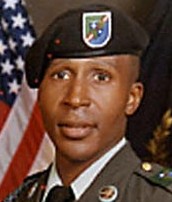
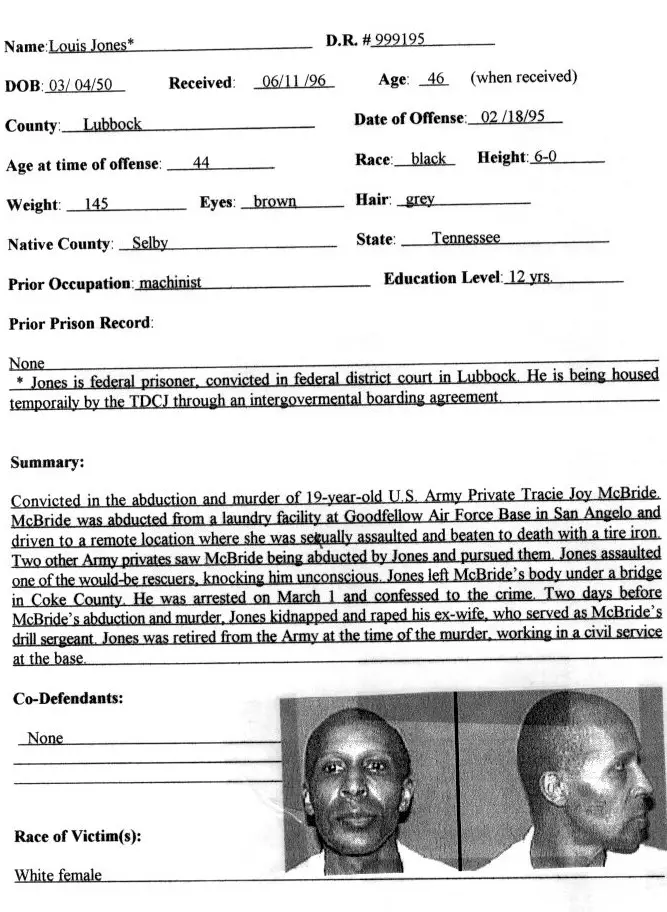
Louis JONES
Jr.
Classification: Murderer
Characteristics: Kidnapping - Rape
Number of victims: 1
Date of murder: February 18,
1995
Date of arrest:
March 4,
1995
Date of birth:
March 4,
1950
Victim profile: Tracie
Joy McBride, 19 (U.S. Army Private)
Method of murder:
Beating with a tire iron
Location: Lubbock County, Texas, USA
Status: Executed
by lethal injection in Texas on March 18,
2003
Jones drove onto the Goodfellow Air Force Base in San Angelo, Texas
and shortly after 9 pm on February 18, 1995 kidnapped Private Tracie
Joy McBride at gunpoint from a laundry room, where she was chatting
on the phone with a friend from Minnesota.
He brought her to his house and sexually assaulted her. Thereafter,
he drove Private McBride to a bridge just outside of San Angelo,
where he repeatedly struck her in the head with a tire iron until
she died.
Petitioner administered blows of such severe force that, when the
victim’s body was found, the medical examiners observed that large
pieces of her skull had been driven into her cranial cavity or were
missing.
The next morning, military officials phoned Tracie's parents to say
Tracie was missing. Two people had seen a man abduct her the night
before. When one man tried to follow, Jones assaulted him, that man
later testified.
Nearly two weeks after the assault, Jones confessed to killing
Tracie and led police to her body under a bridge about 27 miles from
San Angelo. Jones admitted that he had sexually assaulted and beaten
her to death with a tire iron.
Jones served a total of 22 years in the Army as
an airborne ranger, had combat duty in Grenada and the Gulf War, and
retired as a Master Sergeant.
His defense and appeals claimed post-traumatic
stress and Gulf War Syndrome from exposure to nerve gas. The claims
were rejected by the jury and later by appellate courts.
Final Meal:
Whole fruit: nectarines, peaches and plums.
Final Words:
Jones looked toward the witness room and mouthed the words "I love
you." Asked if he had a last statement, Jones said: "Although the
Lord hath chastised me forth, he hath not given me over unto death."
He then began singing a hymn with the refrain: "In the cross, in the
cross, be my glory ever 'til my raptured soul shall find rest beyond
the river." (From the hymn "Jesus Keep Me Near the Cross.")
ClarkProsecutor.org
ProDeathPenalty.com
The federal prosecutor with a Southern accent
came to Jim and Irene McBride's door in Centerville with a weighty
question few Minnesotans have ever had to answer. Did they want the
death penalty for the man who killed their daughter?
It was 1995.
Army Pvt. Tracie McBride, 19, had been kidnapped by a stranger and
bludgeoned to death months earlier as she stood watch at an Air
Force base laundry room in Texas.
The McBrides didn't hesitate in
their answer. Yes, they said, Louis Jones Jr. should die for what he
did. If Tracie could no longer feel joy, could no longer call her
family, why should he? A federal jury in Texas agreed.
Jones, a decorated Army veteran, is scheduled to
be executed March 18. In the nearly eight years since her death,
McBride family members haven't wavered in their opinion that the
sentence should be carried out, Tracie's mother and sister said.
Their opinions and those of other relatives and friends -- in the
form of more than 70 letters to the U.S. Department of Justice
pardon attorney -- could play a role once again. Jones and his
attorney have asked President Bush to spare Jones' life, claiming
that his crime was affected by brain damage he suffered from toxins
he was exposed to when he served in the Gulf War.
The clemency
petition, which followed two appeals and other court proceedings,
has dredged up painful memories once again for the McBride family,
they said. If the death sentence is carried out, they feel they
won't be forced to dwell on the horror of the crime each time a
legal proceeding pops up. "We're not going to have these constant
reminders in the negative sense." Irene McBride is counting on Bush
to let the sentence stand. She plans to witness Jones' execution. "We're
not looking for comfort out of this," she said. "We're looking for
justice. His execution will not bring Tracie back, but it will show
us that the justice system in America still works."
Jones drove onto the base in San Angelo, Texas,
fixated on finding his ex-wife, who worked there and had made it
clear that their separation was permanent, his defense attorney said
in the petition.
But other evidence showed Jones had just gotten off
the phone with his wife and knew she wasn't on the base, Irene
McBride said. Somehow, shortly after 9 p.m. Feb. 18, 1995, Jones
ended up at the laundry room where Tracie McBride was chatting on
the phone with her best friend in Minnesota.
The next morning,
military officials phoned Tracie's parents to say Tracie was missing.
Two people had seen a man abduct her the night before. When one man
tried to follow, Jones assaulted him, that man later testified.
Nearly 2 weeks later, Jones confessed to killing
Tracie and led police to her body under a bridge about 27 miles from
San Angelo, a city of about 100,000 residents in western Texas,
about 225 miles west of Austin.
Jones said he had beaten her with a
tire iron. Prosecutors, in a statement of facts sent to Washington,
said Jones also had admitted sexually assaulting McBride. The mental
images of what happened that night still haunt her family, they
said. "It's always a part of you," Stacie McBride said.
Evidence of brain damage was discovered in
connection with Jones' trial in 1995, according to his defense
attorney, Timothy Floyd.
But attorneys didn't know its cause or the
role it played in the crime, he said. Now, Floyd contends, medical
research has linked Jones' type of brain damage to exposure to
chemicals in the Gulf War. University of Texas epidemiologist Dr.
Robert Haley has found that those suffering from a certain form of
Gulf War Syndrome have symptoms including hostility, aggression,
rigid thinking and obsessiveness, according to the petition.
Floyd
argues that Jones had fixated on talking to his former wife the
night of the kidnapping. The syndrome, Floyd wrote, "can cause
people like Mr. Jones to embark on a course of behavior that is
driven -- from which they cannot step back or modulate."
After 22 years of service in the Army, Jones
struggled in civilian life. He dropped out of college because of
poor grades, delivered newspapers and drove a shuttle bus. He became
increasingly aggressive and irritable, leading to the breakup of his
marriage, ex-wife Sandy Lane testified at his trial. Lane testified
that Jones raped her at his apartment 2 days before he kidnapped
McBride. She also said he acted "very crazed" and was "spinning out
of control, bouncing from thought to thought."
Prosecutor Tanya Pierce portrayed Jones as a
calculating, cold-blooded killer who meticulously sought to cover
his tracks.
The petite McBride, who was 5-foot-2 and weighed about
100 pounds, had volunteered for laundry-room duty at Goodfellow Air
Force Base the evening of Feb. 18, 1995, when Jones kidnapped her at
gunpoint.
He raped her at his apartment, then made her gargle
mouthwash and clean her genital area with towels and peroxide. Jones
washed Tracie McBride's clothes after assaulting her and made her
walk out of his apartment on towels, believing it would prevent her
boots and clothes from picking up carpet fibers, which might link
him to the crime.
She also had to sit on towels as Jones drove her
to a bridge about 20 miles outside town. About 2 weeks after the
kidnapping, Jones led investigators to the bridge where he had
dumped McBride's body. Her head had been crushed with a tire iron.
Prosecutors presented evidence of Jones' aggressive behavior before
the Gulf War. They cited 4 incidents in which he had beaten up co-workers
or fellow soldiers and offered testimony that he had slapped his
wife.
The evidence of Gulf War Syndrome isn't an excuse
for Jones' actions, but an explanation and a mitigating factor, the
clemency petition says. In his letter to Bush, Jones described his
sorrow and explained that he has reformed. "By succombing [sic] to
my temptations," he wrote, "I destroyed the family of Specialist
Fourth Class Tracie Joy McBride, as well as my own."
Floyd argued in
the petition that the jury already was struggling with whether to
impose the death sentence and the link to Gulf War Syndrome would
have changed the outcome. "Had the jury known of the link between
the crime and Mr. Jones's brain injury from honorable service to our
country in the Gulf War, the jury very likely would not have imposed
the death penalty," he wrote.
Haley's office said the epidemiologist has never
presented his research in a court case, but Gulf War Syndrome has
been cited in other criminal cases. In one, a man convicted of
killing his girlfriend and three children in Florida in 1998 had
been diagnosed with Gulf War illness 2 years earlier.
A judge in his
case said there was no correlation between the diagnosis and the
murders, according to an Associated Press report. Guy H. Baker,
accused of shooting two St. Paul police officers to death, claimed
that Gulf War Syndrome had put him in severe pain. He pleaded guilty
to the murders in 1994. The possibility of the syndrome has been
raised in the case of accused Washington-area sniper John Allen
Muhammad, who has yet to face trial.
Under federal law, a defendant sentenced to death
gets an automatic appeal that is limited to evidence presented at
the trial.
The defendant can also file a petition for post-conviction
review to bring up evidence not presented at the trial, explained
Elisabeth Semel, director of the death penalty clinic at the
University of California, Berkeley.
While more than one petition can
be filed, "the opportunity to succeed on a second petition is
extremely limited to situations such as actual innocence," Semel
said. Floyd pointed out that the president can grant clemency for
any reason. Irene McBride said she doesn't expect to feel comforted
if Jones is put to death. "Nobody's going to win. . . .All this is
going to be is justice," she said. Comfort would only come, if when
Jones died, "we got Tracie back," she said.
The family simply wants
to grieve in a normal way "rather than it being brought up over and
over and over again," Irene McBride said. The family wants to focus
on the happy memories of Tracie: Her energetic smile. The way she
loved to make classmates happy by baking chocolate chip cookies so
often that she knew the recipe by heart. Her soprano voice at church,
she said. How would they feel if, as in Minnesota, the death penalty
were not an option and Jones was sentenced to life in prison? "No
matter what somebody is convicted of . . . they always try to appeal
for something lower," Irene McBride said. "I think it would be worse
to think that he could ever get out."
Often, Irene McBride wonders what her daughter's
life would have been like. She imagines Tracie Joy McBride marrying
the Marine she was dating 8 years ago. She sees her teaching music
to children, baby-sitting the 7 nieces and nephews born after her
death and helping her sister prepare for her upcoming wedding.
But
on Feb. 18, 1995, Louis Jones Jr. kidnapped the 19-year-old
Centerville, Minn., soldier from the Goodfellow Air Force Base in
Texas, raped her and bludgeoned her to death. She had been there
just 9 days.
Amid the debate over the fairness of capital punishment
and executing a former soldier with Gulf War syndrome, her family
says it boils down to this: Jones deserves to die because Tracie
deserved to live. "Closure is a big word. We're not expecting
comfort from all this," said Irene McBride. "All we're expecting is
justice." Tracie's parents, her siblings and nieces and nephews will
be in Terre Haute for Jones' execution. More than 70 family members
and friends have written letters opposing his clemency petition.
In one of the letters, Dawn Bryant relives the
last time she heard from her best friend. Tracie had called and the
2 were chatting about their boyfriends when the phone was muffled
and Tracie started talking to someone else. The phone was
disconnected, but Bryant had no idea that Jones had just abducted
her friend from the laundry room. "I wish I had called somebody,"
Bryant said eight years later. "I was the last person she spoke
loving words to. I was the last person who heard her laugh."
Friends
and family say Tracie was always cheerful, an achiever who earned
the nickname "Guy Smiley" from her drill instructor. She graduated
from basic training at the top of her company before being
transferred to Goodfellow for military intelligence training.
She
baked cookies for other soldiers, although those who were mean to
her friend, Tracie Rafn, missed out on many a treat. "I was T1 and
she was T2," said Rafn. "I hear my name, and I want to stay in touch
with her parents, but how do I call them and say, 'It's Tracie?'
There's always going to be that reminder of her."
After Tracie's
death, residents tied yellow ribbons in the tiny Twin Cities suburb,
and a park was later dedicated to her. A choir director wrote a song
in her memory, because she was active in the choir, band and theater
there. Mike Smith, the family's pastor, describes himself as
forgiving but says forgiveness is not an issue here. "This was one
of the most heinous crimes," said Smith. "It's not so much vengeance
against Louis Jones, but there needs to be justice for the crime --
and justice is the death penalty."
In the past few months, friends and family were
forced to relive painful memories as Jones petitioned President Bush
for clemency, claiming that Gulf War syndrome contributed to his
crimes. "It's like packing tape stuck to your thigh and then tearing
it off," said Rafn. "There's literally physical pain when you think
about what happened." People went to the Gulf War and didn't commit
murder, said Irene McBride. "We feel bad for his family, but he made
the choice, and now he has to (suffer) the consequences. The rest of
us are paying for the choices he made." Irene McBride said. "I don't
want him living in a prison where he can watch cable TV, lift
weights, go to the library, eat, sleep, talk with his family,"
Stacie McBride said. "Where was the mercy when Tracie pleaded? . . .
She did nothing. . . . he refused to have any lenience on her."
UPDATE: Jones, a decorated Army veteran who
blames childhood abuse and exposure to nerve gas during the Gulf War
for his killing of a female soldier has asked President Bush to
spare his life. Jones has exhausted his appeals. McBride's mother,
Irene McBride, said the petition is a ploy by Jones to escape the
consequences for killing her daughter. "I agree with the judge, the
jury, the Supreme Court and the appellate court," she said. "They
didn't feel (the brain damage) was enough. A lot of people have come
back from the Gulf War and not murdered people. I feel they are
still just looking for an excuse for murder. Brain injury, Gulf War
syndrome -- that's not an excuse to murder somebody." Members of the
McBride family in Centerville, Minn., their friends and others who
knew Tracie McBride have written letters to the Justice Department,
pleading that Jones' execution take place as scheduled.
UPDATE: "Today was a day of justice for Tracie,"
Irene McBride, the victim's mother, said after she witnessed the
execution. "Today Louis Jones finally was made accountable for his
actions, and today he will meet his ultimate judge. Everybody is
glad this is over. It's been a long 8 years," she said. "The healing
is not over; it's just beginning."
A Hymn on His Lips, Veteran is Executed
Gulf
soldier ignores his victim's relatives as they watch him die
By Shannon Tan -
Indianapolis Star
March 19, 2003
TERRE HAUTE, Ind. -- Without so much as a glance
toward the loved ones of the woman he killed, Louis Jones Jr. went
to his death Tuesday. Sentenced in 1995 to die for kidnapping,
raping and killing 19-year-old Pvt. Tracie Joy McBride, Jones was
pronounced dead at 7:08 a.m. after an injection of lethal chemicals
at the federal penitentiary.
He became the third federal prisoner
put to death in 40 years. The others were Oklahoma City bomber
Timothy McVeigh and Texas drug lord Juan Raul Garza, both in June
2001.
Jones, a decorated Gulf War veteran, received a
fraction of the attention given to those cases. As the death chamber
curtain opened at 7 a.m. Tuesday, Jones looked toward the witnesses
he had invited and mouthed the words, "I love you."
Draped with a
white sheet and strapped to a hospital table, he could see his four
supporters and loved ones and the eight members of the media. He
could not see the McBride family, hidden behind a one-way glass, and
did not acknowledge them.
Jones first recited Psalm 118:18: "The Lord hath
chastened me sore: but he hath not given me over unto death." In a
hoarse voice, he then began singing the hymn "Jesus Keep Me Near the
Cross," repeating the chorus -- "In the cross, in the cross, be my
glory ever 'til my raptured soul shall find rest beyond the river."
A Bureau of Prisons official cut into his singing to read the
charges of which Jones was convicted. Jones kept on singing until
U.S. Marshal Jim Kennedy gave the final go-ahead for the execution.
The speaker from the death chamber was turned off, but Jones
continued to sing.
At 7:06 a.m., an official announced that the
first of three drugs had been administered. Jones' eyes froze open,
staring blankly. His lips remained parted, as if halted in midsong.
At 7:07 a.m., the second drug was administered. He was pronounced
dead a minute later, after the third drug -- which stopped his heart
-- had been administered.
On Monday, the Supreme Court refused to block the
execution, and President Bush denied Jones' clemency petition. The
petition claimed Jones suffered brain damage and a change in
personality after being exposed to sarin nerve gas during the 1991
war. Assistant U.S. Attorney Tanya Pierce, who prosecuted Jones,
dismissed his claims. "It is an insult to the thousands and
thousands of people who went over there and did their patriotic
duty, came back and are law-abiding citizens," Pierce said.
Jones' attorney, Tim Floyd, said his client had hoped Bush would intervene.
"It is a cruel irony," Floyd said, "that on the day we mobilize for
war in Iraq, the life of Sergeant Louis Jones Jr. -- a consummate
soldier -- was ended at the hands of the government he proudly
served."
Jones spent the early morning meeting with his
daughter, 22-year-old Barbara Jones, according to Floyd. She did not
witness the execution. His last meal consisted of peaches,
nectarines and plums. "He died with a song of praise to God on his
lips," said Floyd, who witnessed the execution.
After the execution, 10 relatives and friends of
Tracie McBride, wearing badges with her picture on them, addressed
the media. "The tears we have shed today are not for Louis Jones,"
said Tracie's sister, Stacie McBride. "They are for Tracie and for
Tracie alone." Stacie McBride, 24, who hopes to become a criminal
prosecutor, said she was shocked that Jones did not apologize to the
family. "He did not even acknowledge us," she said. "The whole thing
was very self-serving. It was unbelievable."
In a statement later read by his attorney, Jones
said: "I accept full responsibility for the pain, anguish and the
suffering I caused the McBrides for having taken Tracie from them."
Jones served in the Army for 22 years before retiring with the rank
of master sergeant in 1993. In 2000, the Pentagon sent Jones a
letter telling him he had been exposed to chemical agents when the
Army demolished a munitions plant in Khamisiyah, Iraq. Jones' family
will claim his body after the Vigo County coroner releases it.
Barred from burial in a veterans cemetery, Jones
will be buried in a Chicago cemetery instead. Fears that McVeigh, a
fellow Gulf War veteran, might be buried in a military cemetery led
to a 1997 law prohibiting the honor for people convicted of capital
crimes. "Now another family has been devastated," said Jones'
minister, the Rev. J. Jason Fry, an execution witness. "A daughter
has lost her father. Grandchildren will never know their grandfather."
The McBride family said their healing has just
begun. "Today was a day of justice for Tracie," said her mother,
Irene McBride, Centerville, Minn. "It's been a long eight years, and
the healing process is not over."
Gulf War Veteran is Executed
Indianapolis Star
March 18, 2003
TERRE HAUTE, Ind. -- A Gulf War veteran convicted
of raping and killing an Air Force recruit was put to death this
morning at the U.S. Penitentiary. Louis Jones Jr., 53, claimed that
exposure to nerve gas during the 1991 Gulf War may have damaged his
brain and sparked uncontrollable violence.
Jones is the third person
-- after Oklahoma City bomber Timothy McVeigh and drug kingpin Juan
Garza -- put to death by the federal government since 1963. All
three lethal injections have taken place at the federal execution
facility near Terre Haute.
In Jones’ final moments, he looked toward the
room where the witnesses he had selected were watching and mouthed
the words, “I love you.” Also watching was the family of Pvt. Tracie
Joy McBride, the 19-year-old woman Jones raped and beat to death.
Jones did not acknowledge the family members, and expressed no
remorse for the killing. Asked by prison officials whether he had a
last statement, Jones said: “The Lord hath chastened me sore: but he
hath not given me over unto death.” He then began singing a refrain
-- “In the cross, in the cross, be my glory ever ’til my raptured
soul shall find rest beyond the river” -- from the hymn "Jesus Keep
Me Near the Cross." Jones was declared dead at 7:08 a.m.
"Today was a day of justice for Tracie," said her
mother, Irene McBride. She and other family members wore white
badges with a black and white photo of the young victim. "The tears
we have shed today are not for Louis Jones, they are for Tracie and
Tracie alone," said a sister, Stacie McBride. As the execution time
neared, about a dozen death penalty opponents held a candlelight
vigil about a quarter-mile from the prison. No death penalty
supporters were present. A sign leaning against a fence in front of
the group said, "The tragic irony: As we rush recklessly to war with
Iraq we are killing a veteran of the first Gulf War."
President Bush turned down a request for clemency
on Monday. Earlier, the U.S. Supreme Court rejected Jones' final
appeal. Monday night the Texan had a last meal of whole fruit:
nectarines, peaches and plums.
On Feb. 18, 1995, Jones kidnapped McBride at
gunpoint from the Goodfellow Air Force Base in San Angelo, Texas,
where he was a civilian employee. Two soldiers witnessed the
kidnapping and tried to follow them, but Jones assaulted one of the
men, knocking him unconscious. Jones raped McBride in his home
before driving her to a bridge, where he bludgeoned her to death
with a tire iron. Her disappearance was unsolved for 12 days until
Jones' ex-wife told police that Jones had abducted and raped her two
days before McBride was kidnapped. After he was arrested, he
confessed to killing McBride and took police to her body.
Jones had powerful people working to spare his
life. Former presidential candidate Ross Perot, who has helped fund
research into the illnesses plaguing many Gulf War veterans, tried
to get Jones' sentence commuted to life without parole. Sen. Kay
Bailey Hutchinson, a Texas Republican, said last month the execution
should be delayed while experts determine whether Jones suffers from
Gulf War syndrome, a term used to describe a variety of illnesses
suffered by Gulf War veterans.
As an Army Ranger, Jones led his platoon in a
combat jump onto Grenada during that 1983 invasion. In Operation
Desert Storm, he drove through burning oil fields in an area filled
with land mines. He retired from the Army as a master sergeant in
1993. Jones' appellate attorney, Timothy Floyd, contended that new
medical evidence showed Jones suffered brain damage after being
exposed to nerve gas during the Gulf War. A jury in 1995 had
rejected Jones' claims of post-traumatic stress and convicted him.
Anti-Death Penalty Advocates Protest on Prison
Grounds, Say System is Flawed
By Patricia L. Pastore -
Terre Haute Tribune
March 19, 2003
"The United States proclaims that we are one
nation under God. We have a responsibility and a duty to mankind to
be a light to the world by ending this kind of murder." -- Samuel
Brown of Paris, Ill., minister of the Universal Life Church.
A somber and reverent mood of anti-death penalty
activists on the U.S. Penitentiary grounds in Terre Haute was
enhanced early Tuesday by dark clouds that nearly obscured the moon.
Many held lighted candles. Members of the vigilant group talked
among themselves from about 4 a.m. until the sentence was carried
out at 7:08 a.m.
Space set aside for death penalty advocates nearly
50 yards away remained unoccupied throughout the vigil. Penitentiary
staff monitored both areas. Family members and friends of the
victims gathered in a prison chapel. Alice Fitzgerald and her
husband, Bert Fitzgerald of Madison, were among about 70 individuals
protesting the execution of Louis Jones, Jr., a decorated Gulf War
veteran. Jones retired from the military after 22 years of service
as an Army airborne ranger.
Two years later, he kidnapped and
murdered 19-year old Tracie McBride and received the death penalty
Nov. 3, 1995. Jones was one of many death-row inmates this couple
befriended.
The Fitzgeralds are members of the Indiana Citizens to
Abolish Capital Punishment. Bert Fitzgerald claims the justice
system is inconsistent and defective.
"The system is greatly flawed,
he said while standing beside his wife on a dew-drenched lawn. "Death-penalty
sentences are administered arbitrarily. It has to do with geography,
race and competency of one's legal representative. Even if it wasn't,
it would still be wrong. It serves no useful purpose."
Seated on a
bale of straw, Alice Fitzgerald grasped about a half-dozen yellow,
pink and red rosebuds in her hand. She said they were made with love
from toilet paper by Terre Haute death- row inmates. One by one,
buses dropped off more activists to the site.
The protesters
gathered in a special area separated from the rest of the grounds by
portable orange fencing. Security was tight. Wandering the grounds
aimlessly wasn't allowed. "People here are standing up for injustice
committed in our name," Bert Fitzgerald said, as another bus waited
for its passengers to disembark. "Why do we kill people who kill
people to show that killing people is wrong?" read a sign he propped
up against the fence.
Fitzgerald has compassion for the victim's
family, too, he said. He believes Jones and those who committed
similar crimes belong in prison. Life without parole is a fitting
sentence for those who committed crimes such as Jones,' Bert
Fitzgerald said. A Paris, Ill., minister was among the group. "Something
came over me spiritually and I felt a compulsion to participate,"
said Samuel Browne of the Universal Life Church. "I'm opposed to the
death penalty.
The United States proclaims that we are one nation
under God. We have a responsibility and a duty to mankind to be a
light to the world by ending this kind of murder." Several Sisters
of Providence from St. Mary-of-the-Woods prayed, a couple of
Buddhists softly chanted and Protestants from different church
organizations meditated or prayed as they stood or sat in a circle
surrounding dozens of yellow and white daisies. Kevin Griffith, co-organizer
of the protest group and an Indiana State University librarian,
stood outside the circle to speak with a reporter from Minnesota,
McBride's home state. "The death penalty is unfairly applied to
minorities and economically disadvantaged people," he said. "You
rarely find a wealthy person on death row. Check the statistics."
Jones committed a horrible crime and deserves to be punished,
Griffith said, "We must not forget the victim, but, it isn't the
state's right or our right to decide that he die," he said. Near
Griffith's feet a red sign with white lettering read: "DON'T: USE MY
TAX DOLLARS TO KILL ANYONE!" A man in a black jacket and white shirt
turned to another and said, "Jones is a victim, too. They made a
killer out of him when he fought for his country in the Gulf War."
Griffith believes this country needs to do more research on Gulf War
syndrome to determine if veterans exposed to nerve agents and
chemical weapons suffered permanent damage, he said. Talking ceased
about 6 p.m., when the activists started what they call a "Circle of
Silence." Above, a drab, gray sky was the perfect accompaniment for
the grim faces in this circle.
Prayers for the victim and prayers
for Jones continued until after he was pronounced dead. The anti-death
penalty activists left, reverently and quietly. All pledge they will
continue to protest until capital punishment is abolished in
Indiana.
The victim's mother, Irene McBride, doesn't believe Jones
showed remorse before he died. She also doesn't have the right to
forgive him for his terrible crime, she said, with red-rimmed eyes
as evidence of her pain. "Forgiveness belongs between him and God,"
she said. "God will judge Louis Jones. I can't right now. Everybody
has a right to an opinion, but until people have been there they
can't judge us."
Should Louis Jones Die?
Convicted of a Brutal
Murder, This Veteran Now Says He’s Suffering from Gulf War Syndrome
By Mark Miller -
Newsweek
March 13, 2003
One night eight years ago,
former Special Forces soldier Louis Jones Jr. stole onto a military
base in San Angelo, Texas. He was looking for his estranged wife,
also an Army officer, with whom he had violently fought earlier in
the week. Instead of his wife, he found Pvt. Tracie McBride.
HE FORCED MCBRIDE, at gunpoint, to leave the base
and, after raping her in his apartment, took her to a desolate area
30 miles outside of town where he beat her over the head with a tire
iron until she was dead. He left her body under a bridge. Tracie
McBride was 19 years old.
Unless President George W. Bush intervenes, Jones
will be executed on March 18 for the rape and murder of McBride. He
will be the third person—after Timothy McVeigh and drug kingpin Juan
Garza—put to death by the federal government since 1963. (Because he
kidnapped McBride from an Air Force base, his case was a federal
crime.)
Jones, currently awaiting execution in Terre Haute, Ind.,
has exhausted all of his appeals. His only recourse now lies with
the president. Jones’ attorney has asked Bush to commute his death
sentence to life in prison without the possibility of parole.
Prisoners seeking clemency from the White House
are hardly unusual. But the Jones case is. Jones served in the 1991
gulf war, and his attorney argues that Jones suffers from Gulf War
Syndrome, the name given to a mysterious group of symptoms and
illnesses afflicting more than 100,000 American soldiers who fought
in the conflict. According to an expert consulted by the defense,
Gulf War Syndrome is characterized by damage to the region of the
brain regulating mood, emotions, impulse control and other factors
that could explain Jones’ violent behavior the night he killed
McBride.
As an Army Airborne Ranger, Jones participated in
the invasion of Grenada. He led his platoon in a dangerous combat
jump onto the island in the face of enemy fire. During the gulf war,
he participated in the ground attack on Iraq and was awarded a
Commendation Medal for meritorious service.
Shortly after the war,
he was promoted to Master Sergeant and was awarded the Meritorious
Service Award. Now, as Bush weighs ordering another war with Iraq,
he must also decide whether to allow the execution of a once-highly
decorated soldier who fought in the last war—and who may have been
damaged by his service to his country.
While Jones never denied killing McBride (he
confessed to the crime when first questioned by police) his trial
attorneys sought to explain his behavior to the jury by arguing that
Jones had been severely sexually and emotionally abused as a child.
The defense lawyers also argued that Jones suffered from Post
Traumatic Stress Disorder (PTSD) arising from his service in the
military. Both prosecution and defense witnesses at the trial found
that Jones suffered from neurological problems and organic brain
damage, but they disagreed on the severity and the degree to which
the problems contributed to his crime. The jury rejected the PTSD
claims and sentenced Jones to death.
While pursuing the appeals process for Jones, his
appellate attorney, Timothy W. Floyd, a professor at Texas Tech
University School of Law, began studying the controversial subject
of Gulf War Syndrome. Not long after the end of the Gulf War, many
veterans began complaining of a variety of illnesses and symptoms:
memory problems, muscle fatigue, difficulty with balance, severe
headaches, rashes and unexplained skin diseases, Chronic Fatigue
Syndrome and other similar ailments—some so severe that their
sufferers have been completely disabled.
There is no precise figure
available of those afflicted, but at least 100,000 and possibly more
were affected. The number of those most sick is much smaller, most
experts believe. After 12 years-and more than $200 million in
federal research-the causes of Gulf War Syndrome are still hotly
debated. But several recent studies have shown exposure to the
multiple chemicals that were present during the war could cause
neurological damage consistent with that found in many sick gulf war
veterans.
Some vets suspect that insecticides and
pesticides could be to blame. During the war, the military routinely
doused the camps with pesticides containing Dursban, which was
banned for residential and commercial use by the EPA in 2000 because
of significant health concerns. In addition, soldiers were issued
individual tubes of insecticide containing DEET, a common chemical.
Some soldiers also tied Dursban-laced flea collars around their
necks and hands, although the military did not sanction the
practice. The soldiers’ uniforms were impregnated with permethrin
(used to control body lice and other insects) as a further
precaution.
The soldiers were exposed to other chemicals as
well. More than 250,000 troops ingested the substance Pyridostigmine
Bromide, or PB, an anti-nerve gas pretreatment with significant side
effects of its own. U.S. troops were given PB pills to take only if
a chemical attack was imminent. PB was an “investigational” drug at
the time and the FDA had given the military special permission to
allow its use.
Soldiers were supposed to take the drug only in very
limited, controled doses, but investigators have found that many
soldiers took multiple doses in the mistaken belief that they would
build up an immunity to chemical weapons exposure. Some recent
studies have implicated PB as a possible factor in Gulf War
illnesses, although the FDA recently approved the drug for use in
any upcoming war with Iraq.
Some vets suspect that their illnesses may have
bee caused by chemical weapon attacks. Iraqi president Saddam
Hussein had threatened to use his enormous stores of chemical and
biological agents against the United States and other allied troops
but no large-scale attack ever came.
The Pentagon says there is no
evidence that Iraqi forces ever used chemical weapons at all,
despite the thousands of alarms sounded by chemical weapons
detectors throughout the theater of operations. They were all false
alarms, the military said, although more sophisticated sensors
brought in the Czech military did detect small amounts of Sarin and
other chemical agents in a few instances during the war. The
Pentagon does not dispute the Czech data but says it cannot explain
it.
After the war, when U.S. soldiers were destroying
Iraqi weapons munitions, they blew up a huge cache near Khamisiyah
in Iraq. At the time, the soldiers believed the depot contained only
conventional weapons but, in fact, it also contained stores of Sarin
gas, a chemical agent that can be highly lethal.
It was not until
1996 (after Jones’ trial) that the Pentagon acknowledged that Sarin
gas had been released at Khamisiyah, and it sought to downplay its
significance. At first, it said only a few hundred soldiers might
have been exposed to low-levels of Sarin, then a few thousand. Later
the Pentagon concluded that more than 100,000 U.S. soldiers were
exposed to very low levels of the chemical agent.
Pentagon officials
have consistently maintained that the exposure level was so low that
it would have no consequences on the health of the troops. The
newest research, however, strongly suggests that even at very low
levels of exposure, Sarin can cause brain damage, particularly when
combined with the other chemicals that the troops were exposed to
during the war.
Louis Jones was one of the soldiers almost
certainly exposed to the low levels of Sarin at Khamisiyah. The
Pentagon sent him a letter notifying him of his likely exposure in
1997, and another letter in 2000. He never received the mail,
because he was in prison. It wouldn’t have mattered to his legal
appeals, however, because new evidence can’t be introduced in the
appellate process. Indeed, much of the research linking chemical
exposure-particularly Sarin gas exposure-to Gulf War Syndrome wasn’t
done until after Jones’ 1995 conviction, so it wasn’t available for
his defense. “The jury was not aware, because they could not be
aware, that there evidence that is clear now that Sgt. Jones was
exposed to the nerve gas of Saddam Hussein,” says his attorney, Tim
Floyd.
Last fall, while researching contingencies if all
of his client’s appeals were rejected, Floyd began researching Gulf
War illnesses. An internet search turned up the work of Dr. Robert
Haley, head of epidemiology at the University of Texas Southwestern
Medical Center in Dallas. In 1997, Haley published the first
significant studies linking chemical exposures, including Sarin gas,
and Gulf War Syndrome.
Floyd asked Haley to review his Jones’ medical
records. Haley did and concluded that Jones suffered clear brain
damage related to his service in the Gulf War. “In my opinion,”
Haley wrote in his report, “Jones’ Gulf War service involved
chemical exposures that caused brain cell damage to deep brain
structures (basil ganglia).
The site of the brain cell damage…was
responsible for the personality changes that contributed
significantly to the tragic events of his crime.” Floyd asked prison
officials to allow a blood test and an MRI spectroscopy-an advanced
brain scanning test-to help corroborate the diagnosis. Prison
officials allowed the blood test but turned down the request for the
expensive MRI spec scan, which would have involved moving Jones from
prison to a civilian hospital.
The results of the blood test further
confirmed Haley’s diagnosis: it revealed that Jones has a genetic
variance making him even more susceptible to Sarin gas poisoning
than the average person. The test revealed that Jones has extremely
low levels of a naturally occurring enzyme that would help protect
his brain from low-level exposure to Sarin and other similar
chemical agents.
The White House has little to say about Jones’
request except that it is “now receiving careful consideration,”
according to spokeswoman Ashley Snee. As governor of Texas, Bush
intervened only once in a death penalty case. Sen. Kay Bailey
Hutchison, Republican of Texas and a close political ally of Bush,
recently came out in favor of giving Jones the advanced MRI
spectroscopy test. If the results corroborate Haley’s diagnosis of
deep brain tissue damage and Gulf War Syndrome, Hutchison says “you
have to go back and start the [legal] process again for him.”
Jones’ attorney says he is only seeking to have
his client’s death sentence commuted to life in prison with no
possibility of parole. “He has never wanted to make excuses for this
crime. That is still true,” Floyd says. “He believes he is
responsible and he ought to be punished severely for it.”
The prosecutor in the case, Assistant U.S.
Attorney Tanya K. Pierce, declined to comment on the new issues
raised by Jones in his request for clemency. She did argue at Jones’
trial that his actions the night he murdered McBride demonstrated
that he was no madman. He tried to cover up evidence of the crime,
including forcing his victim to walk on towels in his apartment so
fiber and other evidence would be hidden.
Tracie McBride’s family is outraged by Jones’
petition. “I think it’s an excuse. There’s a lot of people that go
to the Gulf War and don’t come back and murder people,” Irene
McBride, Tracie’s mother, told ABC’s Good Morning America. “I think
that there is no reason that a criminal should be able to look at
their past or their present not to change what they did. It’s not
about the criminal. It’s about the crime.” Tracie’s sister, Stacie
McBride, told a reporter that death was the only punishment
acceptable for Jones. “I don’t want him living in a prison where he
can watch cable TV, lift weights, go to the library, eat, sleep,
talk to his family,” she said. “Where was the mercy when Tracie
pleaded? He refused to have any lenience on her.” The heartbroken
McBride family says it will travel to Terre Haute next week-and that
they fervently hope the execution of Louis Jones Jr. will proceed.
Jones Executed by Feds for Rape, Murder of
Female Soldier
By Robert Anthony Phillips
TheDeathHouse.com
March 18, 2003
Former Army Ranger Louis Jones Jr. was executed
Tuesday morning by lethal injection for the rape and murder of a
female soldier in Texas, singing a religious hymn as he was being
put to death. Jones' fate was sealed when the U.S. Supreme Court on
Monday refused his appeal and President George Bush rejected his
plea for clemency. Jones, 53, was executed at the United States
Penitentiary. He became the third condemned murderer executed under
the federal death penalty laws since 1963. He was pronounced dead at
7:08 a.m.
When asked if he had a last statement, Jones said
that "Although the Lord hath chastised me forth, he hath not given
me over unto death.” As he lay on the execution gurney he began
singing a religious hymn.
Jones was given his death sentence for the murder
of Pvt. Tracie McBride, 19. Jones beat her to death with a tire iron
after sexaully assaulting her. Jones snatched her at gunpoint from a
base laundry at Goodfellow Air Force Base in San Angelo, Tex., and
imprisoned her at his home.
Jones' lawyers had argued that exposure to nerve
gas during the Gulf War damaged Jones' brain and made him
uncontrollably violent. Jones had no criminal record before
murdering McBride. His appeals exhausted, Jones had sent a letter to
Bush asking to be spared from the execution gurney in return for
life in prison without parole. "Aside form the horrible crimes and
sins which I committed...I am truly sorry for the terrible pain and
suffering I have left with her famly and friends of which they
continue to suffer." Jones become a born again Christian in prison.
In the modern era of the death penalty, three
federal prisoners have now been executed. Before Jones, Oklahoma
City bomber Timothy McVeigh and drug lord Juan Raul Garza went to
the federal death chamber here. Bush refused to commute the sentence
of Garza and McVeigh had waived his appeals and wanted to be
executed.
Nerve Gas Damaged Brain?
Jones' lawyer and supporters claimed that the
former Master Sergeant was not fully responsible for the murder
because chemical exposure during the Gulf War damaged his brain.
They say Jones was one of thousands of soldiers explosed sarin, a
nerve gas, during the Gulf War. Government prosecutors have disputed
the nerve gas claim. Sen. Kay Bailey Hutchison had gone as far as
saying that Jones should receive a brain scan to determine if any
damage was done.
Victim's Family: Jones No Hero
A former Army Airborne Ranger, Jones took part in
the Grenada and Gulf War campaigns. During the Gulf War, he was
awarded a Commendation Medal for meritorious service and later was
promoted to Master Sergeant. But the family of McBride told a local
newspaper from Texas that they don't want to hear the word "hero"
attached to Jones' name.
Kidnapped From Laundry Room
Jones, who retired from the Army in 1993 after 22
years, confessed to the abduction and murder of McBride. McBride had
arrived on the base just eight days before and was taken by Jones at
gunpoint from a base laundry room. Prosecutors said Jones sexually
abused McBride, gagging her and keeping her inside a closet at his
San Angelo home. Later, he drove her to an isolated area in Coke
County, about 20 miles from the city, where he beat her to death
with a tire iron. Jones led investigators to her body 12 days later.
Defense lawyers stated in court documents that Jones had recently
broken up with his wife and attacked McBride because she resembled
his ex-wife.
Key Issue: Sentencing Options
A key legal issue in the case was whether the
trial court was required under the Eight Amendment to instruct the
jury what would happen to Jones if they did not return a death
sentence. At his trial in Lubbock, Tex., Jones' lawyers asked the
judge to tell the jury that if they were unable to unanimously agree
on sentencing, the judge would sentence Jones to "life without
possibility of release," but the court refused. Two jurors, who said
they initially did not want to sentence Jones to death, later said
they switched their votes to death after they were led to believe
that failure to bring back a death sentence could mean Jones would
receive a "lesser sentence."
In writing the majority opinion, Justice Clarence
Thomas stated that the Constitution does not require the
instructions on sentencing options and the jury was not misled. The
dissenting opinion was written by Justice Ruth Bader Ginsburg. She
wrote that a new sentencing hearing should be held and that the jury
be accurately informed of the sentencing options if the panel did
not want to condemn Jones to death. Conviction of the kidnapping
count had given Jones an automatic life prison sentence. The
sentencing issue went all the way to the U.S. Supreme Court, which
in June 1999 upheld the verdict in a narrow 5-4 vote.
History of Federal Executions
Between 1927 and 1963, the federal government
executed 34 convicted killers, rapists and kidnappers found guilty
under various federal statutes. These included spies, kidnappers and
even several rapists who did not kill. The Capital Punishment
Research Project reports that, in total, 340 persons have been
executed in the history of the federal government. After 1963, the
federal death penalty remained on the books, but was never changed
or updated to reflect new legal guidelines that came after the
Supreme Court ruled death penalty statutes unconstitutional in 1972.
But that changed when the Federal Death Penalty Act of 1994 was
passed.
What started off in 1988 as a federal statute to
allow the government to seek death sentences against "drug kingpins"
was later expended to allow the Department of Justice to seek the
death penalty for about 60 crimes, including treason, drug-related
murders, genocide and even the murder of a federal prisoner.
The first person executed under the act was
Oklahoma City bomber McVeigh on June 19, 2001. Eight days later,
Garza was executed.
Stop the Execution of Louis Jones!
Death Penalty Focus
March 18, 2003
Background:
Louis Jones, black male, age 52, will be executed
by lethal injection at the U.S. Penitentiary in Terre Haute, Indiana
on Tuesday March 18, 2003, 7:00 AM (EST). Jones was convicted of the
abduction and murder of Tracie Joy McBride from Goodfellow Air Force
Base in San Angelo, Texas in 1995. He will be the third federal
death row inmate executed since the 1994 Federal Death Penalty Act.
Jones is a decorated Gulf War veteran, who
retired from the Army in 1993 after 22 years of service. Many
experts believe that Jones suffers from a severe form of "Gulf War
Syndrome." He was repeatedly exposed to chemicals and toxins during
the Gulf War, which experts believe caused brain cell damage and
could explain the significant changes in his behavior and
personality after returning home from the war. Evidence of this
disorder was not raised at his trial due to the limited medical and
scientific knowledge on this issue at that time.
Two jurors from Jones's original trial have also
alleged that there was some confusion over the jury instructions
that may have led to Jones receiving the death penalty rather than
life without parole. The judges' instructions led them to believe
that if they did not vote unanimously for a death sentence or life
without parole, the judge would impose a lesser sentence.
As the
jury was split 10 to 2 in favor of a death sentence, the two jurors
changed their votes, believing that if they did not deliver a
unanimous sentence there was a possibility that Jones would be
released at some point. They have since expressed great regret over
sentencing Jones to death.
Jones has expressed remorse for his crime, has no
prior criminal record and a model record as a prisoner. He clemency
petition is seeking commutation to life imprisonment without parole.
Gulf War veteran executed by the United States
of America on March 18, 2003
Deathrow.at
A decorated veteran of the 1991 Gulf War has been
executed at the Terre Haute federal prison in Indiana for the rape
and murder of a female soldier in 1995. Louis Jones had pleaded for
clemency claiming that exposure to Iraqi nerve gas during the war
and a sickness known as Gulf War Syndrome had made him violent.
Jones, aged 53, died from lethal injection at
0708 after the United States Supreme Court and President George W
Bush refused to commute his sentence to life imprisonment. He was
the third person to be put to death by the federal government, since
it resumed executions in 2001 after a 38-year suspension.
Jones’ lawyers said that he had suffered severe
brain damage as the result of a combination of childhood abuse,
post-traumatic stress disorder following combat and exposure in 1991
to Iraqi nerve agents, and it was this that made him violent. In
subsequent appeals his attorney Timothy Floyd argued that the jury
had not been privy to Pentagon intelligence about US troops'
exposure to nerve gas which was only made known after the trial.
In December 2000 the Pentagon informed Jones that
he, and about 100,000 other allied troops, may have been exposed to
low levels of Sarin nerve gas as they pursued retreating Iraqi
forces. Jones appealed to Mr Bush to commute the sentence to life
imprisonment - but failed.
The Human Rights group Amnesty International
criticised the execution of the Gulf War veteran especially as it
comes on the eve of a possible new conflict with Iraq. "As he
prepares his country for war in Iraq, President George Bush has
maintained his support for state-sanctioned killing at home," a
statement from the group said. "More than 100 countries have turned
their backs on this cruel and irrevocable punishment," Amnesty
International continued. "What the US Government has done today sets
it apart from a clear majority of nations."
Gulf War veteran on death row asks Bush for
clemency
Associated Press
A decorated Army veteran who blames childhood
abuse and exposure to nerve gas during the Gulf War for his killing
of a female soldier has asked President Bush to spare his life.
As the president considers sending thousands of
Americans into another war against Iraq, Louis Jones Jr. is
scheduled to die by lethal injection March 18 at the federal prison
in Terre Haute, Indiana. He has exhausted his appeals.
Jones, 52, admitted killing Pvt. Tracie McBride
in 1995 after kidnapping her from Goodfellow Air Force Base in San
Angelo and raping her. During his 1995 trial in Lubbock, defense
experts testified that he suffered from brain damage from abuse as a
child and post-traumatic stress from his combat tours in Grenada and
the Gulf. Prosecutors brought in their own experts to dispute the
claims.
After the trial, a Dallas researcher who has
studied veterans of the 1991 war against Iraq concluded that Jones
suffered from a severe form of Gulf War Syndrome from exposure to
sarin nerve gas and other toxins. Jones' attorney filed a clemency
request with Bush in December, seeking a life sentence without
parole. Jones has also written personally to the president,
admitting his crime and expressing remorse. The Justice Department
is consulting with the White House on how to respond to the clemency
request. Prosecutors oppose the request.
Jones grew up in Chicago and spent 22 years in
the military before retiring in 1993 as a master sergeant in the
Airborne Rangers. His honors included a meritorious service medal, a
Southwest Asia service medal with three bronze service stars, a
Kuwait liberation medal, badges for marksmanship and parachuting,
and a good-conduct medal, according to his plea for clemency.
But, the petition says, Jones was a changed man
after returning from the Gulf in May 1991. "It solves the mystery
that was at the heart of the trial: how and why someone with the
background and character of Louis Jones could have committed such a
horrible crime," the petition says.
Dr. Robert W. Haley, an epidemiologist and expert
on Gulf War diseases at UT Southwestern Medical Center in Dallas,
said in the clemency petition that Jones suffers from brain damage,
not a psychological illness. Jones and his unit were exposed to
chemical fallout following U.S. bombing raids on Iraqi weapons
storage sites, the petition said. He suffered from "irritability and
hostility, and numerous neurological symptoms," Haley wrote.
Haley did not examine Jones or testify at his
trial. He based his diagnosis on reviewing medical records and on
reports by psychiatrists and neurologists who testified during the
trial. McBride's mother, Irene McBride, said the petition is a ploy
by Jones to escape the consequences for killing her daughter. "I
agree with the judge, the jury, the Supreme Court and the appellate
court," she said. "They didn't feel (the brain damage) was enough. A
lot of people have come back from the Gulf War and not murdered
people."
Members of the McBride family in Centerville,
Minnesota, their friends and others who knew Tracie McBride have
written letters to the Justice Department, pleading that Jones'
execution take place as scheduled.
A recent study of Gulf War Syndrome indicates
that some people's genetic makeup leaves them more vulnerable to
even low levels of nerve gas, according to the clemency petition.
The research was done by Dr. Rogene Henderson at the University of
New Mexico, on a grant from the Pentagon. A blood test done on Jones
in January shows he lacks a common enzyme that would have helped his
body metabolize nerve gas, said Jones' lawyer, Timothy W. Floyd. The
research behind the enzyme theory was conducted by Haley.
Louis Jones Jr.
Jones has exhausted all legal
appeals. His attorney filed a clemency petition Dec. 30, asking
President Bush to commute the sentence to life without parole.
The petition included new medical evidence that
Jones suffered brain damage from continued exposure to toxins in the
Persian Gulf War. According to the petition, Jones' unit moved into
areas exposed to fallout from sarin nerve gas after Iraqi weapons
stores were bombed.
Dr. Robert W. Haley, an expert on Gulf War
diseases and director of the Southwestern Medical Center at the
University of Texas, reviewed Jones' medical records and found that
his symptoms pointed to "the most severe form of Gulf War syndrome."
Gulf War syndrome refers to a range of unexplained illnesses
reported by some veterans. High-profile cases involving Gulf War
veterans include accused sniper John Allen Muhammad and three
veterans who allegedly killed their wives at Fort Bragg, N.C., last
year.
Jones, a 22-year Army Ranger veteran, returned
from the war with a noticeable change in personality, becoming more
irritable and hostile, Haley said. Fixated on his ex-wife, Jones
drove to the base one evening in February 1995 to look for her.
Instead, he found McBride. "I am truly sorry for the terrible pain
and suffering I have left with her family and friends, of which they
continue to suffer," Jones wrote in a letter to Bush.
During his trial, jurors rejected the defense
claim that Jones suffered from post-traumatic stress disorder.
Prosecutors argued that Jones planned the murder and tried to cover
it up by making McBride walk on towels in his apartment so she
wouldn't pick up carpet fibers. At his sentencing hearing, jurors
were instructed that they could recommend death, life in prison
without the possibility of release, or a lesser sentence. After
deliberating for a day and a half, they returned a verdict
recommending death.
Two jury members, including the lone black juror,
later said they were pressured into switching their votes to death
because they believed a deadlock meant Jones would get a lesser
sentence and could be released from prison. Jones' kidnapping
conviction would automatically sentence him to life in prison.
In a 5-4 vote, a sharply divided U.S. Supreme
Court upheld his death sentence in 1999. "The federal government is
poised to execute this one who clearly suffers from this service-related
ailment, which likely played a role in his criminal act," Texas
minister Rev. J. Jason Fry wrote in a letter supporting clemency for
Jones. "At the very same time the same government is sending other
men and women into harm's way, to the same region to defend our
country, as Louis Jones has done."
After the jury convicted Louis Jones of the crime,
they were presented with substantial mitigating evidence to weigh
against the government's contention that the aggravating factors
relating to the crime and the defendant should result in a death
sentence. The defence evidence included details of Jones' childhood
of physical and sexual abuse; his achievements during his 22-year
career in the army; possible post-traumatic stress disorder as a
result of his experiences on active service; and evidence of various
mental impairments at the time of the crime.
Louis Jones was facing one of two sentences: a
death sentence or life imprisonment without the possibility of
parole. Because of the kidnapping charge, under federal law he would
never be released if the jury voted for imprisonment. However, the
judge instructed the jury that it could recommend death, life
without the possibility of release, or a lesser sentence. If they
chose the latter, he, the judge, would decide its length. The jury
evidently did not reach its verdict easily. It took a day and a half
to decide, during which time it rejected three of the aggravating
factors alleged by the government, including that Jones posed a
future danger to society and that his crime had involved substantial
planning or premeditation. Nevertheless, it returned a unanimous
vote for death.
After the trial, two jurors provided affidavits
that there had been confusion and coercion in the jury room. They
said that the judge's instruction had led some jurors to believe
that if they could not reach a unanimous verdict either on death or
life without the possibility of release, that the judge would impose
a lesser sentence. The whole jury was agreed that they did not want
this to happen. After a while, the vote stood at 10 for death with
two women (the signatories to the affidavits) holding out for
imprisonment. The majority pressed the two women to change their
vote.
One of them, the lone African American on the jury, was
singled out after she began crying and saying that she could not
impose a death sentence. The majority, the other woman's affidavit
claimed, began ''getting on her'' and ''pushing her hard'' until the
black woman finally changed her vote. At that point the second woman
changed her vote too. In her affidavit, the African American juror
stated: ''I do not feel that the death sentence is the appropriate
sentence in this case and I changed my vote because of the intense
pressure from other jurors and the information that Mr Jones would
get a sentence that would result in his release from prison if we
had a hung jury.''
In 1999, a sharply divided US Supreme Court
upheld the death sentence. Four of the nine Justices dissented,
believing that the jury had been misinformed by the judge's
instruction, and that there was, at least, a reasonable likelihood
that this had tainted the jury deliberations. Furthermore, the
dissenting Justices agreed with the defence contention that:
''Capital sentencing should not be a game of 'chicken', in which
life or death turns on the happenstance of whether the particular 'life'
jurors or 'death' jurors in each case will be the first to give
in...''.
A War Hero, a Condemned Killer
Exposed to
poison gas in the Persian Gulf, Louis Jones Jr. apparently came home
with brain damage. In 1995, he murdered a woman
By Richard A.
Serrano - Los Angeles Times
January 14, 2003
LUBBOCK, Texas -- As he deploys tens of thousands
of American troops to the Middle East, President Bush now must
decide whether to block the upcoming execution of a highly decorated
career soldier who apparently suffers brain damage from his Gulf War
experience. Louis Jones Jr. came home in 1991 a changed man after
the war with Iraq, according to psychiatric reports and family
testimony. He drank too much, divorced and eventually left the Army
after 22 years, retiring as a master sergeant in the Airborne
Rangers. His ex-wife described him as "very crazed ... panicked ...
spinning out of control."
On a February evening in 1995, he kidnapped a
female recruit at a base near here, raped her and bludgeoned her to
death with a tire iron. Because the crime occurred on a military
facility, Jones was tried in Lubbock federal court. He was convicted
by a jury that rejected his claims that he had been traumatized by
his experiences in battle in Grenada and the Persian Gulf.
Jones has exhausted his legal appeals and is
scheduled to die March 18. He would be just the third person
executed by the federal government since 1963. The others were
Oklahoma City bomber Timothy J. McVeigh and Texas drug kingpin Juan
Garza, both in June 2001. His last hope is Bush, who just presided
over a war in Afghanistan after which a number of U.S. troops showed
signs of emotional distress. Last year, for example, three special
operations soldiers returned to Ft. Bragg, N.C., and allegedly
killed their wives. A clemency petition was filed Dec. 30 by Jones'
appellate attorney, Timothy W. Floyd of Lubbock, asking that Jones'
sentence be commuted to life without parole. The Justice Department
is consulting with the White House on how to proceed. The request
comes at a time when public debate about the fairness of capital
punishment has been renewed. Last weekend, such concerns prompted
the outgoing Illinois governor to commute the death sentences of 167
inmates.
In Jones' case, he admits to the killing. But his
petition includes new medical evidence strongly suggesting that he
developed brain damage from "the most severe form of Gulf War
Syndrome" after continued exposure to toxins in the war. His unit
repeatedly underwent "poison gas alerts" as they moved into areas
where the air was filled with chemical fallout, after Iraqi weapon
storage sites had been hit by U.S. bombs, the petition claims. Gulf
War Syndrome is an unscientific term used to describe a range of
medical problems that Gulf War veterans suffer two to three times
more often than veterans not deployed to the region. But numerous
studies have found that while the illnesses are real, they cannot be
traced to any specific Gulf War exposure.
The findings of Jones' brain damage were
developed by Dr. Robert W. Haley, a defense witness and expert on
Gulf War diseases who is director of Southwestern Medical Center at
the University of Texas at Dallas. The diagnosis had not been made
at the time of Jones' trial. "Mr. Jones, and many thousands of other
similarly exposed soldiers, returned from the Gulf War with quite
debilitating symptoms," Haley concluded.
He determined that Jones
suffered from "irritability and hostility, and numerous neurological
symptoms." He said Jones' chemical exposures "caused brain cell
damage" and that this was a "likely explanation for his crime." The
doctor noted that at Jones' trial, his lawyers argued that he
suffered from post-traumatic stress disorder, fallout from his
service in the Gulf and in the 1983 invasion of Grenada. He said the
lawyers were not then aware of the significant brain damage, and
that the nation had not yet come to terms with how devastating
diseases associated with the Gulf War would become. But prosecutors
rejected that argument, noting that Jones planned the murder and
carefully tried to cover up the crime.
In a letter to the president that Jones typed
from death row at the U.S. penitentiary in Terre Haute, Ind., he
acknowledged "the horrible crimes and sins which I committed" and
his remorse for taking the life of 19-year-old Tracie Joy McBride,
an Army private at Goodfellow Air Force Base at San Angelo, Texas.
Jones also touched on his personal failures since the Gulf War.
"Mr. President," he wrote, "there are many, many
lusts of this world which we, as mortals, are tempted by....
Regardless of how little or how much any temptation influenced me, I
could have been just as strong a man morally as I was a good soldier....
" He signed it, "Humbly, Louis Jones Jr., Master Sergeant, U.S. Army,
Retired."
Jones had no prior criminal record and his
military career was exemplary, according to his Army personnel file.
Along with fighting two wars, he served as a platoon sergeant and
Ranger instructor, and won numerous awards and citations. "You have
served your country well, and will be missed," he was told on his
official discharge papers. "Your performance brings great credit
upon yourself, the Ranger Training Brigade and the United States
Army."
Whether Jones' violent act had anything to do
with the emotional or physiological effects of war, or both, today's
military is mindful of what happened at Ft. Bragg and plans enhanced
psychological services for a war in Iraq. "Often this is where these
problems get picked up," said Army Col. James Stokes, a combat and
operational stress control officer. "When you get into a shooting
situation, you see people killed and good friends injured and you
are in danger yourself."
Jeanne Stellman, a professor of public
health at Columbia University, has studied Vietnam veterans over the
last 15 years and found that "depression, anxiety and other
psychological problems" still bother large numbers of them 30 years
after that war ended. But, she said, "the Army has a job to fight a
war and to protect our country, and we as people just seem to think
that this can be done without damage. It can't."
The 52-year-old Jones came from a poor and
troubled childhood, often the victim of physical and sexual abuse,
according to evidence at his trial. It was in the Army where he
excelled. Mark Cunningham, a psychologist who examined Jones and
testified at his trial, said the military became his "primary life
support," so much so that he referred warmly to the Army simply as "Sam."
But Dr. Stephen E. Peterson, a psychiatrist who
was a trial witness, said Jones also suffered emotionally. In
Grenada he parachuted into live enemy fire. He felled an enemy
soldier with sniper fire, and saw close-up others being killed by
howitzer shells. In Operation Desert Storm, he made his way through
the burning oil fields. "This man had a lot of stress in the
military," Peterson said. " ... Despite the fact that he looked good
on the outside, this man was torn up on the inside."
Back home, his third wife, Sandra Lane, an Army
staff sergeant, noted that he had lost his humor, suffered daily
headaches and drank too much. He became domineering and then, she
said, he hit her. Jones sought help from a base anger management
program, but classes were canceled. He was referred to a family
shelter on the base. He visited a mental health clinic and a
chaplain and the judge advocate general's office. In the spring of
1993, he took a standard retirement and left the Army. He tried
college but quit after earning Ds. He ran through a series of low-paying
jobs delivering newspapers, working in fast-food restaurants and
driving a bus.
Jones was arrested within two weeks of McBride's
disappearance, and led the police to her body under a bridge. He
told authorities that he kidnapped her thinking she looked like ex-wife
Sandra. He also described an out-of-body experience during the
abduction and murder. "There was like a dream," he said. "What am I
doing? ... Anger, evil, all of that wasn't me." Jones also told Dr.
Jonathan H. Pincus, a neurology specialist, that as he killed the
woman he saw black smoke billowing up like in Kuwait, and he heard
laughing. "It was Satan's voice," Jones said, standing on a chair to
dramatize the moment. "There were 3 million things going around in
my mind."
But prosecutor Tanya Pierce said Jones carefully
orchestrated the killing and tried to cover up evidence, even making
McBride walk on towels in his apartment so as not to pick up carpet
fibers on her boots. She said he knew what he was doing. "There was
a lot more than that he just went off his nut," the prosecutor said.
"It didn't hold water for the jury." Jones apologized in court to
the McBride family. "If I live from now until the end of eternity
with the pain that I have, it would never scratch the surface of the
pain that you have....I took a life that wasn't mine...." The Rev.
J. Jason Fry, a Texas minister who befriended Jones, has also
written the president asking for leniency. He said Jones is a born-again
Christian and he would be no danger if left to live out his life in
prison.
Fry also found "tragic irony" in Jones' fate, and
what it may portend for future soldiers returning from Iraq. "The
federal government is poised to execute this one who clearly suffers
from this service-related ailment, which likely played a role in his
criminal act," Fry told Bush. "At the very same time, the same
government is sending other men and women into harm's way, to the
same region to defend our country." Just, he added, "as Louis Jones
has done."
Minnesota family wants
execution of daughter's killer to proceed
Star Tribune
January 27, 2003
The federal prosecutor with a Southern accent
came to Jim and Irene McBride's door in Centerville with a weighty
question few Minnesotans have ever had to answer. Did they want the
death penalty for the man who killed their daughter? It was 1995.
Army Pvt. Tracie McBride, 19, had been kidnapped by a stranger and
bludgeoned to death months earlier as she stood watch at an Air
Force base laundry room in Texas. The McBrides didn't hesitate in
their answer. Yes, they said, Louis Jones Jr. should die for what he
did. If Tracie could no longer feel joy, could no longer call her
family, why should he?
A federal jury in Texas agreed. Jones, a
decorated Army veteran, is scheduled to be executed March 18. In the
nearly eight years since her death, McBride family members haven't
wavered in their opinion that the sentence should be carried out,
Tracie's mother and sister said. Their opinions and those of other
relatives and friends -- in the form of more than 70 letters to the
U.S. Department of Justice pardon attorney -- could play a role once
again.
Jones and his attorney have asked President Bush to spare
Jones' life, claiming that his crime was affected by brain damage he
suffered from toxins he was exposed to when he served in the Gulf
War. The clemency petition, which followed two appeals and other
court proceedings, has dredged up painful memories once again for
the McBride family, they said. If the death sentence is carried out,
they feel they won't be forced to dwell on the horror of the crime
each time a legal proceeding pops up, said Stacie McBride, the
victim's sister. "We're not going to have these constant reminders
in the negative sense."
Her last night
Jones drove onto the base in San Angelo, Texas,
fixated on finding his ex-wife, who worked there and had made it
clear that their separation was permanent, his defense attorney said
in the petition. But other evidence showed Jones had just gotten off
the phone with his wife and knew she wasn't on the base, Irene
McBride said. Somehow, shortly after 9 p.m. Feb. 18, 1995, Jones
ended up at the laundry room where Tracie McBride was chatting on
the phone with her best friend in Minnesota. The next morning,
military officials phoned Tracie's parents to say Tracie was missing.
2 people had seen a man abduct her the night before. When one man
tried to follow, Jones assaulted him, that man later testified.
Nearly 2 weeks later, Jones confessed to killing
Tracie and led police to her body under a bridge about 27 miles from
San Angelo, a city of about 100,000 residents in western Texas,
about 225 miles west of Austin. Jones said he had beaten her with a
tire iron. Prosecutors, in a statement of facts sent to Washington,
said Jones also had admitted sexually assaulting McBride. The mental
images of what happened that night still haunt her family, they
said. "It's always a part of you," Stacie McBride said.
Medical developments
Evidence of brain damage was discovered in
connection with Jones' trial in 1995, according to his defense
attorney, Timothy Floyd. But attorneys didn't know its cause or the
role it played in the crime, he said. Now, Floyd contends, medical
research has linked Jones' type of brain damage to exposure to
chemicals in the Gulf War.
University of Texas epidemiologist Dr.
Robert Haley has found that those suffering from a certain form of
Gulf War Syndrome have symptoms including hostility, aggression,
rigid thinking and obsessiveness, according to the petition. Floyd
argues that Jones had fixated on talking to his former wife the
night of the kidnapping. The syndrome, Floyd wrote, "can cause
people like Mr. Jones to embark on a course of behavior that is
driven -- from which they cannot step back or modulate."
Trial evidence showed the crime was a well-thought-out
sequence of events, Irene McBride said. Jones washed Tracie
McBride's clothes after assaulting her and made her walk on towels
he had placed on the floor of his apartment to prevent fibers in his
apartment from sticking to her clothes, according to a prosecution
memo. The evidence of Gulf War Syndrome isn't an excuse for Jones'
actions, but an explanation and a mitigating factor, the clemency
petition says. In his letter to Bush, Jones described his sorrow and
explained that he has reformed. "By succombing [sic] to my
temptations," he wrote, "I destroyed the family of Specialist Fourth
Class Tracie Joy McBride, as well as my own."
Floyd argued in the petition that the jury
already was struggling with whether to impose the death sentence and
the link to Gulf War Syndrome would have changed the outcome. "Had
the jury known of the link between the crime and Mr. Jones's brain
injury from honorable service to our country in the Gulf War, the
jury very likely would not have imposed the death penalty," he
wrote.
Syndrome defense
Haley's office said the epidemiologist has never
presented his research in a court case, but Gulf War Syndrome has
been cited in other criminal cases. In one, a man convicted of
killing his girlfriend and three children in Florida in 1998 had
been diagnosed with Gulf War illness 2 years earlier. A judge in his
case said there was no correlation between the diagnosis and the
murders, according to an Associated Press report. Guy H. Baker,
accused of shooting two St. Paul police officers to death, claimed
that Gulf War Syndrome had put him in severe pain. He pleaded guilty
to the murders in 1994.
The possibility of the syndrome has been
raised in the case of accused Washington-area sniper John Allen
Muhammad, who has yet to face trial. Under federal law, a defendant
sentenced to death gets an automatic appeal that is limited to
evidence presented at the trial. The defendant can also file a
petition for post-conviction review to bring up evidence not
presented at the trial, explained Elisabeth Semel, director of the
death penalty clinic at the University of California, Berkeley.
While more than one petition can be filed, "the opportunity to
succeed on a second petition is extremely limited to situations such
as actual innocence," Semel said. Floyd pointed out that the
president can grant clemency for any reason.
Lingering effects Irene McBride said she doesn't
expect to feel comforted if Jones is put to death. "Nobody's going
to win. . . .All this is going to be is justice," she said. Comfort
would only come, if when Jones died, "we got Tracie back," she said.
Families often feel it's going to make them feel better, said Joseph
Diaz, a professor at Southwest State University in Marshall, Minn.,
who has studied the death penalty. "They don't have to get another
letter saying there's another appeal, he's being moved to another
prison. . . . They want it to be over with," said Diaz, who recently
wrote a book about executions. But often, he said, an execution
doesn't provide the comfort a victim's family seeks. "What usually
happens is an intense sense of guilt afterward," Diaz said. The
family simply wants to grieve in a normal way "rather than it being
brought up over and over and over again," Irene McBride said. The
family wants to focus on the happy memories of Tracie: Her energetic
smile. The way she loved to make classmates happy by baking
chocolate chip cookies so often that she knew the recipe by heart.
Her soprano voice at church, she said.
How would they feel if, as in Minnesota, the
death penalty were not an option and Jones was sentenced to life in
prison? "No matter what somebody is convicted of . . . they always
try to appeal for something lower," Irene McBride said. "I think it
would be worse to think that he could ever get out." "I don't want [Jones]
living in a prison where he can watch cable TV, lift weights, go to
the library, eat, sleep, talk with his family," Stacie McBride said.
"Where was the mercy when Tracie pleaded? . . . She did nothing. . .
. [Jones] refused to have any lenience on her."
Terre Haute welcomes new prison
- 300 federal jobs will benefit city, where next federal execution
is set for March 18.
Indianapolis Star
As officials at the nation's death row prepare
for the 3rd federal execution in 40 years, local residents are
embracing a new prison -- expected to be completed next year -- that
will double the number of inmates at the U.S. Penitentiary. The new
facility, south of the existing one, will create 300 jobs and is
expected to house 960 high-security inmates. And, although the
Bureau of Prisons has no additional expansion plans, local officials
already have asked for a 3rd prison. "There is such a win-win
relationship," said Rod Henry, president of the Greater Terre Haute
Chamber of Commerce. "There's a lot of federal jobs. Those jobs
equate into loaves of bread and cars and homes being purchased, and
gallons of milk and donations to church or United Way." Henry said
he's not concerned that the scheduled execution of Louis Jones Jr.
on March 18 will cause any disruptions.
Prison officials have put some new rules in
place, such as reducing the time allowed for demonstrations to 3
hours before the execution, spokesman Jim Cross said Wednesday. But
there will be little difference between Jones' execution and those
of Oklahoma City bomber Timothy McVeigh and Texas drug lord Juan
Raul Garza in June 2001.Jones, 52, was the 1st person in the nation
condemned under a 1994 law that extended the death penalty to more
than 40 federal crimes.
In 1995, Jones kidnapped 19-year-old Pvt. Tracie
McBride at gunpoint from Goodfellow Air Force Base in San Angelo,
Texas. He sexually assaulted and bludgeoned her to death. Jones has
exhausted all legal appeals. His attorney filed a clemency petition
Dec. 30, asking President Bush to commute the sentence to life
without parole. The petition included new medical evidence that
Jones suffered brain damage from continued exposure to toxins in the
Persian Gulf War. According to the petition, Jones' unit moved into
areas exposed to fallout from sarin nerve gas after Iraqi weapons
stores were bombed.
Dr. Robert W. Haley, an expert on Gulf War
diseases and director of the Southwestern Medical Center at the
University of Texas, reviewed Jones' medical records and found that
his symptoms pointed to "the most severe form of Gulf War syndrome."
Gulf War syndrome refers to a range of unexplained illnesses
reported by some veterans. High-profile cases involving Gulf War
veterans include accused sniper John Allen Muhammad and three
veterans who allegedly killed their wives at Fort Bragg, N.C., last
year.
Jones, a 22-year Army Ranger veteran, returned
from the war with a noticeable change in personality, becoming more
irritable and hostile, Haley said. Fixated on his ex-wife, Jones
drove to the base one evening in February 1995 to look for her.
Instead, he found McBride. "I am truly sorry for the terrible pain
and suffering I have left with her family and friends, of which they
continue to suffer," Jones wrote in a letter to Bush.
During his
trial, jurors rejected the defense claim that Jones suffered from
post-traumatic stress disorder. Prosecutors argued that Jones
planned the murder and tried to cover it up by making McBride walk
on towels in his apartment so she wouldn't pick up carpet fibers. At
his sentencing hearing, jurors were instructed that they could
recommend death, life in prison without the possibility of release,
or a lesser sentence. After deliberating for a day and a half, they
returned a verdict recommending death.
Two jury members, including
the lone black juror, later said they were pressured into switching
their votes to death because they believed a deadlock meant Jones
would get a lesser sentence and could be released from prison. Jones'
kidnapping conviction would automatically sentence him to life in
prison. In a 5-4 vote, a sharply divided U.S. Supreme Court upheld
his death sentence in 1999.
"The federal government is poised to execute this
one who clearly suffers from this service-related ailment, which
likely played a role in his criminal act," Texas minister Rev. J.
Jason Fry wrote in a letter supporting clemency for Jones. "At the
very same time the same government is sending other men and women
into harm's way, to the same region to defend our country, as Louis
Jones has done." The victim's relatives in Minnesota are pleading
for the execution to go forward.
Gulf War veteran on death row
asks Bush for clemency
Associated Press
February 18, 2003
A decorated Army veteran who blames childhood
abuse and exposure to nerve gas during the Gulf War for his killing
of a female soldier has asked President Bush to spare his life. As
the president considers sending thousands of Americans into another
war against Iraq, Louis Jones Jr. is scheduled to die by lethal
injection March 18 at the federal prison in Terre Haute, Ind. He has
exhausted his appeals.
Jones, 52, admitted killing Pvt. Tracie McBride
in 1995 after kidnapping her from Goodfellow Air Force Base in San
Angelo and raping her. During his 1995 trial in Lubbock, defense
experts testified that he suffered from brain damage from abuse as a
child and post-traumatic stress from his combat tours in Grenada and
the Gulf. Prosecutors brought in their own experts to dispute the
claims. After the trial, a Dallas researcher who has studied
veterans of the 1991 war against Iraq concluded that Jones suffered
from a severe form of Gulf War Syndrome from exposure to sarin nerve
gas and other toxins.
Jones' attorney filed a clemency request with
Bush in December, seeking a life sentence without parole. Jones has
also written personally to the president, admitting his crime and
expressing remorse. The Justice Department is consulting with the
White House on how to respond to the clemency request. Prosecutors
oppose the request.
Jones grew up in Chicago and spent 22 years in
the military before retiring in 1993 as a master sergeant in the
Airborne Rangers. His honors included a meritorious service medal, a
Southwest Asia service medal with three bronze service stars, a
Kuwait liberation medal, badges for marksmanship and parachuting,
and a good-conduct medal, according to his plea for clemency. But,
the petition says, Jones was a changed man after returning from the
Gulf in May 1991. "It solves the mystery that was at the heart of
the trial: how and why someone with the background and character of
Louis Jones could have committed such a horrible crime," the
petition says.
Dr. Robert W. Haley, an epidemiologist and expert on
Gulf War diseases at UT Southwestern Medical Center in Dallas, said
in the clemency petition that Jones suffers from brain damage, not a
psychological illness. Jones and his unit were exposed to chemical
fallout following U.S. bombing raids on Iraqi weapons storage sites,
the petition said. He suffered from "irritability and hostility, and
numerous neurological symptoms," Haley wrote. Haley did not examine
Jones or testify at his trial. He based his diagnosis on reviewing
medical records and on reports by psychiatrists and neurologists who
testified during the trial.
McBride's mother, Irene McBride, said the
petition is a ploy by Jones to escape the consequences for killing
her daughter. "I agree with the judge, the jury, the Supreme Court
and the appellate court," she said. "They didn't feel (the brain
damage) was enough. A lot of people have come back from the Gulf War
and not murdered people." Members of the McBride family in
Centerville, Minn., their friends and others who knew Tracie McBride
have written letters to the Justice Department, pleading that Jones'
execution take place as scheduled.
A recent study of Gulf War Syndrome indicates
that some people's genetic makeup leaves them more vulnerable to
even low levels of nerve gas, according to the clemency petition.
The research was done by Dr. Rogene Henderson at the University of
New Mexico, on a grant from the Pentagon. A blood test done on Jones
in January shows he lacks a common enzyme that would have helped his
body metabolize nerve gas, said Jones' lawyer, Timothy W. Floyd. The
research behind the enzyme theory was conducted by Haley.
Hutchison says condemned
veteran should get MRI before execution
Associated Press
February 26, 2003
Sen. Kay Bailey Hutchison said Wednesday that a
Gulf War veteran facing possible federal execution should be allowed
to get a brain scan before President Bush decides whether the
soldier should be put to death. Decorated Army veteran Louis Jones
Jr. is scheduled to die by lethal injection March 18 at the federal
prison in Terre Haute, Ind. He has exhausted appeals but has asked
President Bush to spare his life. He blames childhood abuse and
exposure to nerve gas during the Gulf War for his killing of Pvt.
Tracie McBride. "He should not be executed until he has the MRI to
determine if there is brain damage," said Hutchison, a Texas
Republican. MRI is an abbreviation for magnetic resonance imaging, a
high powered brain scan.
Hutchison has been a champion of research by Dr.
Robert Haley, an epidemiologist with the University of Texas
Southwestern Medical Center, on Gulf War veterans. She has secured a
total $11 million in federal money to support his studies, including
$1 million contained in the 2003 spending bill that Congress passed
this month.
Haley's research has shown that some Gulf War Veterans'
illnesses can be attributed to brain damage caused by toxic
substances, particularly sarin nerve gas. His studies also have
shown that soldiers who are the sickest have lower levels of an
enzyme whose purpose is to protect the body from such toxic and
lethal substances. Jones, 52, has admitted killing McBride after
kidnapping her from Goodfellow Air Force Base in San Angelo and
raping her.
During his 1995 trial in Lubbock, defense experts
testified that he suffered from brain damage from abuse as a child
and post-traumatic stress from his combat tours in Grenada and the
Gulf. Prosecutors brought in their own experts to dispute the claims.
Haley said in Jones' clemency petition that Jones suffers from brain
damage, not a psychological illness.
He based his diagnosis on a
review of medical records and discussions with psychiatrists. Jones'
petition is before Bush now. Hutchison said she would like to see a
further study of Jones including whether he had had violent
outbursts. She said if the brain X-ray shows he has brain damage and
he has not had previous problems with violence, the judicial process
should begin again in his case. McBride's family opposes a halt to
Jones' execution.
White House receives
recommendation on clemency for convicted murderer
Associated Press
March 14, 2003
The Justice Department this week sent its private
recommendation to the White House about the clemency petition of
Louis Jones Jr., scheduled to die by lethal injection Tuesday for
the 1995 slaying of 19-year-old Army Pvt. Tracie McBride. Jones'
petition seeks a life sentence without parole rather than the death
penalty because of brain damage suffered from exposure to toxic
chemicals from his time in the Gulf War. The brain damage led Jones
to commit the slaying, the petition states.
Timothy Floyd of Lubbock,
Jones' attorney, said the 52-year-old is spending his days praying
and visiting with friends and family. "He has hope, but he's a
person of such deep faith, he's prepared for what might happen
between today and Tuesday," Floyd told the San Angelo Standard-Times
in Friday's editions.
In a letter that was part of the petition, Dr.
Robert Haley, an epidemiologist at the University of Texas
Southwestern Medical Center at Dallas, wrote that a blood test
revealed severe brain damage, most likely stemming from chemical
exposure during the Gulf War and that Jones has a genetically based
absence of the enzyme that might have protected him from those
agents. U.S. Sen. Kay Bailey Hutchison, R-Texas, who secured $11
million in federal grants to support Haley's work, last month
publicly advocated a brain scan to ascertain whether the affliction
contributed to Jones' crime.
8 years after McBride was kidnapped from
Goodfellow Air Force Base in San Angelo and then raped and killed,
her mother said the words "war hero," so often used to characterize
Jones, still sting. "A war hero wouldn't kill another solider," said
Irene McBride of Centerville, Minn. "He is a convicted, confessed
murderer." Jones, who admitted he killed Tracie McBride and has
expressed remorse, has exhausted his appeals, leaving President Bush
as his only hope for a reprieve. "The president is aware of the
situation, and he will make a careful decision on this matter before
the 18th," White House spokesman Taylor Gross said. The execution is
set for 7 a.m. Tuesday at the federal penitentiary in Terre Haute,
Ind.
Condemned Killer Exposed to
Nerve Gas Seeks Mercy
The New York Times
March 16, 2003
In 2000, the Pentagon sent Louis Jones Jr. a
letter telling him that he had been exposed to chemical agents as a
soldier in the Persian Gulf war. The chemicals were released, the
letter said, when the Army demolished a munitions plant in
Khamisiyah, Iraq, in March 1991. The Pentagon has since said the
chemicals were the nerve agents sarin and cyclosarin. The letter
never reached Mr. Jones, who is a retired 22-year veteran of the
Army Airborne Rangers. The mail service on death row in the federal
penitentiary in Terre Haute, Ind., is apparently not all it might
be.
Unless the Supreme Court or President Bush acts,
Mr. Jones, 53, will be executed at 7 o'clock on Tuesday morning. He
would be the 3rd inmate executed by the federal government in 40
years. His lawyer, Timothy Floyd, said the chemicals to which Mr.
Jones was exposed in Iraq changed his personality, unbalanced his
mind and played a significant role in the crimes he was convicted of
committing. In a clemency petition, Mr. Floyd has asked the
president to commute Mr. Jones's sentence to life without a
possibility of release.
A White House spokesman, Ken Lisauis, said
President Bush was considering Mr. Jones's petition. "The president
is aware of this case and will give the matter careful
consideration," Mr. Lisauis said. Mr
. Jones does not deny that he kidnapped Pvt.
Tracie McBride, 19, from Goodfellow Air Force Base in San Angelo,
Tex., in 1995, raped her and smashed her skull with a tire iron. He
was convicted of kidnapping, rape and murder. In a letter to
President Bush, Mr. Jones admitted that he "wantonly took" a "precious
life." "I think of the marine she was engaged to," he wrote of his
victim. "I think of the children she could have had. Her son could
have discovered a cure for a disease of our time." Mr. Jones, who
wrote that he had become a Christian, asked for clemency so that he
could minister to other prisoners for the rest of his life. The
evidence of Mr. Jones's exposure to nerve agents was not available
at his trial in 1995, though the defense did argue that he suffered
from post-traumatic stress disorder.
But that was hard to reconcile with Mr. Jones's
earlier combat service, Mr. Floyd said. Mr. Jones had led his
platoon in a parachute jump in the invasion of Grenada, facing enemy
fire. "Their jump was one of the lowest, and therefore most
dangerous, ever attempted in combat," Mr. Floyd wrote in the
clemency petition. Yet his client suffered no obvious psychological
trauma as a consequence, Mr. Floyd said. Mr. Jones's lawyers and
family said that on returning from the gulf war, he was a changed
man: hostile, irritable and rigid.
He retired with an honorable
discharge, as a master sergeant, in 1993. His marriage disintegrated.
In its letter to gulf war veterans, the Pentagon did not acknowledge
that the exposure had damaged their health. "Based on current
medical evidence and ongoing research, there is no indication that
any long-term health effects would be expected from the brief, low-level
exposure to chemical agents that may have occurred near Khamisiyah,"
Bernard Rostker, a Pentagon official, wrote.
The Supreme Court declined to overturn Mr.
Jones's death sentence in 1999. Justice Ruth Bader Ginsburg, in a
dissent joined by three other justices, wrote that his crime
"followed Jones's precipitous decline in fortune and self-governance
on termination of his 22-year Army career." The court was not
presented with evidence about the nerve agents in Iraq. Its decision
turned instead on whether the judge's instructions to the jury were
confusing. Had the jurors known he had been exposed to the
chemicals, Mr. Jones's defenders say, that information might well
have tipped the balance away from a death sentence. Two jurors who
voted for the death penalty later said they had mistakenly assumed
any other vote might allow the judge to sentence Mr. Jones to
something less than life in prison.
Court records show that six or more jurors agreed
that several so-called mitigating factors advanced by the defense
were present, among them that Mr. Jones had no criminal record and
that he "had served his country well in Desert Storm, Grenada, and
for 22 years in the United States Army." Only one juror agreed that
Mr. Jones "suffered from numerous neurological or psychological
disorders at the time of the offense."
Dr. Robert W. Haley, a
professor of epidemiology at the University of Texas Southwestern
Medical Center in Dallas and an expert on illnesses related to the
gulf war, examined Mr. Jones's medical records last year at the
request of the defense. He concluded that Mr. Jones had been in
vigorous health when he went to Kuwait in January 1991. He returned,
Dr. Haley wrote in a report in December, with brain damage. "The
best available scientific and medical evidence," he wrote, "leads to
the conclusion that this brain damage was caused by exposures in the
gulf war. "The personality and behavior changes causes by this
condition contributed significantly to the commission of the crime
for which he was sentenced to death."
Tanya K. Pierce, who prosecuted Mr. Jones,
declined to comment on Dr. Haley's report or on the evidence at the
trial. Ms. Pierce directed a reporter to court papers setting out
the details of the crime and information about Private McBride, who
was described as a remarkable young woman and a model soldier. If
the execution proceeds, Mr. Jones will be the third federal inmate
executed in recent years.
The others were Juan Garza, a drug
trafficker and murderer, and Timothy J. McVeigh, the Oklahoma City
bomber. Both were executed in 2001. Mr. Jones's case has attracted
the attention of Senator Kay Bailey Hutchison, Republican of Texas.
"As a strong proponent of the death penalty, I believe that justice
must be swift, but also sure," Ms. Hutchison said. "I believe all
relevant information must be considered in any death penalty case so
when ultimate justice is meted out we can be certain without a doubt
the right decision was made," she said.
Ms. McBride's younger sister, Stacie McBride, 24,
has just taken the bar examination and says she wants to be a
prosecutor. She was unimpressed by Mr. Jones's clemency petition.
"As President Bush looks at it and the pardon attorneys look at it,"
she said, "they will find it is a meritless excuse. The just result
is to carry out the sentence." Stacie McBride said she had visited
prisons to get a sense of what life without parole might be like. "It's
not as bad as what Tracie went through," she said. "Louis Jones has
had the opportunity to eat, sleep, breathe, work out, go to the
library, read books, write letters, get letters, visit with his
family. Tracie has missed out on that for 8 years and for the rest
of her life."
Family, friends seek closure,
not comfort
Indianapolis Star
Often, Irene McBride wonders what her daughter's
life would have been like. She imagines Tracie Joy McBride marrying
the Marine she was dating 8 years ago. She sees her teaching music
to children, baby-sitting the 7 nieces and nephews born after her
death and helping her sister prepare for her upcoming wedding.
Tracie Joy McBride was kidnapped on Feb. 18, 1995, raped and
bludgeoned to death. But on Feb. 18, 1995, Louis Jones Jr. kidnapped
the 19-year-old Centerville, Minn., soldier from the Goodfellow Air
Force Base in Texas, raped her and bludgeoned her to death. She had
been there just 9 days.
Amid the debate over the fairness of capital
punishment and executing a former soldier with Gulf War syndrome,
her family says it boils down to this: Jones deserves to die because
Tracie deserved to live. "Closure is a big word. We're not expecting
comfort from all this," said Irene McBride. "All we're expecting is
justice." Tracie's parents, her siblings and nieces and nephews will
be in Terre Haute for Jones' execution. More than 70 family members
and friends have written letters opposing his clemency petition.
In one of the letters, Dawn Bryant relives the last time she heard from
her best friend. Tracie had called and the 2 were chatting about
their boyfriends when the phone was muffled and Tracie started
talking to someone else. The phone was disconnected, but Bryant had
no idea that Jones had just abducted he friend from the laundry room.
"I wish I had called somebody," Bryant said eight years later. "I
was the last person she spoke loving words to. I was the last person
who heard her laugh."
Friends and family say Tracie was always cheerful,
an achiever who earned the nickname "Guy Smiley" from her drill
instructor. She graduated from basic training at the top of her
company before being transferred to Goodfellow for military
intelligence training. She baked cookies for other soldiers,
although those who were mean to her friend, Tracie Rafn, missed out
on many a treat. "I was T1 and she was T2," said Rafn. "I hear my
name, and I want to stay in touch with her parents, but how do I
call them and say, 'It's Tracie?' There's always going to be that
reminder of her."
After Tracie's death, residents tied yellow
ribbons in the tiny Twin Cities suburb, and a park was later
dedicated to her. A choir director wrote a song in her memory,
because she was active in the choir, band and theater there. Mike
Smith, the family's pastor, describes himself as forgiving but says
forgiveness is not an issue here. "This was one of the most heinous
crimes," said Smith. "It's not so much vengeance against Louis Jones,
but there needs to be justice for the crime -- and justice is the
death penalty."
In the past few months, friends and family were
forced to relive painful memories as Jones petitioned President Bush
for clemency, claiming that Gulf War syndrome contributed to his
crimes. "It's like packing tape stuck to your thigh and then tearing
it off," said Rafn. "There's literally physical pain when you think
about what happened." People went to the Gulf War and didn't commit
murder, said Irene McBride. "We feel bad for his family, but he made
the choice, and now he has to (suffer) the consequences," Irene
McBride said. "The rest of us are paying for the choices he made."
Gulf vet's case may be warning:
As execution looms for man who said nerve gas damaged his brain,
some fear what awaits troops
Indianapolis Star
March 17, 2003
Timothy McVeigh. Louis Jones Jr. Accused
Washington, D.C.-area sniper John Allen Muhammad. All were Gulf War
veterans -- and Jones, at least, is claiming he came home from the
war with brain damage after being exposed to nerve gas. In 1995, he
kidnapped, raped and killed a female recruit. He is slated for
execution Tuesday at the federal penitentiary near Terre Haute. But
some see his case as a stark warning to the troops -- including more
than 4,000 Hoosier reservists called to active duty -- preparing to
fight a new war with Iraq.
Joyce Riley, a nurse and spokeswoman for the
American Gulf War Veterans Association, is furious that troops are
being deployed in the region again. "We support the military, but we
are against sending troops in an area where they're going to become
cannon fodder," said Riley, who suffers from a neurological disorder
she attributes to her service in that war. "Gulf War veterans aren't
just sick, they're dying."
Gulf War veteran Rick Wilson of
Indianapolis attributes his migraine headaches and joint pain to an
extended exposure to low levels of a cocktail of poison gases. "If
those guys get sick like we are or sicker, I'm concerned the Veteran
Affairs and Defense Department are not going to be responsive to
their needs," said Wilson, a member of the staff of U.S. Rep. Dan
Burton, R-Ind. "Those troops loyal to Saddam Hussein know they're
going down with him, and I wouldn't put it past them to use that
stuff."
Jones was a career noncommissioned officer, a
decorated combat veteran with no criminal history before the Gulf
War. Yet, after his service in the Middle East, experts said, he
came to suffer the most severe form of Gulf War syndrome, an
affliction that may have led to violence. His experience illustrates
the unknown dangers today's troops may risk as they, too, face the
threat of biological and chemical weapons. Some fear the nation
could soon have another generation of veterans plagued by mysterious
sicknesses that appear to have unleashed deadly violence in some
victims.
Gulf War syndrome is an unscientific term that
covers medical symptoms ranging from muscle pain to memory loss and
violence. Problems after the war first surfaced among a group of
Indiana reservists. Some theorize that the toxic stew of nerve gas
traces from destroyed weapons, smoke from burning oil wells and dust
from uranium shells may have combined with other factors to sicken
troops in 1991. Others reviewing the illnesses point to the stress
of combat as the key factor.
The root cause has not been identified.
A decade after the Gulf War, 15 % of veterans were on disability.
According to the U.S. Department of Veterans Affairs, that number
was much smaller for veterans of the Vietnam War (7.7 %), Korean War
(5.4 %) and World War II (10.9 %). But while Gulf War veterans
report falling sick twice as often as other vets, 224 federally
funded studies costing $212 million have not found "any kind of
causal link between illnesses and service in the gulf," according to
Austin Camacho, Defense Department spokesman.
The Department of Veterans Affairs plans to spend
$20 million more on research into Gulf War illnesses in 2004, twice
the amount spent in any other year. Studies have found evidence that
the sicknesses are neurological in nature. Exposure to nerve gas has
been linked to damage in the brain's basal ganglia -- the same areas
affected in Huntington's disease -- which has resulted in homicidal
and suicidal behavior, said Dr. Robert W. Haley, an expert on Gulf
War illnesses and director of the Southwestern Medical Center in
Dallas. Although nerve gas isn't believed to have been used by Iraqi
troops, some of it may have been released when coalition forces
destroyed captured stockpiles.
The Defense Department says it has
taken steps to protect American troops now back in the gulf region.
Those changes include improved chemical protection suits, screening
troops before they leave and after they come home, a computer system
tracking vaccinations, and better alarms to alert troops of nearby
biological and chemical agents. "Our objective is to take what we
learned from the Gulf War to try to do things better," said Camacho.
"Everyone admits it wasn't handled as well as it could have been in
protecting the health of the service members."
High Court Won't Block Gulf
Vet Execution
Associated Press
March 17, 2003
The U.S. Supreme Court refused Monday to block
the execution of a decorated Gulf War veteran who claims severe
brain damage from his exposure to Iraqi nerve gas led him to kill.
Unless President Bush intervenes, Louis Jones Jr. will be executed
by injection Tuesday at the U.S. Penitentiary near Terre Haute, Ind.
As the execution neared, Jones met Monday with his 22-year-old
daughter, his attorney and two spiritual advisers.
Attorney Timothy
Floyd said his client was trying to remain hopeful as he awaited
word on whether Bush would consider his request to commute his death
sentence to life in prison. "He was really remarkably strong and I
think at peace with whatever happens. I attribute that to his deep
faith -- I think that's sustained him through this," Floyd said.
Jones, 53, admitted kidnapping 19-year-old Pvt. Tracie Joy McBride
from a Texas Air Force base, raping her and beating her to death
with a tire iron.
His attorneys filed a late appeal to the U.S.
Supreme Court, but the high court refused Monday to grant a stay
blocking the execution. The court did not comment on its decision.
Jones' appeal claimed the federal death penalty is unconstitutional
under a 2002 court ruling. In his request for executive clemency,
Jones argues he suffered brain damage from sarin nerve gas wafting
from an Iraqi weapons depot destroyed by American troops in March
1991 after the 1991 Gulf War ended. Floyd said evidence showing that
came to light only after Jones' trial.
In December 2000, the
Pentagon informed Jones that he, along with about 130,000 other
soldiers, may have been exposed to low levels of nerve gas. During
Jones' trial, defense experts testified he suffered brain damage
from abuse as a child and post-traumatic stress from his combat
tours. Federal prosecutors oppose Jones' clemency request, pointing
to evidence of his aggressive behavior before the Gulf War,
including 4 incidents in which he beat up co-workers or fellow
soldiers. He killed McBride on Feb. 18, 1995, 2 years after his
honorable discharge from the Army. If the execution proceeds, Jones
would be the 3rd person – after Oklahoma City bomber Timothy McVeigh
and drug kingpin Juan Garza – put to death by the federal government
since 1963.
Bush, Supreme Court refuses to
block Jones execution
Gulf War vet blames Iraqi nerve gas for
killing, Unless President Bush intervenes, Louis Jones Jr. will be
executed Tuesday.
March 17, 2003
President Bush and the U.S. Supreme Court refused
Monday to block the execution of a decorated Gulf War veteran who
says severe brain damage from his exposure to Iraqi nerve gas led
him to kill. Louis Jones Jr., convicted of killing a female soldier,
is scheduled to be executed by injection Tuesday at the U.S.
Penitentiary near Terre Haute. Bush rejected Jones' request to
commute his death sentence to life in prison without parole, said
Justice Department spokesman Mark Corallo. Corallo and White House
officials declined to explain Bush's decision. A senior
administration official said the decision stemmed from a belief that
Jones was tried and convicted by a jury of his peers in a "heinous,
premeditated murder."
As the execution neared, Jones met Monday with
his 22-year-old daughter, his attorney and two spiritual advisers.
Attorney Timothy Floyd said his client had been hopeful as he
awaited word on whether Bush would consider his request to commute
his death sentence to life in prison. "He was really remarkably
strong and I think at peace with whatever happens. I attribute that
to his deep faith -- I think that's sustained him through this,"
Floyd said before Bush's decision was announced. Jones, 53, admitted
kidnapping 19-year-old Pvt. Tracie Joy McBride from a Texas Air
Force base, raping her and beating her to death with a tire iron.
His attorneys filed a late appeal to the U.S.
Supreme Court, but the high court refused Monday to grant a stay
blocking the execution. The court did not comment on its decision.
Jones' appeal claimed the federal death penalty is unconstitutional
under a 2002 court ruling. In his request for executive clemency,
Jones argues he suffered brain damage from sarin nerve gas wafting
from an Iraqi weapons depot destroyed by American troops in March
1991 after the 1991 Gulf War ended.
Floyd said evidence showing that
came to light only after Jones' trial. In December 2000, the
Pentagon informed Jones that he, along with about 130,000 other
soldiers, may have been exposed to low levels of nerve gas. During
Jones' trial, defense experts testified he suffered brain damage
from abuse as a child and post-traumatic stress from his combat
tours.
Federal prosecutors oppose Jones' clemency
request, pointing to evidence of his aggressive behavior before the
Gulf War, including four incidents in which he beat up co-workers or
fellow soldiers. He killed McBride on February 18, 1995, 2 years
after his honorable discharge from the Army. If the execution
proceeds, Jones would be the 3rd person – after Oklahoma City bomber
Timothy McVeigh and drug kingpin Juan Garza – put to death by the
federal government since 1963.
U.S. Executes Gulf War Veteran
By Nancy Mayfield.
March 18, 2003
TERRE HAUTE, Ind. (Reuters) - A Gulf War veteran
whose plea for clemency claimed exposure to Iraqi nerve gas made him
violent was executed by the U.S. government on Tuesday for the 1995
rape and murder of a young servicewoman. Louis Jones, Jr., 53,
became the third federal death row convict to be put to death since
the government resumed executions in June 2001 with those of fellow
Gulf War veteran and convicted Oklahoma City bomber Timothy McVeigh
and drug kingpin Juan Garza eight days later.
Jones died at 7:08
a.m. EST after an injection of lethal chemicals at the federal
penitentiary at Terre Haute, Indiana, site of the only federal
execution chamber. His final meal the evening before consisted of
peaches, nectarines and plums. "Though the Lord has chastised me
forth he hath not given me over unto death," Jones said as the drugs
were injected. He then began singing a hymn beginning "Jesus keep me
near the cross..." before drifting off. He was the 17th person put
to death in the United States so far this year, at a time of renewed
debate in the country on the death penalty and continuing
international criticism. The governor of Illinois earlier this year
emptied that state's death row, citing injustices in the law.
Jones appealed to President Bush to commute his
sentence to life in prison, based on disclosures since his 1995
trial about allied exposure to nerve gas during the 1991 conflict
and ailments collectively known as Gulf War Syndrome. A decorated
former member of the U.S. Special Forces who had retired from the
military, Jones confessed to breaking into Goodfellow Air Force Base
in San Angelo, Texas, ostensibly to look for his estranged wife, and
abducting Air Force Pvt. Tracie McBride instead. He admitted raping
the 19-year-old McBride in his apartment, then taking her to a
bridge where he beat her to death with a tire iron.
ARGUED WAS EXPOSED TO GAS
He was tried in under the 1988 law that
reinstated federal executions because McBride was kidnapped from a
U.S. military base. Texas Tech University law professor Timothy
Floyd, who handled Jones' appeals, argued the jury did not get to
hear about subsequent Pentagon (news - web sites) revelations that
Jones was among more than 100,000 allied soldiers exposed to Sarin
nerve gas while chasing retreating Iraqi troops. Prosecutors argued
Jones had shown violent tendencies before the Gulf War, citing
beatings he administered to a few fellow soldiers.
At his trial,
defense lawyers argued Jones did not have a criminal record prior to
McBride's murder, but had suffered abuse as a child and post-traumatic
stress disorder from his wartime duties. He parachuted under fire
into Grenada during the 1983 U.S. invasion of the Caribbean island
and was among front-line troops that drove into Iraq in the Gulf War.
The United States is the only western democracy in which the death
penalty is still used. According to Amnesty International, in 2001
China carried out the most executions, 2,468, followed by Iran, 138,
Saudi Arabia 79 and the United States 66.
Gulf War Vet Executed for
Killing Soldier
AP March 18, 2003
TERRE HAUTE, Ind. (AP) -- A decorated Gulf War
veteran who claimed his exposure to Iraqi nerve gas caused him to
rape and kill a female soldier was executed by injection Tuesday.
Louis Jones Jr., 53, died by injection at the U.S. Penitentiary near
Terre Haute after President Bush and the U.S. Supreme Court refused
his two final requests that they intervene. Jones, who had no
previous criminal record, admitted kidnapping 19-year-old Pvt.
Tracie Joy McBride from a Texas Air Force base, raping her and
beating her to death with a tire iron.
His attorneys said exposure to the gas caused
severe brain damage that led him to kill. The issue was not raised
at Jones' trial because he became aware of the exposure only
afterward. Jones was the third person -- after Oklahoma City bomber
Timothy McVeigh and drug kingpin Juan Garza -- put to death by the
federal government since it resumed executions in 2001 after a 38-year
suspension. The federal government handled the prosecution because
McBride was abducted from a military base. "Today was a day of
justice for Tracie,'' said Irene McBride, the victim's mother. She
witnessed the execution along with her husband and their four other
children. "Everybody is glad this is over. It's been a long eight
years,'' she said. "The healing is not over; it's just beginning.''
In Jones' final moments, he looked toward the room where the
witnesses he had selected were watching and mouthed the words ``I
love you.'' He did not look toward the room where McBride's family
watched. Asked if he had a last statement, Jones said: ``Although
the Lord hath chastised me forth, he hath not given me over unto
death.'' He then began singing a hymn with the refrain: "In the
cross, in the cross, be my glory ever 'til my raptured soul shall
find rest beyond the river.'' Jones was declared dead at 7:08 a.m.
In a statement read later by his lawyer, Jones
said: "I accept full responsibility for the pain, anguish and the
suffering I caused the McBrides for having taken Tracie from them.''
Jones' attorney, Timothy Floyd, said the execution "represents the
failure of the federal government to understand and be accountable
for the impact of nerve agents on the soldiers who were exposed to
it in the service of their country.''
About 60 death penalty opponents held a
candlelight vigil near the prison. No death penalty supporters were
present. A sign leaning against a fence in front of the group said:
``The tragic irony: As we rush recklessly to war with Iraq we are
killing a veteran of the first Gulf War.'' The White House and the
high court refused Monday to block the execution after reviewing
Jones' nerve gas claims. White House officials declined to explain
Bush's decision, and the court did not comment.
Prosecutors and McBride's family in Centerville,
Minn., opposed Jones' clemency request, pointing to evidence of his
aggressive behavior before the Gulf War, including four incidents in
which he beat up co-workers or fellow soldiers. Following his Gulf
War service, Jones was promoted to master sergeant and honored with
a Meritorious Service Award. Jones killed McBride in 1995, two years
after his honorable discharge from the Army. During his trial,
defense experts testified Jones suffered brain damage from abuse as
a child and post-traumatic stress from his combat tours. After his
conviction, the Pentagon informed Jones that he and about 130,000
other soldiers may have been exposed to low levels of nerve gas from
an Iraqi weapons depot that troops destroyed in March 1991.
Assistant U.S. Attorney Tanya Pierce, who
prosecuted Jones and witnessed the execution, said she expects
claims of Gulf War syndrome will be used as a criminal defense by
other veterans. ``Because it is written in a clemency petition,
people take it as gospel,'' Pierce said. ``Although I am not trying
to minimize any illnesses people may have had, it is an insult to
thousands and thousand of people who went over there, who did their
patriotic duty and came back as law-abiding citizens,'' Pierce said.
Veteran to be executed today:
Supreme Court denies stay of execution
By Karin Grunden and
Melissa Vogt - Tribune-Star
March 18, 2003
Louis Jones Jr.'s appeal to President Bush for
clemency failed Monday, virtually ensuring his execution at 7 a.m.
today in the U.S. Penitentiary, Terre Haute. Bush rejected Jones'
request to commute his sentence to life in prison without parole,
said Justice Department spokesman Mark Corallo. Late Monday,
officials at the penitentiary said they were ready to proceed with
the third lethal injection in Terre Haute since 2001, when federal
executions resumed. Jones dined on a last meal Monday of peaches,
nectarines and plums, given to him whole, said Chris Nickrenz,
spokesman for the prison.
Nickrenz staged a news conference before 12
members of the media late Monday evening. He said prison security
staff moved Jones from his regular cell in the secured housing unit
at 3:42 a.m. Monday to a holding cell near the execution chamber.
Jones, 53, a decorated U.S. Army veteran, admitted to killing 19-year-old
Army Pvt. Tracie McBride after kidnapping her from a Texas Air Force
Base in 1995. Two years after being honorably discharged from the
Army, Jones abducted McBride, raped her in his apartment before
taking her to a bridge where he bludgeoned her to death with a tire
iron and left her body.
In a request for clemency, Jones argued that
exposure to sarin nerve agent after the 1991 Gulf War left him with
severe, personality-altering brain damage. That evidence did not
exist at his trial. That brain damage, compounded by the physical
and sexual abuse Jones suffered as a child, led him to commit the
1995 killing, contends his attorney, Timothy Floyd.
Federal prosecutors and McBride's family oppose Jones' clemency request,
pointing to evidence of his aggressive behavior before the Gulf War,
including four incidents in which he beat up co-workers or fellow
soldiers. Jones had also filed a late appeal to the U.S. Supreme
Court, but the high court on Monday refused to grant a stay blocking
the execution. The court did not comment on its decision. Jones'
appeal claimed the federal death penalty is unconstitutional under a
2002 court ruling.
The timing of Jones' execution and the looming
War on Iraq are ironic, said Suzanne Carter, a Terre Haute anti-death
penalty activist. "Here's a person that was very likely damaged by
sarin nerve gas during the first Gulf War and the president is now
going to send other soldiers to the same area," she said, standing
in front of the Vigo County Courthouse, where about two dozen
protesters gathered Tuesday evening.
Holding signs that read "Stop State Killing" and
"Thou Shalt Not Kill," the death-penalty opponents marched south
along Third Street to Voorhees Street, where they gathered at St.
Margaret Mary parish. There, protesters watched a recording of
former Illinois Gov. George Ryan's announcement commuting the
sentences of all the state's death-row inmates to life in prison.
Among those at St. Margaret Mary was Al Branch of Rockport, whose
grandson is on Florida's death row. This was his third time in Terre
Haute to protest a federal execution. He described it as his moral
duty to share his opinion on capital punishment. "Guilt or innocence
is not important to me in a death-penalty case," the 75-year-old
said. No one deserves to die, Branch said.
Sarah Dillon, 29, of Terre Haute, who was
protesting Jones' execution, said she fears that soldiers now headed
to the Persian Gulf could return home poisoned, like Jones. "It
seems hypocritical that we are talking about this upcoming war ...
and yet we are going to be killing a veteran," Dillon said. Jones
killed McBride two years after his honorable discharge from the Army.
After his Gulf War service, Jones was promoted to master sergeant
and honored with a Meritorious Service Award. In December 2000, the
Pentagon informed Jones that he, along with about 130,000 other
soldiers, may have been exposed to low levels of nerve gas.
Dr. Robert Haley, an epidemiologist with the
University of Texas Southwestern Medical Center who has studied
illnesses reported by Gulf war vets, said blood tests show Jones
suffered the most severe form of Gulf War Syndrome. He also said a
blood test shows he lacks a common enzyme that would have helped his
body metabolize nerve gas.
That evidence, Jones' decorated military
career and his previous lack of a criminal record, make him
different from the 23 other inmates on federal death row, said his
attorney, Timothy Floyd. "Compared with his whole life story up to
that point, it's inexplicable that somebody like him could do
something as horrible as he did," said Floyd, a law professor at
Texas Tech University. "It's sort of a mystery, but the answer to it
is what happened to him over there in Iraq."
The victim's father, Jim McBride, who plans to
attend Jones' execution with his wife, Irene, their four other
children and other relatives, said the family wants justice carried
out.
None of Jones' relatives, including his 22-year-old daughter,
will attend. Instead, Floyd and the Rev. Jason Fry of Kingsville,
Texas, will be there. Fry, who met Jones shortly after McBride's
murder, said he is now a devout, born-again Christian. Jim McBride
thinks the nerve-gas-exposure argument is ridiculous.
Jones alone is
to blame for his daughter's killing, he said. "There were several
thousand troops in the same war, and I have yet to hear of any one
of them coming home, kidnapping, raping and violently murdering a
young lady," said McBride of Centerville, Minn.
SUPREME
COURT OF THE UNITED STATES
No.
97—9361
LOUIS JONES, PETITIONER
v. UNITED STATES
ON WRIT OF CERTIORARI TO THE
UNITED STATES COURT OF APPEALS
FOR THE FIFTH CIRCUIT
June 21, 1999
Justice
Thomas delivered the opinion of the Court,
except as to Part III—A*.
Petitioner
was sentenced to death for committing a
kidnaping resulting in death to the victim. His
sentence was imposed under the Federal Death
Penalty Act of 1994, 18 U.S.C. § 3591 et seq.
(1994 ed. and Supp. III). We are presented with
three questions: whether petitioner was entitled
to an instruction as to the effect of jury
deadlock; whether there is a reasonable
likelihood that the jury was led to believe that
petitioner would receive a court-imposed
sentence less than life imprisonment in the
event that they could not reach a unanimous
sentence recommendation; and whether the
submission to the jury of two allegedly
duplicative, vague, and overbroad nonstatutory
aggravating factors was harmless error. We
answer “no” to the first two questions. As for
the third, we are of the view that there was no
error in allowing the jury to consider the
challenged factors. Assuming error, arguendo,
we think it clear that such error was harmless.
I
Petitioner
Louis Jones, Jr., kidnaped Private Tracie Joy
McBride at gunpoint from the Goodfellow Air
Force Base in San Angelo, Texas. He brought her
to his house and sexually assaulted her. Soon
thereafter, petitioner drove Private McBride to
a bridge just outside of San Angelo, where he
repeatedly struck her in the head with a tire
iron until she died. Petitioner administered
blows of such severe force that, when the
victim’s body was found, the medical examiners
observed that large pieces of her skull had been
driven into her cranial cavity or were missing.
The
Government charged petitioner with, inter
alia, kidnaping with death resulting to the
victim, in violation of 18 U.S.C. § 1201(a)(2),
an offense punishable by life imprisonment or
death. Exercising its discretion under the
Federal Death Penalty Act of 1994, 18 U.S.C. §
3591 et seq., the Government decided to
seek the latter sentencing option. Petitioner
was tried in the District Court for the Northern
District of Texas and found guilty by the jury.
The
District Court then conducted a separate
sentencing hearing pursuant to §3593. As an
initial matter, the sentencing jury was required
to find that petitioner had the requisite intent,
see §3591(a)(2); it concluded that petitioner
intentionally killed his victim and
intentionally inflicted serious bodily injury
resulting in her death. Even on a finding of
intent, however, a defendant is not death-eligible
unless the sentencing jury also finds that the
Government has proved beyond a reasonable doubt
at least one of the statutory aggravating
factors set forth at §3592. See §3593(e).
Because petitioner was charged with committing a
homicide, the Government had to prove 1 of the
16 statutory aggravating factors set forth at 18
U.S.C. § 3592(c) (1994 ed. and Supp. III) (different
statutory aggravating factors for other crimes
punishable by death are set forth at §§3592(b),
(d)). The jury unanimously found that two such
factors had been proved beyond a reasonable
doubt–it agreed that petitioner caused the death
of his victim during the commission of another
crime, see §3592(c)(1), and that he committed
the offense in an especially heinous, cruel, and
depraved manner, see §3592(c)(6).1
Once
petitioner became death-eligible, the jury had
to decide whether he should receive a death
sentence. In making the selection decision, the
Act requires that the sentencing jury consider
all of the aggravating and mitigating factors
and determine whether the former outweigh the
latter (or, if there are no mitigating factors,
whether the aggravating factors alone are
sufficient to warrant a death sentence).
§§3591(a), 3592, 3593(e).
The Act, however, requires more exacting proof
of aggravating factors than mitigating ones–although
a jury must unanimously agree that the
Government established the existence of an
aggravating factor beyond a reasonable doubt,
§3593(c), the jury may consider a mitigating
factor in its weighing process so long as one
juror finds that the defendant established its
existence by preponderance of the evidence,
§§3593(c), (d).
In addition to the two statutory aggravators
that established petitioner’s death-eligibility,
the jury also unanimously found two aggravators
of the nonstatutory variety2
had been proved: one set forth victim impact
evidence and the other victim vulnerability
evidence.3
As for mitigating factors, at least one juror
found 10 of the 11 that petitioner proposed and
seven jurors wrote in a factor petitioner had
not raised on the Special Findings Form.4
After
weighing the aggravating and mitigating factors,
the jury unanimously recommended that petitioner
be sentenced to death. App. 57—58. The District
Court imposed sentence in accordance with the
jury’s recommendation pursuant to §3594. The
United States Court of Appeals for the Fifth
Circuit affirmed the sentence. 132 F.3d 232
(1998). We granted certiorari, 525 U.S. ___
(1998), and now affirm.
II
A
We first
decide the question whether petitioner was
entitled to an instruction as to the
consequences of jury deadlock. Petitioner
requested, in relevant part, the following
instruction:
“In the
event, after due deliberation and reflection,
the jury is unable to agree on a unanimous
decision as to the sentence to be imposed, you
should so advise me and I will impose a sentence
of life imprisonment without possibility of
release. …
.....
“In the
event you are unable to agree on [a sentence of]
Life Without Possibility of Release or Death,
but you are unanimous that the sentence should
not be less than Life Without Possibility of
Release, you should report that vote to the
Court and the Court will sentence the defendant
to Life Without the Possibility of Release.” App.
14—15.
In
petitioner’s view, the Eighth Amendment requires
that the jury be instructed as to the effect of
their inability to agree. He alternatively
argues that we should invoke our supervisory
power over the federal courts and require that
such an instruction be given.
Before
we turn to petitioner’s Eighth Amendment
argument, a question of statutory interpretation
calls for our attention. The Fifth Circuit held
that the District Court did not err in refusing
petitioner’s requested instruction because it
was not substantively correct. See 132 F.3d, at
242—243.
According to the Court of Appeals,
§3593(b)(2)(C), which provides that a new jury
shall be impaneled for a new sentencing hearing
if the guilt phase jury is discharged for “good
cause,” requires the District Court to impanel a
second jury and hold a second sentencing hearing
in the event of jury deadlock. Id., at
243. The Government interprets the statute the
same way (although its reading is more nuanced)
and urges that the judgment below be affirmed on
this ground.
Petitioner,
however, reads the Act differently. In his view,
whenever the jury reaches a result other than a
unanimous verdict recommending a death sentence
or life imprisonment without the possibility of
release, the duty of sentencing falls upon the
district court pursuant to §3594, which reads:
“Upon a
recommendation under section 3593(e) that the
defendant should be sentenced to death or life
imprisonment without possibility of release, the
court shall sentence the defendant accordingly.
Otherwise, the court shall impose any lesser
sentence that is authorized by law.
Notwithstanding any other law, if the maximum
term of imprisonment for the offense is life
imprisonment, the court may impose a sentence of
life imprisonment without possibility of release.”
Petitioner’s argument is based on his
construction of the term “[o]therwise.” He
argues that this term means that when the jury,
after retiring for deliberations, reports itself
as unable to reach unanimous verdict, the
sentencing determination passes to the court.
As the
dissent also concludes, post, at 14—15,
petitioner’s view of the statute is the better
one. The phrase “good cause” in §3593(b)(2)(C)
plainly encompasses events such as juror
disqualification, but cannot be read so
expansively as to include the jury’s failure to
reach a unanimous decision. Nevertheless, the
Eighth Amendment does not require that the jury
be instructed as to the consequences of their
failure to agree.
To be
sure, we have said that the Eighth Amendment
requires that a sentence of death not be imposed
arbitrarily. See, e.g., Buchanan
v. Angelone, 522 U.S. 269, 275 (1998). In
order for a capital sentencing scheme to pass
constitutional muster, it must perform a
narrowing function with respect to the class of
persons eligible for the death penalty and must
also ensure that capital sentencing decisions
rest upon an individualized inquiry. Ibid.
The instruction that petitioner requested has no
bearing on what we have called the “eligibility
phase” of the capital sentencing process. As for
what we have called the “selection phase,” our
cases have held that in order to satisfy the
requirement that capital sentencing decisions
rest upon an individualized inquiry, a scheme
must allow a “broad inquiry” into all
“constitutionally relevant mitigating evidence.”
Id., at 276. Petitioner does not argue,
nor could he, that the District Court’s failure
to give the requested instruction prevented the
jury from considering such evidence.
In
theory, the District Court’s failure to instruct
the jury as to the consequences of deadlock
could give rise to an Eighth Amendment problem
of a different sort: We also have held that a
jury cannot be “affirmatively misled regarding
its role in the sentencing process.” Romano
v. Oklahoma, 512 U.S. 1, 9 (1994). In no
way, however, was the jury affirmatively misled
by the District Court’s refusal to give
petitioner’s proposed instruction. The truth of
the matter is that the proposed instruction has
no bearing on the jury’s role in the sentencing
process.
Rather, it speaks to what happens in the event
that the jury is unable to fulfill its role–when
deliberations break down and the jury is unable
to produce a unanimous sentence recommendation.
Petitioner’s argument, although less than clear,
appears to be that a death sentence is arbitrary
within the meaning of the Eighth Amendment if
the jury is not given any bit of information
that might possibly influence an individual
juror’s voting behavior.
That contention has no merit. We have never
suggested, for example, that the Eighth
Amendment requires a jury be instructed as to
the consequences of a breakdown in the
deliberative process. On the contrary, we have
long been of the view that “[t]he very object of
the jury system is to secure unanimity by a
comparison of views, and by arguments among the
jurors themselves.” Allen v. United
States, 164 U.S. 492, 501 (1896).5
We further have recognized that in a capital
sentencing proceeding, the Government has “a
strong interest in having the jury express the
conscience of the community on the ultimate
question of life or death.” Lowenfield v.
Phelps, 484 U.S. 231, 238 (1988) (citation
omitted). We are of the view that a charge to
the jury of the sort proposed by petitioner
might well have the effect of undermining this
strong governmental interest.6
We
similarly decline to exercise our supervisory
powers to require that an instruction on the
consequences of deadlock be given in every
capital case. In drafting the Act, Congress
chose not to require such an instruction. Cf.
§3593(f) (district court “shall instruct the
jury that, in considering whether a sentence of
death is justified, it shall not consider the
race, color, religious beliefs, national origin,
or sex of the defendant or of any victim and
that the jury is not to recommend a sentence of
death unless it has concluded that it would
recommend a sentence of death for the crime in
question no matter what the race, color,
religious beliefs, national origin, or sex of
the defendant or of any victim may be”).
Petitioner does point us to a decision from the
New Jersey Supreme Court requiring, in an
exercise of that court’s supervisory authority,
that the jury be informed of the sentencing
consequences of nonunanimity. See New Jersey
v. Ramseur, 106 N. J. 123, 304—315, 524
A. 2d 188, 280—286 (1987). Of course, New
Jersey’s practice has no more relevance to our
decision than the power to persuade. Several
other States have declined to require a similar
instruction. See, e.g., North Carolina
v. McCarver, 341 N. C. 364, 394, 462
S. E. 2d 25, 42 (1995); Brogie v.
Oklahoma, 695 P.2d 538, 547 (Okla. Crim. App.
1985); Calhoun v. Maryland, 297 Md.
563, 593—595, 468 A. 2d 45, 58—60 (1983);
Coulter v. Alabama, 438 So. 2d 336,
346 (Ala. Crim. App. 1982); Justus v.
Virginia, 220 Va. 971, 979, 266 S. E. 2d 87,
92—93 (1980).
We find the reasoning of the Virginia Supreme
Court in Justus far more persuasive than
that of the New Jersey Supreme Court, especially
in light of the strong governmental interest
that we have recognized in having the jury
render a unanimous sentence recommendation:
“The
court properly refused an instruction offered by
the defendant which would have told the jury
that if it could not reach agreement as to the
appropriate punishment, the court would dismiss
it and impose a life sentence. While this was a
correct statement of law it concerned a
procedural matter and was not one which should
have been the subject of an instruction. It
would have been an open invitation for the jury
to avoid its responsibility and to disagree.”
Id., at 979, 266 S. E. 2d, at 92.
In light of
the legitimate reasons for not instructing the
jury as to the consequences of deadlock, and in
light of congressional silence, we will not
exercise our supervisory powers to require that
an instruction of the sort petitioner sought be
given in every case. Cf. Shannon v.
United States, 512 U.S. 573, 587 (1994).
B
Petitioner
further argues that the jury was led to believe
that if it could not reach a unanimous sentence
recommendation he would receive a judge-imposed
sentence less severe than life imprisonment, and
his proposed instruction as to the consequences
of deadlock was necessary to correct the jury’s
erroneous impression.
Moreover, he contends that the alleged confusion
independently warrants reversal of his sentence
under the Due Process Clause, the Eighth
Amendment, and the Act itself. He grounds his
due process claim in the assertion that
sentences may not be based on materially untrue
assumptions, his Eighth Amendment claim in his
contention that the jury is entitled to accurate
sentencing information, and his statutory claim
in an argument that jury confusion over the
available sentencing options constitutes an
“arbitrary factor” under §3595(c)(2)(A).
To put
petitioner’s claim in the proper context, we
must briefly review the jury instructions and
sentencing procedures used at trial. After
instructing the jury on the aggravating and
mitigating factors and explaining the process of
weighing those factors, the District Court gave
the following instructions pertaining to the
jury’s sentencing recommendation:
“Based upon
this consideration, you the jury, by unanimous
vote, shall recommend whether the defendant
should be sentenced to death, sentenced to life
imprisonment without the possibility of release,
or sentenced to some other lesser sentence.
“If you
unanimously conclude that the aggravating
factors found to exist sufficiently outweigh any
mitigating factor or factors found to exist, or
in the absence of any mitigating factors, that
the aggravating factors are themselves
sufficient to justify a sentence of death, you
may recommend a sentence of death. Keep in mind,
however, that regardless of your findings with
respect to aggravating and mitigating factors,
you are never required to recommend a death
sentence.
“If you
recommend the imposition of a death sentence,
the court is required to impose that sentence.
If you recommend a sentence of life without the
possibility of release, the court is required to
impose that sentence. If you recommend that some
other lesser sentence be imposed, the court is
required to impose a sentence that is authorized
by the law. In deciding what recommendation to
make, you are not to be concerned with the
question of what sentence the defendant might
receive in the event you determine not to
recommend a death sentence or a sentence of life
without the possibility of release. That is a
matter for the court to decide in the event you
conclude that a sentence of death or life
without the possibility of release should not be
recommended.” App. 43—44.
The
District Court also provided the jury with four
decision forms on which to record its
recommendation.7
In its instructions explaining those forms, the
District Court told the jury that its choice of
form depended on its
recommendation:
“The forms are self-explanatory: Decision Form A
should be used if you determine that a sentence
of death should not be imposed because the
government failed to prove beyond a reasonable
doubt the existence of the required intent on
the part of the defendant or a required
aggravating factor. Decision Form B should be
used if you unanimously recommend that a
sentence of death should be imposed.
Decision Form C or Decision Form D should be
used if you determine that a sentence of death
should not be imposed because: (1) you do not
unanimously find that the aggravating factor or
factors found to exist sufficiently outweigh any
mitigating factor or factors found to exist; (2)
you do not unanimously find that the aggravating
factor or factors found to exist are themselves
sufficient to justify a sentence of death where
no mitigating factor has been found to exist; or
(3) regardless of your findings with respect to
aggravating and mitigating factors you are not
unanimous in recommending that a sentence of
death should be imposed. Decision Form C should
be used if you unanimously recommend that a
sentence of imprisonment for life without the
possibility of release should be imposed.
“Decision Form D should
be used if you recommend that some other lesser
sentence should be imposed.” Id., at
47—48.
Petitioner
maintains that the instructions in combination
with the Decision Forms led the jury to believe
that if it failed to recommend unanimously a
sentence of death or life imprisonment without
the possibility of release, then it would be
required to use Decision Form D and the court
would impose a sentence less than life
imprisonment.8
The scope of our review is shaped by whether
petitioner properly raised and preserved an
objection to the instructions at trial. A party
generally may not assign error to a jury
instruction if he fails to object before the
jury retires or to “stat[e] distinctly the
matter to which that party objects and the
grounds of the objection.” Fed. Rule Crim. Proc.
30.
These timeliness and specificity requirements
apply during the sentencing phase as well as the
trial. See 18 U.S.C. § 3595(c)(2)(C); see also
Fed. Rules Crim. Proc. 1, 54(a). They enable a
trial court to correct any instructional
mistakes before the jury retires and in that way
help to avoid the burdens of an unnecessary
retrial. While an objection in a directed
verdict motion before the jury retires can
preserve a claim of error, Leary v.
United States, 395 U.S. 6, 32 (1969),
objections raised after the jury has completed
its deliberations do not. See Singer v.
United States, 380 U.S. 24, 38 (1965);
Lopez v. United States, 373 U.S. 427,
436 (1963); cf. United States v.
Socony-Vacuum Oil Co., 310 U.S. 150, 238—239
(1940).
Nor does a request for an instruction before the
jury retires preserve an objection to the
instruction actually given by the court.
Otherwise, district judges would have to
speculate on what sorts of objections might be
implied through a request for an instruction and
issue rulings on “implied” objections that a
defendant never intends to raise. Such a rule
would contradict Rule 30’s mandate that a party
state distinctly his grounds for objection.
Petitioner
did not voice the objections to the instructions
and decision forms that he now raises before the
jury retired. See App. 16—33. While Rule 30
could be read literally to bar any review of
petitioner’s claim of error, our decisions
instead have held that an appellate court may
conduct a limited review for plain error. Fed.
Rule Crim. Proc. 52(b); Johnson v.
United States, 520 U.S. 461, 465—466 (1997);
United States v. Olano, 507 U.S.
725, 731—732 (1993); Lopez, supra, at
436—437; Namet v. United States,
373 U.S. 179, 190—191 (1963).
Petitioner, however, contends that the Federal
Death Penalty Act creates an exception. He
relies on language in the Act providing that an
appellate court shall remand a case where it
finds that “the sentence of death was imposed
under the influence of passion, prejudice, or
any other arbitrary factor.” §3595(c)(2)(A).
According to petitioner, the alleged jury
confusion over the available sentencing options
is an arbitrary factor and thus warrants
resentencing even if he did not properly
preserve the objection.
This
argument rests on an untenable reading of the
Act. The statute does not explicitly announce an
exception to plain-error review, and a
congressional intent to create such an exception
cannot be inferred from the overall scheme.
Statutory language must be read in context and a
phrase “gathers meaning from the words around it.”
Jarecki v. G. D. Searle & Co., 367
U.S. 303, 307 (1961); see also Gustafson
v. Alloyd Co., 513 U.S. 561, 575 (1995).
Here, the same subsection that petitioner relies
upon further provides that reversal is warranted
where “the proceedings involved any other legal
error requiring reversal of the sentence that
was properly preserved for appeal under the
rules of criminal procedure.” §3595(c)(2)(C).
This language makes clear that Congress sought
to impose a timely objection requirement at
sentencing and did not intend to equate the
phrase “arbitrary factor” with legal error.
Petitioner’s broad interpretation of
§3595(c)(2)(A) would drain §3595(c)(2)(C) of any
independent meaning.
We
review the instructions, then, for plain error.
Under that review, relief is not warranted
unless there has been (1) error, (2) that is
plain, and (3) affects substantial rights.
Johnson, supra, at 467; Olano, supra,
at 732. Appellate review under the plain-error
doctrine, of course, is circumscribed and we
exercise our power under Rule 52(b) sparingly.
See United States v. Young, 470
U.S. 1, 15 (1985); United States v.
Frady, 456 U.S. 152, 163, and n. 14 (1982);
cf. Henderson v. Kibbe, 431 U.S.
145, 154 (1977) (“It is the rare case in which
an improper instruction will justify reversal of
a criminal conviction when no objection has been
made in the trial court”). An appellate court
should exercise its discretion to correct plain
error only if it “seriously affect[s] the
fairness, integrity, or public reputation of
judicial proceedings.” Olano, supra, at732 (internal quotation marks omitted);
Young, supra, at 15; United States v.
Atkinson, 297 U.S. 157, 160 (1936).
Petitioner’s
argument–which depends on the premise that the
instructions and decision forms led the jury to
believe that it did not have to recommend
unanimously a lesser sentence–falls short of
satisfying even the first requirement of the
plain-error doctrine, for we cannot see that any
error occurred. We have considered similar
claims that allegedly ambiguous instructions
caused jury confusion. See, e.g.,
Victor v. Nebraska, 511 U.S. 1
(1994); Estelle v. McGuire, 502
U.S. 62 (1991); Boyde v. California,
494 U.S. 370 (1990).
The proper standard for reviewing such claims is
“‘whether there is a
reasonable likelihood that the jury has applied
the challenged instruction in a way’ that
violates the Constitution.” Estelle, supra,
at72 (quoting Boyde, supra,
at380); see also Victor, supra,
at 6 (applying reasonable likelihood standard to
direct review of state criminal conviction).9
There is
no reasonable likelihood that the jury applied
the instructions incorrectly. The District Court
did not expressly inform the jury that it would
impose a lesser sentence in case of deadlock. It
simply told the jury that, if they recommended a
lesser sentence, the court would impose a
sentence “authorized by the law.” App. 44. Nor
did the District Court expressly require the
jury to select Decision Form D if it could not
reach agreement. Instead, it exhorted the jury
“to discuss the issue of punishment with one
another in an effort to reach agreement, if you
can do so.” Id., at 46.
Notwithstanding
the absence of an explicit instruction on the
consequences of nonunanimity, petitioner
identifies several passages which, he believes,
support the inference that the jury was confused
on this point. He trains on that portion of the
instructions telling the jury that the court
would decide the sentence if they did not
recommend a sentence of death or life without
the possibility of release. Petitioner argues
that this statement, coupled with two earlier
references to a “lesser sentence” option, caused
the jury to infer that the District Court would
impose a lesser sentence if they could not
unanimously agree on a sentence of death or life
without the possibility of release.
He maintains that this inference is strengthened
by a later instruction: “In order to bring back
a verdict recommending the punishment of death
or life without the possibility of release, all
twelve of you must unanimously vote in favor of
such specific penalty.” Id., at 45.
According to petitioner, the failure to mention
the “lesser sentence” option in this statement
strongly implied that, in contradistinction to
the first two options, the “lesser sentence”
option did not require jury unanimity.
Petitioner
parses these passages too finely. Our decisions
repeatedly have cautioned that instructions must
be evaluated not in isolation but in the context
of the entire charge. See, e.g.,Bryan
v. United States, 524 U.S. 184, 199
(1998); United States v. Park, 421
U.S. 658, 674 (1975); Cupp v. Naughten,
414 U.S. 141, 147 (1973); Boyd v.
United States, 271 U.S. 104, 107 (1926). We
agree with the Fifth Circuit that when these
passages are viewed in the context of the entire
instructions, they lack ambiguity and cannot be
given the reading that petitioner advances. See
132 F.3d, at 244. We previously have held that
instructions that might be ambiguous in the
abstract can be cured when read in conjunction
with other instructions. Bryan, supra, at
199; Victor, supra, at 14—15; Estelle,
supra, at 74—75.
Petitioner’s claim is far weaker than those we
evaluated in Bryan, Victor, and
Estelle because the jury in this case
received an explicit instruction that it had to
be unanimous. Just prior to its admonition that
the jury should not concern itself with the
ultimate sentence if it does not recommend death
or life without the possibility of release, the
trial court expressly instructed the jury in
unambiguous language that any sentencing
recommendation had to be by a unanimous vote.
Specifically, it stated that “you the jury, by
unanimous vote, shall recommend whether the
defendant should be sentenced to death,
sentenced to life imprisonment without the
possibility of release, or sentenced to some
other lesser sentence.” App. 43.
Other instructions, by contrast, specified when
the jury did not have to act unanimously. For
example, the District Court explicitly told the
jury that its findings on the mitigating
circumstances, unlike those on the aggravating
circumstances, did not have to be unanimous.10
To be sure, the District Court could have used
the phrase “unanimously” more frequently. But
when read alongside an unambiguous charge that
any sentencing recommendation be unanimous and
other instructions explicitly identifying when
the jury need not be unanimous, the passages
identified by petitioner do not create a
reasonable likelihood that the jury believed
that deadlock would cause the District Court to
impose a lesser sentence.
Petitioner
also relies on alleged ambiguities in the
decision forms and the explanatory instructions.
He stresses the fact that Decision Form D (lesser
sentence recommendation), unlike Decision Forms
B (death sentence) and C (life without the
possibility of release), did not contain the
phrase “by unanimous vote” and required only the
foreperson’s signature. These features of
Decision Form D, according to petitioner, led
the jury to conclude that nonunanimity would
result in a lesser sentence. According to
petitioner, the instructions accompanying
Decision Form D, unlike those respecting
Decision Forms B and C, did not mention
unanimity, thereby increasing the likelihood of
confusion.
With
respect to this aspect of petitioner’s argument,
we agree with the Fifth Circuit that “[a]lthough
the verdict forms standing alone could have
persuaded a jury to conclude that unanimity was
not required for the lesser sentence option, any
confusion created by the verdict forms was
clarified when considered in light of the entire
jury instruction.” 132 F.3d, at 245. The
District Court’s explicit instruction that the
jury had to be unanimous and its exhortation to
the jury to discuss the punishment and attempt
to reach agreement, App. 46, make it doubtful
that the jury thought it was compelled to employ
Decision Form D in the event of disagreement.
Petitioner
also places too much weight on the fact that
Decision Form D required only the foreperson’s
signature. Although it only contained a space
for the foreperson’s signature, Form D, like the
others, used the phrase “We the jury recommend …
,” thereby signaling that Form D represented the
jury’s recommendation. Id., at 59.
Moreover, elsewhere, the jury foreperson alone
signed the jury forms to indicate the jury’s
unanimous agreement. Specifically, only the jury
foreperson signed the special findings form on
which the jury was required to indicate its
unanimous agreement that an aggravating factor
had been proved beyond a reasonable doubt. Id.,
at 51—53. In these circumstances, we do not
think that the Decision Forms or accompanying
instructions created a reasonable likelihood of
confusion over the effect of nonunanimity.11
Even
assuming, arguendo, that an error
occurred (and that it was plain), petitioner
cannot show that it affected his substantial
rights. Any confusion among the jurors over the
effect of a lesser sentence recommendation was
allayed by the District Court’s admonition that
the jury should not concern itself with the
effect of such a recommendation. See supra,
at 17 (quoting App. 44). The jurors are presumed
to have followed these instructions. See
Shannon, 512 U.S., at 585; Richardson
v. Marsh, 481 U.S. 200, 206 (1987).
Even if the jurors had some lingering doubts
about the effect of deadlock, therefore, the
instructions made clear that they should set
aside their concerns and either report that they
were unable to reach agreement or recommend a
lesser sentence if they believed that this was
the only option.
Moreover,
even assuming that the jurors were confused over
the consequences of deadlock, petitioner cannot
show the confusion necessarily worked to his
detriment. It is just as likely that the jurors,
loathe to recommend a lesser sentence, would
have compromised on a sentence of life
imprisonment as on a death sentence. Where the
effect of an alleged error is so uncertain, a
defendant cannot meet his burden of showing that
the error actually affected his substantial
rights. Cf. Romano, 512 U.S., at 14.
In Romano, we considered a similar
argument, namely, that jurors had disregarded a
trial judge’s instructions and given undue
weight to certain evidence. In rejecting that
argument, we noted that, even assuming that the
jury disregarded the trial judge’s instructions,
“[i]t seems equally plausible that the evidence
could have made the jurors more inclined to
impose a death sentence, or it could have made
them less inclined to do so.” Ibid. Any
speculation on the effect of a lesser sentence
recommendation, like the evidence in Romano,
would have had such an indeterminate effect on
the outcome of the proceeding that we cannot
conclude that any alleged error in the District
Court’s instructions affected petitioner’s
substantial rights. See Park, 421 U.S.,
at 676; Lopez, 373 U.S., at 436—437.
III
A
Apart
from the claimed instructional error, petitioner
argues that the nonstatutory aggravating factors
found and considered by the jury, see n. 2,
supra, were vague, overbroad, and
duplicative in violation of the Eighth Amendment,
and that the District Court’s error in allowing
the jury to consider them was not harmless
beyond a reasonable doubt.
The
Eighth Amendment, as the Court of Appeals
correctly recognized, see 132 F.3d, at 250,
permits capital sentencing juries to consider
evidence relating to the victim’s personal
characteristics and the emotional impact of the
murder on the victim’s family in deciding
whether an eligible defendant should receive a
death sentence. See Payne v. Tennessee,
501 U.S. 808, 827 (1991) (“A State may
legitimately conclude that evidence about the
victim and about the impact of the murder on the
victim’s family is relevant to the jury’s
decision as to whether or not the death penalty
should be imposed. There is no reason to treat
such evidence differently than other relevant
evidence is treated”).
Petitioner does not dispute that, as a general
matter, such evidence is appropriate for the
sentencing jury’s consideration. See Reply Brief
for Petitioner 15. His objection is that the two
nonstatutory aggravating factors were
duplicative, vague, and overbroad so as to
render their use in this case unconstitutional,
a point with which the Fifth Circuit agreed, 132
F.3d, at 250—251, although it ultimately ruled
in the Government’s favor on the ground that the
alleged error was harmless beyond a reasonable
doubt, id., at 251—252.
The
Government here renews its argument that the
nonstatutory aggravators in this case were
constitutionally valid. At oral argument,
however, it was suggested that this case comes
to us on the assumption that the nonstatutory
aggravating factors were invalid because the
Government did not cross-appeal on the question.
Tr. of Oral Arg. 25. As the prevailing party,
the Government is entitled to defend the
judgment on any ground that it properly raised
below. See, e.g., El Paso Natural Gas
Co. v. Neztsosie, 526 U.S. ___, ____
(1999) (slip op., at 4); Northwest Airlines,
Inc. v. County of Kent, 510 U.S. 355,
364 (1994) (“A prevailing party need not cross-petition
to defend a judgment on any ground properly
raised below, so long as that party seeks to
preserve, and not to change, the judgment”).
It further was suggested that because we granted
certiorari on the Government’s rephrasing of
petitioner’s questions and because the third
question–“whether the court of appeals correctly
held that the submission of invalid nonstatutory
aggravating factors was harmless beyond a
reasonable doubt”–presumes error, we must assume
the nonstatutory aggravating factors were
erroneous. Tr. of Oral Arg. 25—27.
We are not convinced that the reformulated
question presumes error. The question whether
the nonstatutory aggravating factors were
constitutional is fairly included within the
third question presented–we might answer “no” to
the question “[w]hether the Court of Appeals
correctly held that the submission of invalid
nonstatutory aggravating factors was harmless
beyond a reasonable doubt,” 525 U.S. ___ (1998),
by explaining that the Fifth Circuit was
incorrect in holding that there was error.
Without a doubt, the Government would have done
better to call our attention to the fact that it
planned to argue that the nonstatutory
aggravating factors were valid at the
petitioning stage. But it did not affirmatively
concede that the nonstatutory aggravators were
invalid, see Brief in Opposition 18—22, and
absent such a concession, we think that the
Government’s argument is properly presented.12
1
We first
address petitioner’s contention that the two
nonstatutory aggravating factors were
impermissibly duplicative. The Fifth Circuit
reasoned that “[t]he plain meaning of the term
‘personal characteristics,’ used in [nonstatutory
aggravator] 3(C), necessarily includes ‘young
age, slight stature, background, and
unfamiliarity,’ which the jury was asked to
consider in 3(B).” 132 F.3d, at 250. The problem,
the court thought, was that this duplication led
to “double counting” of aggravating factors.
Following a Tenth Circuit decision, United
States v. McCullah, 76 F.3d 1087,
1111 (1996), the Fifth Circuit was of the view
that in a weighing scheme, “double counting” has
a tendency to skew the process so as to give
rise to the risk of an arbitrary, and thus
unconstitutional, death sentence. 132 F.3d, at
251. In the Fifth Circuit’s words, there may be
a thumb on the scale in favor of death “[i]f the
jury has been asked to weigh the same
aggravating factor twice.” Ibid.
We have
never before held that aggravating factors could
be duplicative so as to render them
constitutionally invalid, nor have we passed on
the “double counting” theory that the Tenth
Circuit advanced in McCullah13
and the Fifth Circuit appears to have followed
here. What we have said is that the weighing
process may be impermissibly skewed if the
sentencing jury considers an invalid factor. See
Stringer v. Black, 503 U.S. 222,
232 (1992). Petitioner’s argument (and the
reasoning of the Fifth and Tenth Circuits) would
have us reach a quite different proposition–that
if two aggravating factors are “duplicative,”
then the weighing process necessarily is skewed,
and the factors are therefore invalid.
Even
accepting, for the sake of argument,
petitioner’s “double counting” theory, there are
nevertheless several problems with the Fifth
Circuit’s application of the theory in this
case. The phrase “personal characteristics” as
used in factor 3(C) does not obviously include
the specific personal characteristics listed in
3(B)–“young age, her slight stature, her
background, and her unfamiliarity with San
Angelo”–especially in light of the fact that
3(C) went on to refer to the impact of the crime
on the victim’s family.
In the context of considering the effect of the
crime on the victim’s family, it would be more
natural to understand “personal characteristics”
to refer to those aspects of the victim’s
character and personality that her family would
miss the most. More important, to the extent
that there was any ambiguity arising from how
the factors were drafted, the Government’s
argument to the jury made clear that 3(B) and
3(C) went to entirely different areas of
aggravation–the former clearly went to victim
vulnerability while the latter captured the
victim’s individual uniqueness and the effect of
the crime on her family. See, e.g., 25
Record 2733—2734 (“[Y]ou can consider [the
victim’s] young age, her slight stature, her
background, her unfamiliarity with the San
Angelo area. … She is barely five feet tall [and]
weighs approximately 100 pounds. [She is] the
ideal victim”); id., at 2734 (“[Y]ou can
consider [the victim’s] personal characteristics
and the effects of the instant offense on her
family… . You heard about this young woman, you
heard about her from her mother, you heard about
her from her friends that knew her. She was
special, she was unique, she was loving, she was
caring, she had a lot to offer this world”). As
such, even if the phrase “personal
characteristics” as used in factor 3(C) was
understood to include the specific personal
characteristics listed in 3(B), the factors as a
whole were not duplicative–at best, certain
evidence was relevant to two different
aggravating factors.
Moreover, any risk that the weighing process
would be skewed was eliminated by the District
Court’s instruction that the jury “should not
simply count the number of aggravating and
mitigating factors and reach a decision based on
which number is greater [but rather] should
consider the weight and value of each factor.”
App. 45.
2
We also
are of the view that the Fifth Circuit
incorrectly concluded that factors 3(B) and 3(C)
were unconstitutionally vague. In that court’s
view, the nonstatutory aggravating factors
challenged here “fail[ed] to guide the jury’s
discretion, or [to] distinguish this murder from
any other murder.” 132 F.3d, at 251. The Court
of Appeals, relying on our decision in
Maynard v. Cartwright, 486 U.S. 356,
361—362 (1988), also was of the opinion that
“[t]he use of the terms ‘background,’ ‘personal
characteristics,’ and ‘unfamiliarity’ without
further definition or instruction left the jury
with … open-ended discretion.” 132 F.3d, at 251
(internal quotation marks omitted).
Ensuring
that a sentence of death is not so infected with
bias or caprice is our “controlling objective
when we examine eligibility and selection
factors for vagueness.” Tuilaepa v.
California, 512 U.S. 967, 973 (1994). Our
vagueness review, however, is “quite deferential.”
Ibid. As long as an aggravating factor
has a core meaning that criminal juries should
be capable of understanding, it will pass
constitutional muster. Ibid. Assessed
under this deferential standard, the factors
challenged here surely are not vague.
The jury should have had no difficulty
understanding that factor 3(B) was designed to
ask it to consider whether the victim was
especially vulnerable to petitioner’s attack.
Nor should it have had difficulty comprehending
that factor 3(C) asked it to consider the
victim’s personal traits and the effect of the
crime on her family.14
Even if the factors as written were somewhat
vague, the Fifth Circuit was wrong to conclude
that the factors were not given further
definition, see 132 F.3d, at 251; as we have
explained, the Government’s argument made
absolutely clear what each nonstatutory factor
meant.15
3
Finally,
we turn to petitioner’s contention that the
challenged nonstatutory factors were overbroad.
An aggravating factor can be overbroad if the
sentencing jury “fairly could conclude that an
aggravating circumstance applies to every
defendant eligible for the death penalty.”
Arave v. Creech, 507 U.S. 463, 474
(1993). We have not, however, specifically
considered what it means for a factor to be
overbroad when it is important only for
selection purposes and especially when it sets
forth victim vulnerability or victim impact
evidence.
Of course, every murder will have an impact on
the victim’s family and friends and victims are
often chosen because of their vulnerability. It
might seem, then, that the factors 3(B) and 3(C)
apply to every eligible defendant and thus fall
within the Eighth Amendment’s proscription
against overbroad factors. But that cannot be
correct; if it were, we would not have decided
Payne as we did.
Even though the concepts of victim impact
and victim vulnerability may well be relevant in
every case, evidence of victim
vulnerability and victim impact in a particular
case is inherently individualized. And such
evidence is surely relevant to the selection
phase decision, given that the sentencer should
consider all of the circumstances of the crime
in deciding whether to impose the death penalty.
See Tuilaepa, 512 U.S., at 976.
What is
of common importance at the eligibility and
selection stages is that “the process is neutral
and principled so as to guard against bias or
caprice in the sentencing decision.” Id.,
at 973. So long as victim vulnerability and
victim impact factors are used to direct the
jury to the individual circumstances of the
case, we do not think that principle will be
disturbed. Because factors 3(B) and 3(C)
directed the jury to the evidence specific to
this case, we do not think that they were
overbroad in a way that offended the
Constitution.
B
The
error in this case, if any, rests in loose
drafting of the nonstatutory aggravating factors;
as we have made clear, victim vulnerability and
victim impact evidence
are appropriate subjects for the capital
sentencer’s consideration. Assuming that use of
these loosely drafted factors was indeed error,
we conclude that the error was harmless.
Harmless-error
review of a death sentence may be performed in
at least two different ways. An appellate court
may choose to consider whether absent an invalid
factor, the jury would have reached the same
verdict or it may choose instead to consider
whether the result would have been the same had
the invalid aggravating factor been precisely
defined. See Clemons v. Mississippi,
494 U.S. 738, 753—754 (1990).
The Fifth Circuit chose to perform the first
sort of analysis, and ultimately concluded that
the jury would have returned a recommendation of
death even had it not considered the two
supposedly invalid non-statutory aggravating
factors:
“After
removing the offensive non-statutory aggravating
factors from the balance, we are left with two
statutory aggravating factors and eleven
mitigating factors to consider when deciding
whether, beyond a reasonable doubt, the death
sentence would have been imposed had the invalid
aggravating factors never been submitted to the
jury. At the sentencing hearing, the government
placed great emphasis on the two statutory
aggravating factors found unanimously by the
jury–Jones caused the death of the victim during
the commission of the offense of kidnapping; and
the offense was committed in an especially
heinous, cruel, and depraved manner in that it
involved torture or serious physical abuse of
the victim. Under part two of the Special
Findings Form, if the jury had failed to find
that the government proved at least one of the
statutory aggravating factors beyond a
reasonable doubt, then the deliberations would
have ceased leaving the jury powerless to
recommend the death penalty. Therefore, the
ability of the jury to recommend the death
penalty hinged on a finding of a least one
statutory aggravating factor. Conversely, jury
findings regarding the non-statutory aggravating
factors were not required before the jury could
recommend the death penalty. After removing the
two non-statutory aggravating factors from the
mix, we conclude that the two remaining
statutory aggravating factors unanimously found
by the jury support the sentence of death, even
after considering the eleven mitigating factors
found by one or more jurors. Consequently, the
error was harmless because the death sentence
would have been imposed beyond a reasonable
doubt had the invalid aggravating factors never
been submitted to the jury.” 132 F.3d, at 252.
Petitioner
claims that the court’s analysis was so
perfunctory as to be infirm. His argument is
largely based on the following passage from
Clemons: “Under these circumstances,
it would require a detailed explanation based on
the record for us possibly to agree that the
error in giving the invalid ‘especially heinous’
instruction was harmless.” 494 U.S., at 753—754
(emphasis added).
Clemons, however, involved quite
different facts. There, an “especially heinous”
aggravating factor was determined to be
unconstitutionally vague. The only remaining
aggravating factor was that the murder was
committed during a robbery for pecuniary gain.
The State had repeatedly emphasized the invalid
factor and said little about the valid
aggravator. See id., at 753.
Despite this, all that the Mississippi Supreme
Court said was: “‘We
likewise are of the opinion beyond a reasonable
doubt that the jury’s verdict would have been
the same with or without the “especially heinous,
atrocious or cruel” aggravating circumstance.’”
Ibid. (quoting Clemons v.
State, 535 So. 2d 1354, 1364 (Miss. 1988)).
We quite understandably required a “detailed
explanation based on the record” in those
circumstances.
The same
“detailed explanation … on the record” that we
required in Clemons may not have been
necessary in this case. Cf. Sochor v.
Florida, 504 U.S. 527, 540 (1992) (there is
no federal requirement that state courts adopt
“a particular formulaic indication” before their
review for harmless error will pass scrutiny).
But even if the Fifth Circuit’s harmless-error
analysis was too perfunctory, we think it plain,
under the alternative mode of harmless-error
analysis, that the error indeed was harmless
beyond a reasonable doubt. See §3595(c)(2)
(federal death sentences are not to be set aside
on the basis of errors that are harmless beyond
a reasonable doubt). Had factors 3(B) and 3(C)
been precisely defined in writing, the jury
surely would have reached the same
recommendation as it did. The Government’s
argument to the jury, see, e.g., 25
Record 2733—2734, cured the nonstatutory factors
of any infirmity as written. We are satisfied
that the jury in this case actually understood
what each factor was designed to put before it,
and therefore have no doubt that the jury would
have reached the same conclusion had the
aggravators been precisely defined in writing.
***
For the foregoing
reasons, the judgment of the Court of Appeals is
affirmed.
It is so ordered.
*****
Notes
*.
* Justice Scalia joins all but Part III—A of the
opinion.
1.
As phrased on the Special Findings Form
returned by the jury, the statutory aggravating
factors read: “2(A). The defendant LOUIS
JONES caused the death of Tracie Joy McBride, or
injury resulting in the death of Tracie Joy
McBride, which occurred during the commission of
the offense of Kidnapping.” “2(C). The
defendant LOUIS JONES committed the offense in
an especially heinous, cruel, and depraved
manner in that it involved torture or serious
physical abuse to Tracie Joy McBride.” App.
51—52.
2.
The term “nonstatutory aggravating factor” is
used to refer to any aggravating factor that is
not specifically described in 18 U.S.C. § 3592.
Section 3592(c) provides that the jury may
consider “whether any other aggravating factor
for which notice has been given exists.”
Pursuant to §3593(a), when the Government
decides to seek the death penalty, it must
provide notice of the aggravating factors that
it proposes to prove as justifying a sentence of
death.
3.
As phrased on the Special Findings Form, the
nonstatutory aggravating factors read: “3(B).
Tracie Joy McBride’s young age, her slight
stature, her background, and her unfamiliarity
with San Angelo, Texas.” “3(C). Tracie Joy
McBride’s personal characteristics and the
effect of the instant offense on Tracie Joy
McBride’s family constitute an aggravating
factor of the offense.” App. 53.
4.
The mitigating factors that the jury found as
set forth on the Special Findings Form (along
with the number of jurors that found for each
factor in brackets) are as follows: “1.
That the defendant Louis Jones did not have a
significant prior criminal record.” [6] “2.
That the defendant Louis Jones’ capacity to
appreciate the wrongfulness of the defendant’s
conduct or to conform to the requirements of law
was significantly impaired, regardless of
whether the capacity was so impaired as to
constitute a defense to the charge.” [2]
“3. That the defendant Louis Jones
committed the offense under severe mental or
emotional disturbance.” [1] “4. That the
defendant Louis Jones was subjected to physical,
sexual, and emotional abuse as a child (and was
deprived of sufficient parental protection that
he needed).” [4] “5. That the defendant
Louis Jones served his country well in Desert
Storm, Grenada, and for 22 years in the United
States Army.” [8] “6. That the defendant
Louis Jones is likely to be a well-behaved
inmate.” [3] “7. That the defendant Louis
Jones is remorseful for the crime he committed.”
[4] “8. That the defendant Louis Jones’
daughter will be harmed by the emotional trauma
of her father’s execution.” [9] “9. That
the defendant Louis Jones was under unusual and
substantial internally generated duress and
stress at the time of the offense.” [3]
“10. That the defendant Louis Jones
suffered from numerous neurological or
psychological disorders at the time of the
offense.” [1] App. 54—56. Seven jurors added
petitioner’s ex-wife as a mitigating factor
without further elaboration. App. 56.
5.
We have thus approved of the use of a
supplemental charge to encourage a jury
reporting itself as deadlocked to engage in
further deliberations, see Allen v.
United States, 164 U.S., at 501, even
capital sentencing juries, see Lowenfield
v. Phelps, 484 U.S. 231, 237—241 (1988).
6.
It is not insignificant that the Courts of
Appeals to have addressed this question, as far
as we are aware, are uniform in rejecting the
argument that the Constitution requires an
instruction as to the consequences of a jury’s
inability to agree. See, e.g., Coe
v. Bell, 161 F.3d 320, 339—340 (CA6
1998); Green v. French, 143 F.3d
865, 890 (CA4 1998); United States v.
Chandler, 996 F.2d 1073, 1088—1089 (CA11
1993); Evans v. Thompson, 881 F.2d
117, 123—124 (CA4 1989). Indeed, the Fifth
Circuit, in the alternative, reached the same
conclusion in this very case. See 132 F.3d 232,
245 (1998).
7.
The decision forms read as follows: “DECISION
FORM A. “We the jury have determined that a
sentence of death should not be imposed because
the government has failed to prove beyond a
reasonable doubt the existence of the required
intent on the part of the defendant or a
required aggravating factor.” “DECISION FORM B.
“Based upon consideration of whether the
aggravating factor or factors found to exist
sufficiently outweigh any mitigating factor or
factors found to exist, or in the absence of any
mitigating factors, whether the aggravating
factor or factors are themselves sufficient to
justify a sentence of death, we recommend, by
unanimous vote, that a sentence of death be
imposed.” “DECISION FORM C. “We the jury
recommend, by unanimous verdict, a sentence of
life imprisonment without the possibility of
release.” “DECISION FORM D. “We the jury
recommend some other lesser sentence.” App.
57—59.
8.
Petitioner does not argue that the District
Court’s instructions on the lesser sentence
option, standing alone, constituted reversible
error although the parties agree that, after the
jury found petitioner guilty of kidnaping
resulting in death, the only possible sentences
were death and a life sentence. See Brief for
Petitioner 18—19; Brief for United States 13,
n. 2; see also 18 U.S.C. § 1201. Petitioner made
such an argument below; the Fifth Circuit,
however, concluded that the instructions as to
the lesser sentence option did not rise to the
level of plain error. 132 F.3d, at 246—248.
9.
Petitioner concedes that the Boyde
standard applies to the extent that he is
advancing a constitutional claim, but relying on
our prior decision in Andres v. United
States, 333 U.S. 740, 752 (1948), he
contends that a more lenient standard applies to
the extent that he seeks relief under the
statute directly. Our decisions in Boyde
and Estelle, however, foreclose that
reading of Andres. In Boyde we
noted that our prior decisions, including
Andres, had been “less than clear” in
articulating a single workable standard for
evaluating claims that an instruction prevented
the jury’s consideration of constitutionally
relevant evidence. 494 U.S., at 378. In order to
supply “a single formulation for this Court and
other courts to employ in deciding this kind of
federal question,” we announced the “reasonable
likelihood” standard. Id., at 379. We
made this same point later in Estelle,
noting that “[i]n Boyde … we made it a
point to settle on a single standard of review
for jury instructions–the ‘reasonable likelihood’
standard–after considering the many different
phrasings that had previously been used by this
Court.” 502 U.S., at 72, n. 4.
10. The relevant portion of the instruction
read: “You will also recall that I previously
told you that all twelve of you had to
unanimously agree that a particular aggravating
circumstance was proved beyond a reasonable
doubt before you consider it. Quite the opposite
is true with regard to mitigating factors. A
finding with respect to a mitigating factor may
be made by any one or more of the members of the
jury, and any member who finds by a
preponderance of the evidence the existence of a
mitigating factor may consider such factor
established for his or her weighing of
aggravating and mitigating factors regardless of
the number of other jurors who agree that such
mitigating factor has been established.” App.
43.
11. Petitioner also urges us to take
cognizance of two affidavits prepared after the
jury had returned its sentencing recommendation.
One affidavit, attached to petitioner’s new
trial motion, was executed by an investigator
for the federal public defender after a juror
had contacted the public defender’s office.
Id., at 66—68. The other affidavit, attached
to petitioner’s motion to reconsider the
District Court’s order denying his motion for a
new trial, was executed by one of the jurors.
Id., at 78—80. The Fifth Circuit ruled that
petitioner could not rely on these affidavits to
undermine the jury’s sentencing recommendation.
132 F.3d, at 245—246. Petitioner did not raise
this independent determination in any of his
questions presented, and we do not believe that
the issue is fairly included within them. We
therefore decline review of this ruling by the
Fifth Circuit. See this Court’s Rule 14.1(a);
Berkemer v. McCarty, 468 U.S. 420,
443, n. 38 (1984).
12. The dissent would treat this aspect of
the Government’s argument as waived. Post,
at 17, n. 24. As Justice Ginsburg explained, for
a unanimous Court, in Caterpillar Inc. v.
Lewis, 519 U.S. 61 (1996): “Under this
Court’s Rule 15.2, a nonjurisdictional argument
not raised in a respondent’s brief in opposition
to a petition for a writ of certiorari ‘may
be deemed waived.’ ” Id., at 75, n. 13 (emphasis
added). But we have not done so when the issue
not raised in the brief in opposition was
“predicate to an intelligent resolution of the
question presented.” Ohio v. Robinette,
519 U.S. 33, 38 (1996) (internal quotation marks
omitted); see also Caterpillar, 519 U.S.,
at 75, n. 13. In those instances, we have
treated the issue not raised in opposition as
fairly included within the question presented.
This is certainly such a case. Assessing the
error (including whether there was error at all)
is essential to an intelligent resolution of
whether any such error was harmless. Moreover,
here, as in Caterpillar, “[t]he parties
addressed the issue in their briefs and at oral
argument.” Ibid. By contrast, in the
cases that the dissent looks to for support for
its position, there were good reasons to decline
to exercise our discretion. In Roberts v.
Galen of Va., Inc., 525 U.S. 249, 253—254
(1999) (per curiam), the “claims [we
declined to consider did] not appear to have
been sufficiently developed below for us to
assess them,” and in South Central Bell
Telephone Co. v. Alabama, 526 U.S.
___, ___ (1999) (slip op. at 10), the argument
respondent raised for the first time in its
merits brief was “so far-reaching an argument”
that “[w]e would normally expect notice [of it],”
especially when, unlike this case, the
respondent’s argument did not appear to have
been raised or considered below.
13. The Tenth Circuit, in a decision
subsequent to McCullah, has emphasized
that factors do not impermissibly overlap unless
one “necessarily subsumes” the other. Cooks
v. Ward, 165 F.3d 1283, 1289 (1998).
14. Petitioner argues that the term
“personal characteristics” was so vague that the
jury may have thought it could consider the
victim’s race and the petitioner’s race under
factor 3(C). In light of the remainder of the
factor and the Government’s argument with
respect to the factor, we fail to see that
possibility. In any event, in accordance with
the Death Penalty Act’s explicit command in
§3593(f), the District Court instructed the jury
not to consider race at all in reaching its
decision. App. 47. Jurors are presumed to have
followed their instructions. See Richardson
v. Marsh, 481 U.S. 200, 206 (1987).
15. We reiterate the point we made in
Tuilaepa v. California, 512 U.S. 967
(1994)–we have held only a few, quite similar
factors vague, see, e.g., Maynard
v. Cartwright, 486 U.S. 356 (1988) (whether
murder was “especially heinous, atrocious, or
cruel”), while upholding numerous other factors
against vagueness challenges, see 512 U.S., at
974 (collecting cases).