Murderpedia has thousands of hours of work behind it. To keep creating
new content, we kindly appreciate any donation you can give to help
the Murderpedia project stay alive. We have many
plans and enthusiasm
to keep expanding and making Murderpedia a better site, but we really
need your help for this. Thank you very much in advance.
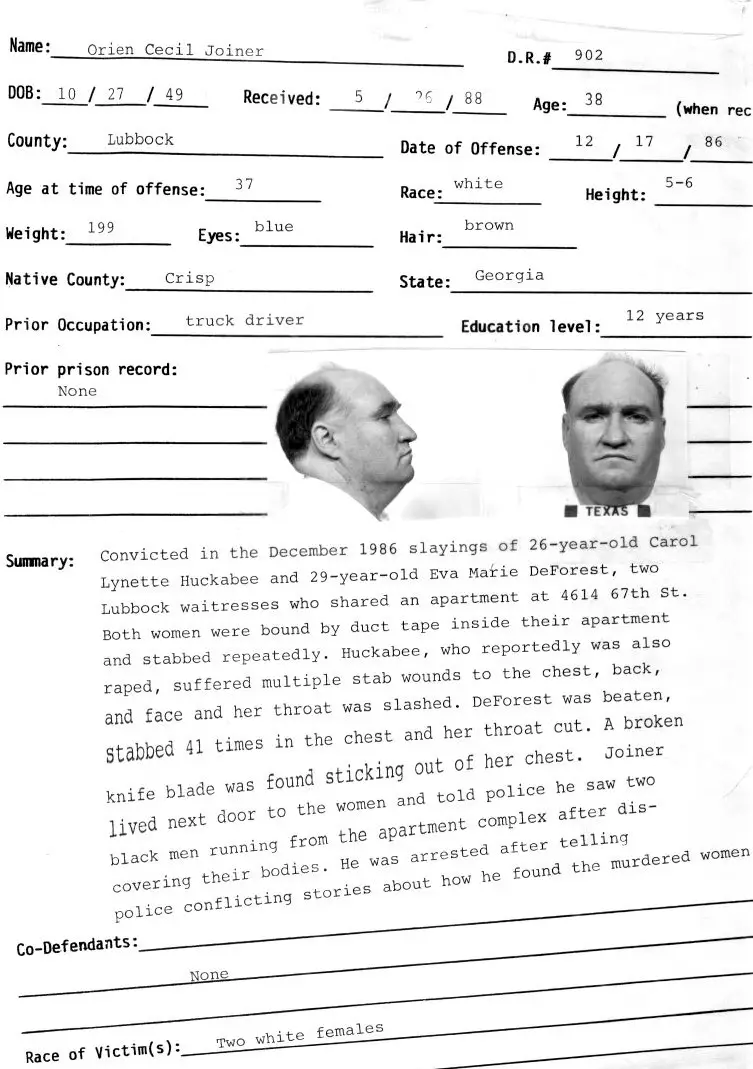
Orien Cecil JOINER
A.K.A.: "O. C."
Classification: Murderer
Characteristics: Rape
Number of victims: 2
Date of murders: December 17,
1986
Date of arrest: 3 days after
Date of birth:
October 27,
1949
Victims profile: Carol Lynette Huckabee,
26, and Eva Marie DeForest, 29
Method of murder: Stabbing
with knife
Location: Lubbock County, Texas, USA
Status: Executed
by lethal injection in Texas on July 12,
2000
Summary:
Orien Cecil "O.C." Joiner, 50, was executed by lethal injection on
12 July in Huntsville, Texas for the murder of two next-door
neighbors.
Carol Lynette Huckabee and Eva Marie DeForest were two waitresses
who shared an apartment in Lubbock. In December 1986, an intruder
bound both women with duct tape and stabbed them to death.
Huckabee, 26, was raped and suffered multiple stab wounds to the
chest, back, and face, and her throat was slashed. DeForest, 29, was
beaten, stabbed 41 times in the face, and her throat was cut. A
broken knife blade was left sticking out of her chest.
A resident of the apartment complex where Huckabee and DeForest
lived, saw Joiner (who lived next door) near their apartment with
blood on his shirt and dripping from his hand.
Tests done on
Joiner's shirt found that a blood stain on the shirt matched the
blood type of Carol Huckabee. Another stain found on Joiner's shirt
matched DeForest's blood type.
Final meal:
1/2 lb. Hamburger
steak (well done), brown gravy and grilled onions, large order of
deep french-fried fries with ketchup, five pieces of buttered
grilled Texas toast, iced tea with real sugar, hot honey buns with
melted butter on the side
Final words:
Kathy, y'all take and I bless all of you and I am glad I have had
y'all in my life. As I have said from the very first thing, I am
innocent of this crime and God knows I am innocent and the four
people that was murdered know I am innocent and when I get to heaven
I'll be hunting you and we'll talk. I feel sorry for the families
that's had to suffer and my family and I have 'em all in my prayers.
I love you all. Y'all take and y'all look after Sheila and Shannon
and them, call 'em and get the pictures to 'em and everything and,
ah, again, like I said, I feel sorry for the families, but if it
takes my death to make them happy, then I will bless them. I have no
hard feelings toward anyone cause the Lord feels that it is my time
to come home to Him, my work on earth is done and that, ah, like I
said, I am just sorry for, but they will have to go through this one
time again, cause sooner or later, whoever did this crime is going
to be caught and they'll have to come down here and do this again
and they will realize they witnessed an innocent man going to be
with Jesus Christ.
Texas Attorney General
MEDIA ADVISORY - ORIEN CECIL JOINER SCHEDULED TO
BE EXECUTED
AUSTIN - Texas Attorney General John Cornyn
offers the following information on Orien Cecil Joiner who is
scheduled to be executed after 6 p.m., Wednesday, July 12th:
Orien Cecil Joiner was convicted and sentenced to
death in April 1988 for the December 1986 murders of Carol Lynette
Huckabee and Eva Marie DeForest.
Joiner murdered Huckabee and
DeForest, who were roommates, in their Lubbock apartment. Huckabee
was stabbed in the chest and her throat was cut. Evidence also
showed that Joiner had raped Huckabee. DeForest was stabbed 41 times
and was found with blunt force trauma to her forehead. Also her
throat was cut.
EVIDENCE
A resident of the apartment complex where
Huckabee and DeForest lived, saw Joiner near their apartment with
blood on his shirt and dripping from his hand. Two days after the
murders, pictures of Joiner were taken showing a cut on his right
hand, cuts on his fingers and bloodstains on clothes he was wearing
the day of the murders.
Joiner told police that he saw two black men
running out the back of the victims' apartment, however, there were
no footprints found leaving the scene or on muddy ground on the
other side of the fence Joiner told police the men jumped over.
Tests done on Joiner's shirt found that a blood stain on the shirt
matched the blood type of Carol Huckabee. Another stain found on
Joiner's shirt matched DeForest's blood type.
APPEALS TIMELINE
March 18, 1992, Court of Criminal Appeals denied
motion for rehearing.
June 28, 1993, United States Supreme Court denied petition for writ
of certiorari.
June 11, 1998, Trial court entered findings of fact and conclusions
of law recommending that briefing filed in State court be denied.
Sept. 16, 1998, Court of Criminal Appeals denied relief based on its
own review.
March 2, 1999, Federal District Court denies relief and affirms
Joiner's conviction.
April 6, 1999, District Court denies permission to appeal.
Nov. 30, 1999, Fifth Circuit Court of Appeals denies permission to
appeal.
April 3, 2000, Supreme Court denies writ of certiorari.
To date, Joiner has not filed a clemency petition
with the Texas Board of Pardons and Paroles.
PRIOR CRIMINAL HISTORY
Joiner had behaved violently toward his wife
shortly before he committed the murders. Shortly after Thanksgiving
Joiner and his wife agreed to separate.
On Sunday, Dec. 14,1986, Joiner arrived
unexpectedly at Gustafson's (his wife) apartment. As soon as she let
him inside, Joiner closed the door behind him, pulled an open knife
from his right rear pocket, and placed it to her throat. Joiner
carried this particular knife with him on a daily basis. He then
told Gustafson "not to say anything and not to scream or he would
kill [her] right there."
Joiner then walked Gustafson over to the couch
and punched her twice in the face with his right fist. He cut her
sweater off and forced her to remove her pants and underwear. He
punched her several more times in the face, chest, stomach, and ribs.
Joiner continued this physical abuse of his wife
throughout that night and the early morning hours of Monday, Dec.
15, 1986. He punched her in the face and mouth several more times
and, at one point, attempted to strangle her. During this entire
episode, Joiner repeatedly told Gustafson that he "ought to kill [her]
right then and there."
Joiner made Gustafson call in sick to work. All
that day, he kept her and son James inside the apartment. By Tuesday
morning, Gustafson had convinced Joiner that she would not have him
arrested and that they would be reconciled.
He then allowed her to
leave with James to go to work. Gustafson did not return until
Wednesday evening, accompanied by a girlfriend and two police
officers, to retrieve her clothing and that of her son.
Kathleen Gustafson also testified that in 1985,
she was doing laundry in the laundry room when she needed to use the
bathroom. When she returned, Joiner did not believe her explanation
of where she had gone, accusing her of lying and "screwing around."
While she held her young son, Joiner hit Gustafson in the stomach
with his fist, hard enough to cause her to drop to her knees. The
noise caused a custodian to go to the laundry room to check on what
had happened.
A few months later, Gustafson's son was tickling
Joiner as he slept. Joiner grabbed him by his hair and threw him off
the mattress. Gustafson remembered slapping Joiner and told him to
leave James alone. Joiner then pulled out his knife and threatened,
"Don't ever hit me again."
Around Christmas, 1986, Joiner called Gustafson
from the Lubbock County Jail, following the Huckabee and DeForest
murders. He asked if she were going to file for divorce. When she
answered affirmatively, Joiner threatened to have both her and her
son killed.
The jury also heard several other instances of
Joiner's violent conduct. Pat Fink, who had worked with Joiner and
Gustafson since 1985, testified that he had seen Joiner threaten
people with his knife on four or five occasions. In Fink's opinion,
Joiner had a quick and violent temper.
Ernest Denman had been Joiner's employer from
September 1984 until March 1986. He saw Joiner threaten co-workers
with his knife on two occasions. First, Joiner had indicated his
desire to cut off facial features, i.e., a nose, tongue, or ear.
On the second occasion, Joiner threatened to make
"a woman" out of a male co-worker. Joiner was also placed on a 90-day
probation by Denman for pulling his knife on a group of workers who
were unloading his trailer.
ProDeathPenalty.com
Carol Huckabee, 26, and Eva DeForest, 29, were
waitresses and roommates in Lubbock Texas. They were found murdered
inside their apartment and both women had been bound with duct tape
and stabbed repeatedly.
Carol was raped, and suffered multiple stab
wounds to the chest, back and face before having her throat slashed.
Eva was beaten, stabbed 41 times in the chest and her throat was cut.
A broken knife blade was found sticking out of her chest.
Joiner lived in the apartment next door and
initially told police that he saw two assailants fleeing from the
apartment and gave conflicting statements about how he found the
murdered women.
A photograph taken of Joiner's right hand
immediately after the murders showed cuts on his hand and fingers.
During the trial, Joiner's estranged wife
presented testimony of Joiner's violent nature, which had escalated
prior to and during the couple's separation. She said that Joiner
had repeatedly beaten her and, towards the end, had put a knife to
her throat and threatened to kill her.
One resident of the apartment complex where
Joiner and the two waitresses lived testified that he had seen
Joiner near the women's apartment on the night of the murder with
blood on his shirt.
Tests done on the blood stains showed that the
blood was, in fact, that of both Huckabee and Deforest. A friend who
knew Joiner well also testified that Joiner had a violent temper and
had, on numerous occasions, threatened him and others with a knife
that he carried.
Texas Execution Information Center
Txexecutions.or
Orien Cecil "O.C." Joiner, 50, was executed by
lethal injection on 12 July in Huntsville, Texas for the murder of
two next-door neighbors.
Carol Lynette Huckabee and Eva Marie DeForest
were two waitresses who shared an apartment in Lubbock. In December
1986, an intruder bound both women with duct tape and stabbed them
to death.
Huckabee, 26, was raped and suffered multiple stab wounds
to the chest, back, and face, and her throat was slashed. DeForest,
29, was beaten, stabbed 41 times in the face, and her throat was cut.
A broken knife blade was left sticking out of her chest.
Joiner, then 37, called the police and told them
that he discovered the bodies then observed two men running from the
apartment complex and escaping over a fence. When police checked the
muddy ground around the fence, they could find no footprints.
Joiner
was arrested after telling the police conflicting stories about how
he found the murdered women.
A witness told police that he saw Joiner near the
victim's apartment with blood on his shirt and dripping from his
hand. Blood on his shirt and his shoes matched the blood types of
both of the slain women. He also had cuts on his right hand and
fingers.
Four weeks earlier, Joiner had been hospitalized
for emotional problems. Witnesses at his trial testified that he
carried a particular knife with him on a daily basis and that he had
threatened people with that knife on different occasions. He
reportedly threatened to kill or injure his estranged wife, co-workers,
and others.
Three days before the murders, Joiner
unexpectedly showed up at his estranged wife's apartment and
physically abused her throughout the night and into the next day. He
allowed her to leave after she promised not to have him arrested and
to reconcile with him.
In a death-row interview, Joiner said that he was
innocent. He said he saw the bloody bodies through a window, put his
fist through the window to get the door opened, then called police.
He said that the blood on his shoes got there when he and a police
officer walked through the apartment.
He also said that although he
was innocent and about to be executed, he was "happy as a lark"
because of his belief in God.
"As I have said from the very first day, I am
innocent of this crime and God knows I am innocent and the poor
people that were murdered know I am innocent and when I get to
Heaven, I (will meet them) and we'll all talk, Joiner said in his
final statement. While receiving the lethal injection, he mouthed "I
love you" to someone. He was pronounced dead at 6:17 p.m.
Trucker Executed for Double Slaying in Lubbock
By Michael Graczyk -
ReporterNews.com
Associated Press
HUNTSVILLE, Texas (AP) — Former long-haul trucker
Orien Cecil Joiner went quietly to his death Wednesday, proclaiming
his innocence while insisting he was ready to die. “My work on earth
is done,” Joiner said before receiving a lethal injection for the
fatal slashing and stabbing of two Lubbock women who lived in an
apartment next to him in December 1986.
Joiner's statement lasted
less than two minutes. He spoke matter-of-factly and nodded and
smiled at a friend. “As I've said since the very first thing, I am
innocent of this crime,” he said. “And God knows I'm innocent, and
the poor people that was murdered knows I am innocent. And when I
get to heaven, I'll be meeting you and we'll all talk.”
Joiner, 50, said he felt sorry for the family of
the victims, but that someday the real killer would be caught and
another execution would have to take place. “If it takes my death to
make them feel happy, then I will bless them. I don't have hard
feelings toward anyone because the Lord feels that it is my time to
come home to him,” he said.
The lethal drugs were administered at
6:11 p.m. Joiner was pronounced dead at 6:17 p.m. While being
injected, he mouthed “I love you” to someone. Then he gasped,
coughed and closed his eyes.
Joiner's execution brought to 25 the number of
condemned inmates put to death in Texas this year. One more
execution is set for later this month and at least six are scheduled
for August.
Joiner had called police the week before Christmas 1986
to tell them he discovered the bloody bodies of waitresses Carole
Huckabee, 26, and Eva Marie DeForest, 29, after seeing two men flee
the women's apartment and escape over a backyard fence. Authorities,
however, determined it was Joiner who was responsible for the
carnage.
Both victims were bound with duct tape. DeForest
was stabbed 41 times, her throat was cut and the broken knife blade
was left sticking out of her chest. Huckabee, her roommate, had her
face and neck slashed plus four stab wounds to her chest. Both were
raped during or after the fatal attacks.
Prosecutors produced a
witness, a neighbor, who testified he saw Joiner near the victims'
apartment with blood on his shirt and dripping from his hand. Tests
of blood stains on Joiner's shirt matched the blood types of both
women. “The state doesn't have to prove motive, but obviously the
sexual aspect looms large in that regard,” former Lubbock County
District Attorney Travis Ware, who prosecuted Joiner, said this week.
“Presumably they were objects of his fancy.”
Joiner, in a recent death row interview, said he
spotted the bloody bodies when he looked through a window, put his
fist through the window to get the door open, then called police.
He said blood on his shoes, which prosecutors used against him at his
trial, got there when he and a police officer walked through the
apartment. “I'm very sorry for their families, along with my family,
thinking I did something I didn't,” he said.
Police investigating Joiner's report that two men
ran from the victims' apartment could find no footprints in the
muddy ground where Joiner said he saw the men hop a fence. The
punishment drew far less attention than the execution last month of
convicted killer Gary Graham.
Graham's claims of innocence and an
unfair trial focused attention on Texas as the nation's most active
execution state and the support of the death penalty by Bush, the
presumptive Republican presidential nominee.
”(Graham) had a lot of important people backing
him and he was black,” Joiner, who is white and was known in prison
as O.C., said. “He was in the cell next door to me. He told me: 'If
I wasn't black, O.C., I wouldn't be getting all this publicity.'”
Asked if that troubled him, Joiner replied: “At first, it did... I
don't mind dying, if that's what the Lord wants, but I want my
innocence proven. If not for my belief in the Lord, I'd be a nut
case. But I'm happy as a lark. I know where I'm going.” Joiner, who
grew up in Macon, Ga., said he moved his small trucking business
from North Carolina to Texas to take advantage of Texas' lower taxes.
“Greed brought me to Texas,” he said.
Four weeks before the killings, Joiner was
hospitalized for emotional problems. Evidence showed three days
before the murders, he held his estranged wife hostage at knifepoint
and assaulted her. Prosecutors also showed the jury he had an
explosive temper and an affinity for knives.
Deathrow.at
ORIEN CECIL JOINER - Executed on July 12, 2000
Joiner (50) was executed for killing two women
who lived in the apartment next to him in 1986. In his very short
last statement he said: "As I've said since the very first thing, I
am innocent of this crime," he said. "And God knows I'm innocent,
and the poor people that was murdered knows I am innocent. And when
I get to heaven, I'll be meeting you and we'll all talk."
Prosecutors produced a witness, a neighbor, who
testified he saw Joiner near the victims' apartment with blood on
his shirt and dripping from his hand. Tests of blood stains on
Joiner's shirt matched the blood types of both women.
Joiner, in a recent death row interview, said he
spotted the bloody bodies when he looked through a window, put his
fist through the window to get the door open, then called police. He
said blood on his shoes, which prosecutors used against him at his
trial, got there when he and a police officer walked through the
apartment.
58 F.3d 143
In re Orien Cecil
JOINER, Petitioner.
No. 95-10376.
United States Court of Appeals, Fifth Circuit.
June 27, 1995.
On Petition for Writ of Mandamus
to the United States District Court for the Northern District of
Texas.
Before KING, HIGGINBOTHAM and
BARKSDALE, Circuit Judges.
PER CURIAM:
Orien Joiner was convicted of
capital murder and sentenced to death in Texas state court. The
Texas Court of Criminal Appeals affirmed his conviction, and the
U.S. Supreme Court denied certiorari. Joiner filed pro se
motions for stay of execution in state court, but the Texas
District Court and Court of Criminal Appeals denied the motions
and refused to appoint an attorney for state habeas proceedings.
Applying McFarland v. Scott,
--- U.S. ----, 114 S.Ct. 2568, 129 L.Ed.2d 666 (1994), the U.S.
District Court for the Northern District of Texas appointed
counsel to prepare Joiner's federal habeas petition. Seeking to
develop claims that had not been presented to the state courts,
appointed counsel asked the magistrate to authorize
investigative and expert assistance under 21 U.S.C. Sec.
848(q)(9). The magistrate denied the motion, and the district
judge overruled Joiner's objections to the magistrate's order.
Joiner seeks review in this court via petition for writ of
mandamus. We deny the petition.
Joiner concedes that he failed
to exhaust state remedies by first presenting all of the claims
he now raises to a state court. He nevertheless argues that he
has a right to federal counsel, including investigative and
expert assistance, to help him exhaust his state habeas
remedies. He relies on McFarland, which held that 21 U.S.C. Sec.
848(q)(4)(B) entitles prisoners seeking federal habeas relief to
court-appointed counsel for the preparation of a habeas petition.
--- U.S. at ----, 114 S.Ct. at 2572. The issue in that case was
whether the statutory right to appointed counsel attaches before
a prisoner files a federal habeas petition. Id. at ----, 114
S.Ct. at 2571-72. The Court answered that question in the
affirmative, reasoning that appointed counsel and experts are
necessary to prepare and present federal habeas cases
effectively. Id. at ----, 114 S.Ct. at 2572.
McFarland did not decide
whether the statutory right to appointed counsel in "every
subsequent stage of available judicial proceedings" extended to
state collateral review. 21 U.S.C. Sec. 848(q)(8). In other
words, McFarland addressed the timing of appointment of counsel,
not the scope of appointment. We settled the latter issue in
Sterling v. Scott, 57 F.3d 451 (5th Cir.1995). Sterling involved
a federal habeas petitioner who relied on McFarland in seeking
federally appointed counsel to exhaust his claims in state
postconviction proceedings. We held that McFarland resolved only
the issue of timing, leaving open the meaning of 21 U.S.C. Sec.
848(q)(8).
Sterling went on to decide
that, read as a whole, the statute provides counsel only for
proceedings after the end of state court proceedings. We are
bound by this prior panel opinion and hold that Joiner has no
right to the assistance of federally appointed counsel or
experts to exhaust state remedies.
In the alternative, Joiner
argues that he need not exhaust state remedies. The state
refused to appoint counsel for Joiner's state habeas case, and
Joiner claims that state remedies are by definition inadequate
because Joiner could not do a good job if he proceeded pro se.
It is true that prisoners who proceed pro se in state court but
fail because of ineptitude may perhaps be excused from taking
further steps to exhaust state remedies. See Hollis v. Davis,
941 F.2d 1471, 1475 (11th Cir.1991); Potter v. Dowd, 146 F.2d
244, 247 (7th Cir.1944). But even if this was the law in our
circuit, Joiner would still have to make an effort to exhaust
state remedies on his own. Otherwise, the exhaustion requirement
would be a nullity.
Because Joiner has no right to
federally appointed experts in state habeas proceedings, and
because he did not exhaust state remedies before raising his
federal claims, we DENY the petition for writ of mandamus.
*****
KING, Circuit Judge, specially
concurring:
Although I am uneasy about our
holding in Sterling v. Scott, 57 F.3d 451 (5th Cir.1995), I
agree that Sterling controls the outcome here and I therefore
concur.