Murderpedia has thousands of hours of work behind it. To keep creating
new content, we kindly appreciate any donation you can give to help
the Murderpedia project stay alive. We have many
plans and enthusiasm
to keep expanding and making Murderpedia a better site, but we really
need your help for this. Thank you very much in advance.
Yang
JIAQIN
Classification:
Homicide
Characteristics: Mentally ill - Outside an elementary school
Number of victims: 2
Date of murder:
April 13, 2010
Date of arrest:
Same day
Date of birth: 1969
Victim profile:
A schoolboy and an elderly woman
Method of murder: Hacked to death with a meat cleaver
Location: Xichang, Sichuan
Province, China
Status:
In closed psychiatric confinement
April 13, 2010 –
Xichang, China – Yang Jiaqin – 2 dead – 5 Injured
An assailant armed with a meat cleaver attacked
students and bystanders outside an elementary school, killing a
schoolboy and an elderly woman and wounding three other children and
two adults before being arrested by police. The assailant, identified
as 40-year-old Yang Jiaqin, was reported to be mentally ill.
Life in Shadows for Mentally Ill in China
By Sharon LaFraniere - The New York Times
November 10, 2010
XIZHEN, China — After five months in a rundown ward
at the Hepu County Psychiatric Hospital, Yang Jiaqin no longer suffers
terrifying hallucinations. Still, his wife dares not mention children,
not even their own, for fear of unleashing the demons that possessed
him one day last spring.
On a warm, sunny afternoon in April, Mr. Yang burst
from his home in this rural village near the Vietnamese border,
carrying a kitchen cleaver. He encountered three youngsters headed
home from school on the dirt path outside. He hacked two primary
schoolers, badly wounding both, and slit a second grader’s throat,
leaving him dying on the ground. Then he moved on. By the time police
officers caught up and subdued him, he had slashed two more people to
death.
The victims’ families have focused their rage on
the police. Three days earlier, Mr. Yang had struck a neighbor in the
head with an ax, but was not detained.
“They are completely responsible for this,” said Wu
Huanglong, the second grader’s father. “They did not protect us.”
But Mr. Yang’s doctors see a bigger failing.
Despite clear signs of schizophrenia, Mr. Yang had received medical
care for just one month in the previous five years.
“If he had been given medication and treatment, his
illness would not have developed,” said Chen Guoqiang, the psychiatric
hospital’s chief doctor. “If he had been able to control his
hallucinations, he would not have killed anyone.”
It has been nearly 35 years since the end of the
Cultural Revolution, when mental illness was declared a bourgeois self-delusion
and the sick were treated with readings from Chairman Mao. Psychiatric
treatment has returned. But mental health remains a medical backwater,
desperately short of financing, practitioners and esteem.
Too often, the official response to mental illness
is to look the other way. The government authorities, already shaken
by an attack the previous month in which eight schoolchildren were
stabbed to death, threw a news blackout over the Xizhen incident lest
it inspire copycats or incite further outrage.
At least three of six men whose attacks near
schoolyards this year left 21 people dead had earlier appeared
deranged or suicidal, according to news reports. But in the highest-level
statement on the killings, Prime Minister Wen Jiabao said only that
China needed to resolve “social tensions” underlying the attacks.
Yan Jun, director of the mental health division of
the Ministry of Health, refused repeated requests for an interview.
The ministry said in a written statement that the government was
“continuously strengthening” both its resources and professionals to
provide mental health care.
A Dearth of Care
It has far to go. Only 1 in 12 Chinese needing
psychiatric care ever sees a professional, according to a study last
year in The Lancet, a British medical journal. China has no national
mental health law, little insurance coverage for psychiatric care,
almost no care in rural communities, too few inpatient beds, too few
professionals and a weak government mental health bureaucracy, Chinese
experts in the field say.
The Health Ministry’s own mental health bureau,
established four years ago, consists of three people. Dr. Yan, the
director, is a public health specialist, not a psychiatrist.
Every few years, China’s news media declare that a
national mental health law is speeding toward adoption. The first
draft was written half a century ago. Asked how many revisions it has
undergone, Dr. Ma Hong of the Peking University Institute of Mental
Health said, “Countless.”
Most psychiatric hospitals are financially unviable,
said Yu Xin, who directs the Peking University Institute of Mental
Health. One, in Hubei Province, opened a box factory in the 1990s to
stay afloat. The fee structure is so absurd, he said, that hospitals
can charge patients more for computer-generated diagnoses based on
filled-out forms than for sessions with actual psychiatrists.
The Lancet study estimated that roughly 173 million
Chinese suffer from a mental disorder. Despite government efforts to
expand insurance coverage, a senior Health Ministry official said last
June that in recent years, only 45,000 people had been covered for
free outpatient treatment and only 7,000 for free inpatient care
because they were either dangerous to society or too impoverished to
pay.
The dearth of care is most evident when it comes to
individuals who commit violent crimes. For example, after Liu Yalin
killed and dismembered an elderly couple cutting firewood in a
Guangdong Province forest, he was judged to be schizophrenic and
released to his brother. Unable to afford treatment, the brother flew
Mr. Liu to the island province of Hainan, in the South China Sea, and
abandoned him, a Chinese nongovernment organization, Shenzhen Hengping,
said in a recent report.
Last year, Mr. Liu killed and dismembered an 8-year-old
Hainan girl.
“The government doesn’t want to cough up the money
to treat these people, so they just give them back to their families,”
said Huang Xuetao, a mental health lawyer and one of the authors of
the report.
Left to their own devices, some relatives resort to
heartbreaking solutions. In 2007, He Jiyue, a government psychiatrist,
discovered a 46-year-old man locked behind a metal door in a stinking
room in a rural Hebei Province home. The man was mentally ill, his
aged parents told Dr. He. They had locked him up after he attacked his
uncle.
That was 28 years earlier. The man, a high school
graduate, could no longer speak. “I said to the parents: ‘How could
you do this to somebody?’ ” Dr. He recalled. They replied, “We had no
choice.”
In the past three years, Chinese mental health
workers have rescued 339 other people whose relatives were too poor,
ignorant or ashamed to seek treatment. Some, shackled in outdoor sheds,
were “treated just like animals,” said Dr. Liu Jin, of the Peking
University mental health institute.
Chronic shortages of both doctors and facilities
ensure that what care exists is limited. China averages just one
psychiatrist for every 83,000 people — one-twelfth the ratio in the
United States — and most lack a university degree in any subject, much
less mental health, Dr. Ma said.
“Professional psychiatrists in China are like
pandas,” said Zhang Yalin, assistant director of the mental health
research institute at Central South University’s medical school.
“There are only a few thousand of us.”
A Profession Lacks Respect
Psychiatry’s bottom-of-the-barrel image in the
medical community deters students from joining the profession. Dai
Jun, a 24-year-old medical student in Wuhan, in central China, said he
studied psychiatry when he enrolled at Nanjing Medical University six
years ago because it was the only specialty with an opening. As an
intern, he noticed that psychiatrists were not treated or rewarded
like other doctors.
Patients often give surgeons and other specialists
“hongbao” — envelopes of cash that can make up a third of a doctor’s
income — in exchange for better treatment. Psychiatrists get neither
hongbao nor respect.
“People think, ‘Oh, you are constantly locked up
with crazy people. Maybe you are going to go crazy yourself, or you
are already crazy. That is why you want to do this,’ ” Mr. Dai said.
At his first opportunity, he switched to orthopedics.
Although research is scanty, a recent Health
Ministry survey suggests that the need for more specialists is growing
fast. The study found that the incidence of mental disorders had
climbed more than 50 percent from 2003 to 2008. Although some of the
increase was because of greater awareness and reporting, Dr. Ma argues
that the incidence of stress-related disorders like depression and
anxiety has shot up.
“Chinese society is just changing too fast for
people to adjust to it,” she said.
The government recently pledged to invest more in
mental health care, mostly by pouring billions of dollars into new and
renovated psychiatric hospitals. Many psychiatric hospitals are more
than half a century old and located — by design — far from cities.
China added 50,000 psychiatric hospital beds from 2003 to 2008. But it
needs more: Tibet, a region nearly three times as big as California,
lacks a single psychiatric institution, the Peking University mental
health institute says.
The Downward Spiral
Like much of rural China, Xizhen, in southern
Guangxi, one of China’s poorest provinces, is isolated from services.
Here, several hundred villagers tend fields of towering green sugar
cane and cassava plants, sinking wells for water and chopping wood for
fuel. Untrained practitioners who call themselves doctors handle most
medical needs. The nearest hospital is an hour away by car.
Yang Jiaqin was a local health care worker.
Although neither he nor his wife, Wen Zhaoying, had medical training
beyond high school, the two dispensed care for years from a tiny
clinic opposite Xizhen’s primary school. Five years ago, Ms. Wen said,
it became obvious that her husband was the one who needed treatment.
Always excitable and easily frightened, she said, he became obsessed
with the notion that people were after him.
One night that autumn, he fled his house during a
raging storm. Relatives found him the next day pacing near a pond,
covered with scratches, shaking violently, she said. “It was very
scary,” he told her. “People were chasing me all night.”
Relatives ferried Mr. Yang to the Hepu County
Psychiatric Hospital, a sprawling, ramshackle collection of one-story
buildings outside Beihai, the closest city. Administrators say the
hospital’s five doctors serve a region of more than one million people.
There, Ms. Wen said, a psychiatrist prescribed
medication that helped calm her husband. Still, his episodes grew more
severe. In 2007, she said, Mr. Yang leaped from a third-floor window
to escape imaginary pursuers, breaking his leg. In 2008, he fled
Shenzhen, where he had become a migrant worker, and called the police
from a Shanghai television tower, threatening suicide.
Doctors at a Shanghai psychiatric hospital
diagnosed his condition as schizophrenia, administered antipsychotic
drugs and, a month later, set him free.
Family members say that was Mr. Yang’s last
encounter with a mental health professional. Mr. Yang refused doctors’
advice to return to his local psychiatric hospital, his wife said, so
she went alone, Shanghai prescription in hand. Without examining her
husband, she said, a psychiatrist decided that he was not psychotic
and changed his medication.
By last spring, Mr. Yang, 40, was afraid to leave
his dim mud-clay house. “All he did was stay home and cry,” Ms. Wen
said. Last April 9, the demons inside him took control.
That evening, Mr. Yang smashed through the wooden
door of his 63-year- old neighbor, Wu Wenguang, and struck him in the
head with an ax. At the hospital where doctors stitched his wound, Mr.
Wu said, the local police chief told him: “When crazy people hurt
somebody, there is nothing we can do.”
Ms. Wen said the police found her husband at home
that Friday night but told her the matter was best settled privately.
“None of this would have happened” had they arrested him, she said. In
a statement, the police insisted that they had searched fruitlessly
for Mr. Yang, then told his wife he should turn himself in.
Ms. Wen said she began arrangements that weekend to
admit her husband to a hospital. Mr. Yang’s 74-year-old mother, Pei
Renyuan, said her son warned that he would kill himself and “take all
of you with me.” Mr. Yang’s younger brother was assigned to watch him.
The following Monday afternoon, Wu Junpei, a
spirited 8-year-old who loved to draw, sing and practice gymnastics,
left school with friends, taking his usual shortcut past the Yang
house toward his home 10 minutes away. Mr. Yang jumped onto the path
with a cleaver and slashed a first grader, who fled. Then he turned on
Junpei, slicing his arm and neck in quick succession.
Wu Zunwei, the boy’s 14-year-old cousin, was next.
“I fell to my knees and begged him, ‘Please don’t hurt me,’ ” Zunwei
recalled. Mr. Yang slashed his shoulder. “He didn’t say anything,”
Zunwei said. “He was crying.”
Wu Huanglong, 43, raced over on his motorcycle to
find his son lying, face up, on his blood-soaked navy backpack. “When
I saw his eyes were staring up at me,” he said, “I thought to myself:
‘This is it. I am finished. I have lost everything.’ ”
Running from house to house, Mr. Yang killed a 70-year-old
woman who was making firecrackers, and a man who was watching a
television drama on his sofa. He slashed the man’s wife and a girl
drawing well water.
The police, who seemed so quick to dismiss Mr. Yang’s
earlier attack, were suddenly energized. Junpei’s 20-year-old sister
said riot police officers descended on the hospital that night,
wrapped Junpei’s corpse in a sheet and drove off with it, ignoring her
screams of protest.
The county government has yet to release the body,
Mr. Wu said. Villagers say that is probably because Mr. Wu refuses to
sign a declaration that no one is to blame for his son’s death in
exchange for about $19,000 in compensation.
Dr. Chen, the psychiatric hospital’s chief doctor,
said Mr. Yang’s rampage occurred because “he has never been under
systematic care.” His family, he said, “did not take his illness
seriously enough.”
But he also said that his own hospital sometimes
released mental patients purely because families could not afford
treatment.
“The government has to invest more so that we can
take care of all the patients who need treatment, regardless of
whether or not the family can pay for it,” he said.
Dr. Chen and another hospital doctor say Mr. Yang’s
condition has now stabilized. Their goal is to send him home. But Ms.
Wen said she could neither care for him nor cover the cost of
continued treatment.
If she does not pay, she said, hospital officials
have warned that her husband will be released to her custody.
Zhang Xue, the hospital’s president, denies that.
“I have never heard of such a thing,” she said. “The government takes
this case very seriously and is devoting resources to it,” she said.
Autumn is still warm in Xizhen. Farmers harvest
peanuts in their undershirts. Schoolchildren shoot marbles outside.
After dinner, Mr. Yang’s aged parents like to leave their double
wooden door open for air.
Junpei’s mother often shows up to burn incense on
their doorsill, wailing in the gathering dark. She and her husband say
Mr. Yang’s family is pretending that he is mentally ill to protect him.
Ms. Pei, Mr. Yang’s mother, said she could not face
the woman’s grief or her own shame. As soon as she sees her, she shuts
the doors.
Dan Levin and Xiyun Yang contributed reporting from Beijing. Research
was contributed by Helen Gao, Benjamin Haas and Ashley Li from
Beijing, and Wang Xiao from Xizhen.
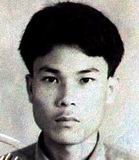
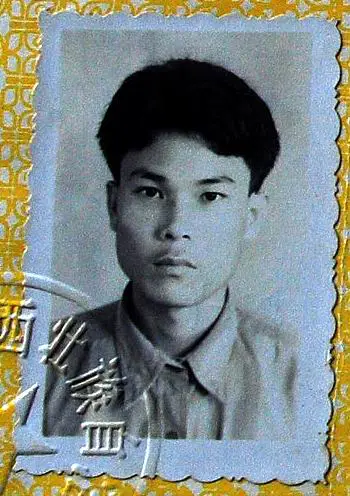
Yang Jiaqin's identification photo.
He had received medical care for just one month in the previous five
years.
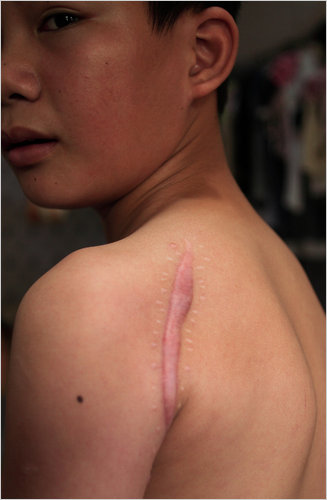
Wu Yuankun, a first grader who was
slashed in the attack by Yang Jiaqin.
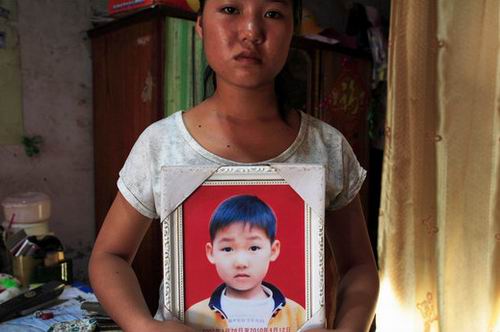
Wu Xiaoyu, 20, holding a photo of her brother, 8-year-old
Wu Junpei. The boy was killed by Yang Jiaqin, a mentally ill man who
failed to receive adequate treatment.