Murderpedia has thousands of hours of work behind it. To keep creating
new content, we kindly appreciate any donation you can give to help
the Murderpedia project stay alive. We have many
plans and enthusiasm
to keep expanding and making Murderpedia a better site, but we really
need your help for this. Thank you very much in advance.
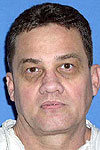
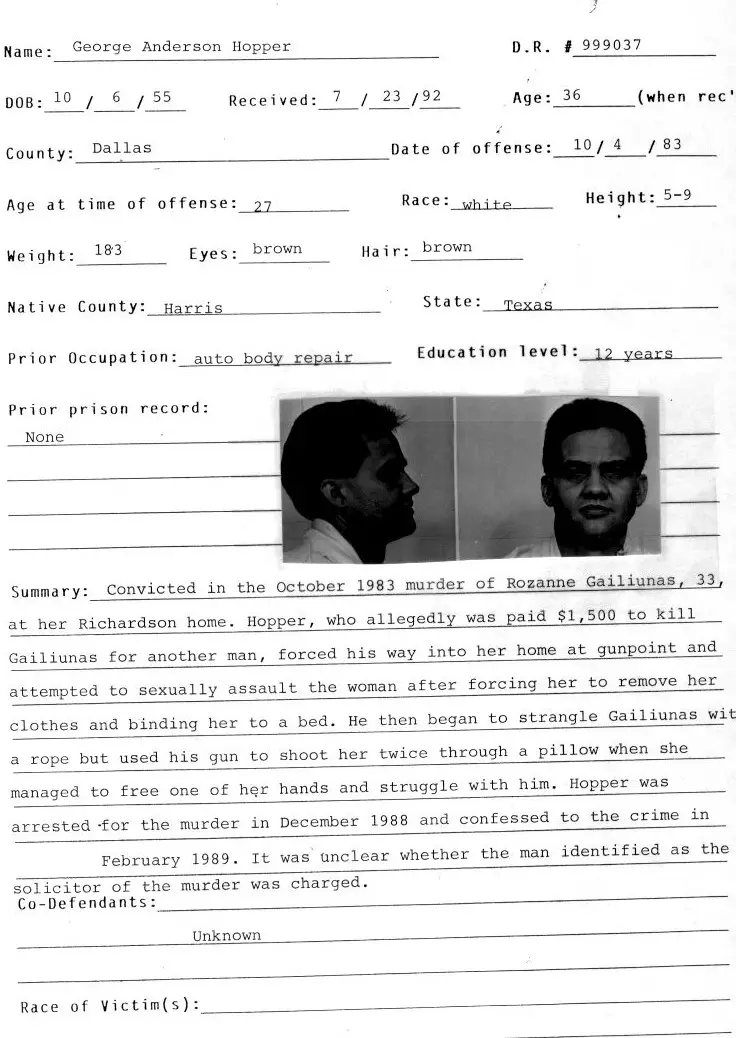
George Anderson
HOPPER
A.K.A.: "Andy"
Classification: Murderer
Characteristics:
Murder for hire
- Rape
Number of victims: 1
Date of murder: October 4,
1983
Date
of arrest:
December 20,
1988
Date of birth:
October 6,
1955
Victim profile: Rozanne Gailiunas
(female, 33)
Method of murder:
Shooting
Location: Dallas County, Texas, USA
Status: Executed
by lethal injection in Texas on March 8,
2005
Summary:
In 1983 Hopper entered the Richardson, Texas home of 33-year-old
Rozanne Gailiunas and attacked her in her bedroom.
While her four-year-old son was sleeping in another room, Hopper
tied Gailiunas to her bed, strangled her and shot her twice in the
head.
Gailiunas’ son found his mother with tissue stuffed in her mouth and
making a gurgling sound. Gailiunas lived for two days before she was
taken off life-support and died.
The murder went unsolved for nearly 5 years until the investigation
centered on Joy Davis Aylor, a Dallas socialite whose husband had
been having a relationship with Gailiunas at the time of her murder.
Through the confessions of several middlemen it was learned that
Aylor had paid $5,000 for “taking care of” Rozanne. The
investigation led to Hopper who had been given $1,500.
Upon arrest, Hopper admitted to the murder, providing the police
with detailed audio and video confessions.
Aylor fled to Canada, then France, on the eve of her 1990 murder
trial. After two years assuming a false identity there, France
agreed to extradition upon the agreement of Texas authorities not to
seek the death penalty. Aylor was convicted of Murder and is serving
a life sentence.
Citations:
Hopper v. Cockrell, Not Reported in F.Supp.2d (2002) (Habeas)
Hopper v. Dretke, 106 Fed.Appx. 221, 2004 WL 1663599 (5th
Cir. 2004)(Habeas)
Final Meal:
Six eggs over easy, 10 biscuits, 12 pieces of bacon, a bowl of grits,
white gravy, strawberry preserves, french fries, fried chicken and
chocolate meringue pie.
Final Words:
Hopper turned toward four members of his victim's family, including
the son who discovered his mother's body, and said he was sorry."I
have made a lot of mistakes in my life. The things I did changed so
many lives. I can't take it back. It was an atrocity. I am sorry. I
beg your forgiveness. I know I am not worthy of it. Then he turned
his head toward a second window, where his parents were among those
watching. He told them he loved them and thanked them "for
everything.''
ClarkProsecutor.org
Texas Attorney General
Media Advisory
Friday, March 4, 2005
George
Anderson Hopper Scheduled For Execution
AUSTIN – Texas Attorney General Greg Abbott
offers the following information about George Anderson Hopper, who
is scheduled to be executed after 6 p.m. Tuesday, March 8, 2005, for
the 1983 capital murder of Rozanne Gailiunas in her Richardson home.
FACTS OF THE CRIME
On October 4, 1983, Hopper attacked 33-year-old
Rozanne Gailiunas in the bedroom of her Richardson, Texas, home.
While her four-year-old son was sleeping in another room, Hopper
tied Gailiunas to her bed, strangled her and shot her twice in the
head. Gailiunas’ son found his mother with tissue stuffed in her
mouth and making a gurgling sound. Gailiunas lived for two days
before she was taken off life-support and died.
Gailiunas’ murder went unsolved until early 1988
when the investigation centered on Joy Aylor, whose husband had been
having a relationship with Gailiunas at the time of her murder.
Through the confessions of several middlemen who had each skimmed
portions of a $5,000 payment, Aylor had paid as an advance for
“taking care of” Rozanne, the investigation led to Hopper who had
been given $1,500 of the original $5,000 as the next person in the
chain of Aylor’s murder-for-hire scheme.
After a five-month, multi-state attempt to elude
the police, Hopper was arrested on December 20, 1988, in the Dallas
area. On February 27, 1989, Hopper admitted to the murder, providing
the police with detailed audio and video confessions. Ultimately,
Hopper was convicted for the capital murder of Rozanne Gailiunas and
sentenced to death.
PROCEDURAL HISTORY
February 14, 1991 -- A Dallas County grand jury
indicted Hopper for capital murder for killing Rozanne Gailiunas.
March 2, 1992 -- A Dallas jury found Hopper guilty of capital murder.
March 16, 1992 -- The punishment phase concluded with a death
sentence.
November 5, 1997 -- The Texas Court of Criminal Appeals affirmed
Hopper’s conviction and sentence.
March 1, 2000 -- The Texas Court of Criminal Appeals denied Hopper’s
state application for writ of habeas corpus.
October 31, 2002 -- A U.S. district court denied a federal petition
for writ of habeas corpus.
July 22, 2004 -- The 5th U.S. Circuit Court of Appeals denied relief.
Rehearing was denied on September 27, 2004.
December 1, 2004 -- A Dallas county district court set the execution
for March 8, 2005.
December 10, 2004 -- Hopper filed a petition for writ of certiorari
in the U.S. Supreme Court. The petition is pending.
CRIMINAL HISTORY
• 1976 -- Hopper (age 20) charged with indecent
exposure for exposing himself to an apartment manager in Houston,
TX.
• 1984 -- Hopper arrested in connection with a pick-pocketing
incident at Richardson Square Mall.
• 1982-1986 -- Hopper sold marijuana on consignment from drug dealer/friend.
George Anderson
Hopper, a 49-year-old
white male, was executed by lethal injection at the
Texas State Penitentiary in Huntsville, Texas on
March 8, 2005. Hopper was found guilty of the 1983
murder of Rozanne Gailiunas, a 33-year-old white
female. Hopper, who was 27-years-old when he
committed the capital crime, was sentenced to death
on March 16, 1992.
On October 4, 1983, 4-year-old
Peter Gailiunas Jr. found his mother, Rozanne
Gailiunas, naked and unconscious in her Richardson,
Texas bedroom. The boy’s mother had been brutally
assaulted and shot twice in the head. She never
regained consciousness and died at the hospital two
days later after which Peter Gailiunas put up a
$25,000 reward for information leading to an arrest
for his wife's murder. At the time of her death
Rozanne had been having an affair with Larry Aylor.
Several years later, Carol
Garland, in pursuit of the reward, told police that
her sister, Joy Davis Aylor, a 34-year-old white
female, had arranged to have Rozanne murdered.
Police confirmed that Joy, Larry’s wife, had paid
$5000 to Carol’s husband, William Westley Garland,
to have Rozanne killed, and they were able to trace
the money as it then passed to Brian Lee Kreafle who
in turn hired Hopper. Each individual had skimmed a
little of the money and passed the remainder along.
Hopper apparently received $1500 of the original
$5000.
Police began looking for Hopper
in the summer of 1988 to discuss Rozanne's murder.
At that time police did not know whether Hopper was
Rozanne's killer—all police knew then was that
Hopper was the most recent person to receive the
money.
On December 20,
1988, Hopper was arrested and arraigned the
following day even though counsel was not appointed
and Hopper made no request for counsel at that
arraignment. On December 22 and despite his lack of
counsel Hopper contacted Detective McGowan offering
to cooperate. Hopper admitted that he had received
the money to kill Rozanne and that he had passed
$1000 of that money on to a drug dealer named
"Chip." Hopper also gave McGowan a description of
Chip as well as information regarding Chip's usual
haunts.
Hopper was not appointed counsel
until December 27, six days after his arraignment
and five days after he first willingly spoke with
McGowan and gave the detective the "Chip story." Jan
Hemphill, the court appointed counsel, met with
Hopper several times over the next few weeks as well
as with the prosecution.
The prosecution informed Hemphill
of its intent to seek the death penalty for Joy
Aylor as well as the shooter. The prosecution also
told Hemphill that it was willing to work with all
of the middlemen in the chain to get those two death
penalty convictions. Hemphill repeatedly advised
Hopper of the prosecution's plans and discussed with
him the risks of cooperation. She also advised
Hopper that her advice was based on the information
that Hopper had given her.
On February 21, 1989, Hopper
again contacted McGowan and informed the detective
of his intent to cooperate. He told McGowan that he
had spoken with Hemphill and that Hemphill had given
Hopper permission to contact police. McGowan then
called the prosecution who verified with Hemphill
that Hopper had her permission to talk with police.
The prosecution also secured Hemphill's consent to
give Hopper a polygraph examination, and a blanket
consent to talk to Hopper in the future without
having to contact her first.
The following day Hopper met with
McGowan. Hopper was read his Miranda rights, and
after waiving those rights, completed a six page
written statement detailing and supplementing the
story he had previously given to McGowan that
inculpated the drug dealer Chip. After this
interview Hopper was told that the story would be
verified by a polygraph examination to be scheduled
in the upcoming few days.
On Februrary 27 Hopper was given
a polygraph examination. Prior to this examination
he was again read his Miranda rights. After being
told that the polygraph examination indicated
falsity and after receiving a fresh Miranda
recitation Hopper was questioned by McGowan who
asked Hopper to tell his story once again, starting
at the beginning. After Hopper recounted the "Chip
story," McGowan told Hopper that McGowan believed
Hopper was not telling police the entire story.
McGowan then showed Hopper a picture of Chip and
told Hopper that the police were close to locating
Chip. The detective asked Hopper what would happen
if police questioned Chip and Chip passed a
polygraph. Hopper said that the investigation would
"lead back to me [Hopper]" and asked "Can I go back
and think about it?" The detective responded, "Andy,
I want the truth now." After a brief pause Hopper
admitted that he killed Rozanne and gave a factually
detailed confession that was both audio and
videotaped.
Hopper’s confession and the gun
used to shoot Rozanne were admitted into evidence at
his trial. Also admitted into evidence was testimony
regarding an independent confession Hopper made to a
jailhouse informant, and an admission of guilt in a
letter Hopper wrote to a close friend. The testimony
of the jailhouse informant closely tracked the
confession that Hopper gave to police. The letter
admission of guilt was not detailed, but in that
letter Hopper wrote: "I am the one who killed this
person."
Joy Aylor was convicted of
capital murder and sentenced to life in prison. She
was arrested in September 1988 and released on
$140,000 bail the night before her 1990 murder trial
was to begin, Aylor emptied her bank accounts and
fled to Canada with her attorney, who was also
reportedly her lover. After the lawyer was arrested
in Canada on a drug charge, Aylor fled to Mexico and
then Europe. She settled around Nice, France living
under the alias Elizabeth Sharp. Her identity was
exposed after she became involved in a minor traffic
accident while driving a rental car. She was
arrested in March 1991 but the French government
refused to extradite her because of its opposition
to capital punishment. In December 1993 Aylor was
returned to Texas after the State pledged that she
would not face the death penalty. Garland and
Kreafle were each sentenced to 30 years’
imprisonment.
Wikipedia.org
ProDeathPenalty.com
George Hopper was sentenced to death in 1988 for
the October 1983 strangulation and shooting of Richardson nurse
Rozanne Gailiunas, 33.
Hopper was hired to kill Ms. Gailiunas by Dallas socialite Joy Davis
Aylor, who was ultimately convicted of capital murder in 1994 and
who is now serving a life sentence.
George Anderson Hopper, 44, was convicted in March 1992 for the
October 1983 murder of Rozanne Gailiunas. Hopper was sentenced to
die by lethal injection.
According to court records, Hopper was hired by an unidentified man
to kill the 33-year-old Gailiunas for $1,500. Hopper carefully
planned the attack by surveying Gailiunas's Richardson home twice -
breaking in once, prosecutors said.
Once Hopper felt he knew the area well enough, he posed as a flower
delivery man and coerced his way into the woman's home.
While Gailiunas' 4-year-old son slept across the hall, Hopper tied
the woman to her bed, raped her then strangled her.
When Gailiunas managed to break free and attempted to struggle,
Hopper shot her through a pillow with a .25-caliber pistol, the
records say. Hopper was hired by Joy Davis Aylor to kill Ms.
Gailiunas. Rozanne was dating Ms. Aylor's estranged husband at the
time of the killing.
Ms. Aylor was convicted of capital murder in 1994 and is serving a
life sentence in prison.
Book on this case: Open Secrets: A True Story of Love, Jealousy, and
Murder (St. Martin's True Crime Library) by Carlton Stowers.
Texas Execution Information
Center by David Carson
Txexecutions.org
George "Andy" Anderson Hopper, 49, was executed
by lethal injection on 8 March 2005 in Huntsville, Texas for the
murder-for-hire of a 33-year-old woman.
On 4 October 1983 in Richardson, 4-year-old Peter
Gailiunas Jr. found his mother, Rozanne, 33, lying on her bed,
bloody, naked, and unconscious. Her mouth was stuffed with tissue
and she was making a gurgling sound. She had been strangled and shot
twice in the head. She was taken to the hospital, where she died
after two days.
At the time of the murder, the victim had been
having an affair with Larry Aylor, a wealthy homebuilder who was
building a new house for the Gailiunases. Gailiunas and Aylor had
both filed for divorce from their spouses and had plans to marry.
Peter Gailiunas Sr. accused Aylor of the murder. Aylor, in turn,
accused Peter. Both men were cleared, however, and no arrests were
made. Aylor's socialite wife, Joy, 34, was also initially considered
as a suspect. Peter Gailiunas put up a $25,000 reward for
information leading to an arrest for his wife's murder.
Larry and Joy Aylor reconciled after his affair
was disclosed, but in 1986, they were again considering divorcing.
Around that time, Larry was ambushed at his ranch by two gunmen, but
he managed to escape. Two years later, he received an anonymous
phone call from a woman claiming that the 1986 attempt on his life
was connected to Rozanne Gailiunas' death. Aylor urged the woman to
call the police.
That woman, Carol Garland, did call the police,
and asked about the $25,000 reward. She then told police that her
sister, Joy Aylor, paid her husband, William Garland, $5,000 to have
Rozanne Gailiunas killed. Garland and another man, Brian Kreafle, in
turn hired Hopper and paid him $1,500 to carry out the crime.
Hopper eluded police for five months, but was
finally arrested in the Dallas area on 20 December 1988. He gave
detailed audio and video confessions on 27 February 1989. He said
that he went to Gailiunas' home posing as a flower delivery man.
Once inside the house, he forced Gailiunas to remove her clothing,
then tied her to a bed and attempted to rape her. He then began to
strangle her with pantyhose. When the victim freed one of her hands
and began struggling with him, he shot her in the head twice through
a pillow.
The investigation went on for two more years
before Hopper was indicted. Hopper had no prior felony convictions.
He had previously been charged with indecent exposure and had been
arrested for pickpocketing. A jury convicted Hopper of capital
murder in March 1992 and sentenced him to death. The Texas Court of
Criminal Appeals affirmed the conviction and sentence in November
1997. All of his subsequent appeals in state and federal court were
denied.
Joy Aylor was arrested in September 1988, but was
released on $140,000 bail. The night before her 1990 murder trial
was to begin, she emptied her bank accounts and fled to Canada with
her attorney, who was also reportedly her lover. After the lawyer
was arrested in Canada on a drug charge, Aylor then fled to Mexico,
then Europe. She settled around Nice, France, living under the alias
Elizabeth Sharp. Her identity was exposed after she became involved
in a minor traffic accident while driving a rental car. She was
arrested in March 1991.
The French government refused to extradite
her, however, because of its opposition to capital punishment. Aylor
was returned to Texas in December 1993 after the state pledged that
she would not face the death penalty. She was convicted of capital
murder and was sentenced to life in prison.
William Garland and Brian Lee Kreafle also
received life sentences.
In 1993, Gailiunas' parents won a $35 million
lawsuit against Joy Aylor for her responsibility in their daughter's
death.
Aylor was also found to be behind the 1986
attempted murder of her husband. Larry Aylor won a $31.2 million
lawsuit against his wife in 1990. The two gunmen involved in that
crime were also apprehended, convicted, and sent to prison.
The long, intricate story was made into two books:
"To Hatred Turned: A True Story of Love and Death in Texas" by Ken
Englade in 1993, and "Open Secrets: A True Story of Love, Jealousy,
and Murder" by Carlton Stowers in 1994. It also inspired a made-for-television
movie, "Telling Secrets," starring Cybill Shepherd in 1993.
"I have made a lot of mistakes in my life,"
Hopper said in his last statement. "The things I did changed so many
lives. I can't take it back. It was an atrocity. I am sorry. I beg
you forgiveness. I know I am not worthy of it." Hopper then told his
parents that he loved them and said a brief prayer. The lethal
injection was then started. He was pronounced dead at 6:22 p.m.
National Coalition to Abolish
the Death Penalty
George Hopper Jr. - TEXAS - March 8, 2005
Texas March 8, 2005 The state of Texas is
scheduled to execute George Hopper Jr. March 8 for the 1983 murder
of Rozanne Gailiunas. Joy Davis Aylor hired Hopper through a series
of middle men to kill Gailiunas who was said to be having an affair
with her husband. Aylor fled to France for several years before
French officials agreed to extradite her on the condition that
prosecutors promise not to seek the death penalty. Aylor, who was
able to hire a high profile defense attorney to represent her,
received a prison term rather than the death penalty.
According to court records, at trial Hopper
focused on the fact that he was not permitted to have a lawyer
present during all of the periods where he was being questioned. He
argued this rendered his confession inadmissible. After the trial,
it was revealed that the lead police investigator and key witness
against Hopper, Captain Morris McGowan, signed a book deal for
$109,000 for helping author Carlton Stowess write a book entitled
Open Secrets about the events leading up to the trial. McGowan said
he didn’t tell prosecutors about the deal in part because “the
district attorney’s office wouldn’t approve of it.”
Subsequently, the defense was not aware of
McGowan’s monetary gain for his involvement in the case until after
the trial. McGowan was never questioned about his motivations at
trial. He also acknowledged some inconsistencies between Hopper’s
police statement and evidence found at the crime scene. Please take
a moment to write the state of Texas requesting that Hopper’s
sentence be commuted to a prison term.
Convicted hit man put to death for role in
Dallas case murder case
Houston Chronicle
March 8, 2005
HUNTSVILLE - An apologetic former auto insurance
appraiser who authorities said collected $1,500 to kill a Dallas-area
physician's wife more than two decades ago was executed Tuesday
evening.
Asked by the warden if he had a final statement,
George Anderson Hopper turned toward four members of his victim's
family, including the son who discovered his mother's body, and said
he was sorry. "I have made a lot of mistakes in my life. The things
I did changed so many lives. I can't take it back. It was an
atrocity. I am sorry. I beg your forgiveness. I know I am not worthy
of it,'' he said, his voice breaking with emotion. Then he turned
his head toward a second window, where his parents were among those
watching. He told them he loved them and thanked them "for
everything.'' Hopper, 49, said a brief prayer, which his mother
repeated with him. He gasped a couple of times as the lethal drugs
took effect. Eight minutes later at 6:22 p.m., he was pronounced
dead.
Hopper was condemned for being the hit man in a
complicated scheme initiated by a woman bitter because her
soon-to-be ex-husband was dating the murder victim. Rozanne
Gailiunas, 33, was killed in the October 1983 attack at her home in
the Dallas suburb of Richardson. She had been raped, choked with
pantyhose, shot twice in the head, had tissue jammed down her throat
and was tied naked to a four-poster bed. Her then 4-year-old son
found her unconscious. She died two days later.
It was years, however, before police could
unravel the case, which became one of the most intricate and complex
ever in Dallas County and took authorities to Canada, Mexico and
Europe. ``Our family is certainly looking forward to closing this
chapter,'' said Peter Gailiunas, whose wife was killed. Gailiunas
was there but did not witness the execution with his son, now 25.
Hopper's execution was the fourth this year in Texas.
The U.S. Supreme Court refused to stop the
punishment. In late appeals, Hopper's lawyers had argued his
confession was obtained improperly because detectives continued
questioning him after he asked to be returned to his jail cell to
think about what he wanted to do. Attorneys also contended Hopper,
known to friends as ``Andy,'' had poor legal help in the early
portions of his case.
Hopper was one of about a half-dozen people
convicted of charges related to the scheme authorities said was
hatched by Dallas socialite Joy Aylor, who fled the country just
before her own murder trial. She was arrested in France years later
and eventually was returned to Texas where she was convicted of
capital murder and sentenced to life in prison.
Hopper had posed as a flower delivery man to get
into his victim's house. "It was just such a cunning murder plan,''
said Dan Hagood, who prosecuted both Hopper and Aylor. He described
Hopper as "a fellow who looks like the boy next door, ... one of
those you wouldn't have a sense of danger.''
Hopper had no previous prison record but had been
arrested in 1976 in Houston for indecent exposure and in 1984 for
theft related to a pickpocket incident at a Richardson shopping
mall. When initially questioned by police about the Gailiunas
slaying, he fled and eluded detectives for six months.
Prosecutors said Aylor wanted Rozanne Gailiunas
dead because the former Richardson nurse was dating and planned to
marry Aylor's estranged husband. Gailiunas and her husband were
separated, as were Aylor and her husband, a Dallas home builder. Joy
Aylor fled to Canada with $200,000 and a new lover, a Dallas
attorney, on the eve of her 1990 murder trial. After the lawyer was
arrested in remote western Canada on a drug charge, Aylor
disappeared to France. For two years she assumed a false identity as
Elizabeth Sharp, living in a villa outside Nice. She was exposed
after a rental car she was driving was involved in a minor traffic
accident.
As part of their agreement with French
authorities to return her to Texas, prosecutors didn't seek the
death penalty in her case. Authorities said Aylor had contacted her
brother-in-law, a pest control contractor, and put up $5,000 to
arrange the slaying. He contacted an auto mechanic who hired Hopper.
The men all got a piece of the money. Aylor's sister, the pest
control contractor's wife, helped police by recording conversations
implicating Aylor in the plot.
Hitman Put to Death in 4th Texas Execution of
Year
Reuters News
Mar 8, 2005
HUNTSVILLE, Texas (Reuters) - A hitman convicted
of killing a woman in a murder-for-hire scheme apologized for his
crime as he lay strapped to a gurney awaiting the lethal injection
on Tuesday, the fourth execution this year in Texas. George Hopper,
49, was the 340th person executed since 1982 in Texas, the leading
death penalty state.
He condemned for the murder of Rozanne Gailiunas
on Oct. 4, 1983, in a hit arranged by the jealous wife of a man
Gailiunas was dating. Prosecutors said Hopper bound Gailiunas, 33,
to a bed in her Dallas area home, then strangled her and shot her
twice in the head. He received $1,500 for the hit, they said.
In a final statement while strapped to a gurney
in the Texas death chamber, Hopper apologized for the crime. "I have
made a lot of mistakes in my life. The things I did changed so many
lives. I can't take it back, it was an atrocity. I am sorry," he
said.
For his final meal, Hopper requested six eggs
over easy, 10 biscuits, 12 pieces of bacon, a bowl of grits, white
gravy, strawberry preserves, french fries, fried chicken and
chocolate meringue pie.
Texas currently has nine more executions
scheduled this year.
Hit man executed for role in Dallas case
Dallas Morning News
Tuesday, March 8, 2005
HUNTSVILLE, Texas (AP) -- An apologetic former
auto insurance appraiser who authorities said collected $1,500 to
kill a Dallas-area physician's wife more than two decades ago was
executed Tuesday evening.
Asked by the warden if he had a final statement,
George Anderson Hopper turned toward four members of his victim's
family, including the son who discovered his mother's body, and said
he was sorry. "I have made a lot of mistakes in my life. The things
I did changed so many lives. I can't take it back. It was an
atrocity. I am sorry. I beg your forgiveness. I know I am not worthy
of it," he said, his voice breaking with emotion. Then he turned his
head toward a second window, where his parents were among those
watching. He told them he loved them and thanked them "for
everything." Hopper, 49, said a brief prayer, which his mother
repeated with him. He gasped a couple of times as the lethal drugs
took effect. Eight minutes later at 6:22 p.m., he was pronounced
dead.
Hopper was condemned for being the hit man in a
complicated scheme initiated by a woman bitter because her
soon-to-be ex-husband was dating the murder victim. Rozanne
Gailiunas, 33, was killed in the October 1983 attack at her home in
the Dallas suburb of Richardson. She had been raped, choked with
pantyhose, shot twice in the head, had tissue jammed down her throat
and was tied naked to a four-poster bed. Her then 4-year-old son
found her unconscious. She died two days later.
It was years, however, before police could
unravel the case, which became one of the most intricate and complex
ever in Dallas County and took authorities to Canada, Mexico and
Europe. "Our family is certainly looking forward to closing this
chapter," said Peter Gailiunas, whose wife was killed. Gailiunas was
there but did not witness the execution with his son, now 25.
Hopper's execution was the fourth this year in
Texas.
The U.S. Supreme Court refused to stop the
punishment. In late appeals, Hopper's lawyers had argued his
confession was obtained improperly because detectives continued
questioning him after he asked to be returned to his jail cell to
think about what he wanted to do. Attorneys also contended Hopper,
known to friends as "Andy," had poor legal help in the early
portions of his case.
Hopper was one of about a half-dozen people
convicted of charges related to the scheme authorities said was
hatched by Dallas socialite Joy Aylor, who fled the country just
before her own murder trial. She was arrested in France years later
and eventually was returned to Texas where she was convicted of
capital murder and sentenced to life in prison.
Hopper had posed as a flower delivery man to get
into his victim's house. "It was just such a cunning murder plan,"
said Dan Hagood, who prosecuted both Hopper and Aylor. He described
Hopper as "a fellow who looks like the boy next door, ... one of
those you wouldn't have a sense of danger."
Hopper had no previous prison record but had been
arrested in 1976 in Houston for indecent exposure and in 1984 for
theft related to a pickpocket incident at a Richardson shopping
mall. When initially questioned by police about the Gailiunas
slaying, he fled and eluded detectives for six months.
Prosecutors said Aylor wanted Rozanne Gailiunas
dead because the former Richardson nurse was dating and planned to
marry Aylor's estranged husband. Gailiunas and her husband were
separated, as were Aylor and her husband, a Dallas home builder. Joy
Aylor fled to Canada with $200,000 and a new lover, a Dallas
attorney, on the eve of her 1990 murder trial. After the lawyer was
arrested in remote western Canada on a drug charge, Aylor
disappeared to France. For two years she assumed a false identity as
Elizabeth Sharp, living in a villa outside Nice. She was exposed
after a rental car she was driving was involved in a minor traffic
accident. As part of their agreement with French authorities to
return her to Texas, prosecutors didn't seek the death penalty in
her case.
Authorities said Aylor had contacted her brother-in-law,
a pest control contractor, and put up $5,000 to arrange the slaying.
He contacted an auto mechanic who hired Hopper. The men all got a
piece of the money. Aylor's sister, the pest control contractor's
wife, helped police by recording conversations implicating Aylor in
the plot.
Execution set for Tuesday in complex Dallas
murder case
By Michael Graczyk -
Ft. Worth Star-Telegram
AP Mar. 7, 2005
HUNTSVILLE - A man convicted of strangling and
shooting the wife of a suburban Dallas physician is set to die,
closing a chapter in one of the area's most complex and prolonged
murder cases.
Former auto insurance appraiser George Anderson
Hopper faced lethal injection Tuesday for the 1983 slaying of
Rozanne Gailiunas, 33, who was choked with pantyhose and shot twice
in the head. The mortally wounded woman - raped, tissue stuffed down
her throat, tied to a four-poster bed - was found in her Richardson
bedroom by her then 4-year-old son. She died two days later. Hopper,
49, who evidence showed received some $1,500 for the killing, would
be the fourth Texas inmate executed this year if his appeals fail.
Defense attorneys argued Hopper's confession was
obtained improperly because detectives continued questioning him
after he asked to be returned to his jail cell to think about what
he wanted to do. "Any reasonable interpretation of the English
language clearly indicated that (Hopper) invoked his constitutional
protections," Roy Greenwood said in his petition pending before the
U.S. Supreme Court. Hopper's initial trial lawyer also offered
little help, the appeal contends.
Hopper is the last link in a complicated chain
that prosecutors said was initiated by Dallas socialite Joy Aylor.
She wanted Gailiunas dead because Gailiunas was dating Aylor's
estranged husband, testimony showed. Gailiunas and her husband,
Peter Gailiunas Jr., were separated, as were Aylor and her husband,
Larry Aylor, a Dallas home builder. Rozanne Gailiunas planned to
marry Larry Aylor, according to testimony.
"Unfortunately, there's not anything that's ever
going to undo or be able to repair the heartache and grief that this
act has caused so many of us," said Dr. Gailiunas, who has remarried
and practices in Dallas. "But nevertheless, to the extent this will
at least start that healing process, we'd like to get it over with."
Joy Aylor fled to Canada with $200,000 and her
new lover, a Dallas attorney, on the eve of her 1990 murder trial.
After the lawyer was arrested in remote western Canada on a drug
charge, Joy Aylor disappeared to France. For two years she assumed a
false identity as Elizabeth Sharp, living in a villa outside Nice.
She was located after her lover's a rental car was involved in a
minor traffic accident. Joy Aylor was imprisoned for two years while
prosecutors negotiated with the French government. After she was
returned to Texas, she was convicted and sentenced to life in prison
in 1994. Under terms of the extradition, prosecutors agreed to not
pursue the death sentence, which is illegal in France.
Hopper, who has been on death row since 1992, and
Aylor, imprisoned near Gatesville, declined recent interview
requests. Others related to the case also are in prison. Buster
Matthews was sentenced to life for trying to kill Joy Aylor's
husband in a separate 1986 sniper attack financed by Joy Aylor.
Bill
Garland, a former pest control contractor, pleaded guilty in 1995 to
accepting money from Joy Aylor to arrange that unsuccessful murder
attempt. Garland also pleaded guilty and received 30 years in prison
for using money from her to hire Hopper. Brian Lee Kreafle, a former
auto mechanic, was sentenced to 30 years after pleading guilty to
soliciting capital murder and admitting to transferring instructions
and money to Hopper.
Authorities said Joy Aylor contacted Garland
about arranging the slaying. Garland hired Kreafle, who hired
Hopper. It was Carole Garland, his wife and Joy Aylor's sister, who
tipped police about the plot and helped detectives by recording
conversations implicating Joy Aylor.
When Hopper initially was questioned, he fled
police during an interview under the guise of needing a drink of
water. He was picked up six months later, amid a nationwide manhunt.
"Most crimes happen in a few moments of time," recalled Kevin
Chapman, the lead prosecutor in the trials of Hopper and Aylor. "This
one - the crime, the coverup - spanned five years. I had a notebook
with 60 pages of dates, just dates of events, a ton of bank records,
phone records, file cabinets full of stuff."
Chapman, now in private business in Austin, said
it was remarkable the principles all had jobs and came from good
families with solid backgrounds. Joy Aylor, who worked as a
decorator, had wealth and social standing. He said Hopper, married
and the father of two daughters, was likable and charismatic. "I
viewed it as a thrill killing," Chapman said. "He stripped her,
tried to have sex with her, for $1,500. It was a power thrill deal.
"It should have been a lot different. He should have been a
productive member of society."
Background: Following final state court appellate
affirmance of his conviction of capital murder and his sentence of
death, and denial of his state court petition for habeas corpus,
petitioner sought writ of habeas corpus in federal court. The United
States District Court for the Northern District of Texas denied
petition and refused to grant certificate of appealability (COA).
Petitioner appealed.
Holdings: The Court of Appeals, Dennis, Circuit
Judge, held that:
(1) COA would issue with respect to defense counsel's conduct in
connection with post-indictment polygraph examination of and
interview with defendant;
(2) defense counsel's failure to be present at, or to negotiate
agreement with prosecutors to limit scope of, polygraph examination
and interview was reasonable strategic choice;
(3) COA would issue with respect to claimed Miranda violation;
(4) defendant's question to interrogating officers was too ambiguous
to invoke right to silence or right to counsel;
(5) failure to disclose investigating detective's book deal did not
implicate defendant's right to confront adverse witnesses or to
disclosure of impeachment evidence; and
(6) existence of book deal did not constitute structural error
warranting reversal. Certificate of appealability granted in part
and denied in part; affirmed.
In 1992, George Anderson Hopper was convicted of
capital murder and sentenced to death for the murder of Rozanne
Gailiunas. After he exhausted his state remedies, Hopper filed a §
2254 petition for a writ of habeas corpus in federal district court
raising seven grounds for relief. The district court denied Hopper's
petition in its entirety and refused to grant a certificate of
appealability ("COA").
Hopper now seeks a COA on three [FN1] broad
grounds: (1) ineffective assistance of counsel arising from a
post-indictment polygraph and custodial interview that resulted in
Hopper's confession to Rozanne's murder; (2) denial of his
constitutional rights to counsel and silence during that custodial
interview in violation of Miranda v. Arizona, [FN2] which would
render Hopper's confession and certain after-acquired corroborating
evidence inadmissible; and, (3) due process and confrontation clause
violations arising from the lead investigator's surreptitious entry
into a book deal about the case. We grant a COA on Hopper's
ineffective assistance claim to the extent that the two-part
analysis in Strickland v. Washington [FN3] is applicable. We also
grant COA on Hopper's Miranda claims, but deny COA as to all other
claims. After a review of the merits, however, we affirm the
district court's denial of habeas relief as to the ineffective
assistance and Miranda claims.
On October 4, 1983, Rozanne Gailiunas was found
unconscious in the bedroom of her home. She had been brutally
assaulted and shot twice in the head. Rozanne never regained
consciousness and died a few days later. Her murder went unsolved
for several years until a tip to the police suggested that Rozanne's
murder was arranged by Joy Aylor, the estranged wife of Rozanne's
boyfriend. Police confirmed that Ms. Aylor paid $5,000 to have
Rozanne killed, and were able to trace the money as it passed
through the hands of several individuals. Each individual had
skimmed a little of the money and passed the remainder along. The
last person in this chain was Hopper, who apparently received $1,500
of the original $5,000.
The police began looking for Hopper in the summer
of 1988 to discuss Rozanne's murder. At that time, the police did
not know whether Hopper was Rozanne's killer. All the police knew
then was that Hopper was the most recent person to receive the
money.
Despite an attempt to flee from justice, Hopper
was arrested on December 20, 1988 and arraigned the following day.
But counsel was not appointed and Hopper made no request for counsel
at that arraignment. On December 22, 1988, and despite his lack of
counsel, Hopper contacted Detective McGowan offering to cooperate.
Hopper admitted that he had received the money to kill Rozanne, and
that he had passed $1,000 of that money on to a drug dealer named
"Chip." Hopper also gave Detective McGowan a description of Chip as
well as information regarding Chip's usual haunts.
Hopper was not appointed counsel until December
27, six days after his arraignment and five days after he first
willingly spoke with Detective McGowan and gave the detective the
"Chip story." Jan Hemphill, the appointed counsel met with Hopper
several times over the next few weeks as well as with the
prosecution. The prosecution informed Hemphill of its intent to seek
the death penalty for Joy Aylor as well as the shooter.
The
prosecution also told Hemphill that it was willing to work with all
of the middlemen in the chain to get those two death penalty
convictions. The record shows that Hemphill repeatedly advised
Hopper of the prosecution's plans and discussed with him the risks
of cooperation. The record also shows that Hemphill advised Hopper
that her advice was based on the information that Hopper gave her.
On February 21, 1989, Hopper again contacted
Detective McGowan and informed the detective of his intent to
cooperate. Hopper also told Detective McGowan that he had spoken
with Hemphill and that Hemphill had given Hopper permission to
contact the police. Detective McGowan then called the prosecution
who verified with Hemphill that Hopper had her permission to talk
with the police. The prosecution also secured Hemphill's consent to
give Hopper a polygraph examination, and a blanket consent to talk
to Hopper in the future without having to contact her first.
The following day, on February 22, 1989, Hopper
met with Detective McGowan. Hopper was read his Miranda rights, and
after waiving those rights, Hopper completed a six-page written
statement detailing and supplementing the story he had previously
given to Detective McGowan that inculpated the drug dealer Chip.
After this interview, Hopper was told that the story would be
verified by a polygraph examination to be scheduled in the upcoming
few days.
Hopper was given a polygraph examination on
February 27, 1989. Prior to this examination, he was again read his
Miranda rights. After being told that the polygraph examination
indicated falsity, and after receiving a fresh Miranda recitation,
Hopper was questioned by Detective McGowan. The detective asked
Hopper to tell the his story once again, starting at the beginning.
After Hopper recounted the "Chip story," Detective McGowan told
Hopper that McGowan believed Hopper was not telling the police the
entire story. Detective McGowan then showed Hopper a picture of Chip
and told Hopper that the police were close to locating Chip. The
detective asked Hopper what would happen if the police questioned
Chip and Chip passed a polygraph. Hopper said that the investigation
would "lead back to me [Hopper]" and asked "Can I go back and think
about it?"
The detective responded, "Andy, I want the truth now."
After a brief pause, Hopper admitted that he killed Rozanne
Gailiunas. He subsequently gave a factually detailed confession,
which was both audio and videotaped. This confession, along with
corroborating physical evidence, including the gun used to shoot
Rozanne, were admitted into evidence at Hopper's trial. Additionally,
testimony regarding an independent confession Hopper made to a
jailhouse informant and an admission of guilt in a letter Hopper
wrote to a close friend were admitted into evidence along with his
police confession.
The testimony of the jailhouse informant closely
tracked the confession that Hopper gave to the police. The letter
admission of guilt was not detailed, but in that letter Hopper wrote
"I am the one who killed this person."
At trial, Hopper vigorously challenged the
admissibility of the confession and argued a causation theory to the
jury. Hopper's counsel admitted that Hopper was at the scene when
Rozanne was shot and implicitly admitted that Hopper shot her. Using
the results of a post-mortem toxicology test showing that Rozanne
had a significant amount of Thorazine, a sedative, in her blood when
she died, Hopper argued that it was the Thorazine that actually
killed her instead of the bullet that entered her brain. [FN4]
Hopper's theory, supported by an expert witness, was that the
Thorazine exacerbated the brain swelling that Rozanne *226 would
have suffered from the bullet wound and made that brain swelling
ultimately fatal. The prosecution presented its own expert testimony
that contradicted Hopper's causation theory.
FN4. Although Rozanne had been shot twice in the
head, one of the bullets lodged in her jawbone without penetrating
her skull.
A jury convicted Hopper of capital murder in 1992
and he was sentenced to death. After Hopper was convicted,
prosecutors became aware that Detective McGowan had entered into an
agreement to work on a book about the murder of Rozanne Gailiunas.
Evidence adduced in 1994 showed that Detective McGowan first
considered the idea prior to Hopper's arrest and entered into an
oral agreement to collaborate with a writer in late 1989 or early
1990, long after Hopper had confessed. However, a written agreement
of collaboration was signed prior to Hopper's trial.
On direct appeal, the Texas Court of Criminal
Appeals upheld Hopper's conviction and sentence but did not consider
the newly discovered evidence of Detective McGowan's book deal.
Hopper v. State, No. 71,477 (Tex.Crim.App. Nov. 5, 1997) (unpublished).
Hopper did not seek a writ of certiorari from the United States
Supreme Court, but instead, Hopper filed a state application for
habeas corpus.
The trial judge expanded the record to include the
detective's book deal evidence, and entered findings of fact as well
as conclusions of law in denying relief. The trial judge's findings
and conclusions on Hopper's state habeas application were adopted by
the Texas Court of Criminal Appeals in denying habeas relief. Ex
parte Hopper, No. 23,163-02 (Tex.Crim.App. Mar. 1, 2000)(unpublished).
On March 20, 2000, Hopper filed a petition for a writ of habeas
corpus in federal district court, which the court denied.
* * *
With respect to Hopper's claims that Hemphill
provided ineffective assistance of counsel under Strickland v.
Washington and that his Miranda rights were violated when his
confession was admitted at trial, we GRANT his application for COA.
But we conclude that the district court did not err in denying
habeas relief on these claims, and we therefore AFFIRM the district
court's denial of relief. We also DENY Hopper's application for COA
on his other claims. Therefore, we lack jurisdiction to review the
district court's denial of habeas relief as to these claims.
Hopper v. Cockrell,
Not Reported in F.Supp.2d (2002) (Federal Habeas)
FISH, Chief J.
Petitioner George Anderson Hopper has filed an application for a
writ of habeas corpus pursuant to 28 U.S.C. § 2254 . For the reasons
stated herein, the application is denied.
I. PROCEDURAL BACKGROUND
Petitioner was convicted of capital murder and
sentenced to death. His conviction and sentence were affirmed on
direct appeal. Hopper v. State, No. 71,477 (Tex.Crim.App., Nov. 5,
1997). [FN1] Petitioner also filed an application for a writ of
habeas corpus in state court. The Texas Court of Criminal Appeals
denied habeas relief in an unpublished order. Ex parte Hopper, No.
23,163-02 (Tex.Crim.App., Mar. 1, 2000). Petitioner then filed this
action in federal court. Petitioner did not file a petition for writ
of certiorari in the United States Supreme Court.
* * *
During suppression hearings held during trial, as
well as at the trial itself, [FN2] the following relevant facts
regarding petitioner's various statements were adduced. [FN3] After
an extensive multi-state investigation which took several months,
petitioner was arrested by the Richardson Police Department on
December 20, 1988 in connection with the murder of Rozanne Gailiunas.
(SF-LXVI 5). Gailiunas had been discovered in her home on October 4,
1983 with two gunshot wounds to the head. She died three days later.
(SF-LXIII: 145-46, 148-51, 206).
The case remained unsolved until
1988 when the Richardson Police Department was given information
that a woman named Joy Aylor had hired someone to kill Gailiunas.
After some investigation, the police determined that the money given
as payment for the murder had passed through several people's hands.
The last person in this chain was petitioner, and the police began
searching for petitioner in the summer of 1988. But when petitioner
was arrested in December of 1988, the police did not know whether he
had committed the murder, or whether he had passed some or all of
the money he received to another person who had then murdered
Gailiunas. (SF-LXVI 16; LXX 6-14, 109, 116-18).
FN2. The facts surrounding petitioner's
statements given in February of 1989 were elicited from the relevant
parties at both the pre-trial hearing and during trial, with similar
if not identical testimony given at both. The circumstances
surrounding the petitioner's interrogation on December 20, 1988,
however, were not testified to at the pre-trial suppression hearing.
Instead, these facts were elicited through the cross-examination of
Detective Morris McGowan during trial, after defense counsel were
provided a copy of the transcript of this interrogation. (SF-LXXIX
52- 62, 69-110, 117-46).
FN3. See generally the trial court's findings of
fact and conclusions of law signed and entered March 10, 1994,
contained in Supplemental Transcript at 1-10.
On December 20, 1988, while in police custody at
the Richardson Police Department, petitioner was questioned by the
lead detective in the case, Morris McGowan. This interrogation was
audio taped. McGowan began the interrogation by reading petitioner
his Miranda rights. During the interrogation, petitioner several
times mentioned his belief that he needed to speak to an attorney
before dealing with the police.
Nonetheless, McGowan continued to
talk to petitioner, assuring him that anything he said in the
conversation would be off the record and inadmissible in court.
Petitioner made no inculpatory statements to McGowan that day.
Instead, the two spoke about petitioner's life on the run and his
concern for his wife, his children, and his girlfriend, as well as
McGowan's desire to have petitioner cooperate with the police. When
specifically asked by McGowan during the interview if he had shot "the
girl," petitioner answered "no." (SF-LXXXX Defense Record Exhibits 5
and 6).
On December 21, 1988, petitioner was arraigned by
a magistrate judge and advised of his Miranda rights. He was not
appointed an attorney during the arraignment, nor did he request
that one be appointed for him. (SF-LXVIII 26- 31). On December 22,
1988, McGowan received a message that he should contact the jail
because petitioner wanted to see him. (SF-LXVI 63).
When McGowan
spoke to petitioner, petitioner told McGowan that he was given money
to kill Gailiunas but passed $1000 of the money, as well as the
information about Gailiunas, to a drug dealer he knew named Chip,
who had agreed to kill her. (SF-LXVI 57-58, 63-64). Petitioner also
told McGowan where he had last seen Chip and gave a description of
him. (SF-LXVI 65). McGowan assured petitioner that anything he said
during this interview would not be used against him. (SF-LXVI 64).
On December 27, 1989, Jan Hemphill was appointed
to represent petitioner. The two met several times during the next
two months. (SF-LXXXX Defendant's hearing exhibit # 2). In January,
the lead prosecutor informed Hemphill that the state was interested
in prosecuting and seeking the death penalty against the shooter and
the person who initially hired the killer. The prosecutors were thus
willing to work with the middle-men in the scheme. (SF-LXVI 149-50;
LXVII 54).
On February 21, 1989, petitioner told McGowan he had
decided to cooperate with the police. Petitioner informed McGowan
that he had spoken with Hemphill and that Hemphill had given
permission for petitioner to contact the police. (SF-LXVI 6).
McGowan called one of the prosecutors, who in turn verified with
petitioner's attorney that the police had permission to speak to
petitioner and to verify his story with a polygraph examination. (SF-LXVI
135, 137-38; LXVII 59-61).
On February 22, 1989, petitioner met with
McGowan, who again informed petitioner of his Miranda rights.
Petitioner then completed a six-page written statement in which he
outlined how he received $1500 to kill Gailiunas and gave $1000 of
the money to a man named Chip. McGowan informed petitioner that this
statement would have to be verified by a polygraph examination,
which was scheduled for February 27, 1989. (SF-LXVI 7-12).
Prior to the polygraph examination, petitioner
was again given his Miranda rights by the polygraph technician,
Richard Strauss. Petitioner then underwent a polygraph examination,
which he failed. [FN4] After being told that he failed the
examination, petitioner was questioned once again by McGowan.
McGowan advised petitioner of his Miranda rights yet again and asked
him tell his story once more. After petitioner recounted the "Chip"
story again, McGowan stated he did not believe petitioner was
telling the whole truth. McGowan then showed him a picture of Chip
and informed petitioner the police were in the process of finding
Chip.
McGowan asked petitioner what would happen if Chip were
questioned about the murder and denied any involvement. Petitioner
stated that it would lead "back to him" and asked McGowan if he
could "go back and think about it." McGowan replied that he "wanted
it now." Petitioner then admitted killing Gailiunas. Petitioner
subsequently gave both audiotaped and videotaped statements in which
he admitted killing the victim for $1500. His written, audio taped,
and videotaped statements were admitted into evidence at trial. (SF-LXVI
16-30).
FN4. Portions of the pre-examination interview
with Strauss were admitted into evidence, but all statements and
references to the fact that a polygraph examination was given were
not. (SF-LXXXX St. Exh. 56B(1)).
* * *
VI. THE BOOK DEAL
In his fifth through seventh grounds for relief,
petitioner asserts that his constitutional rights were violated
because defense counsel was not informed that the lead detective and
primary witness for the state, Morris McGowan, had signed an
agreement prior to trial to receive monetary compensation for his
assistance in writing a true crime book about the Gailiunas murder.
Specifically, petitioner contends that the failure to disclose this
information to defense counsel: (1) violated his due process rights
under Brady v.. Maryland, 373 U.S. 83, 83 S.Ct. 1194, 10 L.Ed.2d 215
(1963). (2) violated his rights under the confrontation clause of
the Sixth Amendment; and (3) constituted a structural error not
subject to a harmless error review.
A. Applicable Law
The suppression of evidence favorable to the
accused where the evidence is material to either guilt or punishment
violates the accused's due process rights. Brady, 373 U.S. at 87, 83
S.Ct. at 1196-97. Under Brady, the prosecution has the duty to turn
over to the defense both exculpatory and impeachment evidence.
United States v. Bagley, 473 U.S. 667, 682, 683-84, 105 S.Ct. 3375,
3384-85, 87 L.Ed.2d 481 (1985). Evidence is material if there is a
reasonable probability that, had the evidence been disclosed, the
result of the proceeding would have been different. Id., 473 U.S. at
682, 105 S.Ct. at 3383 .
A reasonable probability of a different
result is shown when the suppression of evidence undermines
confidence in the verdict. Id. The confrontation clause of the Sixth
Amendment guarantees a defendant the right to physically face those
who testify against him and the right to conduct cross-examination.
Pennsylvania v. Ritchie, 480 U.S. 39, 51, 107 S.Ct. 989, . The
confrontation clause also guarantees the opportunity for effective
cross-examination. Delaware v. Fensterer, 474 U.S. 15, 19-20, 106
S.Ct. 292, 294, 88 L.Ed.2d 15 (1985) (per curiam).
B. Discussion
Prior to the beginning of testimony at the trial
of petitioner's co-defendant, Joy Aylor, the prosecutors became
aware that the lead detective in both cases, Morris McGowan, had
entered into a deal to assist in writing a true crime novel about
the facts surrounding the case. Judge Pat McDowell, the trial judge
in the Aylor case, who was also the trial judge in petitioner's
case, conducted a hearing on this issue prior to the Aylor trial.
McGowan was questioned about the book deal by both the prosecution
and the defense.
During the state habeas process in this case, Judge
McDowell took judicial notice of the relevant portions of the record
from the Aylor trial and included those portions of the record in
the state habeas transcript. (St.Hab. Tr. 669-791, 926). Through
these excerpts from the Aylor trial, along with the actual contract
concerning the book, the following relevant facts have been gleaned
from the state habeas record.
The book deal began when McGowan spoke to an
attorney friend in June of 1988, after Joy Aylor had been arrested
but before petitioner had been identified as a suspect. The friend
mentioned that the case would make an interesting book. A week later,
McGowan contacted the friend about the possibility of someone
writing a book about the case. (St.Hab. Tr. 669-670, 693, 695-96).
This friend subsequently contacted the writer, Carlton Stowers.
McGowan met with Stowers in July of 1988. No decision about writing
a book was made at that time. (St.Hab. Tr. 672, 702, 704).
In January of 1989, McGowan met with another true crime author, who
offered him $75,000 to help with the writing of a book. McGowan
ultimately declined this offer. (St.Hab. Tr. 706, 708-10). Stowers
and McGowan continued to speak periodically. (St.Hab. Tr. 674). In
late 1989 or early 1990, McGowan and Stowers entered into an
agreement to collaborate on a book. (St.Hab. Tr. 711).
In August of 1990, Stowers sent McGowan a book
proposal, along with a letter agreement setting out the terms and
conditions of a financial agreement. (St.Hab. Tr. 714). McGowan did
not read this information initially and told Stowers that he did not
want to read any of the financial information at that point. (St.Hab.
Tr. 714-15). In June of 1991, McGowan met with an attorney, Don
Crowder, and gave Crowder power of attorney to negotiate, on his
behalf, a contract with Stowers. (St.Hab. Tr. 690, 725).
The
contract was signed with Stowers in July 1991. (St.Hab. Tr. 690,
185). The gist of this contract, unknown to McGowan at that time,
was that McGowan would receive a $12,500 advance against royalties
when the book was halfway finished, another $12,500 advance when the
book was completed, fifty percent of any future profit from the book,
and fifty percent of any profit from any future movie or mini-series
based on the book. (St.Hab. Tr. 606, 728-31). McGowan acknowledged
at Aylor's trial, however, that although he did not know the
specifics of the contract, he anticipated that he would receive
fifty percent of any profit from the book. (St.Hab. Tr. 728).
In a
meeting with both his attorney and Stowers prior to petitioner's
trial, McGowan agreed to speak with Stowers about the book after
petitioner's trial. McGowan agreed to do so because, at that point,
Joy Aylor was still at large and he did not believe she would be
returning. (St.Hab. Tr. 732-33). During the trial, McGowan had
dinner with Stowers and a woman from a film production company, who
attended the trial along with Stowers. They did not discuss
McGowan's investigation of the case. (St.Hab. Tr. 734-35).
After
petitioner's trial ended in March of 1992, McGowan met with Stowers
about the case and discussed the investigation in detail. (St.Hab.
Tr. 736-38). In July of 1992, McGowan received a check for $55,000.
(St.Hab. Tr. 739-41).
By the time of Joy Aylor's trial in 1994,
McGowan had received approximately $109,500, including a fee and
royalties from a fictionalized mini-series based on the book. (St.Hab.
Tr. 742-46). McGowan never told the prosecutors about this agreement
until he was specifically asked about it in 1994, before Joy Aylor's
trial began, because he knew that the prosecutors would not approve
of the agreement. (St.Hab. Tr. 622, 747). At Aylor's trial, McGowan
testified that his financial interest in the book never affected his
investigation of the case. (St.Hab. Tr. 751).
1. Brady Claim
Respondent concedes that the evidence of the book
deal was evidence that could have been used to impeach McGowan's
testimony at petitioner's trial and that this evidence was withheld
from the defense. The only question, therefore, is whether this
evidence constitutes material impeachment evidence.
The evidence shows that McGowan became interested
in collaborating with a writer about the case of the death of
Rozanne Gailiunas in 1988. Although he spoke to a couple of authors
about the possibility, he did not enter into an oral agreement to do
so until after the end of 1989 or the beginning of 1990-- several
months after petitioner confessed to him. The written agreement was
signed prior to petitioner's trial, in which McGowan was a key
prosecution witness. Petitioner contends that evidence of the book
deal is material because it may have affected McGowan's
investigation and trial testimony by providing him with a financial
incentive to see that petitioner was arrested, tried, and convicted.
McGowan's behavior in entering into the book deal
and failing to disclose it to the prosecutors is certainly not
laudable. Nothing in the record, however, indicates that McGowan had
any financial incentive that would influence the methods he used and
choices he made in investigating the case or in obtaining
petitioner's conviction. McGowan did not enter into an agreement
until several months after petitioner confessed to the murder. He
did not sign a written contract until several months later.
There is,
therefore, no evidence that this book deal was a financial incentive
for McGowan during the five years that he investigated the case, up
to and including the point where petitioner confessed. Indeed, two
different authors expressed an interest in writing a book about the
case before petitioner was identified as a suspect, indicating that
the success of a book about the story would not hinge on
petitioner's participation in the crime.
Moreover, none of the money McGowan anticipated
receiving was tied to petitioner's conviction. Rather, it was based
on when the book was completed and on sales of the book and future
movies. Petitioner argues that McGowan had a financial interest in
insuring that he was convicted because this would increase the
likelihood of the book's success on the market. In addressing this
claim, the state habeas court observed that Stowers' book focused on
Joy Aylor.
Indeed, the details of petitioner's trial are not recited
until the epilogue and cover only four and a half pages of the 357
pages in the book. (St.Hab. Tr. 928, # 121). Petitioner has not
argued, much less presented clear and convincing evidence, that
these factual findings are incorrect. The record therefore indicates
that petitioner's guilt was insignificant to the success of Stowers'
book.
Further, in determining the materiality of the
evidence withheld, a court should look to whether the testimony was
strongly corroborated by other evidence. Kopycinski v. Scott, 64
F.3d 223, 226 (5th Cir.1995). A defendant must show that the
evidence withheld could reasonably be taken to put the case in a
different light so as to undermine confidence in the verdict. Gibbs
v. Johnson, 154 F.3d 253, 256 (5th Cir.1998) , cert. denied, 526
U.S. 1089, 119 S.Ct. 1501 (1999).
Much of McGowan's testimony was corroborated by
other evidence. Brent Tourangeau testified that he was present when
petitioner made his initial full confession on February 27, 1989. He
heard petitioner ask to "go back and think about it." (SF-LXXI
101-10). As noted earlier, the subsequent audio taped and videotaped
confessions petitioner gave on February 27 were admitted into
evidence, along with the written statement petitioner gave on
February 22, 1989. (SF-LXXXX St. Exh. 55, 56 & 56(A)). Portions of
the pre-polygraph examination, in which he repeated the "Chip" story,
were admitted into evidence. (SF-LXXXX St. Exh. 56B(1)).
In his
confessions, petitioner admitted that he used a friend's gun and
explained how he obtained it. The testimony of that friend, Terry
Harmon, along with a police officer who responded to the scene of
the murder and a firearm specialist, established that Harmon's gun
was used to kill the victim. (SF-LXIV 62-65; LXXI 72-80, 151). In
his confession, petitioner explained that he gained entrance into
the house by posing as a flower delivery man and that he left a
plant in the house on the floor.
This was corroborated by
photographs from the house showing a plant sitting on the floor of
the living room. (LXXXIX St. Exh. 11, 21). Finally, two of
petitioner's friends testified that petitioner confessed to them
that he had murdered the victim. Petitioner's letter confession to
one of the friends was admitted into evidence. (SF-LXVIII 68-79;
LXXXVII 10-77; LXXXX St. Exh. 63A).
In light of this corroborating evidence, the
suppression of information regarding McGowan's book deal cannot
reasonably be seen to have put petitioner's case in a different
light so as to undermine confidence in the guilty verdict. In
denying this ground for relief, the state habeas court initially
concluded that petitioner had not established McGowan's potential
bias. (St.Hab. Tr. 929-30, # 127-28). Alternatively, the state
habeas court concluded that evidence of McGowan's potential bias was
not material due to the corroborating evidence of petitioner's
confessions and guilt. (St.Hab. Tr. 933- 35). These conclusions are
not unreasonable.
2. Confrontation Clause Claim
Petitioner also contends that he was denied his
constitutional rights under the confrontation clause because his
attorneys were not able to cross-examine McGowan about the book deal.
As support, petitioner cites Davis v. Alaska, 415 U.S. 308, 94 S.Ct.
1105, 39 L.Ed.2d 347 (1974). In Davis, the Supreme Court ruled that
Alaska's state policy of not disclosing juvenile court records
violated Davis' right to cross-examine a prosecution witness at his
burglary trial for his possible bias when the witness himself was on
juvenile probation for two separate burglaries.
The Court concluded
that Davis was entitled to the reversal of his burglary conviction
because there had been "constitutional error of the first magnitude
and no amount of showing of want of prejudice would cure it." Id.,
415 U.S. at 318, 94 S.Ct. at 1111, citing Smith v. Illinois, 390 U.S.
129, 131, 88 S.Ct. 748, 750, 19 L.Ed.2d 956 (1968). However, the
Supreme Court has subsequently held that a confrontation clause
violation is subject to a harmless error analysis. Delaware v. Van
Arsdall, 475 U.S. 673, 679, 106 S.Ct. 1431, 1435, 89 L.Ed.2d 674
(1986) .
Other than citing to Davis v. Alaska, petitioner
does not explain why the book deal cannot be addressed fully under
the standard outlined in Brady and its progeny. Contrary to
petitioner's reliance on Davis v. Alaska, the Supreme Court in
Bagley specifically differentiated between the failure of the
government to disclose impeachment evidence and the direct
restriction on cross-examination that occurred in Davis. Bagley, 473
U.S. at 677-78, 105 S.Ct. at 3381.
The Court then went on to hold
that suppression of impeachment evidence amounts to a constitutional
violation only if it deprives a criminal defendant of a fair trial.
This occurs only if the evidence is material to the case. Id., 473
U.S. at 681-82, 105 S.Ct. at 3383. Clearly, the Supreme Court has
specifically rejected the extension of its confrontation clause case
law to circumstances where a defendant asserts that impeachment
evidence has been withheld by the prosecution.
The state habeas court concluded that
petitioner's confrontation clause claim was without merit because he
failed to establish that the book deal showed any bias by McGowan
and because any denial of the right of confrontation was harmless. (St.Hab.
Tr. 936). These conclusions did not result in a decision that is
contrary to clearly established federal law.
3. Structural Error Claim
Finally, petitioner asserts that McGowan's
behavior in accepting financial remuneration for his assistance in
writing a book about the case violated his due process and equal
protection rights under the Fourteenth Amendment and constituted "structural
error" requiring the reversal of his conviction and the granting of
a new trial. He asserts that, unlike a constitutional error that
occurs during the presentation of the case to the jury, the book
deal was an error which cannot be properly analyzed under a harmless
error standard and instead requires an automatic reversal of the
conviction.
As support for this claim, petitioner relies on
various cases where attorneys were paid by third parties, where
attorneys had media deals, and where government witnesses had
received some sort of payment for testifying. Petitioner's assertion,
however, is not supported by the cases he cites. As petitioner
acknowledges, none of these cases holds, or even suggests, that his
allegations amount to "structural error" that is immune to a harm
analysis.
To the contrary, the Fifth Circuit has specifically held
that a claim that counsel had a "media deal" with the client in
order to be paid for his work must be addressed using the Strickland
standard, under which prejudice must be shown. Beets v. Scott, 65
F.3d 1258, 1272-73 (5th Cir.1995), cert. denied, 517 U.S. 1157, 116
S.Ct. 1547 (1996). The Fifth Circuit has also concluded that
reversal of a conviction where contingent fees are paid to a
government witness is warranted only where an informant is paid to
target a particular defendant before the crime is committed. United
States v. Yater, 756 F.2d 1058, 1067 (5th Cir.), cert. denied, 474
U.S. 901, 106 S.Ct. 225 (1985) .
In short, none of the cases cited by petitioner
supports his claim that, as a matter of public policy, his
conviction should be reversed because a police investigator in the
case signed a book deal before his trial began. Moreover, the
Supreme Court has acknowledged only a limited set of circumstances
involving structural error. These include where there has been a
total deprivation of counsel or where the trial judge was not
impartial. Arizona v. Fulminante, 499 U.S. 279, 309, 111 S.Ct. 1246,
1265, 113 L.Ed.2d 302 (1991). Thus, there is no support in Supreme
Court precedent for petitioner's contention that the structural
error doctrine should be extended to his case.
Nor is petitioner entitled to relief under a
harmless error standard. Under this standard, a petitioner must
prove that an error had a "substantial and injurious effect or
influence in determining the jury's verdict." McGowan's book deal
must, therefore, be analyzed in the context of its effect on
petitioner's trial--not, as petitioner urges, as a bad act committed
by a public official. Its effect on the trial was defense counsel's
inability to question McGowan about his potential bias because of
the book deal. The Brady/Bagley materiality standard, however, is
even stricter than the Brecht standard. Kyles v. Whitley, 514 U.S.
419, 435-36, 115 S.Ct. 1555, 1566-67, 131 L.Ed.2d 490 (1995).
Because this court has already determined that the book deal
evidence was not, under Brady, material evidence requiring a
reversal of this conviction, there is no need to re-evaluate the
harm under the Brecht standard.
Petitioner raised this issue in his state habeas
application. The state court concluded that petitioner was not
entitled to relief since none of the case law cited supported
petitioner's contention that his conviction should be overturned due
to McGowan's book deal. (St.Hab. Tr. 944, 950). This conclusion did
not result in a decision contrary to clearly established federal law.
Petitioner's fifth through seventh grounds for relief are overruled.
* * *
Petitioner's application for writ of habeas
corpus is DENIED.