Murderpedia has thousands of hours of work behind it. To keep creating
new content, we kindly appreciate any donation you can give to help
the Murderpedia project stay alive. We have many
plans and enthusiasm
to keep expanding and making Murderpedia a better site, but we really
need your help for this. Thank you very much in advance.
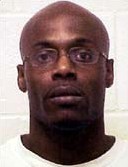
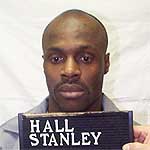
Stanley L. HALL
Classification: Murderer
Characteristics: Robbery
- Kidnapping
Number of victims: 1
Date of murder:
January 14,
1994
Date of arrest:
Same day
Date of birth:
August 1,
1967
Victim profile: Barbara Jo Wood,
44
Method of murder:
Pushing
the victim off the
McKinley Bridge
Location: St. Louis County, Missouri, USA
Status: Executed
by lethal injection in Missouri on March 16,
2005
Summary:
Stanley Hall and Rance Burton drove to a St. Louis shopping center
looking for a vehicle to steal to use in a drive by shooting.
They approached Barbara Jo Wood as she pulled into the parking lot
and forced her at gunpoint to the passenger side and then drove her
in her car to the McKinley Bridge.
Wood was forced out of the car, and eventually thrown off the bridge
to the icy river 75 feet below.
Witnesses in a passing car saw the struggle and notified police.
Burton got back in Wood’s car and drove away.
The police arrived and captured Hall moments after he pushed Wood
off the bridge. The body of Barbara Jo Wood was recovered from the
river 7 months later.
Following his arrest, Hall admitted forcing Wood over the guardrail.
At the time, Hall was on parole for wounding a 4-year-old girl while
he was chasing and shooting at a man in St. Louis in 1987.
Citations:
State v. Hall, 955 S.W. 2d 198 (Mo. banc 1997) (Direct
Appeal). Hall v. Missouri, 523 U.S. 1053 (1998) (Cert. Denied). Halt v. State, 16 S.W. 3d 582 (Mo. banc 2000) (PCR). Hall v. Luebbers, 341 F.3d 706 (8th Cir. 2003). (Habeas) Hall v. Roper, 124 S.Ct. 2031 (2004) (Cert. Denied).
Final Meal:
T-bone steak, shrimp and french fries.
Final Words:
"I'd like them to know I'm sorry, seriously sorry."
ClarkProsecutor.org
Capital Punishment in Missouri
from Missouri.net
State of Missouri v. Stanley L. Hall, 955
S.W. 2d 198 (Mo.banc 1997)
Stanley Hall was executed at 12:06 a.m., March
16, 2005.
Case Facts:
On the evening of January 15, 1994,
Stanley Hall and Rance Burton borrowed a car and drove to the South
County Shopping Center in St. Louis, Missouri. They were searching
for a vehicle to steal. Hall and Burton got out of their car and
approached Barbara Jo Wood’s car as she pulled into the parking lot.
They forced her at gunpoint to the passenger side and then drove her
in her car to the McKinley Bridge.
Wood was forced out of the car, and there was a
struggle on the bridge. At some point she was wounded. Witnesses in
a passing car saw her bleeding. Burton got back in Wood’s car and
drove away. Wood, pleading for her life was still holding on to Hall
as he tried to lift her over the bridge railing. He eventually
succeeded, and Wood fell ninety feet to the river.
Meanwhile, the two witnesses in the car had
notified the Venice, Illinois police department. The police arrived
and captured Hall moments after he pushed Wood off the bridge. The
icy condition of the river impeded search and rescue attempts.
Both witnesses identified Hall as the man they
has seen struggling with Wood. After waiving his Miranda rights,
Hall identified Barbara Jo Wood from a picture as the woman he had
thrown into the river. Seven-and-a-half months later, the lower
portion of a torso matching Wood’s physical condition was found in
the Mississippi River.
Legal Chronology
1994
01/15 -Stanley Hall murders Barbara Jo Wood in St. Louis, Missouri.
1996
03/18 - Hall goes on trial for First Degree Murder in the Circuit
Court of St. LouisCounty. On March 27, 1996, Hall is found guilty,
and the jury recommends a sentence of death.
06/21 - That court sentences Hall to death.
1997
10/21 - The Missouri Supreme Court affirms Halt’s conviction and
sentence.
1998
03/30 - The United States Supreme Court denies Hall’s petition for
writ of certiorari.
1999
02/20 - Hall files a post-conviction relief motion in the circuit
court.
05/11 - Circuit court denies Halt’s post-conviction relief motion.
2000
04/25 - Missouri Supreme Court affirms the circuit court’s denial of
Hall’s post-conviction relief motion.
2001
01/16 - Hall files a petition for writ of habeas corpus in the
United States District Court.
09/05 - The United States District Court denies Hall’s petition for
writ of habeas corpus.
2003
09/02 - The Eighth Circuit Court of Appeals affirms the denial of
Halt’s petition for writ of habeas corpus.
2004
04/19 - The United States Supreme Court denies Hall’s petition for
writ of certiorari.
07/27 - State files motion to set execution date with the Missouri
Supreme Court.
2005
02/15 - Missouri Supreme Court sets Hall’s execution for March 16,
2005.
Missouri Executes Stanley Hall
By Tim O'Neil
and Heather Ratcliffe -
St. Louis Post-Dispatch
AP - 03/16/2005
POTOSI, Mo. (AP) -- Eleven years after he threw a
woman to her death in the icy Mississippi River, Stanley L. Hall of
St. Louis was executed by injection.
Hall, 37, was pronounced dead at 12:06 a.m. in
the Potosi Correctional Center for the murder of Barbara Jo Wood of
south St. Louis County on Jan. 14, 1994. He and an accomplice had
kidnapped her from the South County Shopping Center because they
planned to use her car in a drive-by shooting. Hall admitted that he
threw the struggling Wood from the McKinley Bridge. The accomplice
was never charged.
"I'd like them to know I'm sorry, seriously sorry,"
Hall said late Tuesday night, in his final statement to the Wood
family. Eight of Wood's relatives, including her mother, Phyllis
Velcheck, 81, witnessed the execution.
Hall was the first person put to death in
Missouri since October 2003. Last fall, Missouri Attorney General
Jay Nixon and several prosecutors criticized the Missouri Supreme
Court for not setting execution dates for six murderers, including
Hall.
Missouri has executed 62 people since 1989, when
it resumed carrying out the penalty under current Supreme Court
rules. Missouri executed a modern-era record nine in 1999 and six in
2002 before the slowdown that drew criticism.
Hall had a last meal of T-bone steak, shrimp and
french fries before learning that the U.S. Supreme Court rejected
his appeal shortly after 6 p.m. Tuesday. Gov. Matt Blunt sealed his
fate one hour later by refusing to reduce the sentence.
"It is undisputed that Stanley Hall killed
Barbara Jo Wood," Blunt said in a statement. "I hope this action
brings (her family) the closure they deserve and I hope God will
have mercy on Stanley Hall's soul." Nelson L. Mitten, Hall's lawyer,
told the courts he recently uncovered new evidence of Hall's mental
retardation that would make him ineligible for the death penalty. "I
think it's unfortunate that the courts have not recognized Mr.
Hall's mental retardation and taken appropriate action to see that
this execution is halted," Mitten said.
Hall's last hope had been gubernatorial clemency.
"So now there is going to be another killing," said Margaret
Phillips of Missourians to Abolish the Death Penalty. Opponents of
capital punishment held vigils in St. Louis and other cities, and
gathered outside the prison fence. Mark Velcheck of Florissant, one
of Wood's brothers, said earlier Tuesday he was relieved that the
sentence would be carried out. "I'm glad for Barbara that this
person will pay the price," said Velcheck, a witness. "You hate to
say you want somebody to die, but this guy deserves it."
Reached by telephone shortly before the Supreme
Court ruled, Hall said he hoped for a reprieve but was prepared to
accept death. He said he converted to Islam seven years ago. "I am
not ready to go, but I am so very prepared," Hall said. "I'm still
keeping faith and hope alive. I want (Wood's) family to know how so
very sorry I am for being involved in what I was involved in. If I
had a gun, I'd shoot myself if it would bring her back."
Wood, a mother of two grown sons, worked for a
title insurance company in Clayton. She had gone to the mall to
report for her part-time job at Dillard's. Hall wanted a car to
shoot a man who had wounded one of his cousins a month earlier. At
the time, Hall was on parole for wounding a 4-year-old girl while he
was chasing and shooting at a man in St. Louis in 1987.
Mitten said he had uncovered a report showing
that the Special School District of St. Louis County had listed
Hall's IQ at 57 when he was seven. The claim of "new evidence" was
important because courts rarely consider appeals based upon
information they had heard before. But Nixon argued that Hall's own
defense psychologist testified in 1996 that Hall was not mentally
retarded. On Monday, the federal appeals court said Mitten failed to
show that the old IQ report "could not have been discovered
previously . . ."
ProDeathPenalty.com
On the evening of January 15, 1994, Stanley Hall
and Rance Burton borrowed a car and drove to the South County
Shopping Center in St. Louis, Missouri. They were searching for a
vehicle to steal. Hall and Burton got out of their car and
approached Barbara Jo Wood's car as she pulled into the parking lot.
They forced her at gunpoint to the passenger side and then drove her
in her car to the McKinley Bridge. Wood was forced out of the car,
and there was a struggle on the bridge.
At some point she was wounded--witnesses in a
passing car saw her bleeding. Burton got back in Wood's car and
drove away. Wood, pleading for her life, was still holding on to
Hall as he tried to lift her over the bridge railing. He eventually
succeeded, and Wood fell ninety feet to the river. Meanwhile, the
two witnesses in the car had notified the Venice, Illinois police
department.
The police arrived and captured Hall moments after he
pushed Wood off the bridge. The icy condition of the river impeded
search and rescue attempts. Both witnesses identified Hall as the
man they had seen struggling with Wood. After waiving his Miranda
rights, Hall identified Barbara Jo Wood from a picture as the woman
he had forced over the guardrail. Seven-and-a-half months later, the
lower portion of a torso matching Wood's physical description was
found in the Mississippi River.
On March 7, 1994, a year and eight months before
Hall gave his statement pursuant to the alleged plea agreement, he
gave the St. Louis County police a complete confession. Hall gave a
detailed account of his trip to the mall, the kidnapping of Barbara
Jo Woods, and the theft of her car. He recounted how Woods was
pleading for her life as he struggled with her on the bridge. He
described how, first, she grabbed on to the car door; then she was
shot; next she grabbed hold of Hall; and finally, she clung to the
bridge itself as Hall struggled to lift her over the guardrail. Hall
confessed that he was the one who pushed her until she finally went
over the railing.
National Coalition to Abolish
the Death Penalty
Missouri - Stanley Hall - February 20, 2005
On March 16, 2005 the State of Missouri is
scheduled to execute Stanley L. Hall, a 37-year-old black male, for
the murder, kidnapping, and robbery of Barbara Jo Wood in St. Louis.
This will be the first execution in the State of Missouri in almost
a year and a half. Missouri courts have been hesitant to issue death
warrants, resulting in an unofficial moratorium on its death penalty.
They have overturned approximately half of the considered death
sentences in the last two years, according to the Associated Press.
Despite this, an execution date has been issued
for Stanley Hall who, along with Rance Burton (who was not given the
death penalty even though he admittedly shot the victim), was
responsible for the death of Barbara Jo Wood. Hall was tried by an
all-white jury that excluded any prospective jurors who oppose the
death penalty.
There are circumstances that have prompted Hall
to file motions regarding his ineffective defense counsel. So far
all have been denied. Examples of these issues are:
· During Hall’s trial, prosecution showed
numerous gruesome photographs of the body believed to be the victim
of this crime. Such photos are admissible unless the probative value
is outweighed by the inflammatory nature of the photographs or if
they are used solely for arousal of the jury. Since identification
of the body of the victim was not an issue at trial, these
photographs were arguably used solely for shock value and had no
probative value. Unfortunately, this objection was not raised by
defense during trial.
· Remarks made by prosecution were deemed to be
“personalization” (i.e., instilling fear in the jurors by
personalizing the evidence). Prosecutors called on the jurors to
protect their mothers, daughters, and sisters and make sure Stanley
Hall was brought down. In a later stage of appeal defense argued
that prosecutors “crossed the line” by “calling on the jurors’ most
primitive fears.” Again, this point was not raised by defense
counsel at trial or upon direct appeal.
· The Defendant entered into a plea bargain with
the state for a sentence of life without parole. The Courts aren’t
forced to accept the terms of a plea bargain negotiated by the State,
but “if the state receives a confession through promises of leniency,
however, and then the State reneges, that confession cannot be used
at trial.” Prosecutors managed its way around this rule by having
the defendant give his confession on two occasions and linked only
one to the plea bargain. They then only submitted the other
confession at trial as evidence.
Defense counsel neglected to raise any issue of
the confession and polygraph test that were given as a condition of
the plea bargain until the mitigating stage of the sentencing phase.
Since this evidence was not relevant to the defendant’s character or
previous history, it was not allowed at this point in the trial and
consequentially the jury was never made aware of the issue.
· Finally, in the sentencing phase the prosecutor
related a story of his childhood dog that had problems with
“distemper” and the vet told him he’d have to put the dog down
because that was the only solution. As a little boy he was very sad
that there was no other solution, but he explained that people had
to do what was best for society and the people around them. The
prosecutor then compared this dog to the Defendant. The courts
frowned on this tactic used by prosecution but overruled the
defense’s objection.
The governor of Missouri receives a non-binding
recommendation from the Board of Probation and Parole for clemency/commutations.
Police detective sees killer “get what he had
coming"
By Heather Ratcliffe -
St. Louis Post-Dispatch
March 17, 2005
POTOSI, Mo. - As the blinds were raised to expose
a window on the Missouri execution chamber, Tim Fitch leaned forward
in a plastic chair in the witness gallery to get a better last look
at the murderer who had confessed to him 11 years before. Beyond the
glass, Stanley Hall lay motionless on a gurney, only his head
peeking out from a crisp white sheet that hid an intravenous needle
that was to deliver three lethal drug doses to his arm. He never
looked Fitch's way. Hall turned to the right to look at his family
behind another window. He smiled, mouthed a few inaudible words and
then closed his eyes forever.
It was 12:06 a.m. Wednesday. Fitch said his
thoughts were not on Hall at all but on Barbara Jo Wood and the
painful death she suffered when Hall tossed her off the McKinley
Bridge. "He got off too easy for what he did," said Fitch, a St.
Louis County police major. He now heads the Patrol Division, but in
1994 he was a detective working on the killing of Wood, a random
carjacking victim slain to eliminate the witness.
Fitch and his partner, Detective Tim Hagerty, had
listened to Hall describe lifting the woman, who was already shot,
over his head and throwing her alive into the frigid Mississippi
River. It was the audiotape the officers made of the confession that
helped persuade a St. Louis County jury to convict Hall and sentence
him to death. This was the first time Fitch attended an execution,
something he said he did to represent all the police and prosecutors
on the case. "It's not going to bring Barbara Wood back," he said.
"But I'm happy for the family. I could see this brought some
closure."
Eight members of Wood's family, who witnessed
Hall's execution at the prison in Potosi, asked officials to speak
with Fitch and the two prosecutors who were there with him. The
three were met in the family's waiting room with hugs and thank yous.
"I just want to thank everyone who was involved in this case,"
Indigo Knight, Wood's niece, said later. "This has brought a lot of
closure to our family." The prosecutors, Dean Waldemer and Keith
Jensen, declined to comment. After his conviction, Hall had thrown a
200-pound table at them in court.
Wood, 44, a mother of two grown sons, was on her
way to work at the South County shopping center when Hall and an
accomplice kidnapped her in her car on Jan. 15, 1994. "This is the
crime that every father, husband or brother fears," Fitch said.
"Imagine sending your wife to the mall to go shopping and never see
her again. This is why we have the death penalty, for horrific
crimes like this."
The day after Wood disappeared, police in
Illinois notified county detectives that they had arrested a
suspect. Witnesses had called Venice police after seeing someone
struggling with a woman on the bridge. Officers arrived in time to
catch Hall but too late to save Wood. Fitch and Hagerty, handling
the case because Hall had disappeared in their venue, peppered Hall
with questions, and he eventually described the kidnapping and
murder. Not enough evidence could be developed to charge the
suspected accomplice.
Hall's lawyers failed to win a delay Tuesday
night based on arguments that his IQ was too low to qualify for
execution. He chose a last meal of steak, shrimp and French fries.
In his last statement Tuesday night, Hall apologized to the Wood
family. Hall, who said he found religion in prison, told them he was
"truly and sincerely sorry."
The family was not moved. "It doesn't quite mean
so much to say you're sorry when you're about to die," said Daniel
Velcheck, Wood's youngest brother. "I don't believe him. I thought I
saw a smile on his face before he closed his eyes. He was only sorry
he was getting killed."
As several of Hall's relatives watched him die at
the execution chamber, they smiled and laughed and pumped their
fists. "That was something he asked for," said Stephanie Hall,
Stanley Hall's wife. "He didn't want to see us cry. He wanted to see
smiles in his last moments." She said Stanley Hall smiled at the
family during his last moments because he knew he was going to a
better place. She said he mouthed the words "I love you" and "Keep
up" as an encouragement to them to be strong. Stephanie Hall said
she and her husband wanted to express his regret to the Wood family
years ago, but because of pending legal appeals, he was advised not
to.
Death penalty opponents demonstrated at several
locations, including the Potosi Correctional Center, which was
conducting Missouri's 62nd execution since capital punishment was
restored under current law. A Catholic priest from St. Louis, the
Rev. Carl Kabat, 71, of the Oblate order, was arrested when he
attempted to enter the prison in protest. "I don't think anyone has
the right to take another life," Kabat said. "I certainly sympathize
with Ms. Wood's family, and I know it hurts. But I'm not sure that
this really brings closure. It's only vengeance."
Fitch said he felt little reaction to the
execution itself but appreciated the gratitude of the victim's
family. "What we do, we are doing for those people," he said. "Stanley
Hall got what he had coming to him."
Missouri Death Row Inmate Executed For 1994
Murder Of Lemay Woman
By Ann Rubin -
KSDK-TV
March 16, 2005
(KSDK) -- The state of Missouri carried out the
execution of Stanley Hall early Wednesday morning. Hall's life ended
nearly 11 years after he kidnapped a Lemay woman, shot her and threw
her body into the Mississippi River. Stanley Hall spent his last
hours Tuesday with his wife, his mother and his extended family at
the state prison in Potosi. Hall's wife Stephanie says, "It's been a
long day. For the last few days, not much sleep. Emotions are like a
roller coaster."
They say Hall has been holding up well, and in a
phone interview a few hours before his scheduled execution he
admitted he has made his peace, "I prepared myself 11 years ago for
this day to come. My spirits are strong and now that we have
received the decision that Governor Blunt and others have made, it's
something I have to live with."
In 1994, Hall kidnapped and later
killed Barbara Jo Wood. He took her at gunpoint from a south St.
Louis County shopping mall, shot her, and pushed her off the
McKinley Bridge to her death. A fisherman found her body in the
Mississippi River seven months after her murder.
Wood's family has said repeatedly that her killer
should be shown no mercy. "I think that the facts of this case are
being forgotten, of the extreme brutality of this murder that he and
his accomplice committed 11 years ago," said Scott Wood, the
victim's son.
Stanley Hall wants the Wood family to know he is
sorry, "I've spoken to several news channels and radio stations and
extended my condolences and my sympathies to the family."
With all his appeals exhausted and his request
for clemency denied, Stanley Hall made the most of his last hours,
and he had a few words for the people he loves, "I want all my
family and friends, my other son and all the people who gave me
support to know that I'm still standing strong, and I'm going to be
that way until the last second, minute, hour, or whatever it is."
State executes killer Stanley Hall
Penalty opponents pray as Missouri ends 17 months without an execution
Springfield News-Leader
March 16, 2005
St. Louis — Missouri proceeded with its first
execution in 17 months, putting killer Stanley Hall to death early
today. In the final hours of his life, Hall said he was at peace.
Hall, 37, died by injection at the Potosi Correctional Center for
the 1994 murder of Barbara Jo Wood of St. Louis County. The U.S.
Supreme Court denied Hall's request for a stay of execution Tuesday
evening and Gov. Matt Blunt later denied clemency.
Blunt said he found no reason to set aside the
result of previous judicial decisions in the case. "My thoughts and
prayers are with Barbara Jo Wood's family," Blunt said in a written
statement. "I hope this action brings them the closure they deserve,
and I hope God will have mercy on Stanley Hall's soul."
Still, Hall, in a telephone interview, said his
spirits were high. "I still have hope and faith that things come out
for the better," Hall said. "Still at the same time, I'm prepared
for the worst."
About 30 death penalty opponents gathered at a
chapel behind St. Agnes Cathedral in Springfield on Tuesday night to
pray for a stay of Hall's execution and drum up support for a
moratorium in Missouri. The Rev. Larry Maddox, president of the
local chapter of the National Association for the Advancement of
Colored People, said the country's criminal justice system was
flawed and unfair to African-Americans. He called on Christians to
oppose the death penalty. "We need to wipe it out," Maddox said. "It's
not good for this country. It's not good for this state." Laura
Graham of Springfield, who attended the vigil, said she opposed the
death penalty because she believes in the "sanctity of life." "It
just doesn't make sense," said Graham, 51.
Wood's brother, Mark Velcheck of Florissant, said
Hall should be shown no mercy. "The thing that bothers me is people
are portraying him as a victim. He's not a victim. He's a murderer
...," Velcheck said.
Hall's attorney, Nelson Mitten, sought to halt
the execution based on testing he recently discovered showing that
Hall's IQ at age 7 as measured at 57. An average IQ is 100.
Subsequent IQ scores for Hall were generally in the 70-75 range.
Attorney General Jay Nixon said that put him in the borderline
mentally retarded range. The U.S. Supreme Court banned executions of
the mentally retarded in 2002, and Missouri issued a similar ban a
year earlier. But there is no ban against executing the borderline
mentally retarded.
On Jan. 15, 1994, Hall and a friend borrowed a
car and drove to South County Mall in search of a car to steal and
use in a drive-by shooting. Wood arrived at the mall for her part-time
job at the Famous-Barr department store. The men pulled a gun,
forced Wood into the passenger seat of her 1991 Geo and drove her to
the McKinley Bridge over the Mississippi River. There, Wood was
forced out of the car and shot. With Wood struggling and pleading
for her life, Hall lifted her over the bridge railing, and she
dropped 90 feet into the icy water. Witnesses notified police, who
captured Hall moments later.
State Executes Stanley Hall For 1994 Killing
By Stve Walsh -
MissouriNet.com
Unofficial Death Penalty Moratorium Ends
Early this morning, Stanley Hall was executed for
killing Barbara Jo Wood. Appeal after appeal came and went. Finally,
with all appeals exhausted, Hall was executed early this morning and
pronounced dead at 12:06. In Hall's final statement, he apologized
to the Wood family for what he had done.
Wood's relatives, who
witnessed the execution, made it clear they were not ready to accept
the apology and expressed satisfaction that justice had been carried
out. The execution ends an unofficial moratorium on the death
penalty in Missouri. There hadn't been an execution in the state
since John C. Smith was put to death in October of 2003.
Missouri has executed convicted killer Stanley
Hall for the 1994 murder of a St. Louis woman. On the evening of
January 15, 1994, Stanley Hall and an accomplice searched the South
County Shopping Center in St. Louis for a car to steal. They came
across Barbara Jo Wood, who was pulling into the parking lot, and
kidnapped her at gunpoint - taking her to the McKinley Bridge, which
crosses the Mississippi River at St. Louis.
Wood was forced out of
the car, a struggle ensued, and she was shot. Hall then threw his
victim over the guardrail into the water 90 feet below. Hall was
quickly arrested, admitted the crime, and was sentenced to death.
First Missouri execution since 2003
By Annie Getsinger -
Columbia Missourian
March 16, 2005
In a telephone interview from his holding cell in Potosi, Hall also
expressed remorse for killing Barbara Wood, 44, in 1994. “I am truly
and sincerely sorry for what took place and what I was involved in,”
he said.
Hours before the execution, Wood’s brother, Mark
Velcheck of Florissant, said Hall deserved no mercy. “The thing that
bothers me is people are portraying him as a victim. He’s not a
victim. He’s a murderer. His time has come,”’ Velcheck said.
In 1996, Hall was convicted of the murder of Wood,
a St. Louis County woman, and was sentenced to death. He and an
accomplice abducted Wood from South County Mall in January 1994,
intending to use her car in a drive-by shooting. They took her to
the McKinley Bridge, where they shot her. Hall then threw her over
the guardrail and into the Mississippi River. He was arrested and
confessed to the murder, but his accomplice was never charged.
Hall’s death sentence mobilized death penalty
opponents in Columbia, where 24 people gathered Tuesday evening at a
vigil outside the Boone County Courthouse to protest Hall’s
execution. Jeff Stack, coordinator of Mid-Missouri Fellowship of
Reconciliation, organized the event, which was attended by members
of his organization and other local groups within Missourians to
Abolish the Death Penalty as well as those who did not represent an
organization. Stack and two others who attended the vigil went to
the parking lot of St. Luke’s Methodist Church for a prayer vigil.
“I would like to see the abolition of the death
penalty or at least a moratorium on it so that we can better see how
it is used and the fairness or unfairness of it,” said Jean Murray
of Ashland, who attended the two vigils in Columbia and one in
Jefferson City at the Capitol. Stack traveled to Potosi later in the
evening.
Hall’s request to the Missouri Supreme Court for
a stay of his execution on the grounds that he was mentally retarded
was denied Monday. Under the 2002 U.S. Supreme Court ruling in
Atkins v. Virginia, it is unconstitutional to execute a person who
is mentally retarded. The motion requested that Hall be resentenced
to life imprisonment without the possibility for parole and also
requested a hearing.
During his trial, the psychologist who testified
in his defense did not indicate that Hall was mentally retarded.
However, as Nelson Mitten, Hall’s most recent attorney, pursued his
school records as part of a clemency application, he found that they,
along with IQ tests, provided evidence of mental retardation that
was never entered into the trial.
When Hall was tried, both the
Atkins case and a similar Missouri statute from 2001 had not been
decided, and mental retardation was not considered a mitigation
factor, Mitten said. “The psychologist from Mr. Hall’s trial has
reviewed the new records, which he believes call into question his
earlier decision,” Mitten said.
The American Association on Mental Retardation’s
Web site states that “mental retardation is generally thought to be
present if an individual has an IQ test score of approximately 70 or
below.” While tests placed Hall’s IQ both above and below 70, the
tests vary by a deviation of five points. His attorney said Hall,
whose highest score on record placed his IQ at 75, was mentally
retarded. A test done when Hall was 7 years old reported an IQ of
57.
Phyllis Velcheck, Wood’s 81-year-old mother, was
at Potosi along with several other family members to witness Hall’s
execution. In an interview early Tuesday, she said Hall’s supporters
were “grasping at straws.” “All of this was in the trial. They’re
just bringing it up at the last minute,” she said of the claim that
he was mentally retarded. “He’s already had 11 more years than my
daughter, who he killed, and I’m looking forward to his execution
tonight. It will put a finality and ending to it all.”
Mark Velcheck, Wood’s brother, expressed similar
sentiments. He was present at the execution. “It’s important (to be
there) because that’s a family member he murdered, and my sister
would have wanted us to be there,” he said. “I’m not saying that his
dying is going to bring her back, but I just want an end to this.”
Velcheck said he couldn’t see his sister’s killer being
rehabilitated. “My sister was a nice person with a couple of boys,”
he said.
The 8th U.S. Circuit Court of Appeals ruled
Tuesday afternoon to deny Hall’s appeal. Hall and his attorneys then
sought a stay of execution from the U.S. Supreme Court. The request
was denied just after 6 p.m. Tuesday in a message faxed to Mitten. A
request for clemency from Gov. Matt Blunt was also denied. A news
release from Blunt’s office said he “found no reason to set aside
the result of previous judicial decisions of the case.”
“We kill a human being, and it tells us more
about our state and our society rather than the individual we kill,”
said Stack, who visited and interviewed Hall three times for
KOPN/89.5 FM and the Mid-Missouri Fellowship of Reconciliation
newsletter.
Hall married his wife, Stephanie, on March 4. The
two met through her stepson, who was an inmate at Potosi. She
described her husband as someone who had changed during his
incarceration. Through the now-defunct Youth Enlightenment Program,
designed to allow prisoners to help at-risk kids reform their
behavior, Hall worked to mentor young offenders and potential
offenders, she said.
Interviewed over the phone from prison Tuesday
morning, Hall said he enjoyed being able to help in this capacity.
“I know deep in my heart that I’ve had the opportunity to touch some
that might be in the same position I am in now,” he said.
Despite this change in outlook, Hall said he felt
the justice system let him down throughout his trial and the appeals
process. But it was his 11-year-old son he seemed to have most on
his mind the day before his death. Hall only recently found out he
was the father of the boy.
The son is now living in circumstances
similar to those in which he grew up, he said. “I had no one there
to assist me and guide me when I was his age,” Hall said of his son.
“I feel like I should have all of my life to be able to teach him to
stay on the right path.”
Killer hopes his IQ spares him from date with
death
By Tim O'Neil -
St. Louis Today
March 11, 2005
Six days before his scheduled execution, Stanley
L. Hall asked the Missouri Supreme Court on Thursday to spare his
life because of new evidence that he is mentally retarded.
Hall, 37, is scheduled to be executed early
Wednesday for throwing Barbara Jo Wood of south St. Louis County to
her death from the McKinley Bridge into the icy Mississippi River on
Jan. 15, 1994. Hall and an accomplice abducted her at the South
County Mall because they wanted to use her 1991 Geo Storm in a
drive-by shooting.
Wood, 44, had gone to the mall for her part-time
job at Dillard's. She had been shot but was still alive and
struggling when Hall threw her into the river. Partial remains were
found in the river eight months later near Chester, Ill.
On Feb. 15, the Missouri Supreme Court set Hall's
execution date. In his petition Thursday, Nelson L. Mitten, Hall's
lawyer, asked the court to delay the execution, consider new
evidence of Hall's mental abilities, and either reduce the sentence
to life in prison or order a new sentencing hearing.
Attorney
General Jay Nixon will respond in court "and fight any effort (by
Hall) to avoid his penalty," spokesman Scott Holste said. In 2001,
the Missouri Legislature established guidelines to bar the execution
of the legitimately mentally retarded. One year later, the U.S.
Supreme Court outlawed the execution of mentally retarded persons.
Mark Velcheck of Florissant, one of Wood's
brothers, said he hoped the court throws out Mitten's request. He is
one of six relatives, including the victim's mother, Phyllis
Velcheck, 81, who intend to witness the execution in the Potosi
Correctional Center. "(Hall's) been talking retardation from the
beginning. He's never even said he's sorry, so I don't buy anything
he says," Mark Velcheck said. "I guess I just want to see him die."
Mitten said he was preparing a petition for
clemency to Gov. Matt Blunt when he discovered Hall was diagnosed
with an IQ of 57 when he was 7 years old. Mitten said a psychologist
diagnosed him last week with an IQ of 65.
Mitten had been planning
to join a lawsuit by another condemned Missourian that the state's
method of execution by lethal injection is unconstitutionally cruel
and unusual. But he said Thursday he changed his strategy when he
found the additional evidence of retardation.
Missouri has not executed anyone since October
2003.
State v. Hall,
955 S.W.2d 198 (Mo. 1997) (Direct Appeal).
Defendant was convicted in the Circuit Court, St.
Louis County, Emmett M. O'Brien , J., of murder in the first degree,
kidnapping, robbery in the first degree, and two counts of armed
criminal action, and was sentenced to death. He appealed. The
Supreme Court, White, J., held that: (1) defendant had not entered
into enforceable plea agreement; (2) certain veniremembers were
properly removed for cause; (3) state did not violate Batson; (4)
plea negotiations, results of polygraph test, and police reports
were not admissible as mitigating evidence in penalty phase; (5)
prosecutor's improper closing argument did not cause defendant
manifest injustice; (6) jury instructions were proper; and (7) death
penalty was not disproportionate. Affirmed.
WHITE, Judge.
A jury convicted defendant Stanley Hall of murder in the first
degree, kidnapping, robbery in the first degree, and two counts of
armed criminal action. The jury recommended a sentence of death. The
trial court followed the recommendation. This Court has exclusive
jurisdiction over the appeal. Mo. Const. art. V, section 3. We
affirm the judgment.
I. FACTS
This Court reviews the facts in the light most
favorable to the verdict. State v. Shurn, 866 S.W.2d 447, 455 (Mo.
banc 1993).
On the evening of January 15, 1994, Stanley Hall
and Rance Burton borrowed a car and drove to the South County
Shopping Center in St. Louis, Missouri. They were searching for a
vehicle to steal. Hall and Burton got out of their car and
approached Barbara Jo Wood's car as she pulled into the parking lot.
They forced her at gunpoint to the passenger side and then drove her
in her car to the McKinley Bridge.
Wood was forced out of the car, and there was a
struggle on the bridge. At some point she was wounded--witnesses in
a passing car saw her bleeding. Burton got back in Wood's car and
drove away. Wood, pleading for her life, was still holding on to
Hall as he tried to lift her over the bridge railing. He eventually
succeeded, and Wood fell ninety feet to the river. Meanwhile, the
two witnesses in the car had notified the Venice, Illinois police
department. The police arrived and captured Hall moments after he
pushed Wood off the bridge. The icy condition of the river impeded
search and rescue attempts.
Both witnesses identified Hall as the man they
had seen struggling with Wood. After waiving his Miranda rights,
Hall identified Barbara Jo Wood from a picture as the woman he had
forced over the guardrail. Seven-and-a-half months later, the lower
portion of a torso matching Wood's physical description was found in
the Mississippi River.
A. Motion to Enforce Plea Agreement
On May 10, 1994, Hall entered a plea of not
guilty to murder in the first degree, kidnapping, robbery in the
first degree, and three [FN2] counts of armed criminal action. On
March 15, 1996, three days before Hall's trial was set to begin,
Hall filed a "Motion to Enforce the Negotiated Plea Agreement"
seeking to enter a plea of guilty in exchange for a life sentence.
Hall alleged that the State had negotiated a plea agreement with him,
that he had completed the conditions required of him, and that the
State was refusing to honor the agreement. Hall maintained that the
terms of the agreement were that the State would recommend a life
sentence on the following conditions: (1) that Hall provide complete
and truthful information about the crime and all those involved,
specifically Rance Burton, (2) that he pass a lie detector test, and
(3) that the State independently corroborate his information about
Burton.
On March 7, 1994, a year and eight months before
Hall gave his statement pursuant to the alleged plea agreement, he
gave the St. Louis County police a complete confession. Hall gave a
detailed account of his trip to the mall, the kidnapping of Barbara
Jo Woods, and the theft of her car. He recounted how Woods was
pleading for her life as he struggled with her on the bridge.
He described how, first, she grabbed on to the car door; then she was
shot; next she grabbed hold of Hall; and finally, she clung to the
bridge itself as Hall struggled to lift her over the guardrail. Hall
confessed that he was the one who pushed her until she finally went
over the railing.
Hall alleges that in November 1995, he confessed
again pursuant to the purported plea agreement. The motion to
enforce the plea agreement does not allege that the first and second
confessions differed in any respect, however. The motion does not
summarize the second confession other than to state that Hall gave
the police "a complete and truthful account."
Though Hall requested
to make an offer of proof on other issues, he never offered to prove
the contents of the second confession. Even if there had been a plea
agreement, and the State breached it after obtaining a second
confession, and Hall did pass a lie detector test, Hall's only
relief would be the exclusion of the second confession. [FN3] Id.
The trial court did not have before it any allegations or offers of
proof regarding any information the State may have gained through
the second confession. As it was not detrimental to Hall to repeat
an earlier confession and the State did not unjustly benefit by
hearing the confession a second time, the record supports the trial
court's ruling.
* * *
Considering the crime, the strength of the
evidence, and the defendant, this Court finds that the sentence is
proportionate to cases where the sentencer found beyond a reasonable
doubt any one of the above aggravating circumstances.
Supreme Court of Missouri
Stanley L. Hall, Appellant, v.
State of Missouri, Respondent.
SC81782
25/04/2000
Circuit Court of St. Louis County, Hon. Emmett M.
O'Brien
In January 1994, Stanley Hall kidnapped a woman
in the South County Shopping Center in St. Louis County. His
accomplice shot her, and Hall threw her alive over the McKinley
Bridge. Hall was convicted of first-degree murder, among other
crimes, and sentenced to death, which this Court affirmed on appeal.
He now appeals denial of post-conviction relief. AFFIRMED.
John C. Holstein, Judge
OPINION
After a jury trial,
movant Stanley Hall was convicted of first degree murder, kidnapping,
first degree robbery and two counts of armed criminal action. He was
sentenced to death on the first degree murder count. All convictions
were affirmed on appeal. State v. Hall, 955 S.W.2d 198 (Mo.
banc 1997). Hall then filed a motion for post-conviction relief
pursuant to Rule 29.15. He now appeals the denial of his post-conviction
motion. Since this appeal involves the imposition of the death
penalty, this Court has jurisdiction of the appeal. Mo. Const.
art. V, sec. 3.
I.
On January 15,
1994, Hall and Rance Burton went to the South County Shopping Center
in St. Louis County looking for a vehicle to steal and use in a
drive-by shooting. The two noticed Barbara Jo Wood pulling into a
parking lot, approached the vehicle and forced her to accompany them
at gunpoint.
With her sitting on
the passenger side, they drove the vehicle to the McKinley Bridge,
which traverses the Mississippi River from the city of St. Louis to
Illinois. Once there, Wood was forced to exit the car.
Burton shot Wood,
firing several rounds. He got back into the vehicle and left.
However, Hall remained outside the vehicle. Though bleeding from her
wounds, Wood struggled with Hall and begged for him to spare her
life.
After some initial
difficulty, Hall lifted the woman over the bridge guardrail,
dropping her some ninety feet to the icy river below. Hall was later
identified by witnesses in a passing vehicle as the person seen
struggling with Wood. After being arrested, Hall confessed that Wood
was the woman he forced over the guardrail.
Some seven months
later, a lower torso identified as Wood’s was recovered alongside
the Mississippi River near Chester, Illinois. The site is about
seventy miles downstream from the McKinley Bridge. On this evidence,
Hall was convicted and sentenced to death.
II.
Hall’s amended
post-conviction motion asserts fifty-eight claims of ineffective
assistance of trial and appellate counsel. Seven were withdrawn.
Pursuant to the state’s motion to dismiss, the court below dismissed
all but two of the remaining claims without an evidentiary hearing.
Following an
evidentiary hearing, the remaining two claims were denied. Extended
findings of fact and conclusions of law were included in the trial
court’s judgment. Neither of the two claims upon which a hearing was
held is before us on appeal. Only three claims, each of which was
denied without an evidentiary hearing, are raised here.
The findings and
conclusions of the post-conviction court will be affirmed unless
clearly erroneous. Rule 29.15(k). To constitute clear error,
an appellate court, after reviewing the entire record, must be "left
with the definite impression that a mistake has been made." State
v. Clay, 975 S.W.2d 121, 140 (Mo. banc 1998), cert. denied,
___ U.S. ___, 119 S.Ct. 834 (1999).
Three requirements
must be met to entitle a movant to a post-conviction hearing: (1)
the motion must allege facts, not conclusions, warranting relief;
(2) the facts alleged must raise matters not refuted by the files
and records in the case; and (3) the matters complained of must have
resulted in prejudice to the movant. State v. Starks, 856 S.W.2d
334, 336 (Mo. banc 1993).
To be entitled to
relief based on claims of ineffective assistance of counsel, the
motion must recite facts not refuted by the record showing (1) that
counsel’s performance did not conform to the degree of skill, care
and diligence of a reasonably competent attorney, and (2) that
movant was thereby prejudiced. Hill v. Lockhart, 474 U.S. 52,
60 (1985), and Strickland v. Washington, 466 U.S. 668, 687
(1984). In each of the three instances raised on appeal here, the
factual allegations of ineffective assistance of counsel are refuted
by the record or are insufficient to establish a claim of
ineffective assistance of counsel.
III.
In his post-conviction
motion, Hall asserts his trial counsel was ineffective in failing to
object to "improper personalization to the jurors." One way in which
improper personalization results is when the prosecutor asks the
jurors to place themselves or some other identifiable person in the
shoes of the victim or at the crime scene. State v. Simmons,
955 S.W.2d 729, 740 (Mo. banc 1997).
However, it is
acceptable to argue that society is threatened by the conduct of the
accused. Id. Moreover, not every brief, isolated statement in
argument that may be construed as improper personalization is of
such magnitude that it undermines confidence in the outcome of the
case so as to establish prejudice. State v. Tokar, 918 S.W.2d
753, 768 (Mo. banc 1996).
During the
defendant’s closing argument at the guilt phase, Hall’s attorney
argued that the killing of Wood was not deliberate. Instead, he
maintained it was the result of Hall panicking. During the state’s
rebuttal argument in the guilt phase, the prosecutor responded:
Barbara Wood
was chosen for this for no other reason than she was a victim
who [Hall] didn’t think would put up a fight. He is a shadow out
there that has touched all of you, and people like him make
people in our society worried every time our mother, our
daughter, our sister, anyone leaves the house because at random
for his purpose, his decision, that he was going to go kill.
For Hall’s claim of
ineffective assistance of counsel to succeed, he must establish that
if an objection had been made to "improper personalization" it would
have been sustained. In context, the remark was not made to place
jurors or their families in Wood’s place but to indicate that the
defense theory of "panic" and a lack of deliberation was not
credible. See State v. Kreutzer, 928 S.W.2d 854, 873 (Mo.
banc 1996).
Since the comment
here did not directly ask any juror to put themselves or another
identifiable person in the place of the victim or at the scene of
the crime, the argument was not improper personalization. The
argument referred only in general terms to "people in our society"
who are worried about "our sister, our mother, [and] our daughter"
being in danger. The reference was, at most, an indirect reference
of danger to jurors or members of their families. Movant cites no
authority that would mandate sustaining an objection to "improper
personalization" where the only danger alluded to is a general
danger to members of "our society" and "our" female relatives.
Nevertheless,
citing State v. Rhodes, 988 S.W.2d 521, 528 (Mo. banc 1999),
Hall insists that to merely suggest personal dangers to the jurors
or their families is improper personalization. However, Rhodes
carefully distinguished situations where the comments are not
extensive or are insufficiently inflammatory to rise to the level of
prejudicial error. Id. at 529.
Here the quoted
argument refers to jurors and their families only by inference. Even
if one would infer that the prosecutor was referring to a
specifically identifiable person being in the place of the victim or
at the crime scene, the result is no different. An objection to the
isolated statement in the argument may have served to highlight the
comment to the jury. Not every failure to object to argument is
ineffective assistance of counsel, but the alleged improper argument
must be considered in the context of the trial as a whole. Tokar,
918 S.W.2d at 768.
Viewing the record
as a whole, including the eyewitness testimony identifying movant
and Hall’s own confession, the isolated statement in closing
argument does not undermine confidence in the outcome of the case.
The motion court’s conclusion that counsel was not ineffective in
failing to make an objection was not clearly erroneous.
IV.
Hall also claims
the motion court was clearly erroneous in denying a claim that his
trial counsel was ineffective in failing to request a mistrial in
response to police sergeant Tim Hagerty’s testimony during the
state’s case regarding Hagerty’s disbelief of some of Hall’s
statements given during a custodial interview.
Hagerty took Hall
into custody in Illinois on March 7, 1994, and transported Hall to
the St. Louis County police department in Clayton, Missouri. After
obtaining a waiver of rights, Hagerty began his interrogation of
Hall. Hall told Hagerty that once he and Burton arrived on the
McKinley Bridge and he and Wood exited the vehicle, she began
grabbing at him and only then did he push her over the guardrail of
the bridge.
On cross-examination,
defense counsel elicited statements made by Hall to Hagerty in which
Hall claimed to have panicked after Wood was shot and that Hall was
remorseful about Wood’s death. On redirect, the prosecutor asked, "[W]hy
did you keep questioning the defendant?" Over defense counsel’s
objection, Hagerty answered, "Because I didn’t believe many of the
answers he gave me."
Hall asserts that
the testimony was an inadmissible comment by one witness on the
credibility of another witness. In support of the contention, Hall
cites State v. Simmons, 944 S.W.2d 165 (Mo. banc 1997),
State v. Williams, 858 S.W. 796 (Mo. App.1993), and State v.
Biezer, 947 S.W.2d 540 (Mo. App. 1997). Simmons does not
suggest that an interrogating officer may not comment on the
believability of the accused’s answers given during a police
interrogation. Indeed, it is arguable that Simmons permits an
officer to testify that he believed "there was more [the accused]
could have said in his confession." Id. at 176. Simmons
does not aid Hall.
In Williams
and in Biezer it was held impermissible for an expert to
comment on the credibility of a witness who testified at the trial.
Williams, 858 S.W.2d at 798; Biezer, 947 S.W.2d at
541. However, this is not a case where a witness was commenting on
the credibility of another witness who testified before the jury.
Here, Hagerty was
testifying to his belief regarding the complete truthfulness of an
out-of-court statement. Hall was not a witness. Because Hall’s out-of-court
statements to Hagerty were quite damning, the fact that Hagerty did
not completely believe the statements is inconsequential, if not
helpful, to Hall’s defense. The motion court committed no clear
error in finding, as a matter of law, that the trial counsel was not
ineffective in failing to move for a mistrial.
V.
Hall asserts the
motion court clearly erred in denying his claim that appellate
counsel was ineffective in failing to assert a claim of error in the
admission of photographs of a torso discovered near Chester,
Illinois. The torso depicted in the photographs was badly decomposed,
skeletal and, to the untrained eye, barely recognizable as human.
The photographs were taken at the scene where the torso was
discovered and during an autopsy of the torso. The photographs were
identified by two witnesses. The first was Deputy Sheriff Fred
Frederking of the Randolph County, Illinois, Sheriff’s Office.
The other witness
was forensic anthropologist Mark Johnsey, employed by the Illinois
State Police. Both identified the photographs as accurate
representations at the scene where the torso was found and of the
autopsy. While Frederking was assisting in removing the remains, he
noticed what appeared to be an elastic band from a pair of underwear
around the pelvic area of the torso. The torso was taken to the
local funeral home, where an autopsy was conducted.
During the autopsy,
Johnsey examined the underwear waistband and discovered a label
indicating that it was Hanes brand, size 8, women’s underwear. Both
the brand and size were consistent with those worn by the victim.
Moreover, the examination revealed the torso was a female about the
same age as Wood who, like Wood, had borne children.
The examination
also determined that the torso’s height was consistent with Wood’s.
From the state of decomposition, Johnsey was able to testify that
the victim appeared to have died more than six months earlier. At
the time the torso was found, there were no other reports of missing
women who had disappeared from that area of the Mississippi River.
The photographs were then admitted into evidence.
When reviewing a
claim of ineffective assistance of appellate counsel, strong grounds
must exist showing that counsel failed to assert a claim of error
which would have required reversal had it been asserted on appeal
and which was so obvious from the record that a competent and
effective lawyer would have recognized it and asserted it. State
v. Edwards, 983 S.W.2d 520, 522 (Mo. banc 1999).
A competent
appellate lawyer familiar with the precedent of this state and the
record in this case would not conclude that admission of the
photographs was an error, much less an obvious error that would
mandate reversal. The trial court is vested with broad discretion in
the admission of photographs. State v. Rousan, 961 S.W.2d
831, 841 (Mo. banc 1998), cert. denied, 524 U.S. 961 (1998).
Numerous recent cases may be cited generally holding that
photographs of the victim of a homicide are relevant for several
purposes and that such may be admitted.(FN1)
Recently, a claim
almost identical to the one Hall claims his appellate lawyer should
have asserted here was made on direct appeal in Rousan. There,
a photograph depicting the victims’ bodies, which had lain in the
ground for about a year, was admitted into evidence.
This Court noted
that the trial court is vested with broad discretion in the
admission of photographs, that photographs are relevant if they show
the scene of the crime, the identity of the victim, the nature and
content of the wound, the cause of death, the condition and location
of the body or otherwise constitute proof of an element of the crime
or assist the jury in understanding the testimony. If relevant on
those grounds, the photographs may be admitted even if they are
inflammatory. Id. at 844.
Here, the
photographs corroborated the witness’s testimony regarding the
location at which the torso was found, its condition, and the
identifying characteristics which identified the body as the victim
and connected it to the crime. If the photographs are shocking or
gruesome, it is "because the crime is shocking or gruesome." Id.
A competent lawyer
familiar with the most recent pronouncements of this Court on the
subject and familiar with the trial record would not perceive that
admission of the photographs was an obvious basis for reversal of
the appeal. No case is cited or found where trial counsel was held
ineffective for failing to object to such photographs or holding
that appellate counsel was ineffective for not asserting error in
the admission of such photographs.
Nevertheless, Hall
argues that under State v. Floyd, 360 S.W.2d 630, 633 (Mo.
1962), the photographs were inadmissible. That case stands only for
the proposition that such photographs should not be admitted for the
sole purpose of arousing emotions of the jury and to the prejudice
of the defendant. See also State v. Woods, 596 S.W.2d 394,
403 (Mo. banc 1980).
In Floyd,
the prosecutor did not articulate any of the conventional reasons
for admitting the photographs, and none was found to exist. By
contrast, the prosecutor here stated that the photographs were
admitted as corroborative of the testimony that tended to identify
the victim and connect the torso to the crime. Had counsel asserted
the claim of error on appeal, the claim would have been meritless.
Thus, appellate counsel cannot be judged ineffective for failing to
raise the claim. The motion court’s finding was not clearly
erroneous in this regard.
CONCLUSION
The judgment of the
post-conviction court is affirmed.
*****
Footnotes:
FN1. State v. Murray, 744 S.W.2d 762, 772 (Mo. banc 1988);
State v. Feltrop, 803 S.W.2d 1 (Mo. banc 1991); State v.
Newberry, 605 S.W.2d 117 (Mo. 1980); and State v. Woods,
596 S.W.2d 394, 403 (Mo. banc 1980).
Hall v. Luebbers,
341 F.3d 706 (8th Cir. 2003) (Habeas).
Following affirmance of his murder conviction and
death sentence, 955 S.W.2d 198, and of denial of postconviction
relief, 16 S.W.3d 582, petitioner sought habeas corpus relief. After
holding that State of Missouri had not opted-in for expedited habeas
review of capital sentences under Antiterrorism and Effective Death
Penalty Act (AEDPA), the United States District Court for the
Eastern District of Missouri, Jean C. Hamilton, J., denied petition
on merits. State appealed, and petitioner cross-appealed. The Court
of Appeals, Riley, Circuit Judge, held that: (1) Missouri's
postconviction appointment mechanism did not satisfy AEDPA standards
for expedited review; (2) petitioner did not overcome presumption of
correctness attaching to state findings that prosecutor's strikes
conformed to Batson; (3) petitioner was not entitled to specific
performance of plea agreement; (4) prosecutorial remarks in closing
argument did not violate defendant's right to fair trial; (5) any
error in excluding character evidence in penalty phase was harmless;
and (6) any vagueness in instruction on one of six aggravating
factors found by jury was harmless. Affirmed.
RILEY, Circuit Judge.
A jury convicted Stanley Hall (Hall) of first degree murder and
assessed the death penalty as punishment. After the Missouri Supreme
Court affirmed Hall's conviction, sentence, and denial of post-conviction
relief, Hall petitioned the United States District Court for the
Eastern District of Missouri for a writ of habeas corpus pursuant to
28 U.S.C. § 2254 (2000). The district court [FN2] held the State of
Missouri (State or Missouri) had not opted-in for expedited habeas
review and denied Hall's petition. Missouri appeals, and Hall cross-appeals.
We affirm.
I. BACKGROUND
A. Factual Background
In January 1994, Hall and Rance Burton (Burton)
drove to the South County Shopping Center in St. Louis, Missouri.
Searching the parking lot for a vehicle to steal, Hall and Burton
approached Barbara Jo Wood's (Wood) car as it entered the parking
lot.
At gunpoint, Hall and Burton forced Wood into the passenger
side of her car. Hall and Burton then drove Wood's car to the
McKinley Bridge. Stopping on the McKinley Bridge, Hall or Burton
forced Wood out of her car. A struggle ensued, during which Wood
suffered some injuries.
Burton then returned to Wood's car and sped
away, leaving Hall and Wood on the bridge. Hall lifted Wood over the
bridge railing. Pleading for her life, Wood held onto Hall.
Struggling, Hall hurled Wood off the bridge and into the frigid
Mississippi River where she died. Two witnesses reported the
incident. The police arrived and arrested Hall. After waiving his
Miranda rights, Hall confessed to throwing Wood into the river.
B. Procedural Background
A jury convicted Hall of kidnaping, two counts of
armed criminal action, robbery in the first degree, and murder in
the first degree. After the presentation of penalty-phase evidence,
the jury found six aggravating factors and recommended capital
punishment. The trial court accepted the jury's recommendation and
sentenced Hall to death. Hall appealed his conviction and sentence
to the Missouri Supreme Court, which affirmed. See State v. Hall,
955 S.W.2d 198, 211 (Mo.1997).
Hall filed for post-conviction relief,
raising numerous ineffective assistance of counsel claims. The
Missouri post-conviction court denied Hall relief. Hall appealed
three ineffective assistance of counsel claims to the Missouri
Supreme Court. The Missouri Supreme Court affirmed. See Hall v.
State, 16 S.W.3d 582, 588 (Mo.2000).
* * *
For the foregoing reasons, we conclude Hall's
conviction and punishment does not result "in a decision that [is]
contrary to, or involv[es] an unreasonable application of, clearly
established Federal law" or "in a decision that [is] based on an
unreasonable determination of the facts in light of the evidence
presented." 28 U.S.C. § 2254(d)(1)-(2). Further, we conclude Rule
29.16 fails to comply with AEDPA's opt-in requirements. Therefore,
we affirm.