Murderpedia has thousands of hours of work behind it. To keep creating
new content, we kindly appreciate any donation you can give to help
the Murderpedia project stay alive. We have many
plans and enthusiasm
to keep expanding and making Murderpedia a better site, but we really
need your help for this. Thank you very much in advance.
As Raymont Hopewell finished saying he was
sorry to the families of the five people he has confessed to
killing, some audible sighs filled the packed courtroom
yesterday. Some people fidgeted in their seats, while others
murmured displeasure at what they felt was an insincere apology.
Hopewell's statement, in its entirety: "I
just wanted to tell everybody that I'm sorry for their losses."
The killer stared straight ahead as he
uttered the words, his face expressionless. For the
still-grieving families who sat just feet away, the words were
not enough to ease their pain or explain the brutal murders of
four women and a man, all age 60 or older.
"To hear him say that in such a callous
manner, he really shouldn't have said anything at all," said
Isaiah Carter, grandson of Lydia Wingfield, one of Hopewell's
victims. "It was very fake, unreal. The guy wasn't sorry."
Cecelia Smith, who found the body of her
mother, Constance Wills, 60, bound and strangled in February
1999, did not feel Hopewell's single remark was good enough. "I
don't think that it meant anything," Smith said.
Hopewell pleaded guilty in August to five
murders, four rapes and other crimes, a deal that allowed him to
escape the death penalty. As part of the agreement, Judge John
M. Glynn sentenced him to four consecutive life terms without
the possibility of parole.
The 35-year-old defendant, wearing a white
T-shirt, blue jeans and white sneakers, rarely made eye contact
with anyone other than his lawyer and appeared agitated while
others spoke, including two victims who survived their attacks.
Rosellen McDavid, 63, said Hopewell broke
into her home, ordered her down into her cellar and raped her.
McDavid, who uses a cane, went into further detail outside of
the courthouse. She agreed to make her name public.
McDavid said she talked to Hopewell during
the assault, asking how he would feel if someone was doing this
to his mother. "He said, 'My mother is dead,'" McDavid said.
"I still have flashbacks. It's the most
dramatic thing I've ever had to go through," she said.
Elenora Askins-McGee told the court of her
encounter last September with Hopewell, one where she was
stabbed multiple times. She still cannot use her right thumb.
"He's got me so afraid, I'm afraid to sleep
in my house," Askins-McGee said. "I'm afraid to not sleep in my
house. And I'd never been a person to be afraid of anything."
Askins-McGee said she has since dyed her hair
from gray to black because she does not want people to think she
is old. "I was afraid that if somebody would see I was gray-haired,
they would attack me again."
Askins-McGee, 55, said Hopewell broke into
her house through her kitchen window, grabbed her from behind
and put a knife to her throat. Recounting the events for the
second time outside of the courtroom, Askins-McGee said Hopewell
was in her home long enough to drink three cans of soda and eat
a loaf of bread.
She said Hopewell told her multiple times
that he had planned to kill her and her husband, who was also in
the house. But Askins-McGee said she was twice able to
physically keep Hopewell at bay until he left.
"My mother used to say I have a strong mean
streak, and it came out that day," she said.
As the nearly three-dozen family members and
friends of the victims filed out of the courthouse, most were
pleased that Hopewell will spend the rest of his life behind
bars.
Ivan Wingfield, son of Lydia Wingfield, was
one of the few dissenters.
Wingfield had wanted prosecutors to seek the
death penalty and he reiterated his stance during his courtroom
testimony. Prosecutors could have sought the death penalty in
four of the killings because they were committed alongside other
felonies such as rape and burglary.
Hopewell's other murder victims were Sarah
Shannon, 88; Sadie Mack, 78; and Carlton Crawford, 82.
"Because of what this person has done to my
mother, he has torn this family apart," Wingfield said. "For him
to live the rest of his life, I'm not happy at all."
Added Wingfield as he left the building, "I
have my Christian beliefs as well. But the death penalty is
warranted."
Police documents show DNA evidence linking
Hopewell to all five killings and a confession to the Crawford
murder last summer. Prosecutors said in a hearing last month
that Hopewell left behind semen in the bodies of his rape
victims and saliva on soda cans.
Hopewell was arrested and charged in the
Crawford killing Sept. 20. Connections to the other deaths were
made through DNA database hits.
He had previously been arrested for drug
possession, theft, burglary, battery and failure to appear in
court.
"My reaction to this is it wasn't enough,"
said Carter, Wingfield's grandson. "The bottom line is, we're
being punished by having our tax dollars pay for this man. This whole thing is horrendous."
Serial Killer, Rapist Sentenced To Life Without Parole
September
14, 2006
Convicted
serial killer and rapist Raymont Hopewell, 35, was sentenced Thursday to
life without the possibility of parole for a series of attacks, mostly
on elderly women, that terrorized the west Baltimore neighborhood where
he grew up.
Hopewell
issued a half-hearted apology after listening to statements from two
women who survived his attacks and relatives of his murder victims.
He
pleaded guilty to five counts of murder, four counts of rape and various
other crimes and was sentenced to four consecutive life terms.
"I just
want to tell everybody that I'm sorry for their losses," said Hopewell,
who sat slumped in his chair through much of the sentencing hearing.
Rose
Ellen McDavid, an elderly woman who was raped by Hopewell and whose
description to a police sketch artist led to his arrest, described the
attack in harrowing detail and said she thought he would kill her.
She
credited her faith for saving her life.
"God used
me as an instrument to stop his rampage of rape, murder and evil deeds,"
McDavid said.
State's
Attorney Patricia Jessamy, who rarely seeks the death penalty, offered
the plea deal after consulting with the victims' families, said a
spokeswoman for Jessamy.
Many, but
not all, said they would prefer a swift sentence of life without parole
to a drawn-out series of death penalty appeals.
The state
offered the plea deal in August and Hopewell pleaded guilty the next
day.
"Had he
not done that, the state was prepared to seek the death penalty," Burns
said.
Relatives of victims react to plea deal
August 12,
2006
Sons and
daughters, grandchildren and nieces, they filled the courtroom benches
yesterday, steeling themselves to hear about the anguished last moments
in the lives of the aged relatives whom they loved. "Remember us," one
lady hissed as Raymont Hopewell entered the courtroom in shackles and
chains. Her family shushed her. Hopewell had come to this Baltimore
Circuit Court hearing to admit his guilt in a series of crimes that
spanned from 1999 to last September. It took three prosecutors and 45
minutes to describe the rapes, murders, robberies and assaults. Some
relatives sat with their heads bowed and hands folded. Some relatives
trained their eyes on Hopewell, trying to assess his stoicism.
Prosecutors described the deaths of Constance Wills, 60; Sarah Shannon,
88; Sadie Mack, 78; Carlton Crawford, 82; and Lydia Wingfield, 78. Three
of the women had been raped. All had been strangled or smothered.
Hearing the recitation of his mother's rape and death was "painful, in a
way," said Jerrold C. Wingfield. "But I felt a source of some kind of a
relief. Now he has answered to his crimes instead of saying 'not
guilty.'" Next, a prosecutor recounted the Sept. 2 rape of a 63-year-old
woman in her West Baltimore home.
The victim prayed aloud for her
attacker. "You wouldn't want this to happen to your mother," the
prosecutor said the woman told the attacker. Hopewell's final crimes,
police believe, were a pair of terrifying home-invasion robberies Sept.
8 and 10. A 55-year-old woman and 61-year-old man went inside their
Spaulding Avenue home after an evening on their front porch to find a
man hiding in the kitchen. The couple tried to barricade themselves in
the bathroom, but the man stuck his foot in the door to keep them from
closing it. He stabbed both of them in the hands and stole money and
credit cards. The husband had a heart attack, the prosecutor said.
Two
days later, Hopewell used one of the stolen credit cards in a ruse to
talk his way into the Fernhill Avenue home of a 76-year-old woman, who
had had two recent strokes, and her 80-year-old husband, who has
Alzheimer's disease. He stabbed the woman's hand, and when a 67-year-old
woman who also lived there returned home, he stabbed her, too.
Prosecutors gave details about the DNA evidence Hopewell left behind -
semen in the bodies of his rape victims, saliva on cigarette butts and
soda cans, skin cells on a shoelace used to tie up Mack.
The defense
attorney said he had "no additions or corrections" to what prosecutors
had recited. Hopewell, a 35-year-old whose short dreadlocks are specked
with gray, made no statements yesterday, giving just yes and no answers
to questions by the defense attorney and judge. He said he understood
when his lawyer told him the plea "in all circumstances is going to
result in your incarceration for the rest of your life." Hopewell could
have faced the death penalty in four of the killings because they were
committed alongside other felonies, such as rape and burglary.
Instead,
he will receive four consecutive terms of life without parole and other
prison time. When the hearing was over, sheriff's deputies and
correctional officers escorted Hopewell outside to a waiting prison van.
He has been behind bars since his arrest in September.
The victims'
relatives - about two dozen of them - streamed into the courthouse
hallway. Some said they had wished for a trial, and for the death
penalty. Some said they were glad of the finality. "Now he can't hurt
any other families," said Lolita Horton, Wills' granddaughter. "We're
just so happy that it's over."
The Wills children and grandchildren had
known Hopewell as a child, when he was considered part of their family.
They hadn't seen him in years. Horton said the death penalty would have
been pointless: "His life is gone to me." Added Cecelia Smith, who found
the body of her mother, Constance Wills: "I'm satisfied. This gives me
closure. I'd rather have him suffer in there with no light than get the
death penalty."
Jerrold Wingfield, who also knew Hopewell as a child,
said he felt no closure because his mother had died "at the hands of a
predator." But he took a small measure of peace in knowing Hopewell
"will not be able to enjoy freedom." John Mack said he had hoped for a
trial to find out more about how and why Hopewell had picked his mother.
She had lived in her house for 50 years, and for a time, Hopewell had
lived just two blocks away. But nobody in the Mack family had ever met
him, John Mack said. "A trial would have answered some of our
questions," he said. "I don't feel like this is the best for our family,
but I guess this is what had to happen." Reached yesterday evening at
home, Ivan Wingfield, who found his mother's body, said he had been too
upset about the plea deal to come to court. Wingfield said it is unfair
that Hopewell had the choice to live when his five murder victims had no
such choice. "He should suffer," Wingfield said. "He shouldn't have even
had the right to a plea bargain." Hopewell is to be sentenced Sept. 14.
The relatives will return to the courtroom in which they sat somberly
and quietly yesterday. But this time, it will be their turn to talk.
Serial Killer Pleads Guilty To Five Murders, Four Rapes
August 11, 2006
A man
accused of killing five mostly elderly people since 1999 plead guilty
Friday to murder rape and other offenses in connection with the crimes.
Raymont Hopewell, 35. pled guilty to five murders, four rapes and other
crimes to avoid the death penalty. Under terms of the plea agreement,
Judge John M. Glynn will sentence Hopewell to four consecutive life
without possibility of parole prison terms at a Sept. 14 sentencing
hearing.
He also faces numerous other concurrent sentences, including
life and several 25-year and 20-year prison terms. Hopewell was charged
with first-degree murder and assault in the murders. The victims ranged
in age from 60 to 88. Hopewell, who has a history of arrests for
burglary, theft, drug possession and other charges, was convicted on a
drug-dealing charge in 2004 and given an 18-month sentence. He walked
away from a halfway house in Southwest Baltimore. He was arrested in
September in the Aug.
21, 2005 death of Carlton Crawford, 82, a deaf man
who was beaten and strangled. Hopewell was indicted in January in the
February 1999 rape and murder of Constance Wills, 61; the November 2002
rape and murder of Sarah Shannon, 88; the May 2005 murder of Sadie Mack,
78; and the August 2005 rape and murder of Lydia Wingfield, 78.
Police
documents show that DNA evidence links Hopewell to all five killings,
three of which involved rape, and the rape of a woman who lived. DNA
also was recovered at the sites of the other two killings, police said.
The crime spree targeted older people - most of whom had a connection to
Hopewell or his family. His victims would willingly let him in, police
said, and, once inside, he used a knife to threaten residents.
Guilty
plea seen in killings
August 11,
2006
Raymont
Hopewell, accused of being a serial killer who preyed mostly on the
elderly, appears ready to plead guilty today in Baltimore Circuit Court
to five murders, four rapes and other crimes, defense and prosecution
sources confirmed last night. The plea deal would allow Hopewell, 35, to
avoid the death penalty. But it would aim to ensure he is never released
from prison by convicting him of at least one count in every crime with
which he is charged and sentencing him to one of the longest prison
terms any city prosecutor can remember. If he accepts the deal, Hopewell
would be sentenced in a hearing next month to four consecutive terms of
life without parole and other prison time. He has been behind bars since
his arrest in September. Assistant State's Attorney Matthew Fraling and
defense attorney Richard C.B. Woods have worked out the detailed
arrangement over the past few months. A hearing is scheduled today
before Circuit Judge John M. Glynn, who is aware of the negotiations.
Hopewell's plea comes at a crucial moment. He is scheduled for trial
Sept. 14, and, by law, prosecutors must notify him at least 30 days in
advance if they intend to seek the death penalty.
If today's deal falls
apart, prosecutors still have time to do that. Baltimore State's
Attorney Patricia C. Jessamy, unlike her counterparts in surrounding
counties, rarely seeks the death penalty. However, at least four of the
five murders with which Hopewell is charged are capital crimes because
they were committed alongside another felony. It is unclear why Hopewell
appears willing to plead guilty. Reached yesterday, neither Woods nor
Fraling would comment. A court gag order is in place. A review of police
documents shows that DNA evidence linking Hopewell to all five killings,
three of which involved rape, and the rape of a woman who lived, appears
strong. DNA also was recovered at the sites of the other two killings,
according to police.
In addition, police documents show, Hopewell
confessed to killing 82-year-old Carlton Crawford last summer, the sole
known male victim, though he said it was an accident. He also told
police he was at the scene of 78-year-old Lydia Wingfield's rape and
killing last summer, though he said he did not commit those crimes The
crime spree targeted older people - most of whom had some connection to
him or his family. His victims would willingly let him in, and, once
inside, he seemed to take his time, police documents show. It appears he
used a knife to threaten residents.
Some victims were bound at the
ankles and wrists, and some were sexually assaulted. Hopewell smoked
cigarettes and drank beverages inside the homes. Sometimes he left with
a television, other electronics or jewelry, the documents show. Police
have said they investigated other deaths that seemed to fit Hopewell's
pattern, but he has not been charged in any additional crimes since
being indicted in January on the charges tied to today's expected guilty
plea.
The first attack with which Hopewell is charged was on a woman he
had met through her grandson. Constance Wills, 60, was bound and
strangled in February 1999 in her Ellamont Avenue home in West
Baltimore. She had been raped. Next came a woman who was friends with
and a neighbor of Hopewell's mother.
Sarah Shannon, 88, was bound and
strangled Nov. 30, 2002, in her bedroom at Greenhill Apartments on
Violet Avenue. She, too, had been raped. More than two years later, a
78-year-old woman was found dead in her home on North Gilmore Street in Sandtown, two blocks from where Hopewell once lived. Sadie Mack's wrists
had been bound with shoelaces. Police believe Hopewell strangled her May
27, 2005, with his bare hands.
On Aug. 21, police say Hopewell entered a Greenspring Avenue apartment, in the building where the mother of his
children used to live. Hopewell is charged with beating to death Carlton
Crawford, 82, who was deaf, and robbing a 31-year-old deaf man who
interrupted the attack. Nine days later, Hopewell is said to have
knocked on the door of an older woman on Mount Holly Street, a woman
he'd known when he lived in that area as a child. Lydia Wingfield, 78,
was raped and strangled Aug. 30 in her longtime home.
On Sept. 2, a
63-year-old woman was attacked at knifepoint in her West Baltimore home.
Her hands were bound with green ribbons and a tailor's measuring tape.
She was left alive. Less than a week later, on Sept. 8, a 55-year-old
woman and 61-year-old man were threatened with a knife and attacked in
their home on Spaulding Avenue.
Two days later, a 67-year-old woman,
80-year-old man and 76-year-old woman were threatened with a knife and
attacked in their Fernhill Avenue home. Hopewell was arrested Sept. 20
and charged with the Crawford killing. Soon after, one of Wingfield's
relatives was able to link Hopewell to her death. More connections were
made through DNA database hits.
Guilty plea seen in
killings
Serial suspect would receive 4 life terms in
city slayings, rapes
By Julie Bykowicz -
The Baltimore Sun
August 11, 2006
Raymont Hopewell, accused of being a serial
killer who preyed mostly on the elderly, appears ready to plead
guilty today in Baltimore Circuit Court to five murders, four
rapes and other crimes, defense and prosecution sources
confirmed last night.
The plea deal would allow Hopewell, 35, to
avoid the death penalty. But it would aim to ensure he is never
released from prison by convicting him of at least one count in
every crime with which he is charged and sentencing him to one
of the longest prison terms any city prosecutor can remember.
If he accepts the deal, Hopewell would be
sentenced in a hearing next month to four consecutive terms of
life without parole and other prison time. He has been behind
bars since his arrest in September.
Assistant State's Attorney Matthew Fraling
and defense attorney Richard C.B. Woods have worked out the
detailed arrangement over the past few months. A hearing is
scheduled today before Circuit Judge John M. Glynn, who is aware
of the negotiations.
Hopewell's plea comes at a crucial moment. He
is scheduled for trial Sept. 14, and, by law, prosecutors must
notify him at least 30 days in advance if they intend to seek
the death penalty. If today's deal falls apart, prosecutors
still have time to do that.
Baltimore State's Attorney Patricia C.
Jessamy, unlike her counterparts in surrounding counties, rarely
seeks the death penalty. However, at least four of the five
murders with which Hopewell is charged are capital crimes
because they were committed alongside another felony.
It is unclear why Hopewell appears willing to
plead guilty. Reached yesterday, neither Woods nor Fraling would
comment. A court gag order is in place.
A review of police documents shows that DNA
evidence linking Hopewell to all five killings, three of which
involved rape, and the rape of a woman who lived, appears
strong. DNA also was recovered at the sites of the other two
killings, according to police.
In addition, police documents show, Hopewell
confessed to killing 82-year-old Carlton Crawford last summer,
the sole known male victim, though he said it was an accident.
He also told police he was at the scene of 78-year-old Lydia
Wingfield's rape and killing last summer, though he said he did
not commit those crimes
The crime spree targeted older people - most
of whom had some connection to him or his family.
His victims would willingly let him in, and,
once inside, he seemed to take his time, police documents show.
It appears he used a knife to threaten residents.
Some victims were bound at the ankles and
wrists, and some were sexually assaulted. Hopewell smoked
cigarettes and drank beverages inside the homes. Sometimes he
left with a television, other electronics or jewelry, the
documents show.
Police have said they investigated other
deaths that seemed to fit Hopewell's pattern, but he has not
been charged in any additional crimes since being indicted in
January on the charges tied to today's expected guilty plea.
The first attack with which Hopewell is
charged was on a woman he had met through her grandson.
Constance Wills, 60, was bound and strangled
in February 1999 in her Ellamont Avenue home in West Baltimore.
She had been raped.
Next came a woman who was friends with and a
neighbor of Hopewell's mother.
Sarah Shannon, 88, was bound and strangled
Nov. 30, 2002, in her bedroom at Greenhill Apartments on Violet
Avenue. She, too, had been raped.
More than two years later, a 78-year-old
woman was found dead in her home on North Gilmore Street in
Sandtown, two blocks from where Hopewell once lived.
Sadie Mack's wrists had been bound with
shoelaces. Police believe Hopewell strangled her May 27, 2005,
with his bare hands.
On Aug. 21, police say Hopewell entered a
Greenspring Avenue apartment, in the building where the mother
of his children used to live.
Hopewell is charged with beating to death
Carlton Crawford, 82, who was deaf, and robbing a 31-year-old
deaf man who interrupted the attack.
Nine days later, Hopewell is said to have
knocked on the door of an older woman on Mount Holly Street, a
woman he'd known when he lived in that area as a child.
Lydia Wingfield, 78, was raped and strangled
Aug. 30 in her longtime home.
On Sept. 2, a 63-year-old woman was attacked at knifepoint in
her West Baltimore home. Her hands were bound with green ribbons
and a tailor's measuring tape. She was left alive.
Less than a week later, on Sept. 8, a
55-year-old woman and 61-year-old man were threatened with a
knife and attacked in their home on Spaulding Avenue. Two days
later, a 67-year-old woman, 80-year-old man and 76-year-old
woman were threatened with a knife and attacked in their
Fernhill Avenue home.
Hopewell was arrested Sept. 20 and charged
with the Crawford killing. Soon after, one of Wingfield's
relatives was able to link Hopewell to her death. More
connections were made through DNA database hits.
Murder
case gets gag order
December
22, 2005
Prosecutors cannot publicly discuss details on drifter accused of
killing 5 A man charged with killing five mostly elderly people since
1999 was ordered held without bail yesterday while, hours later, a
Baltimore Circuit Court judge issued a ruling prohibiting prosecutors
from making public comments in the high-profile case. Richard Woods, the
public defender for Raymont Hopewell, said a gag order was necessary to
preserve his client's right to an impartial city jury. The case has
generated intense media attention because of the age of the victims and
the nature of the crimes.
Hopewell is accused of killing a woman in
1999, another woman in 2002 and two women and a man this year. He also
is charged with raping another woman and invading two homes. All of the
victims lived on the city's west and northwest sides. Yesterday's motion
by the public defender targeted specific comments by Maj. Richard Fahlteich, commander of the Police Department's homicide unit. In an
address to reporters Monday, Fahlteich said detectives "have absolutely,
positively indisputable evidence that [Hopewell] is the sole suspect."
Woods wrote in his motion that the city state's attorney's office has a
responsibility to prevent comments that "taint the jury pool." But so
far, the gag order applies only to the state's attorney's office. To
prevent police officials from making public comments about the case, the
public defender's office would have to file another motion that
specifically names the department. Woods declined to comment yesterday.
The gag order, issued by Judge John M. Glynn, came hours after Hopewell
appeared in court for a bail hearing. Correctional officers escorted the
suspect, wearing a bright-yellow jumpsuit and shackled in chains, into a
small courtroom at the Central Booking and Intake Center, where a judge
ordered him held without bail on charges involving three of the killings
and the rape.
Hopewell, 34, did not say a word during the hearing, which
began shortly after 11 a.m. and lasted about five minutes. His public
defender at the hearing, Natalie Finegar, did not protest his no-bail
status before District Judge Charlotte M. Cooksey. Assistant State's
Attorney David Chiu told the judge that Hopewell posed "a continuing and
extreme risk to public safety."
Hopewell was the sole defendant ushered
into the Central Booking courtroom, where suspects are usually escorted
in groups of 10 or more for bail hearings. He was the first defendant to
have a bail review yesterday, and correctional officers seated him in
the last row, away from reporters, who were told to sit at the front of
the courtroom. Hopewell has a history of arrests for burglary, theft,
drug possession and other charges.
He was found guilty on a drug-dealing
charge last year and given an 18-month sentence. He walked away from a
halfway house in Southwest Baltimore where he had been ordered to stay,
and state corrections officials issued a warrant for his arrest. But
authorities never caught up with him again until his arrest Sept. 21,
when he was charged in the death of Carlton Crawford, 82, who had been
found beaten and strangled in a Northwest Baltimore apartment complex
one month before.
Police said that they then linked the suspect with DNA
to the slaying of Lydia R. Wingfield, 78, who was killed Aug. 30, and
charged him with that killing last week. Hopewell had been held without
bail for those two slayings when police filed a rape charge and three
additional charges of murder this week. The rape of a 63-year-old woman
occurred Sept. 2. The other victims he is accused of killing are
Constance Wills, 60, in 1999; Sarah Shannon, 88, in 2002; and Sadie L.
Mack, 78, in May. Authorities said they are continuing to investigate
other cases for possible connections to Hopewell. Hopewell's first trial
date is scheduled for Feb. 24, according to the city state's attorney's
office.
Survivor describes struggle for her life
December
21, 2005
Intruder
told woman: 'I'm here to kill you and your husband' Amelia Gertrude
Tabron remembers vividly the words spoken by the man who showed up at
her Northwest Baltimore doorstep Sept. 10. "I'm here to kill you and
your husband," Tabron, 76, recalled yesterday, sitting in the dining
room of the Fernhill Avenue house she has called home for more than
three decades. "He opened the door and those were the first words out of
his mouth," she said slowly, her speech affected by two recent strokes.
"I'll never forget that." They survived -- Amelia Tabron and her
husband, Thomas, 80, who suffers from dementia -- enduring a brief
struggle in which a butcher knife sliced her left hand.
At least five
others -- elderly women and a man, vulnerable, much like them -- did not
survive attacks. Raymont Hopewell, 34, has been charged with killing
five people ages 60 to 88, some of whom he knew from the various
neighborhoods in which he lived. He has a bail hearing scheduled for
today. Two of the slayings occurred in 1999 and 2002, but other crimes
were more recent -- three killings and two home invasions between May
and September -- a chilling trail of beatings and strangulations in the
city's west and northwest. "We are very, very grateful that there
weren't more victims out there," said Maj. Richard Fahlteich, commander
of the homicide unit. But, Fahlteich added, investigators will continue
to examine evidence from other cases for possible links.
Yesterday,
police added another crime to the list. They charged Hopewell with the
Sept. 2 rape of a 63-year-old woman who was attacked at knifepoint in
the basement of her West Baltimore home, her hands later tied behind her
back with green ribbon and measuring tape. Before the attack, court
documents say, the man stood in the woman's kitchen and drank three Diet
Cokes and a bottle of apple juice. He left with the woman's television
set. Tabron, a devout Baptist, said: "I was one of the blessed ones that
made it. It was the grace of God. He was protecting us."
Hopewell didn't
know the Tabrons. At least three of the people he is charged with
attacking he had apparently known or seen years before. Those people
ended up dead. Lydia Wingfield, a 78-year-old woman who police believe
was killed by Hopewell on Aug. 30, has a son who recalls growing up with
Hopewell in a West Baltimore neighborhood, riding bikes and playing
hide-and-seek together.
The suspect told Wingfield he knew her son when
he confronted her in the house, court documents say. Neighbors, friends
Sarah Shannon, 88, lived across the hall from Hopewell's mother in a
Northwest Baltimore apartment building, and family members say the man
visited his mother often. And relatives of 60-year-old Constance Wills,
who police say was killed in 1999, said Hopewell attended their family
gatherings and played with the victim's grandson. "It was sad to know
that it was someone we knew," Wills' granddaughter, Lolita Horton, said
yesterday. "What caused him to do that? I want know why." The killings
began -- as far as police know -- in February 1999. Wills and her
relatives had known Hopewell for years. Her family even has a photo of
Hopewell, taken during a birthday party. When Wills was killed -- she
was found lying on a bed of a second-floor bedroom, dead from
asphyxiation -- relatives said they suspected that the killer was
someone who knew her.
Police charging documents say that DNA evidence
led detectives to their suspect. Hopewell had lived with one of Wills'
daughters for a period of several months. But she kicked him out him out
when he ran up a phone bill, according to Cecelia Smith, another of
Wills' daughters. It has been about a decade since the two families last
met. "We called him our cousin," Smith said yesterday, recalling the
tight bond she once had with her mother's killer. "He was at my mother's
alleged house for birthdays and holidays. It's hard because you wouldn't
think that someone you trust with your family would hurt you like that."
Three years after Wills was killed, on Nov. 30, 2002, police found Sarah
Shannon strangled in a bedroom at a Northwest Baltimore apartment
building. Hopewell's mother -- Carlita Bayton -- lived across the hall
from Shannon at the time, and residents at the building said they
remember seeing Hopewell hanging around. A careful woman Hopewell never
lived there, though he listed the address as a residence at one point.
Shannon, who stood 6 feet tall, was careful about her own security,
residents of the apartment building said yesterday.
Police told
residents there was no sign of forced entry. "She wouldn't have let
anyone into her apartment," said Bertha Gray, 82, a close friend of
Shannon's who lived on the same floor. "We couldn't understand how
someone got in there." For three more years, Hopewell continued to float
around Baltimore. He was convicted on a drug-dealing charge and began
serving an 18-month sentence in July last year. A month later, he walked
away from a halfway house in Southwest Baltimore, where he had been
placed to serve his time. A Division of Correction spokeswoman said
yesterday that a "retake" warrant was issued for Hopewell's arrest, but
authorities didn't catch up with him.
Hopewell's mother died on Dec. 26,
2004, after suffering an intracranial hemorrhage, according to the state
medical examiner's office. On May 27 this year, Sadie L. Mack, a
78-year-old great-grandmother and widow who lived alone in the Sandtown
neighborhood, was found strangled in her bedroom, with her hands bound.
Three months later, on Aug. 21, Carlton Crawford was found beaten and
strangled on the floor of a room in the Louis W. Foxwell Memorial
Apartments for the handicapped in Northwest Baltimore. The 82-year-old
man, who was hard of hearing, was the sole male fatality linked to the
case; court documents say his attacker locked the door to the room.
Court documents say that another man was attacked in the complex the
same day and that the victim fought back. Hopewell had been on the
apartment building's list of people barred from entering the complex,
due to an unspecified incident, court documents show.
Crawford once
lived two blocks away from another victim, Mack, in the 1980s, according
to property records. Police say they haven't found evidence that
Hopewell knew Mack before her killing. Nine days after Crawford's
slaying, Lydia R. Wingfield was found dead in her home in the 2700 block
of Mount Holly St. She had been strangled. A son says he remembers
growing up and playing with Hopewell, who went by the nickname "Money."
Police say the attacks continued into September, until investigators
were able to link the man to Crawford's death. Hopewell was arrested
Sept. 21 and charged in that killing. Last week, he was charged in Wingfield's slaying, followed by charges this week for the killings of
Wills, Shannon and Mack. But authorities believe he carried out more
attacks in September before he was arrested.
In addition to the Sept. 2
rape, for which he was charged yesterday, Hopewell also faces charges
stemming from two home invasions that occurred Sept. 9 and Sept. 10.
Knife attack Police have charged him with breaking into a Spaulding
Avenue home about 11 p.m. Sept. 9 by cutting a screen in a rear kitchen
window. Police said the attacker knocked down a 55-year-old woman, cut
her right hand with a knife and demanded $150. He also cut the hand of
her companion, a 61-year-old man, before fleeing when he realized the
woman had called police, according to court documents.
Tabron was
attacked a day later. But the victim said Hopewell had visited three
days earlier, Sept. 7. He knocked on the door and was let in by her
husband as she prepared for a Labor Day cookout. When she walked into
the living room, she saw her husband sitting his usual chair and a
stranger sitting in across from him on their couch. "I said, 'Can I help
you?'" she recalled. "He said, 'I know your husband. I'm here for
dinner.' ... he seemed very nice." About 10 minutes later, she said, her
niece came downstairs and asked who the man was. "I said I don't know
and she told him to leave," said Tabron. A police report quotes the
niece saying, "Get the hell out!" Police said the man returned Sept. 10.
The Tabrons were home alone, and Tabron said she answered a doorbell.
The man said the woman's niece had dropped her credit card, and then he
forced the door open and uttered the words that froze her in fear. "He
said he was going to kill me and my husband," she said. "I said, 'Why
are you doing this?' He said he wanted money. I said, 'You want money.
I'll give you what you want.'" The man pulled a long butcher knife from
a bag, Tabron said. She tried to grab it but he snatched it back,
slicing her left hand from the thumb and across the span of her palm.
Blood dripped on her carpet. She fell over, or he pushed her -- she
can't remember which.
The man scuffled with her husband, who suffered
minor cuts on his face and hand, according to the police report. He took
some money from Tabron's purse, which was sitting on the dining room
table. Her niece then returned and called police after another struggle.
Amelia Tabron has since suffered from two strokes and kidney failure
that kept her hospitalized for three weeks. "Now, my nerves," she said,
pausing, "They're shocked. I'm dealing with ... I'm jittery. My nerves
are very bad."
Police Charge
Baltimore Man With 5 Murders
The Baltimore Sun
December 21, 2005
The body of Sadie
L. Mack, 78, was found in the bedroom of her West Baltimore home
in May, her hands bound. Carlton Crawford, 82, was beaten to
death in August in his room at an apartment complex for the
disabled. Lydia R. Wingfield, 78, was strangled 10 days later in
her home.
Yesterday, city
police said that one man - a 34-year-old drifter with a lengthy
criminal record - is responsible for a disturbing series of
killings of mostly elderly residents of West and Northwest
Baltimore since 1999 - victims that authorities described as "defenseless."
Raymont Hopewell
has been charged with five counts of murder, and police say they
are investigating other cases. He also has been charged with
five counts of attempted murder stemming from two home invasions
in September.
Police began
exploring the series of killings after Hopewell was arrested in
September as a suspect in Crawford's death.
Detectives said
they linked the man further with the help of a phone call that
Wingfield made to her son shortly before she was killed, which
implicated the suspect through his nickname, as well as DNA and
other forensic evidence.
Maj. Richard
Fahlteich, commander of the homicide unit, said police "have
absolutely, positively indisputable evidence that [Hopewell] is
the sole suspect."
One woman was
killed in 1999, another in 2002 and three more people this year.
The victims' ages ranged from 60 to 88. The man was beaten; the
others were strangled. Police said they were not sure how the
killer got into most of the homes.
Fahlteich said
police were still investigating possible motives. Some cases
might have involved the theft of money or possessions, but the
reasons for other killings are not clear, the major said.
Hopewell, who has
been held in jail since his arrest in September, was taken from
city police headquarters yesterday and returned to the Central
Booking and Intake Center, where he is being held without bail.
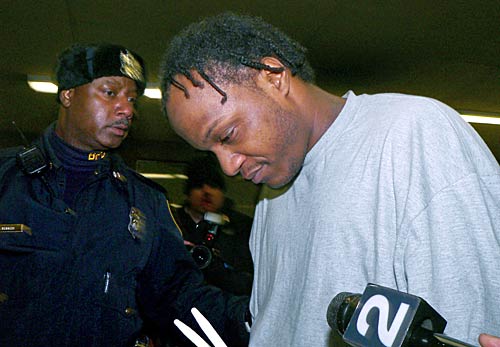
He wore a gray
long-sleeve shirt, blue jeans and white sneakers. He kept his
head down and did not respond to questions from reporters as
three detectives escorted him to a police van.
According to court
records, Hopewell has lived at 11 different addresses over the
past 13 years, including the same apartment building as one
victim killed in 2002 - the Greenhill Apartments, a complex for
the elderly and disabled, in the 2500 block of Violet Ave. in
Park Heights.
His prior arrests
include charges for drug possession, theft, burglary, battery
and failure to appear in court.
Wingfield's son,
Jerrold C. Wingfield, 36, said the family is relieved by the
arrest. "We're gonna see this thing through, all the way to the
end," he said. "He should get the fullest extent of the law,
whatever the law deems he should get, he should get."
Margaret T. Burns,
a spokeswoman for the city state's attorney's office, said that
prosecutors are pursuing the penalty of life without parole in
one of two murder cases that they have reviewed.
Burns said she
could not comment on whether the office would pursue the death
penalty, saying that prosecutors still need to examine the three
additional charges.
Intruder
told woman: 'I'm here to kill you and your husband'
The
Baltimore Sun
December
21, 2005
Amelia
Gertrude Tabron remembers vividly the words spoken by the man
who showed up at her Northwest Baltimore doorstep Sept. 10.
"I'm
here to kill you and your husband," Tabron, 76, recalled
yesterday, sitting in the dining room of the Fernhill Avenue
house she has called home for more than three decades.
"He
opened the door and those were the first words out of his
mouth," she said slowly, her speech affected by two recent
strokes.
"I'll
never forget that."
They
survived -- Amelia Tabron and her husband, Thomas, 80, who
suffers from dementia -- enduring a brief struggle in which a
butcher knife sliced her left hand.
At least
five others -- elderly women and a man, vulnerable, much like
them -- did not survive attacks.
Raymont
Hopewell, 34, has been charged with killing five people ages 60
to 88, some of whom he knew from the various neighborhoods in
which he lived. He has a bail hearing scheduled for today.
Two of
the slayings occurred in 1999 and 2002, but other crimes were
more recent -- three killings and two home invasions between May
and September -- a chilling trail of beatings and strangulations
in the city's west and northwest.
"We are
very, very grateful that there weren't more victims out there,"
said Maj. Richard Fahlteich, commander of the homicide unit.
But, Fahlteich added, investigators will continue to examine
evidence from other cases for possible links.
Yesterday, police added another crime to the list. They charged
Hopewell with the Sept. 2 rape of a 63-year-old woman who was
attacked at knifepoint in the basement of her West Baltimore
home, her hands later tied behind her back with green ribbon and
measuring tape.
Before
the attack, court documents say, the man stood in the woman's
kitchen and drank three Diet Cokes and a bottle of apple juice.
He left with the woman's television set.
Tabron,
a devout Baptist, said: "I was one of the blessed ones that made
it. It was the grace of God. He was protecting us."
Hopewell
didn't know the Tabrons. At least three of the people he is
charged with attacking he had apparently known or seen years
before. Those people ended up dead.
Lydia
Wingfield, a 78-year-old woman who police believe was killed by
Hopewell on Aug. 30, has a son who recalls growing up with
Hopewell in a West Baltimore neighborhood, riding bikes and
playing hide-and-seek together. The suspect told Wingfield he
knew her son when he confronted her in the house, court
documents say.
Neighbors, friends
Sarah
Shannon, 88, lived across the hall from Hopewell's mother in a
Northwest Baltimore apartment building, and family members say
the man visited his mother often. And relatives of 60-year-old
Constance Wills, who police say was killed in 1999, said
Hopewell attended their family gatherings and played with the
victim's grandson.
"It was
sad to know that it was someone we knew," Wills' granddaughter,
Lolita Horton, said yesterday. "What caused him to do that? I
want know why."
The
killings began -- as far as police know -- in February 1999.
Wills and her relatives had known Hopewell for years. Her family
even has a photo of Hopewell, taken during a birthday party.
When
Wills was killed -- she was found lying on a bed of a
second-floor bedroom, dead from asphyxiation -- relatives said
they suspected that the killer was someone who knew her. Police
charging documents say that DNA evidence led detectives to their
suspect.
Hopewell
had lived with one of Wills' daughters for a period of several
months. But she kicked him out him out when he ran up a phone
bill, according to Cecelia Smith, another of Wills' daughters.
It has
been about a decade since the two families last met.
"We
called him our cousin," Smith said yesterday, recalling the
tight bond she once had with her mother's killer. "He was at my
mother's alleged house for birthdays and holidays. It's hard
because you wouldn't think that someone you trust with your
family would hurt you like that."
Three
years after Wills was killed, on Nov. 30, 2002, police found
Sarah Shannon strangled in a bedroom at a Northwest Baltimore
apartment building. Hopewell's mother -- Carlita Bayton -- lived
across the hall from Shannon at the time, and residents at the
building said they remember seeing Hopewell hanging around.
A careful woman
Hopewell
never lived there, though he listed the address as a residence
at one point. Shannon, who stood 6 feet tall, was careful about
her own security, residents of the apartment building said
yesterday. Police told residents there was no sign of forced
entry.
"She
wouldn't have let anyone into her apartment," said Bertha Gray,
82, a close friend of Shannon's who lived on the same floor. "We
couldn't understand how someone got in there."
For
three more years, Hopewell continued to float around Baltimore.
He was convicted on a drug-dealing charge and began serving an
18-month sentence in July last year. A month later, he walked
away from a halfway house in Southwest Baltimore, where he had
been placed to serve his time.
A
Division of Correction spokeswoman said yesterday that a
"retake" warrant was issued for Hopewell's arrest, but
authorities didn't catch up with him.
Hopewell's mother died on Dec. 26, 2004, after suffering an
intracranial hemorrhage, according to the state medical
examiner's office. On May 27 this year, Sadie L. Mack, a
78-year-old great-grandmother and widow who lived alone in the
Sandtown neighborhood, was found strangled in her bedroom, with
her hands bound.
Three
months later, on Aug. 21, Carlton Crawford was found beaten and
strangled on the floor of a room in the Louis W. Foxwell
Memorial Apartments for the handicapped in Northwest Baltimore.
The 82-year-old man, who was hard of hearing, was the sole male
fatality linked to the case; court documents say his attacker
locked the door to the room.
Court
documents say that another man was attacked in the complex the
same day and that the victim fought back.
Hopewell
had been on the apartment building's list of people barred from
entering the complex, due to an unspecified incident, court
documents show.
Crawford
once lived two blocks away from another victim, Mack, in the
1980s, according to property records. Police say they haven't
found evidence that Hopewell knew Mack before her killing.
Nine
days after Crawford's slaying, Lydia R. Wingfield was found dead
in her home in the 2700 block of Mount Holly St. She had been
strangled. A son says he remembers growing up and playing with
Hopewell, who went by the nickname "Money."
Police
say the attacks continued into September, until investigators
were able to link the man to Crawford's death. Hopewell was
arrested Sept. 21 and charged in that killing. Last week, he was
charged in Wingfield's slaying, followed by charges this week
for the killings of Wills, Shannon and Mack.
But
authorities believe he carried out more attacks in September
before he was arrested.
In
addition to the Sept. 2 rape, for which he was charged
yesterday, Hopewell also faces charges stemming from two home
invasions that occurred Sept. 9 and Sept. 10.
Knife
attack
Police
have charged him with breaking into a Spaulding Avenue home
about 11 p.m. Sept. 9 by cutting a screen in a rear kitchen
window.
Police
said the attacker knocked down a 55-year-old woman, cut her
right hand with a knife and demanded $150. He also cut the hand
of her companion, a 61-year-old man, before fleeing when he
realized the woman had called police, according to court
documents.
Tabron
was attacked a day later. But the victim said Hopewell had
visited three days earlier, Sept. 7. He knocked on the door and
was let in by her husband as she prepared for a Labor Day
cookout. When she walked into the living room, she saw her
husband sitting his usual chair and a stranger sitting in across
from him on their couch.
"I said,
'Can I help you?'" she recalled. "He said, 'I know your husband.
I'm here for dinner.' ... he seemed very nice."
About 10
minutes later, she said, her niece came downstairs and asked who
the man was. "I said I don't know and she told him to leave,"
said Tabron. A police report quotes the niece saying, "Get the
hell out!"
Police
said the man returned Sept. 10. The Tabrons were home alone, and
Tabron said she answered a doorbell. The man said the woman's
niece had dropped her credit card, and then he forced the door
open and uttered the words that froze her in fear.
"He said
he was going to kill me and my husband," she said. "I said, 'Why
are you doing this?' He said he wanted money. I said, 'You want
money. I'll give you what you want.'"
The man
pulled a long butcher knife from a bag, Tabron said. She tried
to grab it but he snatched it back, slicing her left hand from
the thumb and across the span of her palm.
Blood
dripped on her carpet. She fell over, or he pushed her -- she
can't remember which.
The man
scuffled with her husband, who suffered minor cuts on his face
and hand, according to the police report.
He took
some money from Tabron's purse, which was sitting on the dining
room table. Her niece then returned and called police after
another struggle.
Amelia
Tabron has since suffered from two strokes and kidney failure
that kept her hospitalized for three weeks.
"Now, my
nerves," she said, pausing, "They're shocked. I'm dealing with
... I'm jittery. My nerves are very bad."
Drifter
charged in 5 city killings
December
20, 2005
The body
of Sadie L. Mack, 78, was found in the bedroom of her West Baltimore
home in May, her hands bound. Carlton Crawford, 82, was beaten to death
in August in his room at an apartment complex for the disabled. Lydia R.
Wingfield, 78, was strangled 10 days later in her home. Yesterday, city
police said that one man - a 34-year-old drifter with a lengthy criminal
record - is responsible for a disturbing series of killings of mostly
elderly residents of West and Northwest Baltimore since 1999 - victims
that authorities described as "defenseless."
Raymont Hopewell has been
charged with five counts of murder, and police say they are
investigating other cases. He also has been charged with five counts of
attempted murder stemming from two home invasions in September. Police
began exploring the series of killings after Hopewell was arrested in
September as a suspect in Crawford's death. Detectives said they linked
the man further with the help of a phone call that Wingfield made to her
son shortly before she was killed, which implicated the suspect through
his nickname, as well as DNA and other forensic evidence.
Maj. Richard Fahlteich, commander of the homicide unit, said police "have absolutely,
positively indisputable evidence that [Hopewell] is the sole suspect."
One woman was killed in 1999, another in 2002 and three more people this
year. The victims' ages ranged from 60 to 88. The man was beaten; the
others were strangled. Police said they were not sure how the killer got
into most of the homes.
Fahlteich said police were still investigating
possible motives. Some cases might have involved the theft of money or
possessions, but the reasons for other killings are not clear, the major
said. Hopewell, who has been held in jail since his arrest in September,
was taken from city police headquarters yesterday and returned to the
Central Booking and Intake Center, where he is being held without bail.
He wore a gray long-sleeve shirt, blue jeans and white sneakers. He kept
his head down and did not respond to questions from reporters as three
detectives escorted him to a police van.
According to court records,
Hopewell has lived at 11 different addresses over the past 13 years,
including the same apartment building as one victim killed in 2002 - the
Greenhill Apartments, a complex for the elderly and disabled, in the
2500 block of Violet Ave. in Park Heights. His prior arrests include
charges for drug possession, theft, burglary, battery and failure to
appear in court.
Wingfield's son, Jerrold C. Wingfield, 36, said the
family is relieved by the arrest. "We're gonna see this thing through,
all the way to the end," he said. "He should get the fullest extent of
the law, whatever the law deems he should get, he should get." Margaret
T. Burns, a spokeswoman for the city state's attorney's office, said
that prosecutors are pursuing the penalty of life without parole in one
of two murder cases that they have reviewed. Burns said she could not
comment on whether the office would pursue the death penalty, saying
that prosecutors still need to examine the three additional charges.
Police said the killings started six years ago: # Constance Willis, 60,
was found dead in her home in the 1100 block of N. Ellamont Ave. in West
Baltimore on Feb. 22, 1999. Little information was immediately available
about Willis' case, and her relatives could not be located last night. #
Sarah Shannon, 88, was found strangled in bedroom at the Greenhill
Apartments on Nov. 30, 2002. At one time, Hopewell had listed the
apartment building as his home address in court records, though it was
unclear whether he lived in the building at the time of the Shannon's
death. # Sadie L. Mack, a 78-year-old widow who was known as "Miss
Sadie" to many in her Sandtown neighborhood, was found dead in her house
in the 1600 block of N. Gilmor on May 27. The mother of seven grown
children had lived alone after her husband's death three years ago,
though her children, grandchildren, and great-grandchildren frequently
visited her. Her body was found by one of her sons in her first-floor
bedroom.
She had been strangled and her hands were bound, family members
said. "She loved this neighborhood," Roy Mack, 50, one of her sons, told
The Sun in June. "She never felt like she wasn't safe." Carlton
Crawford, 82, was found beaten on Aug. 21 in the Louis W. Foxwell
Memorial Apartments for the handicapped in the 3700 block of Greenspring
Ave., Northwest Baltimore. A security guard investigating a noise
complaint found him on the floor of his room. He had lived there since
the early 1980s and had no relatives, police said. Police charging
documents show that Crawford died from blunt force trauma and
asphyxiation.
Over the next several weeks, police said, they developed
enough information to lead them to Hopewell, including finding a witness
who identified the man - but knew him under the alias Kent Fisher - as a
possible suspect in Crawford's homicide. # Lydia R. Wingfield, 78, was
found strangled in her home in the 2700 block of Mount Holly St. on Aug.
31.
Her son found her lying on the living room floor, and in charging
documents, police reported recovering "physical evidence" from the
scene. They did not provide details. Police said they issued a warrant
for Hopewell's arrest, charging him with Crawford's death, and arrested
him Sept. 20. But it was the killing of Wingfield that police said broke
the case open.
On the day she died, Wingfield called her son, Jerrold,
and told him that a man who called himself "Money" had come to her door
and asked for Jerrold Wingfield, telling the woman that he had grown up
with her son. Wingfield told his mother that he didn't know anyone by
that nickname. A friend told him a man nicknamed "Money" did exist and
the nickname referred to Hopewell. Wingfield said he approached police
again with the new information. Wingfield said yesterday that he
remembered playing with Hopewell as a child, riding bikes together and
playing hide-and-seek. "I just remember him as a kid," Wingfield said in
an interview yesterday. "I never seen him as an adult. As a kid, I don't
remember him being a troublemaker. He was a good friend."
In court
charging documents, police say that Hopewell admitted being present in Wingfield's home "around the time" she called her son. A police crime
lab technician took a photo of a tattoo on Hopewell's arm, which reads:
"Money," charging documents said.