Charles Lindbergh was taking his post-victory lap
around the world after becoming the first man to fly solo across the
Atlantic when he was bumped from his front page, above-the-fold perch by
the savage kidnapping and murder of a 12-year-old California girl.
During a brief time around Christmas 1927, the tragic
death of Marion Parker generated banner headlines in newspapers across
the country because of the brutal nature of how she died. The entire
crime and investigation lasted a little over a week, but Marion’s murder
has been immortalized in American folk ballads.
Marion was kidnapped and slain by 19-year-old William
Edward Hickman, a transplant from Kansas City who later gave several
different motives for his crime. At his trial, Hickman was one of the
first California defendants to use the state’s new “not guilty by reason
of insanity plea” to excuse his behavior. Despite that he admitted
committing the atrocities suffered by Marion - which led many people to
believe that no one would so such things if he was sane - Hickman was
unable to convince a jury that he was crazy.
He died for his crimes on the gallows at San Quentin
in October 1928.
The tragedy began on December 15, 1927 when a well-dressed,
articulate young man showed up at the school Marion attended with her
twin sister in Los Angeles. The man told officials that the girls’
father had been taken seriously ill and that he wanted “the younger
daughter” to come quickly to his side. The girls’ teacher was somewhat
confused by the request for just one of the twins as well as the man’s
request for “the younger daughter.” When queried again, the man
corrected himself and asked for “the smaller one.”
He suggested that the teacher contact the bank where
Perry Parker worked as assistant cashier to confirm his story, but his
good faith suggestion aleviated her concerns. The man, later identified
as Hickman, was allowed to take Marion.
Hickman got a good headstart on searchers because no
one realized the girl had been kidnapped until she failed to arrive at
home and a search turned up nothing.
Hickman said later that when he told Marion she was
being kidnapped and held for ransom, she treated it like some sort of
adventure.
“We were driving out in Hollywood Friday night, when
my car was stopped by a traffic light,” Hickman said in a jailhouse
interview. “Marion was beside me and the newsboys waved their papers
close by us. Marion seemed to be amused by this.”
After Marion’s disappearance was reported to police,
the Parker family received a pair of telegrams, one from Pasadena and
the other from Alhambra, signed by “George Fox.” The telegrams told the
family to expect further communication and ransom demands. The
communiques ominously warned Perry Parker not to interfere with the
kidnapper’s plans.
The next day, Parker received the first note from
“Fox.” The note began with the header “Δ ε α τ η” meant to spell the
word “Death” using Greek characters.
“Fox is my name, very sly you know,” began the first
note. “Get this straight. Your daughter’s life hangs by a thread and I
have a Gillette ready and able to handle the situation.”
A second ransom note included the ransom demands and
was again headed “Δ ε α τ η”
“Fox” told Parker to get $1,500 in $20 gold
certificates and be prepared to deliver them that night. He signed the
note “Fox-Fate.”
The kidnapper included a plaintive note from Marion
to her parents begging them to comply. She warned that Hickman had
already threatened to kill her.
“Please, Daddy, I want to come home tonight,” she
added as a postscript to the note she signed “Your loving daughter,
Marion Parker.”
Parker gathered the money, worth about $17,000 today,
and prepared to meet the man he knew as George Fox. Hickman called
Parker on the night of December 16 and gave him instructions on how the
exchange would occur. However, he spotted police in the area that night
and never revealed himself.
On December 17, he sent a third note, blaming Parker
for the failure to complete the exchange.
“I will be two billion times as cautious and clever,
as deadly from now on,” Hickman wrote. “You have brought this on
yourself and you deserve it and worse. A man who betrays his love for
his own daughter is a second Judas Iscariot - many times more wicked
than the worst modern criminal.
“If you want aid against me, ask God, not man,” he
wrote. He included another note from Marion.
The kidnapper and father met at the corner of 5th
Avenue and South Manhattan Street in Los Angeles about 7:30 p.m. on the
17th.
“He pointed a gun at me and said ‘You know what I’m
here for. No monkey business,’” Parker recalled later. “I said ‘Can I
see my little girl?’”
Hickman pointed to a tightly tied package in the car
that revealed only Marion’s head.
“He said she was sleeping,” Parker said. “I assumed
she had been chloroformed.”
Parker handed over the 75 $20 gold certificates and
as they agreed, Hickman drove a block down the road and pushed Marion
out of the car.
Witnesses said Parker ran down to where his little
girl was lying and picked her up in his arms. Then he let out a soul-shattering
anguished cry of grief.
Marion was dead. The package contained just her head
and torso. Her arms and legs had been chopped off where they joined her
body. A wire had been wrapped around her head just above her eyes. It
cut so deeply into her flesh that it left a gaping wound. Her body had
been disemboweled and her entrails replaced with rags. She had also
apparently been flogged to such an extent that the flesh on her back was
flayed.
The autopsy revealed that she had been dead about 12
hours and that there were no signs of sexual assault. The coroner was
unable to determine a cause of death - he assumed it was either
asphyxiation or loss of blood.
Hickman later confessed that although he strangled
Marion and slit her throat, he believed she was alive when he began to
dismember her.
On Sunday, December 18, newspaper-wrapped packages
containing Marion’s arms and legs were found in a nearby park. By that
evening the reward for her killer - dead or alive - had topped $50,000.
Quickly, what would become the largest manhunt in the
history of the West Coast began as hundreds of police officers and
thousands of angry citizens began looking for a young white man, around
25 years old, about 5 feet 8 inches tall, weighing 150 pounds. He was
smooth shaven with thin features and dark wavy hair. At the time, the
kidnapper was driving a dark Ford roadster.
Police got a major break when they traced a laundry
mark on a shirt in which Marion was wrapped to an apartment house in Los
Angeles.
More than 100 cops descended on the apartment
building and conducted a room-by-room search. In one room police found a
dark-haired young man who gave his name as “Donald Evans” asleep in bed.
He allowed four officers to search his room and told them he “hoped they
would catch the fiend.” After police left without finding any clues,
Evans left the building never to be seen there again.
Police found the Ford Roadster - it had been reported
stolen weeks before in Kansas City - and made a major breakthrough when
fingerprints in the vehicle turned out to match those of a petty thief
and forger named Edward Hickman.
Hickman was a former employee of the bank where Perry
Parker was assistant cashier. It turned out that Hickman had been fired
from the bank for forging checks at the bank and that Parker not only
testified at his trial, but opposed a sentencing recommendation of
probation. Hickman served a brief jail term.
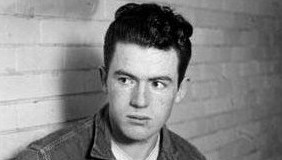
His mugshot soon graced the front page of dozens of
newspapers across the country, prompting sightings as far east as
Chicago.
After seeing Hickman’s mugshot, Evans’s landlady told
the press that he and Hickman were one and the same. The sheriff’s
department confirmed this, but Los Angeles detectives disputed the claim.
Others said they saw Hickman leaving the apartment around the time of
the meeting with Parker carrying newspaper-wrapped bundles. During a
second, more complete, search of the flat, criminalists found human
blood in the apartment.
Despite the unprecedented manhunt - at one point
8,000 local, state and federal officers had made him their top priority
- Hickman eluded authorities and headed north from Los Angeles, stealing
cars along the way.
On December 21, a man matching Hickman’s description
passed one of the marked $20 bills in a store in Seattle. Another turned
up in Portland, Oregon, and on December 22, Hickman was arrested by
police in Pendleton, Oregon.
(The arresting officers subsequently received dozens
of offers to join the Vaudeville circuit.)
Hickman confessed to Oregon officials and was
extradited to California within days. He admitted taking the girl, but
blamed an accomplice for killing her. No accomplice was ever identified,
and the man Hickman blamed had an alibi - he was in jail at the time of
the abduction.
“He said she was crying and he tried to stop her or
something like that, and he figured that the safest way would be to go
ahead and fix it that way,” Hickman told police. “If this fellow had not
killed her it would have come out all right as we had planned, because I
am sure she didn’t want to die.”
At the time of his arrest, Hickman said he planned
the kidnapping because he wanted money for college. Prosecutors
speculated that he wanted revenge against the man who sent him to jail.
Others believed he simply wanted notoriety.
“Don’t you think I will get as much publicity as
Leopold and Loeb?” He asked a newspaperman.
While in custody in Oregon, Hickman began to lay the
groundwork for his insanity defense.
“Wonder if I couldn’t pretend that I was crazy,”
Hickman said to a jail guard. “How does a fellow act when he is crazy?”
In late January 1928, Hickman went on trial in Los
Angeles, and used as his defense a year-old law that allowed a defendant
to admit committing a crime, but to excuse his conduct on the grounds
that he was mentally ill and not responsible for his actions.
“If the defendant pleads only not guilty by reason of
insanity, then the question whether the defendant was sane or insane at
the time the offense was committed shall be promptly tried,” the law
read. “In such trial the jury shall return a verdict either that the
defendant was sane at the time the offense was committed or that he was
insane at the time the offense was committed. If the verdict or finding
be that the defendant was sane at the time the offense was committed,
the court shall sentence the defendant as provided by law.”
The law assumed the sanity of the defendant and
placed the burden of proving insanity on the defense.
Numerous “alienists” examined Hickman and came up
with varying assements of his state of mind. The majority found that he
was sane. The defense put Hickman’s mother on the stand and she
recounted that “insanity ran in the family.”
The prosecution put on witnesses who testified to
Hickman’s state of mind while behind bars; all of them said he appeared
rational to them.
One detective told about riding with Hickman back
from Oregon. Hickman asked about the judge who would hear his case.
“He won’t hang me. He doesn’t believe in capital
punishment,” Hickman said. “But I guess I’ll throw a fit for him in
court anyway.”
Hickman’s comments help contribute to that judge’s
decision to disqualify himself from hearing the case. After a 10-day
trial, the jury found Hickman was sane and he was sentenced to death by
hanging.
A smiling Hickman was asked how he felt about the
verdict.
“The state won by a neck,” he quipped.
In the fall of 1928, the California Supreme Court
upheld the constitutionality of the statute and Hickman’s conviction.
“The rule relating to the defense of insanity does
not shift the burden of proof from the People to the defendant,” the
court held. “But only shifts the burden of introducing evidence and
declares the amount or quantum of evidence which he must produce to
overcome the presumption (of sanity) and show his insanity.”
On October 19, 1928, Hickman mounted the 13 steps to
the top of the gallows. He never expressed any remorse for what he did.
His main concern was how he would be buried.
“Warden,” said Hickman, “tell me they’re going to
bury me here. Honest I don’t want my old man and my mother to spend a
lot of money taking me back east.”
Edgar Rice Burroughs Reports on the
Notorious 1928 Hickman Trial
13 Columns for the Los Angeles Examiner
Erbzine.com
I.- 'HE'S MORAL IMBECILE,' FAMOUS WRITER
SAYS
But Abnormality Does Not by Any Means Imply Insanity,
Edgar Rice Burroughs Opines, Attending First Session.
Los Angeles Examiner ~ January 27, 1928
By Edgar Rice Burroughs
Noted Writer, Creator of "Tarzan" and Author of "The War Chief"
The first session of the Hickman trial was
reminiscent of the Dundee-Hudkins affair and an opening of a Grauman
theater. It resembled Mr. Hudkins' case against Mr. Dundee in that
nothing much happened, while the ceiling and the chandeliers in the
new courtroom showed the Graumanian influence on modern interior
decoration.
The crowd was there, too -- most of it on
Templestreet across the way from the Hall of Justice. Just what it
expecdted to see or hear from this strategic vantage is not entirely
clear, but at that about the only important thing it missed was the
reunion of the Writers Club that opened in Judge Hardy's courtroom at
9:30 in the morning.
Justice Must Triumph
Judging from this initial session of the hearing of
the case of the People against William Edward Hickman it is obvious
that justice must triumph. All the necessary components that enter
into the orerly processes of modern criminal procedure were there -- a
presiding judge, four atorneys,a visiting judge, a court reporter, a
clerk, several bailiffs and 100 representatives of the press. Oh, yes,
we had a defendant also, but he is of minor importance. As a matter of
fact, I did not know he was there until after I had left the courtroom.
Walsh's defense of his client is, of course, that
of insanity. I have read that he has argued that to hang Hickman would
be to indict every normal American boy, whereas were Hickman to be
adjudged insane the heinousness of his abominable crime would become
understandable and excusable upon the grounds of irresponsibility.
Hickman Abnormal
But no one should compare Hicman to any normal
American boy and it is libelous to suggest that he is in any way
representative of American youth, because Hickman is not normal.
But abnormality does not by any means imply
insanity. Hickman is a moral imbecile and moral imbecility is not
insanity. The moral imbecile is as well able to differentiate between
right and wrong as is any normal man -- the difference between the two
lies in the fact that the moral imbecile does not care what the
results may be to others so long as he may gratify his abnormal
egotism or his perverted inclinations.
What if Walsh is successful in his efforts to prove
that Hickman was insane when he kidnapped Marion Parker, that he was
insane when he murdered her, that hewas insane when he cut her little
body apart? He may succeed in doing so, at that, when one stops to
reflect upon the vagueness of the line of demarkation between human
responsibility and the lack of it as viewed from one angle, by
alienists for the defense of the prisoner and from the opposite angle
by alienists for the prosecution.
What May Happen?
What will happen, then, or what may happen. Under
our California law, Hickman might, at the end of one year, demand
another investigation as to his sanity and if found to be then sane,
the authorities would be compelled to free him.
If we hang him we have removed an immediate menace
to our peace and happiness and safety and a potential menace to the
peace and happiness and safety of countless future generations, for
moral imbeciles breed moral imbeciles, criminals breed criminals,
murderers breed murderers just as truly as St. Bernards breed St.
Bernards and thoroughbreds breed thoroughbreds.
But we should not stop with Hickman; in fact, we
need not wait to begin with him. The city whas plenty of moral
imbeciles that we might well dispense with.
Yes, I think we are going to have a great trial if
it ever gets started. There were a bunch of celebrities occupying
ringside seats and society was well represented inside the rail.
It is strange what will attract our best people.
*****
II.- 'I AM EINSTEIN IF HE'S CRAZY', SAYS
BURROUGHS
Hickman Will Get Justice, but it May Not Be What He
Wants, Writer Concludes After Seeing Judge Trabucco in Action
Los Angeles Examiner ~ January 27, 1928
By Edgar Rice Burroughs
Noted Writer, Creator of "Tarzan" and Author of "The War Chief"
We have always been led to feel that there was
something stable and enduring in the judge business - that one's
position was not as precarious as in many other vocations -- but Mr.
Walsh has disillusioned us. He disillusioned Judge Hardy, too. Why,
the judge didn't have a chance to show his samples even before Mr.
Walsh canned him.
Do you know, I think it was mighty fine of Mr.
Walsh to abandon his big practice so unselfishly and come way out here
to California from Kansas City, Mo., and take charge of the
adminstration of justice for us and face all this terrible publicity
with such seet and simple resignation.
You can see that what happened yesterday has
worried Asa a little bit -- he is noticeably quieter and less
obtrusive. It is apparent that he feels that if he's not careful Mr.
Walsh will fire him, too.
Our new guest conductor is Judge J. J. Trabucco of
Mariposa County is, butI'm for it, horse, guns and eversharp, if this
is a sample of the men it turns out. My, what a judge he is! About
five minutes after court opened this morning -- if that is what courts
do -- I felt the same conviction concerning Judge Trabucco that I
experienced at the time I sat on a jury in Federal Judge James' court
-- that if I had been indicted for a crime and I were innocent I
should want to be tried before him without a jury.
There'll Be No Fooling
There ain't goin' to be no foolin' in the trial of
the case of the People vs. William Edward Hickman, and Hickman will
get justice. Justice may not be what he wants, but he's going to get
it.
I saw Hickman today, which makes me believe that I
am a natural born newspaper corresondent, as I was in court only two
days before discovering the defendant. Tomorrow I am going to point
him out to the rest of us journalists, although, at that, it really is
of little moment whether one sees him or not. He is nothing to write
home about.
As a criminal physiognomist, I shall have to admit
to being a total flop. I cannot look at the outside of a man's head
and say that he is a murderer, yet, after watching Hickman all day I
will venture the assertion that if he is crazy, I am Professor
Einstein.
We are now in the throes of selecting a jury, which
appears to consist largely of discovering twelve good men and true
women who never read a newspaper, never knew anything, and not only
never had an opinon, but have not even talkedwith any person who had.
Trial Wasting Money
As I sit up there in that gold-ceiled courtroom
watching all the ponderous machinery of the law, listening to volumes
and volumes of words, seeing the tremendous economic waste that is
represented by the hundreds employed either directly or indirectly in
this hearing who might be profitably employed elsewehre, I am moved to
wonder if, after all it is not we who are crazy, and if Hickman and
his kind may not be in some respects the only sane people.
They know what they want and they brook no
interference. They go after it until they get it. And what are we
doing?
We know that Hickman abducted and murdered little
Marion Parker and I doubt if there is one intelligent person in Los
Angeles County who is not absolutely certain that Hickman knew at the
time of the commission of his crimes that what he was doing was wrong
and yet we are wasting time and money in an unnecessary court
procefure that in the end may possibly defeat justice and place us in
further jeopardy at the hands of Hickman or some other instructive
criminal.
I don not know what we can do about it, but I do
know that it would not be considered rational procedure in an
individual and I cannot believe that it is the voluntary act of a
rational society.
We are the victims of court procedure and of laws
that are wrong and they should be righted by those to whom we look,
usually in vain, for such relief. Until it comes, every degenerate may
rightly feel that he may have his way with our daughters and our lives
with reasonable assurance of immunity from punishment.
In the meantime we are trying Hickman . As I have
not yet seen tomorrow's papers -- they will not be on the streets
until after dinner this evening -- I cannot say which side scored an
advantage today, but the defense led yesterday. Hickman and a defense
alienist got their pictures in the papers, while I failed to see a
single likeness of Asa Keyes.
*****
III.- BURROUGHS CALLS HIM 'INSTINCTIVE CRIMINAL'
Hickman Has Only Anatomical Resemblance to Man; His
Type Menaces Society and Should Be Exterminated, Declares Writer
Los Angeles Examiner ~ January 28, 1928
By Edgar Rice Burroughs
Noted Writer, Creator of "Tarzan" and Author of "The War Chief"
The alienists for the prosecution had a hard day of
it yesterday while the talesmen were being interrogated by the
attorneys for the defense. It was a bad day for psychiatric
superiority complexes in that it revealed the mortifying fact that no
one ever had hear do any of the"so-called alienists," as Mr. Wals
descdribes them; very few of the prospective jurors had read what they
wrote and none could recall what they had said in what they had
written.
This examination of talesmen is tremendously
interesting (and as long as we are paying for it we may as well drive
what satisfaction we can from that fact) in what it reveals, ever so
sketchilly, of the customs and home life of what is, presumably, the
average American citizen.
One point that impressed me particularly is the
apparent absence of discussion in the home circle of topics of general
interest, and I think I may say, without danger of refutation, that
for a week or two at least the kidnaping and murder of Marion Parker
was a matter of quite general public interest. The majority of the
talesmen had not discussed the case with any members of their families,
some had "talked" aboiut it briefly, but only one admitted to any more
than cursory mention. Visualize, if you can, a home without discussion,
which would necessarily imply a home without argument. There aint no
such place.
Unlike Homo Sapiens
Hickman appears to me to be intelligently alert to
all that is going on in the courtroom. I ahve been watching him
intently for two days -- ever since I discovered him -- and I have
dislocated a couple of vertebrae in my neck attempting to keep my eyes
on the court or the attorneys who happened to be propounding a
question, upon the juror when the replied and upon Hickman to note his
reaction.
It is not strange that the young man is self-possessed
and calm, as nothing has occurred as yet during the proceedings to
excite a neurotic canary bird, but I am confident that nothing can
happen to ruffle his self-assurance, no matter how dramatic it may
appear to others, and this belief of mine is based upon a strong
conviction that Hickman except for the fact that he has two arms and
two legs and is otherwise anatoically contructed in the semblance of
the human species, is as unlike homo sapiens as is a mud turtle or a
penguin.
Hickman is an instinctive criminal. He is a
representatvie of a new species of man that has been evolving throuigh
the ages, and only wheen society awakens to the fact that species may
be differentiated by something other than anatomical divergencies and
that psychic anomalies render groups of people more distinct from
other groups that the mere conformation of the skull it will realize
that the members of this new species may not be judged by the same
standards that hold for us or accorded equal consideration, if society,
as it is trying to exist today, is to endure.
No Appeal To Heart
As I sat and watched Hickman I tried to discover
why it was that I experienced none of the reactions I had expected. He
is a youth and youth appeals very strongly to my protective instinct
as well as to my affections, as it does to all fathers; but I could
find in my mind only a sense of revulsion. I was going to say in my
heart, but Hickman does not appeal to the heart. And it was then that
it was impressed upon me that I was not looking at a human being -- I
was watching for reactions in some species of beast that does not
react to the stimluli that affect human beings.
The mind and soul and the instinctive criminal
differ as radically from ours as do the mind and soul of a tiger
differ from those of a lap dog. If the world was overrun with tigers
we should know just what to do about it and that is what we are going
to have to do about this new and terrible species of beast.
'Destruction Our Defense'
Destruction and sterilization are our only defense
and we should invoke them while we are yet numerically in the
ascendancy -- if we are.
As I look at Hickman and recall what those hands
have done, what those eyes have seen, what that mind has evolved, I
cannot hate him. I could not hate the viper that struck me. I should
wish to destroy it, but I could not hate it. And so I should wish to
see Hickman destroyed -- not through hate, not through malice, but,
with all pity, in the interest of posterity.
*****
IV.- 'HE KNOWS RIGHT, BUT BEAST DOESN'T CARE!'
Edgar Rice Burroughs Says Hickman Sane; However,
'Fox' Regards Society as Enemy Against Whom He's Constantly At War
Los Angeles Examiner ~ January 31, 1928
By Edgar Rice Burroughs
Noted writer, creator of "Tarzan" and the "War Chief"
Justice, in all her majesty, strides relentlessly
forward, There were eight cameras in court when I arrive yesterday
morning against seven last Friday. Every press seat was taken and the
minor consierations of completing the jury was finally achieved.
I should like to say something aboiut modern
methods of selecting a jury in a major criminal case, but what is the
use? If I said what I thought it would be deleted.
However, I probably may, with propriety, observe
that the court and the prosecution appear to entertain no hysterical
fear of intelligent talesmen.
AS we become better acquainted with the
personalities of the court room we are struck by the fact that the
outstanding, dominating figure of the HIckman trial is Judge Trabucco.
His alert, dynamic intelligence stimulates and impresses itself upon
every phrase of every activity in that ornate room on the eighth floor
of the Hall of Justice.
Judge Misses Nothing
I have seen judges who appeared to doze behind a
convenient screen of dignity, but this man never dozes. HIs eyes and
ears miss nothing -- he is a veritable watch dog of justice -- and
with that he is the personification of judicial dignity, in that he
inspires absolute respect without adopting the methods ofd either the
martinet or the satirist.
Asa Keyes has not had any occasion to get into
acdtion as yet, but he seems to be well cast. Of the defense attorneys
I believe Cantillon is the keener and will add most to the gaiety of
nations when the curtain rises after the prologue of jury selection.
The zero in the equation is Hickman.
There has been a little comedy relief running
through the prologue, thus closely do comedy and tragedy walk together
through life.
The longer I consider the Hickman affair and the
more I see of Hickman, the more convinced I ecome that the man is no
more a human being in the sense that normal members of society are
human beings, than is an anthropoid ape.
'Brutality Inborn'
He must have been endowed at birth with certain
characteristics that are even more at variance with human
characteristics than those of the apes are at variance with ours, and
one of these characteristics is something that has been called "inborn
brutality of the will."
This new and terrible beast-type in human form,
this homo criminalis, is not necessarily insane, though the taint of
his blood in the veins of homo sapiens might conceivably tend toward
insanity in his progeny. He is as capable of understanding that his
acts transgress the rights of others and the laws of God and man as
are we, but he does not care. He realizes that he is different from
other men and he looks upon organized society as an enemy against whom
he is constantly in a state of war.
Where he combines with others of his kind we find
more or less open warfare against society, and against other groups of
his own kind, as evidenced by the gang wars of Chicago and other large
cities, by such outbreaks as occurred recently at the Folsom
penitentiary and sporadically in other penal institutions throughout
the world.
How are we to arm and defend ourselves against homo
criminals? One brilliant subscdriber writing to a Los Angeles daily
newspaper suggested that as the fear of capital punishment evidently
did not deter Hickman from committing an atrocious murder, captial
punishment must be a failure, and he suggests that we substitute "love"
for hanging.
Love! I doubt that Hickman has ever felt unselfish
love for any living creature. I doubt that he is capable of
experiencing any such noble sentiment, for if he were it is
inconceivable that he could have looked into the eyes of a little girl,
innocent, helpless, wholly within his power, and not have been moved y
those other ordinary human characteristics that are components of
brotherly love -- compassion and the protecdtive instinct of the
normal male.
No, love would be wasted upon Hickman, just as I
firmly believe that the concentrated hate of all mankind that is
directed upon him is wasted as far as it may cause him remorse or
prevent him from a repetition of his criminal acts should he ever
again be turned loose upon society.
*****
V.- IS HICKMAN NOT GUILTY BECAUSE MOTHER
HEARD STRANGE NOISES?
That's Defense Idea as It Appears to Edgar Rice
Burroughs; 'After Sizing Up Jurors, I'm Convinced It Isn't Going to
Get Very Far With Them,' He Adds
Los Angeles Examiner, February 1, 1928
By Edgar Rice Burroughs
Noted Writer, Creator of "Tarzan" and Author of "The War Chief."
Once again I passed through the cordon of police in
the corridor of the Hall of Justice, passed the handsome deputy in the
little pine door and the bailiff at the entrance to the courtroom, and
once again none of them seemed to suspect that I do not know the
difference between right and wrong or that it might seem eminently
proper to me to dismember thema nd scatter their remnants in Elysian
Park.
In fact, I never suspected this myself until I
caught the trend and purpose of the depositions read by the defense
attorneys in Judge Trabucco's court yesterday, from which I gather
that insane people do not know the difference between right and wrong
and that people who suffer from hallucinations are insane.
The idea, as it appeared to me, is to prove that
Hickman is not guilty of kidnaping and murder because his mother
thought she heard strange noises about the house at night.
In other words she suffered from hallucinations,
therefore she was crazy; therefore she did not know the difference
between right and wrong; therefor anyone who does wrong my suffer from
hallucinations, which unquestionably proves them insane, therefore
Hickman is innocent, Q. E. D.
When I was a young man, I thought, upon a certain
occasion, I could thrash a policeman. It was an hallucination. ONce I
had an hallucination that I could write a play. With these facts well
established and a matter of record I may now start upon a career of
murder.
And consider the lives of constant danger that all
of us married men lead, for how many of us are there who do not sleep
nightly in the same room with one who hears things about the house
after dark? That is, I mean, of course if we are sleeping where we
should.
STORY UNCONVINCING
So far the evidence adduced has not been very
convincing, even as to the insanity of Mrs. Hickman, let alone the
inability of her son to know that wanton murder is not considered
entirely good form, and after sizing up the Hickman jury I am of the
opinion that it is not going to get very far with them.
A point was brought out in the deposition of
Hickman's high school chum, John Johnson, that is the most damning
evidence thus far submitted, and that further crystallizes my already
unalterable convition that the world will be better off after Mr.
Hickman has departed hence.
He was a boy orator.
That was the first downward step, after that came forgery, robbery,
kidnaping, murder.
2,000,000 HEFLINS
I have known all along that something like this
was goiong to happen if some steps were not taken to stem the tide of
boy oratory.
Consider the astounding statement made recently in
a local newspaper that the 1928 crop of boy orators will moiunt to the
appalling toal of 2,000,000! Imagine the consequences of annually
turning loose upon us 2,000,000 Heflins.
It is safe to assume that the defense will attempt
to show that insanity is hereditary. That should not be difficult, as
expert opinion is quite unanimous upon that point, and the defense may
even prove that Hickman is or hs been insane, but let us hope that
noting occurs to confuse the legal and medical definition of insanity
in the mind of a single juror.
NORMALITY OF MIND
By medical standards one might easily be accounted
insane whome the law could hold to strict accouintability for his
every act. Mental depression, extreme nervous irritability are not
normal condition sof a healthy mind and a mind tha tis not normal may
be adjudged insane, according to the testimony of one of the
physicians who attended Mrs. Hickman prior to her commitment ot the
Arkansas lunatic asylum.
As a matter of fact, however, the only issue in
this trial may be summed up in a single question: Did William Edward
Hickman believe that he was doing right when he kidnaped and murdered
Marion Parker?
Or, to be more fair, was he ignorant of the fact
that he was committing an act that would prove harmful to her? Such a
conclusion is incredible and because it is so increadible this whole,
seemingly interminable business of determingin something that everyone
already knows, assumes the proportion of a vast hoax -- a hoax that
society is playing upon itself and paying for, not only in money today,
but will continue to pay for in money and tears and suffering for
generations to come.
What is the answer? I believe that the answer could
be given by such men as Judge Trabucco if they were not hampered by
the necessitites of present-day criminal court procedure.
*****
VI.- 'KNEW HE WAS DOING WRONG,' SAYS
BURROUGHS
'NAPOLEON WAS LESS SANE THAN FOX'
'Used Ruthless Methods Because They Offered Him a
Quicker Fulfillment of His Ambitions'
Los Angeles Examiner ~ February 2, 1928
By Edgar Rice Burroughs
Noted Writer, Creator of "Tarzan" and Author of "The War Chief"
In the light of the depositions read in court
yesterday we see Hickman in 1926 as a kindly, considerate, high-minded
youth who aspired to the ministry; a youth who wished to work that he
might make life easier for his mother.
These characteristics were quite evidently deeply
impressed upon the mind of his friends, his teachers and his employers,
and to such effect that not one of them can conceive that this likable
boy of 1926 could possibly have committed murder in 1927, unless he
had undergone such a mental transition in the meantime as to have
become insane to a degree that rendered it impossible for him to
differentiate between right and wrong.
I believe that I can understand and appreciate in
what manner these sentiments have influenced these people to arrive at
these obvious honest convictions. Proper consideration would be shown
Hickman. I hope the jury will show him proper consideration. I hope
they will accord him the same consideration that he accorded Marion
Parker.
REVERSE DEVELOPMENT
By the testimony of one employer, we learn that
Hickman was too tender-hearted to kill a chicken and that another boy
was called upon to do this work for him, which may, in the light of
subsequent events, mean something or nothing. It suggests to my mind
the possibility of what might be termed an anachronistic mental or
spiritual development in Hickman. Most boys like to kill.
As they grow older, this primitive instinct becomes
less and less pronounced until, in mature men, it often disappears
entirely. In Hickman this development may have been reversed, but I
think there is another explanation. I believe there is a very
excellent explanation and I commenced to sense it from the depositions
read Tuesday and yesterday it became almost a conviction.
Deposition after deposition stressed the evident
fact of Hickman's ambition and his willingness to make sacrifices to
achieve that ambition. I believe that the greatest ambition this youth
has ever entertained has been to go to college. He had that in mind
when he strove to win a place in the national oratorical contest. It
was not the glory he wanted. It was the $500 that the Kansas City Star
had offered the winner of this contest -- $500 that would put him that
much closer to the fulfillment of his dreams.
He was an officer of an important student
organization in Central High School in Kansas City, but when he found
that this organization could be of no value to him, he neglected the
duties of his office and later resigned. Nothing mattered but his
selfish ambition.
Out here in Los Angeles he wanted a motorcycle. He
wanted it so badly that he forged to obtain the money to buy it, which
is exactly what might have been expected of any other instinctive
criminal. As long as everything was coming Hickman's way he was all
right, for he was an intelligent boy and he knew that it is better to
win by rightful methods than by wrongful -- and much safer.
REASONED WAY AROUND
When he was having his little successes in high
school there was no reason why he should evince any of the criminal
instincts, the possession of which he was dboutless ignorant himself
at that time; but the moment that an obstacle confronted him he
reasoned a way around it, not because he was insane, but because he
was quite sane, and he did not put aside the wrongful methods of
achieving his ends as a normal boy would have done, but gave them the
same sane and careful consideration that he would rightful methods,
and because the wrongful ones offered an easier and quicker
fulfillment of his ambitions, he chose them, intelligently, ruthlessly.
I am commencing to believe that Hickman never
entertained premeditated murder in his heart. H did not go to the drug
store to kill Toms, but the instant Toms became an obstacle in his
path, he destroyed him just as ruthlessly as he destroyed Marion
Parker a year later when the realization dawned upon him that to
return her alive would most certainly lead to his arrest and
conviction, for Marion was too old and too intelligent to be safely
left alive to describe and identify him.
Hickman's case might be described as ambition gone
wrong. There is nothing new in that. History is full of such cases. We
are surrounded by them in every-day life, though most of them,
fortunately, stop short of murder. Ruthless, selfish ambition.
That is Hickman's dominating characteristic. It was
Napoleon's, and of the two I believe Napoleon was less sane than
Hickman, for he believed that he was doing right in the name of
patriotism and country, while it is evident to any unbiased mind that
Hickman knew he was doing wrong when he killed Toms, when he kidnaped
Marion Parker.
ACT EXCELLENT EVIDENCE
The fact that he murdered Marion Parker is
excellent evidence that he knew that kidnaping was wrong -- I do not
mean legal evidence, because in court you couldn't possibly prove that
the moon is not made of green cheese by admissible evidence -- but to
convince an intelligent audience beyond a reasonable doubt, since from
his purported confession and all of the known facts there is no
reasonable doubt, since from his purported confession and all of the
known facts there is no reasonable explanation of the murder other
than a desire to escape punishment from kidnaping, which presupposes
full knowledge of the wrong fulness of that act.
And why did he kidnap Marion? Again ruthless,
selfish ambition. He wanted $1500 to defray his college expenses, and
he didn't give a whoo-hurrah how he got it. Of course, he is insane --
so was Ponzi.
*****
VII.- 'CRIME EVEN MAY AFFECT PANEL'S LIVES'
Women Who Viewed Photographs Never Will Be Able to
Forget, States Edgar Rice Burroughs
By Edgar Rice Burroughs
Noted Writer, Creator of "Tarzan" and Author of "The War Chief"
Blank paper staring me in the face, words to be
written and nothing to write about that has not been written again and
again, ad infinitum, ad nauseam, e pluribus unum, or what have you.
There was drama yesterday, but that will be written
of by trained men and women whose business it is to portray such
events so vividly that tears will come to your eyes as they came to
the eyes of the sob-shaken jurywomen yesterday when the photographs of
the pitiful little remnants that had once been a happy child were
passed through the jury box.
There may be ten thousands cogent reasons why women
should serve on juries, but the effect of those horrible photographs
upon the women members of the Hickman jury nullify them all. Those
women never will forget what they saw yesterday; upon some of them it
may make such a lasting impression as to affect their entire future
lives and thus the ramifications of Hickman's hideous, wanton crime
multiply an extend, bringing pain and sorrow -- a cancerous growth
that not even the knife can now eradicate.
FIRST UNDER NEW LAW
The consensus of opinion among the more experienced
onlookers indicates that there is s little likelihood that this cause
may terminate where it should -- at the lower end of a hempen rope.
This is the first case of its kind to be tried under the new law
recently passed by the state legislature and there is a question as to
the proper interpretation of that law. Even though the jury agrees an
Hickman is found to have been sane when he committed this crime, it is
thought probable that his attorneys may interpose a new plea of not
guilty and demand a new trial.
Many years ago the state legislature of Idaho
labored an d gave birth to many new laws. After they adjourned for two
years, it was discovered that all of the laws were unconstitutional.
This is not an unusual habit of state legislatures, so we need not be
surprised if something is found amiss in this new California law which
bears upon the case at issue. As a matter of fact, I should be pop-eyed
with surprise if I should discover that a state legislature had ever
done anything right, except inadvertently.
INTERESTING WITNESSES
The witnesses yesterday were more interesting than
their testimony, some of which we were able to hear and some of which
was evidently of such a secret nature that the witnesses confided it
only to the court reporter; but I know what ailed them and they have
my deep sympathy as I have suffered total paralysis of the vocal cords
in a similar situation.
Welby L. Hunt was there, and if he is an example of
the present-day gunman, we fictionalists shall have to stick to Jesse
James and Rube Burroughs for our types -- we could not jiggle a thrill
out of our readers with a description of a bad man who looked like
Welby Hunt. He might be any one of a dozen nice boys who had called on
our daughters; even the dimple in his chin would not completely damn
him. From where I sat, behind a phalanx of opaque star reporters, it
seemed to me that Welby's helices were rudimentary, and if you haven't
a perfectly good helix, you may fall under the suspicions of the
alienists.
Frank R. Peck testified that he is some sort of
building material contractor, but he should be an automobile salesman,
considering the ease with which he disposed of his machine to William
that December evening in Hollywood -- he not only delivered it, but he
gave a complete demonstration within twenty minutes after he met his
prospect. He was called as a defense witness, presumably to bear out
the defendant's contention of insanity, but is a man who will steal a
machine insane? That is the question. I owned a car once that I am
convinced that only an idiot would buy.
Hickman grows paler. His face is absolutely
bloodless. This might be a sick room and HIckman the patient. If it
were, they have called a might good man in consultation. Ol' Doc Keyes,
the well-known chiropractor, is going to advise manipulating the
vertebrae in the patient's neck, if he doesn't die of old age before
the adjustment can be made.
*****
VIII.- MURDER MEANS TO END FOR HIM, SAYS
WRITER
Los Angeles Examiner ~ February, 4, 1928
By Edgar Rice Burroughs
Noted Writer, Creator of "Tarzan" and Author of "The War Chief"
Once upon a time there was young wolf. With his
little brothers and sisters he suckled at his mother's breast and with
them he romped and played i the sunshine. He was a happy, harmless
little puppy. He lived in a country where there were many sheep and
one day, as he was approaching maturity, he killed a little lamb and
tore it to pieces.
And the sheep waxed wroth and in their excitement
they ran around in circles and said unkind things about the young wolf
and demanded that he be punished; but there came a young sheep from
another fold, a young sheep who had no little lambs of his own, and he
said to the angry sheep: "The young wolf did not know what he was
doing when he killed your little lamb." And the sheep said: "How
come?" And the young sheep said: "We have known the young wolf all his
life, we have seen him romp and play in the sunshine with his little
brothers and sisters, we know that he drinks nothing but milk from the
breasts of his mother."
BORN MURDERER
"And what of that?" demanded the sheep. "Can you
not see," asked the young sheep, "that such a kindly little wolf could
not have killed your little lamb and torn it to pieces unless such a
great change had taken place in him that he did not know what he was
doing?" And the sheep scratched their heads and turned to the kindly
shepherd who stood there with his twelve faithful Collies and they
said to him: "Shepherd, we are only sheep; you know more about wolves
than we do and so we are content to leave this matter to you, in whom
we have so much faith, confident that you will protect us from this
wolf and from all other wolves."
The defense plan, in the Hickman case, of
introducing such evidence as to make the crime appear so atrocious
that the jury will be convinced that the Eddie Hickman of 1926 could
not possibly have perpetrated it unless he had become absolutely
insane, ignores the fact that the anti-social tendencies of the
instinctive criminal mature as the individual matures. Rosa Bonheur
did not wrest a paint brush from the hand of the accoucheur and
delineate a noble Norman stallion upon the counterpane of her mother's
bed, and yet Rosa was a born artist.
Hickman did not leap from his cradle, seize a
butcher knife and dismember an innocent little girl, and yet Hickman
was a born murderer. If nothing had thwarted his ambitions, if no
obstacles had intervened to render the winning of an honorable goal
difficult, Hickman would never have committed a murder, nor any other
crime. To the instinctive criminal of his type, crime is merely a
means to an end. It is not in itself the chief consideration, as it
doubtless is in the diseased minds of the criminally insane.
LIKE ENGLISH CASE
Hickman's case is analogous in many respects to
that of a very famous English criminal case of the early part of the
Nineteenth Century, Thomas Wainewright, well known in his time as an
essayist, a man with a brilliant future, started on a career of
forgery and murder for the sole purpose of obtaining funds to satisfy
his craving for a life of ease and luxury. This was his ambition. In
another it might have been an ambition to go to college. What
difference does that make?
He murdered relatives who had befriended him in
order that he might obtain their property. ONe was a beautiful and
very healthy girl whose life he had insured for some ninety thousand
dollars. Her he poisoned. He was a man of super-refinements who hated
all vulgarities and "sordid instincts." Yes, he was very much like
Hickman and a commentator says of him: "Wainewright presents to us a
perfect picture of the instinctive criminal in his most highly
developed shape," but nowhere, in all that has been written of
Wainewright, have I discovered any suggestion whatever that he did not
know the difference between right and wrong.
The defense will show that Hickman is not normal.
Of course he is not normal in the sense that you and I are normal., or
think we are; but in another sense, he is normal -- he is a normal
instinctive criminal and as such he is a very real and terrible menace
to all of us and should be destroyed, as all his kind should be
destroyed, and our laws should be so remodeled that they may be
destroyed with dignity, for ourselves, and dispatch for them --
especially dispatch.
If our criminal laws are remodeled to harmonize
with our blatant claims to rationality a considerable mass of
presently admissible testimony which now wastes a great deal of our
time and money will, happily, go into the discard. What in heck do we
care if the accused has two gold teeth and sore tonsils, or cirrus
meningitis, or dementia praecox or that he is a paranoid who is
suffering with a megalomania? Mussolini may, conceivably, be suffering
with a megalomania, but I doubt that he would consider it entirely
social to cut up our baby sisters, nor, if he did, that we should
agree with him.
We do not care what ails this bird, Hickman. We
know that he murdered Marion Parker. We know that he knew it was a
wrong thing to do. We know that he should be hanged and if he is not
hanged our already tottering respect for our laws may do such a Brodie
that the next murderer we catch -- well, I was going to say something
that I should not say, that no self-respecting, law-abiding citizen
should say, but sometimes it is difficult to make our thoughts behave.
We might send the next one to the Senate from Pennsylvania or Illinois
and if he is as sensitive as Hickman has been described to be, he
would die of shame.
*****
IX.- THRUST AT ALIENISTS MADE BY
BURROUGHS
Los Angeles Examiner ~ February 6, 1928
By Edgar Rice Burroughs
Noted Writer, Creator of "Tarzan" and Author of "The War Chief"
These alienists ought to get together if they want
us to have a lot of confidence in them. ONe of them writes a book in
which he tells about epilepsy, while his brother alienist, testifying
for the same side, describes epilepsy as an archaic, discarded term
born of ignorance.
These alienists are the comedy relief of an
otherwise full drama and if they accomplish anything else in criminal
trials it is to fix definitely in our minds, as a conviction, a
suspicion of long standing, that the estimate of the value of a gored
ox depends solely upon whose ox it is.
But notwithstanding this, we learn much from them, some of which,
however, comes too late, much too late. We learn, for instance, that
if we fail to observe ordinary care and discrimination in the
selection of a germ plasm we may in later life become possessed of
such delusions of grandeur that we shall wish to kill.
LEARNS FROM ALIENISTS
If someone had told Hickman about this nine months
before he was born, he would not have had to strip to the waist before
a courtroom filled with beautiful motion picture actresses and others
of God's favored creatures who can manage to get into department 84 on
some one else's pass and sit in the wrong seats, while a member of the
lunacy commission drew pictures on his back and chest with an
unsterilized key -- pictures that prove conclusively to every
intelligent man and woman in that courtroom that HIckman slew Marion
Parker form solely altruistic motives because, after three minutes and
fifty-eight seconds, the pictures were still visible to the nude eye.
I learned something else from the alienists. I
learned that the least said about the wanderlust I have experienced
from my youth, the better for my standing in the community if you have
a desire to do anything more exciting than emulate the estimable cow
which stands all day, day after day, in the same pasture, contentedly
chewing her cud, you may be a victim of dementia praecox. Not
necessarily, of course; there are other symptoms, but you will fall
under suspicion even though your big toe curls in the right direction
when someone caresses the sole of your foot.
'SIGNS OF DELUSION'
Furthermore, watch your boys if they develop any
youthful ambitions, and keep the butcher knife locked up if one of
them should chance to confide in you that he wants to be something
besides a street cleaner when he grows up. It is a sure sign of
delusions of grandeur and these are almost invariably fatal -- to
someone else.
It seems that Hickman entertained delusions of
grandeur, but he kept them a secret from the world and even from his
intimates until after he had been arrested. If my memory serves me
correctly, these delusions of grandeur occurred to him subsequent to
interviews between himself, his attorneys and and alienist for the
defense, but I may be wrong. I usually am.
And it seems that these delusions may become
retroactive, so to speak. At least they seem to have become, so in
Hickman's case, causing him to perform unsocial acts before he
entertained these delusions of grandeur, for immediately after his
return to Los Angeles, following his arrest, he stated definitely to
an examiner that he had no delusions or hallucinations.
SHOULD BAN PSYCHIATRY
If I were not aware of the high standing and
unimpeachable characters of many alienists, I should be inclined to
ascribe motives to their sworn testimony that might make me the
defendant in a libel suit, but I really do believe them sincere --
most of them; and so I am moved to ascribe, what otherwise might fall
into the category of idiocy or knavery, to the fact that psychiatry
is as far from being an exact science as is alchemy or astrology and,
as such, it has no place in jurisprudence under our existing criminal
court procedure. Briefly, I believe that it can only tend to befuddle
the minds of the jury and becloud the real issues.
*****
X.- SCIENTIFIC DISPUTE LOST ON BURROUGHS
'Alienists All Funny, but One or Two of Them Would
Have Been Enough'; Elder Hickman Given Blame
Los Angeles Examiner ~ February 6, 1928
By Edgar Rice Burroughs
Noted Writer, Creator of "Tarzan" and Author of "The War Chief"
With a key I drew an H on the breast of my 15-year-old
son and one upon my own breast. After ten minutes or so we buttoned up
our shirts and changed the subject. Concerning which the less said the
better; but I know that from now on the rest of the family are going
to look upon us with suspicion. Dermatographia as either a fine art or
a pastime has ceased to interest us.
Alienists have ceased to interest me. Like the
other good things of life one may get too much of them. If Sid Grauman
had been staging this Hickman show we would not have had so many
alienists in the cast. Of course they are all funny, ut one or two of
them, as a foil for the heavy tragedy, would have been sufficient.
Now the talesman who had never been "arrested," and Oddie Buck, the "fittified
nutty sort of a feller," were great comedy relief, but if they had
been multiplied several times they would have ceased to amuse, as the
alienists have ceased to amuse, and, too, these birds cost us money.
At twenty-five to one hundred dollars a day they really should be a
whole lot funnier than they are.
PAID WITNESSES
But there is one thing about them that I like.
Their testimony is unimpeachable. I know that it must be because they
are paid to give it. They are the only paid witnesses. The other
witnesses, being nonunion witnesses, who work for noting, arouse
suspicions in my mind. As a member in good standing of the Authors'
Union, I view them with alarm.
Beside greatly increasing my rather meager
vocabulary, attendance at the Hickman trial has done other things for
me. Among which is an increase in my belief in the value of the Boy
Scout movement. In my former articles I think I have mentioned a
belief, amounting almost to a conviction, that criminals are born,
like artists, book reviewers, psychiatrists and other weird deviations
from Nature's original concept of what a normal human being should be.
Many boys are born with criminal instincts. If they
can be guided through adolescence and up to years of mental maturity
to a point where they can weigh the relative value of a life of crime
against that of a life of probity, the intelligent ones will choose
the latter, and it is the intelligent boys that we must guide away
from criminal lives, as they make the most dangerous criminals. Such
boys, born instinctive criminals, remain instinctive criminals to the
end; but they will commit no crimes as long as it is not to their best
interests to do so. The Boy Scout training develops the high ideals of
normal boys and gives to the abnormal an idealistic goal that may
become a fixed habit of thought to the exclusion of any anti-social
goal that improper home training or environment might suggest.
FAILED AS FATHER
It is a sad commentary upon us fathers that an
international movement, supported and sponsored by a comparatively
few, should be necessary to insure the boys of the so-called civilized
world the training, the example, and the environment that they should
find at home.
Whatever insanity there may be in Hickman evidently
came from h is mother's side, but the real responsibility for this
monster rests equally upon the shoulders of the man who failed
miserably as a husband and worse than miserably as a father . There
are lots worse things in the world than dementia praecox. Moral
imbecility is worse, and the father who will not admit the obligations
of fatherhood and make sacrifices to the end that his boys and girls
be better human beings than he, is a moral imbecile. Through
comradeship, through example, he can guide them from the pitfalls that
his maturer experience teaches him lie in their pathways.
The wonderful boys of the Boy Scouts are going to
keep many of their fellows from the path that William Edward Hickman
knowingly chose, but this responsibility is not, primarily, theirs --
it is mine and yours, if you, too, are a father.
*****
XI.- HICKMAN'S APPEAL TO JURY DERIDED AS
'SOPHOMORIC ESSAY'
TRIAL'S 'BUM SHOW,' SAYS BURROUGHS
'Hickman Called Fox and Other Names, but No Animal
Kills as Wantonly as in His Case'
Los Angeles Examiner ~ February 8, 1928
By Edgar Rice Burroughs
Noted Writer, Creator of "Tarzan" and Author of "The War Chief"
Now I have got to take it all back, or at least a
part of what I have been writing about alienists. Some of them are
sane. It will be perfectly safe to permit Doctor Orbison to remain at
large. Any alienist who can hold the interested attention of the hard-boiled
audience in Department 24, following interminable hours of pompous
asininities, is not only sane, but a good bet for the Orpheum Circuit.
And while I am on the subject of entertainment, I should like to make
a suggestion to the presiding judge of the Superior Court, or whoever
it may be that stages the criminal productions for the edification of
the superior intellects of twentieth century civilization.
We should have a master of ceremonies. It would add
greatly to the joyousness of the occasion if Fred Niblo were there to
introduce the celebrities as they enter the courtroom. Judge
Trabucco's court teems with celebrities, but I am sure that if they
were properly introduced we all would enjoy the sessions more --
especially the celebrities.
Recently I sat all day behind a Prince and never
knew it until it was too late to work up a superiority complex over it.
Princes should be required to have a sword and a haircut so that we
might recognize them -- this one had neither.
'ITS' BUM SHOW'
I understand that there are thousands of good
citizens bewailing the fact that they cannot crash the gate and get
ringside seats for the best advertised show now playing to capacity
houses. I would disillusion them. It is a bum show. The lead is a ham
and the comedians are a flop. The heavy is all right. He goes around
shouting: "No talking in this courtroom," and wakes us up every time
we lapse into beatific unconsciousness of expert testimony.
You people who do not get in are getting the only
entertainment this trial is affording. A hundred trained writers are
being paid fabulous salaries (I use the word fabulous advisedly), to
transmit the details of the case to you in an entertaining manner. It
makes no difference to us whether there are any entertaining details
or not -- we give them to you just the same -- and if you must see the
audience here in the courtroom, buy the current issue of any motion
picture magazine and pick your own audience. If you want to get into
the next murder trial, get into the movies first -- it's easier.
"HICKMAN A BORE"
I am supposed to write about Hickman occasionally,
this being his trial, but Hickman bores me to extinction. If he would
throw something -- a book or a fit -- he would relieve the monotony
and raise himself somewhat toward the plane of Edwin Booth and Ben
Turpin as an entertainer.
He is described as a fox and a cold blooded beast,
as a rat, a snake and a wolf, but did it ever occur to you that the
thing he did, the thing for which he now stands in jeopardy of his
life, is purely and almost exclusively a human act? With one exception
man alone, of all animals, kills wantonly and that exception is man's
best friend., which has been trained and bred by man, the dog; and I
hate to say this about the dog, for I love dogs.
The accumulated testimony of the alienists
fortifies my previously expressed suspicion that no good can come out
of a boy oratory for the boy orator. Hickman's predilection for
oratory has resulted in a gobbiness that may very well hang him. Like
all orators he likes to hear himself go and like the fabled parrot he
has "talked too damn much." He has convicted himself of every crime in
the calendar and proven beyond peradventure of a doubt that he is not
only quite intellectually normal, but even, in some respects,
brilliant.
*****
XII.- PARKER'S NERVE STRAIN SENSED BY
BURROUGHS
Picture of Slain Girl's Father
'Will Be Always With Me,' Says Writer, Even
Contreras Affected
Los Angeles Examiner ~ February 9, 1928
By Edgar Rice Burroughs
Noted Writer, Creator of "Tarzan" and Author of "The War Chief"
It is a fact that there is an element of humor in
every situation, and there is so much seriousness and so much sadness
in the lives of all of us that I always like to try to find the humor.
That is why I prefer Charlie Chaplin to Lon Chaney. But if there was
anything humorous in the court proceedings yesterday during the
hearing of the case of People v. William Edward Hickman, it has been
blotted from my mind by the memory of Perry M. Parker upon the witness
stand. That is a picture that will remain with me as long as I live.
It was not the result particularly, of what Mr.
Parker did, or what he said, or how he said it. He was marvelously
self controlled, though evidently under a terrific nervous strain. It
was the result of what I knew was in his heart and the things that I
knew to be in his memory.
CONTRERAS AFFECTED
I am wondering what Mr. Walsh was thinking. He is,
obviously, an intelligent boy -- a nice boy -- and I cannot but
believe that during the tense moments that Parker sat in the witness
chair this nice boy must have felt some misgivings as to the humanity
of his act in volunteering to defend the monstrous THING that is
called William Edward Hickman.
Probably no man in Los Angeles has seen more
gruesome and heartrending sights than George Contreras, chief of
detectives for the district attorney's office, yet even he was visibly
affected by the memory of what he saw when he answered Mr. Parker's
summons to Manhattan street that December night. Dr. Wagner, autopsy
surgeon, was affected -- everyone was visibly affected except the
THING.
I have heard various estimates of the cost of this
trial to the taxpayers of Los Angeles County. Once estimate was
$50,,,. It may be more, it may be less. If justice is done, we shall
not reckon the cost, but there are grave reasons to believe that, even
though the prosecution is in the hands of one of the greatest
prosecuting attorneys in the United States and is being tried before a
judge who, I understand, has a record of some thirty years on the
bench without a reversal, and the issues are perfectly clear, yet the
defendant may escape on some technicality in the interpretation of a
new law. Such an outcome would be monstrous.
UNIQUE AMONG TRIALS
The Hickman case is drawing to a close. When you
read this it will be only a few hours from going into the hands of the
jury. In some respects it has been unique. I do not recall another
case in which both prosecution and defense were exerting equal efforts
to prove that the defendant had committed an unthinkably atrocious
crime and each equally anxious to impress this fact upon the jury.
As there is humor in every situation so also is
there good. It is difficult to find either here, but let us hope that
good of some nature comes of this, if only that it may serve in some
slight measure to compensate for the harrowing grief that these, our
neighbors, have suffered.
*****
XIII.- 'BATTLE MUST GO ON' VIEW OF
BURROUGHS
'Best We Can Do Is Discourage Other Hickmans From
Plying Trade'
Los Angeles Examiner ~ February 10, 1928
By Edgar Rice Burroughs
Noted Writer, Creator of "Tarzan" and Author of "The War Chief"
Mr. Walsh does not want Hickman hanged for fear
that it will be construed as an indictment of all American youths.
Reasoning from the same promises I cannot bring myself to believe that
it would be highly complimentary to American youth to send Hickman to
an insane asylum.
But I do not reason from any such premises. Hickman
a the end of a rope, or Hickman in a madhouse, cannot and will not
symbolize American youth of this day, or of any other day, unless for
so long a period of time we permit his kind to go unhung that their
blood has so permeated our social fabric as to render the vast
majority of human beings. criminal by heredity.
Hickman is no more representative of the
overwhelming majority of the youth of this or any other country than
is a five-legged calf representative of the genus box, and I have no
patience with Mr. Walsh, or anyone else, who by such implications, or
any other implications of any sort whatsoever, attempts to suggest
that the American youth of today is decadent, morally or physically,
or upon the verge of such decadence, or even tending toward it in any
slightest degree.
YOUTH NEVER FINER
I have had experience of several generations of
children through my own observation and through the observation of my
parents and my grandparents, as well as that of historians, and I rise
up on my hind legs to observe that in all that time there has never
been evidence of a finer, cleaner, more intelligent lot of rational,
reasoning, right-living young people than represented by the boys and
girls of America at the present time.
It is a rank and unforgivable insult to the youth
of America to suggest that Hickman is a type of any recognized form or
tendency in American youth. He is the representative of a type,
however, as I have been attempting to show for the last fifteen days,
and as my esteemed colleague, Mr. Keyes, so ably explained -- he is a
representative of the criminal type -- the type upon which we must
continue to sprinkle insect powder in whatever crevice or corner of
the structure of modern society we may find them.
BATTLE MUST GO ON
The show is almost over -- by the time you read
this, written during the noon recess, let us hope that you will also
have read the verdict of the jury.
Whatever that verdict may be, our battle must go on.
There are more Hickmans in the world. There always have been Hickmans
in the world. There always have been Hickmans -- there always will be
Hickmans. The best that we can do is to discourage the uncaught
Hickmans from plying their chosen profession and to destroy those whom
we do catch.
This trial has been illuminating and instructive in
many respects, not the least of which, to me, has been the discovery
that laymen, law enforcement officers, physicians and jurists, agree
fully with my criticisms of modern methods of handling major criminal
cases, like the Hickman case. It has proven a post-graduate course in
the study of human nature and human emotions and I have emerged rom
all its sordidness and gruesomeness with a finer faith in human nature
than I held at the beginning of the trial.
And I have had a new picture judicial dignity and
the word dignity has taken on a new meaning for me. There is no
pompousness in dignity, there is no theatric posing -- dignity is
human and natural and kindly. A great jurist can rise from his chair
and pour a glass of water for a witness and carry it to him without
any loss of dignity. He can smile with the rest of us without loss of
dignity. He can do these things because his dignity lies within him,
in his own consciousness and in his own fiber -- he, himself, is the
dignity of the law.
I am out of a job now, but I am thinking of
applying for the position of publicist with the American Society of
Psychiatrists.