Murderpedia has thousands of hours of work behind it. To keep creating
new content, we kindly appreciate any donation you can give to help
the Murderpedia project stay alive. We have many
plans and enthusiasm
to keep expanding and making Murderpedia a better site, but we really
need your help for this. Thank you very much in advance.
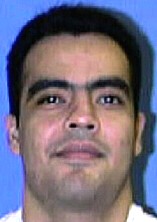
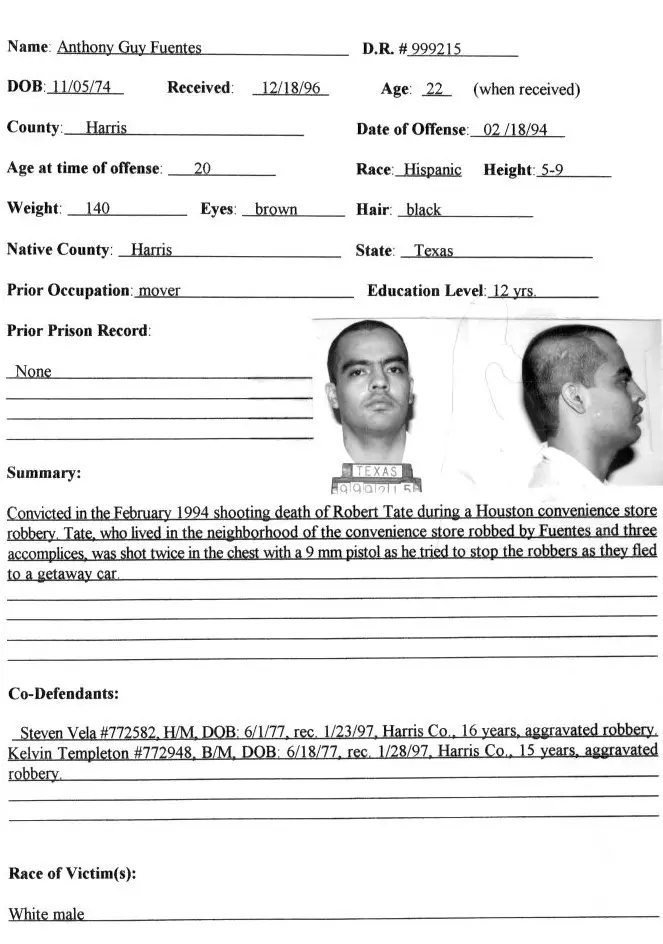
Anthony Guy
FUENTES
Classification: Murderer
Characteristics: Robbery
Number of victims: 1
Date of murder: February 18,
1994
Date
of arrest:
September
1996
Date of birth:
November 5,
1974
Victim profile: Robert Tate,
28
Method of murder:
Shooting
(9 mm pistol)
Location: Harris County, Texas, USA
Status: Executed
by lethal injection in Texas on November 17,
2004
Summary:
On February 18, 1994, Fuentes and three accomplices robbed the Handi
Food Mart in north Houston. Fuentes and one of his companions
brandished pistols.
Robert Tate, who had been drinking beer with friends in the parking
lot of the store, chased one of the bandits when he left the store
with two cases of beer. Tate grabbed accomplice Templeton, and the
robber dropped the beer.
Just then, Fuentes came running out of the store and shot Tate twice
in the chest. Tate died in a ditch across the street from the store.
A witness at the trial identified Fuentes as Tate’s murderer.
Accomplice Templeton also testified at the trial identifying
Fuentes.
Citations:
Fuentes v. State, 991 S.W.2d 267 (Tex.Crim.App. 1999) (Direct
Appeal). Fuentes v. Texas, 528 U.S. 1026, 120 S.Ct. 541, 145 L.Ed.2d
420 (1999). (Cert. Denied) Fuentes v. Dretke, 89 Fed.Appx. 868 (5th Cir. 2004). (Habeas)
Final Meal:
Fried chicken with biscuits and jalapeno peppers, steak and french
fries, fajita tacos, pizza, a hamburger, water and Coca-Cola.
Final Words:
"Sorry that I have to put my family through this. To everybody else,
the truth will be known. It didn't come out in time to save my life.
But when it comes out I hope it stops this. It is wrong for the
prosecutors to lie and make witnesses say what they need them to say.
The truth has always been there. I just hope everybody has their
peace. Today I get mine."
ClarkProsecutor.org
Texas Attorney General
Media Advisory
Wednesday,
November 10, 2004
Anthony Guy Fuentes Scheduled For Execution
AUSTIN – Texas Attorney General Greg Abbott
offers the following information about 30-year-old Anthony Guy
Fuentes, who is scheduled to be executed after 6 p.m. Tuesday,
November 17, 2004. On November 15, 1996, Fuentes was convicted and
sentenced to death for the capital murder of Robert Tate during a
Houston convenience store robbery. A summary of the evidence
presented at trial follows.
FACTS OF THE CRIME
On February 18, 1994, Fuentes and three
accomplices robbed the Handi Food Mart in north Houston. Fuentes and
one of his companions brandished pistols. Robert Tate, who had been
drinking beer with friends in the parking lot of the store, chased
one of the bandits when he left the store with two cases of beer.
Tate grabbed the man, and the robber dropped the beer. Just then,
Fuentes came running out of the store and shot Tate twice in the
chest. Tate died in a ditch across the street from the store.
A witness at the trial identified Fuentes as
Tate’s murderer. Bullets recovered from Tate’s body were consistent
with those used in a 9 millimeter weapon, which are most commonly
semiautomatic. Testimony at the trial indicated that Fuentes used a
semi-automatic gun during the robbery.
PROCEDURAL HISTORY
April 23, 1996 — A Harris County grand jury
indicted Anthony Fuentes for the capital murder of Robert Tate.
November 13,1996 — Fuentes found guilty of capital murder and the
court assessed a sentence of death.
April 28, 1999 — The Texas Court of Criminal Appeals affirmed
Fuentes’ conviction and sentence.
November 29, 1999 — The U.S. Supreme Court denied Fuentes’ petition
for certiorari review.
October 26, 1998 — Fuentes filed an application for writ of habeas
corpus in the state trial court.
September 13, 2000 — The Texas Court of Criminal Appeals denied
habeas relief.
November 14, 2001 — Fuentes filed a petition for writ of habeas
corpus in a U.S. district court in Houston.
March 28, 2003 — The federal district court denied habeas relief.
February 11, 2004 — The 5th U.S. Circuit Court of Appeals denied
Fuentes permission to appeal.
June 2, 2004 — Fuentes petitioned the U.S. Supreme Court for
certiorari review.
October 4, 2004 — The U.S. Supreme Court denied Fuentes’ petition.
June 30, 2004 — The trial court entered an order setting the
execution date for November 17, 2004.
PRIOR CRIMINAL HISTORY
In January 1992, Fuentes, armed with a shotgun,
shot a man in the leg. Fuentes pled guilty to a misdemeanor charge
and served a year in the Harris County Jail for the shooting.
In March 1994, Fuentes shot a man in the back
while the victim was sitting in a car. Fuentes was placed on
probation after pleading guilty to an attempted murder charge for
the shooting.
ProDeathPenalty.com
On Friday, February 18, 1994, Anthony Fuentes,
Kelvin Templeton, Terrell Lincoln, and Steve Vela conspired to rob
the Handi Food Mart and any employees or customers who happened to
be in the store.
The Handi Mart was busy with employees of the
Swartz Electric Company who had just been paid, cashed their
paychecks at the store and were enjoying a few beers and the company
of coworkers outside the premises of the store.
Among those gathered
was Robert Tate, a regular customer and acquaintance of the
proprietors of the Handi Mart and sometime employee of Swartz
Electric.
Fuentes and his cohorts arrived at the store,
noted that it was busy and proceeded with their plan. Templeton went
directly to the coolers, grabbed two cases of beer and walked out.
Fuentes and Vela walked into the store behind Templeton and pulled
out their guns. Vela went to the cashier and demanded money. Fuentes
approached the proprietor and a customer who were standing near the
counter.
The customer was a high school classmate of Fuentes’. He
followed Fuentes’ orders, hiding his identity in fear that Fuentes
would recognize him. Another man was walking into the store when he
noticed that it was being robbed. He ran to inform his co-workers of
the robbery.
Ignoring his friends’ warnings not to get
involved, Robert Tate gave chase when Templeton left the store with
the beer. Tate caught up to Templeton and grabbed him. Templeton
dropped the beer. Just then, Fuentes came running out of the store.
An eyewitness testified that Fuentes came out of the store, ran up
to Tate and Templeton, and shot Tate twice in the chest. Testimony
at trial indicated that Fuentes used a semi-automatic gun. Tate fell
into a nearby ditch and died.
The bullets recovered from Tate’s body were
consistent with those used in a 9 millimeter weapon, which are most
commonly semiautomatic. The eyewitness further testified that,
despite standing five hundred meters from Fuentes, he got a good
look at his face and positively identified Fuentes as Tate’s
murderer. His description of Fuentes was consistent with the
description given by the proprietor as the man who robbed him in the
store. Both witnesses positively identified Fuentes in photo lineups.
Templeton was the only co-conspirator to testify.
He testified that he was not watching when he heard the shots fired;
he thought Tate had shot at him, so he just began running. Templeton
testified that although he did not see it, he was under the
impression that Fuentes had shot Tate because when he looked back,
Fuentes had a gun in his hand and was the one closest to him, and he
had not seen Vela near the victim.
Anthony Guy Fuentes
Txexecutions.org
Anthony Guy Fuentes, 30, was
executed by lethal injection on 17 November 2004
in Huntsville, Texas for the murder of a man
during a robbery.
On 18 February 1994, Robert Tate, 28, was outside
a Houston convenience store where he was a regular customer,
drinking beer with his friends, when a group of four people showed
up and went into the store.
Kelvin Templeton, 17, grabbed two cases
of beer and walked out. Fuentes, then 20, and Steven Vela, 17, went
to the counter with guns. Vela demanded money from the clerk.
Fuentes confronted the store owner and another customer.
One of
Tate's friends then walked in, saw the robbery in progress, and went
back outside to tell the others. Tate began chasing Templeton. He
caught up with him, and Templeton dropped the beer.
Fuentes then
came running from the store and shot Tate twice in the chest with a
9mm pistol. He died in a ditch across the street from the store.
Ten days later, Fuentes was arrested, but not for
the Tate murder. In January 1993, Fuentes shot a man in the leg with
a shotgun. At the time of his arrest, authorities did not know of
his role in the Tate murder.
He was charged with aggravated assault
causing serious bodily injury, a second-degree felony. Five days
after that arrest, while Fuentes was out on bond awaiting trial, he
shot another man.
Five weeks later, in April 1994, he went to trial
for the shotgun incident and pleaded guilty to a misdemeanor charge.
He served one year in Harris County jail. While serving that
sentence, he was arrested, and later convicted, of attempted murder
in the third shooting incident. Authorities still did not know of
his role in the Tate murder. Fuentes was sentenced to 4 years'
probation. Finally, in September 1996, he was arrested for killing
Robert Tate.
Julio Flores, who was in Tate's group in the
parking lot and witnessed the shooting, testified that Fuentes was
the person who shot Tate. Kelvin Templeton also testified against
Fuentes at his trial.
A jury convicted Fuentes of capital murder in
November 1996 and sentenced him to death. The Texas Court of
Criminal Appeals affirmed the conviction and sentence in April 1999.
All of his subsequent appeals in state and federal court were denied.
Steven Anthony Vela and Kelvin Deshan Templeton
were both convicted of aggravated robbery. Vela was sentenced to 16
years in prison. Information on his current status was unavailable
for this report. Templeton's sentence was 15 years. He was paroled
in April 2004. No information was available regarding Terrell
Lincoln, the fourth member of the group.
On a web site devoted to his cause, Fuentes
admitted being part of the convenience store robbery, but insisted
that he was not the gunman who killed Robert Tate. In an interview
on death row, Fuentes would not even admit to being at the scene of
the crime. "I can't be sorry for something I didn't do," he said. "I
never killed anybody."
Fuentes' lawyers claimed that the witnesses gave
conflicting testimonies and that Julio Flores' testimony was
questionable because he had been drinking. Prosecutors said that all
of these issues were raised at trial. "That is the purpose of cross-examination,
and that is what a jury is for," an assistant district attorney said.
"Sorry that I have to put my family through this,"
Fuentes said in his last statement. "And to the family, the truth
will come out, and I hope you find your peace. To everybody else,
the truth will be known. It didn't come out in time to save my life.
But when it comes out, I hope it stops this." The lethal injection
was then administered. Fuentes was pronounced dead at 6:11 p.m.
National
Coalition to Abolish the Death Penalty
Anthony Fuentes - TEXAS -
November 17, 2004
The state of Texas is scheduled to execute
Anthony Fuentes, a 20-year old Latino man, Nov. 17 for his alleged
role in the 1994 shooting death of Robert Tate during a Harris
County convenient store robbery. Fuentes' case is particularly
alarming because there is a possibility he is innocent.
Fuentes robbed the store with Steven Vela, Kelvin
Templeton, and Terrell Lincoln all of whom received prison terms for
aggravated robbery. Fuentes was convicted based on the eye-witness
testimony of Templeton and a man named Julio Flores. Templeton's
testimony stated that he believed Fuentes was likely to have shot
Tate although he did not see who actually fired the shots. Flores
testimony could be considered unreliable as he was 500 meters away
from Fuentes and the crime took place on a dark evening causing poor
visibility.
Evidence supports the claim that Tate was killed
by bullets from what was likely a 9 millimeter weapon. However,
there is no conclusive evidence as to which person, Fuentes or Vela
was using which gun at the time of the robbery. A mutual friend of
the two men testified that he knew Vela to own and use a 9mm gun and
Fuentes a .22 revolver. Fuentes confirmed this during the trial. The
evidence the prosecution used to refute this was eye-witness
testimony and arguably unreliable.
There are other concerning issues surrounding the
trial including the fact that the state struck four African-American
individuals from the jury without giving a specific reason apart
from stating that the jurors were not 'pro-state' enough.
Fuentes' scheduled execution takes place amid a
heightened scrutiny surrounding the death penalty in Harris County
due to massive problems with the crime lab. Police are in the
process of reviewing hundreds of boxes of evidence from thousands of
cases that had been forgotten. The crime lab suspended DNA testing
in December of 2002 because of widespread problems.
Earlier this month, the Houston Chief of Police
requested no one be executed until problems with the lab are fully
resolved. State Senator Rodney Ellis also called for a halt to
executions in Harris County. However, these pleas along with those
of many concerned citizens in Texas, have been dismissed by Governor
Perry.
Overall, upwards of 150 men and women are
currently on death row in Texas from Harris County. Texas has
approximately 450 death row inmates. Harris County accounts for
approximately 30 percent of the inmates on Texas Death row and has
more people on death row than 31 of the 38 states that use the death
penalty.
It is inconceivable that inmates in Texas, and
particularly those in Harris County could continue to be executed
despite such widespread problems with the Houston Crime Lab as it
serves as an indication of a system which is too fraught with error
to assert guilt with absolute certainty.
Please write Gov. Perry urging him to commute
Anthony Fuentes sentence.
Convict in Houston 'Good
Samaritan' slaying executed
Houston
Chronicle
AP - Nov. 17, 2004
HUNTSVILLE - Convicted killer Anthony Fuentes was
executed tonight for fatally shooting a man who tried to nab the
robber of a Houston convenience store 10 years ago. Fuentes, 30,
denied he was responsible for killing Robert Tate, 28, who became
known as a slain good Samaritan, although Fuentes acknowledged he
was with three companions when they were holding up the store.
Fuentes, in a brief statement, said repeatedly
that he had found peace. "Sorry that I have to put my family through
this," he said. Among those watching him die was his grandfather and
two sisters along with two of Tate's brothers. "To everybody else,
the truth will be known," he said. "It didn't come out in time to
save my life ... "But when it comes out I hope it stops this. It is
wrong for the prosecutors to lie and make witnesses say what they
need them to say. The truth has always been there. I just hope
everybody has their peace. Today I get mine."
As the drugs began taking effect, he gasped
slightly. Six minutes later, at 6:17 p.m. he was pronounced dead,
making him the 23rd Texas prisoner to receive lethal injection this
year and the first of two on consecutive evenings this week.
The U.S. Supreme Court last month rejected a
request to review his case. In late appeals seeking to stop the
execution, his lawyers argued prosecutors knowingly allowed false
testimony against Fuentes and suppressed evidence. The Texas Court
of Criminal Appeals dismissed the appeal Wednesday morning. A
request for a stay of execution was filed later in the day with the
Supreme Court, asking the justices for time to review prosecutors'
conduct during the trial. The high court rejected the request about
20 minutes before Fuentes was scheduled to die.
"The state's case was riddled with
inconsistencies," Fuentes' attorneys argued. "The evidence
connecting him to the shooting was so tenuous." Vic Wisner, an
assistant district attorney in Harris County who prosecuted the
case, denied the claims. He said the men who robbed the store with
Fuentes pointed to him as the gunman. It took two years before
authorities could piece together the case and arrest Fuentes and his
three companions. His accomplices received prison terms for
aggravated robbery. Fuentes got a death sentence.
"What Texas doesn't realise is that I am not
afraid to die and they can never break me," Fuentes wrote on an
Internet site devoted to his case.
Court documents show Tate was outside the store
when Fuentes and his group showed up. One of them, Kelvin Templeton,
grabbed a couple cases of beer and walked out as Fuentes and Steve
Vela, both armed, went to the counter. Vela demanded money from the
clerk while Fuentes confronted the store owner and another customer.
A friend of Tate's was walking in, noticed the robbery in progress,
and went back outside to inform Tate, who began chasing Templeton.
Tate nabbed him, but according to a witness, Fuentes emerged from
the store, ran up to Tate and shot him twice. Templeton testified
against Fuentes, saying he didn't see the shooting but believed
Fuentes fired the shots. Defense attorneys at his trial said there
was conflicting testimony as to who killed Tate.
Fuentes had two previous convictions. He pleaded
guilty and spent a year in the Harris County Jail for shooting a man
in the leg with a shotgun in 1992. Eight months before the Tate
slaying, he pleaded guilty to an attempted murder charge and was
placed on probation for shooting a man who was sitting in a car.
On Thursday, another Texas inmate, Troy Kunkle,
was set to die for fatally shooting a Corpus Christi man during a
robbery more than 20 years ago when Kunkle was an 18-year-old high
school student in San Antonio. In July, Kunkle received a reprieve
from the Supreme Court the same day he was supposed to be executed.
The court last month refused to review his case, lifting the
reprieve and setting the execution date.
Condemned man's case flawed,
lawyer says
By Roma Khanna -
Houston
Chronicle
Nov. 16, 2004
An attorney representing a Houston man scheduled
to be executed today argued Tuesday his life should be spared
because of problems with the police work and prosecution in the
case. Anthony Guy Fuentes, 30, is scheduled to receive a lethal
injection this evening for the shooting death of Robert Pres-ton
Tate, 28, after a robbery of a convenience store on Feb. 18, 1994.
Fuentes admits he participated in the robbery but maintains he did
not kill Tate.
An appeal filed Monday notes discrepancies in the
testimony of eyewitnesses and argues that Houston police officers
improperly questioned witnesses. Defense attorneys also argued that
Harris County prosecutors knowingly allowed a witness to give false
testimony and withheld information that would have allowed defense
attorneys to expose inconsistencies. "You have all of these
witnesses who witness the same event, and they are all seeing
different things — some of them are dramatically different," said
Jim Marcus, executive director of the Texas Defender Service and one
of Fuentes' lawyers. "There are so many problems with the eyewitness
testimony, and the case really hangs on putting the right gun in
Fuentes' hands."
Vic Wisner, who prosecuted Fuentes in 1996,
called the claims "preposterous." He pointed to Fuentes' prior
convictions in three nonfatal shootings. "There was nothing
inappropriate about the prosecution in this case," Wisner said. "Our
case was pretty solid in terms of him being the shooter." Assistant
District Attorney Roe Wilson, who has handled Fuentes' case since
his conviction, said many of the claims are issues that defense
attorneys have been aware of since the trial.
If he is put to death today, Fuentes will be the
23rd Texas inmate executed this year and the third from Harris
County in nine days. His appeal is pending before the Texas Court of
Criminal Appeals.
Fuentes was 19 when he and two others robbed the
family-owned Handi Food Mart in north Houston. Tate, a 6-foot 3-inch
construction worker who had been drinking outside, pursued a robber
who ran off with two cases of beer and held him at gunpoint before
he was shot twice in the chest. Fuentes, the only person old enough
to be charged with capital murder, was arrested and sentenced to
death more than two years after the shooting.
The appeal questions the accuracy of testimony
from a witness who identified Fuentes as the triggerman. Julio
Flores, who was outside the store with Tate and other co-workers,
testified he had not been drinking before the shooting. But HPD
reports show that Flores and one of his co-workers both told
officers he had been drinking that night. Wilson notes that the HPD
offense reports were in the prosecutors' file and available to the
defense before Fuentes' trial. Marcus maintains that officers had
other conversations with Flores, including on the night of the
shooting, that Fuentes' trial attorneys did not know about.
The appeal also argues that the testimony of the
prosecution's two key witnesses, Flores and a classmate of Fuentes
who was inside the store, changed and contained inconsistencies. But
"any time when different people are involved, one person might not
see everything, and you are going to come up with inconsistencies,"
Wilson said. "That is the purpose of cross-examination, and that is
what a jury is for."
Death row inmate worried about
his family as execution nears
By Kelly Prew - The Huntsville Item
November 17, 2004
Anthony Guy Fuentes offered no real explanation
from the visiting block on death row last week as to why he was
convicted and sentenced to death for the shooting death of 28-year-old
Robert Tate in 1994. Barring any last-minute rulings, Fuentes will
be put to death tonight at the Huntsville "Walls" Unit.
By his accounts, his childhood was good. Although
his mother was a part of his life, his grandparents raised him and
sent him to a private high school. He has several siblings, and they
all grew up in different households, but they are all close, and
Fuentes said his ultimate fate will impact them more than he wants
to think about. "I'm the oldest," Fuentes said from the visiting
area inside the Polunsky Unit outside of Livingston. "I'm more
concerned right now with what my family is going through. I've said
I was not guilty since the beginning, and they all have stood behind
me. I'm not too sure how everything will go (this week), but if they
let everyone come visit me, they'd all be here."
Fuentes, 30, was convicted in a Harris County
court in 1996 for the capital murder of Tate during a Houston
convenience store robbery. High school acquaintances and co-defendants,
Steven Vela and Kevin Templeton, were convicted of aggravated
robbery. A third co-conspirator, Terrell Lincoln, was also
implicated in the robbery.
According to the Texas Attorney General's office,
Fuentes and the other three men robbed the Handi Food Mart in north
Houston on Feb. 18, 1994. Fuentes and one of his companions
brandished pistols. Tate, the victim, who had been drinking beer
with friends in the parking lot of the store, chased one of the
bandits when he left the store with two cases of beer. Tate grabbed
the man, and the robber dropped the beer. Just then, Fuentes came
running out of the store and shot Tate twice in the chest. Tate died
in a ditch across the street from the store.
A witness at the trial identified Fuentes as
Tate's murderer. Bullets recovered from Tate's body were consistent
with those used in a 9 mm weapon, which are most commonly
semi-automatic. Testimony at the trial indicated that Fuentes used a
semi-automatic gun during the robbery.
When asked in an interview last week, Fuentes
would not admit he was even at the scene, and all he would say about
his guilt or innocence was, "I never killed anybody." Fuentes ended
up on death row seven years ago, and since that time, has said he
has been out of the loop with lawyers and proceedings to stop his
execution. "I met with my original lawyer twice the whole time I've
been in here," he said. "That was the hardest part, never knowing
what was going on."
Attorney Morris Moon with the Texas Defender
Service took over the case in the last few months, but Fuentes said
he has no idea what they will be able to do for him. Calls to Moon
by the Item were not returned. Fuentes' attorneys filed an appeal
late Monday with the Texas Court of Criminal Appeals, claiming
prosecutors knowingly allowed false testimony against Fuentes and
suppressed evidence. "The state's case was riddled with
inconsistencies," Fuentes' attorneys wrote. "The evidence connecting
him to the shooting was so tenuous."
Harris County prosecutor Vic Wisner described
Fuentes as extremely violent and said there were no inconsistencies
or suppressed evidence. He said the men who robbed the store with
Fuentes pointed to him as the gunman. "All the issues he is raising
now were already raised before the jury and were rejected," Wisner
said Tuesday.
Appeals as high as the U.S. Supreme Court have
already been denied. Fuentes said although things look dim, he
hasn't given up hope that a miracle will happen before his scheduled
execution tonight. "My time has been pretty easy here," Fuentes said.
"I don't complain about the conditions. I write letters to my family
and listen to the radio. I don't read books. I'm just concentrating
on my family and preparing them for every possibility. I'm hoping
for a stay, and I haven't given up."
He would be the 23rd Texas prisoner to receive
lethal injection this year and the first of two on consecutive
evenings this week.
Although the capital murder trial was his first
time in a courtroom, Fuentes had prior run-ins with the law. In Jan.
1992, Fuentes, armed with a shotgun, shot a man in the leg. He
pleaded guilty to a misdemeanor charge and served a year in the
Harris County Jail for the shooting. In March 1994, Fuentes shot a
man in the back while the victim was sitting in a car, and was
placed on probation after pleading guilty to an attempted murder
charge for the shooting.
Convict in Houston 'Good
Samaritan' slaying executed
By Michael Graczyk -
Denton
Record-Chronicle
AP 11/18/2004
Convicted killer Anthony Fuentes was executed
Wednesday night for fatally shooting a man who tried to nab the
robber of a Houston convenience store 10 years ago. Fuentes, 30,
denied he was responsible for killing Robert Tate, 28, who became
known as a slain good Samaritan, although Fuentes acknowledged he
was with three companions when they were holding up the store.
Fuentes, in a brief statement, said repeatedly
that he had found peace. "Sorry that I have to put my family through
this," he said. Among those watching him die was his grandfather and
two sisters along with two of Tate's brothers. "To everybody else,
the truth will be known," he said. "It didn't come out in time to
save my life ... "But when it comes out I hope it stops this. It is
wrong for the prosecutors to lie and make witnesses say what they
need them to say. The truth has always been there. I just hope
everybody has their peace. Today I get mine."
As the drugs began taking effect, he gasped
slightly. Six minutes later, at 6:17 p.m. he was pronounced dead,
making him the 23rd Texas prisoner to receive lethal injection this
year and the first of two on consecutive evenings this week.
The U.S. Supreme Court last month rejected a
request to review his case. In late appeals seeking to stop the
execution, his lawyers argued prosecutors knowingly allowed false
testimony against Fuentes and suppressed evidence. The Texas Court
of Criminal Appeals dismissed the appeal Wednesday morning. A
request for a stay of execution was filed later in the day with the
Supreme Court, asking the justices for time to review prosecutors'
conduct during the trial. The high court rejected the request about
20 minutes before Fuentes was scheduled to die.
"The state's case was riddled with
inconsistencies," Fuentes' attorneys argued. "The evidence
connecting him to the shooting was so tenuous." Vic Wisner, an
assistant district attorney in Harris County who prosecuted the
case, denied the claims. He said the men who robbed the store with
Fuentes pointed to him as the gunman.
It took two years before authorities could piece
together the case and arrest Fuentes and his three companions. His
accomplices received prison terms for aggravated robbery. Fuentes
got a death sentence. "What Texas doesn't realise is that I am not
afraid to die and they can never break me," Fuentes wrote on an
Internet site devoted to his case.
Court documents show Tate was outside the store
when Fuentes and his group showed up. One of them, Kelvin Templeton,
grabbed a couple cases of beer and walked out as Fuentes and Steve
Vela, both armed, went to the counter. Vela demanded money from the
clerk while Fuentes confronted the store owner and another customer.
A friend of Tate's was walking in, noticed the robbery in progress,
and went back outside to inform Tate, who began chasing Templeton.
Tate nabbed him, but according to a witness, Fuentes emerged from
the store, ran up to Tate and shot him twice. Templeton testified
against Fuentes, saying he didn't see the shooting but believed
Fuentes fired the shots. Defense attorneys at his trial said there
was conflicting testimony as to who killed Tate.
Fuentes had two previous convictions. He pleaded
guilty and spent a year in the Harris County Jail for shooting a man
in the leg with a shotgun in 1992. Eight months before the Tate
slaying, he pleaded guilty to an attempted murder charge and was
placed on probation for shooting a man who was sitting in a car.
Texas Executes Man for 1994
Murder
Reuters
News
Nov 17, 2004
HUNTSVILLE, Texas (Reuters) - A prisoner
convicted of killing a man during a 1994 robbery was put to death on
Wednesday in the first of two scheduled executions this week in
Texas. Anthony Fuentes, 30, was the 21st person executed this year
in Texas and the 334th since 1982 in the nation's leading death
penalty state.
Fuentes was condemned for the murder of Robert
Tate on Feb. 18, 1994 in Houston. Tate was shot twice in the chest
while trying to stop Fuentes and three accomplices fleeing from a
convenience store they had just robbed. Fuentes admitted taking part
in the robbery, but denied being the triggerman.
In a final statement while strapped to a gurney
in the Texas death chamber, Fuentes said some day "the truth will be
known" about the crime. "It is wrong for the prosecutors to lie and
make witnesses say what they need them to say," he said. "I just
hope everybody has their peace. Today I get mine."
Two of his accomplices, Steve Vela and Kelvin
Templeton, were convicted of aggravated robbery and sentenced to
prison terms of 16 years and 15 years, respectively.
For his final meal, Fuentes requested fried
chicken with biscuits and jalapeno peppers, steak and french fries,
fajita tacos, pizza, a hamburger, water and Coca-Cola.
Condemned man says he's not
killer; Execution set Wednesday
By Roma Khanna -
Houston
Chronicle
Nov. 14, 2004
A construction worker whose 6-foot-3-inch frame
earned him the nickname "Horse," Robert Preston Tate boasted that he
could intimidate any would-be robber who threatened his north
Houston neighborhood hangout. His protective instinct emerged on the
night of Feb. 18, 1994, when armed robbers burst into the Handi Food
Mart, a family-owned store set between houses in a residential area.
The men grabbed two cases of beer and money and
fled. Tate, who was outside, drew his unloaded gun and pursued. The
28-year-old was shot twice in the chest and died as he lay in a
ditch.
More than two years would pass before his arrest,
but Anthony Guy Fuentes, a one-time private school student who spent
summers with his grandmother in Germany, was convicted in Tate's
murder and sentenced to death. He is scheduled to be executed
Wednesday and would be the 23rd man in Texas to receive a lethal
injection this year. Two other inmates from Harris County were
executed last week, and six from around the state are scheduled to
die through March.
With his execution days away, Fuentes, 30, will
not talk about the shooting. He says only what he has maintained
since his arrest: that he was one of three men who robbed the store,
but he did not kill Tate. "I can't be sorry for something I didn't
do," he said in a recent interview from death row in Livingston.
During his 1996 trial, an accomplice and a
bystander testified Fuentes was the triggerman. But Donald Cantrell,
a lawyer who represented Fuentes at trial, said their identification
has always troubled him. He said he has doubts about the testimony
from Fuentes' accomplice, who pleaded guilty and was sentenced to 15
years, and questioned the witness's accuracy. "It was night,"
Cantrell said. "He had been drinking. He saw this person for a
maximum of 30 seconds, and he was some distance away. There is no
question that Anthony was there, but I have always had questions as
to whether he was the shooter."
Fuentes' family has more concerns. They note that
his photo was significantly larger than others in a spread of
suspects and that he was one only one of the robbers old enough to
be eligible for the death penalty. They question whether Tate truly
was the good Samaritan that prosecutors billed him as, saying that
no one was in danger when he chased the robbers.
Prosecutors
maintain the witness testimony is solid and point to Fuentes'
history, which includes two nonfatal shootings that were introduced
in the punishment phase of his trial. "Both accomplices say he was
the shooter, and one was closest to Fuentes at the time," said
Assistant District Attorney Vic Wisner. Fuentes has no appeals
pending, although lawyers are contemplating an 11th-hour effort.
Watched store built
Tate watched the Gaw family build the Handi Mart
in the 1980s. He befriended the Gaw children, particularly the boys
Daniel and Ben, who taught him Chinese phrases so he could speak to
their grandmother. Tate was outside the store drinking a payday beer
with several co-workers on the night he was killed. "It was pretty
shocking," said Daniel Gaw. "He always came around to get whatever,
and then he was dead."
Ricky Spies, a childhood friend who still lives
one block from the store, fondly recalled Tate's personality. "He
would help anybody, and that's what ended up killing him," Spies
said. "He was trying to help somebody and he paid the ultimate price.
If (Fuentes) was the one who killed him, then he deserves to die."
When Fuentes was arrested, his life " was just starting to come
together," said his stepmother Janis Fuentes.
Kicked off the team
Fuentes had fallen in with troublemakers after he
failed an algebra class and was kicked off the Sam Houston High
School varsity football team — before he could take the field for a
game. He failed out of school, and though his grandparents enrolled
him in private school, he landed in the Harris County Jail after
pleading guilty to a 1994 assault. When he was released, his family
said, Fuentes had changed. He worked as a limousine driver and was
making plans to get married when a lead on Tate's murder brought
police to Fuentes.
When he received his execution date in June,
there were a dozen men set to die before Fuentes. Last week, as
prison officials took the last of those men, Frederick Patrick
McWilliams, to the death chamber in Huntsville, Fuentes had few
thoughts about his own execution. "I am not concerned for myself,
but I hate hurting my family," he said. "Because whatever they do to
you is not just done to you. There are other people who suffer." Not
a week passes without a family member visiting, most often his
grandfather, Guy Landrum, who raised Fuentes. They, too, spoke
little last week of hisexecution date. "It is time for him to come
home," said Janis Fuentes. "It is not time for him to die."
Canadian
Coalition to Abolish the Death Penalty
ANTHONY FUENTES
An introduction letter. Well my name is Anthony
Fuentes. I am 24 years old and my birthday is November 5. I'm a
Scorpio. I am on death row in Huntsville, Texas. I have been locked
up since March of 1996. I like to write alot to keep my mind from
this place and situation. I can't talk about my case but I have a
very good chance to prove my innocence of this crime. Well things I
like are sports, languages, music, exercise and competive things I
have an open mind and like to learn new things . I consider myself
mature for my age because I was raised by my grandparents. I
consider friendship very important and I know that friendships can
be made through letters. My family is very close to me. I was not
married and I have no children of my own. The reason for that is
because I believe a family should be together. And I just never
found the right woman to marry. I treat my friends kids like they
are mine. I'm the uncle that all the mom's and dad's hated. I spoil
the kids ! Well I guess I will quit here. Hoping to hear from
somebody ! Sincerely . . .
Anthony Fuentes #999215
Polunsky Unit D.R
3872 FM 350 South
Livingston Texas 77351 USA
Abolition Now!
(FuentesHomepage)
Anthony Fuentes was 20 years old when he got
arrested and 22 years old when he was condemned to death. On this
homepage, you'll be giving an impression of the human being standing
behind the No.: 999215 on Polunsky Unit, Texas, Death Row. You will
learn about the crime, the trial and the evidence Anthony is able to
bring up to prove his innocence. Please take some time to view the
following sites.
Thank you, also in the name of Anthony and his
loved ones, the web-site master.
From the Heart Only - a Death Row Prisoner writes
There are many things wrong with society today:
practically no respect for anything; a material (man-made) world;
and, worst of all, hate. Now I know that some will say since I am on
Death Row, Texas, that I am just speaking lies to save myself, or
even worse, trying to make people think that I am a human being.
People are led to believe that I am an animal, a threat to society,
and that I should be killes for a better future. I sat here for many
years trying to understand this. I have seen the Texas Justice
System's true power. I do not believe I will get justice because the
system is a very strong, influential and profitable business these
days. Nobody, especially the man on the top, George Bush, will do
anything but the abuse of the system. His concern is not for the
future, but for his presence and power.
They say all of us are guilty without a doubt
here. I know this might be a common thing to say, but I am innocent
of this charge. Yeah! Yeah! I can imagine everybody saying: Yeah,
right! If anyone looks into my case they will see I am innocent. But
my word in here means nothing. The truth is here, right in front of
us, but legal words and closed doors, threats and lies from
specially schooled and trained prosecutors (who know the law better
than any of us) perpetuate the abuse of the system with no excuse
other than that Texas wants to kill me for image and profit.
What Texas doesn't realise is that I am not
afraid to die and they can never break me. I have faced death so
many times in this world. Look at the world news. Death is
everywhere in evrey form: sickness; accidents; natural causes; crime.
Texas says an eye for an eye for crimes is
justice. Yet when someone is wrongly killed by the justice systems
employees, they are never wrong; it was "an accident". There have
been hate groups from the beginning of time.Most have a pain inside
that they want everyone else to feel. I understand this pain that
they have. I have had similar pain inside from the deaths of my
friend Mario and my grandmother. But I didn't want anyone else to
feel it, but why: they have nothing to do with it. For me, to make
others feel that pain would be wrong, plain and simple. But Texas
Justice says that they can make money out of this pain.
I notice that for every wrong in society the ones
with influence and power blame something for it. A 3-year old finds
Daddy's gun and accidentally pulls the trigger killing himself. Who
is to blame? The father? No 3-year old could know the true effect of
that and no right-minded person would allow a child to play with a
gun. Yet after all the politics and laws it comes down to this: no
gun, no death by gun. Now you have groups who say it is our right to
bear arms (might I add they are very influential voters, too). They
say they have to protect themselves, their family and their property.
I understand this, but do they have to use guns? I read of a new
technology using "guns" that will not kill anyone but just make a
person harmless.
In my trial prosecutor Vic Wiener said "Why
couldn't I have shot the victim in the leg or arm? To shoot in the
chest is intentionally kill someone or try to". Home owners,
businessmen, Law Officers rarely shoot someone in the leg or the arm,
although homeowners and businessmen normally stop after one or two
shoots compared to the 10 - 14 shots a Law Officer seems to
accidentally fire. Now don't get me wrong: not all people in the
system are like this, but hey do exist and they show that things
need to change.
I know first-hand that life doesn't have to be
like that. I travelled to Europe at a young age. Even then I was
amazed at the lack of violence. The only violence I remember was a
football fans rioting. The places I went to were like a fairly-land
compared to Texas. The great-grandmothers knew the youngest members
of the town. And if someone passed away everyone was at the funeral.
Here you are lucky if your own neighbours show up.
Kids are bound to have disagreements with other
kids. They are learning about life and who they are. Isn't that part
of growing up? Texas makes laws all the time about restricting kids
and punishing them for bad decisions. To me this is wrong. A kid
should be able to be a kid and learn from his/her mistakes. It is
funny how a kid "doesn't know better" or "what they are doing"but
when a kid makes a bad decision He/she " knew everything without a
doubt" according to the Justice System. Look at school these days.
My old High School looks like a prison. I must be considered a
troubled area because I just read that 87 digital cameras are being
installed. But if the people of influence realise it's a troubled
area, why don't hey try to help? There are no programms or
activities to help. Not every child is book smart or athletic. But
they all have potential in life - I mean other than being a money
chip for Texas.
Anthony Fuentes, Death Row, Texas
IMPORTANT FACTS
On February 18, 1994 a Friday evening, Handi Food
Mart a convenience store was robbed and in the aftermath and
completion of the robbery, Robert Tate, who was in parking lot
drinking with friends gave chase and caught Kelvin Templeton who was
carrying 2 12 packs of Budweiser Beer. Mr. Tate was armed with a gun
and piece of chain with lock on one end when he grabbed Templeton by
his shoulder and pointed the gun to his head and told him to drop
the beer. Templeton dropped the beer as requested and was let go.
Templeton was the first robber in and out of store. Templeton was
the only co-conspirator to testify at Fuentes trial of capital
murder.
Templeton's testimony was, "he did not see shooting of Mr.
Tate, but only heard shots and thought that Mr. Tate shot him."
Templeton, who was running away, looked back and saw Fuentes with a
gun in his hand running behind him. He did not see Steve Vela, so
assumed it was Fuentes that shot Mr. Tate. Almost a year and half
from the day of the crime the state's key witness, Julio Flores,
identified Fuentes in photo line up as shooter; Flores is the only
non-accomplice witness to the shooting the state has. Despite many
changes in his testimony, the fact he said "he saw Fuentes walk up
to Mr. Tate and shoot him twice in the chest", is the state's case.
The day of the crime Raymundo Soria who was
inside the store during the robbery stated to investigators that he
knew one of the robbers from school. Soria identified Fuentes from a
photo line up shown to him April 25, 1994. Soria was the only
witness to identify anyone in robbery. Yvonne Miller, who was parked
right in front of store and accompanied by her brother's girlfriend
who knew Fuentes and told Miller his name. Miller gave the name to
investigators but has never been able to identify anyone but
testified the robber she saw jump the counter was same robber that
she saw shoot Mr. Tate. Miller describes hair style of this robber
she saw which is the style Vela had his hair not Fuentes.
There is no other evidence but Fuentes's name and
identification inside the store. None of the accomplices could be
identified or named but 2 years later Vela was confronted and
confessed and gave everybody's name. In his affidavit which was
never able to be cross-examined in trial, he states Fuentes was
shooter. Admits he was the robber who jumped the counter. The state
excepted this confession even though they knew there was 2 guns
involved in the robbery and Vela stated he was unarmed. This case is
not a "Law Of Parties" case.
The state wanted the actual shooter of
Mr. Tate and since Fuentes has been main suspect since February 18,
1994 the case was made against him for capital murder. Steve Vela's
side of this has never been brought out by state or court appointed
attorneys. Even though the scenario the state provided would clearly
make Vela another witness to the shooting.
The state did not want
Vela to testify cause there was witnesses testifying that shooter
was robber who jumped the counter. Yvonne Miller who drove up to
front of store and saw robbery begin and she drove to the corner of
the street which placed her closer to the shooting than any other
witnesses. James Draffin who took a step inside the store before
seeing robbery in progress. Saw robber's gun who jumped the counter
and he received weapons training from the U.S. Army testified that
gun was a semi-automatic pistol.
Both Miller and Draffin were not
drinking and showed up before robbery began. Both knew Mr. Tate and
both testified Fuentes was not the shooter. Rodney Faulkner also
testified that he saw Mr. Tate get shot and that the shooter was not
near Mr. Tate when shots were heard. Raymundo Soria stated the day
of the crime Fuentes carried an "old" gun. At trial over 2 years
later he changed to an automatic gun. Fuentes took the stand at
trial and told his side of what happened the night of the crime.
Which was 1st time.
He spoke of crime other than with his court
appointed attorneys. The courts have justified Fuentes conviction of
capital murder mainly cause of Julio Flores' testimony combined with
Templeton' s testimony. Fuentes who still has court appointed
attorney Michael Charlton who does not discuss his case properly
with him or what he files. Does not file anything Fuentes asks to be
filed in his writs or do any investigation of his own. Fuentes is
awaiting a ruling from the Federal Courts on an evidentiary hearing
and his writ at this time.
Fuentes has maintained he did not shoot Mr. Tate.
The state's theory that Fuentes is shooter is this. Fuentes is not
the robber who jumped counter but confronted Raymundo Soria and Ming
Fong Chow. Raymundo identifies Fuentes at robbery and at trial
changes from "old" gun to automatic gun. Ming Fong Chow also changes
at trial to automatic gun which he did not describe at all before.
Autopsy reports show Mr. Tate was shot with 2 9-millimeter slugs in
the chest. 9-millimeter slugs are most commonly from automatic guns.
Autopsy reports also show that the wounds were downward. Mr. Tate is
6' 2", Fuentes is '5' 9". The state argued that for Fuentes to be
shooter Mr. Tate was bent over holding Templeton to do this they
used Julio Flores testimony that Mr. Tate tackled Templeton.
Templeton testified that Mr. Tate placed a hand on his shoulder and
pointed gun to his head and told him to drop the beer. No wrestling,
tackle, or struggle at all occurred. No other witness stated
otherwise. The state also argued that Vela was nowhere around at all
when Mr. Tate was shot. The state also argues that the shooter was
the 2nd robber out of the store. And Vela's location has never been
clarified even though this has always been Fuentes or Vela shot Mr.
Tate.
Fuentes is fighting to show the truth of his case
that he was not the triggerman who shot Mr. Tate, trying to get more
investigation done, and a lawyer who will argue the facts of this
case.
To donate, please use the following Bank account:
WASHINGTON MUTUAL BANK
929 E.LITTLE YORK RD.
HOUSTON,TX.77076
ACCOUNT NUMBER:0934318165
"Anthony"
(ROUTING No.: 111993776)
account holder: Guy Landrum
ANTHONY FUENTES - CASE AND FACTS
IN THE UNITED STATES DISTRICT COURT FOR THE
SOUTHERN DISTRICT OF TEXAS HOUSTON DIVISION
ANTHONY GUY FUENTES, Petitioner,
v.
JANIE COCKRELL, Director, Texas Department of
Criminal Justice, Institutional Division, Respondent.
CIVIL ACTION NO. H-01-4018
STATEMENT OF FACTS
I. Facts of the Crime
The Court of Criminal Appeals succinctly
summarized the evidence proving Fuentes' guilt in its published
opinion: ...[O]n Friday, February 18, 1994, [Fuentes], Kelvin
Templeton, Terrell Lincoln, and Steve Vela conspired to rob the
Handi Food Mart and any employees or customers who happened to be in
the store. The Handi Mart was busy with employees of the Swartz
Electric Company who had just been paid, cashed their paychecks at
the store, and were enjoying a few beers and the company of
coworkers outside the premises of the store. Among those gathered
was Robert Tate, a regular customer and acquaintance of the
proprietors of the Handi Mart and sometime employee of Swartz
Electric.
[Fuentes] and his cohorts arrived at the store,
noted that it was busy and proceeded with their plan. Templeton went
directly to the coolers, grabbed two cases of beer and walked out.
[Fuentes] and Vela walked into the store behind Templeton and pulled
out their guns. Vela went to the cashier and demanded money.
[Fuentes] approached the proprietor and a customer who were standing
near the counter.
The customer, Raymundo Soria, was a high school
classmate of [Fuentes']. He followed [Fuentes'] orders, hiding his
identity in fear that [Fuentes] would recognize him. James Draffin
was walking into the store when he noticed that it was being robbed.
He ran to inform his co-workers of the robbery. Ignoring his friends'
warnings not to get involved, Tate gave chase when Templeton left
the store with the beer. Tate caught up to Templeton and grabbed him.
Templeton dropped the beer. Just then, [Fuentes] came running out of
the store. Julio Flores testified that [Fuentes] came out of the
store, ran up to Tate and Templeton, and shot Tate twice in the
chest. Testimony at trial indicated that [Fuentes] used a semi-automatic
gun. Tate fell into a nearby ditch and died. The bullets recovered
from Tate's body were consistent with those used in a 9 millimeter
weapon, which are most commonly semi-automatic.
Flores further testified that, despite standing
five hundred meters from [Fuentes], he got a good look at his face
and positively identified [Fuentes] as Tate's murderer. Flores'
description of the appellant was consistent with the description
given by the proprietor as the man who robbed him in the store.
Flores and Soria positively identified [Fuentes] in photo lineups.
Templeton was the only co-conspirator to testify.
He testified that he was not watching when he heard the shots fired;
he thought Tate had shot at him, so he just began running. Templeton
testified that although he did not see it, he was under the
impression that [Fuentes] had shot Tate because when he looked back,
[Fuentes] had a gun in his hand and was the one closest to him, and
he had not seen Vela near the victim.
Fuentes v. State, 991 S.W.2d at 270-71.
II. Facts Relating to Punishment
During the punishment phase of Fuentes' trial the
State offered evidence of Fuentes' prior extraneous offenses to
prove that he constituted a future danger to society and that the
instant offense warranted the death penalty. This evidence included
testimony from Miranda Moreno and Julian Gutierrez regarding an
incident where Fuentes shot them both with a shotgun.
On January 29, 1992, Moreno and Gutierrez, along
with several of their friends, were out playing pool when Fuentes
and Tony Resendez came into the pool hall. Resendez began to argue
with Moreno's cousin, Genesis, so Moreno decided they should leave
the pool hall to avoid causing further trouble.
Moreno and her
friends left and went to a relative's house where they stayed for a
few minutes and then got back into the car to leave. However, before
they could leave, Resendez approached Julian, who was sitting in the
driver's seat, and stabbed him in the neck through the open window.
Julian and his brother John jumped out of the car to pursue
Resendez. Shortly thereafter, Moreno heard a gunshot and turned to
see Fuentes standing near the front of the car with a shotgun. John,
whom Fuentes had shot in the leg, got back into the car, as did
Julian after pleading with Fuentes not to shoot him. While Julian
attempted to drive away, Fuentes shot out the back window of the
car, hitting Moreno in the left side of her face and Julian in the
shoulder.
Moreno was hospitalized for a week, forced to
undergo eye surgery, and ultimately lost sight in her left eye. She
continues to experience pain from the wound that left shotgun
pellets, which doctors were unable to remove, in her face. Julian
was also hospitalized after suffering the gunshot wound to his
shoulder and the stab wound to his neck.
Details of another violent offense committed by
Fuentes were described by Jose ViraMontez in his testimony regarding
a March 5, 1994, drive-by shooting. On the night in question,
ViraMontez, his two brothers, his nephew, and his brother-in-law
were in ViraMontez' car returning from Walgreens. ViraMontez
testified that upon leaving Walgreens, he and his companions noticed
they were being followed by a white Chevy Blazer.
Finally, after
stopping at a red light, the Blazer pulled up behind ViraMontez'
Cutlas Ciera. When the light turned green, the Blazer approached the
side of ViraMontez' car and Fuentes, who was sitting in the
passenger seat, began shooting at them. He fired five shots, the
last one hitting ViraMontez in the back. As a result of that wound,
part of ViraMontez' lung was removed and he was unable to work for
several months. 26 SR 119-121.
Finally, the State also elicited testimony
regarding Fuentes' prior arrests for auto theft in October 1992, and
for illegal possession of a weapon in February 1992. 26 SR 36-73;
81-82. The defense presented numerous witnesses who testified to
Fuentes' general good character and benevolent nature. Several
witnesses offered their opinion that Fuentes' had redeeming social
values and, therefore, should receive a life sentence instead of the
death penalty. The defense also introduced testimony from several
witnesses who testified to Fuentes' talent and achievements.
Included among the family members testifying on
his behalf were Fuentes' mother - Tammy Reeves, his half-sister -
Amy Marie Fuentes, his aunt - Pamula Gonzalez, his cousin -
Christian Vargas, his fiancee - Natalie Robles, and his grandfather
- Guy Landrum. Through their testimony the jury heard that Fuentes
was a loving brother and cousin, that he was well behaved, good
mannered, and didn't start trouble. Fuentes' fiancee testified that
he had provided for her and helped her through surgery, and that he
wanted a child. Finally, his mother and grandfather provided the
jury with background from his childhood and a list of activities
that he participated in during school.
This included evidence that Fuentes went to live
with his grandparents when he was five years old, and that while
growing up he played football, ran track, took karate lessons,
played the trumpet and tuba in band, was a good student who could
read and write German, and was gifted in math, music, and
electronics. His grandfather also testified that Fuentes was deeply
and traumatically affected by the sudden death of his grandmother.
Two former teachers from Hamilton Middle School,
Helen Filenko and Martha Pauler, told the jury that Fuentes was a
good student, respectful, well behaved, and was accepted in the
Vanguard Program, an accel- erated program for gifted students.
Marjorie Kirkland, the director of the private school where Fuentes
attended his junior and senior years of high school, stated that she
remembered him as respectful, polite, with many redeeming qualities,
and no behavioral problems. In addition, numerous friends including
Doris Medina, Benny DeMarco, Ernie Hill, Romero Aguilar, Barbara Van
Curen, and Sieglinde Reub offered testimony on Fuentes' behalf
regarding his general good character and other redeeming qualities.
27 SR 57-62, 101,-04, 127-35, 141-47, 138-40, 171-78, 191-95.
PETITIONER'S ALLEGATIONS
The Director understands Fuentes to raise the
following grounds for federal habeas relief:
1. Fuentes was denied due process in violation of
his constitutional rights under the Fifth and Fourteenth Amendments
as a result of the trial court's failure to instruct the jury on the
lesser included offense of felony murder. (Section II, Amended
Petition at 1-4);
2. Fuentes was denied his Fifth Amendment right
to remain silent and his Fourteenth Amendment right to due process
when the State commented upon his failure to testify during its
closing arguments at the punishment phase of his trial. (Section III,
Amended Petition at 3-4).
3. Fuentes was denied his right due process and
equal protection in violation of his constitutional rights under the
Fourteenth Amendment when the trial court misinformed the jury that
gender could be considered mitigating evidence. (Section IV, Amended
Petition at 4-5).
4. Fuentes was denied his right to effective
assistance of counsel in violation of his constitutional rights
under the Sixth Amendment:
a. when trial counsel failed to adequately
investigate and develop information regarding Steven Vela's juvenile
record (Section V, Amended Petition at 5);
b. when trial counsel failed to adequately
investigate and present evidence to rebut testimony from the
firearms expert regarding the bullets found at the scene (Section V,
Amended Petition at 5-6);
c. when trial counsel failed to request a lesser
included offense instruction for felony murder (Section V, Amended
Petition at 6);
d. when trial counsel failed to elicit
information from the medical examiner regarding the fact that the
victim had been shot with an automatic weapon (Section V, Amended
Petition at 6);
e. when trial counsel failed to elicit certain
information from State witness Julio Flores (Section V, Amended
Petition at 6-7);
f. when trial counsel failed to adequately
investigate the facts and circumstances surrounding the extraneous
offense introduced by the State during the punishment phase of
Fuentes' trial (Section V, Amended Petition at 7);
g. when trial counsel failed to object to the
trial court's voir dire comments regarding the manner in which
punishment is decided in a capital murder case (Section VII,
Skeletal Petition at 13-14);
h. when trial counsel failed to adequately
investigate, discover, and present mitigating evidence at the
punishment phase of Fuentes' trial (Section VIII, Skeletal Petition
at 15-19);
5. Fuentes was denied due process in violation of
his constitutional rights under the Fifth and Fourteenth Amendments
when the prosecutor threatened and intimidated a witness in order to
secure his testimony (Section VI, Amended Petition at 7-8);
6. Fuentes was denied due process in violation of
his constitutional rights under the Fifth and Fourteenth Amendments
when the State failed to disclose exculpatory and impeachment
evidence and introduced false testimony during his trial (Section
VII, Amended Petition at 8-13);
7. Fuentes was denied "meaningful appellate
review" in violation of his constitutional rights under the Eighth
Amendment when the Court of Criminal Appeals refused to review the
sufficiency of the evidence supporting the jury's negative answer to
the mitigation special issue (Section VII, Amended Petition at
13-14);
8. Fuentes was denied due process in violation of
his constitutional rights under the Fifth and Fourteenth Amendments
when the State knowingly presented false testimony from firearms
expert Robert Baldwin (Section III, Skeletal Petition at 5-8);
9. Fuentes was denied due process in violation of
his constitutional rights under the Fifth and Fourteenth Amendments
when the trial court failed to properly instruct the jury on the
definition of reasonable doubt (Section IV, Skeletal Petition at
8-10).
However, all nine requests for relief must fail.
Initially, the Director denies all allegations of fact made by
Fuentes, except those supported by the record and those specifically
admitted herein. In addition, portions of Fuentes fourth claim -
alleging that counsel was ineffective for failing to elicit certain
information from the medical examiner and State witness Julio Flores
- has not been presented to the Court of Criminal Appeals for review,
either on direct appeal or in a state writ application. These claims
are, therefore, unexhausted and procedurally defaulted.
Further,
Fuentes' first and ninth claims - that the trial court erred in
failing to issue a lesser included offense instruction, and in
erroneously instructed the jury on the definition of reasonable
doubt - were rejected by the state court on independent and adequate
state procedural grounds. Thus, these claims are also procedurally
barred from federal habeas relief.
The remainder of Fuentes' claims are without
merit and should be denied.
STATEMENT OF THE CASE
Fuentes was properly convicted and sentenced to
death for murdering Robert Tate while in the course of committing
robbery. Tr 12, 187, 208-210. The Court of Criminal Appeals affirmed
Fuentes' conviction and sentence in a published opinion on April 28,
1999. Fuentes v. State, 991 S.W.2d 267 (Tex.Crim.App. 1999).
Fuentes' petition for writ of certiorari was denied by the United
States Supreme Court on November 29, 1999. Fuentes v. Texas, 528 U.S.
1026, 120 S.Ct. 541 (1999).
Fuentes filed a state application for writ of
habeas corpus on October 26, 1998, while his direct appeal was still
pending. SHTr 2-80. The trial court entered findings of fact and
conclusions of law recommending that relief be denied. SHTr 189-231.
Ultimately, those findings and conclusions were adopted by the Court
of Criminal Appeals when it denied relief on September 13, 2000. Ex
Parte Fuentes, Slip Op. No. 45, 719-01 (Tex.Crim.App. September 13,
2000).
Following the Texas court's denial of relief on his state
habeas application, Fuentes filed a skeletal petition for writ of
habeas corpus in this Court on September 12, 2001, and then later
filed an amended petition on November 14, 2001, asserting the
instant claims for federal habeas relief.
Fuentes v. State, 991
S.W.2d 267 (Tex.Crim.App. 1999) (Direct Appeal).
Defendant was convicted in the District Court,
Harris County, Bob Burdette, J., of capital murder, and he was
sentenced to death. On direct appeal, the Court of Criminal Appeals,
Meyers, J., held that: (1) evidence was sufficient to support
conviction; (2) defendant was not entitled to lesser-included
offense charge on felony murder; (3) state did not engage in
prejudicial argument; (4) anti-sympathy instruction did not comment
on mitigating evidence; (5) seated juror was properly excused after
learning that his son was arrested for violating conditions of his
deferred adjudication; (6) state did not exercise peremptory
challenges in discriminatory manner; and (7) improper soliciting of
evidence of victim's character did not require admission of unlawful
conduct offered in rebuttal. Affirmed. Keller, J., concurred in part,
and otherwise joined majority opinion. McCormick, P.J., concurred.
MEYERS, J., delivered the opinion of the Court,
in which MANSFIELD, HOLLAND, WOMACK, JOHNSON, and KEASLER, J.J.,
joined.
Appellant was convicted in November 1996, of a
capital murder committed on February 18, 1994. Tex. Penal Code §
19.03. The jury's verdicts required the trial court to sentence
appellant to death. Tex. Code Crim. Proc. art. 37.071 § 2. Appeal
from the sentence of death is automatic to this Court. Id; Tex.
Const. Art. I, § 5. Appellant raises seventeen points of error.
In his first point of error, appellant challenges
the legal sufficiency of the evidence to establish beyond a
reasonable doubt that he is the person who shot and killed the
victim. Appellant also argues the evidence is insufficient to
corroborate the accomplice witness testimony.
Reviewed in the light most favorable to the
verdict, Jackson v. Virginia, 443 U.S. 307, 319, 99 S.Ct. 2781, 61
L.Ed.2d 560 (1979), the evidence establishes that on Friday,
February 18, 1994, appellant, Kelvin Templeton, Terrell Lincoln, and
Steve Vela conspired to rob the Handi Food Mart and any employees or
customers who happened to be in the store. The Handi Mart was busy
with employees of the Swartz Electric Company who had just been paid,
cashed their paychecks at the store and were enjoying a few beers
and the company of coworkers outside the premises of the store.
Among those gathered was Robert Tate, a regular customer and
acquaintance of the proprietors of the Handi Mart and sometime
employee of Swartz Electric.
Appellant and his cohorts arrived at the store,
noted that it was busy and proceeded with their plan. Templeton went
directly to the coolers, grabbed two cases of beer and walked out.
Appellant and Vela walked into the store behind Templeton and pulled
out their guns. Vela went to the cashier and demanded money.
Appellant approached the proprietor and a customer who were standing
near the counter.
The customer, Raymundo Soria, was a high school
classmate of appellant's. He followed appellant's orders, hiding his
identity in fear that appellant would recognize him. James Draffin
was walking into the store when he noticed that it was being robbed.
He ran to inform his co-workers of the robbery.
Ignoring his friends'
warnings not to get involved, Tate gave chase when Templeton left
the store with the beer. Tate caught up to Templeton and grabbed him.
Templeton dropped the beer. Just then, appellant came running out of
the store. Julio Flores testified that appellant came out of the
store, ran up to Tate and Templeton, and shot Tate twice in the
chest.
Testimony at trial indicated that appellant used a semi-automatic
gun. Tate fell into a nearby ditch and died. The bullets recovered
from Tate's body were consistent with those used in a 9 millimeter
weapon, which are most commonly semiautomatic.
Flores further testified that, despite standing
five hundred meters from appellant, he got a good look at his face
and positively identified appellant as Tate's murderer. Flores'
description of appellant was consistent with the description given
by the proprietor as the man who robbed him in the store. Flores and
Soria positively identified appellant in photo lineups.
Templeton
was the only co-conspirator to testify. He testified that he was not
watching when he heard the shots fired; he thought Tate had shot at
him, so he just began running. Templeton testified that although he
did not see it, he was under the impression that appellant had shot
Tate because when he looked back, appellant had a gun in his hand
and was the one closest to him, and he had not seen Vela near the
victim.
In arguing the evidence was legally insufficient
to prove beyond a reasonable doubt that appellant was the person who
shot the victim, appellant relies in large part on the testimony of
an expert witness regarding the inaccuracy of eye-witness testimony
and Flores' identification of appellant in particular. For example,
appellant points out that the entire robbery took place very quickly,
visibility was poor at that time of the evening, the witnesses were
some distance from the shooting, there were a number of distractions
and obstructions, and some of the matters Flores testified to were
not supported in the record. The victim was killed with a gun
capable of firing a nine millimeter bullet, but testimony was
inconsistent concerning the types of guns carried by appellant and
Vela in the robbery.
Appellant's arguments amount to attacks on the
credibility of the State's evidence. The jury, as the trier of fact,
is the sole judge of the credibility of the witnesses and of the
strength of the evidence. Bonham v. State, 680 S.W.2d 815, 819
(Tex.Crim.App.1984). When faced with conflicting evidence, this
Court "presume[s] the trier of fact resolved any such conflict in
favor of the prosecution." Turro v. State, 867 S.W.2d 43, 47
(Tex.Crim.App.1993). A reasonable juror could, on the evidence
provided, find beyond a reasonable doubt that appellant was the
person who shot and killed Tate.
Appellant also complains the non-accomplice
evidence (that is, discounting Templeton's testimony) does not "tend
to connect" him with the offense. He contends Flores' testimony was
unreliable for many of the reasons cited above and argues the non-accomplice
evidence was more incriminating of Vela than of appellant. Appellant
also argues that while there is evidence connecting him to the
robbery, there is no non-accomplice evidence connecting him to the
killing.
Flores was not an accomplice. He testified that
he saw appellant run up to the victim and shoot him. This testimony
is sufficient to "tend to connect" appellant with the commission of
the offense. Appellant's first point of error is overruled.
In his second point of error, appellant
challenges the factual sufficiency of the evidence to establish that
he committed capital murder. Clewis v. State, 922 S.W.2d 126, 131-32
(Tex.Crim.App.1996). A factual sufficiency review takes into
consideration all of the evidence and weighs the evidence which
tends to prove the existence of the fact in dispute against the
contradictory evidence. Clewis, 922 S.W.2d at 129, 134; see, e.g.,
Ellis County State Bank v. Keever, 915 S.W.2d 478, 479 (Tex.1995).
But, to avoid intruding on the jury's role as arbiter of the weight
and credibility of the evidence, a factual sufficiency review
remains deferential to the jury's verdict. Clewis, 922 S.W.2d at
133. That a different verdict would be more reasonable is, therefore,
insufficient to justify reversal; the jury's verdict will be upheld,
unless it is so "against the great weight of the evidence " that it
is "clearly wrong and unjust," i.e., manifestly unjust, shocking to
the conscience or clearly biased. Id. at 135.
Appellant cites sufficient conflicting evidence
to support an argument that another reasonable jury, weighing the
evidence and assessing the credibility of the witnesses, could have
reached a different verdict from the one reached by appellant's jury.
But having reviewed the record, we cannot agree with appellant that
the verdict reached was so "against the great weight of the evidence
that it is clearly wrong and unjust, i.e., manifestly unjust,
shocking to the conscience or clearly biased." Appellant's second
point of error is overruled.
* * * *
The judgment of the trial court is affirmed.
Fuentes v. Dretke, 89 Fed.Appx. 868 (5th
Cir. 2004). (Habeas)
Background: After state prisoner's murder
conviction and death sentence were affirmed on direct appeal, 991
S.W.2d 267, prisoner filed petition for writ of habeas corpus. The
United States District Court for the Southern District of Texas
denied petition.
Holdings: Prisoner filed application for
certificate of appealability (COA). The Court of Appeals held that:
(1) petitioner's right to equal protection was not violated by trial
court's remarks to veniremembers;
(2) submission of lesser-included offense jury instruction on felony
murder was not warranted; and
(3) refusal by Texas Court of Criminal Appeals to review sufficiency
of evidence to support jury's negative answer to the mitigation
special issue at the punishment phase did not warrant habeas relief.
Application denied.
Anthony Guy Fuentes requests a certificate of
appealability ("COA") from our court, so that he can challenge the
denial of federal habeas relief for his Texas state court capital
conviction and death sentence. Accordingly, for each claim covered
by a COA request, we must determine whether that request makes the
requisite "substantial showing of the denial of a constitutional
right", 28 U.S.C. § 2253(c)(2), necessary to be permitted to appeal
the denial of that claim in his 28 U.S.C. § 2254 habeas petition.
DENIED.
On direct appeal, and viewed in the light most
favorable to the verdict, the Texas Court of Criminal Appeals
described the facts as follows:
[O]n Friday, February 18, 1994, [Fuentes], Kelvin
Templeton, Terrell Lincoln, and Steve Vela conspired to rob *870 the
Handi Food Mart and any employees or customers who happened to be in
the store. The Handi Mart was busy with employees of the Swartz
Electric Company who had just been paid, cashed their paychecks at
the store and were enjoying a few beers and the company of coworkers
outside the premises of the store. Among those gathered was Robert
Tate, a regular customer and acquaintance of the proprietors of the
Handi Mart and sometime employee of Swartz Electric.
[Fuentes] and his cohorts arrived at the store,
noted that it was busy and proceeded with their plan. Templeton went
directly to the coolers, grabbed two cases of beer and walked out.
[Fuentes] and Vela walked into the store behind Templeton and pulled
out their guns. Vela went to the cashier and demanded money.
[Fuentes] approached the proprietor and a customer who were standing
near the counter. The customer, Raymundo Soria, was a high school
classmate of [Fuentes]. He followed [Fuentes'] orders, hiding his
identity in fear that [Fuentes] would recognize him. James Draffin
was walking into the store when he noticed that it was being robbed.
He ran to inform his coworkers of the robbery.
Ignoring his friends'
warnings not to get involved, Tate gave chase when Templeton left
the store with the beer. Tate caught up to Templeton and grabbed him.
Templeton dropped the beer. Just then, [Fuentes] came running out of
the store. Julio Flores testified that [Fuentes] came out of the
store, ran up to Tate and Templeton, and shot Tate twice in the
chest. Testimony at trial indicated that [Fuentes] used a
semiautomatic gun. Tate fell into a nearby ditch and died. The
bullets recovered from Tate's body were consistent with those used
in a 9 millimeter weapon, which are most commonly semiautomatic.
Flores further testified that, despite standing
five hundred meters from [Fuentes], he got a good look at his face
and positively identified [Fuentes] as Tate's murderer. Flores'
description of [Fuentes] was consistent with the description given
by the proprietor as the man who robbed him in the store. Flores and
Soria positively identified [Fuentes] in photo lineups. Templeton
was the only co-conspirator to testify.
He testified that he was not
watching when he heard the shots fired; he thought Tate had shot at
him, so he just began running. Templeton testified that although he
did not see it, he was under the impression that [Fuentes] had shot
Tate because when he looked back, [Fuentes] had a gun in his hand
and was the one closest to him, and he had not seen Vela near the
victim. Fuentes v. State, 991 S.W.2d 267, 270-71 (Tex.Crim.App.1999).
Fuentes was found guilty in Texas state court for
the capital murder of Robert Tate. The jury then answered Texas'
capital murder special issues in a manner that required the trial
court to impose the death sentence. The Court of Criminal Appeals
affirmed the conviction and sentence. Fuentes, 991 S.W.2d 267. The
Supreme Court of the United States denied certiorari. Fuentes v.
Texas, 528 U.S. 1026, 120 S.Ct. 541, 145 L.Ed.2d 420 (1999).
Fuentes sought habeas relief in state court
during the pendency of his appeal. In February 2000, the trial-level
state habeas court rendered findings of fact and conclusions of law,
recommending that relief be denied. The Court of Criminal Appeals
adopted that recommendation and denied relief in September 2000.
After Fuentes filed a skeletal petition for habeas relief in the
district court to comply with the applicable statute of limitations,
he amended his petition. In March 2003, the district court denied
relief and a COA.