Murderpedia has thousands of hours of work behind it. To keep creating
new content, we kindly appreciate any donation you can give to help
the Murderpedia project stay alive. We have many
plans and enthusiasm
to keep expanding and making Murderpedia a better site, but we really
need your help for this. Thank you very much in advance.
Roger Eugene
FAIN Jr.
Classification: Murderer
Characteristics:
Rape
Number of victims: 3
Date of murders: June 1, 1987 / June-July 1994
Date
of arrest:August 17, 1994
Date of birth: 1954
Victims profile: Linda Sue Donahew,
41 /
Darlene Anderson, 38
/
Sandra Jean Dumont, 39
(his girlfriend)
Method of murder: Stabbing
with knife - Strangulation
Location: Williamson/Tarrant Counties, Texas, USA
Status: Sentenced to life in prison on 1985 and 2007
Twice-convicted killer gets 2nd
life prison term
Fort Worth Star-Telegram
Dec 19, 2007
FORT WORTH, Texas
- The retesting of DNA evidence in a 1987 slaying helped lead to the
conviction of a man already serving life in prison for a 1994
killing.
Jurors in Fort Worth on Wednesday found 54-year-old
Roger Eugene Fain Jr. guilty of capital murder in the rape and slaying
of Linda Sue Donahew of Arlington.
Fain received another life prison term, to be served
consecutively. Prosecutors did not seek the death penalty.
Fain was convicted in 1995 of murdering Sandra Jean Dumont of Round
Rock.
Police said swabs taken from Donahew's body in
1987, which didn't produce a DNA match, were retested after the case
was reopened in August 2005.
A match was confirmed in December 2005 after
police got a warrant to obtain a sample from Fain.
Murderer convicted again
Man who killed in 1994 named in Arlington
death
December 31, 2007
Former Round Rock resident Roger Eugene Fain -
convicted in 1995 and sentenced to life in prison for a 1994 murder
in Williamson County - has gone to trial again, receiving a capital
murder conviction and another life sentence.
On Dec. 19 Fort Worth jurors convicted Fain of
capital murder in the 1987 sexual assault and murder of Arlington's
Linda Sue Donahew.
Fain, 54, still has a minimum of 18 years left on
his Williamson County sentence (from an original 30-year minimum).
Based on parole laws in place in 1987, Fain must serve a 15-year
minimum for Donahew's murder.
The judge in Fort Worth "stacked" Fain's life
sentences, meaning he must finish one before he starts the other.
Based on that, Williamson County District
Attorney John Bradley said this week it is a virtual certainty Fain
will die in prison.
"That really puts the nail in the coffin,"
Bradley said.
According to published reports, Doanhew, 41, was
stabbed to death and strangled in her Arlington home, where her body
was found on June 1, 1987.
Fain was linked to Donahew's murder through DNA
evidence, after the Arlington Police Department's Cold Case Unit
reopened the investigation in 2005.
Fain's Williamson County conviction stems from
the 1994 disappearance and death of Sandra Dumont, 39, who was an
Austin resident and card dealer in an Austin nightclub.
Fain remains the only suspect in the death of
Round Rock's Darlene Anderson, 38, although he has never been
charged with her murder.
"Both of the women, they did have relationships
with him," Bradley said.
The bodies of Dumont and Anderson were found just
a couple of hundred feet apart on Aug. 12, 1994. They were
discovered on private property - what was then a cow pasture - off
the intersection of Louis Henna Boulevard and County Road 169.
"There's a bunch of apartments there now," said
Mike Davis, Fain's court-appointed defense attorney for the Dumont
murder case. "Louis Henna has changed 10,000 percent."
A search on horseback
Louis Henna Boulevard isn't all that's changed in
Round Rock and Williamson County since 1994.
Although the city's population now approaches
100,000, Round Rock was home to only about 35,000 people in 1994.
That was the year computer giant Dell opened its
doors in Round Rock, eventually becoming the city's largest employer.
The year was marked nationally by O.J. Simpson's
arrest and locally by a school board squabble over what literature
high school students should or should not be reading. The book in
question that year was Maya Angelou's "I Know Why the Caged Bird
Sings."
On July 4, 1994, the Round Rock Leader reported
authorities and concerned family members were on the lookout for
Darlene Anderson, who lived in the Round Rock Ranch subdivision -
off Gattis School Road - with her 12-year-old daughter.
She had last been seen the afternoon of June 27.
Those who knew Anderson described her as "very punctual" and her co-workers
at Austin Semiconductor became concerned when she did not show up
for work.
"This is just too damned weird," said her former
husband, Dan Anderson, who lived in Midland at the time.
By mid-July more than 700 volunteers - some of
them on horseback and coming from as far away as San Antonio - would
take part in a two-day search for Anderson.
One of those search participants was Roger Fain,
then a 40-year-old construction worker who lived in a duplex about
one-half mile from Anderson's home.
Davis said two pivotal events led to Fain's
arrest.
First - in early August - Austin Police Sgt.
Michael Phillips found the remains of Anderson and Dumont. Both
women were identified through dental records.
Phillips had learned a gray 1980 Toyota Corolla,
belonging to Dumont, had been found in the area.
Phillips found Anderson's body under a pile of
debris and Dumont's uncovered remains were found nearby.
Like Anderson, Dumont had been reported missing.
She had last been seen at an Austin nightclub - where she was a card
dealer - on July 25.
Davis said that was crucial, but it was Fain's
decision to participate in the horseback search that really did him
in.
Davis recalled why Round Rock Police Department
investigators Dan LeMay and Mary Ryle found good reason to become
suspicious of Fain.
"Everybody that participated in the search, they
took their name and did a search of their criminal history," Davis
said.
$5 million bond
Fain's criminal record was long and about to grow
longer.
It began in 1970, when he was 16 and accused of
raping a 33-year-old woman in his native Florida.
As an adult in Florida - during the 1970s and
'80s - Fain racked up felony convictions for burglary, robbery and
kidnapping.
Fain remained in Florida until 1990.
In May 1991, he was arrested in Cameron County -
which includes the Brownsville area, on the southernmost tip of
Texas - on charges of kidnapping and aggravated sexual assault. Fain
was convicted on a lesser charge of false imprisonment.
Fain went into the Texas prison system in 1991
and was out on parole in 1992, due to prison overcrowding.
"Fain was a direct result ... of there not being
enough space to keep him in long enough," said Georgetown's Chris
Mealy, who from 1987-90 served on the Texas Board of Pardons and
Paroles.
Round Rock police arrested Fain in mid-August of
1994 in northwest Austin - off Pond Springs Road and McNeil Drive -
at the home of his estranged wife.
Justice of the Peace Jimmy Bitz set Fain's bond
at $5 million, which is believed to be a record-high in Williamson
County.
"The community was justifiably concerned," said
District Judge Ken Anderson, who was then Williamson County district
attorney. "When you have two women who disappear [and] get murdered
... it was disconcerting."
The 'boxer's fracture'
Fain had a reputation as a smooth-talking ladies
man, but could not convince a jury how it happened that Dumont had a
broken jaw - and the day after she disappeared he was treated for a
fractured hand.
Judge John Carter (now a U.S. representative) had
moved the trial to Tyler, in East Texas, because of pre-trial
publicity in Williamson County.
"It's almost like the Henry Lee Lucas level of
publicity," Davis told the Leader in 1994.
According to medical evidence, Anderson was
killed by a blow to the head with a blunt object. Dumont was shot in
the head and also suffered the broken jaw.
Investigators Ryle and LeMay uncovered evidence
that Fain had been treated on July 26 - one day after Dumont was
last seen alive - for a broken bone in his right hand.
Fain received treatment at Seton Hospital in
Austin, for what doctors later described as a "boxer's fracture,"
similar to what prizefighters sometimes incur when punching
opponents.
Davis and Bradley said it did not help Fain's
cause, that he at various times offered conflicting explanations for
how his right hand came to be broken. Sometimes he said he'd slammed
the hood of a pickup truck on it. Other times it was a toolbox lid
that was to blame.
Davis said last month's jury in Fort Worth only
deliberated about one hour. In the Tyler case - prosecuted by
Michael Jergins (now a district court judge) and Jana McCowan -
jurors were out for about 12 hours.
"I gave Jergins nothing to do for three months
but prepare for this case," Anderson remembered.
"From a technical standpoint it was a very
interesting case [in Tyler]," Davis said. "Up in Fort Worth, they
had DNA evidence. Here, it turned on the broken hand."
Fain maintains innocence
For reasons still unclear to Bradley and Davis,
Fain attracted an entourage of female friends and admirers, who
followed his courtroom proceedings from pre-trial in Georgetown up
through the Tyler murder trial itself.
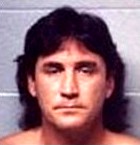
A photograph from Fain's 1994 arrest shows him
shirtless - deep-chested but with the beginnings of a belly - and
Fabio-like long black hair.
"There was something charismatic about him [to
some women]," Bradley said.
"He had this entourage of women who followed him
all the way up to Tyler," Davis recalled.
Fain has maintained his innocence throughout,
acknowledging he knew Anderson and Dumont but denying he killed
either of them.
"I'm not crazy or insane," Fain told the Leader
in a September 1994 interview from the Williamson County Jail. "I'm
not a psycho killer, or a kidnapping rapist from hell."
'No emotion ... no motive'
Anderson, Bradley and Davis said they see Fain as
a man who is calculating and remorseless.
"It does not sadden me to see this [Fort Worth
conviction] Davis said. "I certainly have no obligation to him
anymore."
"I would put Fain and Michael Moore together,"
Bradley said, referring to the man who in 2006 was convicted of
killing pregnant Forest Creek resident Christina Moore (no relation)
and who has been suspected in the 2002 disappearance of Georgetown's
Rachel Cooke, 19.
Michael Moore received a life sentence last year
for Christina Moore's murder.
"I think they would probably be in the same
category," Anderson agreed. "People who either need to be executed
or put in prison for the rest of their life.
"There's no emotion ... no motive ..." Anderson
said. "Those are the scary ones."
Cold case
detectives use DNA to solve 18-year-old murder of Linda Donahew
January 3, 2006
The Arlington
Police Department issued the following press release:
Arlington Cold Case
detectives have use DNA and other evidence to link a convicted murderer
to the 1987 stabbing and strangulation death of Linda Sue Donahew.
Today, Arlington Police presented the case charging Roger Eugene Fain Jr.
with capital murder to the Tarrant County District Attorney's office.
The TCDA accepted the case for prosecution and will seek a grand jury
indictment in the next few weeks.
Linda Donahew was
41 years old when her nude body was found in her Arlington home at 2405
Southcrest Drive on June 1, 1987. She had been sexually assaulted.
Fain is being held
in the Eastham prison in Lovelady, (Houston County) Texas. In 1995, he
was convicted of murdering Sandra Jean Dumont of Round Rock, Texas and
given a life sentence.
Cold Case
investigators learned from Round Rock investigators that there were
several similarities between the Linda Donahew and Sandra Dumont cases,
including that the victims' clothing was cut from their bodies.
Cold Case Detective
Jim Ford was one of the original detectives assigned to the Linda
Donahew case. "Back then, we had a suspect description, vehicle
description and even a composite of the suspect's face, but we didn't
know who he was," Detective Ford said. "Roger Fain's name never came up
because he was only loosely associated with her. That turned out to be
his method of operation."
Swabs taken from
Linda Donahew's body were processed as part of the original evidence but
the 1987 technology did not yield a DNA profile. When her case was
reopened by the Cold Case Unit in August 2005, detectives requested that
forensic scientists in the DNA lab of the Tarrant County Medical
Examiner's office retest samples of bodily fluids taken during her
autopsy.
Within a few weeks,
a complete DNA profile of a sperm was found, entered into the national
Combined DNA Index System (CODIS), and matched to Roger Fain. To confirm
the match, Cold Case detectives obtained a warrant to acquire another
sample from Fain. In late December, the DNA match was confirmed.
Detective Ford and
his Cold Case partner John Bell continued their investigation and
learned more that linked Fain to Linda Donahew.
At the time she was
killed, Fain was living in Dallas and drove a 1976 white Ford pickup
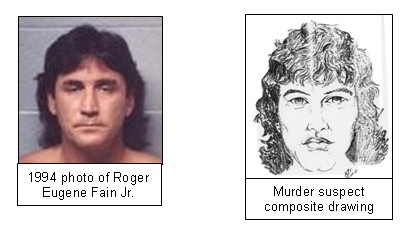
matching the suspect vehicle. One of three composites sketches of the
suspect looks strikingly similar to a 1994 photo of Roger Fain.
"Roger Fain was
seen with Linda Donahew at a horse stable in Arlington and at a local
bar," Detective Ford said. "We have witnesses who, even after all this
time, were able to identify both of them from photo lineups. Perhaps
more significantly, they recalled seeing them together. That helps seal
the case, but without the lead from the DNA technology, this case never
would have been solved."
Since the Cold Case
Unit was formed in November 2004, detectives have cleared four other
murder cases by arrest. Additionally, they cleared eight other murder
cases in which there were enough facts and information to substantiate
issuing a warrant for the suspects' arrest. In each of those eight
cases, however, the suspects are deceased so the cases are now closed.
Investigators will continue to review about 55 cold cases dating back to
1968.