Murderpedia has thousands of hours of work behind it. To keep creating
new content, we kindly appreciate any donation you can give to help
the Murderpedia project stay alive. We have many
plans and enthusiasm
to keep expanding and making Murderpedia a better site, but we really
need your help for this. Thank you very much in advance.
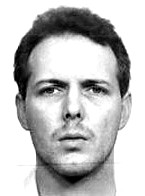
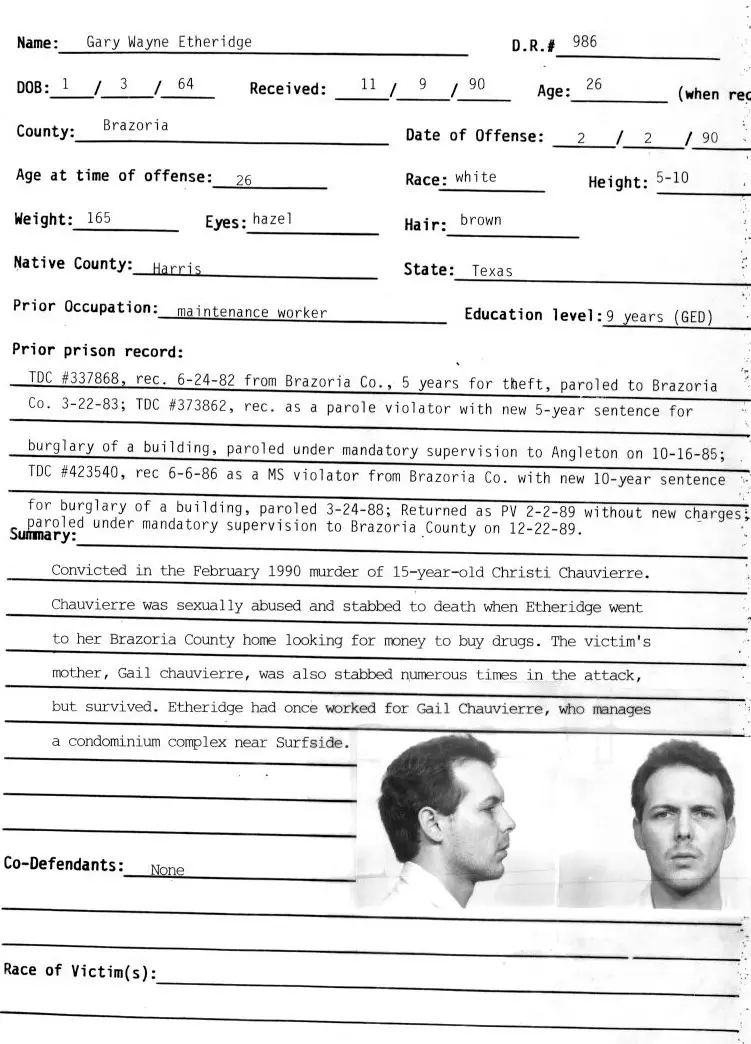
Gary Wayne
ETHERIDGE
Classification: Murderer
Characteristics: Rape - Robbery - Drugs
Number of victims: 1
Date of murder: February 2,
1990
Date of arrest:
5 days after
Date of birth: January 3,
1964
Victim profile: Christie Chauviere
(female, 15)
Method of murder: Stabbing
with knife
Location: Brazoria County, Texas, USA
Status: Executed
by lethal injection in Texas on August 20,
2002
Gail Chauviere was a project manager at a condominium complex in San
Luis Pass.
In late January 1990, Gail hired Etheridge as a
maintenance worker. He repaid the favor two weeks later when he
broke into her home, robbed her, stabbed her repeatedly, and
murdered her daughter.
On the night of February 2, 1990, Gail arrived home from work and
was confronted by Etheridge inside her home, with her 15 year old
daughter, Christie.
Etheridge demanded money, and after receiving it, he pulled a knife
and began stabbing Gail. Miraculously she survived and was later
discovered by a police officer with multiple penetrating wounds to
her neck, face, chest, upper abdomen, and arms.
15 year old Gail was found on the floor with her hands tied with a
telephone cord, and she had been gagged with a towel. She suffered
four fatal stab wounds and was dead at the scene.
A pathologist found no semen in Christie's genitals, however,
injuries to her genitals were consistent with knife wounds.
When Etheridge's car would not start, he left it in the driveway,
stole Gail's and fled. He explained to several friends that he had
to kill someone that night and upon his arrest hitchhiking 5 days
later, confessed to police.
Etheridge had prior convictions for aggravated assault and burglary,
for which he was paroled six weeks before murder.
Final Meal:
Nachos (with cheese and peppers), crispy French fries, one
cheeseburger, one fried chicken patty, one cinnamon roll, cheese,
ketchup, and pickles.
Final Words:
"To the victim's family -- I'm sorry for what was taken from you. I
hope you have peace. To my sweet Claudia, I love you. Stay strong,
keep building, and be careful. I hope there's closure for the
victim's family and everybody. That's about it. I can feel it
burning. I'm getting really dizzy."
ClarkProsecutor.org
Texas Attorney General
Media Advisory
Tuesday, Aug. 20, 2002
Gary
Wayne Etheridge Scheduled to be Executed.
AUSTIN - Texas Attorney General John Cornyn
offers the following information on Gary Wayne Etheridge, who is
scheduled to be executed after 6 p.m. on Tuesday, Aug. 20, 2002.
On Nov. 8, 1990, Gary Wayne Etheridge was
sentenced to die for the capital murder of Christie Chauviere during
the course of committing or attempting to commit robbery, aggravated
sexual assault, and/or kidnapping in Brazoria County, Texas, on Feb.
2, 1990.
A summary of the evidence presented at trial follows:
FACTS OF THE CRIME
Gail Chauviere was a project manager at a
townhouse-condominium complex in San Luis Pass. Gary Wayne Etheridge
started working at the complex in late January 1990.
On the night of
Feb. 2, 1990, Gail arrived home from work around 5:40 p.m. At the
end of the day, Gail regularly brought home a bag of cash from the
apartment complex. A dark car sat in Gail's driveway.
According to Gail's testimony at trial, Etheridge,
who was already inside the house, ordered Gail to come into the
house with him. Christie, Gail's daughter, was sitting on the arm of
a love seat.
Etheridge asked Gail if she was expecting any visitors,
to which she replied that her father was coming over. He then asked,
"Gail, where is the money? I know you bring it home." She told him
the money was in the bank bag. Etheridge asked, "The money is in
there?" Gail responded, "Yes. Take it; take the money and go. Just
take it. I won't tell anybody. Just please don't harm Christie."
As she said this to Etheridge, she reached for
her daughter, who was moving off the love seat toward her mother.
Etheridge jerked Christie to him by her hair. Christie screamed and
Etheridge told her to shut up and threatened to slit her throat.
He then pulled a knife from behind his back and began stabbing Gail. He
stabbed Gail two or three times on her left side, then he started
striking her head. One blow was so severe that Gail thought she
heard an explosion within her head. She blacked out by the fireplace
in the den.
At trial, Gail had only intermittent memories of
what happened after the explosive stab to her head. She remembered
being stabbed in the back and in the lower abdomen. She remembered
trying to push away from Etheridge and begging him, "No, no. Please
don't do this!" She never heard any other intruders in her house and
never heard Etheridge speak to anyone other than her and Christie.
Etheridge said nothing to indicate that anyone else was there. Gail
did not see Etheridge stab Christie.
After his own car would not start, Etheridge took
Gail's car and fled. He picked up his wife, Theresa, and their baby
daughter, Brittany, and two children that Theresa was babysitting.
They stopped at a bar where the mother of the two children worked
and left them with their mother. At the bar, Etheridge told the
woman that he had killed a man in a knife fight.
Etheridge then drove with Theresa and Brittany to
the home of Charles and Glenda Roenker. Glenda, Theresa's cousin,
remembered Etheridge being covered in blood.
Etheridge told the
Roenkers that he had just stabbed a man and that he thought the man
was dead. Etheridge cleaned up in their bathroom, dressed a cut on
his finger, and left with Theresa and Brittany. About a half-hour
later, they returned, asking the Roenkers to take care of Brittany.
Etheridge and Theresa then left again.
Etheridge later abandoned his wife in Mobile,
Alabama, and, after wrecking Gail's car in Alabama, he hitchhiked
back to Texas.
On Feb. 7, 1990, an off-duty Houston police
officer spotted Etheridge walking along Highway 288 and arrested him.
When the officer asked Etheridge if he knew why he was under arrest,
Etheridge responded, "Yes, I know I'm under arrest for killing that
15-year-old girl. I'm sorry for what I did, and I was going back to
Brazoria County to turn myself in."
The officer took Etheridge to the Brazoria County
Courthouse. A Justice of the Peace read Etheridge his rights and had
him sign a document confirming that he had received the warning.
Though told that he had a right to have a lawyer present during
questioning, Etheridge did not request one. Etheridge then spent
four hours answering questions from officers and drafting a written
statement. Etheridge signed each page of the statement.
The next day, the officers conducted another
interview with Etheridge, which they tape recorded. Etheridge denied
raping Christie and said he could not remember stabbing either woman.
He did say unequivocally, "I killed a girl."
He also said that no
one came with him to the Chauviere's house, that he went there alone,
and that he could prove it because someone across the street saw him
arrive and leave.
After the taped interview, the officers allowed
Etheridge to speak to his father on the telephone. Etheridge knew
the officers were recording the call. He denied raping Christie and
told his father to tell anyone that harassed his family that he
killed Christie, not the family. Etheridge declared that he wanted
to talk to the press so that he could tell them that he killed the
girl.
John Rhyne, a Richwood police officer, first
discovered Christie, nude from the waist down, lying in the entrance
way. Her hands were tied in front of her with a telephone cord, and
she had been gagged with a towel. He saw the remnants of a tear
rolling down her cheek.
He then saw Gail, moaning for help, lying in
an adjacent room. A doctor testified that Gail arrived at the
hospital with multiple penetrating wounds to her neck, face, chest,
upper abdomen, and arms. She had a severe wound to her right eye and
a gaping slash wound to her neck.
Christie suffered four fatal stab wounds and was
dead at the scene. Christie's attacker also stabbed her in the face
between her nose and right eye. She also had several defensive
wounds on her forearms. Christie's attacker did not confine his
assault to Christie's upper body.
The pathologist who performed
Christie's autopsy found no semen in Christie's genitals; however,
he testified that the injuries to her genitals were consistent with
knife wounds.
PROCEDURAL HISTORY
In April 1990, Etheridge was indicted in Brazoria
County, Texas, for the capital offense of murdering Christie
Chauviere in the course of a robbery of Gail Chauviere and in the
course of a robbery, aggravated sexual assault, and kidnaping of
Christie Chauviere.
He entered a plea of not guilty. On Nov. 6,
1990, the jury found Etheridge guilty of capital murder. Following a
separate punishment hearing, the trial court sentenced Etheridge to
death.
Etheridge's conviction and sentence were
automatically appealed to the Texas Court of Criminal Appeals, which
affirmed on June 22, 1994, and denied rehearing on May 10, 1995. The
United States Supreme Court denied Etheridge's petition for writ of
certiorari on Oct. 10, 1995.
Etheridge filed an application for writ of habeas
corpus in state court on April 23, 1997, and an amended writ on June
18, 1997. The trial court conducted a hearing via affidavits and
entered findings of fact and conclusions of law recommending the
denial of relief. The Court of Criminal Appeals denied relief on
April 1, 1998.
Etheridge next filed a petition for federal
habeas corpus on Nov. 13, 1998, in the United States District Court
for the Southern District of Texas, Houston Division. On May 19,
1999, the district court denied relief and denied Etheridge
permission to appeal.
On Feb. 2, 2000, the United States Court of
Appeals for the Fifth Circuit similarly denied permission to appeal,
thereby affirming the district court's denial of relief. Etheridge
then filed a petition for writ of certiorari to the United States
Supreme Court, which was denied on Oct. 16, 2000.
On Nov. 1, 2001, Etheridge filed a subsequent
state habeas writ and a motion for a stay of execution. The Court of
Criminal Appeals granted the stay on Nov. 6, 2001. Subsequently, on
April 17, 2002, the Court of Criminal Appeals dismissed Etheridge's
subsequent state habeas writ and vacated his stay of execution.
Consequently, a new execution date was set for June 27, 2002.
On June 20, 2002, Etheridge filed a writ of
mandamus and another motion for a stay of execution in the Court of
Criminal Appeals. Etheridge argued that the trial judge who set the
June 27, 2002, execution date had no authority to do so.
The Court
of Criminal Appeals agreed and granted Etheridge a stay of execution
on June 24, 2002. A new judge was appointed to Etheridge's case and
the Court of Criminal Appeals lifted the stay. On July 10, 2002, the
newly appointed judge set the current Aug. 20, 2002, execution date.
CRIMINAL HISTORY
At the punishment phase of trial, the State
introduced evidence of several previous offenses committed by
Etheridge.
Kyle Teat, a field supervisor for the Brazoria
County Juvenile Probation Department, discussed the juvenile offense
of unauthorized use of a motor vehicle and burglary of a building
committed by Gary Wayne Etheridge and his subsequent breach of
probation by breaking into a car and committing theft.
He identified
an adjudication order against Etheridge for the juvenile offense, an
order of probation, a petition for hearing to modify disposition or
revoke probation due to Etheridge's violation of probation through
the unauthorized use of a motor vehicle, and a final order modifying
disposition for commitment to the Texas Youth Council.
Bonnie Barker, deputy custodian of the Brazoria
County's Sheriff's Department, testified to adult offenses Etheridge
was convicted of, including driving with a suspended license,
driving while intoxicated, burglary of a building, and aggravated
assault.
Jackie Moff, deputy district clerk and custodian of the
records of the Brazoria County district clerk's office, further
explained the conviction for the aggravated assault which occurred
on Nov. 19, 1984, while Etheridge was in the Texas Department of
Corrections, citing indictments for attempted murder and aggravated
assault (habitual).
While Etheridge was only convicted of aggravated
assault, the victim, Geoffrey Mack, confirmed that Etheridge had
stabbed Mack in prison while he slept and then threatened to kill
him when he awoke. Mack claimed that he and Etheridge had argued
over prison barter.
Charles Wagner, former chief of investigation for
the city of Freeport, testified to Etheridge's bad reputation as a
peaceful and law-abiding citizen in the community of Freeport. Larry
Bullard, Wagner's successor, also testified to Etheridge's bad
reputation as a peaceful and law-abiding citizen in Freeport and to
a sting operation where he caught Etheridge selling cocaine.
Etheridge was never convicted of this charge
Payton Taylor, a refrigerator technician,
testified that he worked as a police informant who bought cocaine in
a sting operation against Etheridge. Etheridge later started a fight
with Taylor in the Brazoria County Jail for betraying him. Taylor
also testified as to Etheridge's bad reputation as a peaceful and
law-abiding citizen. John Devens, a Brazoria county jail captain,
testified to Etheridge's bad reputation in jail as a peaceful and
law-abiding citizen since his incarceration for the instant offense.
ProDeathPenalty.com
Gary Wayne Etheridge is on death row for the 1990
stabbing death of 15-year-old Christi Chauvierre.
Etheridge, with a history of theft and burglary
convictions, was on parole for about 6 weeks after serving part of a
10-year term for stabbing another inmate when he showed up at the
home of Gail Chauviere, who managed a condominium near Surfside and
had given him a job.
When Ms. Chauviere resisted his demand for money
for drugs, he sexually assaulted Christi Chauvierre and stabbed both
her and her mother repeatedly. Gail Chauvierre survived the attack
and identified Etheridge as the killer, but died 3 years ago from
complications of injuries suffered in the attack. Upon his arrest,
Etheridge confessed to the crime.
"I'm a Christian hypocrite backslider," Etheridge
once said from death row. "I'm repentant but can't follow the rules.
I still lust after pretty women. I'm human. I'm scared to death of
death." Etheridge won a reprieve of a June 2002 execution date when
the state appeals court delayed his execution based on claims that
the judge who once called him a piece of trash should not have
signed the execution order.
Carolyn Barrett, Christie Chauviere's sister, was
discouraged but not surprised at news the execution was delayed
again. She would not lay odds on when another date will be set. "It
has taken us 2 years to get another one, so I really don't know,"
Barrett said."It questions your faith in the Texas justice system."
Barrett questions the importance of Gayle's comments after
Etheridge's sentencing. Comments Etheridge made to Gail Chauviere as
he left the courtroom that same day are more important, Barrett said.
"Gary looked at my mother and said 'We are all going to die someday,'"
Barrett said. "I know because I was sitting at her right side
holding her hand. My mother held his stare until he looked away and
walked out. I think its very ironic that people will quote Judge
Gayle and what Judge Gayle said and ignore what Gary said to my
mother," Barrett said. "He can do and say what he wants and nobody
cares."
District Attorney Jeri Yenne said Etheridge has
had 12 years worth of appeals. His case is a model for how
safeguards in the legal system should work, Yenne said. "The Gary
Etheridge case should be a stellar example of due process," Yenne
said. "When people complain and moan about the death penalty I want
them to look at the Gary Etheridge case and see how many bites at
the apple he has had. It would have been nice if Christie Chauviere
had had as much due process as Gary Etheridge is afforded before he
executed the death warrant on her," Yenne said.
Gary Wayne Etheridge
Txexecutions.org
Gary Wayne Etheridge, 38, was executed by lethal
injection on 20 August in Huntsville, Texas for killing a 15-year-old
girl in the course of a robbery.
In February 1990, Etheridge, then 26, went to the
home of Gail Chauviere, looking for money to buy drugs. Chauviere
managed a condominium complex where Etheridge once worked doing
maintenance.
He knew that Chauviere brought the money from the
apartment complex home with her, and he knew where she lived because
she let him follow her home from work one day, so she could give him
a stray dog.
Chauviere came home from work one evening to find
Etheridge's car in her driveway. She entered her house and found
Etheridge sitting on the couch with her 15-year-old daughter,
Christie.
Etheridge asked for the apartment money. Chauviere told
him she would give him the money and pleaded with him not to hurt
Christie. Christie then started moving off of the couch toward her
mother. When Etheridge grabbed her by her hair and pulled her back
to him, she screamed.
Etheridge then pulled out a knife and stabbed
Gail more than thirty times until she was unconscious. She suffered
multiple stab wounds to her neck, face, chest, abdomen, and arms.
Etheridge then pulled off Christie's clothes below her waist, tied
her hands with a telephone cord, and gagged her with a towel. He
stabbed her four times and sexually assaulted her with the knife.
The mother survived the attack, but her daughter did not.
Etheridge couldn't start his car, so he fled the
scene in Gail's car. He picked up his wife, Theresa, their baby
daughter, Brittany, and two children that Theresa was babysitting.
He then drove to the bar where the children's mother worked and left
them there. After that, he drove with Theresa and Brittany to the
home of Charles and Glenda Roenker. Gary cleaned up in their
bathroom. Gary and Theresa asked the Roenkers to take care of
Brittany and left her with them.
Etheridge later abandoned his wife in Mobile,
Alabama. He also wrecked Chauviere's car in Mobile and hitchhiked
back to Texas.
He was arrested five days after the murder, less than
fifty miles from the crime scene. When he was arrested, he told the
officer, "Yes, I know I'm under arrest for killing that
fifteen-year-old girl. I'm sorry for what I did, and I was going
back to Brazoria County to turn myself in."
He also made a written
confession and a tape-recorded confession after his arrest. In the
tape-recorded confession, he denied raping Christie and did not
admit to stabbing either woman, but he did state, "I killed a girl."
He said that he was alone the whole time and that someone across the
street saw him arrive and leave.
At his trial, Gail Chauviere identified Etheridge
as the attacker and testified that he was alone. A neighbor who
lived across the street testified that he saw Etheridge driving
Chauviere's car out of the driveway. He also testified that
Etheridge was alone in the car.
The woman whose children Theresa was
babysitting testified that Gary told her he had killed a man in a
knife fight. Glenda Roenker testified that, while at her house, Gary
told her that he had stabbed a man. Etheridge was also placed at the
scene by blood evidence.
Etheridge had an extensive juvenile criminal
history. He joined the adult criminal ranks within a few months of
his seventeenth birthday and remained there until the day he died.
His first conviction was for burglary in May 1981, for which he
received a sentence of five years' probation.
Over the next five
years, he was convicted of theft, aggravated assault, three more
burglaries, DWI, and driving with a suspended license. In all, he
was sent to prison four times, with sentences totaling thirty years.
Each time, he was paroled less than two years into his sentence.
The
last time he walked out of prison was in December 1989, ten months
after returning on a parole violation. (At this time, early release
was common in Texas because of strict prison population caps imposed
by U.S. District Judge William Wayne Justice.) Six weeks later,
Etheridge attacked Gail and Christie Chauviere.
A jury convicted Etheridge of capital murder and
sentenced him to death. The Texas Court of Criminal Appeals affirmed
the conviction and sentence in June 1994. All of his subsequent
appeals in state and federal court were denied, but he did win
several stays of execution during his time on death row.
He was
scheduled to be executed in November 2000, but he received a stay
from the Texas Court of Criminal Appeals. At issue was the
competence of one of his court-appointed attorneys. That matter was
dismissed in April 2002, and his execution was rescheduled for June
2002.
That date was then stayed by the CCA so that it could hear a
complaint against the judge who signed Etheridge's death warrant. A
new judge was assigned to Etheridge's case, and that judge signed a
new death warrant in July 2002.
While on death row, Etheridge married a German
death-penalty opponent named Claudia Schweiger. Schweiger built a
web site, www.garyetheridge.com, which asserted Etheridge's
innocence and appealed for activism and financial support on his
behalf.
According to this web site, Etheridge claimed that he did
not kill Christie Chauviere and that he never confessed to such. He
did admit to robbing and stabbing Gail Chauviere, but said that
someone else at the scene -- who he refused to name -- killed
Christie. He said that he was on his way to turn himself in for
robbing and stabbing Gail when he was arrested.
He said that police
manufactured a confession and coerced him into signing it by beating
him, making threats against his wife and daughter, and refusing his
requests to see a lawyer. Claudia offered to name the actual killer
in a newspaper interview in exchange for payment.
"I never intended to hurt everyone," Etheridge
said in a death-row interview. "I cut and stabbed Gail with a little
bitty pocket knife." He said that Gail fought with him when he tried
to put her in a closet. "She kicked me and it hurt," he said. But he
denied killing Christie. "I was there. I done wrong and I feel
responsible, but I did not kill the girl."
Three days before the execution, Governor Rick
Perry received a registered letter from Claudia Schweiger-Etheridge,
inviting him to witness her husband's execution. "I think it would
be important to you to finally witness an execution since you
already signed so many death warrants," the letter read. (As
mentioned above in the discussion of Etheridge's second stay of
execution, death warrants in Texas are signed by judges, not the
governor.) This letter named Ellis Michael Etheridge, Gary's brother,
as the killer.
The Texas Board of Pardons and Paroles denied
Etheridge's clemency request by a 17-0 vote. The U.S. Supreme Court
also refused to halt the execution. Governor Perry declined to issue
an emergency reprieve. He did not attend the execution.
"To the victim's family -- I'm sorry for what was
taken from you," Etheridge said in his last statement. "I hope you
have peace. To my sweet Claudia, I love you. Stay strong, keep
building, and be careful. I hope there's closure for the victim's
family and everybody. That's about it." After the lethal injection
was started, Etheridge said, "I can feel it burning. I'm getting
really dizzy." He then gasped, sputtered, and lost consciousness. He
was pronounced dead at 6:22 p.m.
Gail Chauviere required blood transfusions
because of her wounds. She contracted hepatitis C from the
transfusions and never fully recovered. She died from the disease in
1999.
Killer of 15-year-old Girl is Executed
By
Michael Graczyk -
Houston Chronicle
AP Aug 20, 2002
HUNTSVILLE -- An apologetic Gary Wayne Etheridge
was executed Tuesday evening for the fatal stabbing of a 15-year-old
girl more than a dozen years ago while the then-paroled burglar said
he was high on drugs.
In a brief final statement, he apologized to the
girl's relatives and expressed love to his wife, who watched through
a window a few feet away. "I'm sorry for what was taken from you,"
he told two sisters and an uncle of his victim, Christie Chauviere.
"I hope you find peace." Then he looked out another window at his
wife and urged her to "stay strong, keep building and be careful. I
love you."
As the drugs began flowing into his heavily
tattooed arms, he added that he hoped "there's closure for the
victim's family and everybody. I feel it burning. Getting real dizzy."
Then he gasped several times and sputtered before he stopped
breathing. He was pronounced dead at 6:22 p.m., nine minutes after
the drugs began flowing.
Etheridge, 38, acknowledged knifing the girl's
mother, who hired him as a maintenance worker despite knowing his
criminal past, but said he wasn't responsible for killing the
teenager at her Brazoria County home on Feb. 2, 1990. Etheridge was
the 22nd Texas inmate put to death this year and the fourth this
month. Last year, 17 prisoners were executed in Texas. A record 40
were put to death in 2000.
"I've been a criminal all my life," Etheridge
said earlier from death row. "I was there. I done wrong and I feel
responsible, but I did not kill the girl." The U.S. Supreme Court,
without comment, refused Tuesday to stop the punishment. His
attorneys had argued in appeals that earlier lawyers did not provide
him competent help.
It was the second time in recent months the
former maintenance man prepared for death. A day before Etheridge
was scheduled to die in June, the Texas Court of Criminal Appeals
halted the punishment after his attorneys complained the judge who
signed his death warrant once called him "a piece of trash" and was
biased against Etheridge. A new judge was assigned to his case and
reset the execution date for Tuesday.
Etheridge, with a history of theft and burglary
convictions, was on parole for about six weeks after serving part of
a 10-year term for burglary when he showed up at the home of Gail
Chauviere. Chauviere had given him a job at a condominium she
managed near Surfside, about 60 miles south of Houston. Etheridge
said he demanded money "to fill a hole for drugs" and he knew the
woman carried in a bag some cash received from tenants. When
Chauviere resisted, she was stabbed. Her daughter also was assaulted
and fatally stabbed with a knife. "I never intended to hurt
everyone," Etheridge said. "I cut and stabbed Gail with a little
bitty pocket knife."
Etheridge, who started using cocaine at age 17,
said he probably was high on drugs at the time and she fought as he
tried to put the woman in a closet. "She kicked me and it hurt," he
said. Etheridge drove off in the woman's car. A neighbor found
Chauviere, seriously wounded with at least 30 stab wounds, and her
daughter. The girl had been bound with a telephone cord and fatally
stabbed several times in the chest. The high school freshman also
had been sexually abused with an object.
Five days later, after wrecking the car in Mobile,
Ala., Etheridge was arrested while hitchhiking south of Houston. He
told police he was heading back to Brazoria County to turn himself
in, apologized to the arresting officer for killing the girl and
gave a written statement that he committed the murder.
In a death row interview, Etheridge blamed the
slaying on a companion. At his trial, however, Gail Chauviere
identified him as the lone attacker.
Canadian Coalition to Abolish
the Death Penalty
CCADP Press Release - August 18, 2002
Governor Perry Invited to Witness Execution of
Gary Etheridge, Aug. 20th
Livingston, TX - August 18, 2002 - "...if you
allow Texas to carry out the execution I will invite you to attend
his execution together with me because in this case I need your
support and guidance. I need a shoulder to lean on and someone who
explain to me that it was the right thing to kill my husband. " -
Gary's wife Claudia, in a letter to Governor Rick Perry - May 17,
2002.
Governor Rick Perry has been formally invited to
attend the August 20th execution of Gary Etheridge as a witness, in
the event he fails to intervene to stop the execution pending
further investigation.
The invitation was extended by Gary's wife
Claudia, along with The Canadian Coalition Against The Death Penalty,
on behalf of Gary Etheridge. The Governor was originally invited to
the execution in May, when Gary faced another execution date that
was stayed. Perry at that time did not respond to Mrs. Etheridge's
letter and invitation. On August 17, a registered letter was sent to
the office of the Governor again extending the invitation. "...It’s
now time for you to have the courage of your convictions and stand
up to your own words. I think it would be important to you to
finally witness an execution since you already signed so many death
warrants," the letter reads.
The involvement of the Canadian group is "indicative
of the level of concern now rising in the international community
over the continued enthusiasm for 'Texecutions,' " Coalition
Director Dave Parkinson, in Toronto, says. The Canadian group is
also encouraging its supporters both in Texas and around the world
to join Texas activists recent call for an all out boycott of the
Lone Star State for its continued application of the death penalty.
"The Governor has to answer not only to his own constituents in
Texas, but to political and economic allies internationally,"
Parkinson says, " Perry's response to the invitation to attend the
execution will indicate whether he takes his responsibility on this
matter seriously, or if a death warrant is just another piece of
paper to be signed from a stack on his desk without any concern for
the implications of what his endorsement means."
CCADP's Tracy Lamourie adds, "Etheridge's
invitation extends to the governor a unique opportunity to make a
public stand, to either have the courage to stand up for his ideals
which apparently involve the taking of life; or to show the
international community how little concern he has for the gravity of
this issue by ignoring the invitation." The Governor has been asked
to recuse himself for the reason of prior involvement with the case.
If Governor Perry recuses himself, this invitation still stands as
he is the signatory not only to Gary's warrant on several occasions,
but to the warrants of dozens of prisoners on a regular basis since
he replaced Governor Bush.
The invitation to the Governor ended with the
words : "With this letter I respectfully invite you in the name of
Mr. Gary Etheridge, in the name of the Canadian Coalition Against
The Death Penalty and in my name, to witness the murder of Mr.
Etheridge on August 20, 2002 after 6:00 PM. Sincerely yours,
-Claudia Schweiger-Etheridge." We await a response from the Governor
as to whether he will have the courage of his convictions and attend.
The CCADP and Claudia Etheridge, both maintain
websites for Gary Etheridge.
The judge hated Gary from childhood on. It was
him who made the statement that he hated the Etheridge brothers and
he wanted to see Gary getting a death sentence already BEFORE the
trial and he sentenced him to die with the following words:
"You know, Etheridge, I have handled you since
you were a kid and you have really graduated to the big time and you
don't want to hear anymore from me, but Mr. Coate (defense lawyer)
made one statement that I want to answer. He told this jury that
nothing would be accomplished by giving you the death penalty. Well,
I can tell you one thing that's going to be accomplished. In my
opinion we are going to clean up a piece of garbage that has become
nothing than a blight on society because that's all you are. You are
going to die, young man, sooner or later by lethal injection. Take
him out of here."
This same Judge Gayle now writes the Texas Board
of Pardons & Paroles Executive Clemency Section to demand that Gary
Etheridge be executed:
Re: Gary Wayne Etheridge No. 000986; Opposition
to petition for clemency.
Gary Wayne Etheridge's crime was one of the most
heinous crimes over which I have ever presided. He earned the death
sentence awarded him and deserves to be executed. He received a fair
trial with experienced, good lawyers representing him at the trial
level and on his appeal to the Court of Criminal Appeals. In
addition, he has filed numerous post-trial writs and has had them
all denied, both at the state and federal level.
It is my understanding that the mother of the
child Etheridge murdered has long since died, her death resulting
from a blood infection she received from blood transfusions made
necessary by the many stab wounds he inflicted on her at the time he
killed her daughter. In my opinion the granting of any form of
clemency will be one of the biggest miscarriages of justice in the
history of the Criminal Justice System.
I adamantly oppose any reprieve or commutation of
his sentence or any type of conditional pardon.
Yours truly, J. Ray Gayle III 239th District
Court
NCADP Execution Alert On Gary
Etheridge
Gary Etheridge, a 38-year old white male, was
convicted of the 1990 murder of Christi Chauvierre, and is now
scheduled to be executed by the State of Texas on Aug. 20.
Etheridge, a heroin addict at the time, initially
acknowledged his guilt and had proceeded to turn himself in at the
time he was arrested.
Etheridge has appealed his conviction on the
grounds that his attorney failed to adequately provide the jury with
evidence of mitigating circumstances on Etheridge’s behalf during
sentencing.
In fact, the jury was offered no evidence
relating to Etheridge’s childhood abuse and severe drug addiction.
Etheridge’s habeas appeal testified to the brutality of his
childhood, stating the jury had not heard evidence that “[he] had
been raped at an early age by an older brother, that he had been
physically abused by a drunken father, that he had observed his
mother attempt suicide several times, that that he had endured a
drug dependency since adolescence.” Moreover, the prosecution had
used a previous altercation Etheridge had in prison to vouch for his
future dangerousness. In fact, Etheridge had resisted being raped by
another prisoner.
Stories such as Etheridge’s are familiar on death
row. An early life of abuse and addiction often leads to a later
life of crime and violence. Clearly Etheridge’s early family life
was troubled and this violence spared no one in the family.
Etheridge and each one of his four brothers had spent a considerable
amount of time in prison before his arrest for murder.
Gary Etheridge is an example of how children who
learn violence at home often take it back out into the streets.
Previously, Etheridge had an execution date for June 27. That date
was stayed because the judge setting the date had referred to
Etheridge as a “piece of trash” during Etheridge’s sentencing. No
court has saw fit to look into charges of the judges obvious bias
against Etheridge and the stay of execution was a mere technicality.
Texas is currently scheduling anywhere from five to seven executions
per month. Please write to the Governor of Texas and let him know
how his state’s resources can be better used to fight crime.
Gary's Original Pen pal Request Sent to the
CCADP
Hello, My name is GARY WAYNE ETHERIDGE. I was
born in Houston Texas on January 3rd, 1964 ...and have lived my
entire life on the coast of Texas near Galveston. I came to death
row November 9th, 1990 for a crime I was accused of involving murder
/ robbery...I was at the crime and I robbed but my hand did not kill.
I am 35 years old and was married and have two
gorgeous precious daughters named Brittany and Brandy.. .my former
wife has since remarried and moved on in life with her new husband...I
am glad that my children have a family and security and can grow and
be happy...but nonetheless I miss them terribly and wish that I
could be part of their lives. I do not hear from them or my former
wife at all. I was a carpenter and apprentice electrician while free
and I also spent many years working offshore on supply boat and
fishing boats, but my heart is with carpentry and building things
and seeing the result of my labor. I am average height and have
light brown hair and blue/grey eyes. I exercise and try to stay in
good health...we are constantly locked in our cages (cells) here and
do not have freedom to go outside or exercise properly as we would
like, so it is a perpetual challenge.
I pay alot of attention to world events and news..
I read all of the news magazines and newspapers that I can get a
hold of....I also enjoy to read novels such as Robert Ludlum and
Dean Coontz...Stephen King and practically anything interesting....one
of the best books I ever read was by Sydney Sheldon "Master of the
Game" and another book called Cain and Abel by another author.
I have studied lawbooks and have a very political
and strong opinion about courts and rights and I try to make sure
that I and all of my peers here are always kept abreast of current
legal developments. ..I take the threat to our life very seriously
and I sometimes may seem dull and without humour because of the
situation I am in...but I do try to relax and have some laughs and
learn to care and share with a new friend. I have never wrote to
anyone in Canada but I am aware that French is spoken in some parts
of Canada and I am learning to read and write French and German and
Italian. I am a huge geography nut.. .I had many maps here that I
would study and travel guide that had pictures I would see parts of
Canada and the world...otherwise I may never see those places. ..but
recently the guards had a major festival of taking inmates property
and they took all of the maps and books I had about geography and
postcards and stuff.
I enjoy all types of music and have mostly
listened to old rock music like the Beatles and Led Zeppelin and
Rolling Stones and that sort of old music and I like Shania Twain
and Garth Brooks. Some classical music such as Vivaldi and Mozart
and Bach. Liszt. I believe that there are people all around the
world that suffer and that need help.. and that we are created with
a inherent instinct to adapt and survive and reason overcome what
oppresses and robs us of liberty and justice. From the beginning of
mankind there have been serious struggles and battles to survive and
together people have overcome 'rise challenges... it is not the size
of the dog in the fight...but it is the SIZE OF THE FIGHT IN THE
DOG. We must value what we believe in and let our values be the fuel
that feeds us.
As for what I am seeking in a friendship...well..that
is Simple..I have no preferences and I will try to meet anyone [that
offers me their friendship] in the middle...We are all humans and we
are all different to some degree and I celebrate the individuality
of that natural fact. I am open to anyone that is open to me.... and
I find something beautiful and interesting in all people.....but I
would like to meet someone that likes to write about once every week
or every two weeks as I would like to share alot and talk alot....I
believe that friendship is like a garden and we can grow what we
want and cultivate and care for it and make it a beautiful thing if
we put the value and concern into it.. ..and since I am locked in a
cage and have no contact to the outside world other than via letters...I
take friendships seriously and spend most of my time thinking and
focused on what we share as friends...of course when I am not
otherwise engaged with my legal battle..and sometimes the two become
one and we fight together, but helping me fight for my life IS NOT a
requisite of being my friend. I only ask that anyone whom offers to
be my friend will have some understanding about this situation and
not demand too much of me as I will not demand too much of them.
The death row in Texas does not allow inmates to
possess pictures of themselves so I do not have a photo to offer...
I'll be glad to plant some seeds and grow a garden with whoever
writes.
SINCERELY, GARY ETHERIDGE
(Gary Etheridge met his wife Claudia as a result
of this pen pal request - They married in 2001.)
Gary Etheridge Homepage
This is a call for help from Gary Etheridge and
his wife Claudia Schweiger-Etheridge for help in the organization
and development of a defense fund for Gary.
Gary has been on Texas death row for 12 years now
for a crime he was a part of, but Gary was not the actual killer and
refused to name the actual killer. So the state of Texas and the
judge accused Gary and manipulated the evidence to seem like Gary
did the crime alone.
There are several items of proof that Gary did
not kill the victim, but lawyers and the judge and prosecution hid
these from the jury and kept Gary from telling his factual story of
the events of the crime. Gary was not alone as the state said.
Cell Door Magazine
On February 2nd, 1990 Christie Chauviere and Gail
Chauviere were robbed and stabbed at their home in Richwood, Texas.
Gary Etheridge worked at the condominiums that Gail managed. Gary
was the maintenance worker.
Gary refused to name who was with him at the
crime because under Texas law all parties at the crime can get a
death sentence. For this reason Gary gave the police several
versions of the events of the crime and demanded that the police
releases Gary’s former wife Teresa from jail as she had also been
charged with the crime. And the police had taken Gary’s infant
daughter (9 months) and hid her away from everyone.
Gary signed a statement about the crime that the
police wrote to fit what they needed Gary to admit to. This was done
in a deal to release Teresa and give Brittany, the daughter, back to
Teresa. Gary refused to name the other party of the crime. The
written statement did not include that Gary killed a girl. Gary did
not confess at any time that he killed Christie Chauviere. He
confessed and always refered to the robbing and stabbing of Gail
Chauviere but he never at any time touched Christie, Gail’s daughter.
A few days after the crime Gary had heard that
the police wanted him for murder charges, so Gary was on the way
back to turn himself in to the police and explain that he did not
kill Christie, but that he did stab and rob Gail. The Houston SWAT
police caught Gary walking down the highway and picked him up. The
police demanded his name and were very aggressive. This frightened
Gary and as a consequence he lied and said his name was other than
Gary.
The SWAT police put handcuffs on Gary and began
demanding answers to their questions. Gary told them he did not ever
touch the girl Christie but that he stabbed Gail and was on his way
to report to the police office for this. The police were not
satisfied with Gary’s answers, so they took him to the woods and
began slapping and beating him until he agreed to answer in a
satisfactory manner. Gary after several minutes of being beaten and
hit agreed to answer in what ever way they wanted, but continued to
ask for a lawyer. The police did not respond to this.
There were police married into the Chauviere
family, Gail’s two older daughters are / were married to police
officers who work for the sheriff‘s office which the SWAT police
delivered Gary to. The police family members of the victim were
there and being physically restrained and were cussing and
threatening to get a hold of Gary. The police used this threatening
situation to force Gary to endure another four hours of police
harrassment and threats and forcing him to answer questions. In
these questions Gary again and again tried to explain that he did
not stab Christie and that he was not alone at the robbery at the
Chauviere home. The police investigated and sought the other
criminal – but Gary refused to say the name and the police put all
blame on Gary alone. This was when Gary signed the statement that
the police wrote to get Teresa out of jail and get Brittany handed
back to Teresa. Teresa was also pregnant with Gary’s second daughter.
The reason that the police suspected Gary in this
crime was because they found the car in the driveway of the
Chauviere home which Gary had been driving.
The car was owned by Teresa’s brother and when
the police went to arrest him to question him on the crime (they
thought he had done it), he told them that he knows Christie and
goes to school with her but that he did not do the crime and that
Gary Etheridge and Teresa Etheridge had bought the car , which was
found in the Chauviere driveway, from him.
Gary has always taken responsibility for his part
of the crime in which he robbed and stabbed Gail Chauviere. Gail is
Christie’s mom. Gail testified at the trial that Gary stabbed and
robbed her but that she never saw Gary stab Christie. Gail also
testified that, when she came home after a few minutes after Gary‘s
arrival at her home, that she saw his car in the driveway and that
both doors were open. This is also a clue that a second man was at
the crime scene.
Gail was stabbed with Gary’s small folding pocket
knife in a rear room in the house. Christie was stabbed to death
with a very large knife in the front room of the house. Gary passed
a lie detector test saying that he did not stab or kill Christie
Chauviere; that he only stabbed and robbed Gail Chauviere.
Because there was no evidence at all to convict
Gary, the police created a drop of Gary’s blood that they claim was
found on Christie’s shirt and used this to support their accusation
that Gary stabbed Christie and Gail at the same time in the same
room with the same knife. The drop of blood was found on Christie’s
shirt which was soaked with her blood to a point that to single out
one small drop of blood is impossible.
Strangely this one small drop of blood was the
only drop of Gary’s blood found near Christie and no other blood
drops were tested ! A proper DNA test will prove that Gary did not
leave his blood on Christie and was not bleeding until he went
outside and the car would not start. So while one tried starting the
car Gary went into the garage and got jumper cables and cut his
finger cutting the strap off the cable binders. Gary’s blood is in
the garage and on the cables.
Because there is no evidence at all to blame Gary
for the murder of Christie, the police developed a theory and
claimed that everything happened in the front room but the crime
foto’s and blood splatters and Gail herself prove that Gail was in
the back of the house and Christie in the front and it is not
possible to stab two women at the same time with two different
knives in two separate rooms by one and the same person. The judge
in this trial is a judge that has always hated Gary from childhood
on and called Gary all sorts of names when he passed the death
sentence on Gary.
The judge even stood up and incited the jury and
spectators to clap and cheer upon his words that Gary is going to
die because he is nothing but a trash. That judge put lawyers on
Gary’s case to cheat Gary out of an effective defense and to rush
the case through very fast and keep Gary from telling his part of
the actual events. Gary cussed and made a scene when the lawyers
refused to allow Gary to take the witness stand and tell what really
happened. Gary wanted to tell the jury what happened, that the blood
drop is not his and that the police beat him and forced him to sign
a statement that they had written.
The lawyers, the judge forced onto Gary’s case
were put on the case specially to keep Gary quiet, rush the case and
forfeit Gary’s rights and allow the judge and prosecution to get
away with all sorts of improper behaviour and cheating lying ways.
Gary was totally alone against the entire state of Texas in this
case. Poor with no money and no help at all. After the trial the
same judge forced Gary to have the same two-faced lawyers to make
his first appeal – and it was rushed and ruined as well.
On the second appeal the judge forced a young two-faced
incompetent and inexperienced lawyer (it was his first death penalty
case after final examination) on the case and Gary resisted and
filed complaints and fought for his rights because the second appeal
is the state habeas corpus and ALL PROOF AND ALL CLAIMS must be made
at the second appeal. The judge put this moron lawyer on Gary’s case
to again rush and keep Gary from developing the truth in the case.
This state habeas appeal was rushed and nothing
at all was developed and the court ruled against Gary quickly. The
judge attempted to force the same lawyer to ruin Gary’s federal
appeal and Gary flatly resisted and filed and complained and managed
to find the help of a friend in Luxembourg which hired a very good
lawyer to make a fair and fully developed appeal in federal court
for Gary.
This new lawyer did develope everything and is
the one that gave Gary the lie detector test which Gary passed. This
new lawyer also proved how the state cheated and lied about the drop
of blood they claim was Gary’s blood. And that they had kept Gary
from telling the full story and that the police lied and cheated
Gary and forced him to sign the things they had written.
The federal court acknowledges that all of these
things the new lawyer developed were reasonable and should have been
developed by the first and second appeal lawyers. But because they
were not raised sooner the court is not allowed to consider them due
to new federal laws that push death cases through the court very
fast and limits what a convict can claim. If the claims were not
made at trial and at the first and second appeal then they are lost
forever. The judge knew this and that‘s why he put the two-faced
lawyers on Gary’s case to cheat Gary. Because of those special
federal limits Gary’s case was rushed through federal court and
never allowed to be properly developed or recognized.
Gary was 40 hours from being strapped on a table
and killed by poison injections on November 8th, 2000. In the 12
years on death row Gary has had very little help and no contact with
family or former wife. Teresa married after a couple of years and is
doing fine. The daughters Brittany and Brandi are doing very well
and that is what is important to Gary. Gary has also remarried.
Claudia and Gary fell in love and got married in 2001 and are doing
fine (under the circumstances). They share as many visits as
possible but since Claudia still lives in Germany it is difficult at
times.
Claudia is the one that managed to save Gary’s
life at the last possible moment by finding a new lawyer to file and
stop the executiion since all other lawyers had abandoned Gary after
court refused to hear his case. Claudia made a frantic action and
got a lawyer who saved Gary’s life by filing new appeals to the
state court about these claims. The state court stopped Gary’s
execution and is now considering wheter or not to grant Gary a new
and fair second state appeal which is the state habeas corpus.
The former lawyers ruined the first state habeas
corpus and the new lawyer that saved Gary 40 hours from death has
asked the court to allow Gary a fair state habeas appeal in order to
develope all of Gary’s proof and claims.
This lawyer cannot continue as Gary’s lawyer for
free and when Gary gets the new state habeas corpus he and Claudia
will need to be ready to hire a competent and professional lawyer to
handle the state habeas corpus. The proper state habeas corpus will
result in a new trial and a new trial will result in Gary being
punished and sentenced for what he actually did to Gail rather than
for what he did not do to Christie.
Deathrow.at
Dear friends of Gary,
Dear opponents of the death penalty,
Today I ask you for some help. As you know is
Gary scheduled to die on June 27th, 2002 and before that date the
Board of Pardons and Parole will think about if they commute his
penalty into a lesser penalty. Chances are very small as you know
but we need to try to convince them that Gary does not deserve the
death penalty.
Please send letters to the Parole Board with the
following contents:
To those who are friends with Gary please write
your personal opinion about him. What he mean to you. What would it
mean to you if Texas will kill him. Please remind them that he did
not kill Christie Chauviere and it only need a DNA testing to prove
this. Please mention that he plays a big role to his little
daughters, that it will hurt them forever when they kill their daddy
and if you like please mentione me, his wife and that it will break
my heart forever. Please ask for justice. Please remind them that
one of the reasons a convict can get the death penalty is that the
jury think he is a future danger and threat to society. To kill Gary
is vengence because for 12 years while on death row he did not hurt
anyone, no other inmate and no guard. This is proof enough that he
is no future dangerous or threat.
To those who ain't in touch with Gary please
write your opinion about the death penalty. That it does not prevent
further crime, that it is no deterrent at all and that it does not
bring closure to the victims family, as a letter of a murder victims
mother proves. She recently wrote a letter to the Parole Board,
asking for the life of her sons killer. Next Wednesday we will see
if her letter was helpful or if they execute Mr. Martinez. The death
penalty only creates a new violent act. The death penalty is
barbaric, old-fashioned and a cruel and unusual punishment etc. etc.
etc.
Please include that we do not plea or beg for
Gary's life because he did not kill. We plea for true justice which
truth will save Gary's life. Please keep the letter short (just one
page) and don't send it anonymus. Include your home address, phone
number and e-mail address. If you have a legible handwriting it
would be best to write by hand or type the letter but don't forget a
hand signed signature. Please send your letters to the Parole Board
chair man Gerald Garrett as well as to each board member and to the
governor Rick Perry.
We have to have everyones letter or statement in
Gary's favor in by Friday June 7th. So please send it right in time.
You know that letters from overseas need round about a week,
sometimes even longer. So please send out your letters quickly.