Murderpedia has thousands of hours of work behind it. To keep creating
new content, we kindly appreciate any donation you can give to help
the Murderpedia project stay alive. We have many
plans and enthusiasm
to keep expanding and making Murderpedia a better site, but we really
need your help for this. Thank you very much in advance.
Richard Eugene
DINKINS
Classification: Murderer
Characteristics: Heated argument
Number of victims: 2
Date of murder:
September 12,
1990
Date
of arrest:
September
1990
Date of birth:
September 29,
1962
Victims profile: Katherine Thompson,
46, and Shelly
Cutler, 32
Method of murder:
Shooting
(.357 Magnum pistol)
Location: Jefferson County, Texas, USA
Status: Executed
by lethal injection in Texas on January 29,
2003
Summary:
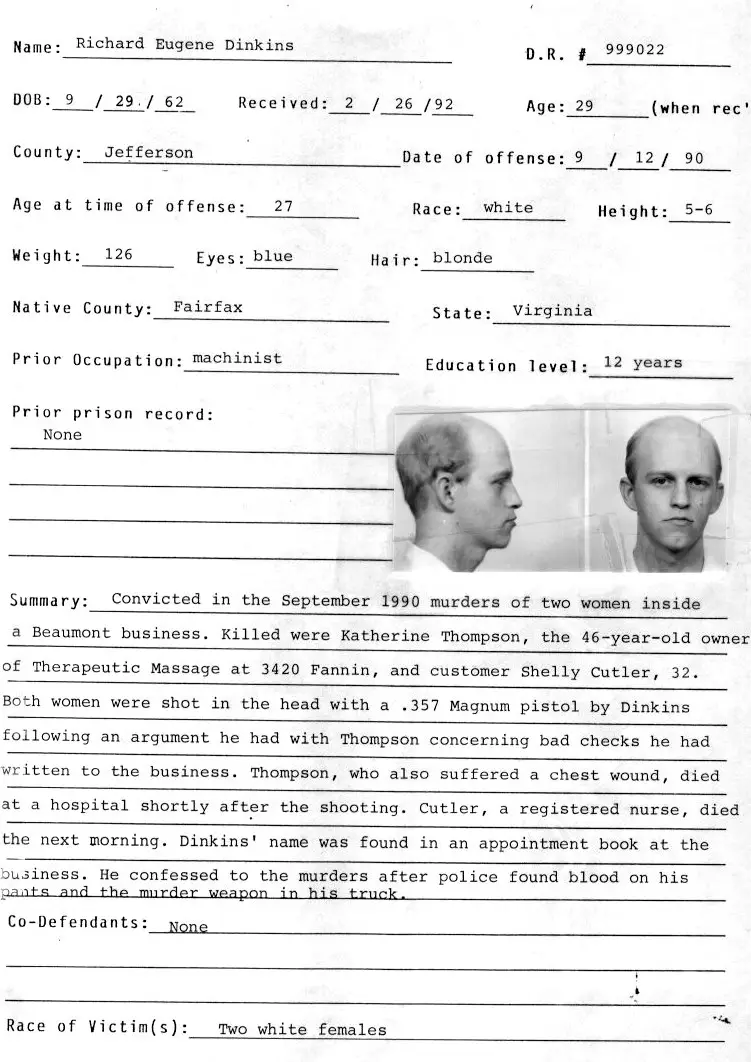
Dinkins was a 27 year old Air Force veteran who went to Thompson's
Massage Therapy Clinic to discuss a bad check he had written earlier.
Dinkins came armed with a .25 caliber handgun and a .357 he had
purchased the day before.
A heated argument ensued between Dinkins and the owner, 46 year old
Katherine Thompson, and when Thompson attempted to push him out the
door, both guns dropped to the floor. Dinkins picked up the .25,
pointed and fired, but it jammed. He then picked up the .357 and
shot Thompson dead.
Cutler, a 32 year old customer and also nurse, ran and locked
herself in an office, but Dinkins shot through a reception window
and the bullet hit her in the head, killing her.
Dinkins name was found in an appointment book and upon arrest,
confessed to the crime. Blood was found on his clothing and the .357
murder weapon was found at his home.
Final Meal:
Liver and onions, two double meat hamburgers with bacon and
mayonnaise, two orders of French fries, vanilla ice cream, two Dr.
Peppers, salad with ranch dressing, and M&M's.
Final Words:
Dinkins declined to make a final statement.
ClarkProsecutor.org
Texas Attorney General
Media Advisory
Friday, January 24, 2003
Richard Dinkins Scheduled to be Executed.
AUSTIN - Texas Attorney General Greg Abbott
offers the following information on Richard Dinkins, who is
scheduled to be executed after 6 p.m. on Wednesday, Jan. 29, 2003.
On Feb. 26, 1992, Richard Dinkins was sentenced
to death for the capital murders of Katherine Thompson and Shelly
Cutler, which occurred in Beaumont, Texas, on Sept. 12, 1990. A
summary of the evidence presented at trial follows:
FACTS OF THE CRIME
Richard Dinkins killed Katherine Thompson and
Shelly Cutler on Sept. 12, 1990, at Thompson's massage therapy
clinic in Beaumont. Both Dinkins and Cutler were clients of
Thompson's, and Dinkins had an appointment that evening to discuss a
bad check he had written to her.
Prior to his appointment with
Thompson, Dinkins placed a .357 revolver and a .25-caliber automatic
handgun in a shoulder sling he wore due to an old injury. He had
purchased the .357 handgun and ammunition a day prior to the offense.
Following a brief discussion about the bad check,
a heated argument took place. Thompson pushed Dinkins toward the
door into the waiting room where Cutler sat.
Dinkins stated that
Thompson struck his injured arm, hurting him. At some point during
the altercation, both handguns fell from Dinkins' sling to the floor.
He picked up the .25 and fired at Thompson but missed. While
attempting to fire again, the gun jammed. Dinkins then picked up the
.357 and shot Thompson in the upper abdomen and then in the head.
Both shots were at close range.
Cutler, who was in the waiting room when the
shooting started , tried to lock herself in Thompson's office.
Dinkins fired through a reception window at Cutler, striking her
once in the top of the head. Dinkins then fled in his vehicle as the
fire alarm sounded.
Thompson suffered two fatal gunshot wounds, one
to her head and one to her abdomen. Cutler died of a single gunshot
wound to the head. A firearms expert testified that slugs recovered
at the crime scene were fired from Dinkins' .357 revolver. An FBI
forensic serologist testified that blood found on Dinkins' blue
jeans was consistent with Thompson's blood type.
PROCEDURAL HISTORY
Dinkins was convicted of capital murder and
sentenced to death in the 252nd District Court of Jefferson County,
Texas, on Feb. 26, 1992.
The Texas Court of Criminal Appeals affirmed
Dinkins' conviction and sentence on Feb. 1, 1995, and the Supreme
Court denied his petition for writ of certiorari on Oct. 2, 1995. On
Nov. 4, 1998, the Court of Criminal Appeals denied his state habeas
petition.
Dinkins then sought federal habeas relief. The federal
district court denied the writ on March 31, 2001. The Fifth Circuit
affirmed on March 28, 2002, and the Supreme Court denied certiorari
on Oct. 7, 2002.
PRIOR CRIMINAL HISTORY
Dinkins has no juvenile criminal history and no
adult incarcerations. He was convicted of theft by a check in 1986,
in Abilene, Texas. He was fined for issuance of bad checks in July
1990, in Lumberton, Texas.
ProDeathPenalty.com
Richard Dinkins killed Katherine Thompson, 46,
and Shelly Cutler, 32, on Sept. 12, 1990, at Thompson's massage
therapy clinic in Beaumont. Both Dinkins and Cutler were clients of
Thompson's at Therapeutic Massage, and Dinkins had an appointment
that evening to discuss a bad check he had written to her.
Prior to
his appointment with Thompson, Dinkins placed a .357 Magnum revolver
and a .25-caliber automatic handgun in a shoulder sling he wore due
to an old injury. He had purchased the .357 handgun and ammunition a
day prior to the offense.
Following a brief discussion about the bad check,
a heated argument took place. Thompson pushed Dinkins toward the
door into the waiting room where Cutler sat. Dinkins stated that
Thompson struck his injured arm, hurting him. At some point during
the altercation, both handguns fell from Dinkins' sling to the floor.
He picked up the .25 and fired at Thompson but missed. While
attempting to fire again, the gun jammed. Dinkins then picked up the
.357 and shot Thompson in the upper abdomen and then in the head.
Both shots were at close range.
Cutler, who was in the waiting room
when the shooting started, tried to lock herself in Thompson's
office. Dinkins fired through a reception window at Cutler, striking
her once in the top of the head. Dinkins then fled in his vehicle as
the fire alarm sounded.
Thompson suffered two fatal gunshot wounds,
one to her head and one to her abdomen. She died at a hospital
shortly after the shooting. Cutler, a registered nurse, died the
next morning of a single gunshot wound to the head.
Dinkins was arrested after his name was found in
an appointment book at the business. He confessed to the murders
after the murder weapon was found in his truck and blood was spotted
on his jeans.
A firearms expert testified that slugs recovered at
the crime scene were fired from Dinkins' .357 revolver. An FBI
forensic serologist testified that blood found on Dinkins' blue
jeans was consistent with Thompson's blood type. Dinkins had no
juvenile criminal history and no adult incarcerations.
He was
convicted of theft by a check in 1986, in Abilene, Texas. He was
fined for issuance of bad checks in July 1990, in Lumberton, Texas.
If Kitty Thompson and Shelly Cutler still were
alive, their work likely would continue to revolve around helping
people, friends and family members said. The 2 women, both nurses,
had known each other only briefly when together they became victims
of Richard Dinkins' bullets.
Dinkins, now 40, is scheduled to be
executed Wednesday for shooting the 2 women to death in Thompson's
Therapeutic Massage offices at 3420 Fannin St. on Sept. 12, 1990. "I
was so angry for so long because she helped so many people," said
Diane Shaffer, a friend of Thompson, who was 46 when she died. That
anger has since been replaced by sadness. "Knowing what Kitty was
all about, it's a little difficult to stay angry at something she
wouldn't have stayed angry about," Shaffer said. "...There's a
person who's now gone who could still be helping people."
In addition to nursing, Thompson worked as a substance-abuse counselor
and massage therapist. The night she died, Thompson left Shaffer's
offices on Fannin Street after a private substance-abuse counseling
session and headed to her massage offices a block away. "The last
thing I remember her saying is 'Lock your doors because there's
crazies around,'" Shaffer said.
But, despite the comment, Thompson
was not a person who lived in fear. "She was an extremely aware
person," Shaffer said. "She was built like a little bulldog." To
succeed in her jobs, Thompson needed, and had, both physical and
mental strength, Shaffer said. "I know when this happened down there
she was given no opportunity to try to diffuse the situation because
she was very confident she could do that with just about anyone,"
Shaffer said.
Dinkins was a 27-year-old assemblies specialist
at American Valve & Hydrant at the time who lived in Sour Lake and
had served in the U.S. Air Force. He had a 6:30 p.m. appointment
with Thompson under a false name.
When he arrived at her office,
they began arguing then physically fighting about money he owed her
for bounced checks from prior appointments, testimony in Dinkins'
1992 trial showed.
Hidden in a shoulder sling, Dinkins had a .25-caliber
pistol and a .357 Magnum that he bought the day before. When the
smaller weapon jammed, he used the .357 Magnum to shoot Thompson in
the head and abdomen and Cutler in the head.
Firefighters found the
two injured women around 8 p.m. when they responded to a smoke alarm
at the office probably tripped by the gun's discharge. Thompson died
before reaching the hospital, and Cutler died the next morning.
Cutler, a 32-year-old traveling nurse who had been in Beaumont only
9 days, was in the office filling out an application for her 1st
appointment with Thompson at 7:30 p.m. Cutler planned to work in
Beaumont for 3 months, then return to Idaho. Cutler loved snow
skiing and worked part-time as a ski instructor, her parents,
Marcille and Larry Cutler of Willow Springs, Mo., said in a
telephone interview this past week. She planned to buy a condo in
Idaho to live in half and rent out the other half, her parents said.
As a traveling nurse, Cutler had worked in Hawaii and South Padre
Island, where she could pursue scuba diving and windsurfing, other
hobbies she loved, while earning more money than she could staying
in one place.
When she left her parents' home for the last time, "she
turned around and said, 'I'll see you guys Christmas,'" her mother
said. "No matter where she was, she'd always be home Christmas," her
father said. "That's probably one of the hardest times for us."
Dinkins has a clemency petition pending with the Texas Board of
Pardons and Paroles but has exhausted all other appeals, said his
attorney, J.D. Hamm of Beaumont. Hamm said he has requested a stay
of execution to explore possible jury misconduct and a change from
the death penalty to a life sentence.
During his post-trial
investigation, Hamm said, two jurors admitted to him that they
considered Dinkins' silence at trial in determining punishment. Hamm
argues that the possible constitutional violation has not been fully
explored during the appeals process.
The board is expected to vote
on the clemency petition early this week. After 12 years of waiting,
Cutler's family members are ready to see the sentence carried out. "None
of us feel resentful," Marcille Cutler said. "We just feel like
justice will be served because we're confident that the trial was a
fair trial.
The evidence was so overwhelming. We felt like he was
guilty and the jury did too. We just feel like this is justice."
Pollie Dean, who supervised Thompson in her substance-abuse
counseling at Beaumont Neurological Hospital, said the approaching
execution date has revived some of the tension and fear that those
who worked near Thompson's offices felt immediately after the
murders. "I believe he deserves it, and I've never been real for or
against the death penalty," Dean said. "But when it hits you
personally and you see the devastation it causes for the entire
family and the entire community ... I wouldn't feel safe with him
being turned back out into the community. It is, I think, what
prisons are made for and the death penalty is made for."
UPDATE: Before he was executed, Richard Dinkins
declined to make a final statement, responding to the warden, "No
sir" when asked if he wanted to say anything. In a written statement,
however, he asked for forgiveness and expressed regrets. "I am sorry
for what happened and that it was because of me that they are gone,"
he said. "If there were any way I could change things and bring them
back I would. But I can't." Dinkins accepted responsibility for the
damage his actions caused but said he had made peace with God and
hoped that "soon everyone will be able to have closure in their
hearts and lives." Last week Dinkins said, "It was my fault. I guess
you just say -- stupidity. I can't be bitter," he said. "I'm the one
who put myself in this situation."
Texas Execution Information
Center by David Carson
Txexecutions.org
Richard Eugene Dinkins, 40, was executed by
lethal injection on 29 January 2003 in Huntsville, Texas for the
murder of two women in a place of business.
On 12 September 1990, Dinkins, then 37, entered a
massage clinic where he had been a customer. He got into an argument
with the owner, Katherine Thompson, 46, over some bad checks he had
written to the business.
According to Dinkins, during the argument,
Thompson pushed him, aggravating an old injury on his arm. A .25-caliber
semiautomatic pistol fell from his clothing. Dinkins grabbed the
pistol from the floor, fired at Thompson, and missed.
When he tried
to fire a second time, the gun jammed. Dinkins then drew a .357
Magnum revolver from his boot. He chased after Thompson and shot her
twice -- first in the upper abdomen, then in the head. Next, Dinkins
went after customer Shelly Cutler, 32, who was sitting in the
waiting room when the argument started.
Cutler ran into Thompson's
office and tried to lock herself in, but Dinkins shot at her through
a window, hitting her in the head. The gunsmoke set off a fire alarm,
and Dinkins fled. Emergency workers responding to the alarm found
both women seriously wounded. Thompson died shortly after her
arrival at the hospital. Cutler died the next morning.
Dinkins' name was found in an appointment book at
the business. He confessed to the murders after police found blood
on his pants and the murder weapon in his truck. At this trial, a
firearms testified that the slugs recovered from the crime scene
matched Dinkins' revolver. A forensics expert testified that the
blood found on Dinkins' jeans was consistent with Thompson's blood
type.
Dinkins was a habitual bad check writer, with two
prior convictions. He had no record of violence and had never been
incarcerated.
A jury convicted Dinkins of capital murder in
February 1992 and sentenced him to death. The Texas Court of
Criminal Appeals affirmed the conviction and sentence in February
1995.
All of his subsequent appeals in state and federal court were
denied. In a death-row interview the week before his execution,
Dinkins said that the gun "just went off" during the struggle with
Thompson. Then, "I saw someone out of the corner of my eye after Ms.
Thompson was shot, and I heard the door rattling," Dinkins said. "I
didn't know who was in there. I could see someone with something in
their hand. I shot at the door knob to keep whoever was back there
from coming out. I didn't know I hit her. It looked like they had
ducked." Though Dinkins denied that he intended to kill the women,
he accepted responsibility for his actions. "It was my fault ... I
can't be bitter," he said. "I'm the one who put myself in this
situation."
Dinkins did not make a last statement at his
execution. He did, however, leave a written statement in which he
apologized to the Thompson and Cutler families. "I am sorry for what
happened and that it was because of me that they are gone," he wrote.
"If there were any way I could change things and bring them back, I
would." He was pronounced dead at 6:18 p.m.
Man Executed for 1990 Murders
By Mark
Passwaters -
The Huntsville Item
January 29, 2003
A Jefferson County man sentenced for killing two
women in 1990, was executed Wednesday night in the death chamber of
the Huntsville "Walls" Unit. Richard Dinkins, 40, is the fifth man
to be put to death in Texas this year.
Dinkins, who had admitted his guilt in the
murders of Katherine Thompson, 46, and Shelly Cutler, 32, did not
make a final statement before the lethal dose of chemicals was
started at 6:11 p.m. He was pronounced dead seven minutes later.
He did, however, write a final statement in which apologized to the
families of Cutler and Thompson. "I am sorry for what happened and
that it was because of me that they are gone," he wrote. "If there
were any way I could change things and bring them back, I would. But
I can't. Because of what I caused to happen many people were
affected and I am very sorry that it did."
As the lethal dose was administered, Dinkins
gasped three times, snorted, and was silent. His cousin, Lisa Smith,
began to cry shortly after Dinkins lost consciousness. Jim Smith, a
spiritual advisor, comforted Dinkins' brothers by saying, "He made
his peace with God. He's not in prison anymore, boys." Dinkins, who
had a history of writing bad checks, arrived at Thompson's
therapeutic massage parlor in Beaumont on the afternoon of Sept. 12,
1990, to discuss a bad check he had written to the business. When
the meeting turned confrontational, Dinkins shot Thompson and Cutler,
another customer, with a .357-caliber revolver.
At a press conference after the execution, Mike
Thompson, Katherine Thompson's son, said he was pleased Dinkins'
sentence had been carried out. "I never hated the man, (but) he took
my mother," he said. "I just wanted to make sure the same happened
to him ... justice was done." Thompson said it made no difference
how his mother died and how Dinkins' sentence was carried out. "Death
is death," he said. "The punishment fit the crime. I came here to
make sure he got what was coming to him."
The next scheduled execution is tonight, when
Granville Riddle is scheduled to be put to death for the 1988 murder
of a man in Amarillo.
National Coalition to Abolish
the Death Penalty
Richard Dinkins (TX) - Jan. 29, 2003
The state of Texas is scheduled to executed
Richard Dinkins, a white man, Jan. 29 for the 1990 murders of
Katherine Thompson and Shelly Cutler in Beaumont. Dinkins, a patron
at Therapeutic Massage, allegedly shot the two women amidst an
argument with Thompson, the owner, over some checks he had written
to the business. Investigators found his name in an appointment book,
and later found blood on his pants and the murder weapon in his
trunk.
After his apprehension, Dinkins agreed to give a
statement confessing to the murders, as long as he could explain his
struggles with severe stress in the process. He told authorities
that a recent break-up of a personal relationship, in conjunction
with harassment at work, had caused him considerable stress. He
worked as an assembly specialist at American Valve and Hydrant, and
claimed his employer wanted to fire him because of his shoulder
injury.
He had serious financial difficulties as well, which only
added to his problems. As for the crime itself, he claimed he
engaged in a slight altercation with Thompson, and his gun, which
was inside his sling, fell to the floor. He then grabbed it, but
remembered nothing from then until the time when the fire alarm went
off.
Dinkins visited Therapeutic Massage in an attempt
to deal with his stress issues, but apparently the treatment was
insufficient. Prior to the incident, he had no history of violence,
and friends and co-workers generally described him as “gentle” and “mild-mannered.”
Furthermore, Dinkins had served as a very productive member of
society before the crime; the Texas Employment Commission knew him
as a “hero” for having subdued a man assaulting a TEC employee.
Dinkins’ most recent appeal included a request
for forensic DNA testing of evidence containing biological material.
Considering Dinkins’ condition at the time of the crime, as well as
the fact that numerous death row inmates in the past have confessed
to crimes they did not commit, the courts should grant this request
before proceeding with this execution. Since the reinstatement of
capital punishment in the United States in 1976, 102 people have
been exonerated from death row due to actual innocence. The risks in
rushing to execute Dinkins are clearly not worth the possible
consequences.
Above it all, this case has too many mitigating
factors to end in an execution. Gov. Rick Perry should weigh the
circumstances and commute Richard Dinkins’ death sentence to life in
prison. Please write the state of Texas and protest this execution.
Convicted Killer of Two Nurses Executed
Houston Chronicle
AP January 29, 2003
HUNTSVILLE - A former machinist who wrote bad
checks to pay for massage treatment at a Beaumont clinic was
executed tonight for gunning down the clinic owner and another woman
there nearly 12 1/2 years ago. Richard Dinkins declined to make a
final statement, responding to the warden, "No sir" when asked if he
wanted to say anything.
In a written statement, however, he asked for
forgiveness and expressed regrets "I am sorry for what happened and
that it was because of me that they are gone," he said. "If there
were any way I could change things and bring them back I would. But
I can't." Dinkins accepted responsibility for the damage his actions
caused but said he had made peace with God and hoped that "soon
everyone will be able to have closure in their hearts and lives."
Dinkins gasped twice as the lethal drugs began
taking effect and was pronounced dead seven minutes later at 6:18
p.m. Dinkins was the fifth Texas inmate to receive lethal injection
this year and the second of three on consecutive evenings this week.
A smoke alarm brought emergency workers to the
massage therapy clinic. When they arrived, instead of discovering
evidence of a fire, they found the two fatally wounded women.
Dinkins, 40, contended his gun "just went off" during a struggle
that left clinic owner and nurse Katherine Thompson, 44, dead.
Prosecutors say the shooting moments later of the second woman,
Shelly Cutler, 32, convinced them and jurors that Dinkins should go
to death row. "The thing that stands out is the murder of the second
victim," said Paul McWilliams, who prosecuted Dinkins for the double
slaying Sept. 12, 1990. "That's not to diminish in any way what
Katherine Thompson went through, but I guess it's one thing to know
that someone is trying to kill you."
Evidence showed Cutler, an Idaho-based traveling
nurse who was filling out paperwork as a prospective patient when
gunfire erupted, ran to an office, closing the door behind her. "We
believe she was trying to call 911, and he reached through the
window and shot her," McWilliams said. "What she must have gone
through!" "I saw someone out of the corner of my eye after Ms.
Thompson was shot and I heard the door rattling," Dinkins said last
week, speaking from a steel-doored cage outside death row. "I didn't
know who was there. I could see someone with something in their hand.
"I shot at the door knob to keep whoever was back there from coming
out. I didn't know I hit her. It looked like they had ducked."
Dinkins then fled, and the smoke from the gunfire
was believed to have tripped the fire alarm. "When I left there, it
was all a blank," he said.
Detectives found Dinkins' name in Thompson's
appointment book. He had been a patient but paid Thompson with bad
checks. Dinkins contended he went to the clinic to resolve the check
dispute but an argument erupted, the two wrestled and his .25-caliber
pistol, hidden in a sling over his arm, fell out. "She grabbed and I
reached, too," he said last week. "I probably scared her. It just
went off. I wasn't thinking right, I'm sure."
The gun then jammed but he said he had another
pistol, a .357-caliber Magnum, concealed in a boot. Both women were
shot in the head with the larger weapon. Thompson died shortly after
the shooting. Cutler, who had been in Beaumont only nine days, died
the following day.
Dinkins lived in nearby Sour Lake and worked as a
machinist for a company that made fire hydrants and water valves. He
confessed to authorities. "It was my fault," Dinkins said last week.
"I guess you just say -- stupidity." Police matched his gun to the
killings and blood on his clothing to the victims. "I can't be
bitter," he said. "I'm the one who put myself in this situation."
Deathrow.at
Executed January 29, 2003
The state of Texas is scheduled to executed
Richard Dinkins, a white man, Jan. 29 for the 1990 murders of
Katherine Thompson and Shelly Cutler in Beaumont. Dinkins, a patron
at Therapeutic Massage, allegedly shot the two women amidst an
argument with Thompson, the owner, over some checks he had written
to the business.
Investigators found his name in an appointment
book, and later found blood on his pants and the murder weapon in
his trunk.
After his apprehension, Dinkins agreed to give a
statement confessing to the murders, as long as he could explain his
struggles with severe stress in the process. He told authorities
that a recent break-up of a personal relationship, in conjunction
with harassment at work, had caused him considerable stress.
He
worked as an assembly specialist at American Valve and Hydrant, and
claimed his employer wanted to fire him because of his shoulder
injury. He had serious financial difficulties as well, which only
added to his problems. As for the crime itself, he claimed he
engaged in a slight altercation with Thompson, and his gun, which
was inside his sling, fell to the floor. He then grabbed it, but
remembered nothing from then until the time when the fire alarm went
off.
Dinkins visited Therapeutic Massage in an attempt
to deal with his stress issues, but apparently the treatment was
insufficient. Prior to the incident, he had no history of violence,
and friends and co-workers generally described him as “gentle” and “mild-mannered.”
Furthermore, Dinkins had served as a very productive member of
society before the crime; the Texas Employment Commission knew him
as a “hero” for having subdued a man assaulting a TEC employee.
Dinkins’ most recent appeal included a request
for forensic DNA testing of evidence containing biological material.
Considering Dinkins’ condition at the time of the crime, as well as
the fact that numerous death row inmates in the past have confessed
to crimes they did not commit, the courts should grant this request
before proceeding with this execution. Since the reinstatement of
capital punishment in the United States in 1976, 102 people have
been exonerated from death row due to actual innocence. The risks in
rushing to execute Dinkins are clearly not worth the possible
consequences.
Above it all, this case has too many mitigating
factors to end in an execution. Gov. Rick Perry should weigh the
circumstances and commute Richard Dinkins’ death sentence to life in
prison. Please write the state of Texas and protest this execution.
Richard Dinkins # 999022
Polunsky Unit
3872 FM 350 South
Livingston, Texas 77351