Murderpedia has thousands of hours of work behind it. To keep creating
new content, we kindly appreciate any donation you can give to help
the Murderpedia project stay alive. We have many
plans and enthusiasm
to keep expanding and making Murderpedia a better site, but we really
need your help for this. Thank you very much in advance.
Robert Rubane
DIAZ
Classification:
Serial killer
Characteristics: Poisoner - Coronary care
nurse
Number of victims: 12
Date of murders: March-April 1981
Date
of arrest:November 24,
1981
Date of birth: 1938
Victims profile: Men and women ranging in age from 52 to
89 (hospital patients)
Method of murder: Poisoning(overdoses of the drug Lidocaine)
Location: Riverside County, California, USA
Status: Sentenced to death on April 11,1984. Died in prison on August 9, 2010
Robert Diaz had always
proclaimed to want to be a doctor. He eventually settled for nursing.
This apparently wasn't a powerful enough position for Diaz. In April of
1981 an anonymous call was placed to the San Bernadino County coroner
claiming that Diaz had possibly killed as many as 19 persons at a
hospital in Perris, California. An investigation was immediately begun
and it wasn't long before it was obvious that Diaz was responsible for
the deaths.
Diaz had been the nurse on
duty when all the patients died, which was only a 12 day period. He
repeatedly predicted the time that some patients would die, almost
precisely. He was even witnessed giving some of the same patients
injections prior to their death. Medical records of some of the
intensive care patients were missing, and Diaz had access to these
records. He worked just one night at San Gregorio Pass Hospital but a
patient had died there that night under the same circumstances as the
victims in the Perris Community Hospital.
Diaz was arrested in
November of 1981 and charged with the deaths of twelve patients. His
trial did not take place until March 1984. Samples taken from exhumed
bodies showed overdoses of the drug Lidocaine, which was also found in
Diaz' home along with syringes and quantities of morphine. He was easily
convicted on March 29, 1984 and sentenced to die.
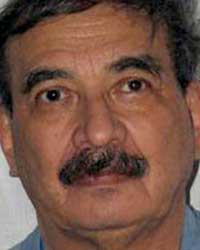
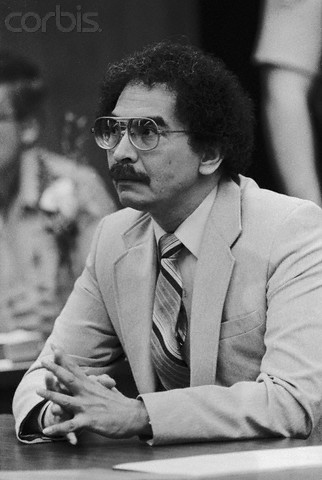
Robert Rubane Diaz
(born 1938), also known as David Robert Diaz, is an American nurse who
was sentenced to death in 1984 for the murders of 12 hospital patients.
He is currently still on death row.
Early
years
Robert Rubane Diaz was born in 1938 and raised in the
Midwest. One of 13 children, he was ill often as
a child, which kept him out of school. Unable to finish school, he
dropped out after completing 10 grades and joined the United States
Marine Corps at age 18. After going AWOL for six weeks, he was
discharged due to his inability to acclimate to military life.
Adulthood
Pursuing his childhood dream of working in the
medical field, Diaz joined a vocational nursing program and insisted
that his relatives call him "Dr. Diaz". He also
believed that he was an Egyptian mystic who had been a member of royalty
in a former life.
He was married in 1961 and divorced in 1972.
Crimes
In early 1981, Community Hospital of
the Valleys in Perris, California experienced an abnormally large number
of deaths among its most elderly patients. To gather evidence, the
coroner exhumed or intercepted all the patients who had recently died
and he collected tissue samples from them. The coroner found that 11
patients had a supposedly lethal level of the heart drug lidocaine in
their system. Investigators focused on Diaz, a male nurse, who worked at
the hospital during many of the deaths. They also investigated his
previous employment and came up with a 12th patient from another
hospital whose exhumed body showed a supposedly lethal level of
lidocaine.
High levels of lidocaine were not necessarily
indicative of poisoning, as hospital staff often used the drug on its
patients. There was no direct evidence against Diaz. No one had seen him
inject a patient with a fatal dose of anything. He had no apparent
motive to kill anyone. A syringe filled with an especially high solution
of lidocaine was found hidden in the Valleys hospital seven months after
it closed.
Following his arrest, numerous pre-filled lidocaine
syringes were found in Diaz’ home. At least two of these syringes
contained 20 percent solutions of lidocaine while marked as two percent
(i.e. 10 times the concentration marked). Also found in his home were
vials of 20 percent lidocaine and empty syringes, implying that syringes
were being refilled with higher concentration than their labels
indicated. Diaz explained only that these articles were mistakenly taken
from the hospital when absent mindedly left in his shirt pocket. No
explanation was given for the apparent tampering.
Diaz claimed the ability to predict patient seizures
and encouraged coworkers to take meals/breaks early in anticipation of
seizures that shift. In at least one case the predicted seizures did
occur. According to his wife, Diaz also spent time staring at the family
cat trying to control it with his mind.
Investigators from the public defender’s office found
that the hospital’s care was lax. Employees were
often unable to read heart monitors and other basic equipment. Doctors
often failed to respond to emergencies. During the deaths Diaz
reportedly blamed the doctors who showed up late.
It was not unusual for Code Blue
alerts to occur nightly and these were not limited to Diaz’ employment
tenure. However it was noted during the trial that the death rate at
Community Hospital of the Valleys was less than one per month during the
12 months prior to hiring Diaz. During the 3 ½ weeks following Diaz’
employment there were 17 deaths; 14 of these patients were under Diaz’s
direct care at the time of seizure and death. This is a monthly death
rate of 19.43 per month.
Following standard procedures, Diaz’ defense would be
extraordinarily costly to the cash strapped public defender’s office. A
new administrator fired all the investigators and implemented a budget
defense for Diaz. At trial, Diaz’ defense
motioned for a bench trial.
The judge convicted Diaz of 12 counts of first-degree
murder. At sentencing the defense failed to present a single character
witness; his five children and his wife did not make an appeal. Diaz’s
wife believes her husband was responsible based on the evidence
presented as well as her personal experiences with him. Initially,
however, she supported her husband. The defense’s short plea for mercy
was that Diaz had saved the state a considerable amount of money. The
judge was not impressed and sentenced Diaz to die by either the gas
chamber or lethal injection.
Diaz has since exhausted his state appeals, but in
1998 a federal judge granted him an evidentiary hearing. As of 2007,
Diaz remains on death row at San Quentin State Prison.
Supreme Court
Decision
The trial became a constitutional test case heard by
the United States Supreme Court when The Press Enterprise newspaper, of
Riverside, California, was denied their request for the transcripts of
pretrial hearings. The case, Press-Enterprise Co. v. Superior Court
of Riverside County, California, was won by the newspaper in 1986.
At the beginning of the trial Diaz had requested that
the public be excluded from preliminary hearings. The Magistrate granted
the unopposed request because of the national attention that the case
had garnered. At the end of the hearings the Press-Enterprise requested
that the transcripts be released, but the request was denied and the
records were sealed. The United States Supreme Court decided that the
public has the right to witness pretrial hearings in criminal cases,
including preliminary hearings.
Wikipedia.org
'Angel of Death' dies in prison
By Richard K. De Atley - The Press-Enterprise
August 11, 2010
Robert R. Diaz, the "Angel of Death" nurse convicted
of killing a dozen of his patients in Riverside County, died of natural
causes Wednesday, 26 years after he was sent to San Quentin's Death Row.
He was 72.
Mr. Diaz died at a community hospital near the prison,
California Department of Corrections and Rehabilitation spokeswoman
Terry Thornton said. He had a lengthy illness. No other details were
released.
In an era of bizarre serial killing cases in
California, Mr. Diaz's was one of the most unusual. His victims, ages 52
to 95, all had to be exhumed; he shunned a jury trial on his attorney's
advice; and a challenge to his closed-to-the-public preliminary hearing
resulted in a major First Amendment decision by the Supreme Court.
Patrick Magers, a retired Riverside County Superior
Court judge who was the prosecutor in Diaz's case, said the case began
when officials at what was then Community Hospital of the Valley in
Perris had a cluster of patient deaths in 1981.
"They realized something was very, very, very wrong,"
Magers said. The officials contacted the coroner's office, which in turn
talked to the district attorney's office. The investigation grew to
other care facilities. Eventually 38 bodies were exhumed.
Tissue from the bodies was sent to a lab in Utah,
which worked on analyzing the samples for three months, Magers recalled.
The conclusion was 12 of the patients died from a
huge overdose of the drug lidocaine, a heart muscle relaxant. And
further investigation showed that the nurse on duty when each of the
patients died was Robert Rubane Diaz, Magers said.
"We are not talking about a therapeutic misadventure,"
Magers recalled in a phone call interview from Florida. "We are talking
about a huge amount of lidocaine -- 1,000 to 2,000 milligrams. The
average dose is 100 milligrams. So the victims received one injection
that was 10 to 20 times higher than any injection should have been."
The Trial
Diaz was charged with killing 12 patients, 11 from
Community Hospital and one from San Gorgonio Pass Memorial Hospital in
Banning. Magers said a 13th victim who died in a San Bernardino hospital
when Mr. Diaz was in attendance was used in the trial to establish a
pattern in the slayings, but was not charged as a murder.
Mr. Diaz testified at the trial.
"I cross-examined him for two days at trial and he
denied any wrongdoing," Magers recalled. "He testified he gave the
proper medication to his patients and had no explanation of how or why
they had massive doses of lidocaine injected into their systems."
Mr. Diaz was convicted by Judge John Hawkins Barnard,
who sentenced him to death. After Barnard died in 2006, his wife said
the jurist spent a week taking walks along the beach and pondering the
sentence before handing it down.
"I can't tell you how many thousands of hours we put
into that case," said Magers, who led the investigation leading up to
the prosecution. Because of the case's unusual origin, all the inquiry
was done by district attorney and coroner's investigators, he recalled.
Mr. Diaz's conviction and sentence was upheld by the
California Supreme Court. He claimed the case against him was largely
circumstantial and that he was given bad advice by his public defender
attorney to have a non-jury hearing.
Since California reinstated the death penalty in
1978, 51 death-row inmates have died from natural causes, 17 committed
suicide, 13 were executed in California and one was executed in
Missouri. Five have died from other causes and one cause of death is
pending. Of the 706 inmates on death row, 68 are from Riverside County.
Landmark case
Mr. Diaz's preliminary hearing was closed to the
public. Magers said he was concerned about publicity leading to a
successful change of venue motion.
The Press-Enterprise newspaper filed a lawsuit
challenging the shutdown of the 41-day hearing. The sealed transcript of
the hearing was eventually released, but the Supreme Court said the
issue still had merit for review.
In what became a landmark ruling, U.S. Supreme Court
Chief Justice Warren Burger ruled in a 7-2 decision in 1986 that those
who seek to close courtrooms or deny the public and press access to the
criminal justice system must meet a high standard to overcome the
presumption of openness.
"It was a very important case," said retired Press-Enterprise
managing editor Mel Opotowsky on Wednesday. "It said for any criminal
proceedings, even if it wasn't a trial, the public had a constitutional
right to be there, and to override that a judge had to have substantial
evidence that it could cause harm to the defendant. It's been cited
hundreds of times over the years."
The case is known as Press-Enterprise II, the numeric
reference to Press-Enterprise I, another key U.S. Supreme Court case won
by the paper in 1984 that allowed public access to examination of
potential jurors.
Information released Wednesday gave no survivors or
other background about Mr. Diaz.
A 2007 New York Times Magazine article identified a
son, Matthew Diaz, and said Matthew also had an older sister and two
younger brothers who were Robert Diaz's children.
The article said Matthew Diaz, while a lieutenant
commander in the United States Navy, was convicted and imprisoned for
insubordination when in 2005 he surreptitiously handed over to the
Center for Constitutional Rights the names and prison serial numbers for
551 men who were then being held by the United States at Guantanamo Bay.
Diaz, Robert R.
One of thirteen children, born and raised in the Midwest, Robert Diaz was frequently ill during childhood, completing only ten years of formal education.
He joined the Marine Corps at age eighteen, then went AWOL for six weeks and was discharged soon after his return to duty.
Married in Jacksonville, Florida, during 1961, he was divorced in 1972. By that time, Diaz had decided to act on his long-standing desire for a medical career, and after the divorce he enrolled in a school for vocational nurses. At family gatherings thereafter, he insisted that the children introduce him to their friends as ''Dr. Diaz."
By early 1981, Diaz was working his way through a series of temporary nursing jobs in several Southern California hospitals.
Coincidentally administrators noted that their older patients had begun to die in record numbers; by the end of April, there were 30 suspicious deaths on file in Los Angeles County, with an equal number spread over Riverside and San Bernadino Counties.
Autopsies revealed high levels of lidocaine -- a drug used to control irregular heartbeats -- in most of the corpses. While normal readings should have indicated 50 to 100 milligrams of lidocaine, the recent dead showed levels of 1,000 milligrams and more -- enough to bring on cardiac arrests instead of saving lives.
A search for common links between the victims demonstrated that a single nurse -- Diaz -- had worked at each and every institution where abnormal death rates, were recorded.
Attention focused on Diaz after the death of Estel Jones, age 62, at Chino Community Hospital. First ascribed to "natural causes," her death was later ruled a homicide, and officers began examining the high mortality rate on Diaz's graveyard shift.
A search of the suspect's home turned up bottles of lidocaine, but charges of illegal drug possession were later dismissed. Diaz fired back with multimillion-dollar lawsuits charging defamation of character and civil rights violations, but skeptical judges dismissed each in turn.
The investigation rolled on, detectives examining fifty deaths, finally narrowing their sights to a dozen where evidence seemed incontrovertible.
On November 24, 1981, Robert Diaz was arrested on twelve counts of first-degree murder: eleven victims, ranging in age from 52 to 89, were killed at Community Hospital of the Valleys, in Perris, California, between March 30 and April 22, 1981; the twelfth, a 79-year-old man, died of a lidocaine overdose at San Gorgonio Pass Memorial Hospital, in Banning, on April 25.
Diaz entered his formal plea, innocent on all counts, at the end of September 1982.
His trial was scheduled to open in March 1983, but various postponements delayed the event until Halloween. Waiving his right to a jury trial, Diaz placed his fate in the hands of a judge, who convicted him on all counts on March 29, 1984.
Two weeks later, on April 11, Diaz was sentenced to die in the gas chamber at San Quentin.
Michael Newton - An Encyclopedia of
Modern Serial Killers - Hunting Humans
Robert Diaz
Coronary-care nurse Robert
Diaz was accused of killing 12 elderly patients with lethal doses of a
heart drug in March and April of 1981. In 1984, he was convicted of
murdering 11 patients at the Community Hospital of the Valleys in
Perris, Calif., and one patient at San Gorgonio Pass Memorial Hospital
in Banning, Calif. He received the death penalty and is on death row at
San Quentin. He
maintains he is innocent.
Nurse sentenced to
die in slayings
The New York Times
April 12, 1984
A nurse convicted of killing 12 elderly
patients with overdoses of a heart-regulating drug was sentenced today
to die in the gas chamber.
The coronary care nurse, Robert Rubane Diaz,
46 years old, received the sentence from Judge John H. Barnard of
Superior Court with little show of emotion.
On March 29, Judge Barnard found Mr. Diaz
guilty of the killings at two Riverside County hospitals in 1981. The
verdict ended a five-month nonjury trial in which prosecutors asserted
that Mr. Diaz had murdered elderly patients in his care by injecting
them with lidocaine, a powerful drug used to control irregular
heartbeats.
Judge Barnard based the sentence on a
finding of special circumstances under a state multiple-murder rule.
Mr. Diaz was arrested Nov. 23, 1981, after
an investigation into the mysterious deaths of several elderly patients
at the Community Hospital of the Valleys in Perris and the San Gorgonio
Pass Memorial Hospital in Banning. Eleven of the 12 deaths occurred at
the Perris facility in March and April 1981.
Autopsies Determined Cause
Investigators determined through autopsies
that the patients were homicide victims and that the bodies contained
more than 1,000 milligrams of lidocaine at the time of death. A normal
dose ranges from 50 to 100 milligrams.
Prosecuting attorneys had argued that Mr.
Diaz, who worked as a temporary nurse on the night shifts at both
hospitals, was the only link between the two facilities' intensive care
units at the time.
''We feel justice was served,'' said Patrick
Magers, a Deputy District Attorney who prosecuted the case, in which the
state never established a motive. ''How many lives can you take without
facing the penalty of losing your own? He was placed in a position of
trust, and violated it in the most appalling way.''
The sentence will automatically be appealed
to the State Supreme Court, and Mr. Diaz's attorneys plan to file a
motion for a new trial. ''I wasn't surprised by the verdict, and I don't
think Mr. Diaz was either,'' said Michael Lewis, a public defender. ''We
had hoped for better. I think he had already reconciled himself to the
outcome.''
Diaz Had Predicted Trouble
At the trial, defense attorneys sought to
support Mr. Diaz's assertions that he was not guilty by arguing that the
buildup of lidocaine in the patients' systems could have been brought
about by therapeutic doses administered over a period of time. John L.
Lee, the chief defense attorney, and Mr. Lewis asserted there was no
evidence the drug had been administered all at once.
But testimony given by nurses who were on
duty at the time of the deaths indicated that Mr. Diaz had predicted
some of the victims would have problems shortly before they began
exhibiting lidocaine-overdose symptoms, which included dizziness,
violent seizures and blueness in the face and extremities.
Lynn Race, a critical-care nurse at the
Perris hospital, testified Mr. Diaz had foreseen patients' sudden
medical problems and had carried medical syringes and vials in his
pockets, a violation of hospital procedure.
The original investigation in the case had
been based on the unusual pattern of deaths among elderly patients in
Los Angeles, Orange and Riverside Counties. Investigators said as many
as 50 patients might have been involved, but said evidence allowed them
to formally charge Mr. Diaz in the deaths of 12.
SEX:M RACE: H TYPE: T MOTIVE: PC
MO: Male nurse; killed patients
age 52-89 by injection.
IN THE MATTER OF ROBERT RUBANE
DIAZ, APPELLANT, v.
LESLIE LUKASH, &C., RESPONDENT.
November 16, 1993
KAYE, CHIEF JUDGE:
On this appeal, we must decide whether petitioner, an
inmate on California's death row, has a "substantial interest" in
certain records of the Nassau County Medical Examiner, so that he may
inspect them. We conclude that the Appellate Division applied an
erroneous legal standard and that in the circumstances presented,
petitioner does have a substantial interest, as a matter of law, in at
least some of the requested records. Accordingly, we reverse dismissal
of the petition and remit for further proceedings.
I.
In March 1981, Robert Rubane Diaz, a registered
nurse, began work on the night shift in the intensive care unit (ICU) of
a community hospital in California. In the next three and one-half weeks,
at least 13 patients on the night shift suffered violent seizures, which
were generally followed by cardiac and respiratory arrest. Nine of these
patients died. Following closure of the ICU at that hospital, Diaz began
work at a different hospital and within three days, while he was on duty,
another patient, displaying the same symptoms, died. Diaz was thereafter
arrested and charged with killing a total of 12 patients by injecting
them with massive doses of lidocaine, a drug commonly used to control
rhythm disturbances in the heart (People v Diaz, 834 P2d 1171,
1176 [Cal 1992], cert denied ___ US ___, 113 S Ct 1356 [1993]). Diaz
waived a jury trial, and after a bench trial was convicted and sentenced
to death.
At trial, experts testifying for the prosecution
relied largely on three types of evidence to conclude that each of the
12 patients--at least 11 of whom received therapeutic doses of lidocaine-
-died of a massive overdose: first, the concentration of lidocaine in
their body tissue upon autopsy; second, the evidence of seizures; and
third, electrocardiograph (EKG) readings (834 P2d at 1185-1187). On
appeal to the California Supreme Court, Diaz attacked the sufficiency of
this evidence. Although concluding that there was sufficient evidence to
support the trial court's finding that someone had administered large
overdoses of lidocaine to the patients (834 P2d at 1188), the court's
opinion suggests that the evidence was not beyond dispute.
As the court noted, for example: "Although
recorded cases involving massive overdoses of lidocaine are rare,
prosecution experts, after reading the scanty literature on the subject,
concluded that these [seizure] symptoms * * * would be the most likely
response to a massive overdose of lidocaine." And responding to Diaz's
argument that the EKG readings were inconclusive: "although the
possibility of other causes may reduce the weight to be attached to the
evidence that the patients had broad QRS complexes [on their EKGs], this
evidence was one link in the circumstantial chain of evidence that the
patients died from overdoses of lidocaine, and was properly relied upon
by the prosecution experts." (834 P2d at 1187.)
The lidocaine concentration in the patients' body
tissues was thus important evidence of causation, but the significance
of that evidence, too, "was hotly contested at trial" (834 P2d at 1187).
Following Diaz's conviction, his appellate counsel
learned of an unpublished doctoral dissertation titled "Lidocaine
Toxicity," authored in 1981 by W. Christopher Long, a graduate student
at St. John's University. Long was at the time a toxicologist with the
Nassau County Medical Examiner's office, and based his dissertation on
measurements of lidocaine found in brain tissue of more than 140
decedents autopsied between 1976 and 1981. Twenty-four had brain tissue
concentrations of 20 mcg./gram or greater--an amount (according to the
petition) the prosecution had claimed at trial was indicative of a
lethal dose. Thus, Diaz argues, either these 24 were also victims of
lethal doses of lidocaine or the prosecution expert testimony was
seriously flawed.
Because the Long dissertation identified patients not
by name but only by Nassau County Medical Examiner case number, in the
present petition Diaz seeks access to the Medical Examiner's records to
help establish his factual innocence. After reviewing the records to
determine the identity and hospital of each decedent, Diaz's
representatives will then attempt to obtain the decedents' hospital
records to learn the exact dose of lidocaine administered and other
variables such as the patient's clinical condition and weight. After his
experts (including Long) synthesize the information in the dissertation,
autopsy reports and hospital records, Diaz intends to seek post-conviction
relief on the ground that "newly-discovered evidence" establishes no
murders occurred.
The petition before us, brought under
County Law § 677(3)(b) and CPLR article 4, involves only the Medical
Examiner's records. (We express no view on the availability of hospital
records.) In this litigation Diaz has disavowed any interest in the
decedents' names, expressing willingness to accept redacted records and
suggesting that disclosure can be coordinated with the hospitals in such
a way that he will never learn the patients' identities. Moreover,
apparently recognizing the substantial administrative burden his request
entails, Diaz has also offered to pay for the costs associated with
searching for, redacting and copying the records.
Supreme Court dismissed the petition, concluding that
Diaz had "not demonstrated that his interest in the records is
sufficiently substantial to overcome the general need to maintain the
confidentiality of the records of the Medical Examiner." The Appellate
Division affirmed, noting that Diaz had "no direct and personal interest
with respect to the individuals whose records he seeks" and that
disclosure would undermine "the legislative concern for confidentiality,
as reflected in the statute." (__ AD2d ___). We granted Diaz's motion
for leave to appeal, and now reverse.
II.
With reference to autopsy reports, County Law § 677
(3)(b) provides:
Such records shall be open to inspection by the
district attorney of the county. Upon application of the personal
representative, spouse or next of kin of the deceased to the coroner
or medical examiner, a copy of the autopsy report, as described in
subdivision two of this section shall be furnished to such applicant.
Upon proper application of any person who is or may be affected in a
civil or criminal action by the contents of the record of any
investigation, or upon application of any person having a substantial
interest therein, an order may be made by a court of record, or by a
justice of the supreme court, that the record of that investigation be
made available for his inspection, or that a transcript thereof be
furnished to him, or both (emphasis added).
The statute thus identifies four
categories of persons who may obtain access to autopsy reports. The
district attorney and close relatives of the decedent may obtain records
as of right, while persons who "may be affected in a civil or criminal
action" or anyone else with a "substantial interest" in the records,
must make judicial application. Diaz seeks release of the records as
someone with a "substantial interest" in them.
The legal question before us is whether an applicant
under that provision must have a "direct and personal interest" in the
autopsy reports, as suggested by the Appellate Division, and if not,
whether the circumstances presented establish a substantial interest as
a matter of law.
By creating a residual category of persons who may
receive autopsy reports--anyone who can demonstrate a "substantial
interest" in the records--it is plain that the Legislature did not
intend to limit access only to the three enumerated classes of persons,
or to persons who have a direct and personal interest in the records.
Instead, the Legislature left open the possibility that a broader range
of persons might obtain records, so long a judicial officer is satisfied
that the applicant's interest in the records is "substantial"--itself a
flexible term. Thus, we agree with Diaz that the Appellate Division
applied an erroneous legal standard.
In determining whether a substantial interest has
been shown, a court should consider, among other things, the reason the
records are sought, the importance of that reason, and the availability
of the information from other sources. Assuming the applicant's interest
in the records is substantial, the court may then consider other factors--for
example, confidentiality concerns--as part of its discretionary power
under the statute.
This two-step analytical framework is reflected in
Central General Hosp. v Lukash (140 AD2d 114, affd for reasons
stated 74 NY2d 619), the only case in which this Court considered the "substantial
interest" requirement. There, a hospital sought autopsy reports for 17
deceased patients who were transferred to the Medical Examiner for
autopsy. Because the attending physician in each case could not
determine the cause of death, the hospital sought the autopsy reports to
further the education of its staff. The Appellate Division, and this
Court on appeal, agreed that this was a "substantial interest" within
the statute:
The educational value of autopsy
findings is well recognized in the field of medicine. The results of
an autopsy can confirm or disprove the diagnosis of the attending
physician and place that physician in a better position to treat
patients with the same or similar illnesses in the future. Indeed, it
would not be overly dramatic to surmise that the information obtained
could save the life of another patient. It is, therefore, logical and
reasonable to hold that the hospital's concern for furthering the
education of its staff is a "substantial interest" within the meaning
of County Law § 677 (3)(b) (140 AD2d at 116).
After determining that a substantial interest was
established, the court then considered whether there were "any
countervailing concerns militating against granting the petitioner's
application" (178 AD2d at 117), and determined that privacy was not
implicated because the hospital was required to keep all information
confidential except in certain circumstances.
In the present case, Diaz argues that the records
will help him establish that no murders in fact occurred. There is a
serious question whether Long's dissertation and the follow-up
information sought constitutes the type of "newly discovered evidence"
that will be considered on Diaz's applications for post-conviction
relief. Manifestly, if the "evidence" is unusable in vacating the death
sentence, Diaz would have no interest in the records within the meaning
of the statute.
While we might be justified in denying the petition
on that ground, or remitting for briefing and consideration of the
question, in this unusual case we decline to do so. It is unwise to
embroil the Nassau County Medical Examiner and the courts of this State
in collateral litigation of an issue that may be central in the
California State and Federal courts. Moreover, the willingness of the
California courts to consider the evidence may turn on what is in fact
uncovered.
Consequently, in the unique circumstances of this
case it is our view that Diaz has established the requisite substantial
interest in the Medical Examiner's records. These records may enable
Diaz to show that he was convicted and sentenced to death for murders
that did not occur. This asserted interest is at least on a par with the
"staff education" identified in Central General (supra). Moreover,
the Long study appears to be the only instance where lidocaine
concentrations in human tissue were studied on such a large scale, and
thus the potentially valuable information is unavailable elsewhere.
It is unclear, however, whether Diaz has a
substantial interest in all of the cases considered by Long. Indeed,
many of the decedents in Long's report had minimal levels of lidocaine.
On remittal, Supreme Court may consider this question. The court may
also, in the exercise of discretion, fashion an appropriate order to
balance any privacy concerns and Diaz's interest in the records, and may
wish to consider Diaz's offer to defray redaction and production
expenses.
Accordingly, the order of the Appellate Division
should be reversed, with costs, and the case remitted to Supreme Court,
Nassau County, for further proceedings in accordance with this Opinion.
*****
Order reversed, with costs, and matter remitted to
Supreme Court, Nassau County, for further proceedings in accordance with
the opinion herein. Opinion by Chief Judge Kaye. Judges Simons, Titone,
Hancock, Bellacosa, Smith and Levine concur.
U.S. Supreme Court
Press-Enterprise Co. v. Superior Court
No. 84-1560
Argued February 26, 1986
Decided June 30, 1986
478 U.S. 1
CERTIORARI TO THE SUPREME COURT OF CALIFORNIA
Syllabus
California filed a complaint against a nurse charging
him with murdering 12 patients by administering massive doses of the
heart drug lidocaine. The Magistrate granted the defendant's motion to
exclude the public from the preliminary hearing on the complaint under a
California statute that requires such proceedings to be open unless "exclusion
of the public is necessary in order to protect the defendant's right to
a fair and impartial trial." At the conclusion of the 41-day preliminary
hearing, the Magistrate refused petitioner's request that the transcript
of the proceedings be released. Thereafter, the State, supported by
petitioner and opposed by the defendant, moved unsuccessfully in the
California Superior Court to have the transcript released. Petitioner
then filed a peremptory writ of mandate with the California Court of
Appeal. Meanwhile, the defendant waived his right to a jury trial, and
the Superior Court released the transcript. After holding that the
controversy was not moot, the Court of Appeal denied the writ. The
California Supreme Court also denied the writ, holding that there is no
general First Amendment right of access to preliminary hearings, and
that. under the California statute, if the defendant establishes a "reasonable
likelihood of substantial prejudice," the burden shifts to the
prosecution or the media to show by a preponderance of the evidence that
there is no such reasonable probability of prejudice.
1. Even though the Superior Court ultimately released
the transcript in question, the case is not moot, because the
controversy is "capable of repetition, yet evading review." Globe
Newspaper Co. v. Superior Court,457 U. S.
596; Gannett Co. v. DePasquale,
443 U. S. 368. Thus, this Court has jurisdiction. P.
478 U. S. 6.
2. The qualified First Amendment right of access to
criminal proceedings applies to preliminary hearings as conducted in
California. First, there has been a tradition of public accessibility to
preliminary hearings of the type conducted in California. As opposed to
grand jury proceedings, preliminary hearings conducted before neutral
and detached magistrates have been open to the public. Second, public
access to such preliminary hearings is essential to the proper
functioning of the criminal justice system. This proper functioning is
not made any less essential by the fact that a preliminary hearing
cannot result in a conviction and the adjudication is before a
magistrate without a jury. The absence of a jury makes the importance of
public access even more significant. Pp.
478 U. S. 6-13.
3. Since a qualified First Amendment right of access
attaches to preliminary hearings as conducted in California, the
proceedings cannot be closed unless specific, on-the-record findings are
made demonstrating that "closure is essential to preserve higher values
and is narrowly tailored to serve that interest." Press-Enterprise
Co. v. Superior Court,464 U. S. 501,
464 U. S. 510. If the interest
asserted is the defendant's right to a fair trial, the preliminary
hearing shall not be closed unless there is a "substantial probability"
that that right will be prejudiced by publicity that closure would
prevent, and that reasonable alternatives to closure cannot adequately
protect the right. Here, the "reasonable likelihood" test applied by the
California Supreme Court placed a lesser burden on the defendant than
the "substantial probability" test required by the First Amendment.
Moreover, the court failed to consider whether alternatives short of
closure would have protected the defendant's interests. Pp.
478 U. S. 13-15.
37 Cal.3d 773, 691 P.2d 1026, reversed.
BURGER, C.J., delivered the opinion of the Court, in
which BRENNAN, WHITE, MARSHALL, BLACKMUN, POWELL, and O'CONNOR, JJ.,
joined. STEVENS, J., filed a dissenting opinion, in Part II of which
REHNQUIST, J., joined, post, p.
478 U. S. 15.
CHIEF JUSTICE BURGER delivered the opinion of the
Court.
We granted certiorari to decide whether petitioner
has a First Amendment right of access to the transcript of a preliminary
hearing growing out of a criminal prosecution.
I
On December 23, 1981, the State of California filed a
complaint in the Riverside County Municipal Court, charging Robert Diaz
with 12 counts of murder and seeking the death penalty. The complaint
alleged that Diaz, a nurse, murdered 12 patients by administering
massive doses of the heart drug lidocaine. The preliminary hearing on
the complaint commenced on July 6, 1982. Diaz moved to exclude the
public from the proceedings under Cal.Penal Code Ann. § 868 (West 1985),
which requires such proceedings to be
open unless "exclusion of the public is necessary in
order to protect the defendant's right to a fair and impartial trial." [Footnote
1] The Magistrate granted the unopposed motion, finding that closure
was necessary because the case had attracted national publicity and "only
one side may get reported in the media." App. 22a.
The preliminary hearing continued for 41 days. Most
of the testimony and the evidence presented by the State was medical and
scientific; the remainder consisted of testimony by personnel who worked
with Diaz on the shifts when the 12 patients died. Diaz did not
introduce any evidence, but his counsel subjected most of the witnesses
to vigorous cross-examination. Diaz was held to answer on all charges.
At the conclusion of the hearing, petitioner Press-Enterprise
Company asked that the transcript of the proceedings
be released. The Magistrate refused, and sealed the record.
On January 21, 1983, the State moved in Superior
Court to have the transcript of the preliminary hearing released to the
public; petitioner later joined in support of the motion. Diaz opposed
the motion, contending that release of the transcript would result in
prejudicial pretrial publicity. The Superior Court found that the
information in the transcript was "as factual as it could be," and that
the facts were neither "inflammatory" nor "exciting," but that there was,
nonetheless, "a reasonable likelihood that release of all or any part of
the transcripts might prejudice defendant's right to a fair and
impartial trial." Id. at 60a, 61a.
Petitioner then filed a peremptory writ of mandate
with the Court of Appeal. That court originally denied the writ but,
after being so ordered by the California Supreme Court, set the matter
for a hearing. Meanwhile, Diaz waived his right to a jury trial and the
Superior Court released the transcript. After holding that the
controversy was not moot, the Court of Appeal denied the writ of mandate.
The California Supreme Court thereafter denied
petitioner's peremptory writ of mandate, holding that there is no
general First Amendment right of access to preliminary hearings. 37
Cal.3d 772, 691 P.2d 1026 (1984). The court reasoned that the right of
access to criminal proceedings recognized in Press-Enterprise Co. v.
Superior Court,464 U. S. 501
(1984) (Press-Enterprise I), and Globe Newspaper Co. v.
Superior Court,457 U. S. 596
(1982), extended only to actual criminal trials. 37 Cal.3d at 776, 691
P.2d at 1028. Furthermore, the reasons that had been asserted for
closing the proceedings in Press-Enterprise I and Globe
-- the interests of witnesses and other third parties -- were not the
same as the right asserted in this case -- the defendant's right to a
fair and impartial trial by a jury uninfluenced by news accounts.
Having found no general First Amendment right of
access, the court then considered the circumstances in which the closure
would be proper under the California access statute,
Cal.Penal Code Ann. § 868 (West 1985). Under the statute, the court
reasoned, if the defendant establishes a "reasonable likelihood of
substantial prejudice," the burden shifts to the prosecution or the
media to show by a preponderance of the evidence that there is no such
reasonable probability of prejudice. 37 Cal.3d at 782, 691 P.2d at 1032.
We granted certiorari. 474 U.S. 899 (1985). We
reverse.
II
We must first consider whether we have jurisdiction
under Article III, § 2, of the Constitution. In this Court, petitioner
challenges the Superior Court's original refusal to release the
transcript of the preliminary hearing. As noted above, the specific
relief petitioner seeks has already been granted -- the transcript of
the preliminary hearing was released after Diaz waived his right to a
jury trial. However, as in Globe Newspaper, supra, at
457 U. S. 603, and Gannett
Co. v. DePasquale,443 U. S. 368,
443 U. S. 377-378 (1979), this
controversy is "capable of repetition, yet evading review.'" It can
reasonably be assumed that petitioner will be subjected to a similar
closure order and, because criminal proceedings are typically of short
duration, such an order will likely evade review. Globe and Gannett,
therefore, require the conclusion that this case is not moot.
Accordingly, we turn to the merits.
III
It is important to identify precisely what the
California Supreme Court decided:
"[W]e conclude that the magistrate shall close the
preliminary hearing upon finding a reasonable likelihood of substantial
prejudice which would impinge upon the right to a fair trial. Penal code
section 868 makes clear that the primary right is the right to a fair
trial, and that the public's right of access must give way when there is
conflict."
It is difficult to disagree in the abstract with that
court's analysis balancing the defendant's right to a fair trial against
the public right of access. It is also important to remember that these
interests are not necessarily inconsistent. Plainly, the defendant has a
right to a fair trial but, as we have repeatedly recognized, one of the
important means of assuring a fair trial is that the process be open to
neutral observers.
The right to an open public trial is a shared right
of the accused and the public, the common concern being the assurance of
fairness. Only recently, in Waller v. Georgia,467 U. S. 39 (1984), for example, we
considered whether the defendant's Sixth Amendment right to an open
trial prevented the closure of a suppression hearing over the
defendant's objection. We noted that the First Amendment right of access
would in most instances attach to such proceedings, and that
"the explicit Sixth Amendment right of the accused is
no less protective of a public trial than the implicit First Amendment
right of the press and public."
Id. at 467
U. S. 46. When the defendant objects to the closure of a
suppression hearing, therefore, the hearing must be open unless the
party seeking to close the hearing advances an overriding interest that
is likely to be prejudiced. Id. at
467 U. S. 47.
Here, unlike Waller, the right asserted is
not the defendant's Sixth Amendment right to a public trial, since the
defendant requested a closed preliminary hearing. Instead, the right
asserted here is that of the public under the First Amendment. See
Gannett, supra, at 443 U. S. 397
(POWELL, J., concurring). The California Supreme Court concluded that
the First Amendment was not implicated, because the proceeding was not a
criminal trial, but a preliminary hearing. However, the First Amendment
question cannot be resolved solely on the label we give the event,
i.e., "trial" or otherwise, particularly where the preliminary
hearing functions much like a full-scale trial.
In cases dealing with the claim of a First Amendment
right of access to criminal proceedings, our decisions have emphasized
two complementary considerations. First, because a "tradition of
accessibility implies the favorable judgment of experience,'" Globe
Newspaper, 457 U.S. at 457 U. S. 605
(quoting Richmond Newspapers, Inc. v. Virginia,
448 U. S. 555, 448 U. S. 589
(1980) (BRENNAN, J., concurring in judgment)), we have considered
whether the place and process have historically been open to the press
and general public.
In Press-Enterprise I, for example, we
observed that,
"since the development of trial by jury, the process
of selection of jurors has presumptively been a public process with
exceptions only for good cause shown."
464 U.S. at 464 U.
S. 505. In Richmond Newspapers, we reviewed some of the
early history of England's open trials from the day when a trial was
much like a "town meeting." In the days before the Norman Conquest,
criminal cases were brought before "moots," a collection of the freemen
in the community. The public trial, "one of the essential qualities of a
court of justice" in England, was recognized early on in the Colonies.
There were risks, of course, inherent in such a "town meeting" trial --
the risk that it might become a gathering moved by emotions or passions
growing from the nature of a crime; a "lynch mob" ambience is hardly
conducive to calm, reasoned decisionmaking based on evidence. Plainly,
the modern trial with jurors open to interrogation for possible bias is
a far cry from the "town meeting trial" of ancient English practice. Yet
even our modern procedural protections have their origin in the ancient
common law principle which provided, not for closed proceedings, but
rather for rules of conduct for those who attend trials. Richmond
Newspapers, supra, at 448 U. S.
567.
Second, in this setting, the Court has traditionally
considered whether public access plays a significant positive role in
the functioning of the particular process in question. Globe
Newspaper, supra, at 457 U. S. 606.
Although many governmental processes operate best under public scrutiny,
it takes little
imagination to recognize that there are some kinds of
government operations that would be totally frustrated if conducted
openly. A classic example is that "the proper functioning of our grand
jury system depends upon the secrecy of grand jury proceedings."
Douglas Oil Co. v. Petrol Stops Northwest,
441 U. S. 211, 441 U. S. 218
(1979). Other proceedings plainly require public access. In Press-Enterprise
I, we summarized the holdings of prior cases, noting that openness
in criminal trials, including the selection of jurors, "enhances both
the basic fairness of the criminal trial and the appearance of fairness
so essential to public confidence in the system." 464 U.S. at
464 U. S. 501.
These considerations of experience and logic are, of
course, related, for history and experience shape the functioning of
governmental processes. If the particular proceeding in question passes
these tests of experience and logic, a qualified First Amendment right
of public access attaches. But even when a right of access attaches, it
is not absolute. Globe Newspaper Co. v. Superior Court, supra,
at 457 U. S. 606. While open
criminal proceedings give assurances of fairness to both the public and
the accused, there are some limited circumstances in which the right of
the accused to a fair trial might be undermined by publicity. [Footnote
2] In such cases, the trial court must determine whether the
situation is such that the rights of the accused override the qualified
First Amendment right of access. In Press-Enterprise I, we
stated:
"[T]he presumption may be overcome only by an
overriding interest based on findings that closure is essential to
preserve higher values, and is narrowly tailored to serve that interest.
The interest is to be articulated along with findings specific enough
that a reviewing court can
determine whether the closure order was properly
entered."
464 U.S. at 464 U.
S. 510.
IV
A
The considerations that led the Court to apply the
First Amendment right of access to criminal trials in Richmond
Newspapers and Globe, and the selection of jurors in
Press-Enterprise I, lead us to conclude that the right of access
applies to preliminary hearings as conducted in California.
First, there has been a tradition of accessibility to
preliminary hearings of the type conducted in California. Although grand
jury proceedings have traditionally been closed to the public and the
accused, preliminary hearings conducted before neutral and detached
magistrates have been open to the public. Long ago, in the celebrated
trial of Aaron Burr for treason, for example, with Chief Justice
Marshall sitting as trial judge, the probable cause hearing was held in
the Hall of the House of Delegates in Virginia, the courtroom being too
small to accommodate the crush of interested citizens. United States
v. Burr, 25 F.Cas. 1 (No. 14,692) (CC Va. 1807). From Burr
until the present day, the near-uniform practice of state and federal
courts has been to conduct preliminary hearings in open court. [Footnote
3] As we noted in Gannett,
several States following the original New York Field
Code of Criminal Procedure published in 1850 have allowed preliminary
hearings to be closed on the motion of the accused. 443 U.S. at
443 U. S. 390-391. But even in
these States, the proceedings are presumptively open to the public, and
are closed only for cause shown. [Footnote 4]
Open preliminary hearings, therefore, have been accorded "the
favorable judgment of experience.'" Globe, 457 U.S. at
457 U. S. 605.
The second question is whether public access to
preliminary hearings, as they are conducted in California, plays a
particularly significant positive role in the actual functioning of the
process. We have already determined in Richmond
Newspapers, Globe, and Press-Enterprise
I that public access to criminal trials and the selection of jurors
is essential to the proper functioning of the criminal justice system.
California preliminary hearings are sufficiently like a trial to justify
the same conclusion.
In California, to bring a felon to trial, the
prosecutor has a choice of securing a grand jury indictment or a finding
of probable cause following a preliminary hearing. Even when the accused
has been indicted by a grand jury, however, he has an absolute right to
an elaborate preliminary hearing before a neutral magistrate.
Hawkins v. Superior Court, 22 Cal.3d 584, 586 P.2d 918 (1978). The
accused has the right to personally appear at the hearing, to be
represented by counsel, to cross-examine hostile witnesses, to present
exculpatory evidence, and to exclude illegally obtained evidence.
Cal.Penal Code Ann. §§ 859-866 (West 1985), § 1538.5 (West Supp.1986).
If the magistrate determines that probable cause exists, the accused is
bound over for trial; such a finding leads to a guilty plea in the
majority of cases.
It is true that, unlike a criminal trial, the
California preliminary hearing cannot result in the conviction of the
accused, and the adjudication is before a magistrate or other judicial
officer, without a jury. But these features, standing alone, do not make
public access any less essential to the proper functioning of the
proceedings in the overall criminal justice process. Because of its
extensive scope, the preliminary hearing is often the final and most
important step in the criminal proceeding. See Waller v. Georgia,
467 U.S. at 467 U. S. 46-47. As
the California Supreme Court stated in San Jose Mercury-News v.
Municipal Court, 30 Cal.3d 498, 511, 638 P.2d 655, 663 (1982), the
preliminary hearing in many cases provides "the sole occasion for public
observation of the criminal justice system." See also Richmond
Newspapers, 448 U.S. at 448 U. S.
572.
Similarly, the absence of a jury, long recognized as
"an inestimable safeguard against the corrupt or overzealous prosecutor
and against the compliant, biased, or eccentric judge,"
Duncan v. Louisiana,391 U. S. 145,
391 U. S. 156 (1968), makes the
importance of public access to a preliminary hearing even more
significant.
"People in an open society do not demand
infallibility from their institutions, but it is difficult for them to
accept what they are prohibited from observing."
Richmond Newspapers, 448 U.S. at
448 U. S. 572.
Denying the transcript of a 41-day preliminary
hearing would frustrate what we have characterized as the "community
therapeutic value" of openness. Id. at
448 U. S. 570. Criminal acts,
especially certain violent crimes, provoke public concern, outrage, and
hostility.
"When the public is aware that the law is being
enforced and the criminal justice system is functioning, an outlet is
provided for these understandable reactions and emotions."
Press-Enterprise I, 464 U.S. at
464 U. S. 509. See also
H. Weihofen, The Urge to Punish 130-131 (1956); T. Reik, The Compulsion
to Confess (1959). In sum:
"The value of openness lies in the fact that people
not actually attending trials can have confidence that standards of
fairness are being observed; the sure knowledge that anyone is
free to attend gives assurance that established procedures are being
followed and that deviations will become known. Openness thus enhances
both the basic fairness of the criminal trial and the appearance of
fairness so essential to public confidence in the system."
Press-Enterprise I, supra, at
464 U. S. 508 (emphasis in
original).
We therefore conclude that the qualified First
Amendment right of access to criminal proceedings applies to preliminary
hearings as they are conducted in California.
B
Since a qualified First Amendment right of access
attaches to preliminary hearings in California under Cal.Penal Code Ann.
§ 858 et seq. (West 1985), the proceedings cannot be closed
unless specific, on-the-record findings are made demonstrating that "closure
is essential to preserve higher values,
and is narrowly tailored to serve that interest."
Press-Enterprise I, supra, at 464
U. S. 510. See also Globe Newspaper, 457 U.S. at
457 U. S. 606-607. If the
interest asserted is the right of the accused to a fair trial, the
preliminary hearing shall be closed only if specific findings are made
demonstrating that, first, there is a substantial probability that the
defendant's right to a fair trial will be prejudiced by publicity that
closure would prevent and, second, reasonable alternatives to closure
cannot adequately protect the defendant's fair trial rights. See
Press-Enterprise I, supra; Richmond Newspapers, supra, at
448 U. S. 581.
The California Supreme Court, interpreting its access
statute, concluded that "the magistrate shall close the preliminary
hearing upon finding a reasonable likelihood of substantial prejudice."
37 Cal.3d at 781, 691 P.2d at 1032. As the court itself acknowledged,
the "reasonable likelihood" test places a lesser burden on the defendant
than the "substantial probability" test which we hold is called for by
the First Amendment. See ibid.; see also id. at 783, 691 P.2d
at 1033 (Lucas, J., concurring and dissenting). Moreover, that court
failed to consider whether alternatives short of complete closure would
have protected the interests of the accused.
In Gannett, we observed:
"Publicity concerning pretrial suppression hearings
such as the one involved in the present case poses special risks of
unfairness. The whole purpose of such hearings is to screen out
unreliable or illegally obtained evidence and insure that this evidence
does not become known to the jury. Cf. Jackson v. Denno,378 U. S. 368. Publicity concerning the
proceedings at a pretrial hearing, however, could influence public
opinion against a defendant and inform potential jurors of inculpatory
information wholly inadmissible at the actual trial."
But this risk of prejudice does not automatically
justify refusing public access to hearings on every motion to suppress.
Through voir dire, cumbersome as it is in some circumstances, a
court can identify those jurors whose prior knowledge of the case would
disable them from rendering an impartial verdict. And even if closure
were justified for the hearings on a motion to suppress, closure of an
entire 41-day proceeding would rarely be warranted. The First Amendment
right of access cannot be overcome by the conclusory assertion that
publicity might deprive the defendant of that right. And any limitation
must be "narrowly tailored to serve that interest." Press-Enterprise
I, supra, at 464 U. S. 510.
The standard applied by the California Supreme Court
failed to consider the First Amendment right of access to criminal
proceedings. Accordingly, the judgment of the California Supreme Court
is reversed.
Section 868, as amended in 1982, provides in full:
"The examination shall be open and public. However,
upon the request of the defendant and a finding by the magistrate that
exclusion of the public is necessary in order to protect the defendant's
right to a fair and impartial trial, the magistrate shall exclude from
the examination every person except the clerk, court reporter and
bailiff, the prosecutor and his or her counsel, the Attorney General,
the district attorney of the county, the investigating officer, the
officer having custody of a prisoner witness while the witness is
testifying, the defendant and his or her counsel, the officer having the
defendant in custody and a person chosen by the prosecuting witness who
is not himself or herself a witness but who is present to provide the
prosecuting witness moral support, provided that the person so chosen
shall not discuss prior to or during the preliminary examination the
testimony of the prosecuting witness with any person, other than the
prosecuting witness, who is a witness in the examination. Nothing in
this section shall affect the right to exclude witnesses as provided in
Section 687 of the Penal Code."
Before 1982, the statute gave the defendant the
unqualified right to close the proceedings. After the California Supreme
Court rejected a First Amendment attack on the old statute in San
Jose Mercury-News v. Superior Court, 30 Cal.3d 498, 638 P.2d 655
(1982), the California Legislature amended the statute to include the
present requirement that the hearing be closed only upon a finding by
the magistrate that closure is "necessary in order to protect the
defendant's right to a fair and impartial trial."
Similarly, the interests of those other than the
accused may be implicated. The protection of victims of sex crimes from
the trauma and embarrassment of public scrutiny may justify closing
certain aspects of a criminal proceeding. See Globe Newspaper Co. v.
Superior Court, 457 U.S. at 457 U.
S. 607-610.
The vast majority of States considering the issue
have concluded that the same tradition of accessibility that applies to
criminal trials applies to preliminary proceedings. See, e.g.,
Arkansas Television Co. v. Tedder, 281 Ark. 152, 662 S.W.2d 174
(1983); Miami Herald Publishing Co. v. Lewis, 426 So.2d 1 (Fla.1982);
R. W. Page Corp. v. Lumpkin, 249 Ga. 576, 578-579, 292 S.E.2d
815, 819 (1982); Gannett Pacific Corp. v. Richardson, 59 Haw.
224, 580 P.2d 49, 56 (1978); State ex rel. Post-Tribune Publishing
Co. v. Porter Superior Court, 274 Ind. 408, 412 N.E.2d 748 (1980);
Ashland Publishing Co. v. Asbury, 612 S.W.2d 749, 752 (Ky.App.1980);
Great Falls Tribune v. District Court, 186 Mont. 433, 608 P.2d
116 (1980); Keene Publishing Corp. v. Cheshire County Superior Court,
119 N. H. 710, 406 A.2d 137 (1979); State v. Williams, 93 N.J.
39, 459 A.2d 641 (1983); Westchester Rockland Newspapers v. Leggett,
48 N.Y.2d 430, 439, 399 N.E.2d 518, 523 (1979); Minot Daily News v.
Holum, 380 N.W.2d 347 (N.D.1986); State ex rel. Dayton
Newspapers, Inc. v. Phillips, 46 Ohio St.2d 457, 351 N.E.2d 127
(1976); Philadelphia Newspapers, Inc. v. Jerome, 478 Pa. 484,
503, 387 A.2d 425, 434 (1978); Kearns-Tribune Corp. v. Lewes,
685 P.2d 515 (Utah 1984); Herald Assn., Inc. v. Ellison, 138 Vt.
529, 534, 419 A.2d 323, 326 (1980); Federated Publications, Inc. v.
Kurtz, 94 Wash.2d 51, 615 P.2d 440 (1980); State ex rel. Herald
Mail Co. v. Hamilton, 165 W.Va. 103, 267 S.E.2d 544 (1980);
Williams v. Stafford, 589 P.2d 322 (Wyo.1979). Cf. In re
Midland Publishing, 420 Mich. 148, 173, 362 N.W.2d 580, 593 (1984)
(proceedings leading to a person's indictment have not been open to the
public).
Other courts have noted that some pretrial
proceedings have no historical counterpart, but, given the importance of
the pretrial proceeding to the criminal trial, the traditional right of
access should still apply. See, e.g., Iowa Freedom of Information
Council v. Wifvat, 328 N.W.2d 920 (Iowa 1983); Minneapolis Star
and Tribune Co. v. Kammeyer, 341 N.W.2d 550 (Minn.1983);
Richmond Newspapers, Inc. v. Commonwealth, 222 Va. 574, 281 S.E.2d
915 (1981).
See State v. McKenna, 78 Idaho 647, 309 P.2d
206 (1957); Davis v. Sheriff, 93 Nev. 511, 569 P.2d 402 (1977).
Although Arizona, Iowa, Montana, North Dakota, Pennsylvania, and Utah
have closure statutes based on the Field Code, see Gannett, 443
U.S. at 391, in each of these States, the Supreme Court has found either
a common law or state constitutional right of the public to attend
pretrial proceedings. See Phoenix Newspapers, Inc. v. Superior Court,
101 Ariz. 257, 418 P.2d 594 (1966); Iowa Freedom of Information
Council v. Wifvat, supra; Great Falls Tribune v. District Court, supra;
Minot Daily News v. Holum, supra; Commonwealth v. Hayes, 489 Pa.
419, 414 A.2d 318 (1980); Kearns-Tribune Corp. v. Lewis, supra.
*****
JUSTICE STEVENS, with whom JUSTICE REHNQUIST joins as
to Part II, dissenting.
The constitutional question presented by this case is
whether members of the public have a First Amendment right to insist
upon access to the transcript of a preliminary hearing during the period
before the public trial, even though the accused, the prosecutor, and
the trial judge have all agreed to the sealing of the transcript in
order to assure a fair trial.
The preliminary hearing transcript to which
petitioner sought access consists of 4,239 pages of testimony by
prosecution witnesses heard over eight weeks. The testimony, contained
in 47 volumes, accuses Mr. Robert Diaz, a nurse, of murdering 12
patients in the hospital in which he worked by injecting them with
lethal doses of a heart drug. The transcript reveals that the defense
put on no witnesses of its own.
Immediately after the Magistrate ordered the
defendant bound over for trial, defense counsel moved that the
transcript of the preliminary hearing be sealed to protect his client's
right to a fair trial. The transcript, in the words
of the Magistrate, revealed "only one side of the story." App. 28a. The
transcript also contained the Magistrate's characterization of Mr. Diaz
as "the most dangerous type of individual there is." Id. at
27a. The prosecutor did not oppose this motion, and the Magistrate,
after hearing petitioner's objection, ordered the transcript sealed.
The Superior Court trial judge denied a motion to
unseal the transcript. He found -- and the finding is amply supported by
the record -- that
"there is a reasonable likelihood that making all or
any part of the transcripts public might prejudice the defendant's right
to a fair and impartial trial."
Id. at 61a. Accord, id. at 62a. The
Magistrate had earlier rejected less restrictive alternatives to sealing
the transcript, concluding that "the only way to protect" the
defendant's "[fair trial] right would be to seal the transcript." Id.
at 37a. [Footnote 2/1]
The Court of Appeal agreed with the trial judge, and
denied the peremptory writ of mandate sought by petitioner. It rejected
petitioner's assertion that "the superior court failed to state any
reasons or make a specific finding to support the sealing order." App.
to Pet. for Cert. E-11. Instead, it confirmed the trial judge's
determinations that "the transcript is indicative of only the
prosecutorial side of the case," id. at E-14; that the public's
right of access was overborne by the "reasonable likelihood of
substantial prejudice" to "the defendant's right to a fair trial,"
id. at E-9; and that "[a]lternatives to sealing the transcript
would not suffice in this
case," id. at E-14. [Footnote
2/2] The California Supreme Court similarly denied petitioner's
request for a peremptory writ of mandate, affirming that a preliminary
hearing transcript can be sealed upon a showing of a "reasonable
likelihood of substantial prejudice which would impinge upon the right
to a fair trial." 37 Cal.3d 772, 781, 691 P.2d 1026, 1032 (1984).
In view of the above, the trial judge had an obvious
and legitimate reason for refusing to make the transcript public any
sooner than he did. His decision plainly did not violate the defendant's
right to a public trial under the Sixth Amendment, for it was the
defendant who objected to release of the transcript. See Gannett Co.
v. DePasquale,443 U. S. 368,
443 U. S. 383-384 (1979). In my
opinion, the judge's decision did not violate the First Amendment,
either.
I
Although perhaps obvious, it bears emphasis that the
First Amendment right asserted
by petitioner is not a right to publish or otherwise
communicate information lawfully or unlawfully acquired. That right,
which lies at the core of the First Amendment, and which erased the
legacy of restraints on publication against which the drafters of that
Amendment rebelled, see Grosjean v. American Press Co.,297 U. S. 233,
297 U. S. 245-250 (1936), may be
overcome only by a governmental objective of the highest order
attainable in a no less intrusive way. See, e.g., Smith v. Daily
Mail Publishing Co.,443 U. S. 97,
443 U. S. 101-106 (1979);
Landmark Communications, Inc. v. Virginia,
435 U. S. 829, 435 U. S. 837-845
(1978); Oklahoma Publishing Co. v. District Court,430 U. S. 308,
430 U. S. 310-312 (1977) (per
curiam); Nebraska Press Assn. v. Stuart,427 U. S. 539,
427 U. S. 556-570 (1976);
Cox Broadcasting Corp. v. Cohn,420 U. S.
469, 420 U. S. 487-497
(1975). The First Amendment right asserted by petitioner in this case,
in contrast, is not the right to publicize information in its possession,
but the right to acquire access thereto.
I have long believed that a proper construction of
the First Amendment embraces a right of access to information about the
conduct of public affairs.
"As Madison wrote:"
"A popular Government, without popular information or
the means of acquiring it, is but a Prologue to a Farce or a Tragedy; or,
perhaps both. Knowledge will forever govern ignorance: and a people who
mean to be their own Governors must arm themselves with the power which
knowledge gives."
"9 Writings of James Madison 103 (G. Hunt ed.1910).
It is not sufficient, therefore, that the channels of communication be
free of governmental restraints. Without some protection for the
acquisition of information about the operation of public institutions
such as prisons by the public at large, the process of self-governance
contemplated by the Framers would be stripped of its substance."
"For that reason, information-gathering is entitled
to some measure of constitutional protection."
Houchins v. KQED, Inc.,438 U. S. 1,
438 U. S. 31-32 (1978) (STEVENS,
J., dissenting). [Footnote 2/3]
Neither our elected nor our appointed representatives
may abridge the free flow of information simply to protect their own
activities from public scrutiny. An official policy of secrecy must be
supported by some legitimate justification that serves the interest of
the public office. Thus, in Pell v. Procunier,417 U. S. 817 (1974), and Saxbe v.
Washington Post Co.,417 U. S. 843
(1974), we confirmed that the warden's regulation of prearranged inmate
press interviews had a legitimate disciplinary and penological basis,
and was
"not part of an attempt by the State to conceal the
conditions in its prisons or to frustrate the press' investigation and
reporting of those conditions."
Pell v. Procunier, 417 U.S. at
417 U. S. 830. Accord, Saxbe
v. Washington Post Co., 417 U.S. at
417 U. S. 848. Likewise, in
Gannett Co. v. DePasquale,443 U. S. 368
(1979), we held that any First Amendment access right "was given all
appropriate deference by the state nisi prius court," id.
at 443 U. S. 392, which had
entered a "finding on the record that an open suppression hearing would
pose a reasonable probability of prejudice to these defendants,'" id.
at 443 U. S. 376. Conversely, in
Richmond Newspapers, Inc. v. Virginia, 448 U.
S. 555 (1980), a violation of the First Amendment was established
by the "total absence of any record justification for the closure order,"
id. at 448 U. S. 584 (STEVENS,
J., concurring). Accord, id. at 448 U.
S. 580-581 (opinion of BURGER, C.J.). The same constitutional
infirmity afflicted the order excluding the public from attending the
testimony of minor victims in a sex offense trial in Globe Newspaper Co.
v. Superior Court, 457 U. S. 596,
457 U. S. 608-609 (1982) ("the
record indicates that the victims may have been willing to testify
despite the presence of the press" (footnote omitted)), and the order
closing the voir dire proceedings and sealing the transcript in Press-Enterprise
Co. v. Superior Court, 464 U. S. 501,
464 U. S. 510-511 (1984) ("prolonged
closure was unsupported by findings"); id. at
464 U. S. 513 ("trial judge
provided no explanation" for his
"broad order"); id. at
464 U. S. 515 (BLACKMUN, J.,
concurring). Cf. Waller v. Georgia, 467 U. S.
39, 467 U. S. 48, n. 7,
467 U. S. 49, n. 8 (1984). [Footnote
2/4]
But it has always been apparent that the freedom to
obtain information that the government has a legitimate interest in not
disclosing, see Globe Newspaper Co. v. Superior Court, 457 U.S.
at 457 U. S. 621 (STEVENS, J.,
dissenting), is far narrower than the freedom to disseminate information,
which is "virtually absolute" in most contexts, Richmond Newspapers,
Inc. v. Virginia, 448 U.S. at 448
U. S. 582 (STEVENS, J., concurring). In this case, the risk of
prejudice to the defendant's right to a fair trial is perfectly obvious.
For me, that risk is far more significant than the countervailing
interest in publishing the transcript of the preliminary hearing sooner,
rather than later. Cf. Gannett Co. v. DePasquale, 443 U.S. at
443 U. S. 393 (upholding closure
of suppression hearing in part because "any denial of access in this
case was not absolute, but only temporary"). The interest in prompt
publication -- in my view -- is no greater than the interest in prompt
publication of grand jury transcripts. As explained more fully below, we
have always recognized the legitimacy of the governmental interest in
the secrecy of grand jury proceedings, and I am unpersuaded that the
difference between such proceedings and the rather elaborate procedure
for determining probable cause that California has adopted strengthens
the First Amendment claim to access asserted in this case.
The Court nevertheless reaches the opposite
conclusion by applying the "two complementary considerations," ante
at 478 U. S. 8, of "experience
and logic," ante at 478 U. S.
9. In my view, neither the Court's reasoning nor the result it
reaches is supported by our precedents.
The historical evidence proffered in this case is far
less probative than the evidence adduced in prior cases granting public
access to criminal proceedings. In those cases, a common law tradition
of openness at the time the First Amendment was ratified suggested an
intention and expectation on the part of the Framers and ratifiers that
those proceedings would remain presumptively open. Thus, in Richmond
Newspapers, Inc. v. Virginia, 448 U.S. at
448 U. S. 564, THE CHIEF JUSTICE
explained that "[w]hat is significant for present purposes is that,
throughout its evolution, the trial has been open to all who cared to
observe."
"[T]he historical evidence demonstrates conclusively that, at the
time when our organic laws were adopted, criminal trials both here
and in England had long been presumptively open."
Id. at 448
U. S. 569 (emphasis added). History was relevant because it
demonstrated that
"[t]he Bill of Rights was enacted against the
backdrop of the long history of trials' being presumptively open. Public
access to trials was then regarded as an important aspect of the process
itself."
Id. at 448
U. S. 575. The opinion for the Court in Globe Newspaper Co.
v. Superior Court, 457 U.S. at 457
U. S. 605, which also concerned the presumptive openness of a
criminal trial, relied expressly on the opinion of THE CHIEF JUSTICE in
Richmond Newspapers for the point that criminal trials were
open "at the time when our organic laws were adopted." 448 U.S. at
448 U. S. 569. Later, in
Press-Enterprise Co. v. Superior Court, the Court quoted the
identical passage from Richmond Newspapers, see 464 U.S. at
464 U. S. 505, and concluded
that "[p]ublic jury selection thus was the common practice in America
when the Constitution was
adopted," id. at
464 U. S. 508. To dispel any
doubt regarding the significance of this evidence, we explained that
"the question we address -- whether the voir dire
process must be open -- focuses on First . . . Amendment values and
the historical backdrop against which the First Amendment was enacted."
Id. at 464
U. S. 509, n. 8 (emphasis added). Thus, in our prior cases,
history mattered primarily for what it revealed about the intentions of
the Framers and ratifiers of the First Amendment.
In this case, however, it is uncontroverted that a
common law right of access did not inhere in preliminary proceedings at
the time the First Amendment was adopted, and that the Framers and
ratifiers of that provision could not have intended such proceedings to
remain open. As Justice Stewart wrote for the Court in Gannett Co.
v. DePasquale:
"[T]here exists no persuasive evidence that, at
common law, members of the public had any right to attend pretrial
proceedings; indeed, there is substantial evidence to the contrary. By
the time of the adoption of the Constitution, . . . pretrial proceedings,
precisely because of the . . . concern for a fair trial, were never
characterized by the same degree of openness as were actual trials."
"Under English common law, the public had no right to
attend pretrial proceedings. E.g., E. Jenks, The Book of
English Law 75 (6th ed.1967) ("It must, of course, be remembered that
the principle of publicity only applies to the actual trial of a case,
not necessarily to the preliminary or prefatory stages of the
proceedings. . . ."); F. Maitland, Justice and Police 129 (1885) (The "preliminary
examination of accused persons had gradually assumed a very judicial
form. . . . The place in which it is held is indeed no open court,'
the public can be excluded if the magistrate thinks that the ends of
justice will thus be best answered. . . ."). See also Indictable
Offences Act, 11 & 12 Vict., ch. 42, § 19 (1848) (providing
that pretrial proceedings should not be deemed an
open court, and that the public could therefore be excluded);
Magistrates' Courts Act, 15 & 16 Geo. 6 & 1 Eliz. 2, ch. 55, § 4(2)
(1952) (same)."
443 U.S. at 443 U.
S. 387-389 (footnotes omitted). [Footnote
2/5] Justice Stewart included in his discussion the following
quotation from Lord Ellenborough; the Law Lord explains, in reasons as
relevant today as they were when the Bill of Rights was adopted, the
historical basis for the closure of preliminary proceedings:
"If anything is more important than another in the
administration of justice, it is that jurymen should come to the trial
of those persons on whose guilt or innocence they are to decide with
minds pure and unprejudiced. . . . Trials at law fairly reported,
although they may occasionally prove injurious to individuals, have been
held to be privileged. Let them continue so privileged. . . . But these
preliminary examinations have no such privilege. Their only tendency is
to prejudge those whom the law still presumes to be innocent, and to
poison the sources of justice."
King v. Fisher, 2 Camp. 563, 570-571, 170
Eng.Rep. 1253, 1255 (N.P. 1811).
In the final analysis, the Court's lengthy historical
disquisition demonstrates only that, in many States, preliminary
proceedings are generally open to the public. See ante at
478 U. S. 10-11, n. 3. In other
States, numbering California and Michigan among them, see In re
Midland Publishing Co.,
420 Mich. 148, 162, 172-174, 362 N.W.2d 580, 588,
593-594 (1984), such proceedings have been closed. [Footnote
2/6] To paraphrase the Court's analysis in McMillan v.
Pennsylvania,477 U. S. 79,
477 U. S. 90 (1986) (footnote
omitted), "the fact that the States" have adopted different rules
regarding the openness of preliminary proceedings
"is merely a reflection of our federal system, which
demands '[t]olerance for a spectrum of state procedures dealing with a
common problem of law enforcement,' Spencer v. Texas,385 U. S. 554,
385 U. S. 566 (1967). That [California's]
particular approach has been adopted in few other States does not render
[its] choice unconstitutional.
As Justice Stewart admonished: we must not 'confus[e]
the existence of a constitutional right with the common law tradition of
open . . . proceedings.' Gannett Co. v. DePasquale, 443 U.S. at
443 U. S. 389, n.19. The recent
common law developments reported by the Court are relevant, if at all,
only insofar as they suggest that preliminary proceedings merit the
'beneficial effects of public scrutiny.' Cox Broadcasting Corp. v.
Cohn, 420 U.S. at 420 U. S. 492.
The Court's historical crutch cannot carry the weight of opening a
preliminary proceeding that the State has ordered closed; that
determination must stand or fall on whether it satisfies the second
component of the Court's test."
If the Court's historical evidence proves too little,
the "value of openness,'" ante at
478 U. S. 13 (quoting Press-Enterprise Co. v. Superior Court, 464
U.S. at 464 U. S. 508), on which
it relies proves too much, for this measure would open to public
scrutiny far more than preliminary hearings "as they are conducted in
California" (a comforting phrase invoked by the Court in one form or
another more than eight times in its opinion). [Footnote
2/7] In brief, the Court's rationale for opening the "California
preliminary hearing" is that it "is often the final and most important
step in the criminal proceeding"; that it provides "`the sole occasion
for public observation of the criminal justice system;'" that it lacks
the protective presence
of a jury; and that closure denies an outlet for
community catharsis. Ante at 478 U. S.
12, 478 U. S. 13 (quotation
omitted). The obvious defect in the Court's approach is that its
reasoning applies to the traditionally secret grand jury with as much
force as it applies to California preliminary hearings. A grand jury
indictment is just as likely to be the "final step" in a criminal
proceeding and the "sole occasion" for public scrutiny as is a
preliminary hearing. Moreover, many critics of the grand jury maintain
that the grand jury protects the accused less well than does a legally
knowledgeable judge who personally presides over a preliminary hearing.
See Hawkins v. Superior Court, 22 Cal.2d 584, 590, 586 P.2d 916, 919-920
(1978) (holding deprivation of preliminary hearing to constitute a
denial of equal protection under State Constitution in part because "`the
grand jury is the total captive of the prosecutor who, if he is candid,
will concede that he can indict anybody, at any time, for almost
anything, before any grand jury'" (quoting Campbell, Eliminate the Grand
Jury, 64 J.Crim.L. & C. 174 (1973))). Finally, closure of grand juries
denies an outlet for community rage. When the Court's explanatory veneer
is stripped away, what emerges is the reality that the California
preliminary hearing is functionally identical to the traditional grand
jury. As THE CHIEF JUSTICE emphasized by his quotation of Cox v.
Coleridge, 1 B. & C. 37, 49-50, 107 Eng.Rep. 15, 19-20 (1822), in his
concurring opinion in Gannett Co. v. DePasquale, 443 U.S. at
443 U. S. 395, n. (emphasis
added):
"'It [the proceeding] is only a preliminary inquiry,
whether there be sufficient ground to commit the prisoner for trial. The
proceeding before the grand jury is precisely of the same nature,
and it would be difficult, if the right exists in the present case, to
deny it in that. This being only a preliminary inquiry, and not a
trial, makes, in my mind, all the difference.'"
The Court's reasoning -- if carried to its logical
outcome -- thus contravenes the "long-established policy that maintains
the secrecy of the grand jury proceedings in the
federal courts" and in the courts of 19 States. United States v.
Procter & Gamble Co.,356 U. S. 677,
356 U. S. 681 (1958). "Despite
the fact that newsgathering may be hampered, the press is regularly
excluded from grand jury proceedings." Branzburg v. Hayes,408 U. S. 665,
408 U. S. 684-685 (1972). This
Court has previously described grand jury secrecy as "indispensable,"
United States v. Johnson,319 U. S.
503, 319 U. S. 513
(1943), and has remarked that "the proper functioning of our grand
jury system depends upon the secrecy of grand jury proceedings,'" United
States v. Sells Engineering, Inc., 463 U. S.
418, 463 U. S. 424 (1983)
(quoting Douglas Oil Co. v. Petrol Stops Northwest,
441 U. S. 211,
441 U. S. 218 (1979)). [Footnote
2/8]
In fact, the logic of the Court's access right
extends even beyond the confines of the criminal justice system to
encompass proceedings held on the civil side of the docket as well. As
Justice Stewart explained:
"If the existence of a common law rule were the test
for whether there is a Sixth Amendment public right to a public trial,
therefore, there would be such a right in civil, as well as criminal,
cases. . . . In short, there is no principled basis upon which a public
right of access to judicial
proceedings can be limited to criminal cases if the
scope of the right is defined by the common law, rather than the text
and structure of the Constitution."
"Indeed, many of the advantages of public criminal
trials are equally applicable in the civil trial context. Thus, in some
civil cases, the public interest in access, and the salutary effect of
publicity, may be as strong as, or stronger than, in most criminal
cases."
Gannett Co. v. DePasquale, 443 U.S. at
443 U. S. 386-387, n. 15.
Cf. Seattle Times Co. v. Rhinehart,467 U.
S. 20, 467 U. S. 29-37
(1984) (newspaper not allowed to publish information to which it was
privy as a litigant in a civil action). Despite the Court's valiant
attempt to limit the logic of its holding, the ratio decidendi
of today's decision knows no bounds.
By abjuring strict reliance on history and
emphasizing the broad value of openness, the Court tacitly recognizes
the importance of public access to government proceedings generally.
Regrettably, the Court has taken seriously the stated requirement that
the sealing of a transcript be justified by a "compelling" or "overriding"
governmental interest, and that the closure order be "narrowly
tailored to serve that interest.'" Ante at
487 U. S. 9 (quoting Press-Enterprise
Co. v. Superior Court, 464 U.S. at 464
U. S. 501); Press-Enterprise Co. v. Superior Court, 464 U.S. at
464 U. S. 510 (quoting Globe
Newspaper Co. v. Superior Court, 457 U.S. at
457 U. S. 607). See ante at
487 U. S. 13-14. This standard
-- as well as the two-part test of history and logic that formed the
basis for the decision today -- originated as two "helpful principles"
in JUSTICE BRENNAN's eloquent concurrence in Richmond Newspapers, Inc.
v. Virginia, 448 U.S. at 448 U. S. 589.
That concurrence recognized that "`[t]here are few restrictions on
action which could not be clothed by ingenious argument in the garb of
decreased data flow,'" id. at 448 U. S.
588 (quoting Zemel v. Rusk, 381 U. S. 1,
381 U. S. 16-17 (1965)), and --
in contrast with the decision today -- stressed that
"[a]n assertion of the prerogative to gather
information must accordingly be assayed by considering the information
sought
448 U.S. at 448 U.
S. 588 (footnote omitted) -- a determination "as much a matter of
sensitivity to practical necessities as . . . of abstract reasoning,"
ibid. The cases denying access have done so on a far lesser
showing than that required by a compelling governmental interest/least
restrictive means analysis, see supra, at
478 U. S. 19-20, and cases
granting access have recognized as legitimate grounds for closure
interests that fall far short of those traditionally thought to be "compelling,"
see Press-Enterprise Co. v. Superior Court, 464 U.S. at
464 U. S. 511-512 (privacy
interest of venirepersons sufficient reason to close presumptively open
voir dire proceeding); see also Richmond Newspapers, Inc.
v. Virginia, 448 U.S. at 448 U. S.
600 (Stewart, J., concurring in judgment).
The presence of a legitimate reason for closure in
this case requires an affirmance. The constitutionally grounded fair
trial interests of the accused if he is bound over for trial, and the
reputational interests of the accused if he is not, provide a
substantial reason for delaying access to the transcript for at least
the short time before trial. By taking its own verbal formulation
seriously, the Court reverses -- without comment or explanation or any
attempt at reconciliation -- the holding in Gannett that a "reasonable
probability of prejudice" is enough to overcome the First Amendment
right of access to a preliminary proceeding. It is unfortunate that the
Court neglects this opportunity to fit the result in this case into the
body of precedent dealing with access rights generally. I fear that
today's decision will simply further unsettle the law in this area.
In so ruling, the Magistrate recognized that he had "an
affirmative constitutional duty to insure that a defendant has a fair
trial," App. 37a, under Gannett Co. v. DePasquale,443 U. S. 368,
443 U. S. 378 (1979) ("To
safeguard the due process rights of the accused, a trial judge has an
affirmative constitutional duty to minimize the effects of prejudicial
pretrial publicity. And because of the Constitution's pervasive concern
for these due process rights, a trial judge may surely take protective
measures even when they are not strictly and inescapably necessary" (citation
omitted)).
Indeed, the Court of Appeal determined that "[t]he
release of the transcript and employment of these alternatives would
tend to exacerbate the existing prejudice." App. to Pet. for
Cert. E-15 (emphasis added and citation omitted).
See Richmond Newspapers, Inc. v. Virginia,448 U. S. 555,
448 U. S. 586-589 (1980) (BRENNAN,
J., concurring in judgment); Saxbe v. Washington Post Co.,417 U. S. 843,
417 U. S. 862-864 (1974) (POWELL,
J., dissenting). In a footnote to my separate writing in Houchins,
I appended a quotation from Justice Stewart's dissenting opinion in
Branzburg v. Hayes,408 U. S. 665,
408 U. S. 728 (1972) (emphasis
added), where he stated that "a right to gather news, of some
dimensions, must exist." The majority agreed with this observation,
acknowledging that "news gathering is not without its First Amendment
protections," id. at 408 U. S.
707, for "without some protection for seeking out the news,
freedom of press could be eviscerated," id. at
408 U. S. 681. See also
Zemel v. Rusk,381 U. S. 1,
381 U. S. 16-17 (1965) ("The
right to speak and publish does not carry with it the unrestrained
right to gather information" (emphasis added)).
In Houchins, I explained why I believed that
the plaintiffs were entitled to put an end to the warden's policy of
concealing prison conditions from the public.
"Those conditions are wholly without claim to
confidentiality. While prison officials have an interest in the time and
manner of public acquisition of information about the institutions they
administer, there is no legitimate penological justification for
concealing from citizens the conditions in which their fellow citizens
are being confined."
438 U.S. at 438 U.
S. 35-36. It seemed clear that an
"official prison policy of concealing such knowledge
from the public by arbitrarily cutting off the flow of information at
its source abridges the freedom of speech and of the press protected by
the First and Fourteenth Amendments to the Constitution."
Accord, Geis, Preliminary Hearings and the
Press, 8 UCLA L.Rev. 397, 406 (1961) ("Preliminary hearings in the
American colonies closely followed the prescriptions of the sixteenth
century English statutes" (footnote omitted)). THE CHIEF JUSTICE pointed
out in his concurring opinion in Gannett that, "[a]t common law,
there was a very different presumption [i.e., in favor of
closure] for proceedings which preceded the trial." 443 U.S. at
443 U. S. 394.
"[N]o one ever suggested that there was any 'right'
of the public to be present at such pretrial proceedings as were
available in that time [that the Bill of Rights was adopted]."
Ironically, California and Michigan are both States
in which preliminary proceedings are generally open to the public, and
are thus -- surprisingly -- part of the recent common law trend in favor
of openness relied on by the Court. It is only on the facts of record in
this case that the California courts ordered the transcript sealed.
Since many -- if not most -- of the state court decisions collected by
the Court hold that the right to a public preliminary hearing is
personal to the accused, see, e.g., State v. Porter Superior Court,
274 Ind. 408, 409-410, 412 N.E.2d 748, 750 (1980); Azbill v. Fisher,
84 Nev. 414, 419, 442 P.2d 916, 918-919 (1968), or, more commonly, that
it is overcome by a showing of potentially prejudicial publicity
equivalent to or less than that required in California, see, e.g.,
State v. Burak, 37 Conn.Supp. 627, 630, 431 A.2d 1246, 1248 (1981)
("likelihood of prejudice"); United States v. Edwards, 430 A.2d
1321, 1345 (D.C.1981) ("likelihood"), cert. denied, 455 U.S.
1022 (1982); Gannett Pacific Corp. v. Richardson, 59 Haw. 224,
233, 580 P.2d 49, 56 (1978) ("substantial likelihood"); Westchester
Rockland Newspapers v. Leggett, 48 N.Y.2d 430, 442, 399 N.E.2d 518,
525 (1979) ("strong likelihood"); Kearns-Tribune Corp. v. Lewis,
685 P.2d 515, 523 (Utah 1984) ("realistic likelihood of prejudice'");
Richmond Newspapers, Inc. v. Commonwealth, 222 Va. 574, 589, 281 S.E.2d
915, 923 (1981) ("likelihood"); Federated Publications, Inc. v. Kurtz,
94 Wash.2d 51, 62, 615 P.2d 440, 446 (1980) ("likelihood of jeopardy"),
courts in these States would presumably have also denied access if
presented with the facts of this case. On this observation, and in view
of the fact that the reasoning of the state courts is heavily dependent
on this Court's cases granting access to criminal proceedings (even if
they are ultimately grounded in state law), it is remarkable that the
Court finds any historical basis for a public right of access to
preliminary proceedings on a showing in excess of that required in
California and met by the defendant in this case.
Given the Court's focus on the history of preliminary
proceedings in general, and its reliance on the broad values served by
openness, see ante at 13, I do not see the relevance of the
fact that preliminary proceedings in California bear an outward
resemblance to criminal trials. To the extent that it matters that, in
California,
"[t]he accused has the right to personally appear at
the hearing, to be represented by counsel, to cross-examine hostile
witnesses, to present exculpatory evidence, and to exclude illegally
obtained evidence,"
ante at 12 (citing Cal.Penal Code Ann. §§
859-866 (West 1985), § 1538.5 (West 1982)), it bears mention that many
other States have reformed their grand juries to include one or more of
these procedural reforms, see W. LaFave & J. Israel, Criminal
Procedure § 15.2(b) (1984). After today's decision, one can only wonder
whether the public enjoys a right of access to any or all of these
proceedings as well.
Five reasons are commonly given for the policy of
grand jury secrecy:
"'(1) To prevent the escape of those whose indictment
may be contemplated; (2) to insure the utmost freedom to the grand jury
in its deliberations, and to prevent persons subject to indictment or
their friends from importuning the grand jurors; (3) to prevent
subornation of perjury or tampering with the witnesses who may testify
before [the] grand jury and later appear at the trial of those indicted
by it; (4) to encourage free and untrammeled disclosures by persons who
have information with respect to the commission of crimes; (5) to
protect the innocent accused who is exonerated from disclosure of the
fact that he has been under investigation, and from the expense of
standing trial where there was no probability of guilt.'"
Douglas Oil Co. v. Petrol Stops Northwest,
441 U.S. at 441 U. S. 219, n. 10
(quoting United States v. Rose, 215 F.2d 617, 628-629 (CA3
1954)); United States v. Procter & Gamble Co.,356 U. S. 677,
356 U. S. 681, n. 6 (1958) (same).
See Illinois v. Abbott & Associates, Inc.,460 U. S. 557,
460 U. S. 566-567, n. 11 (1983).