

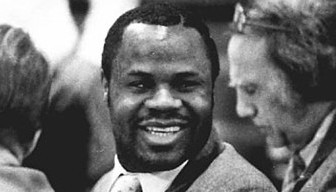
Mr. Davis, 41, was stabbed to death by another inmate around 7:30 p.m. during a recreational break on the grounds of the Shawangunk Correctional Facility in Ulster County, about 80 miles north of New York City, corrections officials said. The other inmate, Luis Rosado, used a crude, nine-inch shank to stab Mr. Davis repeatedly in his head, arms, back and chest, said Erik Kriss, a spokesman for the Department of Corrections.
Mr. Rosado, who has a long record of being disciplined for assaulting others while incarcerated, was arraigned this morning.
Mr. Davis was serving a sentence of 25 years to life for the fatal shooting of a drug dealer, for which he was convicted in 1991 and sent to Shawangunk.
But it was his brutal clash with a throng of police officers five years earlier that made Mr. Davis a hero to some and a symbol of the lawlessness sweeping New York City to others. On the night of Nov. 19, 1986, 20 police officers attempted to raid an apartment in the Morrisania section of the Bronx where Mr. Davis, a suspect in the murders of at least five drug dealers, had been staying.
As the officers stormed the apartment with their guns drawn, Mr. Davis, in blazing fashion, grabbed a pistol and a shotgun and fired at them from a darkened bedroom. At least six of the officers were hit, and two were wounded seriously. The fusillade left the apartment bloodied and littered with spent cartridges, yet Mr. Davis managed a narrow escape through a window.
His escape sparked a nationwide manhunt that ended 17 days later after a standoff at a Bronx apartment building. Mr. Davis took a family hostage in a 14th-floor apartment and gave himself up only after police officers assured him he would not be harmed.
When he was led out of the building, supporters of Mr. Davis’s shouted in unison, “Larry! Larry!”
Mr. Davis was acquitted first of the murders of the suspected drug dealers, after presenting a defense based almost entirely on the argument that he had been framed by the authorities. Then, nine months later, in the denouement of a second trial that captivated New Yorkers and scrutinized the police department, Mr. Davis was acquitted of the attempted murders of nine of the police officers who participated in the 1986 shootout.
Edward I. Koch, the mayor at the time, described the verdict as a “shock” and “horrifying,” and throngs of police officers protested outside the courthouse.
It was never clear from the trial precisely who had fired first, and jurors said they had voted to acquit Mr. Davis because they accepted his assertion that he had shot at the officers in self-defense. Mr. Davis’s defense team argued during the trial that the police were trying to kill Mr. Davis to prevent him from testifying about corrupt officers’ involvement in drug sales — a claim the prosecution fiercely denied.
Despite the attempted-murder acquittal, Mr. Davis was convicted of weapons charges, and sentenced to 5 to 15 years in prison. While serving out that sentence, Mr. Davis was again put on trial, this time in 1991 for the 1986 murder of yet another suspected drug dealer.
Like the earlier cases, the 1991 trial became something of a circus, marked by theatrics from Mr. Davis as well as the supporters and detractors who packed the courtroom. When a guilty verdict was finally read, Mr. Davis’s supporters screamed in anger and had to be escorted from the courtroom by the police. At a hearing one month later, Mr. Davis was sentenced to 25 years to life in prison, but not before being thrown out of the courtroom for repeatedly yelling “I ain’t afraid of you” at acting Supreme Court Justice Steven L. Barrett.
According to Mr. Kriss, the corrections department spokesman, Mr. Davis met his ultimate fate just before 8 p.m. on Wednesday night. At the time, Mr. Davis and 21 other inmates were using a yard for recreation and were scheduled to remain there until 10 p.m. About 7 p.m., Mr. Kriss said, two correction officers spotted Mr. Rosado repeatedly stabbing and attacking Mr. Davis with a flat metal shank.
Officers rushed to the scene and treated Mr. Davis while an ambulance was summoned. By 7:58 p.m., about 12 minutes after the ambulance had arrived, Mr. Davis was pronounced dead.
Mr. Rosado, 42, was serving a sentence of 25 years to life for multiple counts of murder, assault and attempted assault. He had a long and extensive history of being disciplined for violent behavior during his incarceration — including assaults on staff and other inmates — corrections officials said, and had just recently been denied parole in 2007. Mr. Davis also had a long history of being disciplined while incarcerated. His prison records indicate approximately 75 incidents that merited disciplinary action, including assaulting staff and inmates, making threats, harassment, and fighting, Linda Foglia, a corrections spokeswoman, said in an interview on Thursday.
But it did not appear however that Mr. Davis and Mr. Rosado had a history of fighting with each other.
“Inmate Rosado was not charged in any fights previously with inmate Davis,” Ms. Foglia said. “And we take fights very seriously, so if there was a fight between the two, there would have been a ticket and we would have a record of it.”
She added that corrections officers were still trying to figure out what prompted Mr. Rosado to attack Mr. Davis. Mr. Rosado was arraigned at 10:30 a.m. Thursday in Shawangunk Town Court and then returned to the correctional facility.
Mr. Davis would have been eligible for parole in 2016.
The Death of Larry Davis
By Sewell Chan - The New York Times
The news that a prison inmate, Larry Davis, 41, was stabbed to death with a homemade shank on Wednesday evening at a state prison in Ulster County will recall for many New Yorkers a South Bronx criminal case that dominated the headlines for years.
On Nov. 19, 1986, six police officers were shot, four of them seriously, while trying to apprehend Mr. Davis, then 20, at an apartment in the Morrisania section of the Bronx. It was at the time the largest number of officers to be wounded in one shooting in the history of the New York Police Department. Mr. Davis was wanted in connection with the killing of four young men found in the Longwood section of the Bronx on Oct. 30.
Today, an inmate at the prison 80 miles north of the city was being questioned in Mr. Davis’s death. Mr. Davis’s violent death will, for many New Yorkers, recall his remarkable journey through the criminal justice system from 1986 to 1991. During that time, he became, for some, a symbol of murderous drug wars and, for others, a symbol of widespread mistrust of the police.
The November 1986 shootout ended in Mr. Davis’s escape and a citywide manhunt that attracted nationwide attention when it widened to include at least five other cities. Attention was also focused on the overburdened criminal justice system. It turned out that Mr. Davis had remained out of jail for 10 months while a hearing on possible probation violations was postponed four times; officials acknowledged that the probation system was “overwhelmed” and that the jail system was in turmoil. The police even had trouble tracing calls Mr. Davis made to tapped telephones.
Cornered in a Bronx housing project after a tense, all-night siege in which a woman and her two young children were held hostage, Mr. Davis surrendered on the morning of Dec. 6, 1986. He was indicted in the slayings of the four young men, who the police said were drug dealers. Even in jail, Mr. Davis continued to make news, damaging his cell during a thwarted escape attempt.
To many observers, Mr. Davis seemed the embodiment of a trend toward lawlessness that had swept New York, but to others, particularly some residents in heavily black neighborhoods of the Bronx and other boroughs, he became something of a folk hero. Mr. Davis’s defenders had little confidence in the Police Department, which had been plagued by accusations of corruption and ineptitude.
As the case moved through the court system, Mr. Davis’s defense team — led by William M. Kunstler and Lynne F. Stewart — claimed that he shot the six officers in self-defense and that the police were trying to kill Mr. Davis to prevent him from testifying about officers’ involvement in drug sales.
On July 23, 1987, Mr. Davis stabbed a guard at Rikers Island, but that did little to dampen his popularity in some quarters. On Sept. 10, when he was led into State Supreme Court in the Bronx, more than a dozen spectators broke into applause before being brought to order by court officers. As the date of the trial approached, police actions on drug investigations were as much the focus as Mr. Davis’s own actions. The trial finally opened in December.
Mr. Davis’s journey through the criminal justice system ended in two major victories.
On March 3, 1988, after presenting a defense based almost entirely on the assertion that he had been framed, Mr. Davis was acquitted of all charges in the murders of the four suspected drug dealers 16 months earlier. Then, on Nov. 20, a Bronx jury acquitted him of attempted murder of nine police officers. The jury also acquitted Mr. Davis of six counts of aggravated assault in the wounding of six of the officers, one of whom was hit in the mouth and neck by a bullet and forced to retire. But the jury convicted him of six counts of criminal possession of a weapon. Mr. Davis was sentenced to 5 to 15 years in prison on the weapons charges.
Mr. Davis’s saga in the court system continued. On Dec. 2, 1989, he was acquitted of fatally shooting a Harlem drug dealer in 1986.
After being acquitted for the murders of five drug dealers, on March 14, 1991, a jury convicted Mr. Davis of firing a shot through the closed door of a Bronx crack den, killing a drug dealer, Raymond Vizcaino, on Aug. 5, 1986. Mr. Davis was sentenced to 25 years to life.
Even in prison, Mr. Davis continued to file appeals, in an ultimately unsuccessful effort to obtain freedom.
Defiant Larry Davis Gets 25 Years to Life in Killing
By Craig Wolff - The New York Times
April 26, 1991
Larry Davis, whose repeated clashes with the law have made him a hero to some and a pariah to others, was sentenced yesterday to 25 years to life for the 1986 murder of a Bronx drug dealer. But not before he expressed his contempt for the criminal-justice system loudly and at length, creating a tumultuous scene in court until the judge expelled him.
Mr. Davis, already imprisoned for 5 to 15 years for weapons possession in connection with a shootout that left six police officers wounded, will serve the new sentence after his current sentence runs out.
It was the shootout in 1986 that made Mr. Davis famous. He defeated prosecutors' efforts to convict him of attempted murder, and in 1989, in two separate trials, was acquitted in the killing of five drug dealers.
The sentencing yesterday stemmed from a third case, the killing of a Bronx crack dealer on Aug. 5, 1986. Mr. Davis was convicted of shooting the dealer, Raymond Vizcaino, through a door.
In court yesterday, before acting Supreme Court Justice Steven L. Barrett, Mr. Davis, 24 years old, spoke from a wheelchair for almost an hour before he was sentenced. With his mother and about two dozen supporters watching, Mr. Davis repeated his longstanding complaint that the police and the courts were carrying out a vendetta against him.
After Justice Barrett began to speak, Mr. Davis began saying repeatedly in a loud monotone, "I ain't afraid of you." The judge eventually expelled Mr. Davis from the courtroom, saying Mr. Davis, through his behavior, had lost his right to be at his sentencing.
In protest, Michael Warren, Mr. Davis's lawyer, faced the gallery, turning his back to the judge, while Mr. Davis's supporters slowly filed out.
Several messages left for Mr. Warren seeking comment were not returned last evening. He has many times referred to the cases against Mr. Davis as a "conspiracy."
After the shootout with dozens of police officers, Mr. Davis said he had shot at them in self-defense. That contention drew sympathy from many other blacks, who apparently identified with his struggle with the police. When Mr. Davis was captured at a Bronx housing project after a 17-day manhunt, many residents cheered him as was escorted out by police officers. He was acquitted of charges of attempted murder in the shootout.
New York State
Department of
Correctional
Services
Eliot Spitzer,
Governor
Brian Fischer,
Commissioner
Thursday, February 21, 2008
Inmate Larry Davis Dies at Shawangunk Correction Facility in Apparent Homicide
Larry Davis, an inmate at Shawangunk Correctional Facility, died at the facility on Feb. 20, 2008 as the result of an apparent homicide after a fight with another inmate.
The fight occurred at the New York State maximum security prison in Ulster County after 22 of the 85 inmates housed in B block went to B Yard for evening recreation, with three correction officers assigned for supervision. The inmates were scheduled to remain in the yard until 10 p.m.
At approximately 7 p.m., two correction officers observed inmate Luis Rosado (83B2677) assaulting inmate Davis (88T2550) with a weapon. An emergency response was called and the inmates were separated. A 9 ½-inch by 1 ¼-inch flat metal shank was recovered from the scene. None of the other inmates assigned to the yard participated.
Facility staff was assisting inmate Davis into the facility when he collapsed from his injuries. Facility staff then began medical procedures on inmate Davis while awaiting the arrival of an ambulance. Mobil Life Ambulance arrived at the facility at 7:46 p.m., continued treating inmate Davis and contacted a physician at St. Luke’s Hospital. Inmate Davis was pronounced dead at the facility at 7:58 p.m. He received multiple stab wounds to his head, chest, arms, back and legs.
After the incident, inmate Rosado was seen by facility medical staff and found to have no injuries. He was then interviewed by New York State Police, after which he was placed in Shawangunk’s 24-bed Special Housing Unit, which is used to segregate inmates for disciplinary purposes. Inmate Rosado was arraigned at 10:30 a.m. today in Shawangunk Town Court and returned to Shawangunk Correctional Facility.
In addition to the criminal charges, inmate Rosado faces internal departmental disciplinary charges for assault, fighting, refusing a direct order and possession of a weapon in connection with the incident. If found guilty of the internal charges, he will be placed in 23-hour confinement and lose his privileges, which could include packages, commissary access and use of phones.
Shawangunk remains in lockdown today. Inmates in B block, where inmates Rosado and Davis were housed, are eating in their cells while the other blocks are allowed to eat in their regularly assigned dining areas. Staff are conducting frisks of individual cells in B block. Programs throughout the facility are cancelled.
Inmate Davis was 41 years old and serving a 30 years to life sentence out of Bronx County for multiple counts of murder and weapons and one count of attempted robbery. He would have been eligible for parole consideration in 2016. He transferred to Shawangunk in July 2004. He had an extensive disciplinary history during his incarceration.
Inmate Rosado is 42 years old and serving 25 years to life out of New York County for multiple counts of murder, assault and attempted assault. He was denied parole in 2007 and, based on his original charges, is next eligible for parole consideration in 2009. He transferred to Shawangunk in November 2007. He has an extensive violent disciplinary history during his incarceration.
The Department of Correctional Services and the State Commission of Correction are assisting New York State Police out of Highland (845 691-7855) in the criminal investigation of the incident, which is ongoing.
Shawangunk is one of 16 male maximum security facilities in New York State. As of today, it houses 519 inmates. The last facility-wide lockdown there was in 1998. The last homicide in a State prison occurred in a disciplinary segregation cell block at Gouverneur Correctional Facility, in St. Lawrence County, on April 7, 2005.