Murderpedia has thousands of hours of work behind it. To keep creating
new content, we kindly appreciate any donation you can give to help
the Murderpedia project stay alive. We have many
plans and enthusiasm
to keep expanding and making Murderpedia a better site, but we really
need your help for this. Thank you very much in advance.
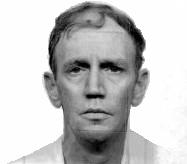
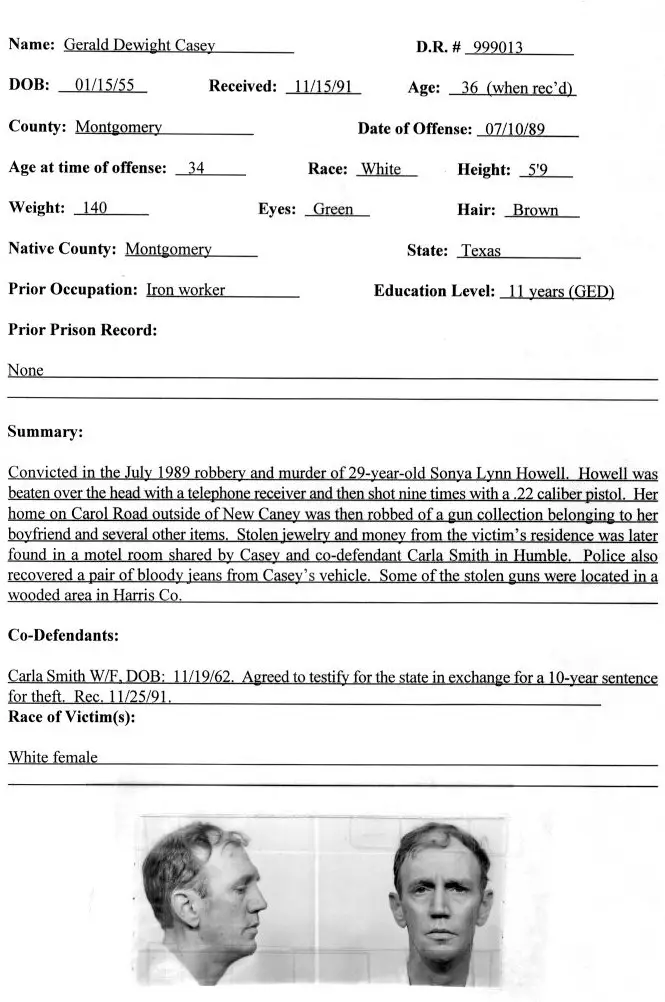
Gerald Dwight
CASEY
Classification: Murderer
Characteristics:
Robbery
Number of victims: 1
Date of murder:
July 10,
1989
Date
of arrest:
July
1989
Date
of arrest: January 15, 1955
Victim profile: Sonya Lynn Howell
(female, 29)
Method of murder:
Shooting (.22 caliber pistol)
Location: Montgomery County, Texas, USA
Status:
Executed
by lethal injection in Texas on April 18,
2002
Summary:
On July 7, 1989, Casey and his accomplice, Carla Smith, visited
Daryl Pennington at his home and attempted to sell him furniture and
a television set in an effort to raise the money they needed to move
from Texas to Florida.
When Pennington refused the sale, Casey and Smith formulated a plan
to steal Pennington's gun collection and sell it for cash. The
victim, Sonya Lynn Howell, lived with Pennington.
Smith testified at trial that, as part of their plan, she was going
to call Howell the morning of July 10, 1989, after Pennington had
gone to work to make sure that Howell was home alone.
Then, she and Casey would go to the Pennington/Howell residence,
subdue, bind and gag Howell, and steal the guns. Smith said that on
the morning of the murder, she dropped Casey off at the trailer and
then drove to a nearby convenience store and waited by the pay phone.
A while later, Casey called from the trailer, she came and picked
him up, and they drove away with the stolen goods. Casey testified
that he and Smith were together with Howell.
He said that the two
women got into an argument, which he tried to break up, but Smith
beat Howell with a telephone and then shot her.
Casey had multiple prior convictions for burglary,
possession of marijuana, heroin, theft, and assault on a police
officer.
Carla Elizabeth Smith was on probation for a robbery
conviction in Georgia at the time of the murder. She received a 10-year
prison sentence for theft for her involvement in Howell's murder.
She was paroled in 1999 and has had no criminal convictions since
then.
Citations:
Casey v. Texas, 115 S.Ct. 1366 (1995) (Cert. denied). Casey v. Cockrell, 273 F.3d 1107 (5th Cir. 2001) (Habeas).
Final Meal:
Fried chicken (3 drumsticks and 3 thighs), 1 quart coleslaw, tea or
juice, vanilla ice cream, and 1 Dr. Pepper.
Final Words:
Casey declined to make a final statement at his execution.
ClarkProsecutor.org
Texas Attorney General
Media Advisory
Wednesday, April 17, 2002
Gerald Dwight Casey Scheduled to be Executed.
AUSTIN - Texas Attorney General John Cornyn
offers the following information on Gerald Dwight Casey, who is
scheduled to be executed after 6 p.m. on Thursday, April 18, 2002.
On Nov. 13, 1991, Gerald Dwight Casey was sentenced to death for the
capital murder of Sonya Howell, which occurred during the course of
his committing robbery in Montgomery County, Texas, on July 10,
1989.
A summary of the evidence presented at trial follows:
FACTS OF THE CRIME
On July 7, 1989, Casey and his accomplice, Carla
Smith, visited Daryl Pennington at his home and attempted to sell
him furniture and a television set in an effort to raise the money
they needed to move from Texas to Florida.
When Pennington refused
the sale, Casey and Smith formulated a plan to steal Pennington's
gun collection and sell it for cash.
The gun collection, which
included one .22-caliber semiautomatic Ruger, one 30.06 Browning
rifle with a scope, one 300 Browning rifle with a scope, two
semiautomatic assault rifles, one HK-91 assault rifle, one 8200
Browning double barrel shotgun, and one Mossbery pump, was kept at
Pennington's residence that he shared with the victim, Sonya Howell.
In one of three prior visits to the Pennington/Howell residence,
Casey had an opportunity to observe and fire several of the guns in
Pennington's collection.
Smith testified at trial that, as part of their
plan, she was going to call Howell the morning of July 10, 1989,
after Pennington had gone to work to make sure that Howell was home
alone.
Then, she and Casey would go to the Pennington/Howell
residence, subdue, bind and gag Howell, and steal the guns. They
decided that after the robbery they would leave Howell in the woods
so Pennington would believe that Howell was the one who had taken
the guns. Finally, they would sell the guns for cash and flee to
Florida.
In the early morning hours of July 10, 1989,
Smith called Howell as planned to confirm that Pennington was not at
home. After concluding that Howell was alone, Smith told her that
she and Casey were coming over to do some "partying."
Before going
to the Pennington/Howell residence, Casey and Smith stopped at
Coleman's, a local convenience store, where Casey wrote down the
number for the store's pay phone. Smith then dropped Casey off at
the Pennington/Howell residence and returned to Coleman's to wait
for Casey's call.
A short time later, Casey phoned Smith on the pay
phone and told her to come pick him up. Smith drove by the residence
but did not see Casey. After driving by a second time, Smith noticed
Casey emerging from a wooded area near the residence. She also
noticed that he was wearing a different shirt and was carrying the
shirt he had worn earlier.
The shirt was covered in blood that was
later determined to be consistent with that of Sonya Howell. Casey
also had with him several guns, two imitation Rolexes, a gold nugget
ring, a class ring, other assorted jewelry, and an "Ozarka" water
jug containing loose change. Once the stolen items were placed in
the back seat of Casey's car, they left the area. Shortly thereafter,
they stopped in an unpopulated subdivision to move the guns, jewelry
and bloody shirt to the trunk of the car.
Casey and Smith returned to their motel room and
began removing the change from the water jug. They went to the bank
to obtain coin wrappers, then began rolling coins.
After a short
time, Casey and Smith went to Kehoe's, a local bar, where Casey made
several attempts to sell the stolen guns. While at the bar, Casey
made several phone calls and asked the employees and patrons of
Kehoe's if they were interested in purchasing weapons.
Eventually,
Smith and Casey moved the guns to William's Gully, a remote area of
Harris County, where they also left the bloodstained shirt, a white
towel and green washrag, each soiled with blood, various unused
rounds of ammunition, and a can of WD-40, used to remove the
fingerprints from the stolen weapons.
Later, when police searched
the motel room they found several of the stolen items, including the
gold ring, two imitation Rolex watches, and assorted rolled coins.
Pennington identified these items as those that were stolen from his
home on July 10, 1989.
Sonya Howell's body was discovered by police on
the evening of July 10, 1989. It was determined that she had been
hit on the head with a telephone receiver and that she died as a
result of 10 wounds inflicted by nine bullets.
It was also
determined that hair samples taken from Casey matched the unknown
hair samples found on the victim's body, and that blood stains on
the washrag and shirt found at William's Gully matched the blood
type of the victim.
In addition to this evidence, there was testimony
from several witnesses who encountered Casey on the day of the
offense and the week following.
Daniel Nee, a daytime bartender at
Kehoe's Bar, testified that around 11:00 a.m. or 12:00 p.m. on
Monday, July 10, 1989, Casey approached him several times about
purchasing some guns.
Ricky Taylor testified that he purchased a
Ruger from Casey while in the parking lot at Kehoe's later that
afternoon. Robert Lindy Lane stated that he purchased an HK-91
assault rifle and semiautomatic assault rifles from Casey shortly
after July 10, 1989.
When purchasing these weapons, Lane noticed
several other guns and a Rolex watch, all of which resembled the
items stolen from Pennington. Gomercindo Santana testified that he
bought a .22-caliber Ruger pistol from Casey.
The guns sold to
Santana and Taylor were recovered and identified by Pennington as
weapons stolen from his collection. Ballistics experts testified
that at least five, if not all of the bullets were probably fired
from the Ruger recovered from Santana.
PROCEDURAL HISTORY
On July 26, 1989, a grand jury indicted Casey in
the District Court of Montgomery County, Texas, for the capital
offense of murdering Sonya Howell in the course of committing the
offense of robbery.
After Casey pleaded not guilty, a jury found him
guilty of the capital offense on Oct. 28, 1991. Following a separate
punishment hearing, on Nov. 12, 1991, the court assessed Casey's
punishment at death.
Casey's conviction and sentence were
automatically appealed to the Court of Criminal Appeals of Texas,
which affirmed in an unpublished opinion on June 22, 1994. Casey
filed a petition for writ of certiorari in the United States Supreme
Court, which was denied on March 20, 1995.
Casey filed a preliminary application for writ of
habeas corpus in the trial court on April 28, 1997. He filed an
amended application on Aug. 20, 1995.
The trial court subsequently
entered findings of fact and conclusion of law recommending that
Casey's application be denied. The Court of Criminal Appeals then
adopted the trial court's findings and denied the application in an
unpublished order on March 4, 1998.
Following the Texas court's denial of his state
writ, Casey filed a skeletal federal habeas petition in the United
States District Court for the Southern District of Texas, Houston
Division, on July 13, 1998. An amended petition was filed on March
8, 1999.
The federal district court denied habeas relief on March 8,
2000. Casey applied to the Fifth Circuit for a certificate of
appealability, but was denied when the court of appeals affirmed the
district court's judgment. Thereafter, Casey filed a petition for
certiorari in the United State Supreme Court. That petition is
currently pending.
PRIOR CRIMINAL HISTORY
During the trial, the State proved that Casey had
several prior convictions for which he served time in the Texas
Department of Criminal Justice - Institutional Division.
On March 29, 1976, he entered a guilty plea to
the charge of burglary to a building and was placed on six years
probation.
His probation was revoked on Nov. 8, 1976 when he pleaded
true to several alleged probation violations. In pleading true to
these allegations, Casey admitted committing the following offenses:
possession of heroin; possession of marijuana; burglary of a
building; theft; and assault on a police officer. That same day,
Casey entered a guilty plea to the charge of burglary of a
habitation and received a five year sentence.
Several years later, on Jan. 21, 1980, he pleaded
guilty to burglary of a habitation and was sentenced to 10 years
imprisonment.
Finally, on Feb. 9, 1989, he pleaded guilty to
misdemeanor possession of marijuana and received a 15 year sentence.
ProDeathPenalty.com
On July 7, 1989, Gerald Casey and his accomplice,
Carla Smith, visited Daryl Pennington at his home and attempted to
sell him furniture and a television set in an effort to raise the
money they needed to move from Texas to Florida.
When Pennington refused the sale, Casey and Smith
formulated a plan to steal Pennington's gun collection and sell it
for cash.
The gun collection, which included one .22-caliber
semiautomatic Ruger, one 30.06 Browning rifle with a scope, one 300
Browning rifle with a scope, two semiautomatic assault rifles, one
HK-91 assault rifle, one 8200 Browning double barrel shotgun, and
one Mossbery pump, was kept at Pennington's residence that he shared
with the victim, Sonya Howell.
In one of three prior visits to the Pennington/Howell
residence, Casey had an opportunity to observe and fire several of
the guns in Pennington's collection. Smith testified at trial that,
as part of their plan, she was going to call Howell the morning of
July 10, 1989, after Pennington had gone to work to make sure that
Howell was home alone.
Then, she and Casey would go to the
Pennington/Howell residence, subdue, bind and gag Howell, and steal
the guns. They decided that after the robbery they would leave
Howell in the woods so Pennington would believe that Howell was the
one who had taken the guns. Finally, they would sell the guns for
cash and flee to Florida.
In the early morning hours of July 10, 1989,
Smith called Howell as planned to confirm that Pennington was not at
home.
After concluding that Howell was alone, Smith told her that
she and Casey were coming over to do some "partying." Before going
to the Pennington/Howell residence, Casey and Smith stopped at
Coleman's, a local convenience store, where Casey wrote down the
number for the store's pay phone. Smith then dropped Casey off at
the Pennington/Howell residence and returned to Coleman's to wait
for Casey's call.
A short time later, Casey phoned Smith on the pay
phone and told her to come pick him up. Smith drove by the residence
but did not see Casey. After driving by a second time, Smith noticed
Casey emerging from a wooded area near the residence. She also
noticed that he was wearing a different shirt and was carrying the
shirt he had worn earlier.
The shirt was covered in blood that was
later determined to be consistent with that of Sonya Howell. Casey
also had with him several guns, two imitation Rolexes, a gold nugget
ring, a class ring, other assorted jewelry, and an "Ozarka" water
jug containing loose change. Once the stolen items were placed in
the back seat of Casey's car, they left the area.
Shortly thereafter,
they stopped in an unpopulated subdivision to move the guns, jewelry
and bloody shirt to the trunk of the car. Casey and Smith returned
to their motel room and began removing the change from the water jug.
They went to the bank to obtain coin wrappers, then began rolling
coins.
After a short time, Casey and Smith went to Kehoe's, a local
bar, where Casey made several attempts to sell the stolen guns.
While at the bar, Casey made several phone calls and asked the
employees and patrons of Kehoe's if they were interested in
purchasing weapons.
Eventually, Smith and Casey moved the guns to
William's Gully, a remote area of Harris County, where they also
left the bloodstained shirt, a white towel and green washrag, each
soiled with blood, various unused rounds of ammunition, and a can of
WD-40, used to remove the fingerprints from the stolen weapons.
Later, when police searched the motel room they found several of the
stolen items, including the gold ring, two imitation Rolex watches,
and assorted rolled coins. Pennington identified these items as
those that were stolen from his home on July 10, 1989.
Sonya
Howell's body was discovered by police on the evening of July 10,
1989. It was determined that she had been hit on the head with a
telephone receiver and that she died as a result of 10 wounds
inflicted by nine bullets.
It was also determined that hair samples
taken from Casey matched the unknown hair samples found on the
victim's body, and that blood stains on the washrag and shirt found
at William's Gully matched the blood type of the victim.
In addition to this evidence, there was testimony
from several witnesses who encountered Casey on the day of the
offense and the week following.
A daytime bartender at Kehoe's Bar
testified that around 11:00 a.m. or 12:00 p.m. on Monday, July 10,
1989, Casey approached him several times about purchasing some guns.
A man testified that he purchased a Ruger from Casey while in the
parking lot at Kehoe's later that afternoon. Another man stated that
he purchased an HK-91 assault rifle and semiautomatic assault rifles
from Casey shortly after July 10, 1989.
When purchasing these
weapons, he noticed several other guns and a Rolex watch, all of
which resembled the items stolen from Pennington. There was
additional testimony from another person who testified that he
bought a .22-caliber Ruger pistol from Casey.
The guns sold were
recovered and identified by Pennington as weapons stolen from his
collection. Ballistics experts testified that at least five, if not
all of the bullets were probably fired from the Ruger. Smith
received a ten-year sentence for her part in the crime.
Texas Execution Information
Center by David Carson
Txexecutions.org
Gerald Dwight Casey, 47, was executed by lethal
injection on 18 April in Huntsville, Texas for the murder of a woman
during a home robbery.
On 10 July 1989, Gerald Casey, then 34, and Carla
Smith, 36, drove to the residence of Daryl Pennington and his
girlfriend, Sonya Howell, 29.
Casey and Smith were acquainted with
Pennington and Howell and had been to their trailer home several
times in the past. On this particular morning, Pennington was at
work, so Howell was home alone. Smith called Howell and told her
that she and Casey were coming over to do some "partying."
Howell was beaten on the head with a telephone
receiver and shot nine times with a .22-caliber pistol. The pair
drove off with several guns, two watches, some jewelry, and a water
jug containing loose change -- all taken from the trailer -- in the
back seat of their car.
Casey and Smith returned to their motel room
first, then to the bank to obtain some coin wrappers, then back to
their room. After a while, they went to a local bar, where Casey
tried to sell the stolen guns to employees and patrons.
They then
went to a remote area and discarded a bloody shirt, several other
items that were stained with blood, some spent ammunition cartridges,
and a can of WD-40.
Daryl Pennington discovered his girlfriend's body
that evening. Hair matching Gerald Casey's was found on her body.
The blood on the discarded items matched Sonya Howell. When police
searched the motel room, they found several of the stolen items,
including the gold ring, two watches, and assorted rolled coins.
Pennington identified these items as those that were stolen from his
home.
At Casey's trial, four individuals testified that
Gerald Casey sold them or tried to sell them guns on or shortly
after 10 July 1989. One of the guns that Casey sold, a .22-caliber
Ruger pistol, was determined by ballistics testing to be the source
of some or all of the shots that killed Sonya Howell.
Carla Smith testified against Casey in a plea
bargain. She testified that she and Casey needed money to move from
Texas to Florida. They had been to Pennington's home several times
and noticed his gun collection. They began planning to steal the
guns and sell them for cash.
They decided that they would go to the
residence when Howell was alone, knock her unconscious, kidnap her,
and steal the guns. They would then leave Howell in the woods so
that Pennington would believe she was the one who stole the guns.
Smith said that on the morning of the murder, she
dropped Casey off at the trailer and then drove to a nearby
convenience store and waited by the pay phone. A while later, Casey
called from the trailer, she came and picked him up, and they drove
away with the stolen goods.
Casey testified that he and Smith were together
with Howell. He said that the two women got into an argument, which
he tried to break up, but Smith beat Howell with a telephone and
then shot her.
Gerald Casey had multiple prior convictions for
burglary of a building and burglary of a habitation, going back to
1976. He also had pled guilty or admitted to possession of marijuana,
possession of heroin, theft, and assault on a police officer. His
probation and prison sentences totaled at least 36 years.
Information on time served in prison was not available for this
report.
A jury found Casey guilty of capital murder in
October 1991 and sentenced him to death. The Texas Court of Criminal
Appeals affirmed the conviction and sentence in June 1994. All of
his subsequent appeals in state and federal court were denied.
Carla Elizabeth Smith was on probation for a
robbery conviction in Georgia at the time of the murder. She
received a 10-year prison sentence for theft for her involvement in
Howell's murder. She was paroled in 1999 and has had no criminal
convictions since then. Daryl Pennington died in 2001.
Casey declined to make a final statement at his
execution. He was pronounced dead at 6:18 p.m.