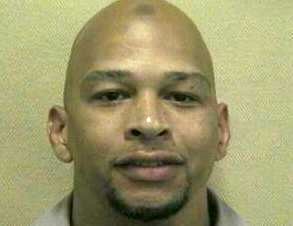
At about half an hour after midnight on the morning
of Tuesday, October 16, 1999, Cherica Adams, 24 year years old and six
months pregnant, was driving home through a middle-class suburban
neighborhood in south Charlotte, North Carolina, when she was shot four
times from a car which pulled alongside her. Seriously wounded, she
drove her BMW off the road onto the lawn of a private home, and was able
to make an emergency call on her car phone. In the phone call, she
identified the driver of a car that had pulled in front of her and
caused her to slow down immediately before the shooting as Rae Carruth,
a member of the Carolina Panthers football team, who had just spent the
evening at a movie theater with her. At Carolinas Medical Center,
Cherica Adams's baby boy was delivered by emergency Caesarean section
and survived; Adams remained in critical condition.
Rae Carruth grew up in Sacramento, California, and
played football for the University of Colorado. He was picked by the
Carolina Panthers as a wide receiver in the 1997 National Football
League draft, and signed a four-year contract for a total of almost
three and three-quarter million dollars.
The police investigation immediately focussed on
Carruth because of Cherica Adams's 911 call, statements she made to
police at the scene, and notes she wrote a few hours after being
admitted to the hospital. On Friday, November 19, police arrested
Michael Eugene Kennedy, 24, of Charlotte, who was alleged to have rented
and driven the car from which the shots were fired. Kennedy had a
lengthy arrest record on assault and drug-related charges extending back
to 1994. Carruth was arrested on November 25, charged with conspiracy to
commit murder, and taken into custody. Also arrested on the same day on
the same charge was William Edward (Van Brett) Watkins, 40, of New York.
Frequently referred to as a career criminal, Watkins had a long record
of violent offenses, and was believed to have fired the shots that hit
Cherica Adams. Stanley Drew Abraham, 19, of Charlotte, believed to have
been a passenger in the car with Watkins and Kennedy, was arrested on
December 2.
Carruth was released on a $3 million bond on December
6. Eight days later Cherica Adams died of multiple organ system failure
resulting from the gunshot wounds, and the charge of first-degree murder
was added to others faced by Carruth and the other three codefendants.
Instead of turning himself into police, as it had been arranged that he
would do in this situation, Rae Carruth disappeared. His flight, however,
was short-lived; the following day FBI agents, acting on information
from his mother, discovered him hiding in the trunk of a car in the
parking lot of a motel in Wildersville, Tennessee. He was returned to
North Carolina and held in jail until his trial. At the end of December
what had been generally supposed was confirmed: tests showed that Rae
Carruth was the father of Cherica Adams's child.
Carruth retained David Rudolph, a founder of the
Chapel Hill firm of Rudolph, Maher, Widenhouse, and Fialko. Rudolph had
a strong reputation as a criminal defense lawyer and had successfully
represented several clients in highprofile cases. He would be assisted
by his partner, Christopher Fialko. The prosecution was headed by
Mecklenburg County assistant district attorney Gentry Caudill; a veteran
prosecutor, this would be his last case before becoming a judge. Van
Brett Watkins accepted a plea bargain, confessing that he had shot
Cherica Adams and pleading guilty to second-degree murder and the other
charges. He agreed to testify against Carruth and the other defendants.
In pretrial motions Rudolph was unsuccessful in attempting to exclude as
evidence the tape of Cherica Adams's 911 call, the notes she had written
in the hospital, and testimony regarding Carruth's flight to Tennessee.
In a separate proceeding in civil court in August
2000, Carruth was found to be indigent, his house having been sold at
foreclosure and his other assets disposed of. This ruling, househowever,
havingbeen was soldsealed at the request of Judge Charles Lamm, who had
been assigned the criminal case. In a decision, which was controversial
in the local legal community when it became known, Judge Lamm instructed
Rudolph and Fialko to continue to represent Carruth as public defenders.
None of this became public knowledge until the closing days of the
ensuing trial.
Jury selection began on October 23, 2000, and lasted
almost a month, resulting in a panel of seven men and five women. As a
part of its opening statement on November 20, the prosecution played the
tape of Cherica Adams' emergency call. Their case centered on the fact,
as subsequent witnesses were called to confirm, that she had identified
Rae Carruth to the dispatcher, again to police at the scene in the
hearing of a paramedic witness, and again at the hospital in the
presence of a nurse. Carruth, the prosecution would show, had recruited
Watkins and Kennedy to kill Adams because he did not want to pay support
for her child, on top of the child support of $3,000 per month that he
already was paying for a child he had fathered in California. The
defense would argue that Carruth had not been involved in any plot to
kill Cherica Adams, that the motive presented was implausible, given the
fact that Carruth was earning $650,000 a year at the time of the
shooting, and that the shooting was an indirect consequence of Carruth's
refusal to finance a drug deal.
The first of several unexpected developments in the
trial occurred the following day when the prosecution presented Michael
Eugene Kennedy as its first witness. Although still facing his own
capital murder trial, Kennedy testified without having entered into a
formal or informal plea bargain arrangement with the prosecution.
Kennedy told the court that he had rented and driven the car from which
the shooting occurred, that Carruth had given him $100 to buy the gun,
and that Carruth's reason was his unwillingness to pay child support.
The prosecution then called another former girlfriend of Carruth who
also testified that Carruth had confessed to her that he had been
involved in the shooting.
After calling several of Carruth's friends to testify
that he wanted the baby, and had no ill-will towards Cherica Adams, the
defense took the unusual step of bringing Brett Watkins to the stand.
Such was Watkins's reputation for impulsive violence that a deputy was
positioned between the witness box and Judge Lamm, on the one side, and
another between Watkins and the jury on the other. During a full day of
confrontational examination, Rudolph attempted to get Watkins to admit
that the killing had occurred because Carruth had refused to finance a
drug deal. Watkins, however, insisted that he had been hired by Carruth,
first with the idea of beating up Cherica so that she would lose the
baby, but then to kill her.
The next day the defense introduced testimony from a
prison officer, Sergeant Shirley Riddle, who testified that she had had
a conversation with Watkins in jail at the time of Cherica Adams's death.
In this conversation he had confessed to the shooting, but had also told
her that he had pulled alongside Cherica Adams's car in order to try to
get her to tell him where Carruth was going. When she made an obscene
gesture at him, he said that he had "just lost it," and started shooting.
According to Sergeant Riddle, Watkins had indicated that it was all
about a drug purchase, and that if Carruth had given them the money they
wanted, the shooting would not have occurred. Rae Carruth did not
testify.
In its rebuttal the prosecution called another former
girlfriend of Carruth from Colorado, Amber Turner, who admitted to
having had an abortion after Carruth had threatened her life. Turner had
been originally listed as a defense witness. Michelle Wright, the mother
of Carruth's six-year-old son, also testified to having been threatened
by Carruth.
After 11 weeks and 70 witnesses, closing arguments
were heard on January 15, 2001. The prosecution played the 911 tape
again, and emphasized the record of the long series of phone calls
between Carruth and Van Brett Watkins during the weeks before the
shooting. For the defense, David Rudolph laid out 10 points, all of
which, he argued, presented reasonable doubt about the plausibility of
the prosecution case.
The jury began deliberations the following day, but
two days later, after 11 hours of discussion, the foreman reported to
Judge Lamm that they were split on all four charges. After repeating
jury instructions, he told them to keep trying, and on Friday, January
19, the jury returned its verdict, finding Rae Carruth not guilty of
first-degree murder, but guilty on the other three charges. He was
sentenced to not less than 18 years, 11 months, and not more than 24
years, four months in prison. Under North Carolina sentencing law, apart
from credit for any time spent in jail awaiting trial, actual time
served cannot be reduced to less than the minimum specified by the judge.
Van Brett Watkins was subsequently sentenced to not less than 40 years
and five months or more than 50 years and eight months. Michael Kennedy
pled guilty to second-degree murder and received a minimum of 11 years
and eight months. Abraham pled guilty to lesser charges as an accessory
and received 90 days in jail and five years probation.
NORTH CAROLINA COURT OF APPEALS
NO. COA02-959
STATE OF NORTH CAROLINA
v.
RAE LAMAR WIGGINS, a/k/a, RAE CARRUTH
Filed: 5 August 2003
Appeal by defendant from judgment entered 11 January
2001 by Judge Charles C. Lamm in Mecklenburg County Superior Court.
Heard in the Court of Appeals 10 June 2003.
TYSON, Judge.
Rae Lamar Wiggins, also known as Rae Carruth (“defendant”),
appeals from judgments entered upon a jury's verdict finding him guilty
of conspiracy to commit murder, firing a gun into occupied property, and
using an instrument with intent to destroy an unborn child. Defendant
was sentenced to an active term of imprisonment of 196 months to 245
months for conspiracy to commit murder. Concurrent sentences of 31 to 47
months were imposed for the remaining convictions.
I. Background
On the evening of 15 November 1999, defendant and his
eight- months pregnant girlfriend, Cherica Adams (“victim”), watched a
movie at a Charlotte theater. The two left the movie theater and rode
together to defendant's house to retrieve the victim's car. While there,
defendant called Michael Kennedy (“Kennedy”) and told him that he and
the victim were about to leave. Victim followed defendant in her vehicle
toward her home.
As they drove along two- lane residential Rea Road,
defendant slowed or stopped his large sport utility vehicle in front of
the victim's car. Victim could not drive her car around defendant's
vehicle. Kennedy drove his rented vehicle beside the victim's car. Van
Brett Watkins (“Watkins”), a passenger, fired five shots from the rental
vehicle into the victim's car. The victim was wounded four times, once
in the neck and three times in the back. Defendant's and Kennedy's
vehicles fled the scene in different directions.
The victim called 911 from her cell phone at 12:31
a.m., pulled into a residential driveway, continuously blew the horn,
and remained on the phone for over twelve minutes until an ambulance
arrived. In her call to 911, the victim described the shooting in detail
and informed the dispatcher and an emergency medical technician that she
had been following defendant, who was her boyfriend and her baby's
father.
Mecklenburg Police Officer Peter Grant (“Grant”)
arrived on the scene around 12:43 a.m. The victim identified defendant
to Grant as the driver of the vehicle that she had also described in the
911 call. The victim was transported by ambulance to Carolinas Medical
Center and arrived at 1:10 a.m. The victim gave Grant a complete
chronology of the events that transpired during the night and early
morning.
Emergency surgery was performed to remove the bullets
and deliver the baby from the victim at 1:30 a.m. At 4:00a.m., the
victim was taken to a trauma intensive care unit. Around 7:00 a.m., an
endotracheal tube was inserted into victim's throat. Traci Willard (“Willard”),
the morning nurse, asked the victim if she remembered what had happened
to her. The victim nodded and motioned for Willard to bring a pen and
paper to her. The victim handwrote notes describing the shooting and
events of the morning and previous evening. Later, the victim's father
asked her if there were any stop signs on the road that would provide
defendant a legitimate reason to stop in the road. The victim shook her
head negatively. The victim died 14 December 1999 as a result of the
inflicted wounds. Victim's infant son survived.
Defendant was charged with and tried capitally for
first- degree murder of the victim, conspiracy to commit murder,
discharge of a firearm into occupied property, and the use of an
instrument to destroy an unborn child. The State presented testimony
from co- conspirators, Watkins and Kennedy. Defendant did not testify
but presented evidence. A jury found defendant guilty of conspiracy to
commit murder, discharge of a firearm into occupied property, and use of
an instrument to destroy an unborn child. Defendant appeals.
II. Issues
Defendant's assignments of error raise the following
issues: (1) whether the notes written by the victim at the hospital are
inadmissible hearsay; (2) whether the exclusion of defendant's theory of
the case and the trial court's failure to instruct the jury on his
theory constituted reversible error; (3) whether thetrial court erred in
allowing the peremptory strikes of black jurors; (4) whether the trial
court erred in failing to assess gender discrimination in the juror
selection; (5) whether the trial court erred in asking the jury to
record its numerical division and to deliberate further; and (6) whether
the trial court erred in determining the aggravating and mitigating
sentencing factors.
III. Hearsay Statements
Defendant argues that the handwritten notes the
victim wrote after awaking from surgery are inadmissible hearsay. The
trial court admitted the hearsay statements as present sense impressions,
an allowed exception under N.C. Rule of Evidence 803(1).
“[P]resent sense impression” is defined as “[a]
statement describing or explaining an event or condition made while the
declarant was perceiving the event or condition, or immediately
thereafter.” N.C.G.S. § 8C-1, Rule 803(1) (2001) (emphasis supplied).
Our Supreme Court analyzed the meaning of “immediately thereafter” in
State v. Cummings, 326 N.C. 298, 389 S.E.2d 66 (1990).
Interpreting the identical Federal Rule, the federal
courts have held that “there is no per se rule indicating what
time interval is too long under Rule 803(1). . . .
[A]dmissibility of statements under hearsay
exceptions depends upon the facts of the particular case.” United
States v. Blakey, 607 F.2d 779, 785 (7th Cir. 1979). Here, [the
victim's] statement was made in close proximity to the event -- a
reasonable inference would be the length of time it took to drive from
Willow Springs to her mother's house in Raleigh. Under the particular
facts of this case, [the victim's] statement to her mother was made
sufficiently close to the event to be admissible as present sense
impressions under Rule 803(1).
Id. at 314, 389 S.E.2d at 75. The reason for
the present sense impression hearsay exception is that closeness in time
between the event and the declarant's statement reduces the likelihood
of deliberate or conscious fabrication or misrepresentation. State v.
Gainey, 343 N.C. 79, 87, 468 S.E.2d 227, 232 (1996).
The State argues that the victim's statements made
soon after the victim awoke from surgery qualify as a present sense
impression. The State contends that the victim's time in surgery should
be removed from the length of time between the shooting and the writings
because the victim could not communicate during the surgery. Even after
subtracting the length of time the victim spent in surgery and recovery,
nearly two additional hours elapsed between the event and the written
statement. Defendant argues the victim's written statements were not a
present sense impression, but an inadmissible past sense impression.
Although the risk is low that the victim formed or seized an opportunity
to manipulate the truth, we cannot hold as a matter of law that
statements made approximately seven hours after the shooting and after
the declarant had undergone general anesthesia and surgery fit within
the present sense impression hearsay exception. See State v. Taylor,
344 N.C. 31, 47, 473 S.E.2d 596, 605 (1996) (statement allowed as a
present sense impression where it was made immediately after declarant
had perceived the condition); State v. Odom, 316 N.C. 306, 313,
341 S.E.2d 332, 336 (1986) (statement allowed as present sense
impression where declarant made statement within ten minutes of
perceiving abduction). The State alternatively argues that the
statements were admissible under Rule 804(b)(5), which allows admission
of trustworthy hearsay consistent with the interests of justice. We
disagree. The trial court did not make findings for this hearsay
exception to apply as required by State v. Triplett, 316 N.C. 1,
340 S.E.2d 736 (1986).
The issue becomes whether this hearsay error was
prejudicial or harmless beyond a reasonable doubt. If the same
information contained in the victim's written statement was properly
introduced into evidence through other witnesses or means, any error in
admitting the victim's statement would be harmless beyond a reasonable
doubt.
The written statements provide details about the
events leading up to and during the shooting. The victim wrote that
defendant called someone before they left his house and stated, “we were
leaving now.” Other comments in the statement included “[h]e was driving
in front of me & stopped in the road & a car pulled [up] beside me & he
blocked the front & never came back” and “[h]e insisted on coming to my
house.”
These statements corroborated other properly admitted
evidence. Kennedy testified that he received a telephone call from
defendant just after midnight on 16 November 1999. Defendant told
Kennedy that “[defendant] was at his house and he was getting ready to
leave the house.” When asked specifically what defendant said, Kennedy
replied, “'We're getting ready to leave the house.'” Kennedy also
testified to the sequence of events that corroborated the victim's
statements. “Rae went over a hill and then down inthe dip. Then, he
stopped his car; she stopped behind his; I stopped behind her. Then,
Watkins told me to pull up beside her car. So, I pulled up beside her
car and he started shooting in her car.” When asked the distance between
defendant's and the victim's vehicles, Kennedy replied “[m]aybe a foot
or so; because he stopped, suddenly.” Watkins began firing “[a]s soon as
we pulled up beside.” Defendant's vehicle “pulled off” as Kennedy turned
his vehicle around in a driveway.
Officer Grant testified that he asked the victim at
the scene if she knew who had shot her. The victim answered “Rae Carruth.”
Grant asked her if defendant was the person driving the vehicle she
described in the 911 call. She replied, “Yes, yes. That's my baby's
daddy.” She gave to Grant the defendant's home address. Grant continued
his questioning of the victim at the hospital. After Grant inquired,
“Did your boyfriend do this to you?”, victim nodded affirmatively. When
asked what happened, the victim told Grant that she and defendant had
attended a movie that night and had traveled back to defendant's house
to retrieve her car. “She was following Rae Carruth, down Rea Road. She
said that along Rea Road, Rae Carruth came to a stop. She had to stop;
because at the point in time where they stopped, it was only a 2-lane
road; and, she couldn't to (sic) around, either way. And she said, when
they stopped the car, a car pulled up next to her; and, shots began
firing.”
Candace Smith (“Candace”), a girlfriend of defendant,
came to the hospital and saw defendant the morning of the shooting.
Shetestified that defendant told her “he wished that she [Cherica] would
die.” Candace asked defendant outside the presence of others if he had
anything to do with the victim being shot. “[H]e wouldn't even look at
me. And, he said that he had been trying to be nice to her; and, go to
doctors appointments and give her money; and keep her happy. . . . And,
that he had been getting money out the bank, a little bit at a time, so
it wouldn't look suspicons (sic), to give to the guy. And, he said he
watched the guy -- well, he hit his brakes, in his car, to slow her car
down. And, he saw the guys pull up and shot into her car. . . . And, he
said, 'I just drove off and went to Hannibal's house.'”
The victim's recorded 911 call and the testimony of
Kennedy, Grant, and Candace duplicate the victim's written statements.
The only portion of the victim's statements allowed into evidence that
was not directly corroborated by other evidence was that defendant
“insisted on going to [the victim's] house.”
The victim telephoned her cousin, Modrey Floyd, at
12:15 a.m. on 16 November 1999, and indicated that it was not the
victim's decision to go to her house. Floyd testified, “[Cherica] said
that she and Rae were on their way over to the apartment. She asked if I
could straighten up because she didn't -- she wasn't expecting him to
come over.”
Given the nature and extent of the State's evidence
implicating defendant's involvement in the shooting, the recorded 911
call and witnesses' testimony that duplicated the victim's written
statements, we hold that any error in admitting thevictim's written
statement was harmless beyond a reasonable doubt.
IV. Exclusion of Defendant's Theory and Failure to
Instruct
Defendant alleges his constitutional rights were
violated when the trial court did not allow presentation of evidence and
failed to instruct the jury on defendant's theory of the case. Defendant
asserts that he was not part of any conspiracy to kill the victim, and
contends that Watkins and Kennedy sought revenge for his failure to
finance a drug deal. Their revenge was taken out against the victim.
Defendant put forth and the trial court admitted
evidence supporting this theory through testimony of Mecklenburg County
Sheriff Sergeant Shirley Riddle. This evidence was limited to
impeachment purposes by the trial court. Riddle testified that she
walked inside Watkins' jail cell to retrieve his “do-rag.” Watkins
blocked her exit and said “'I've got to talk to you.'” Riddle explained
to Watkins that she was not supposed to talk to him about his case.
Watkins said to Riddle, “'I told Kennedy to pull up
beside of Cherica's car; we had lost track of Rae; we wanted to see
which way he was headed.' . . . 'I started waving my arms to get her to
slow down.' . . . 'We were just going to ask her if she knew where Rae
was going. And then, she slowed down.'. . . 'I was telling her to roll
her window down so we could talk to her.' . . . 'She flipped me off.' .
. . 'I just lost it; I lost control.' . . . 'If [Rae] had just given us
the money, none of this would have happened.'”
Defendant's statements made to Leonard Kornberg, his
priorattorney, were not allowed into evidence. The excluded evidence was
defendant's belief that Watkins and Kennedy were angry with him because
he had refused to finance a drug deal. The trial court excluded this
evidence as a self-serving declaration and hearsay, not within the state-of-mind
exception. Similar statements defendant made to James Lasco, his bail
bondsmen, were excluded on the same basis.
Defendant argues that Chambers v. Mississippi,
410 U.S. 284, 35 L. Ed. 2d 297 (1973) supports his assertion that his
constitutional rights were violated by the exclusion of this evidence.
The United States Supreme Court in Chambers overturned a
defendant's conviction where defendant was not allowed to examine a
witness as an adverse witness because the witness did not accuse the
defendant and a Mississippi rule would not allow a party to impeach its
own witness. Id. at 297, 35 L. Ed. 2d at 310. The Court found as
a second prong for overturning the conviction that hearsay evidence of a
witness's confession to the crime with which defendant was charged
should have been admitted. Id. at 300-02, 35 L. Ed. 2d at 311-13.
Defendants' assertion that Chambers' applies at bar is misplaced.
The witness in Chambers testified under subpoena at the
defendant's trial and could be cross-examined regarding his prior
statements. Defendant did not testify, could not be forced to testify
against himself, and he was not subject to cross-examination concerning
statements he reportedly made to his former attorney and bondsman. The
statements were self-serving, were sought to be admitted for the truth
of the matter asserted,and were not evidence of defendant's state of
mind. Defendant's assignment of error is overruled.
Defendant also argues that the trial court erred in
not instructing the jury on defendant's theory of the case. Defendant's
drug deal/revenge theory is not supported by any evidence admitted for
substantive purposes at trial. As we have found no error in excluding
this evidence, the trial court did not err in failing to instruct the
jury on a theory unsupported by the evidence. This assignment of error
is overruled.
V. Peremptory Strikes of Black Jurors
Defendant argues that the trial court erred in
allowing the State to strike jurors based upon their race. Defendant
objected to each peremptory challenge against a prospective black juror
lodged by the district attorney. The trial court rejected defendant's
first seven objections and ruled that defendant had failed to establish
a prima facie case of racial discrimination. After the prosecutor
used a peremptory challenge against the eighth black juror, the trial
court required the district attorney to state his reasons for use of the
challenges and held that defendant had made a “prima facia [sic]”
showing of peremptory excusals against prospective black jurors. The
trial court entered special findings of fact and concluded that the
reasons “proffered by the State for its excusal of each of the eight
minority jurors excused by the State . . . are acceptable, non-pretextual,
race-neutral, and gender neutral.” At this time, “the [S]tate ha[d]
accepted three minority jurors out of the eleven that ha[d] been
selected.” The final jury was comprised of three black women, two non-black
women, and seven non-black men. Defendant argues that the trial court's
late inquiry and decision did not remedy the discriminatory effect of
the State's challenges.
“The Sixth Amendment to the United States
Constitution prohibits the arbitrary exclusion of certain groups or
classes of citizens from the jury in federal and state cases.” State
v. Cole, 343 N.C. 399, 414, 471 S.E.2d 362, 369 (1996), cert
denied, 519 U.S. 1064, 136 L. Ed. 2d 624 (1997), cert. denied,
356 N.C. 683, 577 S.E.2d 900 (2003); U.S. Const. amend. VI. North
Carolina's Constitution expressly provides that “[n]o person shall be
excluded from jury service on account of sex, race, color, religion, or
national origin.” N.C. Const. art I, § 26.
We apply the test set forth by the United States
Supreme Court in Batson v. Kentucky, 476 U.S. 79, 90 L. Ed. 2d 69
(1986) to evaluate whether individuals were impermissibly excluded from
jury service. Our Supreme Court has stated the Batson analysis as
follows:
First, defendant must establish a prima facie
case that the peremptory challenge was exercised on the basis of race.
Second, if such a showing is made, the burden shifts to the prosecutor
to offer a racially neutral explanation to rebut defendant's prima
facie case. Third, the trial court must determine whether the
defendant has proven purposeful discrimination.
State v. Cummings, 346 N.C. 291, 307-8, 488
S.E.2d 550, 560 (1997), cert. denied, 522 U.S. 1092, 139 L. Ed.
2d 873 (1998). The first step of the Batson analysis “'is not
intended to be a high hurdlefor defendants to cross. Rather, the showing
need only be sufficient to shift the burden to the State to articulate
race-neutral reasons for its peremptory challenge.'” State v. Barden,
356 N.C. 316, 345, 572 S.E.2d 108, 128 (2002), cert. denied, ___
U.S. ___, 155 L. Ed. 2d 1074 (2003) (quoting State v. Hoffman,
348 N.C. 548, 553, 500 S.E.2d 718, 722 (1998)). Regarding the second
step on the Batson analysis, the law “does not demand [a race-neutral]
explanation that is persuasive, or even plausible. 'At this step of the
inquiry, the issue is the facial validity of the prosecutor's
explanation. Unless a discriminatory intent is inherent in the
prosecutor's explanation, the reason offered will be deemed race
neutral.'” Purkett v. Elem, 514 U.S. 765, 768, 131 L. Ed. 2d 834,
839, reh'g denied, 515 U.S. 1170, 132 L. Ed. 2d 874 (1995) (quoting
Hernandez v. New York, 500 U.S. 352, 360, 114 L. Ed. 2d 395, 406
(1991)). At “the third step . . . persuasiveness of the justification
becomes relevant . . . the trial court determines whether the opponent
of the strike has carried his burden of proving purposeful
discrimination.” Id., (citing Batson, 476 U.S. at 98, 90
L. Ed. 2d at 88-89).
Although Batson is usually applied in the
context of racial discrimination, we have extended the Batson
analysis to the issue of gender discrimination in jury selection. See
State v. Call, 349 N.C. 382, 403, 508 S.E.2d 496, 510 (1998),
cert. denied, 534 U.S. 1046, 151 L. Ed. 2d 548 (2001) (holding that
gender discrimination claims require a party to show a prima facie
showing of intentional discrimination prior to requiring the
prosecutor to explain thebasis of the challenge and utilizing “the same
type of factors which may be relevant in determining whether a Batson
violation has occurred”).
In analyzing the jury selection process where a
Batson challenge is raised, an appellate court looks to the
following non- exclusive factors:
(1) the characteristic in question of the
defendant, the victim and any key witnesses;
(2) questions and comments made by the
prosecutor during jury selection which tend to support or contradict an
inference of discrimination based upon the characteristic in question;
(3) the frequent exercise of peremptory
challenges to prospective jurors with the characteristic in question
that tends to establish a pattern, or the use of a disproportionate
number of peremptory challenges against venire members with the
characteristic in question;
(4) whether the State exercised all of its
peremptory challenges; and,
(5) the ultimate makeup of the jury in light
of the characteristic in question.
See generally, Call, 349 N.C. at 404,
508 S.E.2d at 510 (1998); State v. Gaines, 345 N.C. 647, 671, 483
S.E.2d 396, 410, cert. denied, 522 U.S. 900, 139 L. Ed. 2d 177
(1997) (regarding gender); State v. Nicholson, 355 N.C. 1, 22,
558 S.E.2d 109, 125, cert. denied, ___ U.S. ___, 154 L. Ed. 2d.
71 (2002) (regarding race). Our review accords deference to the
trial court's ultimate determination because the findings largely “turn
on [an] evaluation of credibility[.]” Batson, 476 U.S. at 98
n.21, 90 L. Ed. 2d at 89 n.21; State v. Norwood, 344 N.C. 511,
476 S.E.2d 349, cert. denied, 520 U.S. 1158, 137 L. Ed. 2d 500
(1996). The trial court's Batson decision “will be upheld unless
the appellate court is convinced that the trial court's determination is
clearly erroneous.” State v. Fletcher, 348 N.C. 292, 313, 500 S.E.2d
668, 680 (1998), cert. denied, 525 U.S. 1180, 143 L. Ed. 2d 113
(1999). With these principles in mind, we turn to defendant's assertions
concerning jury selection.
A. Racial Discrimination
Defendant asserts the trial court erred by finding
the prosecutor did not intentionally discriminate on the basis of race.
The trial court found defendant had made a prima facie Batson
challenge to satisfy the first prong of the analysis. State v. Smith,
328 N.C. 99, 400 S.E.2d 712 (1991). We review the second prong of
Batson, the prosecutor's proffered reasons for striking the jurors,
and the third prong of Batson, whether the trial court properly
found these reasons were not pretextual and the defendant failed to
prove intentional discrimination. State v. Fair, 354 N.C. 131,
557 S.E.2d 500 (2001), cert. denied, 535 U.S. 1114, 153 L. Ed. 2d
162 (2002).
The prosecutor offered race-neutral explanations for
striking each of the eight black jurors. The prosecutor stated he used a
peremptory challenge against Mr. Farmer because he has a son who isthe
same age as defendant. The State was concerned Farmer would be overly
sympathetic. Mr. Farmer also works as a detention officer, has had
contact with defendant and several witnesses, has been supervised by one
of the witnesses, and such supervision may re- occur in the future.
Regarding Ms. McNeal, the prosecutor noted she was equivocal on the
death penalty. Mr. Lee was challenged because counsel for the defendant
had represented Lee within the past two years. Lee also appeared to
suffer memory problems because he did not remember that defendant's
counsel had represented him. Reverend Bethune gave equivocal responses
on the death penalty and participated in a prison ministry. Ms. Maxwell
was a convicted felon, stated that it would be hard for her to follow
the law, and gave equivocal responses on the death penalty. Mr. Dobbins
had a son the same age as defendant, knew and had played sports with
some of the witnesses, was equivocal on the death penalty, and possessed
an unstable employment history. Ms. Nimitz also has a son the same age
as defendant. The prosecutor also believed that Nimitz was too
authoritarian and might cause problems during deliberations. Finally, Ms.
Cunningham was equivocal about the death penalty, articulated a higher
standard of proof than that legally required, and stated that one of the
witnesses is her doctor.
Defendant asserts these reasons, although facially
race- neutral, were pretextual. Defendant argued at trial that other
non-black jurors were not challenged despite being equivocal about the
death penalty, articulating a higher standard of proof, havingchildren
who were defendant's age, or having had contact with some of the
witnesses. Defendant also noted that white jurors, who appeared
authoritarian, were not challenged by the State.
In considering the third prong of Batson, we
consider the race-neutral explanation by the prosecutor, the argument of
pretext by defendant, and the factors our appellate courts have deemed
relevant. First, defendant and the victims were black and the witnesses
were both black and white. Second, the prosecutor made no comments
during jury selection to support an inference of racial discrimination.
Third, the prosecutor exercised nearly 73% (eight of twelve) of his
peremptory challenges against black jurors. Fourth, the State failed to
exercise all of its fourteen peremptory challenges against prospective
members of the jury. Finally, the seated jury was composed of three
black jurors and nine non-black jurors.
The only factor supporting an inference of
discrimination is the disproportionate number of prospective black
jurors peremptorily challenged by the State. We previously held that,
where this factor is approximately 70% “but other elements supporting an
inference are not present[,]” we will not overturn the trial court's
decision that defendant failed to present a prima facie case of
racial discrimination. State v. Mays, 154 N.C. App. 572, 577, 573
S.E.2d. 202, 206 (2002).
In State v. Smith, 328 N.C. 99, 123, 400 S.E.2d
712, 725 (1991), “the State exercised 80% of the peremptories used to
remove black potential jurors.” There, the Court held defendant had
established a prima facie Batson case by proving an inference of
racialdiscrimination. In Smith, however, there was also a
statement by the prosecutor that “tends to support . . . an inference of
discrimination.” Id. Moreover, the case “involved an interracial
killing and attracted much attention,” and the “racial emotions and
publicity surrounding the case were substantial enough for the defendant
to successfully seek a change of venue.” Smith, 328 N.C. at 122,
400 S.E.2d at 725. As in Smith, defendant here was a young,
African-American man, and the victims were both white. Unlike Smith,
however, defendant's motion to change venue was denied, and publicity
was such that many jurors had never heard of the case. Therefore, while
the percentages of peremptory challenges were high in both cases, other
elements supporting an inference are not present in the case at bar.
Id.
This Court in Mays addressed the trial court's
determination of whether the defendant had established a prima facie
case that peremptory challenges were exercised on the basis of race.
Here, our review concerns the trial court's determination of whether the
defendant has proven purposeful discrimination in the jury selection
process. We conclude, as in Mays, that where the only factor
supporting an inference of discrimination is the State's heightened use
of peremptory challenges against prospective black jurors, and other
elements relevant to finding an inference of discrimination are not
present, the trial court's determination, that the State did not
purposefully discriminate on the basis of race, is not “clearly
erroneous.”
B. Gender Discrimination
Defendant demands a new trial and asserts (1) the
trial court did not engage in a proper analysis of gender-based
challenges and(2) that it failed to make an independent assessment of
whether the challenges were motivated by gender. We disagree.
During arguments concerning peremptory challenges,
the trial court stated “I don't think I have to find [the State's reason
for peremptorily striking a potential juror is] a valid reason. I don't
even have to agree with it. I just have to find that it is acceptable,
non-pretextual. . . . And, non-racial and non-gender bias.” The issue of
gender bias was repeatedly brought to the court's attention during the
process of jury selection. In its order concerning Batson issues,
the trial court stated, “Defendant . . . failed to put forth a
sufficient showing of purposeful discrimination on the basis of race or
gender[.]” In its findings of fact, the trial court found the State had
acted “substantially the same with regard to each juror, regardless of
that juror's race or gender[.]” In its findings of fact, the trial court
found the State had acted “substantially the same with regard to each
juror, regardless of that juror's race or gender” in questions and
actions towards all prospective jurors. After reviewing the totality of
the circumstances, the trial court concluded as a matter of law that the
“reason or reasons proffered by the State for its excusal of each [juror]
. . . are acceptable, non-pretextual, race-neutral, and gender neutral.”
The court cited the justifications proffered by the State and considered
by the court. The order clearly indicates that, in light of the State's
rebuttal testimony, it accepted those justifications and concluded the
State had acted in a gender neutral fashion. Defendant's argument, that
the court didnot adequately consider whether the challenges were
motivated by gender, is overruled.
C. Race-Gender Bias
The Batson inquiry remains the same whether
the issue is race alone, or race in conjunction with gender. Purposeful
discrimination against a cognizable group based on constitutionally-protected
traits is prohibited. We consider whether individuals having the same
race and gender have been singled out as a cognizable group.
Defendant and his victim-child are black males. The
witnesses included male, female, black and white individuals. The
prosecutor made no comments during jury selection which imply race-gender
discrimination. While the prosecutor exercised only 33% (4 of 12) of his
peremptory challenges against prospective black male jurors, every black
male prospective juror not excused for cause was challenged. The State
exercised only twelve of its fourteen allowed peremptory challenges
against potential members of the jury. The final jury contained no black
males.
The State's reasons for challenging the potential
black male jurors included: (1) having a son the same age as defendant,
(2) contact with witnesses, (3) prior representation by defense counsel,
(4) memory problems regarding prior representation by defense counsel,
(5) equivocal responses on the death penalty, (6) prison ministry
experience, and (7) an unstable employment history. Defendant asserted
these reasons were pretextual. Defendant's assertion is weaker here than
regarding race alone because otherjurors, who were not black males, were
challenged for these same issues. All are non-discriminatory reasons for
the State to challenge jurors. While the State challenged every
potential black male juror, this amounted to only four of the State's
fourteen peremptory challenges. Fewer challenges against a particular
cognizable group makes it more difficult for a defendant to establish a
pattern of strikes indicating that purposeful discrimination is the
motivating factor. The absence of other factors to establish purposeful
discrimination diminishes defendant's claim. In light of the evidence
before and the inquiry by the trial court, we do not find that the
court's determination that there was no purposeful discrimination
against black males was “clearly erroneous.” The Batson order of
the trial court is affirmed.
VI. Record of Numerical Division by Jury
Defendant argues that the trial court committed plain
error in asking the jury to record its numerical division and requiring
further deliberations. This argument is not supported by a correlating
assignment of error in the record on appeal. Defendant moved this Court
to amend the record on appeal to include a correlating assignment of
error. We do not find that a late amendment prejudices the State. The
issue is addressed and argued in both briefs. We allow defendant's
motion in the interest of justice.
Defendant failed to object to the trial court's
administrative instruction and argues the instruction to the jury
constitutesplain error. Plain error review is appropriate where
defendant alleges the trial court erred in instructing the jury or
admitting evidence. State v. Greene, 351 N.C. 562, 566, 528 S.E.2d
575, 578, cert. denied, 531 U.S. 1041, 148 L. Ed. 2d 543 (2000).
A totality of the circumstances test determines
whether an inquiry into the jury's numerical division is coercive or
whether the inquiry affected the jury's decision. State v. Yarborough,
64 N.C. App. 500, 502, 307 S.E.2d 794, 795 (1983). The trial court
did not ask the jury for their numerical split, but requested they keep
an internal record of the votes. The trial court re- instructed the jury
after making this request, reminded them that they should continue to
deliberate, while remaining true to their convictions, and stated, “none
of you should surrender your honest conviction as to the weight or the
affect (sic) of the evidence, solely because of the opinion of your
fellow jurors; or for the mere purpose of returning a verdict.” Given
the totality of the circumstances and substance of the instruction, no
plain error was committed by the trial court.
VII. Sentencing Factors
Defendant argues that the trial court erred in
finding evidence of the statutory aggravating factor of “took advantage
of a position of trust or confidence” and in not finding the mitigating
factors of aid in apprehension of felon, defendant's support of his
family, and presence of an extensive support system in the community.
A. Aggravating Factor
Defendant argues that his relationship with the
victim did not foster trust and confidence between them. Defendant
contends that nothing leading up to, during, or after the shooting
suggested it was accomplished through an abuse of trust. We disagree.
But for the relationship between defendant and the victim, the victim
would not have been following the defendant and would not have been
forced to stop on a residential two-lane road just after midnight. The
co-defendants would not have had the opportunity to “box” the victim's
car from behind, pull beside the victim's vehicle, and shoot her while
defendant's vehicle blocked her from the front. The crimes against the
victim could not have been carried out without the active participation
of defendant and the trusting relationship between defendant and the
victim, who was following him to her home.
Although these factors square completely with the
commission of the crime, our Court has found the existence of an
aggravating factor of taking advantage of trust and confidence in very
limited circumstances. State v. Marecek, 152 N.C. App. 479, 514,
568 S.E.2d 237, 259 (2002). See also, State v. Rogers, __ N.C.
App. __, __, 577 S.E.2d 666, 669 (2003).
See, e.g., State v. Farlow, 336 N.C.
534, 444 S.E.2d 913 (1994) (factor properly found where nine-year-old
victim spent great deal of time in adult defendant's home and
essentially lived with defendant while mother, a long-distance truck
driver, was away); State v. Arnold, 329 N.C. 128, 404 S.E.2d 822
(1991) (factor properly found in husband-wife relationship); State v.
Potts, 65 N.C. App. 101, 308 S.E.2d 754 (1983), disc. review
denied, 311 N.C. 406, 319 S.E.2d 278 (1984) (factor properly found
where defendant shotbest friend who thought of defendant as a brother);
State v. Baucom, 66 N.C. App. 298, 311 S.E.2d 73 (1984) (factor
properly found where adult defendant sexually assaulted his ten-year-old
brother); State v. Stanley, 74 N.C. App. 178, 327 S.E.2d 902,
disc. review denied, 314 N.C. 546, 335 S.E.2d 318 (1985) (factor
properly found where defendant raped nineteen-year-old mentally retarded
female who lived with defendant's family and who testified that she
trusted and obeyed defendant as an authority figure).
Id. The relationship of husband and wife does
not per se support a finding of trust or confidence where “[t]here
was no evidence showing that defendant exploited his wife's trust in
order to kill her.” Marecek at 514, 568 S.E.2d at 259.
The State presented evidence through Candace that
defendant had tried to be “nice” to the victim by going to doctor
appointments with her. The victim was surprised, but seemed happy, that
defendant wanted her to follow him to her apartment after retrieving her
car. The evidence, when considered in conjunction with the manner in
which the crime was carried out and the pretext of going to the victim's
home, establishes the aggravating factor of abuse of “a position of
trust or confidence” by a preponderance of evidence.
Defendant contends the evidence also shows that the
victim knew defendant was romantically involved with other women. While
this information might preclude the victim from believing defendant's
faithfulness as her boyfriend, it would not cause the victim to be in
doubt for the safety of her life and that of her unborn child around
defendant, the father of that unborn child. This assignment of error is
overruled.
B. Mitigating Factors
Defendant contends the trial court erred in failing
to find three statutory mitigating factors that defendant: (1) “aided in
the apprehension of another felon,” (2) “supports the defendant's family,”
and (3) “has a support system in the community.”
“The burden is on the defendant to establish a
mitigating factor by a preponderance of the evidence.” Marecek,
152 N.C. App. at 513, 568 S.E.2d at 259. The trial court must find a
mitigating factor where evidence to support the factor is substantial,
credible, and uncontradicted. State v. Jones, 309 N.C. 214, 218-
19, 306 S.E.2d 451, 454 (1983). To establish error on appeal, defendant
“must show that the evidence so clearly establishes the fact in issue
that no reasonable inferences to the contrary can be drawn and that the
credibility of the evidence [to support the mitigating factor] is
manifest as a matter of law.” State v. Hughes, 136 N.C. App. 92,
100, 524 S.E.2d 63, 68 (1999), disc. review denied, 351 N.C. 644,
543 S.E.2d 878 (2000) (quoting State v. Jones, 309 N.C. 214,
219-20, 306 S.E.2d 451, 455 (1983)).
Defendant's evidence does not meet the required
standard. Defendant gave the police the telephone number and hotel room
at the Villager Lodge where Watkins, the shooter, was staying on 24
November 1999. Evidence indicated that defendant had previously lied to
police and cooperated only after being pressed by police. In State v.
Brown, 314 N.C. 588, 595-96, 336 S.E.2d 388, 392-93 (1985), our
Supreme Court stated that whatever consideration defendant earned by
helping the police was offset by his earlierdenials of wrongdoing, and
held the trial court had not abused its discretion in failing to find an
early acknowledgment factor. The trial court did not err in failing to
find this mitigating factor at bar.
As to the mitigating factors that defendant supported
his family and had a support system in the community, we find no error
in the trial court's failure to find either mitigating factor. Evidence
regarding defendant's support for his family was contradicted. Defendant
pays child support for his illegitimate son in California, but has not
done so voluntarily. Evidence was presented that defendant wanted to
eliminate the victim and her baby to avoid paying additional child
support. That defendant provides money to various family members is not
per se sufficient where there was evidence that defendant did not
voluntarily provide other means of support, and a possible motive for
the crimes was to avoid paying support.
Regarding defendant's community support system, [t]estimony
demonstrating the existence of a large family in the community and
support of that family alone is insufficient to demonstrate the separate
mitigating factor of a community support system. One witness' conclusory
testimony as to the existence of a support structure is unsubstantial
and insufficient to clearly establish the factor and does not compel a
finding of the mitigating factor.
State v. Kemp, 153 N.C. App. 231, 241-42, 569
S.E.2d 717, 723, disc. review denied, 356 N.C. 441, 573 S.E.2d
158 (2002). Although defendant presented evidence that he had “many
friends” in Charlotte who liked and cared for him, defendant failed to
show theexistence of a “support system in the community.” This
assignment of error is overruled.
VIII. Conclusion
We hold that any error in the trial court's admission
of the victim's written statements as present sense impressions was
harmless beyond a reasonable doubt. Defendant's remaining assignments of
error are overruled.
No prejudicial error.
Chief Judge EAGLES and Judge CALABRIA concur.