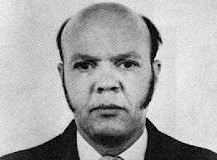
The Trailside Killer of San Francisco
By Katherine Ramsland
Shattered Peace
Edda Kane went out on August 19 in 1979 to hike
the trails in a park at the foot of Mount Tamalpais, also known as "the
Sleeping Lady," which overlooked San Francisco's Golden Gate Bridge.
At 44, she was a married bank executive with an athletic lifestyle.
On this day, she found no one to join her, so she went out alone to
get her workout. But she did not return home that day, so her
worried husband contacted the police. Believing she was in trouble,
they sent out a search team, including dog handlers, just in case
she had fallen and was in some inaccessible place. But despite the
fact that her car remained untouched in the parking lot, they failed
to locate her that night.
Found the next day, Edda was dead. She'd been
attacked from behind and had a bullet wound on the back of her skull.
The police believed, from her position on her knees with her face on
the ground, that possibly she had been forced to show subservience
to her killer, perhaps even to beg for her life. The killer had
removed $10 from her wallet, along with some credit cards, and had
taken her glasses but had left her jewelry. It was the first known
killing on Tamalpais.
Witnesses described two lone men, one blond and
acting rather strangely, and the other wearing a dark blue jacket
which apparently made him sweat. He'd hid his face with it, but
people estimated that he was about 35.
The autopsy showed that Edda had been shot once
with a .44-caliber gun and it appeared that she'd been the victim of
an execution style attack. Yet she had not been raped, so the motive
for this unthinkable attack remained a mystery. In fact, no one who
knew Edda could think of any reason why someone might want to harm
her. There was little evidence in the area to assist the police to
track her killer, so the murder went unsolved. It shook up people
who used the park, but after a while things returned to normal.
Eventually, however, Edda Kane's murder would gain a different
status as more than just an isolated unsolved homicide; it would
become the first of more to come.
The principal source for this spate of murders
during the early 1980s is Robert Graysmith's book, The Sleeping
Lady, as well as news reports from area California papers, primarily
the San Francisco Chronicle. Another key source is John Douglas'
first book, Mindhunter, because he was the FBI profiler who got
involved in the case when it appeared that a serial killer was on
the loose. He provides important insights into how this killer was
studied, as well as explanations for why he might have been a
psychopathic lust killer in the first place.
Graysmith opens his book with the legend of the
Sleeping Lady: a sun god fell in love with an Indian maiden, so he
carried her off into the sky. But then he stumbled over Mount Diablo
and as he fell back to Earth, she was killed. The place where she
hit the ground is where the mountain supposedly grew up into the
profile of a sleeping woman. Or a dead one.
Mixed Signals
Not until spring the following year was there
another violent incident, but in early March, the body of Barbara
Schwartz, 23, was found murdered in the same park where Edda Kane
was killed. Out hiking with her dog on the 8th, the young baker had
been repeatedly stabbed rather than shot, and her wounds had been to
the chest. But there had been a witness who had watched the entire
episode, and it was she who led the rangers to the crime scene.
This female hiker was watching through the trees
as a thin, athletic man, about twenty-five, she guessed, approached
Barbara Schwartz, whose dog was barking. He had a hawk nose and dark
hair, and he wore hiking boots. To her surprise, he suddenly began
to stab Barbara with a knife. They struggled for nearly a minute,
and then he fled as Barbara fell to the ground. The witness ran for
help, so the crime scene was quickly processed and a witness report
drawn up. Police found a pair of blood-stained bifocal glasses that
they hoped had belonged to the killer.
In retrospect, the witness's description would
prove to be wildly erroneous in every respect — which she herself
would later admit — and it would mislead the investigation for some
time. Other hikers that day had seen a lone male, wearing glasses,
who looked to be in his forties. He wore a raincoat, despite the
fact that it was not raining. Although no one knew it at the time,
this man was more likely Barbara's killer.
The pathologist counted twelve separate wounds in
her chest and he estimated that her attacker had used a ten-inch
knife. A few days later, some kids found a boning knife near the
crime scene, crusted with blood. It proved to have been purchased at
a chain grocery store, but the specific location could not be pinned
down. Unfortunately, a TV reporter handled it, obliterating
fingerprints.
The bifocals found near Barbara turned out to be
prison issue, so investigators busily checked lists of recently
released convicts, especially those with a record of sex crimes who
resembled the sketch a police artist had made from the witness
report. At this point, the FBI's San Francisco-based field office
got involved, along with other agencies. However, the investigation
turned up no good leads.
In fact, the police in another jurisdiction did
question a man that night who claimed to have been wounded in a
convenience store attack, but having no access to the Marin County
all-points bulletin, they failed to put and two together. While they
cannot be blamed for that, they neglected to find out that there had
been a convenience store robbery in the area. In any event, this man,
with his quiet manner, looked nothing like the predator who had
stabbed Barbara Schwartz to death, so the link would probably not
have been made that night.
The next day, the wounded man visited an
optometrist — Barbara Schwartz's doctor — to get a new pair of
glasses. Although police questioned him about Barbara's prescription,
he never heard about or saw the flyer about the eyeglasses found at
the scene. That was unfortunate, for it's likely he would have
recognized the unique prescription. Instead, the killer was free to
continue.
One More
Again, months passed, and then another young
woman entered the park alone to go jogging. People were certainly
afraid about being in the wilderness areas, but a few wanted to
demonstrate that the parklands were largely safe. They would soon
learn differently.
Anne Alderson, 26 and a former Peace Corps
volunteer, was seen by several people on October 15, at the end of a
long Columbus Day weekend, and the park's caretaker recalled seeing
her sitting alone in the 5,000-seat amphitheater to watch the sunset.
He considered warning her about the potential danger of being alone
at dusk but decided not to disturb her. Graysmith says that earlier
that day this same witness had seen a lone male in the area as well,
around age 50, who was just standing around. Two other people, says
John Douglas, recalled seeing Anne near the area where Edda Kane had
been killed over a year before. Then she apparently came under
attack, an easy mark, by all accounts.
She, too, had also been shot with a single bullet
from a .38 pistol, which had gone through the right side of her head,
but in this incident, there was a significant difference: Anne had
been raped and then allowed to get dressed again. Her right earring
was missing and she'd been propped, face up, against a rock. What
linked this murder clearly to Edda Kane's was her position. It
appeared from her twisted arrangement that she might have been
forced to kneel as well before being killed. What police did not yet
know is that there were two other victims that weekend, but only
Anne had been quickly found.
Not far away, a double homicide around the same
time provided a tentative lead on a suspect, because the victims had
both been shot by an apparently demented individual.
A Good Suspect
In a home not far from Mount Tamalpais on October
16, 1980, two people were found shot to death. According to the
court records, this is what occurred: Mark McDermand, 35, and his
brother, Edwin, 40, both resided with their mother, Helen McDermand,
75, in Mill Valley. At approximately 8:30 P.M. sheriff's deputies
forced their way into the home at the request of a concerned friend.
They found the body of a man lying in a hallway off to the left of
the living room, whom they learned was Edwin. He had been dead
approximately 12 hours, and several bullet wounds were evident in
his head and chest.
In a locked bedroom was the body of an elderly
woman, subsequently identified as Helen, lying on the bed and
covered by a blanket. The body had a single bullet wound behind the
left ear. Scattered around the floor were eight spent .22 caliber
casings: five near Edwin's body, one in the living room near the
door to Helen's bedroom, one near a bookshelf between Edwin's and
Helen's bedrooms, and one in Edwin's bedroom.
Looking around, the deputies went outside and
observed a small, padlocked door leading into the basement. After
forcing entry, they discovered a note tacked to the inner side of
the door, addressed to "Shitheels" and stating that by the time the
note was discovered, the reader would be "way too late;" the author
would be found on the news or on a "slab." It was signed "Mr. Hate."
This smelly, dirty basement area had been the
bedroom of Mark McDermand. He seemed a likely suspect, as there were
spent .38 caliber casings in his room, along with three live rounds
of .22 caliber ammunition, and ankle holsters for a handgun and a
knife.
The coroner said later that while it was
impossible to determine either victim's exact time of the death,
samples of the vitreous humor fluid from their eyes suggested that
both deaths had occurred from three to four days earlier.
Within a few days, the local newspapers and the
Marin County Sheriff and other members of his staff received letters
from an individual who claimed responsibility. A handwriting expert
testified that the author of these letters was the same person who
had written the note tacked to Mark's bedroom door; the writer
claimed he would not be captured alive. Clearly he was following the
news coverage, so the police devised a plan to lure him in: they
indicated that if he surrendered, they would treat him fairly. They
ran a letter directed to Mark, giving him a phone number.
Capture
An individual identifying himself as Mark
McDermand called the number that evening, October 24. He said he
would consider giving himself up, but he had some things to do first.
He called again two days later, describing details about the
killings. He said he had tried to kill his mother and brother
quickly, but he'd miscalculated with Edwin and had to shoot him five
or six times. His motive was to stop Edwin from hurting others and
to prevent his mother from realizing that he'd killed Edwin. He then
agreed to turn himself in the following day.
When he approached the police, McDermand was
wearing a belt with a .38-caliber revolver in it. He also had a set
of thumb cuffs and three speed loaders. In his car was a .22-caliber
pistol, a .12-gauge shotgun, ammunition, a metal box containing
numerous hypodermic syringes, and some vials of insulin. Mark had
diabetes.
When the investigation was complete, the police
thought they had a good sense of the story. Edwin had a record of
acting strangely and been diagnosed with schizophrenia. He
deteriorated rapidly. Mark became impatient, referring to him as "It"
or "the Thing." On one or more occasion during the six-month period
prior to the murders, he had confided to a friend in a dejected
manner that he didn't know what would become of his brother once
their mother was gone, and that someday he "would put 'it' out of
its misery."
McDermand had borrowed the guns he used in the
homicides, and had then prepared himself to go on the run for a
number of months. In his defense, he said that he had acted out of
diminished capacity and indicated that, like his brother and mother,
he suffered from schizophrenia. There was little dispute that
Edwin's mental state was disorganized, and evidence was offered that
Mark, too, had experienced headaches and blackouts. He claimed he
could not even remember the murders, or when he did, he recalled a
number of different versions.
The jury nevertheless found Mark McDermand guilty
of two counts of first-degree murder, and he received the death
penalty. Yet his potential part in the trailside murders was quickly
resolved: none of his weapons matched the bullets used on the two
victims who'd been shot. And, most telling, after he was in custody,
the murders continued. The next discovery was horrifying.
Gruesome Dump Site
Late that November, it became clear that the
killer had been busier than the police had realized; four bodies
were found on the same day, and the victims appeared to have been
killed in pairs, two recently and two at least six weeks earlier.
A young woman named Shauna May was supposed to
meet friends on November 28 in Point Reyes National Seashore Park to
go hiking. This park was a few miles north of San Francisco and had
not yet become the scene of slaughter. When she failed to show, her
friends alerted park officials. It was two days before they found
her nude body. She'd been trussed with picture frame wire, shot
three times in the head, and shoved into a shallow trench. The
autopsy later determined that she had been raped.
Close by, to the point of touching her, was the
body of another young woman, twenty-two-year-old Diana O'Connell.
She, too, had gone missing while hiking with friends. One had been
in front of her on the path, the other some ways behind. Neither saw
her slip away.
The two victims lay together, face down. It
seemed that Diana, shot once in the head, had been murdered at the
same time as Shauna May, since another hiker had heard four shots in
that area at mid-afternoon. Their clothing was piled onto their
knapsacks and a pair of panties was stuffed in Diana's mouth. She'd
been strangled with wire and raped as well. The police assumed that
the killer had interrupted one of these women in her hike with the
intention of rape and the other had come along at the wrong time. As
a witness, she had to be eliminated, too. A later investigation
indicated they had not known each other.
But the day turned out to be worse than anyone
had anticipated. During the search, two more bodies were discovered
just half a mile away — actually found first — and both victims had
been shot in the head. For the first time, one victim was male. They
were identified as Richard Stowers, 19, and Cynthia Moreland, 18.
They had been engaged to be married and had gone hiking together in
mid-October, in an area that Cynthia reportedly knew quite well.
They'd been reported missing on October 11, but had not been found.
In fact, Rick was considered to be AWOL from the coast guard.
An autopsy placed their time of death just a few
days before that of Anne Alderson. So either there were two
predators roaming the area or the same person had gone looking for
victims in two different parks. Then ballistics analysis confirmed
that the killer of Anne Alderson had also shot May and O'Connell.
There was one very deadly predator.
Hikers were warned in both parks not to hike
alone, although being with another person had not helped Stowers and
Moreland. People who loved the nature trails found other places to
go or remained home until the murders were solved.
Those people who had spotted a victim with
someone offered what little they could recall, and Marin County
Sheriff G. Albert Howenstein Jr. had a composite drawing made to
show others who'd also been in the area. However, it was difficult
to get a consensus on key features. Douglas says that the witnesses
conflicted on such things as the age of the man seen with a victim,
and his facial features.
Many people still recalled an earlier series of
murders in the area that had never been solved, and Douglas
indicates that there was speculation about whether he'd risen his
ugly head again.
Zodiac - David Carpenter
Between December 1968 and July 1969, a decade
earlier than the Trailside Killings, a man shot two couples in
Vallejo, California, on two separate occasions, and called to take
credit for them. One young man had survived to give a description.
Then the editors of three San Francisco papers each received part of
a strange letter claiming to be from the Vallejo killer. He had used
too much postage and his message consisted of a printed cryptogram
composed of symbols and signed with a crossed-circle symbol. One had
to put them all together to crack the code, which a local teacher,
after painstaking work, managed to do. Its author was clearly
playing a sadistic game, as he described his joy in killing people
and his intention to keep doing so.
Thus began a cat-and-mouse game by "the Zodiac,"
as he called himself. Then he attacked a third couple. On September
27, 1969, Cecelia Ann Shepard and her friend, Bryan Hartnell, were
picnicking at Lake Berryessa, where a man wearing a black
executioner's hood approached them. He stabbed them, attacking the
girl repeatedly, and afterward called the police to report it. He
struck again, two weeks later, killing cab driver Paul Stine. Soon
after, the Chronicle received a letter with a torn piece of Stine's
shirt. Yet no leads proved productive, and there was speculation
that this same killer had been responsible for the murder of a young
woman in another town as well. The Zodiac kept in sporadic contact
with the SFPD and the Chronicle, but his killing seemed to end with
seven victims, despite more extravagant claims —and threats — on his
part.
Many different suspects were developed, but none
checked out. The case proved to be one of the rare times when a
serial murderer appeared to be quite clever and well-educated,
making his crimes into a layered series of games. That he seemed to
withdraw and lie low proved disturbing, because if he remained at
large, he could always start up again, there or elsewhere. Douglas
suggested that he might have been arrested for something, which had
kept him from acting. For all anyone knew, this was the same person,
freshly released, although the MO was certainly different. No one
was calling to take credit for these murders, nor offering any codes.
Winter passed without further mishaps that anyone
knew of (they would later learn this was not the case), but the
police were busy with their investigation. Still, they had no leads.
Around this time, the new art of profiling got some play. Graysmith
is dismissive, but John Douglas actually had something interesting
to say.
Profilers
In 1980, Douglas writes, the police from the San
Francisco Bay area had requested the FBI's help on the series of
hiking path murders. By this time, the press had already dubbed the
offender the "Trailside Killer." The initial request went to Special
Agent Roy Hazelwood, who was a sex crimes expert. He and Douglas had
published an article that year about lust murder, setting forth the
distinctions between organized and disorganized killers, and
Hazelwood believed that sexual assault was generally motivated by
aggression, sex or power. The fantasies that occur around puberty
influenced the type of victim a lust killer selects, as well as his
approach, preferred sexual activities, rituals, and decision to
complete the act (or not) with murder.
Hazelwood viewed sex offenders as either
impulsive or ritualistic. Impulsive offenders were opportunistic and
generally of lower intelligence and economic means, and their sexual
behavior often served power or anger needs. Ritualistic offenders,
on the other hand, indulged in paraphilias and compulsive behaviors
that satisfied a specific psychological need. As they centered their
lives around this activity, they learned to lie and manipulate in
order to keep it hidden from others and secretly active.
Hazelwood discussed the case with Douglas, who at
that time was the Bureau's only full-time profiler in the field, and
they worked it together. They were both part of the first generation
of FBI profilers, an elite group of agents hand-picked to learn the
art of the psychological analysis of crime scenes. They had yet to
have any striking cases that would gain them national exposure, but
they were being consulted more often by local jurisdictions whose
investigators were willing to look into any avenue for assistance.
The basic idea of a criminal profile was to
acquire a body of information that revealed a common pattern for a
general description of an UNSUB (unknown subject) in terms of habit,
possible employment, martial status, mental state, and personality
traits. Probing for an experiential assessment of a criminal from a
series of crime scenes involved a detailed victimology — learning
significant facts about the victim's life, especially in the days
and hours leading up to his or her death. Their movements were
mapped and investigators study all of their personal communications
for signals to where they may have crossed paths with a viable
suspect.
Douglas went to San Francisco to examine the
crime scene data and case photos, and he said the killer would be
familiar with the area (so a local man), but he was shy, reclusive,
and may have a speech impediment. Contrary to what some local
psychologists had decided, who had described the offender as
charming, sophisticated and good-looking, Douglas thought he would
be unsure of himself in social situations. He chose victims of
opportunity rather than preferring a certain victim type. He was
white, intelligent, blue collar, and had spent time in jail. His MO
was to approach from behind, if possible, and become aggressive to
overwhelm the victim. He was "like a spider waiting for a bug to fly
into his web." He'd have a history of at least two of the three
background indicators: fire-starting, bed-wetting, and cruelty
animals. Douglas although thought he was probably in his thirties
and had recently experienced some precipitating stressors. While he
had committed rape before this series of murders, he had not killed.
That Douglas had been so specific about the
speech impediment drew a lot of doubt from the task force members;
they wondered how he could know something like that. Douglas
explained that the secluded killing areas, the method of approach,
and the fact that the offender did not approach his victims in a
social situation to lure them indicated some degree of shyness or
shame. He believed it was due to a physical malady. Overpowering
someone gave the killer some sense of compensation for his handicap.
"He has some kind of defect that really bothers him," he said.
The profile did not offer anything that one could
call a viable lead unless they had a suspect, so the police were
still in the same place. They had a guy who roamed the thickest
areas of the hiking trails, lying in wait for potential victims.
With the many miles of trails around San Francisco, there wasn't
much they could do.
After Douglas returned to Quantico, the killer
struck again in March 1981. This time, though, he made a serious
blunder. For him, it was the beginning of the end, even though he
had switched to yet another park.
Survivor
Ellen Marie Hansen and Stephen Haertle,
undergraduates at the University of California at Davis, were hiking
in the Henry Cowell Redwoods State Park on March 29, 1981. This area
was about eighty miles south of San Francisco, near to Santa Cruz —
another town that had suffered a series of murders during the early
1970s. Edmund Kemper, John Linley Frazier and Herbert Mullin had
killed there around the same time, Frazier targeting a family,
Kemper killing coeds, and Mullin imagining he had to eliminate "sacrifices"
to protect the state from an earthquake. It had been nearly a decade,
however, since all of that had happened and all three offenders were
safely behind bars.
Steve Haertle would later describe what had taken
place, as he managed to survive despite being shot. A man approached
them, he said, not far from an observation deck and he had a pistol
in his hand. He threatened them with it and insisted that Hansen
allow him to rape her. She refused, and Haertle begged the man to
let them go, but the stranger lifted his gun and in front of Haertle,
shot Hansen point-blank, twice, in the head and once in the shoulder.
Haertle was horrified but unable to get away as the stranger then
shot him as well. However, the bullets burrowed through his neck, so
he was not killed. The man fled the area as Haertle sought help from
other hikers.
He was obviously in a perfect position to offer
police a description of this attacker, although trauma involving
guns often interferes with one's memory. Steve did recall the man's
crooked yellow teeth and thought he was about fifty and balding.
He'd had a backpack and wore dark glasses, as well as a gold jacket
with lettering on the back and a baseball cap. In addition, he'd
spoken in quick, commanding sentences. Steve estimate that he'd been
about five-foot-ten to six feet tall, and about 170 pounds.
Along with what Haertle offered, other people
also reported a man they had seen on the observation deck, running
after the gunshots, and driving off in a red car of foreign make.
One girl thought it was a Fiat. The Post Standard indicated that
there had been seven witnesses altogether who reported the man to
the police. The resulting physical description differed markedly
from that of the Marin County Killer, but not the MO.
As much as police need to rely on eyewitnesses,
they also know that memory is tricky and many people who believe in
what they've seen are nevertheless wrong. About 80% of people
exonerated in recent years, who served time in prison, can attest to
the mistakes. One man even had five witnesses give erroneous
testimony that linked him to a murder.
Yet investigators did manage to get some good
shoeprint impressions, so that if they developed a suspect, they
could compare his shoe size, and perhaps even his shoes, (if he
didn't toss them), to the impressions.
They ran the composite drawing in a number of
newspapers, both to alert people to what this dangerous person
looked like and to get new leads from residents who might know him.
Only four days later, a woman called to describe a man who resembled
the picture. She had been on a cruise to Japan some twenty-six years
earlier and had confronted a young man named David Carpenter, a
purser on that cruise, who had been bothering her daughter with
inappropriate behavior. She recalled that he had stuttered — the
speech impediment that Douglas had suggested — and had proof of his
name from where he'd signed her daughter's book.
The police looked into it, but there were many
men in northern California named David Carpenter. As they moved
forward with their investigation, the killer was reading the
newspaper. He decided it was time to grow a beard. He also had found
a way to lure another young woman into his net. However, this time
he killed much closer to home, leading the police right to him.
Either stupid or arrogant, he made yet another mistake, and while
the police benefited, a pretty blond fell victim.
The Trusted Friend
On May 2, Heather Roxanne Scaggs, 20, told her
boyfriend that she was going to see David Carpenter about a used car;
supposedly, a friend of Carpenter's was selling it and he was going
to help her to purchase it. She was a student at Econo Quick Print,
where Carpenter taught people how to use computer typesetting
machines, and sometimes he had given her a lift home in a company
car. She had mentioned wanting a car of her own, so he'd told her
about this opportunity. He even offered to loan her whatever amount
she did not yet have. In fact, he pressured her so much with
additional incentives that she finally gave in and agreed to go see
it. Before leaving, she gave her boyfriend, Dan Pingle, the number
and address of David Carpenter, and a time when she expected to
return.
But she did not return then, or hours later, so
Pingle went looking for her and confronted Carpenter. He pretended
that they'd never connected that morning. Now frantic, Pingle
alerted the police. He knew that Carpenter had instructed Heather
not to tell anyone where she was going and to bring $400 for the
car. She'd been in a vulnerable position and had even expressed some
concern about going.
Heather's disappearance brought up Carpenter's
name again, already identified as resembling the composite drawing.
That was too great a coincidence. Although no body had been found,
Heather was about the right age to possibly have become a victim
like those killed along hiking trails. The police checked records
and found Carpenter's parole officer, Richard Wood. As he listened
to their concerns, he started to add things up. Graysmith records
his gut-level impression that Carpenter might be the killer the
police were looking for.
The police now learned that Carpenter had not
shown up in the records of released inmates when they'd initially
looked, due to a technicality. He had been released by California to
serve a federal sentence, Douglas explains, and while free, he was
technically in federal custody. If not for this, he might have been
flagged much earlier.
Wood thought they should keep a watchful eye on
Carpenter, and he did what he could to facilitate their access to
him. Detectives interviewed him about Heather and thought he
resembled the composite of the person seen at the Trailside Murders'
sites. They had also learned that he was a habitual sex offender,
another item not fully documented in his records. The multi-agency
task force got into gear to start following him.
"Please Don't Hurt Me"
The FBI, along with local authorities, set up a
surveillance van outside the house at 36 Sussex Street in San
Francisco where David Joseph Carpenter, 51, lived with his aging
parents. They also followed him to places he went, especially when
he associated with other criminals. Graysmith includes several
photos from a videotape when they caught him walking with a shopping
bag in his hand. They approached him carefully, speaking in soft
tones so as not to alarm him or inspire him to reach for whatever
was in the bag. He seemed confused at first, but soon insisted on
getting a lawyer. At this point, the agents told him he was under
arrest.
"Please don't hurt me," he begged.
In Carpenter's car, a red Fiat with a bent
tailpipe (as described by witnesses), police found books about local
hiking trails, along with many more such maps in his home — over
sixty in all. They also located Carpenter's former fiancé, who told
them that Carpenter had lost his gold jacket around the time of the
Hansen murder. He said it had been stolen, although that had struck
her as unlikely. This testimony proved that he'd at least had a gold
jacket at that time, placing him circumstantially at the site of the
shooting of Hansen and Haertle.
Thus, Carpenter drove a car similar to the one
described by the surviving victim, had the same optometrist as
another victim, had the right distinctive type of clothing, and had
a record for violent sex crimes. He also suffered from explosive
rages and had recently tried to change his "look" with a different
type of frame for his glasses. In addition, several witnesses had
recognized him as the man who had been in the area of an attack.
The police put him in a line-up, inviting
everyone who had made a report to participate. Steve Haertle went to
the station to endure the ordeal of seeing again the man who had
shot him and killed his girlfriend. Despite the newly-grown beard
hiding Carpenter's face, Steve quickly picked him out as the
perpetrator. The Post-Standard indicated that six out of the seven
witnesses did the same, although several were not quite certain. (Graysmith
says that three were unable to make the identification.) A car line-up
was also arranged and witnesses identified the Fiat. Carpenter was
formally charged in the murder and attempted murder in Santa Cruz.
At his arraignment, he stuttered so badly he had a difficult time
answering the judge's questions, which was to simply agree that his
name was as stated.
"Carpenter's face contorted and his head shook as
he struggled to respond," states the Post-Standard. "He finally
managed to utter a 'yes' after the passage of several seconds."
On May 15, 1981, newspapers published the stories
about Carpenter, the supposed Trailside Killer. In a press
conference, officials reiterated that they believed the killer of
eight had psychologically tortured his victims first.
Then decomposed remains of a female were found in
Big Basin Redwoods Park on Sunday, May 24. Her killer had apparently
tried to hide her body under a lot of brush. He'd removed her
clothing and taken everything except an earring — smiliar to an
earlier murder. An analysis of the dental work indicated that they
had found Heather Scaggs. She had been raped and shot once through
the eye with a .38. That made nine dead.
The Man Behind the Predator
By May 27, the Syracuse Herald-Journal noted that
Marin County District Attorney Jerry Herman was going to file
charges against Carpenter in five more of the murders, all linked
via ballistics analysis to Carpenter's guns, and he held out hope
that evidence would surface in at least another murder. He was not
going to file charges in the murders of Barbara Schwartz or Edda
Kane, since evidence was lacking. One of them had been stabbed with
a knife on which there were no usable prints and the other killed
with a different gun, which had not been found. Still, the office
would continue to investigate.
Oddly enough, Lane and Gregg indicate that
Carpenter had been a suspect for a time in the Zodiac killings, but
his handwriting and fingerprints had cleared him. A few people
recall him at one point claiming to be the Zodiac.
Whatever the case, his background was being
thoroughly scrutinized. Born on May 6, 1930, in San Francisco,
Carpenter had been raised by strict and aggressive parents. His
alcoholic father beat him or neglected him, while his near-blind
mother was described as domineering. By the time he was seven, he
was stuttering so badly he had a difficult time in any social
situation. He was often ridiculed, which made him painfully
reclusive. He received no therapy but was instead forced to
participate in extracurricular activities, such as ballet and piano.
He took out his frustrations on animals and also wet the bed (two of
the three indicators, as Douglas pointed out).
As he grew into adolescence, he looked for
opportunities to express his developing sex drive and by the time he
was seventeen, David had been arrested for molesting two young
children, his cousins. He served a year and apparently learned
nothing from the California Youth Authority, because once released,
he became more predatory. Frasier states that he continued offending
until he got married in 1955.
Carpenter worked at various occupations,
including as a ship's purser, a salesman, and a printer. He
apparently had a demanding sex drive that he tried keeping under
control by subjecting his wife to his constant need. They had three
children together, but Carpenter could not continue to control
himself. In addition to his violent rages, he also prowled around,
looking for other women. Finally, his drive was so desperate, he
resorted to outright violence.
Sentenced
In one incident in 1960, fully described by
Graysmith, Carpenter had befriended a woman, inviting her to his
home to meet his wife and including her in some of his celebratory
moments. Then one day, he picked her up, but instead of taking her
to work as promised, he drove to a wooded area of the Presidio and
then acted as if he was lost. At some point he grabbed her,
straddled her, and used a clothesline to bind her. With a knife, he
threatened her, forcing her to be still. He told her he had a "funny
quirk" that needed to be satisfied. When she resisted and tried to
get away, he struck her several times with a hammer. Douglas states
that prior to and during the incident, he lost his crippling stutter.
The victim described his speech as slow and deliberate, in contrast
to the way he usually talked, and he had seemed unduly angry.
This woman might have been Carpenter's first
murder victim had she not been saved by a suspicious military patrol
officer who heard her call for help. He'd been looking for
Carpenter's car, having spotted it earlier, and when he saw what was
happening, he commanded Carpenter to stop. Carpenter shot at him,
missing, so he returned fire and wounded Carpenter. Then the MP
arrested Carpenter and took him in. The victim survived, but
Carpenter, who claimed to have blacked out during the attack, ended
up with a fourteen-year sentence.
During this time, his wife, who'd had to put up
with his temper and sexual demands and who'd just given birth to
their third child, divorced him. To psychiatrists who evaluated him,
he gave a range of different stories about what had occurred, from
amnesia to a lover's quarrel. He'd clearly learned to tell people
what he thought they wanted to hear.
In 1969, Carpenter was freed after only nine
years. He quickly got remarried, and in less then a year, he was
back at it again (and the marriage failed). He tried to rape a woman
by hitting her car to force her out of it. When she struggled
against him, he stabbed her, but she managed to get back into her
car and race toward help. Obviously, Carpenter was now looking for a
way to rape but not return to prison, so he was prepared to
eliminate witnesses. He continued to target women until he was
arrested again in Modesto on February 3, 1970.
While awaiting his trial, Carpenter conspired
with four other inmates at the Calaveras County jail to break out
and escape. They didn't get very far and he was sentenced to seven
years for kidnap and robbery (not for any sex offenses). He also
received two more years for his parole violations. When he got out
in May 1979, he was not listed as a sex offender, although he
clearly was. By August, he had murdered Edda Kane.
Even while Carpenter continued his criminal
activities, he found a way to pass as a normal, productive citizen.
He took courses in computer printing at the California Trade School,
graduating with a degree. Then he got a job as a typesetter
instructor at an agency affiliated with the school. He took up
hiking as a hobby, but not for the same reasons most people do. He
simply liked the shelter afforded in the wilderness for grabbing
young women to rape and kill without being seen. It remained for the
courts to ensure he return to prison for the rest of his life.
The Final Victim
On June 16, 1981, in Castle Rock State Park, rock
climbers came across a jaw bone. At the urging of acquaintances,
they brought it in and the police sent it for analysis. It proved to
be human, and with further work it was identified as the partial
remains of a seventeen-year-old high school student, Anna K.
Menjivar, missing since December 28 the previous year. Many people
had suspected that Carpenter had something to do with her
disappearance.
She had worked part-time at the bank where
Carpenter was a client, and he often engaged in conversation with
her. People were under the impression that she was the reason he
came to the bank. But evidence against him was slim. Even the cause
of death could not be established.
Yet other cases could be prosecuted, and perhaps
that would become some sort of justice for young Anna. Carpenter was
formally charged with the five Marin County killings (Anne Alderson,
Diane O'Connell, Shauna May, Cynthia Moreland, and Richard Stowers),
two rapes, and an attempted rape. The police had recovered the .38
that he'd given to a friend — a bank robber who wanted no part in
protecting a killer and who suspected that Carpenter was setting him
up — and they now had everything they needed to move forward with a
strong case.
Given its inflammatory nature in the Santa Cruz
and San Francisco communities, the venue was shifted three hundred
miles away to Los Angeles.
The First Trial
Carpenter insisted he was innocent and continued
to do so throughout two trials.
His first trial was for the murders of Heather
Scaggs and Ellen Hansen, and the attempted murder of Steve Haertle.
It started on October 11, 1983. The judge seated one jury to decide
his guilt and a second one to decide the penalty in the event of a
conviction. Along with the alternates, this made for a substantial
body of people for the attorneys to address.
It took many weeks of voir dire before DA Art
Danner could present his opening argument in May, which focused on
eyewitnesses and ballistics evidence. Carpenter's gun had been
linked to each of the murders, and Steve Haertle's testimony
identifying Carpenter as the attacker who shot him and killed his
girlfriend was persuasive. It was no surprise that after six weeks
of testimony, the eight-woman, four-man jury deliberated for eight
hours over the course of two and a half days to reach their verdict.
On July 6, 1984, David Carpenter was convicted of two counts of
first-degree murder and one count of attempted murder.
"The balding, bespectacled defendant had no
visible reaction," reported the Syracuse Post-Standard. He attorney
shrugged it off, saying that Carpenter had expected to be convicted
and had prepared for it. He also described his client to the press
as a "mental mess," admitting that he was a killer but resisting the
idea that he should face the death penalty for it: His crimes had
been impulsive, not planned, and he'd been unable to control himself.
Yet no amount of psychological testimony had convinced the jury that
abusive parents were entirely responsible for this killer's
development toward such cruelty.
The second jury found three special circumstances
that warranted the death penalty: committing multiple murders,
committing during a rape, and lying in wait. Carpenter was to be
given the death sentence via execution in San Quentin's gas chamber.
But the court was not finished with him. He had a
second trial coming right up for the Marin County killings — though
it would be delayed for several years by legal wrangling. And this
trial would have an unexpected and disheartening glitch.
Five More
The second trial opened in San Diego on January
5, 1988. Deputy DA John Posey had a huge job ahead of him in his
first death-penalty case, with more than sixty witnesses, but he'd
long prepared for the task. Carpenter's attorneys were public
defenders Frank Cox and Steve Berlin. Robert Graysmith attended this
proceeding and offers a first-hand account. Unlike the Los Angles
trial, in which the defense had offered few witnesses, Carpenter's
witness list this time numbered over thirty, and he himself would
testify.
It took until May 10, in a trial that once again
proved that Carpenter's gun was the one that shot the victims, and
he was convicted of all five of those murders. He'd offered
carefully constructed alibis, but the prosecutors proved that his
documentation had been altered or that he'd been mistaken about some
of his dates.
For seven days, Carpenter was on the stand.
Although he appeared calm and prepared, reading from his calendar
and collection of receipts, he stuttered from time to time as he
described his acquaintances from prison and his various liaisons
with women. He also detailed his activities during the time of each
of the murders of which he was accused. Still, he also showed his
anger and his slippery and glib nature.
It was no surprised that after only seven hours,
another jury also recommended the death sentence for him, which the
judge accepted.
However, a few months later, the jury forewoman,
Barbara Durham, revealed something that could have made a difference.
She told friends that she had been aware (or became aware during the
trial) of Carpenter's convictions in Los Angeles in 1984 for the
Santa Cruz murders. She had concealed this fact during voir dire (or
during the trial). Judge Herbert Hoffman had to consider whether to
call a mistrial and have Carpenter retried. Since he thought the
evidence had been strong, it was a difficult decision.
On February 21, 1989, Judge Hoffman ruled that
while he believed that Carpenter was certainly guilty of the crimes,
since a member of the jury had unlawfully referred to his prior
conviction during discussions, he had to order a new trial. He made
no secret of the fact that he considered this a travesty of justice,
especially because the trial had been costly.
In 1994, state prosecutors asked the California
Supreme Court in San Francisco to overturn that decision, since the
evidence for Carpenter's guilt was overwhelming. However, the Deputy
State Public Defender insisted that the jury had been contaminated
and the trial had been essentially biased and unfair.
On March 6, 1995, the court refused to give David
Carpenter a new trial. Justice Armand Arabian stated that it's
virtually impossible to keep secrets in such cases and he believed
that the forewoman's knowledge had not unduly biased the jury. Thus,
they overturned Judge Hoffman's decision — probably without too much
disappointment for him.
In 1997, the state Supreme Court upheld the death
penalty for the Scaggs and Hansen murders, and on November 29, 1999,
they also upheld Carpenter's death penalty from his second trial.
Six of the seven judges agreed that he'd had a fair trial for the
five Marin County murders and had been sentenced properly. As of
this writing, he remains on death row in San Quentin, awaiting
appeals through the federal courts. At age 76, he is currently the
oldest inmate there.
CrimeLibrary.com