Murderpedia has thousands of hours of work behind it. To keep creating
new content, we kindly appreciate any donation you can give to help
the Murderpedia project stay alive. We have many
plans and enthusiasm
to keep expanding and making Murderpedia a better site, but we really
need your help for this. Thank you very much in advance.
Harvey
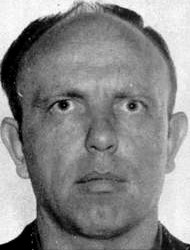
Louis CARIGNAN
A.K.A.: "Harv
the Hammer"
Classification:
Serial killer
Characteristics:
Rape
Number of victims: 5 +
Date of murders: 1949 / 1972 - 1974
Date
of arrest:September 24,
1974
Date of birth:
May 18,
1927
Victims profile: Laura Showalter,
58 /
Leslie Laura Brock, 19 /
Kathy Sue Miller, 15 / Eileen Hunley / Kathy Schultz
Method of murder:
Hitting with a hammer
Location: Alaska/Washington/Minnesota, USA
Status: Sentenced to death in Alaska in 1949. Reversed in 1951.
Paroled in 1960. Sentenced
the maximum of
forty years in prison in Minnesota in 1975
Harvey Louis Carignan
(born May 18, 1927) is an American serial killer
currently serving a life sentence at the Minnesota Correctional Facility
– Stillwater for the murders of two women. He had been previously
convicted for a 1949 rape and murder he committed while stationed in the
U.S. Army, in Anchorage, Alaska. He was paroled for that crime in 1960.
Harvey Carignan
By all rights, Harvey Carignan should
never have become a serial killer. Sentenced in Alaska to be hanged for
murdering a woman during 1949, the hulking killer might have been
eliminated early on had not the system intervened. An over-zealous
sheriff had elicited confessions from the suspect with assurances that
Carignan would not be executed, a condition that appeals courts found
disturbing.
Carignan's death sentence was reversed in 1951, and after
serving nine more years on a conviction for attempted rape, he was
paroled in 1960. There would be more arrests, for burglary, assault, and
other crimes; in 1965, Carignan was sentenced to a term of fifteen years
in Washington, but with time off for good behavior, he would hit the
streets again in 1969, consumed with an abiding rage against society in
general and women in particular.
Harvey married a Seattle widow shortly after his parole, but their
relationship was doomed from the beginning. Sullen, uncommunicative,
Carignan would frequently get up at night and drive long distances,
"to be alone and think." When he refused to share his thoughts
or name his destinations on the long nocturnal drives, the marriage fell
apart.
Remarrying another widow in 1972, Carignan showed no improvement.
His lascivious attentions to a teenaged step-daughter finally forced the
girl to run away from home, and he was faced with yet another failing
marriage in the spring of 1973.
That May, young Kathy Miller answered
Harvey's advertisement for employees at a service station that he leased.
The girl was missing for a month before two boys discovered her remains
while hiking on an Indian reservation north of Everett, Washington. Nude
and bundled in a sheet of plastic, Kathy had been bludgeoned with a
hammer, knocking holes the size of nickels in her skull.
Detectives in Seattle were aware of Harvey's record, and they hounded
him with such intensity that he departed from their city shortly after
Kathy Miller's body was retrieved.
A speeding ticket from Solano County,
California, on June 20 placed Carignan in the vicinity where half a
dozen women had been murdered in the past two years, but there was
nothing solid to connect him with the crimes, and he was on his way
cross-country, seeking sanctuary in his old, familiar haunts of
Minneapolis.
On June 28, Marlys Townsend was assaulted at a bus stop in
that city, clubbed unconscious from behind. She woke in Harvey's car,
still groggy from the blow, but when he tried to make her masturbate him,
she found strength enough to save herself by leaping from the speeding
vehicle.
Police made no connection with the human time-bomb ticking in
their midst. September 9, Jewry Billings, age thirteen, was hitching
rides in Minneapolis to reach her boyfriend's house, when Carignan
pulled up and offered her a ride.
Inside the car, he threatened Jewry
with a hammer, forced her to fellate him while he rammed the hammer's
handle in and out of her vagina. When he finished with her, Carignan
released his battered captive, but the incident was so humiliating that
the girl maintained it as a closely-guarded secret for a period of
several months.
A year would pass before detectives witnessed Harvey's handiwork again.
On September 8, 1974, he picked up Lisa King and June Lynch, both
sixteen, while they were hitching rides in Minneapolis. He offered money
if the girls would help him fetch another car that had been stranded in
a rural area.
Once out of town, however, Harvey stopped the car and
started beating June about the head and face. When Lisa ran for help, he
sped away and left his latest victim bleeding on the roadside.
A month
before, on August 10, another romance had collapsed for Harvey, ending
no less tragically for his intended. Eileen Hunley was a woman of the
church, who looked for good in others. She had looked for good in Harvey
Carignan, when they began to date, but there was nothing to be found.
She had informed her friends of her intent to terminate the sour
relationship, but Eileen Hunley disappeared on August 10. When she was
found in Sherbourne County five weeks later, she would be a rotting
corpse, her skull imploded by the force of savage hammer blows.
An
engine failure on September 14 almost cost Gwen Burton her life. When
Harvey Carignan appeared to offer her a ride, she had no inkling that
the trip would turn into an endless nightmare. Once alone, he ripped her
clothing, choked her into semi-consciousness, and raped her with the
handle of his hammer, finally slamming her across the skull with brutal
force before he dumped her in a field to die. Miraculously, she survived
and crawled until she reached a local highway, where a passing motorist
arrived in time to save her life.
On September 18 -- the day Eileen Hunley's body was recovered -- Harvey
picked up Sally Versoi and Diane Flynn. He used the old ruse about
fetching a car, then began to make lewd propositions, assaulting both
girls when they failed to respond on command. They escaped when he ran
short of fuel and was forced to stop at a rural service station. Two
days later, eighteen-year-old Kathy Schultz did not return on schedule
from her college classes, and a missing persons bulletin was issued by
police. Her corpse was found next day, by hunters, in a corn field forty
miles from Minneapolis. As in the other cases, Kathy's skull had been
destroyed by crushing hammer blows.
Police in Minneapolis were talking to their counterparts in Washington
by now, and within days, survivors started picking Harvey out of lineups
as the man who had abducted and assaulted them throughout the past two
years.
A search of his possessions turned up maps with some 181 red
circles drawn in isolated areas of the United States and Canada. Some of
the circles yielded nothing, indicating points where Harvey had applied
for jobs or purchased vehicles, but others seemed to link him with a
string of unsolved homicides and other crimes involving women. One such
cryptic circle marked the point where Laura Brock had disappeared, near
Coupeville, Washington. Another, at Medora, North Dakota, coincided with
discovery of a murdered girl in April 1973. Yet another had been drawn
around the very intersection in Vancouver where a woman, waiting for the
city bus, had been assaulted from behind and beaten with a hammer. An
ill-conceived insanity defense involving messages from God did not
impress the jury at Carignan's trial for attempted murder (of Gwen
Burton) in March 1975.
He was convicted and received the maximum of
forty years in prison. Since no criminal in Minnesota may be sentenced
to a term exceeding forty years, the other trials and sentences were
merely window dressing: 30 years for the assault on Jewry Billings; 40
years for Eileen Hunley's murder; 40 years for killing Kathy Schultz.
One hundred fifty years in all, of which the killer may be forced to
serve no more than forty, with the usual time off for "good
behavior."
Michael Newton - An Encyclopedia of Modern Serial
Killers - Hunting Humans
The Want-Ad Killer:
Harvey Carignan (1983)
Ann Rule
(as Andy Stack)
The Want-Ad
Killer is the second book in Ann Rule's
Andy Stack trilogy of serial killers. After his first grisly crime,
Harvey Louis Carignan beat a death sentence and continued to manipulate,
rape, and bludgeon women to death using want ads to lure his young
female victims. His weapon of choice was a claw hammer which he used to
rape and bludgeon his victims earning him the nickname of "Harv the
Hammer." He described himself as: "An instrument of God, one who was
acting under His personal instructions. Murder, rape and mutilation are
all part of a Grand Plan. God is a figure with a large hood and you
can't see his face." Under so-called orders from God, he killed at least
5 and maybe as many as 18 women.
Harvey Louis Carignan was born on May
18, 1927, in Fargo, North Dakota. His twenty-year-old mother was not
married. When he was three or four his mother married and had a second
son. At the age of six he was undersized and had a twitch in his face.
He was also a chronic bed wetter and had an imaginary friend, Paul.
When Carignan was eight, he was sent to live with his
aunt and uncle in Cavalier, ND, which lasted a short time and he was
sent back home. When he turned ten he was sent to live with his
grandmother in Williams, ND, then sent to live with another aunt before
going back home to his mother. He was still suffering from bedwetting
and started stealing. At age eleven, he was sent to reform school in
Mandan, ND for seven years. During this time he was diagnosed with
childhood Chorea, a nervous disorder marked by muscular twitching of
arms, legs and face and Carignan claimed female employees sexually
abused him. When he left the reform school at age eighteen he enlisted
in the U.S. Army.
On July 31, 1949 while stationed at Fort Richardson
in Anchorage, Alaska, Carignan raped and killed 57-year-old Laura
Showatler. She died from several blows to the head. Less than two
months later, Carignan attempted to rape Dorcas Callen but she escaped.
She told the police she had been approached by an intoxicated soldier at
around 7 a.m. Callen and another eyewitness, John Keith, identified
Carignan in a line-up. On September 17, 1949, Carignan was brought to
the U.S. Marshal for the murder of Laura Showatler where he provided
officials with a written confession, but there was no mention of a
murder. His confession to the murder was oral. In 1950 he was charged
and convicted of first degree murder. He was sentenced to death by
hanging. His lawyers, however, filled an appeal with the Supreme Court.
The Supreme Court ruled that Carignan’s confession was unlawfully
elicited by an overzealous police officer who assured Carignan that he
would not be executed if he confessed. In 1951 the Supreme Court
overruled his death sentence due the officers’ violations of the McNabb
rule. In 1952 he was transferred to Alcatraz where he served eight more
years and on April 2, 1960, he was paroled.
Four months later he was arrested in Minnesota for
burglary, assault, and attempted rape. He was convicted and sentenced to
two and one half years in a Minnesota State prison and another 2,086
days in federal prison in Leavenworth, Kansas. On March 2, 1964, he was
released on parole and move to Seattle where he was arrested on November
22, 1964, for second-degree burglary and sentenced to fifteen years in
the Washington State prison in Walla Walla. During his stay there he
obtained in his high school diploma (GED) and took some college courses.
In 1968 he was paroled.
A year later he married Sheila Moran and moved in
with her and her daughter. That same year he was arrested for parole
violation and suspicion of robbery. He was sent back to Walla Walla for
a year and his wife divorced him due to physical abuse.
On April 14, 1972, Carignan married Alice Johnson and
moved in with her and her two children, Billy (11) and Georgia (14). Two
months later Billy moved out to live with his real father due to the
beatings he had been receiving from Carignan.
On July 27, 1972, Virginia Piper disappeared. It is
speculated that Carignan had kidnapped her. On October 15, 1972, ninteen-year-old
Leslie Laura Brock of Bellingham, Washington was found dead. She died
from several blows to the head. Witnesses claimed that they saw her get
into Carignan's silver truck.
On May 1, 1973, Kathy Sue Miller, age fifteen,
answered Carignan's want ad for employees at a service station that he
was leasing. When the girl showed up in response to the ad, he sexually
assaulted and killed her. Her body was found months later by two boys
hiking on the Indian reservation north of Everett, Washington. She was
naked, bundled in a sheet of plastic, and had been beaten with a hammer
which left nickel-size holes in her skull.
On June 28, 1973, forty-seven-year-old Mary Townsend
was attacked by Carignan at a bus stop. He attacked her from behind
knocking her unconscious. When she awoke, she was in his vehicle and he
began to command sexual favors, but she managed to leap from the vehicle
and escape. A few days later, he was arrested for assaulting of his wife,
Alice, who decided to leave him.
On September 9, 1973, he picked up Jerri Billings, a
thirteen-year-old hitchhiker. He forced her to perform sexual acts on
him while he assaulted her with a hammer. After the assault, he released
her. She did not mention the event until several months later.
By May of 1974, Carignan had given up on Alice, and
started dating and living with Eileen Hunley, whom he picked up
hitchhiking, after moving to Minnesota. In August Eileen broke off her
relationship with him. She disappeared on August 10, 1974. Her rotting
corpse was found five weeks later in Shelbourne County. Her skull was
imploded by the force of savage hammer blows and she had been raped with
a tree branch.
On September 8, 1974, Carignan picked up seventeen-year-old
June Lynch and sixteen-year-old Lisa King who were hitching rides in
Minneapolis. Once they reach the outskirts of town he stopped the car
and started beating June in the head and face with a hammer. Lisa
escaped. While she was running for help, Carignan sped off leaving June
on the road side for dead.
On September 14, 1974, Carignan picked up Gwen Burton
from a Sears parking lot. He ripped her clothing, choked her into semi-consciousness
and sexually assaulted her with a hammer. He dumped her body in a near
by field but she survived and was able to craw to the road side for help.
Four days later, he picked up Versoi and Diane Flynn. He forced them to
perform oral sex and would beat them if they didn’t follow his commands.
The two girls were able to escape when Carignan stopped for fuel. Two
days later, Kathy Shultz did not show up at her classes. Her body was
found the next day by hunters in a cornfield forty miles form
Minneapolis. As in the other cases, Kathy's skull had been destroyed by
crushing hammer blows.
By this time, police in Minneapolis were talking to
their counterparts in Washington, and within days, survivors started
picking Carignan out of lineups as the man who had abducted and
assaulted them throughout the past two years. A search of his
possessions turned up some maps with 181 red circles drawn in isolated
areas of the United States and Canada. Some of the circles indicated
places where he had applied for jobs or purchased vehicles, but others
seemed to link him with a string of unsolved homicides and other crimes
involving women. One circle marked the place where Laura Brock had
disappeared, near Coupeville, Washington. Another, at Medora, North
Dakota, coincided with discovery of a murdered girl in April 1973. Yet
another had been drawn around the very intersection in Vancouver where
Mary Townsend had been waiting for the city bus and had been assaulted
from behind and beaten with a hammer.
In February of 1975, Carignan was tried on the
attempted murder and aggravated sodomy in Gwen Burton's case. He pled
not guilty by reason of insanity claiming that God told him to kill
those women. The jury was not convinced by the insanity plea and found
him guilty. He was sentenced to a maximum of forty years in prison.
Since no criminal in Minnesota may be sentenced to a term exceeding
forty years, the other trials and sentences, 30 years for the assault on
Jewry Billings; 40 years for Eileen Hunley's murder; and 40 years for
killing Kathy Schultz, were mere formalities. Out of the one hundred
fifty years, the convicted killer will have to serve no more than forty,
with the usual time off for "good behavior."
Carignan turned eighty-one May 18, 2008 and is still
serving time at the Minnesota Correctional Facility-Stillwater in
Bayport, Minnesota. His inmate records at this prison show the spelling
of his first name as Harvy (no E) not Harvey as in information provided
elsewhere.
Mysterycrimescene.com
Harvey Carignan
SKCentral.com
What is your full name? Harvey Louis Carignan
How old are you? Born May 15 or 16, 1926 or May 18, 1927.
Record-wise, the May 18, 1927 appears to be the correct date, but my
family lore and stories I heard from others makes it appear that May
15, 1926 is it. Actually, it doesn't make a hell of a lot of
difference at this time in my life other than as a conversation peice.
How tall are you and how much do you weight? 6'2", 270lbs down
from 289. Both are much to heavy.
What is your marital status? Divorced.
Do you have any kids? Three. All deceased. One by gunshot, one
from cancer, and the other from a dope overdose.
Are you in contact with your family? With some, with others not.
What was the last vehicle you owned? 1966 Toronado, 1968
Chevrolet Caprice, 1968 Chevrolet Pick-up 1/2 ton, and a 1973 Tornado.
I was arrested in 1974, so the vehicles were not all so old as they
seem.
What is your most treasured honor? To be loved by a good woman.
Describe the perfect woman. That is a matter of individual
taste and what I think is perfect couldn't possibly be of any interest
to you.
Who were your childhood hero's? John Dillinger, "Baby Face"
Nelson, and J. Edgar Hoover. The first two I knew through family
connections and the third because I was brainwashed.
What are your favorite TV shows? Nova, Antique Show, Trading
Spaces, and numerous sports shows.
What are your favorite movies? The Best Years Of Our Lives, The
Hunchback of Notre Dame with Charles Lawton, A Tale of Two Cities, and
many more of that kind and ilk.
What is your favorite song? 1943: Doris Day and Les Brown:
Sentimental Journey. A girlfriend liked it and introduced me to it and
I never got over it. Other than that Flamingo and Poinciana by Duke
Ellington.
Who is your favorite musician? Jimi Hendrix
What is your favorite band? Count Basie, Cab Calloway, and Duke
Ellington in ascending order.
Who are your favorite singers? Female: Peggy Lee Male: Joe
Williams
What were your hobbies before going to prison? Music and travel.
What are your hobbies now? Music and letter writing.
What is your favorite meal? Almost anything except seafood,
which makes me ill; I cannot stand the iodine.
Any recommended reading? Philosophy, Pyshcology, and anything
by Michel Foucault and THE LAST PURITAN by George Santayana.
What is the last book you read? Discipline and Punish by Michel
Foucault.
Describe the ideal evening. Free: An evening at home with my
family. In prison: Having a good letter to read and to answer to and
to top it off with a good book or movie.
What was your last New Year's resolution? None. I never made
one.
Nobody knows you're.... And they never will!
What is your biggest regret? That I did not learn the meaning
of regret earlier in my life.
If you were president, what would you do? Just be president and
would probably be ashamed of how I attained the office.
What is your advice to kids? Do not have parents.
What don't you like about people? Their arrogance and feeling
of superiority over other animals.
What is your biggest fear? I have no fears I can explain.
What are your pet peeves? Arrogant and stupid police officers.
Do you have any superstitions? None.
What do your friends like about you? I respond candidly and
truthfully.
Who, in history, would you have liked to have met? Some of the
Mountain Men and Indian Chiefs.
If you were an animal, what would you be? A human being.
What are your personal goals in life? So few were attained that I gave
up having them except to be released from prison under my terms.
What are some of your personal interests? People, books, music,
art, and theater in general.
What is your favorite color? Blue
How do you view yourself? A most ordinary and compassionate
person whose interests are such that I would not ever again get into
trouble, not because I am better than I was, but because I learned I
was a good person and how to maintain that status.
What do you think of this country? It is probably one of the
last so-called free countries in which the government is the citizens
worst enemy.
What is your political party? None.
What are your thoughts on:
Crime? Crime certainly exists and must be punished, but most
crimes were created by Congress and state legislatures at the behest
of teh criminal justice system so it might grow and become more
powerful.
Drugs? Except for those drugs that might lead people to harm
others, I think the government should keep its nose out of people's
business, especially drugs like marijuana, which if it was legal,
would cut out the use of a lot of other manufactured drugs.
Sex? Everyone should have some according to their preferences
and enjoy it immensely.
Alcohol? It is the bane of children and more dangerous than
many drugs. Still, such a high priority should not be put on keeping
it away from youth, it only makes them want it more.
Finish this sentence. I consider myself.... An above average
intelligen person who, if my training and lucky had been different,
would have been a most successful person in either the education or
business fields.
What do you expect from a friendship? A relationship that is
pleasureable to both parties, which, course, involves having
valuesthat matter and trust each in the other that is not misplaced.
What is your opinion on Religion? God revealed himself to the
Jewish people and has served them well as a go-between between
themselves and The Force that creates teh laws of the universe.
According to the Bible, God hated almost everyone except the Hebrew
and nations, especially those who worshipped other gods and such
nations as were a bane to the Jewish people, which would make him most
dissatisfied with America in our time where our religion is our
monetary values and our god is our money.
What are your artistic interests? Music, books, and classical
sculpture.
Do you consider yourself racist, sexist, or homophobic? None of
the above, but at one time I was homophobic and did not have a good
day unless I beat the hell out of at least one. The rason for this
treatment I received while in the state training school where
homosexuality was rampant among the trainee inmates, some of the
guards and their children, and the administration that was in charge
when I first arrived. I never participated but I had to withstand
remendous pain and suffering from some of the inmates and the
superintendent.