Murderpedia has thousands of hours of work behind it. To keep creating
new content, we kindly appreciate any donation you can give to help
the Murderpedia project stay alive. We have many
plans and enthusiasm
to keep expanding and making Murderpedia a better site, but we really
need your help for this. Thank you very much in advance.
Kenneth Eugene
BRUCE
Classification: Murderer
Characteristics: Robbery
Number of victims: 1
Date of murder: December 10,
1990
Date of arrest:
4 days after
Date of birth:
October 21,
1971
Victim profile: Helen
Elizabeth Hayers (female, 55)
Method of murder:
Shooting
Location: Collin County, Texas, USA
Status: Executed
by lethal injection in Texas on January 14,
2004
United States Court of
Appeals For the Fifth Circuit
Bruce, a 19-year-old high school student at the time working as a
pizza delivery driver, left work early.
Later that evening, Bruce
and two others the juvenile appeared at the Prosper, Texas, home of
Richard and Helen Ayers, claiming to have car trouble and looking
for jumper cables.
They eventually forced their way into the home at gunpoint,
ransacked the home, and ordered them to lay face down on a mattress
in the bedroom.
Both were then shot. The attackers left the bedroom,
and Mr. Ayers thought they were leaving the house.
Mr. Ayers had been shot in the back. He was paralyzed from the waist
down but he did not lose consciousness.
Mrs. Ayers told her husband
she had been shot in the leg. Mr. Ayers told her to hold on until
help could come. Mr. Ayers then heard someone say, “Shoot them again
and make sure they are dead.”
Mrs. Ayers was then shot in the head,
killing her instantly. Mr. Ayers was shot again in the shoulder.
The attackers then left the house with several jewelry boxes and
most of the phones that were in the house. Mr. Ayers remained
conscious but he could not move because of his paralysis.
He lay on
the mattress for about three hours looking at his dead wife until
his son came home from work and summoned help.
Upon arrest, Bruce initially gave an oral statement and a videotaped
statement in which he denied participating in any of the shootings,
although he admitted he was present when they occurred.
The police later found property of the victims in the front seat of
Bruce’s car. Bruce then admitted shooting Mrs. Ayers during the
second round of shooting; however, he claimed he aimed for her leg
or the lower part of her body.
Accomplice Eric Lynn Moore also received a death sentence.
Accomplices Sam Andrews and Anthony Quinn Bruce received a life
sentences.
Citations:
Bruce v. Texas, 116 S.Ct. 523 (1995) (Cert. Denied). Bruce v. Cockrell, 74 Fed.Appx. 326 (5th Cir. 2003) (Habeas).
Final Meal:
Double cheeseburger, french fires, orange juice and pecan pie.
Final Words:
"Yes sir. I would like to thank God for all the blessings He has
given me. And I pray that through His mercy, He will allow me into
His grace. And to the family of Ms. Ayers, I would like to apologize
for all the pain and suffering and that God gives you closure. And I
pray that He blesses you. And to my family, know that I love every
single one of you and pray that God gives you peace and strength. I
may not be with you in the physical, but by grace, my heart will be
with you all and I know God loves every one of you all."
ClarkProsecutor.org
Texas Attorney General
Media Advisory
Tuesday, January 6, 2004
Kenneth Eugene Bruce to be executed
AUSTIN- Texas Attorney General Greg Abbott offers
the following information about 32-year-old Kenneth Eugene Bruce,
who is scheduled to be executed after 6 p.m. on Wednesday, January
14, 2003, for a Collin County capital murder.
On February 27, 1992, Kenneth Eugene Bruce was
sentenced to die for the capital murder of 55-year-old Helen Ayers,
which occurred near Prosper, Texas, on December 10, 1990. A summary
of the evidence presented at trial follows.
FACTS OF THE CRIME
On the evening of December 10, 1990, Bruce, a 19-year-old
high school student at the time, was working as a delivery driver
for Cicci’s Pizza in Celina, Texas. Bruce asked the manager if he
could leave work early. When the manager asked why, Bruce said he
had to go “knock somebody out” and raised his hand in a fist. Bruce
left in his car with 19-year-old Sam Andrews and a juvenile. They
later picked up another person, 23-year-old Eric Moore.
Later that evening, Bruce and the juvenile
appeared at the Prosper, Texas, home of Richard and Helen Ayers,
claiming to have car trouble and looking for jumper cables. Mr.
Ayers told them he would meet them at the Ayers’ detached garage.
Mr.
Ayers could not find his jumper cables in the garage, so he invited
the two men into his home to warm themselves while Mr. Ayers called
his son at work to see if he knew where the jumper cables were.
However, before Mr. Ayers could make the call,
Andrews came into the house through the front door and Moore came
into the house through the back door. Moore and Andrews both had
guns.
Moore took Mr. Ayers’s billfold, and ordered him to call Mrs.
Ayers into the room and to bring her purse. During this time, Bruce
and the juvenile ransacked the master bedroom. Moore and Andrews
“herded” the Ayers into their master bedroom and ordered them to lay
face down on a mattress that had been pulled off of one of the beds
and thrown to the floor.
The Ayers were then shot. The attackers
left the bedroom, and Mr. Ayers thought they were leaving the house.
Mr. Ayers had been shot in the back. He was paralyzed from the waist
down but he did not lose consciousness. Mrs. Ayers told her husband
she had been shot in the leg. Mr. Ayers told her to hold on until
help could come.
Mr. Ayers testified he then heard voices in the
back of the house, and the men returned. Mr. Ayers heard someone say,
“Shoot them again and make sure they are dead.” Mr. Ayers could not
tell for sure who said this, but he assumed it was Moore. Mr. Ayers
then saw a hand with a gun go down and shoot Mrs. Ayers in the head,
killing her instantly. Mr. Ayers was shot again in the shoulder. The
attackers then left the house with several jewelry boxes and most of
the phones that were in the house.
Mr. Ayers remained conscious but he could not
move because of his paralysis. He lay on the mattress for about
three hours looking at his dead wife until his son came home from
work and summoned help.
The police arrested Kenneth Eugene Bruce on
December 14th after they stopped him in his car close to where he
went to school. Initially, Bruce gave an oral statement and a
videotaped statement in which he denied participating in any of the
shootings, although he admitted he was present when they occurred.
Bruce also led the police to a field where most of the victims’
property had been discarded. The police later found additional items
of the victims’ property in the front seat of Bruce’s car.
On December 19th, when Bruce was confronted with
inconsistencies from his accomplices’ statements, the police
obtained another videotaped statement from Bruce in which he
admitted shooting Mrs. Ayers during the second round of shooting;
however, he claimed he aimed for her leg or the lower part of her
body.
The forensic evidence proved otherwise. Mrs.
Ayers suffered three gunshot wounds from a single weapon: one to the
head and two to the thigh. It was determined that the thigh wounds
were inflicted before the head wound based on the extensive
hemorrhaging found.
The head wound caused death almost instantly
because the bullet passed through the brain stem destroying those
parts of the brain that control heartbeat and respiration. The
medical examiner determined Mrs. Ayers could have survived the thigh
wounds with proper treatment.
PROCEDURAL HISTORY
Mar. 5, 1991 — A Collin County grand jury
indicted Kenneth Bruce for the capital offense of murdering Helen
Ayers while in the course of committing and attempting to commit the
robbery of Helen or Richard Ayers, and while committing and
attempting to commit the burglary of the habitation of Helen and
Richard Ayers.
Feb. 26, 1992 — A jury found Bruce guilty of
capital murder.
Feb. 27, 1992 — Following a punishment hearing,
the court assessed a sentence of death.
Feb. 8, 1995 — Conviction and sentence affirmed
on direct appeal by the Texas Court of Criminal Appeals in an
unpublished opinion.
Nov. 27, 1995 — Bruce’s petition for writ of
certiorari was denied by the U.S. Supreme Court
Nov. 3, 1997 — Bruce filed an application for
writ of habeas corpus in the trial court.
Oct. 27, 1999 — Bruce’s application for writ of
habeas corpus was denied by the Texas Court of Criminal Appeals.
Nov. 13, 2000 — Petition for writ of habeas
corpus filed in U.S. District Court for the Eastern District of
Texas.
Apr. 24, 2002 — The federal court granted summary
judgment and denied Bruce’s petition for habeas relief.
Jun. 21, 2002 — The federal court granted Bruce
permission to appeal.
Aug. 4, 2003 — The 5th U.S. Circuit Court of
Appeals affirmed the denial of habeas in an unpublished opinion.
Nov. 3, 2003 — Bruce filed a petition for writ of
certiorari in the U.S. Supreme Court, which is currently pending.
Jan. 6, 2004 -- Bruce filed a state habeas
application, raising a jury instruction issue.
ProDeathPenalty.com
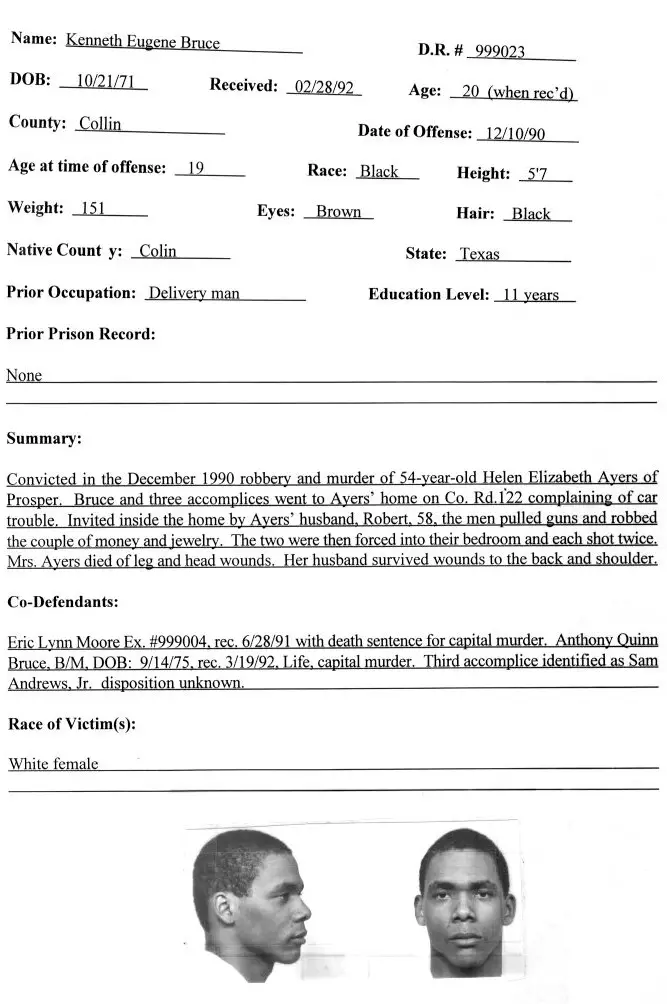
Kenneth Bruce was convicted of the Dec. 10, 1990,
robbery and murder of Helen Elizabeth Ayers of Prosper, Texas. Bruce
and three accomplices, Eric Moore, Anthony Bruce and Sam Andrews, Jr,
went to Helen's home and told her husband Robert they were having
car trouble.
He invited them inside where they pulled guns on the
couple and robbed them of money and jewelry. The couple were forced
into their bedroom and Robert and Helen were both shot twice. Helen
died of wounds to her head and legs. Robert was shot in the back and
the shoulder, but survived.
Kenneth Eugene Bruce
Txexecutions.org
Kenneth Eugene Bruce, 32, was executed by lethal
injection on 14 January 2004 in Huntsville, Texas for the murder and
home robbery of a 54-year-old woman.
On 10 December 1990, Richard Ayers, 58, answered
the front door of his rural home. Kenneth Bruce, then 19, and his
cousin, Anthony Bruce, 15, told Ayers that they were having car
trouble and asked him for some jumper cables. Ayers first attempted
to find some jumper cables in the garage. Unable to locate them, he
invited the men into his home to keep warm while he called his son
to see if he knew where the jumper cables were.
Before Ayers could make the phone call, he was
surrounded by four men. Sam Andrews, 19, came in through front door,
and Eric Moore, 23, came in through the back. Both were holding guns.
Moore took Ayers's billfold and ordered him to call his wife into
the room with her purse.
In the meantime, Kenneth and Anthony Bruce
were in the master bedroom, looking for valuables. They also pulled
a mattress onto the floor. Moore and Andrews then ordered the Ayers
into the bedroom and made them lay face down on the mattress. The
Ayers were then shot, and the assailants left the bedroom.
Richard Ayers was shot in the back. He was
paralyzed from the waist down. Helen Ayers was shot in the leg. Both
victims remained conscious and spoke to each other, thinking that
the assailants had left the house.
Mr. Ayers then heard voices in
the back of the house, and the men returned to the bedroom. Ayers
heard someone say, "Shoot them again and make sure they are dead."
Helen Ayers was then shot in the head and killed instantly. Richard
Ayers was shot in the shoulder. The attackers then left. Ayers
remained conscious, but paralyzed, on the mattress for about three
hours, until his son came home from work.
Eric Moore and Sam Andrews turned themselves in
to police afterward. The Bruce cousins were arrested four days later.
Kenneth Bruce confessed to being present at the shootings and led
police to a field where most of the victims' property had been
discarded.
The police later found some of the Ayers' property in
Bruce's car. In a subsequent confession, Bruce admitted shooting
Helen Ayers during the second round of shooting. He claimed that he
was aiming for her leg or the lower part of her body.
The medical examiner testified that Helen Ayers
was shot three times. The first two shots were in her thigh. The
shot to her head occurred later. He testified that she could have
survived the thigh wounds with proper treatment. Mr. Ayers,
wheelchair bound, testified at all four trials.
The criminals stole
only a few relatively inexpensive items, and discarded most of those.
According to trial testimony, the robbers believed that the Ayers
were rich, because their house had nice Christmas lights.
Bruce had no prior criminal history. A jury
convicted Kenneth Bruce of capital murder in February 1992 and
sentenced him to death. The Texas Court of Criminal Appeals affirmed
the conviction and sentence in February 1995. All of his subsequent
appeals in state and federal court were denied.
Eric Lynn Moore, who Ayers described as the
ringleader of the gang, was convicted of capital murder and
sentenced to death. He is on death row as of this writing. Anthony
Quinn Bruce and Sam Andrews Jr. were convicted of capital murder and
received life sentences. They remain in prison as of this writing.
"To the family of Ms. Ayers, I would like to
apologize for all the pain and suffering and that God give you
closure, and I pray that he blesses you," Bruce said in his last
statement. He then expressed love to his own family. The lethal
injection was administered, and Bruce was pronounced dead at 6:29
p.m.
Murder Nets Killer $10, Cheap Jewelry and
Death Needle
TheDeathHouse.com
January 14, 2004
HUNTSVILLE, Tex. - After killing a woman during a
home invasion robbery, Kenneth Bruce stole $10 and some cheap
jewelry. He also got a trip to the death house. Bruce, 32, was
executed by lethal injection at the state prison here Wednesday
night, becoming the second condemned killer put to death in Texas in
2004.
Bruce was executed for the December 1990 murder
of Helen Elizabeth Ayers, 58. Bruce and three of his cousins knocked
on the door of the home of Helen Ayers and her husband in Prosper
complaining of car trouble.
When the couple let the young men inside,
the Ayers were taken to a bedroom, shot twice and their home robbed.
Helen Ayers died, but her husband survived. He remains paralyzed
from the gunshot wounds. He laid next to his dead wife for three
hours before he was found.
Mom Watches Son Die
In his last statement from the death gurney,
Bruce first looked toward family members of Helen Ayers, who were
present to witness the execution, and apologized. "....I would like
to apologize for all the pain and suffering and that God give you
closure," Bruce said. "And I pray that he blesses you."
The Ayers'
son, daughter and two family friends witness the execution, a Texas
prison spokeswoman said. Bruce then told members of his family that
he loved them. His mother was present, watching her son die while
she was sitting in a wheelchair.
The lethal injection of chemicals
began at 6:21 p.m.and Bruce was pronounced dead at 6:29 p.m. For his
last meal, Bruce requested a double cheeseburger, french fires,
orange juice and pecan pie, said Michelle Lyons, a spokeswoman for
the Texas Department of Criminal Justice.
High Price To Pay For $10
Another man involved in the murder, Eric Lynn
Moore, also received a death sentence. Two others received life
terms in prison. Bruce was 19-years-old at the time of the murder.
Prosecutors said that only inexpensive jewelry and $10 was taken in
the robbery.
In his early federal appeals, Bruce's lawyers had
claimed ineffective assistance of counsel. Appeals lawyers claimed
that Bruce's trial lawyer, during the punishment phase of the trial,
failed to find and present mitigating evidence of child abuse and
neglect.
Bruce's mother was just 14 when she gave birth to Bruce.
One affidavit reported that Bruce's mother was always drunk. A
visitor reported seeing the 12-year-old Bruce eating dog food. In
his last appeals, Bruce's lawyers tried unsuccessfully to claim that
death by lethal injection was cruel and unusual punishment.
Man apologizes before execution
By Juan A. Lozano -
Fort Worth Star-Telegram
Associated Press Jan. 15, 2004
HUNTSVILLE - A former pizza delivery driver was
executed Wednesday for fatally shooting a woman after robbing her
and her husband of inexpensive jewelry and less than $10.
In the
death chamber, Kenneth Eugene Bruce, 32, first addressed the family
of his victim, Helen Ayers, and then spoke to his family. "To the
family of Mrs. Ayers, I would like to apologize for all the pain and
suffering and that God gives you closure. And I pray that he blesses
you," he said. Bruce then told his family, "I may not be with you in
the physical but by grace my heart will be with you all and I know
God loves every one of you all." Bruce's mother wept loudly and was
allowed to sit in a wheelchair when she was unable to stand on her
own. Bruce was pronounced dead at 6:29 p.m. He was the second inmate
executed in 2004.
The execution was delayed briefly as officials
awaited a ruling from the U.S. Supreme Court, which denied 5-4 a
request from Bruce's attorneys for a stay. The court did not explain
its decision In their appeal, Bruce's lawyers had raised concerns
about the instructions given to jurors at his trial and questioned
the constitutionality of the drugs used in a lethal injection,
contending that the drugs, as administered, resulted in cruel and
unusual punishment.
On Dec. 10, 1990, two young men knocked on the
door of the home of Helen and Richard Ayers in rural Collin County,
saying that their car had broken down and that they needed jumper
cables. After Richard Ayers invited them inside to keep warm, two
more men barged in, armed with guns. After turning over a wallet and
a purse, the couple was taken to a bedroom and told to lie face down.
Then they were shot. Helen Ayers, 54, was killed. Richard Ayers, 58,
lay wounded on the floor for about three hours until a son arrived
home from work.
Two of the four men, Eric Lynn Moore and Sam
Andrews, turned themselves in to authorities within days. Bruce,
then 19, and his cousin, Anthony Quinn Bruce, then 15, were arrested
four days later. Kenneth Bruce and Moore each received the death
penalty. The others were sentenced to life in prison.
Richard Ayers, paralyzed and confined to a
wheelchair, testified against each at their trials. The issue of the
lethal drugs was raised last month in two other Texas cases,
resulting in punishment delays. But the 5th Circuit later declined
to rule on an appeal refiled in those cases, and execution dates for
those two inmates were reset.
National Coalition to Abolish the Death
Penalty
Kenneth Bruce, TX - Jan. 14, 6:00 PM CST
The state of Texas is scheduled to execute
Kenneth Bruce, a black man, Jan. 14 for the 1990 murder of Helen
Elizabeth Ayers, a white woman, in Collin County. The execution is
scheduled for 6:00 PM EST Bruce, was an accomplice only and fired no
weapon, Bruce’s lawyers presented no mitigating evidence, and he did
not receive adequate funding to pay for defense experts.
Bruce, 19 at the time, was one of four young men
who entered the home of Richard and Helen Ayers seeking help. The
two older men surprised the Ayers with guns and demanded money and
jewelry.
The two younger men, Mr. Bruce and his 15 year-old cousin
Anthony, acted as accomplices though unaware of any plan. Mrs. Ayer
was shot and killed and her husband was paralyzed. Under Texas law,
all four men were charged with capital murder.
Anthony, because of
his age, was sentenced to life in prison, while the others received
the death penalty. At trial, Randall Price, a clinical forensic
psychologist, testified that Mr. Bruce had the best potential for
rehabilitation that he had ever seen, “given the proper motivation.”
In his opinion, “based on Mr. Bruce’s potential for rehabilitation,
his higher than average intelligence and lack of criminal history,
he did not constitute a threat of future dangerousness.
Mr. Bruce was a young man who had been abused and
abandoned by his parents and was very susceptible to peer pressure.
However, his lawyers did not call his mother or father to testify,
leaving the jury with the impression that they were indifferent and
allowing the prosecution to argue that he lacked family support and
stability. Mr. Bruce has one daughter, information that was not
presented for mitigation.
Mr. Bruce was offered a plea bargain by the state.
His lawyers advised against accepting the plea, and misinformed him
of his parole eligibility if he did accept the plea. Furthermore,
his lawyers incompetently advised Mr. Bruce to change his story and
testify at trial, which was contrary to a prior confession.
Mr. Bruce’s case also represents the most common
death row conviction; that of a black man and a white woman. While
whites and blacks are murder victims in nearly equal numbers, 80
percent of people those executed were convicted of killing white
victims.
Mr. Bruce was a young and easily influenced man
at the time of his crime. Please contact Gov. Perry and urge him to
declare a moratorium on executions in order to study the racial and
class bias inherent in its implementation. Please urge him to
commute the death sentence of Mr. Bruce.
North Texas man executed for $10 fatal robbery
By Juan Lozano -
Longview News-Journal
AP January 14, 2004
HUNTSVILLE, Texas — A former pizza delivery
driver was executed Wednesday for the 1990 shooting death of a woman
after robbing her and her husband of some inexpensive jewelry and
less than $10. Kenneth Eugene Bruce first addressed the family of
his victim, Helen Ayers, and then spoke to his family. "And to the
family of Ms. Ayers, I would like to apologize for all the pain and
suffering and that God gives you closure. And I pray that he blesses
you," he said.
Turning to his family, Bruce told them he loved them.
"I may not be with you in the physical but by grace my heart will be
with you all and I know God loves everyone of you all," he said.
Bruce's mother wept loudly and was allowed to sit in a wheelchair
when she was unable to stand on her own.
Bruce was pronounced dead at 6:29 p.m., eight
minutes after the lethal dose began.
Bruce, who was 19 at the time of Ayers' death,
was one of four men convicted for the slaying after forcing their
way into her home in rural Collin County. Bruce, now 32, was the
second Texas inmate put to death this year.
David Ayers, the victim's son, said Bruce's
apology didn't help his family. "It seemed to be a little more
heartfelt than I expected it to be," he said. "I still thought he
got what he had coming to him."
The execution was delayed briefly as officials
awaited a ruling from the U.S. Supreme Court, which denied by a 5-4
vote a request from Bruce's attorneys for a stay. The court did not
explain its decision In their appeal to the Supreme Court, his
lawyers had raised concerns about the instructions given to jurors
at his trial and questioned the constitutionality of the drugs used
in a lethal injection, contending the drugs as administered resulted
in cruel and unusual punishment.
Helen Ayers died a couple of weeks before
Christmas 1990 after two young men knocked on the door of the home
of Helen and Richard Ayers, saying their car had broken down and
they needed some jumper cables. But after Richard Ayers invited the
pair inside to keep warm, two more young men barged in, armed with
guns. After surrendering a wallet and a purse, the couple was herded
into a bedroom and told to lie face down on a mattress.
Then they
were shot. And shot again moments later to make sure they were dead.
Helen Ayers, 54, was killed in the second volley. Her 58-year-old
husband was seriously wounded. Richard Ayers, paralyzed after being
shot in the back, remained on the floor for some three hours next to
his dead wife until their son arrived home from work and found the
carnage at the home near Prosper, about 30 miles north of Dallas.
Two of the four, Eric Lynn Moore and Sam Andrews,
turned themselves in to authorities within days. Bruce and his
cousin, Anthony Quinn Bruce, then 15, were arrested four days after
the attack. Kenneth Bruce and Moore each received the death penalty.
The two others got life terms. Richard Ayers, confined to a
wheelchair, testified against each of them at their trials.
Bruce, working as a pizza delivery driver when
the crime occurred, declined to speak to reporters from death row.
On a Web site where prisoners seek pen pals, he described himself as
a song writer and poet interested in sports, reading and music.
On Tuesday, the 5th U.S. Circuit Court of Appeals,
refused to stop the execution and rejected Bruce's appeal of a lower
court's dismissal of the drug suit. The issue of the lethal drugs
was raised last month in two other Texas cases, resulting in
punishment delays. But the 5th Circuit later declined to rule on an
appeal refiled in those cases and execution dates for those two
inmates were reset. "None of these guys is challenging the legality
of the conviction or sentence," David Dow, a University of Houston
law professor involved in the appeals, said Tuesday. "They're all
saying you can execute me but just can't torture me. The question is
how to get a court to address this."
Bruce v. Cockrell, 74 Fed.Appx. 326
(5th Cir. 2003) (Habeas).
Defendant convicted of capital murder and
sentenced to death petitioned for a writ of habeas corpus. The
United States District Court for the Eastern District of Texas,
denied relief, and the defendant appealed, challenging the denial of
habeas relief, and requesting a certificate of appealability (COA).
The Court of Appeals, E. Grady Jolly, Circuit Judge, held that: (1)
defendant's claim that his trial counsel rendered ineffective
assistance was procedurally defaulted; (2) state court did not
unreasonably apply Strickland in concluding that defendant was not
prejudiced by counsel's failure to present, at the punishment phase,
evidence of parental abuse and neglect; (3) petitioner failed to
show cause to excuse his procedural default as to a claim that
mitigating evidence could be given only partial effect under the
special issues submitted to the jury; and (4) alleged appointment of
incompetent state habeas counsel was not a ground for relief.
Affirmed, and request for certificate of appealability (COA) denied.
Kenneth Eugene Bruce was convicted of capital
murder in the state courts of Texas and sentenced to death. Based on
a certificate of appealability ("COA") granted by the district court,
he appeals that court's denial of federal habeas relief and, in
addition, requests a COA from this court for two more issues. We
AFFIRM the district court's judgment and DENY Bruce's COA request.
The State presented evidence that Bruce and three
of his cousins robbed and shot Mr. and Mrs. Ayers, killing Mrs.
Ayers and seriously injuring Mr. Ayers. The jury convicted Bruce of
capital murder and the judge sentenced him to death based on the
jury's answers to the special punishment issues. The Texas Court of
Criminal Appeals affirmed his conviction and sentence on direct
appeal, and the Supreme Court denied certiorari. Bruce v. State, No.
71,466 (Tex.Crim.App. Feb. 8, 1995) (unpublished), cert. denied, 516
U.S. 991, 116 S.Ct. 523, 133 L.Ed.2d 430 (1995).
Bruce filed an application for state habeas
relief in which he claimed that his trial counsel rendered
ineffective assistance by failing to investigate and present
mitigating evidence at the punishment phase of trial. The Texas
Court of Criminal Appeals denied relief based on the trial court's
findings of fact and conclusions of law. Ex parte Bruce, No.
43,165-01 (Tex.Crim.App. Oct. 27, 1999) (unpublished).
Bruce filed a petition for federal habeas relief
in November 2000. He claimed that his trial counsel rendered
ineffective assistance at the punishment phase by failing to
discover and present mitigating evidence of child abuse and neglect,
and by failing to present statistical evidence and expert testimony
to rebut the State's evidence of future dangerousness.
The State moved for summary judgment. It argued
that Bruce's claim that counsel was ineffective by failing to
present evidence to rebut the State's evidence of future
dangerousness was unexhausted.
Furthermore, the claim was
procedurally barred because it would be dismissed as an abuse of the
writ if presented in a second state habeas application. With respect
to Bruce's other ineffective assistance claim (failing to discover
and present evidence of child abuse and neglect), the State argued
that it was reasonable trial strategy for trial counsel to present
evidence of rehabilitative potential rather than a questionable
history of abuse.
* * *
At the punishment phase, the State presented
evidence of the random selection of the victims, evidence that Bruce
and the others had attempted to commit other offenses on the same
night, evidence that the offense was committed for monetary gain,
evidence of Bruce's lack of remorse and *336 his failure to take
responsibility for the offense, and evidence that Bruce possessed a
razor blade while in jail awaiting trial.
In the light of this
aggravating evidence, including the brutal, cruel and senseless
nature of the murder of Mrs. Ayers, we are satisfied that there is
no reasonable probability that the jury would have answered the
special issues in a different manner had counsel presented the
evidence of abuse and neglect described in Bruce's affidavit and the
unsigned affidavit of federal habeas counsel's investigator.
* * *
For the reasons set out above, the judgment of
the district court denying federal *339 habeas relief is AFFIRMED,
and Bruce's request for an expansion of the COA is DENIED.