Murderpedia has thousands of hours of work behind it. To keep creating
new content, we kindly appreciate any donation you can give to help
the Murderpedia project stay alive. We have many
plans and enthusiasm
to keep expanding and making Murderpedia a better site, but we really
need your help for this. Thank you very much in advance.
Dale BURR
Classification: Murderer
Characteristics:
National symbol of the farm crisis
Number of victims: 3
Date of murders: December 9, 1985
Date of birth: 1922
Victims profile: His wife, Emily, 64 / Bank President John Hughes, 46 / Richard Goody, 38
Method of murder:
Shooting (Remington
12-gauge pump shotgun)
Location: Hills, Johnson County, Iowa, USA
Status:
Committed suicide by shooting himself the same day
Hills, Dec. 9, 1985
Farmer Dale Burr shot his wife, Emily, at their
home; bank president John Hughes at his office; and a neighbor,
Richard Goody, at Goody's farm. Burr then shot himself as law officers
approached.
Dale Burr, 63, of rural Lone
Tree, considered himself a victim of the agriculture economy crisis of
the time.
On Monday, December 9, 1985, he drove
to Hills Bank and Trust Company in Hills, Iowa, where he shot and
killed Hills Bank President John Hughes, 46. The gunman later returned
to Lone Tree, where he shot and killed neighbor Richard Goody, 38, on
Goody’s Farm. Goody’s wife Marilyn and son Mark fled the farm while
being fired upon, but escaped unharmed.
Burr then drove home where he shot
and killed his wife, Emily, 64. Before leaving again in his pickup to
take his own life, Burr left a note addressed to his son John that
read, “I’m sorry, I can’t take the problems anymore".
TheGazette.com
"He Couldn't Manage Any More"
By Jacob V. Lamar Jr. - Time.com
June 24, 2001
After a lifetime working land inherited from his
father and grandfather, Dale Burr was going broke. He found himself,
at age 63, more than half a million dollars in debt on the 560 acres
in Lone Tree, Iowa, that constituted his livelihood, home and
heritage. While visiting his brother-in-law Keith Forbes late last
month, the ordinarily tight-lipped farmer and his wife Emily, 64,
bemoaned their financial troubles for four hours. "We haven't even got
money for groceries," Emily confided. Said Forbes: "It hurt Dale not
to be able to pay his debts. He said the Hills Bank was after him to
sell his livestock and machinery and rent his land out. But he was too
proud for that."
That pride, perhaps mingled with psychopathy,
boiled over in Burr last week when he went on a calculated shooting
spree, killing his wife, a bank president and a fellow farmer before
taking his own life. The grotesque tragedy reflected the agony of
America's beleaguered farm belt, where in the past three years
thousands of spreads have been foreclosed and dozens of banks have
shut down in the worst economic crisis since the Depression.
In the wake of the Iowa killings, Midwesterners
wondered whether the frustration of the struggling agrarian class
would lead to more violence. "A lot of our callers are on the edge,"
says Dan Levitas of Prairiefire, a Des Moines-based hot line for
troubled farmers, "and it might not take much to push them over. Some
say if they're going to go, they're going to take someone with them."
Burr went over the edge on a bitterly cold Monday
morning last week. Before setting out in his aging pickup, the
strapping 6-ft. 2-in. Burr strode into the kitchen of his farmhouse
and shot his wife Emily dead; friends said he evidently could not bear
her having to live with what he was about to do. He then drove six
miles to Hills (pop. 550), Iowa, and entered the Hills Bank & Trust
Co., where he owed more than $400,000. After a teller refused to cash
a $500 check because his account was overdrawn, Burr fetched a loaded
12-gauge shotgun from his truck. Concealing the weapon in his
overalls, he returned to the bank, pushed open the door to the office
of Bank President John Hughes, 46, and fired a single blast, hitting
Hughes in the head and killing him instantly. In an adjoining office,
he aimed at two other bank officers but double-pumped the gun,
ejecting a round that might otherwise have taken their lives.
Leaving the bank, Burr hunted down Richard Goody,
38, on a nearby farm. Goody had won a $6,000 judgment from Burr's son
in a land dispute; there was a score to settle. Burr shot the younger
man in the face, leaving his corpse in the snow between two hog
feeders. Just then Goody's wife, returning from an errand, drove up in
a truck with their six-year-old son. Horrified, she gunned the engine
and fled; Burr fired but missed.
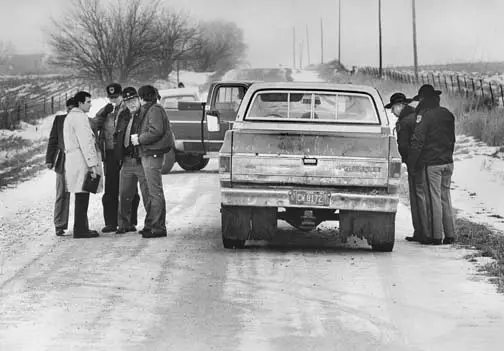
As Burr headed back to his farm, a Johnson County
deputy sheriff drove up behind him, siren blaring. Burr pulled off the
road, while the officer waited in his car for reinforcements. When
other deputies and state police arrived, they found Burr slumped in
his truck, dead of two self-inflicted gunshot wounds. At the farm,
authorities found the body of Emily Burr, along with a one-sentence
note Burr had scrawled. According to a sheriff's deputy, "He said he
couldn't manage his problems any more."
The rampage left Iowa perplexed, as well as
anguished. "Nobody thought Dale would do things like that," said a
farmer who knew Burr. "He was quiet, didn't smoke or drink, didn't
socialize much. His life was his wife and that farm of his." But Burr
felt overwhelmed by his debts: in addition to the Hills Bank loans, he
owed $139,900 to another bank and nearly $10,000 to his brother-in-law
Forbes. Nevertheless, with his land alone worth about $2,000 an acre,
his farm still had enough value to protect him from foreclosure. "Burr
was not destitute," Neil Milner of the Iowa Bankers Association says.
"There had to be other emotional considerations that led him to
cold-blooded murder." A cruel irony was that Hills Bank President
Hughes had a reputation throughout southeast Iowa as a farmer's
friend. Ray Marner Jr. of Lone Tree's Farmers & Merchants Savings Bank
recalled, "He realized how hard it is to turn down someone for a loan
during the week, when you have to sit next to them in church on
Sunday." Hughes, whose bank has more than $200 million in assets, had
no intention of foreclosing on Burr's farm, even though the farmer
could not make his interest payments. Said a farmer who admired
Hughes: "Dale Burr had no right to shoot him, take him away from us."
But as farm foreclosures have increased, many
farmers have come to view bankers as the enemy. In 1983 a Minnesota
farmer and his son lured a bank president and a loan officer to their
foreclosed ten-acre tract, ambushed and killed them. Last year a
Nebraska farmer was killed in a shootout after firing at state
troopers with a rifle. The conflict began earlier in the day when
sheriff's deputies tried to serve him legal papers concerning $300,000
in overdue loans. This fall in Iowa two occasions were recorded in
which farmers, carrying loaded guns in their trucks, thought about
murdering bankers. "A year ago, I'd have said what happened at Hills
this week was unthinkable," said one Johnson County bank president.
"No more."
Relatives and friends who grieved for the victims
could only pray that the violence in the heartland, and the despair
that has incited it, would subside. In Iowa City, 1,500 mourners
jammed a memorial service for Hughes, where the Rev. Henry Greiner
called on elected officials to "heed the cries of those who till the
soil and feed the nation." In Lone Tree, Dale and Emily Burr were
buried side by side in a cemetery just a mile from their farm. The day
^ before, Richard Goody's widow turned down the offer of a military
funeral for her husband even though, as a Viet Nam veteran, he was
entitled to one. "No more guns," Marilyn Goody said softly.
On The Road: Johnson County, Iowa
When Dale Burr shot his wife, his banker, and
himself, he became a national symbol of the farm crisis. Some of his
neighbors see it differently
By Curtis Hartman - Inc.com
May 1, 1986
NO ONE WILL EVER KNOW THE complete truth about Dale
Burr's rampage through this community of rolling hills and family
farms in southeastern Iowa last December 9. But the shotgun blasts he
fired that day would startle the nation. "Indebted farmer kills 3,
then self," the headlines read. America's farm crisis, it seemed, was
turning bloody.
The tragedy began around 11 a.m., when the
63-year-old Burr, dressed in overalls and work boots, went down to the
basement of the family homestead for his aging Remington 12-gauge pump
shotgun. Emily Burr, his wife of 40 years, was his first victim,
killed with a blast to the chest while she was baking cookies in the
cheerful kitchen of the family's white farmhouse. Then Burr got in his
green Chevy pickup and drove down the highway from Lone Tree to the
nearby town of Hills, home of Hills Bank & Trust Co., holder of Burr's
mortgage. Forty-six-year-old John Hughes, the bank's president, was
Burr's second victim, killed by a shotgun blast to the head while he
sat at his desk just off the lobby.
Burr then drove to the home of 37-year-old Richard
Goody, a tenant-farmer with whom he'd been embroiled in a land
dispute. Burr shot and killed Goody, then fired at Goody's fleeing
wife and six-year-old son before returning to his pickup. Spotted by a
sheriff's deputy on the gravel road leading back to his farm, Burr was
stopped. But while the deputy waited for backup to help with the
arrest, Burr took his own life with two shotgun blasts to the chest.
By early afternoon a swarm of local and national
reporters had descended on tiny Hills, population 547. America's farm
problems are hardly a breaking story: falling commodity prices and
rising debt loads have made pictures of auction foreclosures in the
Farmbelt a staple on the nightly news. But Dale Burr's rampage made
the story fresh again. Rather than just losing a business or a factory
like any other overextended small-business man, a foreclosed farmer
loses his home and his way of life, too. Dale Burr seemed a perfect
illustration of the human strain of the farm crisis: more than half a
million dollars in debt to his bankers, expecting to be driven off the
land his family had worked since 1879. It seemed easy to understand
the pressures that had driven this hardworking and genial
fourth-generation farmer, a pillar of Our Redeemer Lutheran Church, to
such desperate acts.
A "tragedy waiting to happen," was how the press
reported it. From the statehouse in Des Moines, Gov. Terry E. Branstad
expressed his "anguish" that "the stressful economic times" had
produced such violence. "Inevitable," local farm activists called it.
They recited tales of other farmers stopped, loaded shotgun in hand,
on the way to the bank, and predicted more terror on the farms unless
Washington provided debt relief or price support for the embattled
farmer. In Washington, Burr's name was invoked by lobbyists seeking to
soften the Administration's farm bill, while one zealot even asserted
that President Reagan himself was responsible for the carnage that
cold and dreary December day in Iowa.
But the tale, in truth, is far more complicated
than a simple story of hard times, harsh bankers, and one poor farmer
who suddenly snapped. The farm crisis is real, tragic and pervasive;
its scars have changed the face of the heartland. But Johnson County,
Iowa, with its rich land and a thriving state university nearby, has
been less ravaged than most of the state, thanks in part to banker
John Hughes. And as for farmer Dale Burr, evidence now suggests he was
something other than a pawn of forces beyond his control. His
financial problems were far less severe than those of many of his
neighbors, and most of them were created by his own shortcomings as a
farm manager.
In the hamlets that dot Johnson County, most folks
are still unwilling to talk about Dale Burr. His memory hangs like a
pall over the farms around Hills. Burr was one of them, and his
problems, in some measure, are the same as theirs. But his story is a
nightmare the local families would rather forget. Who, after all,
wants to go to sleep at night wondering if someone else is going to
pick up a shotgun in the morning? The farmer down the road, perhaps?
Or the man who lies sleeping fitfully in the next bed?
Dale Burr himself was never the talkative sort.
Like most men who run their own businesses, he kept his finances
between himself, his banker, and his God. But he did unburden himself
once, just nine days before the shooting, talking with Ruth Forbes,
his sister, and Ruth's husband, Keith.
Keith Forbes knew that something was wrong that
Saturday noon as soon as he saw his brother-in-law through the kitchen
window. It wasn't likely, Forbes figured, that Burr was coming over to
ask for help getting the last of his crop in. Although almost half his
corn and a quarter of his soybeans lay buried under what was left from
the Thanksgiving blizzard, Burr was known for harvesting late, and
planting late as well, and for always working alone. Nor was it likely
that he had come to pay off the $10,000 he owed for fertilizer and
pesticides -- he was always slow to pay a bill. And Burr was hardly
the visiting type. Their farmhouses were hardly three miles apart, and
Forbes would see Burr two or three times a week driving his pickup or
his tractor, yet Burr never had the time to sit over a cup of coffee
for a talk.
Forbes got his first surprise at the door, when he
saw how bad both Dale and his wife, Emily, looked. Dale Burr was a big
man, a muscular and strapping six footer; as a child he'd won a prize
as "the healthiest boy in Johnson County," and he'd never lost that
ruddy youthfulness, until now. This day he looked like an old man,
tired and drawn. "He looked like a dog with the pride kicked out of
him," Forbes recalls. Emily looked even worse. She had always been the
perfect lady, warm if a bit quiet, and meticulous about personal
grooming.But when she came into the
Forbeses' kitchen that day, her hair was a tangled mess of knots.
Forbes had never seen her so "nervous, almost hysterical."
"They have mortgaged my machines, my land, and my
livestock," Burr told the Forbeses over coffee, "even my grain in the
field. My back is agin the wall.
"I'm throwing her up. I'm just walking out the
door."
Forbes was stunned. While deep debt has become a
fact of life in farm country, like most of his neighbors Forbes had
always considered Burr a wealthy man. Starting with grandfather John
P., the Burr family had prospered by farming Johnson County's rich
soil, each generation doing a little better than the last. Dale's
grandfather had been given the honorary title of president of the bank
in Lone Tree. Dale's father, Vernon, had been an honorary
vice-president, spreading the family holdings by buying cheap land
during the Great Depression.
Dale had started off with a leg up, too, inheriting
his two-story farmhouse surrounded by some of the best soil in the
state. He'd worked hard, day after day starting his chores well before
first light and working till long past dark. Until he was 56 he'd
farmed alongside old Vernon, living just one house away with the bride
he had met at a county fair, raising their two daughters and one son,
helping out at 4-H or Our Redeemer Lutheran Church. Now, with son John
recently turned 39 and still living at home, Dale was bringing him
into the operation, just as his dad had done for him. In 1977 they'd
bought a 40-acre parcel to get John started, adding another 40 in 1978
and then another 80 in 1982 -- the land where Richard Goody had been a
tenant. Father and son worked as a team, with John tending the hogs
while Dale raised crops on as much of the family's 700-plus acres as
he could get to.
Now Burr, sitting on a black vinyl chair in the
Forbeses' kitchen, was despondent as he sketched out the extent of his
debt. First he spread scraps of brown paper across the oval plastic
table, notes for the approximately $48,000 he had borrowed from his
mother, confined to a nursing home for the past four years. Then there
were the mortgages -- just under $425,000 borrowed between March 1984
and March 1985. In addition, the local farm service had liens against
Dale for $15,354, and against his son for $36,300. Dale was also
overdue in his property-tax payments.
The final straw, he told Forbes, had come over the
last corn he had managed to harvest before the first snow. In exchange
for a loan of about $20,000, he had sealed 9,000 bushels as collateral
deposited with the Johnson County Agricultural Stabilization and
Conservation Service (ASCS) -- corn he could repurchase later for
commercial resale if the price rose in the spring. Then, to buy a
little time, Burr had driven over to Hills to deposit the service's
check in his personal account, using the money to pay off his lien and
his old property taxes.
His relief would be short lived. The ASCS evidently
had made a mistake: its check should have been payable jointly to Burr
and the bank. Now, the ASCS wanted its money back, and the bank still
had the corn. "They're gettin' real rough over there," Burr complained
of his lenders. "If they'd leave me alone I could pay all my interest,
but as it is I can't even sell nothing." He said he expected the bank
to foreclose within the week. His scheduled appointment would be just
a formality.
"What will the neighbors say?" a worried Emily
asked. "We won't even have the money to buy groceries."
At the time, Forbes had thought the Burrs were both
overreacting. With more than 600 acres, and another 120 he would
inherit when his mother died, Burr still had a positive net worth.
Although he held debts of well over $500,000, land like his was still
fetching almost $2,000 an acre, and he could walk away from it all a
wealthy man by Johnson County standards, with more than half a million
dollars in his pocket. Or if he chose to stay on the land, Burr's
problem seemed to present nothing more than a simple business
challenge, with a simple business solution.
Still, Forbes couldn't help but wonder just where
all the money had gone. "Dale had borrowed more than a half million in
a short period of time, and there was nothing to show." He and Emily
didn't spend much money on clothes, and they hadn't had a new car in
years. Clearly, he hadn't put it into the property. Although their
white house was meticulously kept up, the 120-foot live-stock barn had
caved in about three years ago, and the outbuildings looked like they
hadn't seen paint or nail since old Vernon Burr passed on. Women or
drugs? Gambling or hard drink? Each possibility seemed more
implausible than the last. The Burrs' only relaxation was the monthly
game of bid-euchre they played with a group of other couples to pass
the time between harvest and planting
"We talked for about four hours," Forbes recalls.
Burr seemed receptive to his suggestion of filing for protection from
his creditors under Chapter 11. And as a customer of the Hills bank
himself, Forbes assured Burr that president John Hughes was "a swell
fella," almost always willing to pull a farmer through. "I thought
everything was worked out. When he left, gosh, he was almost elated.
'Maybe I can work this out,' he said. 'God, if I can get my crop in I
can work out of it."
Emily, however, was still distraught. "When she
left she asked my wife, 'Ruth, come see me, please.' She kept telling
us, 'They're going to put Dale in jail.' I only thought she meant he
couldn't pay his bills. But now I wonder what she knew. Was she trying
to tell us something?"
There is not much to see on the main street of
Hills, Iowa, on a winter's day. A sign welcomes you to "Where Town and
Country Meet," but there is precious little town left. A few neat
houses, three of the first eight with faded For Sale signs. Two
taverns, Max's Lounge and Hills Tap, and an Amoco gas station, a small
convenience store, a galvanized-metal grain dealer, a tanning salon,
and the bank. "Save the Farmer," a pickup's dusty bumper sticker
reads, "Export Reagan."
Mostly a visitor notices the smell, the rich scent
of hogs hanging in the air like a ripe cloud. It is the smell of an
industry in trouble, the worst farm recession, some say, since the
Great Depression. Nationally, about 25% of America's 650,000 farmers
are in danger of default, with debt-to-asset ratios of more than 70%.
In Johnson County, by contrast, less than 10% of
the family farming operations are in danger of going belly-up next
year. Farmers here were spared the worst of the 1983 drought, and,
thanks to the university at the county seat up in Iowa City just seven
miles away, there are part-time jobs a farmer can find, emptying trash
barrels, perhaps, or driving a bus.
But "no one is talking about any profit farm
farming, that's for sure," one area farmer admits. "Our cost of
production is way more than we can take in.Even without any debt,
we're just hanging on."
"Heck," his neighbor agrees, "it's getting so you
can barely call yourself a farmer anymore if you aren't looking hard
at Chapter 7 or Chapter 11."
It is one of the most widespread industry shakeouts
in American history. "A whole generation of farmers is being pushed
out of business," explains Stan Johnson, director of the Center for
Agriculture & Rural Development at Iowa State University. "Anyone who
started farming or was expandingt between 1977 and 1983 is in severe
financial trouble. It doesn't matter if he is a good manager or not."
The 1970s had been a heady time for agriculture, an
era comparable to the booms that followed each world war. Costs were
rising with inflation, but profits were rising even faster.
International drought, overseas crop failures, and the hunger of the
Third World pushed the prices for American farm products to historic
heights. Feed the world, America's farmers were told. Modernize.
Mechanize. Expand.
The watchword was leverage: with the average price
of an acre of Iowa ground shooting up 345% between 1972 and 1981, the
real interest rate on money borrowed to buy land fell as low as -1.6%.
Rather than lending to a farmer based on the production value, bankers
were lending on sale value, considering land as a growth asset more
than an income producer. What was a little debt if it could bring you
so much equity? Hang the cash flow -- go for the capital gain.
After the Reagan inauguration, however, the farm
boom went bust, just as each boom had gone bust in the past. Costs
kept rising, especially the cost of credit, as the Federal Reserve
Board tightened the money supply. But everything else collapsed.
Exports fell by a third, as heavy international harvests, followed by
a worldwide recession and then a strengthening dollar, eroded newly
won overseas markets. Harvests were heavy at home, too, cutting prices
even further. The price of corn fell more than 30%, while the cost of
production was rising 45%. Farmers' return on equity fell from a high
of 13.5% during the boom to a low of -15.7%.
Inevitably, the bubble in land prices -- which
William R. Bernau, superintendent of banking in Iowa, compares to "the
old tulip bulb deal that Holland had in the seventeenth century" --
collapsed as well. The average acre of Iowa ground had sold for $2,539
in 1981. By 1985 it would fetch only $1,275. Instead of the -1.6%
during the boom, real interest rates soared to highs of 6% to 8%.
Farmers who had thought themselves rich -- and then borrowed against
the asset value of their land -- suddenly saw their borrowing power
disappear and the value of their assets drop almost 50%.
"People may wonder why I made the decision to
expand," oine farmer explains, "but I'd just had a son, and given the
information I was given it seemed the right thing to do. The
land-grant colleges were telling us we'd have $10,000 land by the
1990s, so use your leverage. What a joke. Now my boy tells me he
wouldn't be caught dead farming -- he doesn't want to end up 'a loser'
like his dad."
Melissa Farley, an Iowa City psychotherapist who
counsels rural families under stress, sees a predictable cycle in
Johnson County farmers. Denial gives way to anger, then to depression
and self-doubt. "When I talk to farm women, they all say they
understand how Burr felt," Farley says. "There is a progressive sense
of being pushed up against the wall. They've been independent all
their lives, then they lose control of everything. The bank controls
every bit of cash that comes through their hands. There is a terrible
lack of dignity. People are scared. They last out. There are more
temper out-bursts, more substance abuse, and more domestic violence --
a lot of women getting hit these days."
In the past, families in Johnson County have always
come together in crisis, with barn raisings and potluck suppers to
bind the community close. But the current hard times are driving
people apart. No one wants to face failure in front of his neighbors;
the guilt and self-criticism is already too searing. There is help
available -- a suicide hot-line and crisis-intervention centers -- but
few farmers can admit to their own despair. Farm activist groups like
Prairiefire Rural Action organize regular "survival meetings," two or
three hours at night in a church basement. It's a chance to share the
hardship and explore the economics and politics of the crisis, but
more farmers are too ashamed to come. When Jo Anne Neuzil, a Johnson
County farm wife who had become a self-trained bankruptcy adviser,
wanted to move her practice from the living room of her home to an
office in town, the farmers who were working with her balked. They
couldn't come to see her in town, they explained. Someone might spot
them there, or recognize their pickup. Then people would talk.
Neuzil saw Dale Burr on a rainy day right before
the killings, when he pumped gas for her at the self-serve just
outside of Hills. "I knew he wanted to talk, but he just waved at me,"
she remembers. "He looked like the sorriest guy that ever walked."
I'm sorry," he said in the note left back at the
house. "I can't take the problems anymore."
If Dale Burr had killed only himself, he would have
been nothing more than a statistic, one more frarm suicide to add to
the growing list. It was his murder of banker John Hughes that led the
television cameras and city reporters to invade the quiet main street
of Hills and made Burr a national symbol of the farm crisis. But
Hughes was no more the average Iowa banker than Dale Burr was the
average Iowa farmer.
It seemed everyone in Johnson County knew the
president of Hills Bank & Trust Co. Hughes was a local boy who came
back home after college, a farmer's son born and bred in Johnson
County, a former 4-H member who went on to turn a small-town bank into
the fifteenth largest lending institution in the state.
Hills Bank & Trust, too, had a history: founded in
1904, not long after the town's first tavern, it had prospered even
through the Depression, conservative in its lending, but somewhat
limited in its growth by an Iowa law that prevented expansion except
to contiguous towns. Unsuccessful in changing the law once he became
president of Hills Bank in 1975, Hughes found a way around it,
arranging for the town to annex the railroad right-of-way that ran
like a thread from Main Street in Hills up to Iowa City, the county
seat. Thanks largely to that clever bit of urban expansion, deposits
at Hills climbed from $35 million to $193 million in 10 years,
allowing the bank to diversify its portfolio and reduce agricultural
lending to less than one-quarter of its portfolio. Thus, while 11 Iowa
banks had failed in 1985, the bank in Hills was booming.
The bank was a reflection of Hughes's personality.
A former president of the Iowa Chamber of Commerce, active in
charities, Hughes made friends easily, and turned customer service
into a professional creed. He worked farmer's hours, 7 in the morning
to 7:30 at night, and expected his colleagues to do the same. Most
days you could find him away from his desk, out in the lobby of the
new bank he had built in Hills, visiting with customers. He knew most
of their names, knew the names of their children and grandchildren,
knew how their hogs were doing, knew whether they followed his beloved
Chicago Cubs. When a faculty appointment was announced at the
university, he would call the professor personally to put the Hills
Bank at his or her disposal. If someone celebrated a fiftieth wedding
anniversary, customer or not, he would send a card with a note. At the
customer-appreciation picnic last year, Hughes was on his feet most of
the afternoon, helping serve barbecue to about 9,000 people.
There was no security guard on duty when Dale Burr
walked into the bank, shotgun concealed inside his overalls. But even
if there had been, it is unlikely he would have questioned the
farmer's presence. Burr, after all, was a customer, encouraged to drop
by whenever he came to town. Hughes was sitting at his desk just off
the lobby when he was killed.
Fifteen hundred people turned up at St. Andrew
Presbyterian Church in Iowa City to hear Hughes eulogized two days
after the killings. "It's ironic," said Neil Milner, executive
vice-president of the Iowa Bankers Association. "Of all the lenders in
the state, he was the one who was trying to help people the most."
"He'd let everybody go the limit on loans -- you'd
have to be down to where you didn't have a dime before he'd
foreclose," a customer told the press. "That's why this is so hard to
understand."
If people in Hills didn't see John Hughes as the
stereotype ofr the uncaring banker, they hardly saw Dale Burr as the
symbol of America's embattled farmer. Because he had been born to
relative privilege, he'd never had to learn to live with hard times.
"Hell," one neighbor said, "he had 600 acres given to him, and he
couldn't hang on to them. I had to work for the land I'm about to
lose."
You could see the problem just driving by the Burr
family spread. It wasn't just the unharvested corn under the snow or
the ramshackle barn; signs of sloppy operation were everywhere. The
yard by the shed, for example, is carpeted in corn, spillage left on
the ground after hauling. "I could make a living on what he lost," one
neighbor marveled.
"The truth of it is he wasn't much of a manager,"
another explained. "He was always two months behind, and he always
lost half his crop. His work was excellent, when he got to it. When he
set out to put in a four-acre farm, he worked it until it was a
garden; it had to be perfect. But if he'd been a little more
roughshod, he could have saved weeks throughout the year.
"He was a great one for work, but he didn't have
the time to get everything done, and he would not hire a man. He
didn't want to spend the money. All he would have had to do was set
down with a pencil and figure out the cost of the labor to see he
could have saved in the long run. But he was never much with a
pencil."
It was the same story with John Burr's hogs.
Although an investment in a mechanical feeder would have paid out in
saved costs within a year, feeding was still done by hand. The Burrs
would also hold their livestock too long, selling at full weight
rather than half-growth, earning more cash but a far lower profit.
The problems, Keith Forbes explains, really began
with the death of Vernon Burr seven years ago. "After that, things
went downhill fast. Dad was Dale's manager -- if there was a decision,
Dad made it. And when Dad couldn't make the decisions anymore, Dale
was lost."
The disputed 1982 land purchase that led to the
death of Richard Goody was the most dramatic of Burr's mistakes. The
80-acre parcel was considered prime farmland, rich and flat. But the
purchase price of $3,750 an acre was the highest in the history of the
county, adding $300,000 to the Burr debt. Over the next three years
the value of the land would fall drastically, chopping an estimated
$150,000 from the Burr net worth. But, more important, the property
could never have produced a positive cash flow. Retired loan officer
and farmer Melvin Schneider estimates that the annual debt service
alone on the land was $312 an acre, at a time when an average corn and
bean mix harvest could fetch only $300 an acre.
But Burr had managed to make a bad situation even
worse. Goody was a tenant on the land, having farmed it since 1969.
His father had farmed it for a decade before that. According to Iowa
law, if a tenant is not given legal notice of the termination or
expiration of his lease before September 1, his tenancy is assumed for
another full year. Burr, who had bought the property in July, hadn't
taken appropriate steps to inform the Goodys of his plans to use the
land himself. Under standard tenancy agreements, Burr would still have
been entitled to half the crop produced by his tenant (or its value)
in that final year. But young John Burr, angry at Goody's refusal to
leave the land, decided to get his revenge by chisel-plowing the
fields, leaving a regular pattern of holes that made it impossible for
anyone either to furrow-plow for crops or put out livestock. Goody
sued, and was awarded $5,829.60 in damages, plus legal costs.
For Dale Burr it was simply one more bill to pay,
one more costly mistake. "Dale was not sharp financially," Forbes
says, "and it all just got to him.
"He had always just figured he had plenty of money.
It used to be he could walk down the street and buy anything, and all
of a sudden he found himself with nothing. People had always looked up
to him, and he was too proud to admit he'd have to sell land to get
out of trouble. He had a lot of pride that his dad and his granddad
were all successful, and he could see that he would be hurting the
Burr name bad."
But while his pride may have been hurt, it was
unlikely that Burr stood on the brink of financial ruin, as he feared.
After the killing, officials at Hills Bank & Trust insisted that no
foreclosure "was or is" planned for the Burr property. Indeed,
according to senior vice-president Jim Gordon, the bank was expecting
to finance Burr's operational needs for the 1986 crop year.
And as for the fateful meeting that loomed so large
in Burr's mind, bank officials say that, as far as they know, no
appointment had been scheduled.
By the middle of January, things seemed back to
normal in Hills. Another Farmbelt murder/suicide, this time in South
Dakota, pushed Dale Burr off the front pages, and now only an
occasional reporter wanders down Main Street, looking for clues. The
sight of a locked bank door makes Iowans nervous these days, so Hills
Bank & Trust reopened the day after the shooting -- but this time
there is a security guard standing in the lobby.
One evening in December, four white crosses
appeared on the lawn leading up to St. Joseph's Catholic Church, the
lone church in Hills. Father David Hitch scheduled a candlelight
prayer service there, hoping it would be "a time to share concern with
the community," but the turnout was thin, and no one has mentioned the
crosses since.
But Father Hitch tried again. Late in January, the
church organized a benefit breakfast for Marilyn Goody and her two
children. Eighteen hundred people turned out at $3 a head for eggs and
juice, pancakes and whole hog sausage. But no one wanted to talk about
Dale Burr, and no one lingered much. There were chores to attend to,
work that had to be done.
Most of them knew there would be a long season of
cold ahead. One in every 15 Iowa farmers would be denied credit for
this spring's crop, and federal price supports, already pegged below
production cost, are likely to be cut even further under the era of
Gramm-Rudman. Folks in Hills can't imagine how things could get worse,
but they see no reason to hope things will get better.
Out at the Burr family farm, son John has taken the
nameplate off the mailbox to discourage the curious. He keeps to
himself mostly, spending hour after hour with his hogs. But he does
talk regularly with his uncle.
"John told me, 'I'm gonna hold her all," Keith
Forbes remembers. "He said, 'I'm gonna fight my damndest." That would
not be enough, however. On February 13, John frofeited the contract
for the purchase of the Goody land. But even without that obligation,
Forbes thinks the odds John Burr can make it are "zero."
It's the same old story. "John is one hell of a
chore man; he'll chore till midnight," Forbes says. "But he's never
been much with a pencil."
Law enforcement officers check the
scene where distraught farmer Dale Burr shot himself to death in his
pickup truck.