Murderpedia has thousands of hours of work behind it. To keep creating
new content, we kindly appreciate any donation you can give to help
the Murderpedia project stay alive. We have many
plans and enthusiasm
to keep expanding and making Murderpedia a better site, but we really
need your help for this. Thank you very much in advance.
Ernest BROWN
Classification: Murderer
Characteristics:Jealousy
- Arson
Number of victims: 1
Date of murder: September 5,
1933
Date of birth:1898
Victim profile:Frederick
Ellison Morton
(his employer and lover's husband)
Method of murder: Shooting
Location: Yorkshire,
England, United Kingdom
Status: Executed by
hanging
at Armley prison in Leeds on February 6, 1934
Ernest Brown was found
guilty and sentenced to be hanged for the murder of Frederick Ellison
Morton in September 1933. He had killed him with a shotgun. He was
hanged by Tom Pierrepoint.
Ernest
Brown was 35 and worked for Frederick Ellison Morton a wealthy cattle
farmer at Saxton Grange, a remote Yorkshire farmhouse, as a groom. His
wife Dorothy Morton was attracted to Brown and became his mistress.
After a disagreement with Mr Morton Ernest Brown left his job only to
beg to be reinstated a few days later. Morton agreed but instead of
being grateful Brown seemed to resent Morton even more.
On 5
September 1933 Brown had an argument with Dorothy and struck her. Brown
later went outside and discharged a shotgun. He told them he was
shooting at rats. Mrs Morton and her companion, Ann Houseman were scared
and when they discovered that the phone was dead they locked themselves
in their bedroom.
At about 3.30 in the morning there was a loud
explosion and the garage was set on fire. The two women ran from the
house and hid in fields nearby.
Because
of the intensity of the fire it was not possible to inspect the garage
until 9am the next morning. On investigation the police found the garage
contained two cars one of which had Mortons body inside. He had been
shot in the chest.
Brown was convicted and was hanged at Armley prison
in Leeds on 6 February 1934 by Tom Pierrepoint.
RealCrime.co.uk
Ernest Brown was
employed as a groom by Frederick Ellison Morton. Morton was a wealthy
cattle factor and he lived with his wife and child at Saxton Grange, a
remote Yorkshire farmhouse.
Morton's wife, Dorothy, became Brown's
mistress but their relationship was spoiled by Brown's raging jealousy.
Brown left Saxton Grange after a disagreement over his duties but
returned within days asking to have his job back. He was re-employed but
was resentful about his status.
On 5th
September 1933 Mr Morton went out for the day in one of his two cars. In
the early evening Brown and Dorothy Morton argued and he struck her to
the ground. Brown went out and a short while later Mrs Morton and her
companion, Ann Houseman, heard the discharge of a shotgun outside the
house. He told the two women that he was shooting at rats. The women
were terrified by this time and, when they found that the telephone had
gone dead, locked themselves in an upstairs room.
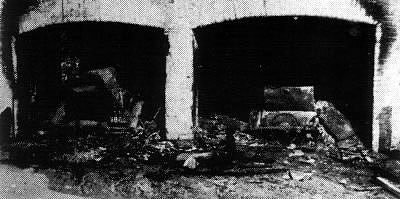
At 3.30am
there was an explosion, followed by a fire, in the garage. The two women
ran from the house and hid in fields near-by. Because of the intensity
of the fire it was not possible to inspect the garage until 9am. Inside
the remains of the garage were both of Morton's cars and, in one of
them, was the body of Morton. He had been shot in the chest.
Brown's
trial took place in Leeds. Forensic evidence showed that the telephone
lines had been severed by a knife that Brown had taken from the kitchen
and that the explosion had been caused by the petrol that had been
spread around the garage. 35-year-old Brown was found guilty and hanged
at Armley Gaol, Leeds, on 6th February 1934.
Murder-UK.com
Evelyn Foster – Otterburn
January 6th, 1931
Burned almost beyond recognition, Evelyn Foster
whispered from her hospital bed: “I gave a lift in my car to a man who
was smartly dressed, wore a bowler hat and had a Tyneside accent. He
wanted to go to Ponteland, about 25 miles away, to catch a Newcastle
bus.”
During the journey, the man began touching her up.
Distraught, Evelyn pulled into the verge, whereupon he knocked her
unconscious. When she came round he had taken over the driving. He
stopped the car, poured some liquid over her, got out, and set the
vehicle on fire.
Trapped in the flames, Evelyn had some difficulty
getting out of the car to crawl some yards away. She remembered hearing
another car stop, men’s voices, then the other car drove away.
Evelyn, daughter of an Otterburn garage owner, was
not raped, she was not bruised where she said she was struck, and was
thought to have been sitting in the burning car for some while. It would
have been impossible for a man to drive the car sitting in the position
she said her attacker had occupied.
So did it happen like she said, that night of Tuesday,
January 6th, 1931? Did she have a twisted, hidden motive? No, said the
coroner’s jury. It was murder.
They were probably right. For only 20 months later
Ernest Brown, 31, a groom, was found guilty of the murder of his boss,
Frederick Morton. Brown, who had been having an affair with Mrs. Morton,
shot the husband at close range then set fire to his car – with Morton
inside it. The killing took place 100 miles away, near Tadcaster in
Yorkshire.
Brown was a natty dresser, wore a bowler hat and
spoke with a Tyneside accent. Just like the man Evelyn described.
On the scaffold the chaplain told him: “You should
use these last few moments to confess your sins and make your peace with
God.” As the hangman was about to despatch him he was thought to have
murmured: “Otterburn.”