Murderpedia has thousands of hours of work behind it. To keep creating
new content, we kindly appreciate any donation you can give to help
the Murderpedia project stay alive. We have many
plans and enthusiasm
to keep expanding and making Murderpedia a better site, but we really
need your help for this. Thank you very much in advance.
John BARLOW
Classification: Murderer
Characteristics: Motive unknown
Number of victims: 2
Date of murder:
February 16, 1994
Date of birth: 1946
Victims profile: Financial
dealers Eugene and Gene Thomas, father and son
Method of murder:
Shooting
Location: Wellington,
North Island, New Zealand
Status: Sentenced to life in prison(minimum 14 years)
in
1995
The Thomas Murders
On 16
February, 1994, financial dealers Eugene and Gene Thomas, father and
son, were found shot to death in their offices at the Invincible
Building on The Terrace in Wellington.
The main suspect
was John Barlow who was seen leaving the building around the time the
murders occurred. Barlow contacted the media before his arrest to
publicize his claims of innocence. He said he had seen the bodies and
left immediately, telling no-one for fear of being blamed.
Barlow was
arrested and charged with both murders. Police found that the diary on
Eugene Thomas's desk had a page torn out for the day of the murders.
Through a documents expert it was established that the missing page had
recorded an appointment with Barlow at 5.30pm.
Barlow gave
different accounts of what he had seen and heard on the day of the
murders. In one account he said Gene Thomas asked him to return later
and he left. In the second, he said he heard a gunshot when he was
leaving and on his way home, decided to come back and investigate. He
found Gene and Eugene dead and left the crime scene.
The first trial
began in 1995. The main piece of police evidence was Barlow's CZ27
pistol, silencer and .32 ammunition. This had been recovered from the
Happy Valley rubbish tip, after police had found a receipt in Barlow's
belongings for the tip dated one day after the murders. The pistol had a
.22 calibre barrel but the Thomases had been shot with a .32 barrel. It
was established that the pistol was designed to take a .32 barrel but
this was not found.
Evidence was
also introduced that Barlow had told to a friend he had found the bodies
when he turned up for the meeting. He said he had earlier lent Eugene
Thomas the pistol and found it lying next to him. Panicking that the
murder weapon would be traced to him, he decided to get rid of it.
At the first and
second trial the defense pointed to lack of motive even though Barlow
was known to have a large loan with the Thomases' business and was in
financial hardship. Because the .32 barrel was never found, it was not
conclusively established that Barlow's pistol was the murder weapon. The
defense also provided expert testimony that the bullets found in the
bodies could not have been fired from the pistol. Both trials ended in
hung juries.
A third trial
took place in October 1995. New evidence from the prosecution was
introduced, which negated the defense's contention that the bullets
could not have been fired from the pistol. The new study and testimony
said the CZ27 pistol could have fired the fatal shots and the bullets
found at the tip were the same type as the bullets in the bodies. This
was strongly contested by the defense.
John Barlow was
found guilty of both murders. Later the Court of Appeal upheld the
verdict, feeling confident in the third jury's decision.
Barlow is
serving mandatory life with no parole until he has served at least 14
years.
Crime.co.nz
Barlow loses
final murder appeal
Nzherald.co.nz
Thursday Jul 9, 2009
Convicted double murderer John
Barlow has lost his final bid to have his convictions overturned, after
the Privy Council in London ruled against his appeal yesterday.
The five law lords who heard
Barlow's appeal announced that while he had an arguable case, on the
evidence he was properly convicted by the jury.
"The board accordingly concludes
... that, while the introduction of the misleading evidence ... was
indeed a miscarriage, no substantial miscarriage of justice actually
occurred," the judgment said.
Barlow's lawyer, Greg King,
appealed to the council in February to have the murder convictions
quashed.
Mr King rubbished FBI forensic
evidence that led a jury to send his client to prison.
After twice going through trials
that ended in hung juries, Barlow was jailed for the murder of
Wellington father and son Eugene and Gene Thomas in 1994.
Mr King's first victory was for the
law lords to hear the petition for special leave to appeal, and to
consider evidence the New Zealand Court of Appeal would not hear when it
denied Barlow an appeal in March last year.
Mr King told the law lords that
crucial evidence relating to the weapon and bullets that killed the
Thomases had been falsely linked to Barlow, a former antiques dealer,
who is serving a minimum term of 14 years' jail in Rimutaka Prison,
Upper Hutt.
Mr King said evidence given by FBI
agent Charles Peters had been flawed and that had unduly influenced the
jury at Barlow's third trial, after the juries at the two previous
trials had failed to reach a verdict.
The tests have since been
discredited worldwide for providing a high number of false matches.
The Crown case in all three trials
hinged on proving that Barlow's CZ27 pistol, and related bullets and a
silencer, was the murder weapon.
Mr King would not comment on the
Privy Council's verdict. He said he would comment after reading the full
ruling.
Gun views keep double murderer behind bars
By Isaac Davison - Nzherald.co.nz
Friday Apr 3, 2009
Double-murderer John Barlow has lost a chance of parole because of his
"manipulative" personality and insistence on his right to own guns.
The Parole Board refused to release Barlow after a psychological
assessment described the 63-year-old as a controlling figure.
The board said he also had a "completely inappropriate attitude to
guns".
But Barlow's wife Angela believes the decision is political and that her
husband has unjustly been denied release because of a hardline climate
on bail and parole offenders.
The assessment by psychologist Dr Nick Wilson said Barlow had been
well-behaved in prison and was at a low risk of re-offending.
But the board said his comments about the importance of firearms were
"breathtaking" and "of considerable concern".
The board concluded that Barlow had a sense of entitlement with regard
to protecting himself, and could exercise this entitlement in "easily
imagined circumstances."
Barlow was serving a life sentence for the execution-style shootings of
Wellington father and son Eugene and Gene Thomas in 1994.
He has spent 14 years in Rimutaka prison.
Around the time of his trial Barlow told police that Americans who had
firearms for protection hardly ever used them and "hardly anyone was
ever shot".
He admitted lending weapons to others "for their protection", and
classed that breach of the law as on the same level as speeding.
His bail was revoked because two firearms were found hidden in his
house, despite him being required to surrender firearms. The guns were
hidden in the insulation in the ceiling and inside a grandfather clock.
He was described as using "florid and extravagant language" in referring
to having had two guns for protection against people who might be
threatening to him.
Barlow denies killing the Thomases, and is awaiting a decision from the
Privy Council in London on an appeal lodged in February.
A
parole hearing in November was adjourned to allow for further
psychological testing.
The subsequent psychological report said Barlow had "a superficial
elitist interpersonal style that is usually characterised by an internal
strong focus and entitlement beliefs."
He had denied having a manipulative personality, but the board felt his
controlling nature could prevent any dangerous behaviour after his
release from being revealed.
"Given his intelligence and quite dominant personality, there would seem
to us to be no real chance of anyone within his close vicinity alerting
the appropriate authorities if an unsafe situation were to arise
following release."
The board acknowledged the "outstanding" support of Angela Barlow, who
had visited him in prison once a week for more than 14 years.
But it described her as "uncritical" of her husband, and said it was not
convinced she would speak up if difficulties arose after his release.
Angela Barlow had told the board the question of her alerting the police
was "irrelevant", but it was concerned Barlow's controlling personality
would quieten her.
Angela Barlow told the Herald last night she was "shocked and
devastated" by the board's decision.
"The political climate has made it very difficult for him. Right now
people are hard on bail, hard on parole. They are letting the wrong
people out, and keeping in someone who deserves to be out."
She rejected the board's descriptions of his interest in guns and
manipulative personality.
"It is absolutely made up. He had guns but that was just because he
collected everything. The comments about his attitude - I have been
married to him for 39 years and he is not like that to me. It offends
me."
The Parole Board also took into account strong opposition from the
victims' families to Barlow's release. Letters from the families said
his double killing continued to cause deep distress and damage.
But the board said it supported reintegrative leave for Barlow, as he
was in the reintegrative phase of his sentence.
"Release to work and graduated home leaves will be appropriate in a safe
planned way at this time."
Barlow was drug-free, kept himself busy in prison and was well-behaved.
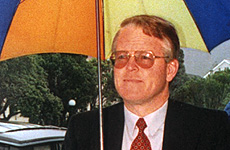
John
Barlow arrives at his trial in 1995
(Photo Martin Hunter)