Murderpedia has thousands of hours of work behind it. To keep creating
new content, we kindly appreciate any donation you can give to help
the Murderpedia project stay alive. We have many
plans and enthusiasm
to keep expanding and making Murderpedia a better site, but we really
need your help for this. Thank you very much in advance.
Johnson
AZIGA
Classification: Murderer
Characteristics:
The
first person to be charged and convicted of first-degree murder in
Canada for spreading HIV
Number of victims: 2
Date of murders: December 2003 / May 2004
Date of arrest:
August 30, 2003
Date of birth: 1956
Victims profile:
Women
Method of murder: Criminal transmission of
HIV
Location: Hamilton, Ontario, Canada
Status:
Sentenced
to life imprisonment with no possibility of parole for 25 years on
May 7, 2009
Johnson Aziga (born 1956) is a Ugandan-born
Canadian man resident in Hamilton, Ontario, Canada, notable as the
first person to be charged and convicted of first-degree murder in
Canada for spreading HIV, after two women whom he had infected without
their knowledge died.
Background
Aziga was a former staffer at the Ontario Ministry
of the Attorney General. According to CBC News, he was diagnosed with
HIV in 1996. He had unprotected sex with 11 women without telling them
he was HIV-positive. Seven of these women later tested positive for
HIV, two of whom died of complications of AIDS, in December 2003 and
May 2004.
Several Canadian courts have ruled that persons who
are not informed that a sexual partner is HIV-positive cannot truly
give consent to sex. As a consequence of this, the death of the two
women is automatically considered to be murder instead of a lesser
charge such as manslaughter.
Arrest and trial
Aziga was arrested in August 2003. On November 16,
2005, Justice Norman Bennett of Hamilton ruled there is sufficient
evidence for Aziga to stand trial. His trial date was initially set
for May 2007 but was moved back several times. As of May, 2008, the
trial was set to begin October 6, 2008.
The decision to try Aziga was criticized by Richard
Elliott, deputy director of the Canadian HIV/AIDS Legal Network, who
described the decision as "not particularly helpful" and argued that
it may lead to a "dominant impression out there of people living with
HIV as potential criminals, which is not an accurate or fair
representation.”
Aziga was not the first Canadian ever to face
criminal charges for knowingly exposing others to HIV. In an earlier
case, Charles Ssenyonga of London, Ontario was prosecuted on the
lesser charges of aggravated assault and criminal negligence causing
bodily harm, although he died of meningitis before a verdict was
rendered in his case.
In the 1999 decision R. v. Cuerrier, the
Supreme Court of Canada ruled that people who knowingly exposed others
to HIV through unprotected sex could be charged with a crime on the
grounds that failure to disclose one's HIV status to a sex partner
constitutes fraud.
Aziga's trial began in October 2008. Among the
first revelations made in trial proceedings are claims by Aziga's
former girlfriends that he lied about his HIV status and continued
having unprotected sex until the morning of his arrest in 2003.
Aziga's lawyers claim that no conclusive link can be shown to indicate
that the deaths of his former girlfriends can be attributed to
HIV/AIDS.
On April 4, 2009, Aziga was found guilty of two
counts of murder in the first degree, 10 counts of aggravated sexual
assault, and one count of attempted aggravated sexual assault by nine
men and three women on Hamilton Superior Court jury. Aziga was
sentenced to life imprisonment with no possibility of parole for 25
years, the mandatory sentence in Canada for a conviction of
first-degree murder. Aziga has expressed his intention to appeal his
conviction.
On August 2, 2011, a court in Hamilton, Ont.
granted a request by Crown Prosecutors to have Johnson Aziga jailed
indefinitely under the Dangerous Offender act, because he is believed
to be at a high risk to re-offend.
Wikipedia.org
HIV killer declared dangerous offender
Toronto.ctv.ca
Augut 2, 2011
Johnson Aziga, the first person in Canada convicted
of murder through HIV transmission, has been declared a dangerous
offender.
With the designation, the Hamilton, Ont. man can be
jailed indefinitely.
The Ugandan immigrant was convicted in 2009 of two
counts of first-degree murder, 10 counts of aggravated sexual assault
and one count of attempted aggravated sexual assault.
The Crown argued Aziga should be labelled a
dangerous offender because of his abnormally high libido and because
he has shown little remorse.
Aziga "represents a gamble on the safety of the
women in this community." Ontario Justice Thomas Lofchik said in a
50-page decision.
After the decision, Aziga, 54, said he wanted to
renounce his Canadian citizenship and serve his time in Kenya or
Uganda.
Aziga, a father of three, admitted to having
unprotected sex with 11 women without telling them he has HIV, but has
repeatedly said he can't know for sure that he infected any of them.
Two of those women later died from AIDS-related
cancers. Five others have tested positive.
In court on Tuesday, Aziga said he intended to use
condoms but didn't because the women insisted.
Previously, he accused the jury that convicted him
of racism and blamed health officials for not instructing him on how
to properly disclose his HIV status.
He was diagnosed with HIV in 1996 and ordered by
public officials to disclose his illness to sexual partners.
Aziga was a highly-educated employee of the Ontario
government at the time of his arrest.
Aziga has been in custody since 2003.
Aziga finally apologizes, in bid to avoid
dangerous offender status
Thespec.com
May 26, 2011
It is an apology that was eight years and 11 ruined
lives in the making.
Read slowly to a courtroom devoid of those women
for whom it was intended.
“I apologize to the families of the deceased women
and the complainants for what I have put them through,” Johnson Aziga
said, as he got to the last line of his statement. “And continue to
put them through.”
The prepared statement took about five minutes to
deliver.
Aziga spent the next four hours telling the court
about his own hardships.
For the first time since he was arrested in 2003,
the convicted HIV killer apologized in his own well-crafted words as
he took the stand at his dangerous offender hearing Wednesday. His
lawyers had apologized on his behalf previously, but the 54-year-old
former provincial statistician never testified at his murder trial.
Aziga, who is originally from Uganda, is believed
to be the first person in the world convicted of murder after failing
to disclose his HIV infection to sexual partners. Two women are dead,
five others live with HIV and four more escaped infection but have
been psychologically damaged by fear and betrayal.
In April 2009, a jury found Aziga guilty of two
counts of first-degree murder, 10 counts of aggravated sexual assault
and of attempted sexual assault.
If he is declared a dangerous offender, Aziga could
stay in prison for an indeterminate amount of time.
“The day I learned that I was HIV positive in 1996
felt like I had been shot in the head, heart and soul,” Aziga began
after shuffling — his ankles shackled — to the witness stand. “At that
time, AIDS was regarded as a death sentence and I was given only about
five years to live.”
Aziga sunk into depression and alcoholism after his
diagnosis, court heard. He wanted desperately to know how he got
infected. He has never found an answer.
He did not tell anyone of his infection, he said in
his statement. Indeed, his best friend, who testified earlier in the
day, told court that although he and Aziga lunched together often and
were very close, he knew nothing of his HIV status until he was
arrested.
“My marriage started unravelling,” Aziga continued
in his statement. “In short order, my wife and I were separated and
eventually divorced. Strenuous litigation around children and their
support drained me of any energy I had.”
He was lonely.
“As time went on I started seeking company from the
very places where I was getting my alcohol, those being bars and
clubs.”
He told the court that although he was getting HIV
counselling, it did not include “sensitivity training as precisely how
to disclose to my partners that I was HIV positive.”
“I sincerely regret and apologize that advising my
partners of my HIV infection was not close to my mind. I wish I had
behaved differently. This was the time when I was at my most loneliest
and therefore desirous of female companionship.”
“I used condoms,” he said, “but sometimes
spontaneity during drunken episodes overtook the ability and
opportunity to use condoms. Whenever any female partner asked me to
use a condom, I used a condom. Others did not like condoms … I also
did not admit to having any sexually transmitted virus because then I
would be deprived of companionship.”
Some victims testified earlier that they used
condoms when they first met Aziga, but after a relationship developed
and Aziga assured them he did not have an STD, they stopped using
condoms.
“I was a walking shell and not a full human being,”
Aziga said. “My ability to think was impaired … I thought I could die
any time and it did not matter anymore. In my twisted mind, I was
under attack by external forces.”
Then Aziga, who has fired lawyers, delayed and
stalled court proceedings and dragged his case out for eight long
years — not including his pending appeal — said, “I tried to resolve
these matters as delicately as I could but the criminal process became
so overwhelming, especially after the murder charges were laid, that I
had to go through to the end.”
Finally, Aziga promised the court that if he is
ever released into the community, he will not reoffend.
“I will always advise any prospective partner in
future of my infection and I will always wear a condom.”
He wants a second chance. But he already had 11
chances to do the right thing.
Aziga found guilty of first-degree murder
Toronto.ctv.ca
April 4, 2009
An HIV-positive Ontario man has been convicted of
first-degree murder in the deaths of two women who died from
AIDS-related illnesses.
In a precedent-setting case, Johnson Aziga, a
52-year-old from Hamilton, was also found guilty on 10 counts of
aggravated sexual assault and one count of attempted aggravated sexual
assault.
A sentencing hearing is expected to take place on
May 7.
During the trial, which began in October of last
year, prosecutors said that Aziga had unprotected sex with former
female co-workers and women he met at bars.
Aziga had been aware he was carrying HIV since 1996
and public health officials had ordered him to disclose his illness to
any potential sexual partners.
During the trial, the jury of three women and nine
men had to decide if the illnesses and deaths could be directly linked
to Aziga, a Ugandan immigrant who worked for the Ontario Ministry of
the Attorney General.
The Crown said that seven women were infected with
HIV and that two of them died after Aziga, in police custody since
2003, neglected to tell them about his illness.
Aziga met both of the deceased women while working
for the Ontario government, the court heard.
Another four women were also exposed to the virus,
but later tested negative for HIV, prosecutors told the court.
The defence, meanwhile, argued that Aziga's brain
disorder and personal problems would not have enabled him to purposely
hurt the women.
The jury issued their decision on Saturday
afternoon after three days of deliberation.
During the trial, the court watched a videotaped
statement from one of Aziga's former lovers who was only weeks away
from her death.
During the interview, which was taped by police,
the woman said Aziga never disclosed his illness during their
relationship in the summer of 2000.
"No, he never did. Not at any time," said the
woman, who was only identified as S.B.
The woman clearly stated that she would have
refused sex with Aziga had she known he was carrying HIV.
Three weeks after the tape was made, S.B. died from
AIDS-related cancers.
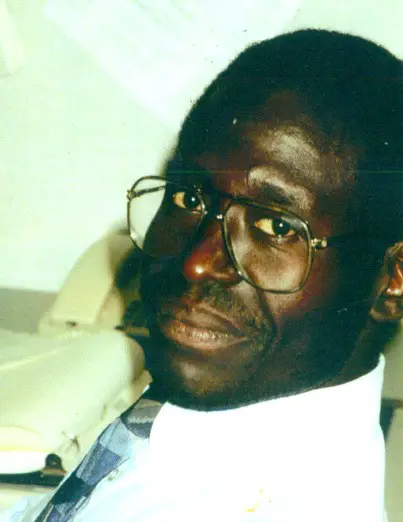
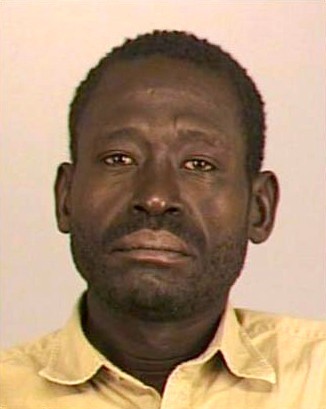
Johnson Aziga
Johnson Aziga is shown in an undated handout photo.
(HO, Hamilton Spectator / THE CANADIAN PRESS)