Murderpedia has thousands of hours of work behind it. To keep creating
new content, we kindly appreciate any donation you can give to help
the Murderpedia project stay alive. We have many
plans and enthusiasm
to keep expanding and making Murderpedia a better site, but we really
need your help for this. Thank you very much in advance.
Christina
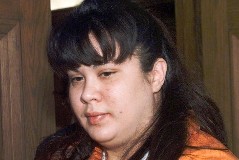
Marie RIGGS
Classification: Murderer
Characteristics:
Parricide
Number of victims: 2
Date of murders:
November 4,
1997
Date of arrest:
Next day
(suicide attempt)
Date of birth: September
2, 1971
Victims profile: Justin Thomas, 5, and Shelby
Alexis, 2 (her
two children)
Method of murder: Smothering
with a pillow
Location: Pulaski County, Arkansas, USA
Status:
Executed
by lethal injection in Arkansas on May 2,
2000
Riggs, a licensed nurse, was convicted of murder by smothering her two
preschool-aged children in their beds at the family's Sherwood home.
On November 4, 1997, Riggs obtained the anti-depressant
Elavil from her pharmacist, the painkiller morphine and the toxic
potassium chloride from the hospital where she worked.
The heart-stopping
potassium chloride is the same drug used in the lethal cocktail injected
into condemned inmates in the death house.
Riggs gave the children a small amount of Elavil to
put them to sleep. Then she placed each of the children in their beds.
About 10 p.m., she injected 5 year old Justin with
undiluted potassium chloride. But unless it is diluted, the drug causes
burning and pain. Justin woke and cried out in terror. She then
smothered the boy with a pillow.
Moving to her 2 year old Shelby, Riggs passed on the
potassium chloride injection because of the pain it had caused Justin.
She suffocated her daughter with a pillow.
Riggs then placed the children side-by-side on her
bed and covered them with a blanket. She wrote suicide notes, took 28
Elavil tablets, normally a lethal dose, and injected herself with enough
undiluted potassium chloride to kill five people. The Elavil took effect,
and she fell unconscious to the floor.
The next day, she was discovered by her mother and
rushed to the hospital.
At her June 1998 trial, Riggs contended she was not
guilty by reason of insanity, blaming chronic, acute depression, but the
Pulaski County jury convicted her.
During the penalty phase, Riggs would not allow
attorneys to put on a defense, saying she wanted a death sentence. The
jury obliged.
Riggs was the fifth woman executed in the United
States since the reinstatement of the death penalty in 1976. She was
also the first woman executed in Arkansas in more than 150 years.
They Kill Women, Don't They?
By Michael Haddigan - Arkansas Times Online
April 9, 1999
Arkansas moves toward its first execution of a woman.
NEWPORT — An eternity ago, Christina Riggs spent her
days shuttling her two pre-school children to day care, working as a
licensed practical nurse and managing a calamitous love life.
Now her
days are filled with monotony, silence, solitude and soul-crushing guilt.
Riggs was convicted last year of smothering her two preschool-aged
children in their beds at the family's Sherwood home.
She is the only
inmate on the state's newly inaugurated Death Row for women at the
Correction Department's McPherson Unit at Newport. She could become the
first woman executed in Arkansas in modern times.
But there's another distinction that sets Riggs apart
from the rest of Arkansas's condemned inmates. While many claw
desperately for life through legal appeals and appeals of appeals, Riggs
is what in the death penalty business they call "a volunteer."
She says
she has appealed her death sentence only reluctantly. And, the condemned
woman says, she's eager to die. "I'll be with my children and with God.
I'll be where there's no more pain," Riggs said in a recent interview at
the Newport prison. "Maybe I'll find some peace."
Riggs is one of 48 condemned women in American
prisons. Death sentences for women are rare, and actual executions are
even more infrequent. The state of Arkansas has never executed a woman.
But, according to Watt Espy, an independent Alabama death penalty
researcher, at least three women were executed in Arkansas before the
Civil War. Executions were the responsibility of the counties until 1913
when the state took them over. Since then, the names of only three other
women have appeared on the death list. All eventually had their
sentences reduced.
Riggs meets with her infrequent visitors in a
visitation hall not far from the cell where she has been quartered in
solitude since her conviction. Handcuffed as she always is when outside
her cell, Riggs talks with visitors through a thick clear plastic window
and over the hum of the visitation hall's soft-drink machines.
A guard
stands just out of earshot. Prison food, she said, is good. Too good,
really. Time on the death list has aggravated a lifelong struggle with
her weight, she said. "I've put on 30 pounds since I've been here,"
Riggs said smiling.
Dressed in off-white prison scrubs and sneakers,
Riggs wears a little makeup and has taken pains to curl her hair — using
rolled-up tube socks as curlers. "You'd be surprised at what you learn
in prison," she said. Riggs learned the sock-curling technique in the
Pulaski County Jail and later taught it to Whitewater defendant Susan
McDougal while they were both being held there.
On Death Row, Riggs said, she's trying hard to deal
with what she did to her children, Justin, 2, and Shelby, 5. Pictures of
the children decorate a mirror in her cell. At times, she speaks of them
almost as if they were still alive. "Sometimes I can't think about
them," Riggs said as tears rolled down her cheeks. "It's like they're
being ripped away from me all over again."
During her trial, Riggs blamed chronic, acute
depression for the state of mind that led her to drug and suffocate her
children and then to unsuccessfully attempt suicide. But Pulaski County
Prosecuting Attorney Larry Jegley said the jury saw a much different
Christina Riggs. "Essentially, what the jury saw was that she was self-centered,
that she viewed the children as an inconvenience and an interference
with what she wanted to pursue," Jegley said. "She placed her interests
above those of the children."
Alone in the isolation of her cell, the
condemned woman said, Death Row is a state of mind. She continues to be
haunted by the memory of her children. "A lot of regret. That's what
goes through my mind, day-in, day-out," Riggs said. "God's punishing me.
He let me live so I would suffer."
By her own account, the torment of the last few years
came after a lifetime of sexual abuse, depression and failed
relationships. A native of Lawton, Okla., Riggs lived most of her life
in Oklahoma City.
According to a journal Riggs recently began in prison,
her stepbrother sexually abused from about age 7 to 13. At 13, she was
also abused by a neighbor, she said. Within a year, she began drinking,
smoking cigarettes and marijuana. "I felt that no boy liked me because
of my weight, so I became sexually promiscuous because I thought that
was the only way I could have a boyfriend," she wrote.
By age 16, Riggs
was pregnant, and in January 1988 she gave the baby boy up for adoption.
After high school, she became a licensed practical nurse and worked part-time
as a home care nurse and full-time at a Veterans Administration
hospital. After dating several men, including a sailor and a bar bouncer,
Riggs began a relationship with Timothy Thompson, who was stationed at
Tinker Air Force Base.
In late October 1991, she learned she was pregnant
again. She told Thompson about the baby the day before his discharge
from the service. According to the condemned woman's mother, Carol
Thomas of Jacksonville, Thompson at first wouldn't accept the baby as
his own.
He moved back to his native Minnesota. "Chrissy's luck with men
was about zero to nothing," Thomas said. Meanwhile, the pregnant woman
rekindled her relationship with the sailor, Jon Riggs, while he was home
on leave. "It was great," she wrote in her prison journal. "He felt the
baby's first kick. As far as he was concerned, it was his baby."
The baby, Justin, was born on June 7, 1992. His
little sister would later call him Bubbie. The nickname stuck. "As I
held Justin in my arms and looked into his little face, I became so
scared. Would I be a good Mom? Could I give him all he needed?" Riggs
wrote.
Jon Riggs eventually moved in with her, but their relationship
was troubled from the start, the condemned woman wrote. She became
pregnant again, and the couple married in July 1993. But bitter
disappointment visited again. Christina Riggs had a miscarriage on her
wedding night.
The marriage teetered on the verge of divorce, Riggs
wrote, and she became depressed and suicidal, partly, she says, as a
result of prescribed birth control medication. A doctor prescribed the
anti-depressant Prozac. But when she began to feel better, she stopped
taking the drug.
Carol Thomas said her daughter confided in her about
the depression, but minimized its effect. "She's always been that way.
If I pushed her hard she might get mad and tell me what was going on,"
Thomas said. But generally Riggs kept her feelings to herself, her
mother said.
In the spring of 1994, Riggs became pregnant again, and in
December, Shelby Alexis Riggs was born. Her family called the child
Sissie. "We were so happy. she was so beautiful. I didn't think things
could get any better. (Jon) cried. I cried. He was full of so much love
for her. The way he looked at her," Riggs wrote in the journal.
When a terrorist bomb ripped apart Oklahoma City's
Murray Federal Building in April 1995, Riggs said the hospital assigned
her to work at a triage station a short distance from the blast site.
Defense attorneys indicated during her trial that she suffered from
post-traumatic stress disorder as a result. But prosecutors contended
the hospital had no record that she worked in the blast zone.
In the
summer of 1995, the couple decided to move to Sherwood where her mother
was then living. The couple hoped the grandmother could help with day
care. Riggs got a job at Baptist Hospital where her mother is employed
as as a food service worker.
Both children had health problems. Shelby
had a series of serious ear infections, and Justin's attention deficit
disorder and hyperactivity made him more than a handful, Thomas said.
Eventually, the Riggs' marriage crumbled. Christina
divorced Jon Riggs and moved back to Oklahoma City after the father
punched Justin in the stomach so hard that the boy required medical
attention, according to court documents. Justin was crushed. "Justin
would say, 'My Daddy hurt me, and then he went away,' " Thomas recalled.
From then on, Riggs' difficult financial circumstances got worse.
Child
support payments from Riggs came irregularly, court documents say. And
while Riggs worked long hours at a new job at the Arkansas Heart
Hospital and at a temporary nursing agency, her child care bills mounted.
"The more you work, the more you need day care," she recalled during the
prison interview. "Then you feel bad about having them in day care."
Riggs remembered dropping off her daughter Shelby at
day care for the first time. The child cried as her mother walked to the
car. "She was beating on the glass, yelling, 'Mama! Mama!' " Riggs
recalled.
Riggs wrote hot checks. Her car registration and insurance
expired. She realized she was going under, Riggs said. "I started out in
a boat with a small hole. But the hole kept getting bigger, and no
matter how hard you bail, you keep sinking," she said. "I was tired and
I gave up. Suicide seemed like the only thing." Carol Thomas said she
sensed something was wrong and asked her daughter what was wrong. "She'd
just say she was tired and working too many hours," Thomas remembered.
Because Riggs' appeal is still pending, the condemned
woman's lawyer, John Wesley Hall of Little Rock, allowed an interview
only on the condition that she not be asked about her crime. But court
papers and trial testimony offer a chilling account of the killings.
On
November 4, 1997, Riggs gathered drugs she would need. She obtained the
anti-depressant Elavil from her pharmacist, the painkiller morphine and
the toxic potassium chloride from the hospital where she worked.
The
heart-stopping potassium chloride is the same drug used in the lethal
cocktail injected into condemned inmates in the death house. Riggs gave
the children a small amount of Elavil to put them to sleep. Then she
placed each of the children in their beds.
About 10 p.m., she injected
Justin with undiluted potassium chloride. But unless it is diluted, the
drug causes burning and pain. Justin woke and cried out in terror.
Crying herself now, she injected her son with morphine. It had no effect,
and he continued to wail. She then smothered the boy with a pillow.
Next, she moved to Shelby's bed. Riggs decided to
forego the potassium chloride injection because of the pain it had
caused Justin. She suffocated her daughter with a pillow. Riggs then
placed the children side-by-side on her bed and covered them with a
blanket.
She wrote suicide notes to her mother and her ex-husband Jon
Riggs. She took 28 Elavil tablets, normally a lethal dose, and injected
herself with enough undiluted potassium chloride to kill five people.
The Elavil took effect, and she fell unconscious to the floor. It was
all over by about 10:30 p.m.
The undiluted potassium chloride burned a hole in her
arm as big as a silver dollar as she lay in a stupor. After Riggs failed
to show up for work the next day, Thomas telephoned her daughter's home
but got no response. So she drove to her daughter's apartment and let
herself in.
She found the children dead, and thought Christina Riggs was
dead too. "All I could do was turn around and around and scream and
holler, 'No. No. No.' " Thomas said. "There's no way to describe how I
felt." Thomas punched 911 into her cell phone. "My daughter and her
babies are dead!" she cried.
Paramedics and police found Riggs barely
alive and took her to the Baptist Memorial Medical Center emergency room
in North Little Rock. Doctors stabilized Riggs, and later moved her to
intensive care where police, who had found the syringes and the suicide
notes, kept her under guard.
At her June 1998 trial, Riggs contended she was not
guilty by reason of mental disease or defect, but the Pulaski County
jury convicted her. During the penalty phase, Riggs would not allow Hall
to put on a defense, saying she wanted a death sentence.
The jury
obliged. Prosecutor Jegley said he doesn't buy Riggs' prayer for death.
"One of the things that was clear to the jury was that she was extremely
self-centered and manipulative. Saying she wanted to die may have been
one of the manipulative machinations that she had grown comfortable with
throughout her life," Jegley said.
Attorney John Wesley Hall said the Supreme Court will
likely hear her appeal by the summer. He contends that Circuit Judge
Marion Humphrey erred when he failed to throw out the statement Riggs
made to police from her hospital bed after the failed suicide try.
Hall said Riggs was still "literally hallucinating" from the drug overdose at
the time. Hall also contends the court allowed prosecutors to prejudice
the jury by showing them four photographs of the dead children. Riggs is
still bitter about the photographs, but she seems to bear no malice for
the legal system that sentenced her to death.
But if the death penalty was an expression of the
jurors' revulsion, they weren't the only ones outraged. Riggs said her
early days in the county jail were the toughest. Some women inmates were
incensed that Riggs killed her children while they endured a forced
separation from their own. "One woman spit at me and cussed me," she
said. Now, in the McPherson Unit, she is almost totally isolated from
other inmates.
As the appeal of her death sentence slowly winds its
way through the legal system, Riggs spends much of her time reading or
watching television through the glass of her cell door. "I didn't read a
whole lot before I came to jail. I hated reading," Riggs said. "Now I
read three or four novels a week. My mom sends them."
Riggs walks
circles during exercise periods in the small outdoor courtyard adjoining
her cell. She corresponds with prisoners in other states who she said
are giving her "an education" about how to be a Death Row inmate.
Riggs also hears regularly from death penalty
opponents from as far away as England and Austria. But she doesn't have
much in common with them. "I still believe in the death penalty even
though I'm sitting here on Death Row," Riggs said. "In my case, I'm glad
I have the option." She said lifelong incarceration is a "waste of tax
dollars" and torture for the inmate who can only leave prison "feet
first" anyway.
Thomas said she hopes her daughter will change her mind,
but she supports her decision. "She tells me she is adamant. she does
not want to do life," Thomas said. "I want her to do whatever she needs
for her. I know how hard it is for her to be in solitary up there by
herself."
Riggs said she often wishes she was doing only a ten-year
stretch and that her children were still alive. "I'd give anything to
have 10 years if I just knew my kids were on the other side of the fence
waiting for me," she said. Riggs says she doesn't know what she would do
with a lifetime behind bars. If she could get therapy in prison, maybe
she'd feel differently, she said. "My kids were all I had." Riggs says
she believes her children are in heaven and that she will join them
there when she dies. "I know it sounds crazy," she said. "But the
torture I have put myself through every day is worse than anything you
can imagine."
ProDeathPenalty.com
Gov. Mike Huckabee on Thursday set May 2 for the
execution of Christina Marie Riggs, who was sentenced to die by lethal
injection for killing her 2 children.
Riggs was convicted in Pulaski County Circuit Court
for the Nov. 5, 1997, deaths of Justin, 5, who was injected with
potassium chloride and morphine, then smothered, and Shelby Alexis, 2,
who was smothered.
Prosecutors said Riggs, who was living at Sherwood at
the time, decided that the children had become an inconvenience to her.
They said she left the children by themselves while
she competed in karaoke contests and plotted their deaths for 2 or 3
weeks.
Last week, the state Supreme Court affirmed a Pulaski
County Circuit Court ruling that granted Riggs' request to stop her
appeals and found that she was competent to do so.
Prison officials say records going back to 1913
indicate that no woman has been executed by the state. Riggs is the only
woman on Arkansas' death row.
Huckabee said that deciding Riggs' date was
uncomfortable because of her sex and because her victims were children.
"With all candor, I find myself very much aware that this would be a
first in Arkansas," he said. "I'm not particularly comfortable or
necessarily happy with that. On the other hand, I recognize the crime
and the process that we have to go through, and I'll weigh all of those
things, but I'm going to try my best to be as objective as I can be in
all of this."
Christina Marie Riggs
Capital Punishment USA
Christina Marie Riggs is unique among the women on
these pages in that she insisted on her execution, which took place on
the 3rd of May 2000.
She was the first woman to be executed in Arkansas,
since the state took over responsibility for executions in 1913 and only
the fifth nation-wide since 1977.
She confessed to the killing of her
two children, Justin Thomas aged 5 and Shelby Alexis, 2 in November 1997
and asked the jury for the death sentence at the sentencing phase of her
trial, telling them "I want to die. I want to be with my babies. I want
you to give me the death penalty."
The crime
After her arrest, Christina made a detailed taped
confession to the police explaining how she had killed her children. She
told them she had mixed an amount of the antidepressant drug Elavil with
water and made the children drink it.
Elavil also has a sedative effect
and when the children became drowsy she injected Justin in the neck with
potassium chloride (one of the drugs used both in lethal injections and
open heart surgery to stop the heart beating). Sadly she didn't realize
that she had to dilute the potassium chloride for it to work - instead
of killing Justin, as she intended, it left him in agony and she gave
him an injection of morphine to ease the pain. Weeping, she rocked him
in her arms, according to court statements.
When his pain had subsided
she smothered him with a pillow and then did the same to Shelby, leaving
their bodies side-by-side on a bed, covered with a blanket. She then
wrote a suicide note to her estranged husband and left it on the bedside
cabinet.
"I hope one day you will forgive me for taking my
life and the life of my children. But I can’t live like this any more,
and I couldn’t bear to leave my children behind to be a burden on you or
to be separated and raised apart from their fathers and live knowing
their mother killed herself."
She then swallowed 28 tablets of Elavil
and injected herself with potassium chloride. Her mother, Carol Thomas,
became concerned that she couldn't raise her daughter and called the
police. Officers David Smith and Steve Henker entered her apartment and
found the children's bodies and Christina on the floor in the bedroom.
She was semi-conscious and not responding. She was taken to the Baptist
Memorial Medical Center in North Little Rock for treatment and arrested
by Sherwood police immediately after her release the following day. The
Pulaski County Coroner Mark Malcolm estimated that the children had been
dead for 10 - 14 hours before they were discovered.
The trial
Christina came to trial at the Pulaski County Circuit
Court in June 1998 and entered a plea of not guilty by reason of mental
disease or defect. Her defense did not dispute the fact that she had
killed her children. Her defense attorneys claimed that she had a long
history of depression and low self esteem.
She was relatively poor, a
single mom and very overweight at 280 pounds. It seems clear that when
she killed her children that she intended to kill herself too and one
psychiatrist testified that she was a mentally ill woman who suffered
severe depression, which led her to believe that it was "an act of love"
to take her children with her.
She did not want the children separated after her
death. The specialists who testified in her defense said that her family
had a long history of depression and suicide.
She was said to suffer
from an hereditary chemical imbalance that caused depression. Christina
also claimed to have been sexually abused as a child, which caused her
to internalize her feelings. It had also been claimed, prior to the
trial, that she had become traumatized by working as a nurse at the
scene of the Oklahoma City bombing.
This was later disputed and was not
used in evidence by the defense. She did work as a nurse in Oklahoma
City but there was no record of her actually being at the scene of the
bombing or treating its victims.
The prosecution painted a rather different picture,
however. They claimed that she killed the children because they were an
inconvenience to her and that she had planed the murders for several
weeks in advance.
They also claim that she left them alone in the house
or with her mother while she went out at night to Karaoke bars. The
eight minute long taped confession was permitted to be entered as
evidence and played to the jury giving them a chilling account of how
she planned and carried out the killings.
On June 30th 1998, the jury of 7 women and 5 men took
just 55 minutes to find her guilty of two counts of first degree murder.
Christina collapsed in the court on receiving the verdict.
The trial now
moved into the sentencing phase and Christina told the jurors "I want to
die. I want to be with my babies. I want you to give me the death
penalty." They agreed and Circuit Judge Marion Humphrey sentenced her to
death by lethal injection. Christina said "thank you" and squeezed her
attorney's hand. The initial execution date was set for August 15th
1998.
She did allow a motion to be filed for a retrial,
however, claiming she did not get a fair trial because her police
confession (the main evidence against her) was admitted into evidence.
Her attorney, John Wesley Hall Jr., told the court that Christina was
still under the influence of the Elavil when she gave her confession to
police and that Elavil can cause confusion. ''She did not know where she
was or what day it was and that she was hallucinating about the officers
arriving on an escalator to talk to her,''
It was also claimed that the
prosecuting attorney made prejudicial opening remarks to the jury and
that they did not take their oath seriously. These motions were rejected
by Circuit Judge John Langston. The state Supreme Court overturned all
appeals and accepted a motion from her in July 1998 that she was
competent to be executed.
On death row
Christina was the only inmate to be housed in the
three cell female death row facility at the Correction Department's
McPherson Unit at Newport after her sentence. By all accounts she was
well cared for. She was allowed to meet with her occasional visitors in
a visitation hall not far from her cell.
She was handcuffed whenever she
was outside her cell and talked to her visitors through a clear plastic
window. Prison food was good. "I've put on 30 pounds since I've been
here," she said. She was given the standard off-white prison scrubs and
sneakers to wear and was allowed to curl her hair and use a little
makeup. She was able to watch television and read several books a week
which her mother sent in for her.
She was allowed to exercise in a small
outdoor courtyard adjacent to her cell. When interviewed, she said that
it was hard trying to deal with what she did to her children, pictures
of whom decorated the mirror in her cell. She told the interviewer that
she was eager to die. "I'll be with my children and with God. I'll be
where there's no more pain. "Maybe I'll find some peace."
Execution
The Arkansas state governor Mike Huckabee reviewed
the case but declined to intervene and eventually the execution was set
for Tuesday 3rd May, to be carried out between the hours of 8 and 9 p.m.
in the Cummins Unit, outside Pine Bluff.
Christina was flown from female
death row in the McPherson Unit to the Cummins Unit three days prior to
execution.
The execution began 18 minutes late because of difficulty in
finding a suitable vein to put the catheters into. Christina agreed to
have the catheters placed in veins in her wrists.
Her last words,
strapped to the gurney, were "There is no way no words can express how
sorry I am for taking the lives of my babies," she said. "Now I can be
with my babies, as I always intended." She also said "I love you, my
babies". The execution went smoothly and she was certified dead nine
minutes later.
Background
She had had a difficult childhood. She was born in
Lawton, Oklahoma in 1971 and claimed to have been sexually abused by her
stepbrother between the age of 7 and 13. At 13 she was also abused by a
neighbor. By 14 she was drinking, smoking cigarettes and marijuana. Her
obesity was a major problem - she is quoted as saying "I felt that no
boy liked me because of my weight, so I became sexually promiscuous
because I thought that was the only way I could have a boyfriend," The
inevitable pregnancy followed and in January 1988 she gave the resulting
baby boy up for adoption.
On graduating from high school she became a licensed
practical nurse. She became pregnant again in October 1991 (with Justin)
although the father abandoned her immediately on learning the news.
A little later she went back with a former boyfriend, Jon Riggs, who
eventually moved in with her and married her in July 1993 by which time
she was pregnant again - sadly this pregnancy resulted in a miscarriage.
The marriage was not a success and Christina became depressed and
suicidal, being prescribed the anti-depressant drug Prozac.
In 1994, she became pregnant again, and in December,
Shelby Alexis was born. They moved to Sherwood, Arkansas in 1995 to be
near where her mother lived so as to be able to get some help with child
care. She and Jon soon divorced and she was left to fend for herself
with two small children. Her already poor financial situation began to
deteriorate.
Her child support payments from the children's fathers were
irregular, she claimed, and the day care costs for her children high. By
this time she was working at the Arkansas Heart Hospital (from where she
stole the potassium chloride, the morphine and the syringes and needles).
Other bills came in such as her car registration and insurance. She
found herself in an increasingly desperate financial situation. Suicide
she told one interviewer "seemed like the only thing."
One can imagine that it would be easy to have
suicidal thoughts in this situation - it is hardly uncommon, although
the prosecution challenged her financial hardship. She was apparently
earning $17,000 a year working 12 hour shifts at the Heart Hospital and
according to them the children's fathers were making most of their
maintenance payments.
Larry Jegley, the Pulaski Country prosecutor who led
the case against her, told reporters he didn’t buy her "excuses" for
murdering her children. "Simply put, she’s a self-centered, selfish,
premeditated killer who did the unspeakable act of taking her own
children’s lives." "She used every excuse in the world." "I think the
jury just saw her as the manipulative, self-centered person she really
and truly is.
She claims she was horribly depressed, she was overweight,
she was a single mom, and she didn't have enough money. My response to
that is welcome to America. Plenty of folks are in far worst situations
than she was." There would seem to be some truth in that too.
Comment
The basic facts of Christina's case are simple - she
did kill her two children and wanted to be put to death for so doing.
These facts are not in dispute. Had she succeeded in killing herself,
after the children, as she intended few people would have ever of heard
of her and it would be just another of those sad cases where people kill
their family and then themselves.
Unusually, perhaps, Christina believed in capital
punishment herself, telling an interviewer "I still believe in the death
penalty even though I'm sitting here on Death Row. In my case, I'm glad
I have the option." She felt that life without parole was a "waste of
tax dollars" and cruel to the inmate who can only leave prison "feet
first".
Mianette Layne, a criminal justice and psychology
student who corresponded with Christina is quoted as saying of her "I
think that she is comforted that she will be punished for what she did,"
"Her days are guilt-ridden, and she is not getting any help dealing with
that guilt. She believes that she will be with her children when she
dies, and this is also comforting to her."
Prosecutor Larry Jegley was not impressed by
Christina's request to be allowed to be executed, however, telling
reporters "One of the things that was clear to the jury was that she was
extremely self-centered and manipulative.
Saying she wanted to die may
have been one of the manipulative machinations that she had grown
comfortable with throughout her life."
Did she deserve the death penalty?
There is no doubt in law that if you kill your children and then fail in
a suicide attempt you can be guilty of murder.
Christina clearly felt this and refused to let her
defense put some of the obvious mitigating factors to the jury. A lot of
people would consider that the killing of two small children by the
mother who they love and trust to be a particularly heinous crime and
one which deserves death. Perhaps she was manipulative and selfish, I
think we all can be at times.
Raising two small children in difficult
financial circumstances may have just got to Christina over time, she
knew it was going to be a long time before they grew up and she may not
have been able to take the stress of it any longer. I don't feel
personally that Christina was really an evil woman but rather a sad and
somewhat inadequate person who saw killing the children and herself as
the easy way out of the stresses of life. Equally I think not executing
her would have been the ultimate cruelty.
Mom Who Killed Kids Is Eager to Die
Waives Appeals So She Can Join Victims
By Robert
Anthony Phillips -
APBNews Online
April 30, 2000
LITTLE ROCK, Ark.(APBnews.com) -- Christina Marie Riggs is
looking forward to being strapped to gurney and dying by lethal
injection. Only then does she think she'll find peace in murdering her
two children, Justin, 5, and Shelby, 2.
She believes she will be
reunited with them in heaven and forgiven by God. "She is racked by
guilt," said John Wesley Hall, her lawyer. "I talk to her every day.
Like I said, her state of mind is good but she actually is looking
forward to dying." She may get her wish this Tuesday.
Riggs, 29, has
waived her death penalty appeals after the Arkansas Supreme Court upheld
her conviction and sentence. She has even forbidden her lawyer from
filing a clemency petition. If nothing changes, she will die by lethal
injection in the Cummins Unit, outside Pine Bluff, between the hours of
8 and 9 p.m.
Was depression a factor?
There is no doubt that Riggs killed her children. She
gave police an audio-taped confession detailing how she injected Justin
with poison, hoping to make his death peaceful, but instead causing him
agony. She then smothered both Justin and Shelby and tried to commit
suicide.
But the debate over whether Riggs, a one-time licensed
practical nurse, should die centers on why she killed her children.
Those who feel she should be spared say the single mother developed
severe depression that twisted her mind and made her believe it was an
act of "mercy" to spare them from being unloved and unwanted after her
death. "I think that she is comforted that she will be punished for what
she did," said Mianette Layne, a criminal justice and psychology student,
who has corresponded with Riggs over the years. "Her days are guilt-ridden,
and she is not getting any help dealing with that guilt. ...She believes
that she will be with her children when she dies, and this is also
comforting to her." "This case is truly pitiful," said Rita Spellinger,
executive director of the American Civil Liberties Union in Arkansas. "Helping
her commit suicide is not what we should be doing."
Rocks anguished child in arms The murders occurred in
Riggs duplex home in Sherwood. On the night of Nov. 4, 1997, Riggs
placed a small amount of Elavil, an antidepressant with sedative affects,
into water and made Justin and Shelby drink it.
Later, Riggs injected a
large dose of potassium chloride into Justin's neck, which awakened him
in agony. She gave him another injection of morphine to ease the pain,
and wept as she rocked him in her arms, according to court statements.
Then, she smothered Justin with a pillow. Riggs also smothered to death
2-year-old Shelby. She laid the two children side-by-side on a bed and
covered them with a blanket. She then wrote a suicide note and left it
on the nightstand.
She mailed a similar letter to Shelby's father the
day before, authorities said. "I hope one day you will forgive me for
taking my life and the life of my children," Riggs wrote. "But I can't
live like this any more, and I couldn't bear to leave my children behind
to be a burden on you or to be separated and raised apart from their
fathers and live knowing their mother killed herself." Riggs then
injected herself with potassium chloride and swallowed 28 tablets of
Elavil.
'Her babies are dead'
The next day, when Riggs didn't show up for work, her
mother, Carol Thomas, went to the house to find her. She found her
daughter unconscious and the children dead. "My daughter and her babies
are dead," she reported to police. Carol Thomas did not respond to
requests for comment.
Hall, along with a psychologist and psychiatrist,
said that her life was collapsing under the weight of being a single
mother. Riggs had been arrested on a bad check charge and threatened
with jail time if she issued any more bad checks.
She claimed she was
having trouble getting support money from a child's father. She was
working 12-hour shifts at Arkansas Heart Hospital, but it still wasn't
enough to cover daycare and other expenses, she said. Riggs even claimed
to have had to pawn her television and VCR to pay for Justin's birthday
party.
Hall said that Riggs earned about $17,000 a year. She was also
severely depressed, Hall stated. The sexual abuse she claimed to have
suffered as a child, her failed relationships with men and a poor self-image
over a weight problem helped turn her into a child killer, doctors and
Hall argued in court.
Was murder an act of 'love?'
A psychiatrist testified that Riggs was a mentally
ill woman who suffered severe depression, which led her to believe that
it was "an act of love" to take her children with her in death. Doctors
who talked to Riggs say she killed them out of "mercy" to save them from
being separated after her death.
In addition, the psychologist and
psychiatrist who testified on her behalf at trial said that Riggs'
family has a long history of depression and suicide.
Riggs also claimed
to have been sexually abused as a child, which caused her to internalize
her feelings and suffer silently. But Pulaski County Prosecutor Larry
Jegley says he doesn't buy Riggs' "excuses" for murdering her children.
"Simply put, she's a self-centered, selfish, premeditated killer who did
the unspeakable act of taking her own children's lives," Jegley told
APBnews.com.
'She used every excuse in the world' Jegley said that
to Riggs, the children were a "hindrance" and an "inconvenience." She
locked them in their room for hours and left Justin and Shelby alone
when she went out to Karaoke bars.
Other times she left the children
with her mother. The allegation angered Hall, who said that if Riggs did
lock Justin and Shelby in a room "it only happened one time." He said
the woman who testified to that later admitted that she gave Riggs her
own child to watch. "She used every excuse in the world," Jegley said.
"I think the jury just saw her as the manipulative, self-centered person
she really and truly is. She claims she was horribly depressed, she was
overweight, she was a single mom, and she didn't have enough money. My
response to that is welcome to America. Plenty of folks are in far worst
situations than she was."
Prosecutors said that Riggs also claimed that
while previously working at a hospital in Oklahoma City, she suffered
traumatic stress disorder while treating victims of the April 1995
bombing. However, hospital officials later said there was no record of
Riggs treating any bombing victims.
In addition, Jegley stated the
children's fathers made most of their support payments, contrary to
Riggs' claims she was having a difficult time obtaining money from them.
Justin was born out of wedlock to an Air Force airman and Shelby was the
product of a failed marriage that ended in divorce. Jegley stated that
he believes Riggs' suicide attempt was a ruse. He said she took just
enough to render her unconscious.
'I want to die'
Police interviewed Riggs after she was revived and
obtained an eight-minute, tape-recorded confession detailing the murders.
Riggs had pleaded not guilty by reason of mental disease or defect at
her trial in 1998. After being convicted, Riggs asked the jury for a
death sentence. "I want to be with my babies," Riggs told the jury. "I
started this out seven months ago. And I want you to give me the death
penalty. ...This was a decision I made seven months ago." The jury
granted her request.
Web site tells Riggs story Photographs of the
children are posted on a Web site Layne started called "Voices For
Christy." There's a photo of a happy baby Shelby. She's wearing a red
dress with a pink bow. Another shows Justin playing with a toy.
The site
also contains research on women who kill their children and three
excerpts from Riggs' prison diaries. In these diaries, Riggs claims
various factors led her to murder.
She says she was molested as a child
and teenager, and began drinking and using marijuana when she was about
13. She wrote that because of her weight, she had a self-image problem
and became a promiscuous teenager.
She became pregnant at 16 -- the
father an African-American boy -- and gave up the child for adoption,
she said in her diary. In 1991, she has became pregnant with Justin
during an affair with a man serving in the Air Force. "He was so
beautiful," Riggs said of Justin. "When I held him in my arms, I thought
my heart would explode. I was so proud. ...I held Justin in my arms and
looked into his little face. I became so scared. Would I be a good mom?
Could I give him all he needed?"
Life 'not different' from ours
Riggs said that after Justin's father left, she got
back together with an old boyfriend. He told her he wanted to marry her
and treat Justin as his own son. The couple married, but divorced. That
marriage produced Shelby, Riggs wrote.
Layne said she created the site
to show the "fragile line" that separates Riggs from other people. "People
are curious about how this sort of crime happens, and I wanted to put
some information out there with some real research about why mother's
killed their children," Layne said. "I wanted people to see that her
life was not so different from the rest of ours. It was that moment that
made it different, and I wanted people to see how fragile a line it is."
Layne's research suggests that psychological factors are present in many
of the mothers who kill their children -- depression, psychosis and
personality disorders. She states that social factors include marital
problems, financial problems and social isolation.
Riggs: Evil or mad with depression?
Is Riggs just a selfish killer who took the lives of
her children or a woman so beaten by life that her mind became ravaged
by depression? It depends on who you ask. "Most decent folks' initial
reaction to a parent taking his or her child's life ... is that she's
got to be crazy," Jegley said. "People want to find an explanation for
the unspeakable. You just have to acknowledge that some folks are evil.
They are so wrapped up in themselves that they view children as property
to be disposed of." The prosecutor's claims anger Hall. "He's just
trying to justify killing her," Hall said. "I think the prosecutor is
evil and it's more evil how they have twisted the facts. ...I think that
people are so horrified and scared by this kind of crime that they have
to draw a very clear line around these people, basically labeling them
as pure evil so that they are not confused with the rest of us."
If Riggs enters the death house Tuesday, she will
become the first woman executed in Arkansas since the state took over
all executions from the county in 1913, state prison officials said.
Hall said Riggs gets letters from people urging her to appeal her
conviction. Her mother is with her each day from 8 a.m. to 5 p.m., he
said. Jim Harris, a spokesman for Gov. Mike Huckabee, said no
applications for clemency have been filed.
Sexism and the death chamber
Chivalry lives when a
woman must die
By Cathy Young -
Salon.com
May 4, 2000
On Tuesday night in Varner, Ark., 28-year-old
Christina Marie Riggs was executed for the 1997 murders of her two small
children. She was given a lethal injection of potassium chloride, the
drug she had originally planned to use to kill her children. (She
suffocated them after a botched attempt of the drugging plan.)
Riggs, a former nurse, was put to death despite pleas
for her life from anti-death-penalty groups including Amnesty
International and the American Civil Libertes Union.
In fact, there was
little difference between the execution of Riggs and the other 28
executions carried out in the United States so far this year, except
that Riggs, who said she wanted to die to be with her "babies," had
refused to appeal her sentence or to seek clemency from Arkansas Gov.
Mike Huckabee. And yet her death was much bigger news.
The cause for intense public soul-searching and
beating of breasts was not the nature of Riggs' crime or her wish to die.
It was her gender. It was, for all intents and purposes, a demonstration
of garden-variety sexism. And this isn't the first time our hypocrisy
has been blatantly displayed.
Riggs was the first woman to be executed
in Arkansas in 150 years, and only the fifth executed in the nation
since the U.S. Supreme Court lifted the ban on capital punishment in
1976.
Obviously, the very rarity of women's executions makes them
newsworthy. But this is only the statistical manifestation of the
stubborn gender discrimination that taints our attitude about capital
punishment in this country.
Whether one sees the death penalty as justice or
barbarism (and, for the record, I have no moral objection to imposing it
for premeditated murder, though the risk of the state taking an innocent
life is troubling enough to warrant opposition to the practice), surely
the perpretrator's gender should be irrelevant.
But that is not the way
it works in the real world. We are consistently more likely to seek
mitigating circumstances for women's heinous deeds, to see female
criminals as disturbed or victimized rather than evil. The thought of a
woman in the death chamber makes people cringe -- even those who have no
problem with sending a man to his death for his crimes.
It appears that chivalry still lives when a woman
must die.
Two years ago, there were many more headlines and
much more debate as Karla Faye Tucker awaited execution in Texas for a
brutal double murder.
Tucker had become a born-again Christian and her
clemency petition was backed by such unusual suspects as Christian
Coalition leader Pat Robertson, Moral Majority founder Jerry Falwell and
right-wing hero Oliver North -- all generally pro-capital punishment.
While most of Tucker's champions insisted that redemption and not
womanhood was the issue, none had intervened on behalf of male murderers
who had experienced similar death-row conversions.
And there was ample
evidence to suggest that the support for "this sweet woman of God," as
Robertson put it, was not entirely gender-neutral. On CNN's "Crossfire,"
when asked if the crusade to save Tucker was an instance of "misplaced
chivalry," North gallantly replied, "I don't think chivalry can ever be
misplaced" -- though he went on to insist that "gender is not a factor."
Meanwhile, on the left, the chivalrous Geraldo Rivera dispensed with any
pretense of neutrality and issued a bizarre plea to Texas Gov. George W.
Bush on his CNBC show: "Please, don't let this happen. This is -- it's
very unseemly. Texas, manhood, macho swagger ... What are ya, going to
kill a lady? Oh, jeez. Why?"
The lady in question, by the way, had used a pickax
to dispatch two sleeping people (one of whom had made her angry by
parking his motorbike in her living room) and later bragged that she
experienced an orgasm with every swing.
American Civil Liberties Union
April 28, 2000
The Honorable Mike Huckabee
Governor, State of Arkansas
Re: Execution of Christina Riggs
Dear Governor Huckabee:
I understand that you believe that, under Arkansas
law, the Governor does not have the power to grant clemency to a
prisoner who has not asked for clemency first. I believe that question
is debatable.
However, you do have the power to grant Christina, or any
prisoner, a reprieve, to give her more time to consider further appeals
and a clemency request. I am asking you to do that now, know that there
are many who would do everything in their power to persuade Christina to
do so.
Imagine this scenario: a man who claims he is
innocent is convicted of capital murder; he waives all appeals and
decides to die; another man comes forward, confesses and has the DNA
sample to prove it. Even if the innocent man does not ask for clemency,
certainly in a just and democratic state the governor must have the
right to intervene on his behalf and say, "this state will not execute
an innocent man."
I understand that you have a keen interest in due
process, especially in capital cases. In considering your decision,
please also take these facts about the trial into consideration.
Although the police were instructed not to speak to Christina out of the
presence of her attorney, a statement was taken from her while she was
in a drugged state. Please see below the excerpt from her original
appeal:
At 9:20 a.m., with Appellant's family still demanding
to see her, and officers telling them that she was incapable of seeing
them because she was in no condition to talk to them, Dets. Jones and
Williams went into Appellant's room, Mirandiz-ed her, and pro-ceed-ed to
take an eight minute statement.
At times, Appellant was variously crying
uncontrollably, talking fairly rationally, did not know where she was or
what day it was, and was then delusional and hallucinating. One could
infer from the statement that, as soon as Appellant said something truly
delusional, the officers immediately cut off the questioning. The
statement ended at 9:28 a.m.
Two minutes after the statement was concluded, a
doctor came into her room and found her unconscious and difficult to
wake and talk to. [My emphasis] He found that she was still suffering
greatly from the effect of the drug overdose. Shortly thereafter,
Appellant was charged with the capital murder of her two children and
moved to the County Jail. She was still suffering from the ef-fects of
the drug overdose and was not aware of what was going on. . . .
This is the first case to truly deal with a suspect
in a crime being under the direct influence of a powerful drug and
literally hallucinating during the taking […] of a statement. Also, the
police knew that Appellant's family had retained her a lawyer and agreed
not to talk to her and then took a statement anyway. The statement is
involuntary under the "totality of circumstances" for multiple reasons.
It would be a terrible shame if the State of Arkansas
executed a person with mental illness because 1) a statement was taken
from her in a drug-induced hallucinatory state, 2) the jury failed to
judge her mental state properly, and 3) she was too depressed or deluded
to ask for help herself.
Thank you for considering a reprieve for Christina
Riggs. This would allow the possibility of her pursuing federal appeals,
and enable our criminal justice system to work to its fullest potential
in the matter of life and death.
Sincerely,
Rita Sklar, Executive Director, ACLU of Arkansas
Christina Marie Riggs (1971 – May 2, 2000) was
a murderer executed in Arkansas by lethal injection. She was convicted
of the November 4, 1997 murder of her two preschool-aged children,
Justin and Shelby Alexis Riggs in their beds at the family's Sherwood,
Arkansas home.
The murder
Riggs, a licensed nurse, was convicted of murder by smothering her two
preschool-aged children in their beds at the family's Sherwood home. On
November 4, 1997, Riggs obtained the anti-depressant Elavil from her
pharmacist, the painkiller morphine and the toxic potassium chloride
from the hospital where she worked. The heart-stopping potassium
chloride is the same drug used in the lethal cocktail injected into
condemned inmates in the death house.
Riggs gave the
children a small amount of Elavil to put them to sleep. Then she placed
each of the children in their beds. About 10 p.m., she injected 5 year
old Justin with undiluted potassium chloride. But unless it is diluted,
the drug causes burning and pain. Justin woke and cried out in terror.
She then smothered the boy with a pillow.
Moving to
her 2 year old Shelby, Riggs passed on the potassium chloride injection
because of the pain it had caused Justin. She suffocated her daughter
with a pillow. Riggs then placed the children side-by-side on her bed
and covered them with a blanket.
She wrote suicide notes saying "I hope one day you
will forgive me for taking my life and the life of my children. But I
can’t live like this any more, and I couldn’t bear to leave my children
behind to be a burden on you or to be separated and raised apart from
their fathers and live knowing their mother killed herself.".
She then took 28 Elavil tablets, normally a lethal
dose, and injected herself with enough undiluted potassium chloride to
kill five people. The Elavil took effect, and she fell unconscious to
the floor.
The next day, she was discovered by Officers David
Smith and Steve Henker after a call by her mother Carol Thomas, who had
became concerned that she couldn't reach her daughter. The officers
entered her apartment and found Riggs and rushed her to the hospital.
She was taken to the Baptist Memorial Medical Center in North Little
Rock for treatment and arrested by Sherwood police immediately after her
release the following day.
The Pulaski County Coroner Mark Malcolm estimated
that the children had been dead for 10 - 14 hours before they were
discovered. After her arrest, Christina made a detailed taped confession
to the police explaining how she had killed her children.
Trial and appeals
Christina came to trial at
the Pulaski County Circuit Court in June 1998 and entered a plea of not
guilty by reason of mental disease or defect. Her defense did not
dispute the fact that she had killed her children. Her defense attorneys
claimed that she had a long history of depression and low self esteem.
She was relatively poor, a single mom and very overweight at 280 pounds.
It seems clear that when she killed her children that she intended to
kill herself too and one psychiatrist testified that she was a mentally
ill woman who suffered severe depression, which led her to believe that
it was "an act of love" to take her children with her.
She did not want the children separated after her death. The specialists
who testified in her defense said that her family had a long history of
depression and suicide. She was said to have suffered from an hereditary
chemical imbalance that caused depression. Christina also claimed to
have been sexually abused as a child, which caused her to internalize
her feelings.
It had also been claimed, prior to the trial, that
she had become traumatized by working as a nurse at the scene of the
Oklahoma City bombing. This was later disputed and was not used in
evidence by the defense. She did work as a nurse in Oklahoma City but
there was no record of her actually being at the scene of the bombing or
treating its victims.
The prosecution painted a rather
different picture, however. They claimed that she killed the children
because they were an inconvenience to her and that she had planned the
murders for several weeks in advance. They also claimed that she left
them alone in the house or with her mother while she went out at night
to Karaoke bars. The eight minute long taped confession was permitted to
be entered as evidence and played to the jury giving them a chilling
account of how she planned and carried out the killings.
On June 30th 1998, the jury of 7 women and 5 men took just 55 minutes to
find her guilty of two counts of first degree murder. Christina
collapsed in the court on receiving the verdict. The trial now moved
into the sentencing phase and Christina told the jurors "I want to die.
I want to be with my babies. I want you to give me the death penalty."
During the penalty phase, Riggs would not allow
attorneys to put on a defense, saying she wanted a death sentence. The
jury obliged and Circuit Judge Marion Humphrey sentenced her to death by
lethal injection. Christina said "thank you" and squeezed her attorney's
hand. The initial execution date was set for August 15th 1998.
She did allow a motion to be filed for a retrial, however, claiming she
did not get a fair trial because her police confession (the main
evidence against her) was admitted into evidence. Her attorney, John
Wesley Hall Jr., told the court that Christina was still under the
influence of the Elavil when she gave her confession to police and that
Elavil can cause confusion. She did not know where she was or what day
it was and that she was hallucinating about the officers arriving on an
escalator to talk to her,
It was also claimed that the prosecuting attorney
made prejudicial opening remarks to the jury and that they did not take
their oath seriously. These motions were rejected by Circuit Judge John
Langston. The state Supreme Court overturned all appeals and accepted a
motion from her in July 1998 that she was competent to be executed.
Execution
The Arkansas state governor Mike
Huckabee reviewed the case but declined to intervene and eventually the
execution was set for Tuesday 3rd May, to be carried out between the
hours of 8 and 9 p.m. in the Cummins Unit, outside Pine Bluff. Christina
was flown from female death row in the McPherson Unit to the Cummins
Unit three days prior to execution.
The execution began 18 minutes late because of
difficulty in finding a suitable vein to put the catheters into.
Christina agreed to have the catheters placed in veins in her wrists.
Her last words, strapped to the gurney, were "There is no way no words
can express how sorry I am for taking the lives of my babies." she said.
"Now I can be with my babies, as I always intended." She also said "I
love you, my babies". The execution went smoothly and she was certified
dead nine minutes later.
Riggs was executed by lethal
injection at the Cummins unit of the Arkansas Department of Corrections
on Thurday, May 2, 2000. Riggs was the 22nd person executed by the state
of Arkansas since Furman v. Georgia, 408 U.S. 238 (1972), after new
capital punishment laws were passed in Arkansas and that came into force
on March 23, 1973. She was also the 5th female murderer executed in U.S.
and the 1st female murderer executed in Arkansas since 1976.
Wikipedia.org
Supreme Court of Arkansas
Riggs v. State
Christina Marie RIGGS v. STATE of Arkansas.
No. CR 98-1281.
November 04, 1999
John Wesley Hall, Jr., Little Rock, for
appellant.Mark Pryor, Att'y Gen., by: David R. Raupp, Sr. Asst. Att'y
Gen., Little Rock, for appellee.
Appellant Christina Marie Riggs appeals her
judgment of conviction for the capital murder of her two children,
Justin Thomas (age 5) and Shelby Riggs (age 2). She raises four
points on appeal relating to the guilt phase of her trial: (1) that
her statement to police was involuntary and her waiver of Miranda
rights was also involuntary, unknowing, and unintelligently made due
to her attempted suicide by drug overdose and overreaching police
conduct; (2) that the trial court erred in refusing to give
instructions that the jury should consider her mental disease and
defect in assessing her ability to form the necessary intent to
murder; (3) that the trial court erred in overruling her objection to
prejudicial remarks in the prosecutor's opening statement; and (4)
the trial court erred in admitting into evidence four prejudicial
photographs. Riggs presents no issues relating to the sentencing
phase of her trial and at her trial asked to receive the death penalty
after her guilt for capital murder was determined. We are not
persuaded that any of these issues has merit, and we affirm.
The record reveals that at the time of the murders
of her children Riggs was a licensed practical nurse at the Arkansas
Heart Hospital in Little Rock. On the last day of her work at the
hospital which was November 4, 1997, she obtained Elavil, which is an
antidepressant. She also obtained morphine and potassium chloride.
She returned to her residence in Sherwood, and that night at about ten
o'clock, she gave Elavil to her children to make them sleep. After
they fell asleep, she injected Justin with potassium chloride. When
he woke up crying in pain, she injected him with morphine. When that
did not quiet him, she smothered him with a pillow. According to
Riggs, Justin fought back as she smothered him. After her experience
with Justin and the potassium chloride, she decided to smother Shelby
with a pillow, which she did. She told police that Shelby only
fought “a little bit.” Following the murders, she moved the bodies
of the dead children into her bedroom and placed them together in her
bed. She wrote suicide notes to her mother, Carol Thomas; her
sister, Roseanna Pickett; and a former husband, John Riggs. She
next took a considerable dosage of Elavil and injected herself with
potassium chloride. The drugs caused her to pass out on her bedroom
floor. This was estimated to have occurred at approximately
ten-thirty p.m. that same night.
The following day, which was November 5, 1997,
Riggs's mother attempted to locate her and came to her house in
Sherwood at about four o'clock in the afternoon. She found the
bodies of the two children and her unconscious daughter. She called
911, and paramedics arrived on the scene. The paramedics eventually
took Riggs to Baptist Memorial Hospital in North Little Rock at about
five-thirty p.m., where her stomach was pumped and she was stabilized.
Meanwhile, the Sherwood police conducted a search
of Riggs's home, where they found the suicide notes, the bottle of
Elavil, the morphine, potassium chloride, and the used syringes.
Back at the hospital, Riggs's family members had arrived, including
her mother and sisters, and they asked to see her. The Sherwood
Police Department had instructed police officers and hospital staff
not to permit her to talk to or see her family. Shortly after
midnight, Riggs's family retained an attorney to represent her. The
attorney contacted the Sherwood Police Department and told police
officers not to speak to Riggs without his being present.
On the morning of November 6, 1997, Detectives
Charles Jones and Cheryl Williams of the Sherwood Police Department
arrived to take Riggs's statement. At 9:20 a.m., Detective Jones
gave Riggs Miranda warnings and took an eight-minute statement. In
that statement, Riggs admitted to killing her children and explained
the details of the killings, together with her attempted suicide.
Riggs was released from the hospital several hours later and moved to
the Pulaski County Jail. She was charged with two counts of capital
murder. Later, she pled not guilty by reason of mental disease or
defect.
Before her trial, Riggs moved to suppress the
statement made to the Sherwood detectives in the hospital on the basis
that her statement was involuntary because of her drugged condition
and because her family had retained an attorney for her. According
to her motion, taking the statement under these conditions violated
her right to due process of law and her right to counsel. The trial
court denied Riggs's motion and found that after listening to a
recording of her statement, there was no indication that she was
hallucinating. The court also found that she was sufficiently
coherent, that her statement was voluntary, and that she had been
accorded her rights under Miranda.
At trial, the jury rejected Riggs's defense of
mental incapacity caused by severe depression, and she was convicted
on both counts of capital murder. During the penalty phase, Riggs
testified and asked that she be sentenced to death. The jury
sentenced her to death on both counts. Riggs initially refused to
appeal, and this court stayed her execution for a determination of
whether she had the capacity to choose between life and death under
Franz v. State, 296 Ark. 181, 754 S.W.2d 839 (1988). See Riggs v.
Humphrey, 334 Ark. 231, 972 S.W.2d 946 (1998) (per curiam ). Before
the trial court could conduct the hearing, Riggs agreed to appeal the
guilt phase of her trial. She instructed her attorney not to appeal
any of the issues related to the penalty phase.
I. Suppression of Her Statement
For her first point, Riggs claims that the trial
court erred in finding that her statement to the detectives was
voluntary and her waiver intelligently made, because she was still
under the influence of the drugs taken during her suicide attempt and
was hallucinating when she made her statement. She further claims
that isolating her from family and retained counsel violated her Fifth
and Sixth Amendment rights.
a. Custody
We initially address whether Riggs was an accused
in custody at the time she gave her statement to the Sherwood police.
The State argues that she was not in custody for purposes of Miranda
protection when she talked to the police detectives. We disagree.
In 1995, we discussed several United States Supreme
Court decisions regarding what constitutes custodial interrogation:
It is settled that the safeguards prescribed by
Miranda become applicable as soon as a suspect's freedom of action is
curtailed to a “ degree associated with formal arrest.” Berkemer v.
McCarty, 468 U.S. 420, 440, 104 S.Ct. 3138, 82 L.Ed.2d 317 (1984),
citing California v. Beheler, 463 U.S. 1121, 1125, 103 S.Ct. 3517, 77
L.Ed.2d 1275 (1983) (per curiam). Stated another way, the Supreme
Court defined custodial interrogation as meaning the questioning
initiated by law enforcement officers after a person has been taken
into custody or otherwise deprived of action in any significant way.
Miranda v. Arizona, 384 U.S. 436, 444, 86 S.Ct. 1602, 16 L.Ed.2d 694
(1966); see also Stansbury v. California, 511 U.S. 318, 114 S.Ct.
1526, 128 L.Ed.2d 293 (1994) (per curiam); and Oregon v. Mathiason,
429 U.S. 492, 97 S.Ct. 711, 50 L.Ed.2d 714 (1977) (per curiam). The
Supreme Court further explicitly recognized that Miranda warnings are
not required simply because the questioning takes place in the station
house, or because the questioned person is one whom the police
suspect. Beheler, 463 U.S. at 1125, 103 S.Ct. 3517. In resolving
the question of whether a suspect was “in custody” at a particular
time, the only relevant inquiry is how a reasonable man in the
suspect's shoes would have understood his situation. The initial
determination of custody depends on the objective circumstances of the
interrogation, not on the subjective views harbored by either the
interrogating officers or the person being interrogated. Stansbury,
114 S.Ct. at 1529.
State v. Spencer, 319 Ark. 454, 457, 892 S.W.2d
484, 485 (1995). In later cases, we have followed the standards set
forth in Spencer. See, e.g., Wofford v. State, 330 Ark. 8, 952
S.W.2d 646 (1997); Solomon v. State, 323 Ark. 178, 913 S.W.2d 288
(1996).
In the instant case, we have no doubt that viewing
the objective circumstances, a reasonable person in Riggs's shoes
would have believed she was in custody. First, she was under a
police guard at the hospital, she was strapped to her bed in the ICU
unit, and her family was prevented from seeing her.1
Second, the police officers had found her dead children and had
reasonable cause to believe that she killed them based on the suicide
notes found at her house. Third, she was read her Miranda rights by
the Sherwood police detectives, which indicates that she was more than
a mere suspect. We hold that the objective circumstances of the
interrogation support a conclusion that Riggs was in custody.
b. Voluntariness of the Statement.
We have said that statements made while in police
custody are presumed to be involuntary and the burden rests on the
State to prove their voluntariness and a waiver of Miranda rights by a
preponderance of the evidence. See Rychtarik v. State, 334 Ark. 492,
976 S.W.2d 374 (1998); Smith v. State, 334 Ark. 190, 974 S.W.2d 427
(1998). In determining voluntariness, this court looks to whether
the statement and waiver were the result of free and deliberate choice
rather than coercion, intimidation, and deception. Rankin v. State,
338 Ark. 723, 1 S.W.3d 14 (1999); Smith v. State, supra, citing
Colorado v. Spring, 479 U.S. 564, 107 S.Ct. 851, 93 L.Ed.2d 954 (1987)
and Moran v. Burbine, 475 U.S. 412, 106 S.Ct. 1135, 89 L.Ed.2d 410
(1986). On appeal, this court makes an independent determination of
the voluntariness of a confession, but in doing so, we review the
totality of the circumstances and will reverse only when the trial
court's finding of voluntariness is clearly against the preponderance
of the evidence. See Jones v. State, 323 Ark. 655, 916 S.W.2d 736
(1996); Trull v. State, 322 Ark. 157, 908 S.W.2d 83 (1995). We
recognize in our determination of whether a trial court's finding is
clearly erroneous that conflicts in testimony are for the trial court
to resolve. See Jones v. State, supra. Where it is apparent from
the record that a statement is not the product of an accused's free
and rational choice and where the undisputed evidence makes clear that
the accused did not want to talk to police detectives, the Supreme
Court has held that due process of law requires that the resulting
statement not be used against the accused. Mincey v. Arizona, 437
U.S. 385, 98 S.Ct. 2408, 57 L.Ed.2d 290 (1978). Other factors
mentioned in Mincey, in addition to the fact that the accused made
repeated requests that the interrogation stop so he could retain a
lawyer, were that he was weakened by pain and shock, isolated from
family, friends, and legal counsel, and was barely conscious. Under
these circumstances the Court held that Mincey's will was overborne
and the statement could not be used against him.
Riggs argues lack of voluntariness in connection
with her statement but also as concerned her waiver of Miranda rights.
Her primary claim is that her medical condition rendered her
vulnerable and that she was hallucinating and delusional at the time
of the statement. She was, according to her theory of the case,
incapable of choosing to make a voluntary statement when she talked to
the Sherwood detectives the morning of November 6, 1997.
We turn then to the statement made by Riggs to the
police detectives, the accuracy of which was stipulated by the
prosecutor and defense counsel:
detective Jones: This is Detective Jones of the
Sherwood Police Department. Today's date is November 6, 1997. The
time is 9:20 a.m. Present in this inter.. room is Detective Cheryl
Williams and Christina Riggs. Christina, do you understand that I am
tape recording this?
riggs: Yes, I do.
detective Jones: Okay, Christina. I want to
advise you of your rights. You have the right to remain silent.
Anything you say, can and will be used against you in a court of law.
You have the right to talk to a lawyer and have him present with you
while you are being questioned. (Riggs crying) If you cannot afford
to hire a lawyer, one will be appointed to represent you before any
questioning, if you wish. (Riggs crying) You can decide at any time
to exercise these rights and not answer any questions (Riggs crying)
or make any statements. Do you understand your Miranda rights,
Christina? (Riggs crying in the background)
riggs: Yes, I do, sorry.
detective Jones: You do. Okay. Christina, what
we are doing is investigating the death of your two babies. Do you
want to tell us what happened?
riggs: (Crying) I killed them.
detective Jones: What did you say?
riggs: I said ․
detective Jones: Did you say you killed them?
riggs: I'm sorry.
dectective Jones: Christina, how did you go about
doing that?
riggs: I got some bottles (inaudible) and stuff
from here ․ I need a cigarette (inaudible) ․ Darvocet.
detective Jones: Are you saying that you got some
medicine from the hospital?
riggs: (no verbal response)
detective Jones: Christina, how did you do it?
Did you give them an injection? Did you give them a shot?
riggs: I tried to ․ and ․ I did it with Justin,
because I figured with him being the oldest one that he would give me
more problem.
detective Jones: Uh-huh. (yes)
riggs: So, I tried it with him and I thought it
would just stop his heart. But it hurt. Oh, he said it hurt ․
(inaudible ).
detective Jones: Uh-huh. (yes)
riggs: It didn't work, he just kept calling,
“Momma! Momma! Momma!” I just figured it was too late now because
I had no place to turn back to. I cleaned out my checking account
and gave my mother all the money I had. (Crying)
detective Jones: Christina, why did you do this?
riggs: Because I wanted to die. But I didn't
want to die and leave my kids behind or for them to be a burden to
somebody else. I didn't want them to think I didn't love them and I
didn't want them to grow up separately because they have two different
Daddy's. And I knew if I passed away they would be fighting my
Mother for custody and I didn't want that for nobody.
detective Jones: You felt like you were doing it
for the kids' sake?
riggs: In a way, yeah. (Inaudible) ․ my piece of
mind.
detective Jones: Christina, did you really want to
die?
riggs: (Crying)
detective Jones: And you felt it would be better
if your children just die with you and ․ was the children already dead
before you took your medicine?
riggs: Yes.
detective Jones: How long had they been dead
before you took your medicine?
riggs: About twenty minutes.
detective Jones: About twenty minutes?
riggs: That's because I drank and got up and
smoked a cigarette and got back and sit for a minute and (inaudible) I
was like, “Okay, I'm going to do it now. I can't turn back now
because you've already killed Justin.” And ․ so I did it.
detective Jones: What time did you give them the
medicine? Do you remember?
riggs: (inaudible) Justin about 10:15 or 10:30.
detective Jones: 10:15 or 10:30 in the morning?
riggs: No, in the evening.
detective Jones: Oh, in the evening?
riggs: Last night.
detective Jones: Okay.
riggs: Then I smoked another cigarette and waited
․ and suffocated Shelby.
detective Jones: You suffocated Shelby?
riggs: (Crying)
detective Jones: What did ․ how did you suffocate
her?
riggs: I put a pillow over her head.
detective Jones: Okay, Did you ․
riggs: (Crying)
detective Jones: Had you given her any medicine at
all, or ․ any of the Morphine or the Potassium Chloride?
riggs: I slipped them ․ I made them drink half of
an Elavil because I figured that would make them sleep a little bit
better so that it wouldn't wake them (inaudible).
detective Jones: So, Shelby, Shelley, you killed
her with a pillow. You suffocated her. And what about the little
boy. How did you do him?
riggs: I gave him the medicine and when it didn't
work (inaudible).
detective Jones: You suffocated him too?
riggs: (Crying) yes.
detective Jones: With a pillow?
riggs: (Crying)
detective Jones: Were they fighting while you were
suffocated (sic ) them?
riggs: Justin did. Shelby a little bit but not
much. (Crying)
detective Jones: When did you decide to do this,
Christina? On what day did you decide to do this?
riggs: Uh ․ the best I remember it was Sunday
night or Saturday night, because we was out talking and this and that
and the other ․ and they caught me.
detective Jones: Who caught you?
riggs: The Sherwood (inaudible) got me depressed.
I was thinking about what was going on in my life and that things
aren't always working for me and (inaudible).
detective Jones: When did you get those drugs from
the hospital?
riggs: When?
detective Jones: Uh-huh? (Yes)
riggs: Yesterday.
detective Jones: Yesterday?
riggs: (No verbal response)
detective Jones: You mean the day that you killed
them? Is that the day that you got the drugs? The last was it ․
riggs: (Inaudible) Seventh street right
(inaudible).
detective Jones: Was it the last day that you
worked at the hospital or the day before that?
riggs: I think ․
detective Jones: When you got ․
riggs: I got the drugs and I gave them to my kids.
That's the only drugs that I had in my hand. And I know that there
was three Valiums in a vial in there, but there wasn't enough to even
cover the jar up (inaudible ) put it in my pocket and bring them home.
detective Jones: Uh-huh. (yes)
riggs: And I know I should have thought better ․
had somebody rinsing with me, but ․ they were just what came home in
my pockets.
detective Jones: Did you know what you were going
to do when you took the drugs from the hospital? Did you have
intentions of giving them to your children? And how many days did
you think about this before you killed your children?
riggs: About three weeks. Two weeks.
detective Jones: Two or three weeks. In other
words, you've been thinking about doing this for the last two or three
weeks?
riggs: (No verbal response)
detective Jones: What made you decide to just go
ahead and do it?
riggs: I just can't take it no more.
detective Jones: You couldn't take it any more.
riggs: I felt like I was out of control.
detective Jones: Did you just feel like your life
was in a mess?
riggs: (No verbal response)
detective Jones: Had you talked to anybody about
this? Your Mom or anybody?
riggs: I've tried to talk to people about what I
feel and what I think and they were just like, “I don't have time
right now. We'll do it some other time.” So, I just got to where I
don't care any more. I (inaudible) but they can't give me no help.
detective Jones: So you just felt like nobody was
listening to you?
riggs: (Crying)
detective Jones: Okay, Christina ․
riggs: Answer me something. Did you come down
the escalators by yourself?
detective Jones: Uh, did we come down the
escalator by ourself?
riggs: Your Mother. When ․ she came in town.
detective Jones: Your Mother?
riggs: It seems like I keep seeing some old people
getting on the elevators ․ sitting down away from the (inaudible).
She didn't like what was on it, so she put (inaudible ) just like your
mother.
detective Jones: Christina, do you have anything
more to say about your babies or anything?
riggs: I wish I hadn't done it now.
detective Jones: Okay. Detective Williams, do you
have anything to add to this interview?
detective Williams: No.
detective Jones: This is Detective Jones, the time
is 9:28 a.m. This concludes this interview.
The trial court had the recorded statement and
transcribed text before it at the suppression hearing. The court
also had the testimony of Dr. Joe Buford, who was the emergency room
physician late afternoon on November 5, 1997, when Riggs was admitted
to Baptist Memorial Hospital. He testified that she was presented as
a “probable overdose,” and because of this, her stomach was pumped,
and she was given charcoal to absorb any of the remaining drugs in her
stomach. Dr. Buford testified that he saw Riggs on the morning of
November 6, 1997, and at that time, she was alert and oriented and her
vital signs were stable. This was before Riggs gave her statement.
He added that she responded appropriately to his questions, and that
she did not appear to be incoherent or suffering from hallucinations
at that time.
Karen Stiles, a registered nurse in the intensive
care unit at the hospital, testified that she first came into contact
with Riggs on the evening of November 5, 1997. Ms. Stiles stated
that at that time, Riggs was combative and incoherent. Ms. Stiles
testified that the next morning, Riggs was calm, and she answered
questions appropriately. Ms. Stiles referred to her assessment notes
and stated that at seven-thirty or eight o'clock in the morning, Riggs
was awake, alert, and oriented. She also testified that according to
her notes, Riggs was speaking rapidly and was hard to understand, but
that she could understand her. Ms. Stiles then referred to the
assessment she did of Riggs using the Glascow Coma Scale. According
to Ms. Stiles, the scale is used to determine a patient's level of
consciousness. Ms. Stiles testified that at eight o'clock in the
morning on November 6, 1997, she gave Riggs a fifteen, the highest
score she could receive on the scale. On cross-examination, Ms.
Stiles noted that Riggs signed the discharge orders from the physician
but that her signature was illegible.
Detective Jones and Detective Williams testified at
the suppression hearing that Riggs made no attempt to stop the
statement and that they in no way forced her to give the statement.
Detective James Harper of the Sherwood Police Department testified
that he sat in Riggs's hospital room the night of November 5, 1997,
and the early morning of November 6, 1997. At one point he overheard
her say: “I had to do it so I wouldn't leave them behind.”
To counter this evidence, Riggs called several
witnesses at the suppression hearing. Another emergency room
physician, Dr. Jim Rice, testified that Riggs was “combative at times”
and “just incoherent and not really making any sense,” when she was
brought into the emergency room on November 5, 1997. Julia Brown, a
nurse, stated that Riggs was confused as late as four o'clock in the
morning of November 6, 1997, but she was not surprised that the nurse
on the next shift four hours later found her to be alert, oriented,
and responsive because it is not unusual for an overdose victim “to
come around.”
Riggs's family members also testified at the
suppression hearing. Her mother, Carol Thomas, told the court that
Riggs was confused the day after the statement was given about whether
Shelby was alive. She “hallucinated” about a conversation with her
that did not happen. Riggs's sister, Roseanna Pickett, testified
that the day after the statement, Riggs was incoherent and thought she
was playing with Shelby. Her aunt, Mary Willis, testified that the
next day, Riggs was “seeing things,” including her dead children and a
piece of gum. Another sister, Elizabeth Nottingham, testified that
the following day, Riggs was groggy, not making sense, and “
describing hallucinations.” There is, too, the fact that at the end
of her questioning Riggs made reference to the detective's mother
descending on an escalator and old people getting on elevators which
had no bearing on the subject matter of the interview and was arcane
and bizarre.2
The trial court was confronted with all of this
testimony and the statement itself and found the statement to be
voluntary and not the product of delusion or hallucinations. It is
clear to us that the testimony was in conflict, and we have no doubt
that Riggs was somewhat impaired at the time she talked to police
detectives because of the drug overdose. Yet, we have resolutely
held that conflicts in the testimony and the extent of her impairment
are for the trial court to resolve. See, e.g., Jones v. State,
supra; Trull v. State, supra. We also defer to the trial court in
its determination of credibility of witnesses in suppression matters.
See Rankin v. State, supra. In the instant case, according to the
testimony of Dr. Buford and Ms. Stiles, who were in contact with Riggs
the morning of November 6, 1997, Riggs was alert and responsive before
she gave her statement. The statement itself further portrays an
ability to answer questions and describe events which physical
evidence already in the hands of police confirmed. Rational response
to questioning is a legitimate factor for the trial court to consider.
See Midgett v. State, 316 Ark. 553, 873 S.W.2d 165 (1994);
McDougald v. State, 295 Ark. 276, 748 S.W.2d 340 (1988). And unlike
the facts in Mincey v. Arizona, supra, Riggs never requested that the
interview stop so that she could retain counsel. Under these
circumstances, we hold that the trial court did not clearly err in
finding that her statement was voluntarily given. See Jones v.
State, supra.
Having held as we do, there is one aspect of the
trial court's ruling following the suppression hearing with which we
disagree. The trial court refers to the mental evaluation of Riggs
by Dr. John Anderson, a psychologist with the Arkansas Division of
Mental Health Sciences, who concluded that Riggs was able to
appreciate the criminality of her conduct at the time of the murders
on November 4, 1997. The trial court stated that it “leaned on” the
evaluation in finding Riggs mentally competent to give her statement
because the murders and police interview were close in time. That
part of the ruling discounts the drug overdose and vulnerability of
Riggs to having her will overborne, all of which forms the cornerstone
of her voluntariness argument.
The trial court went forward, however, and made the
following ruling:
Furthermore, the Court, in listening to the tape
today, doesn't have any indication that there is hallucination during
the time of questioning. If so, it's certainly not evident from the
tape. And I believe that the statement made by the defendant is
sufficiently coherent as to establish the fact that it is a voluntary
statement. Her rights were accorded. There's no indication that
there are any constitutional violations. There is no indication of
any false promises made by police officers. No denial. The
statement was given only after the Miranda rights were given.
And, looking at all the totality of the
circumstances, the Court is of the opinion that this statement should
not be suppressed. So, the defendant's motion to that effect is
denied.
It is this finding by the trial court which we hold
is not clearly erroneous.
c. Legal Counsel
Riggs next contends that her hospital statement was
involuntary because police officers isolated her from her family and
withheld information that her family had retained legal counsel for
her. Counsel had been retained before she gave her statement to the
two detectives the morning of November 6, 1997.
There was no reversible error in this regard. The
United States Supreme Court has made it clear that failure by police
officers to inform an accused that counsel has been retained by the
accused's family is not enough to invalidate the confession. See
Moran v. Burbine, supra. In Moran, the accused's sister arranged
legal counsel for her brother. The lawyer called the police
department and stated that she would act as the accused's counsel,
should the police choose to question him. The lawyer was informed
that the accused would not be questioned until the next day. Despite
that information, less than an hour later, police officers began a
series of interviews where the accused confessed to committing the
murder in question. The Court held that the police officers' failure
to inform the accused of the attorney's telephone call did not deprive
him of information essential to his ability to knowingly waive his
Fifth Amendment rights to remain silent or Sixth Amendment right to
counsel. The Court said:
Events occurring outside of the presence of the
suspect and entirely unknown to him surely can have no bearing on the
capacity to comprehend and knowingly relinquish a constitutional
right․ No doubt the additional information would have been useful to
respondent; perhaps even it might have affected his decision to
confess. But we have never read the Constitution to require that the
police supply a suspect with a flow of information to help him
calibrate his self-interest in deciding whether to speak or stand by
his rights.
475 U.S. at 422, 106 S.Ct. 1135. The Court
continued: “Nor do we believe that the level of the police's
culpability in failing to inform respondent of the telephone call has
any bearing on the validity of the waivers.” 475 U.S. at 423, 106
S.Ct. 1135.
Hence, under Moran, even if the Sherwood Police
Department deliberately withheld information from Riggs regarding
retention of an attorney, that would not invalidate her waiver of her
Fifth or Sixth Amendment rights. Those rights are personal to the
accused, and she clearly waived them.
d. Harmless Error.
There is an alternative basis for our affirmance of
the trial court's admission of the statement and that is harmless
error beyond a reasonable doubt. Here, we are concerned only with
the verdict of guilty for capital murder, because Riggs did not
contest her death sentence and, indeed, invited it.
To conclude that a constitutional error is harmless
and does not mandate reversal, this court must conclude beyond a
reasonable doubt that the error did not contribute to the verdict.
See Jones v. State, 336 Ark. 191, 984 S.W.2d 432 (1999), Schalski v.
State, 322 Ark. 63, 907 S.W.2d 693 (1995); Allen v. State, 310 Ark.
384, 838 S.W.2d 346 (1992); Vann v. State, 309 Ark. 303, 831 S.W.2d
126 (1992); see also Chapman v. California, 386 U.S. 18, 87 S.Ct.
824, 17 L.Ed.2d 705 (1967). The United States Supreme Court has held
that the admission of an “involuntary confession” is subject to a
harmless error analysis. See Arizona v. Fulminante, 499 U.S. 279,
111 S.Ct. 1246, 113 L.Ed.2d 302(1991); see also Criddle v. State, 338
Ark. 744, 1 S.W.3d 436 (1999); Martin v. State, 328 Ark. 420, 944
S.W.2d 512 (1997); rev'd on other grounds, State v. Bell, 329 Ark.
422, 948 S.W.2d 557 (1997); Isbell v. State, 326 Ark. 17, 931 S.W.2d
74 (1996).
In the case before us, the jury heard abundant
evidence that Riggs committed the murders. The question then for
this court to determine is if we excise from the evidence Riggs's
statement given to the Sherwood police detectives, does the remaining
evidence show beyond a reasonable doubt that she committed the
murders? See Chapman v. California, supra. We conclude that it
does.
The testimony from Riggs's suicide letters and
witnesses for both the State and defense is rife with statements that
Riggs admitted she killed her children. What follows are examples of
this cumulative testimony:
I. Riggs's letter to Carol Thomas saying she had
killed the children.
II. Riggs's letter to John Riggs saying she had
taken the lives of the children.
III. Riggs's statement overheard by nurse Julia
Brown: “I killed my kids.”
IV. Riggs's telephone call to David McCombs where
she described injecting her boy who then cried and smothering her
daughter with a pillow.
V. Testimony of defense witness, Dr. Bradley Diner,
a psychiatrist, that Riggs described how she injected her son with
potassium chloride and morphine and suffocated her daughter.
VI. Testimony of defense witness, Dr. James
Moneypenney, a psychologist, that Riggs told him that she killed her
children by giving them Elavil and then smothering them with a pillow.
He further testified about Riggs planning the murders forty-eight
hours before hand and getting the drugs, pulling money out of her
checking account for her mother, and writing suicide letters.
VII. Testimony of Riggs's sister, Elizabeth
Nottingham, that Riggs told her she was sorry for what she did.
VIII. Testimony of Carol Thomas that Riggs told her
she injected Justin who cried, “It hurts. It hurts.” She couldn't
do that to Shelby, she said, so she smothered her.
IX. State witness Dr. John Anderson, a
psychologist, who stated that Riggs told him she killed her children
and told him how she did it.
X. State witness Dr. Wendall Hall, a psychiatrist,
who testified Riggs told him she killed her children immediately
before trying to kill herself and that she had planned all this in
advance.
There was, in addition, the physical evidence found
by police officers at Riggs's residence in Sherwood on November 5,
1997, which included the bottle of Elavil, morphine, potassium
chloride, the used syringes, the two deceased children, and Riggs
collapsed at the foot of the bed in an unconscious state. There was
also the testimony of the medical examiner that there was evidence
that the two children had been suffocated.
We conclude that this cumulative evidence of
Riggs's confessed guilt and physical evidence established her guilt
for capital murder beyond a reasonable doubt even without her
statement to the Sherwood police detectives.
II. Jury Instructions on Intent
For her second point, Riggs contends that the jury
instruction given on the affirmative defense of mental disease or
defect was misleading because it instructs the jury not to consider
the evidence of her mental defect or disease until after it determines
that the State has met its burden of proving criminal intent beyond a
reasonable doubt. She urges that evidence of mental disease or
defect should be considered by the jury at the time it considers
criminal intent as an element of the crime of murder. She concedes
that this court has already decided this issue unfavorably to her in
Westbrook v. State, 274 Ark. 309, 624 S.W.2d 433 (1981), and in
Robinson v. State, 269 Ark. 90, 598 S.W.2d 421 (1980). She argues,
nonetheless, that this court should overrule those decisions. She
points to approximately eleven other jurisdictions that require juries
to be instructed that evidence of mental disease or defect may be
considered by the jury at the time of determining the requisite intent
to commit the murder and argues that Arkansas should join those
jurisdictions. Her final claim is that with the correct instruction,
the jury could very well have convicted her of first- or second-degree
murder or even manslaughter, because there was abundant evidence of
her depression which drove her to do what she did.
We decline to overrule our existing precedent on
this point. First, Riggs has offered no persuasive authority for why
our precedent should be overturned. See McGhee v. State, 334 Ark.
543, 975 S.W.2d 834 (1998); Sanders v. County of Sebastian, 324 Ark.
433, 922 S.W.2d 334 (1996). Second, we do not agree that the
instructions given were violative of due process. The instructions
read by the trial court include instructions on the law relating to
capital murder, first-degree murder, second-degree murder, and
manslaughter. Each instruction included the level of criminal intent
necessary to commit those crimes. The instructions also advised that
the State must prove the elements of the crimes beyond a reasonable
doubt. The jury was then instructed that Riggs was not responsible
for her crime if, as a result of mental disease or defect, she lacked
the capacity to appreciate the criminality of her conduct or to
conform it to the requirements of law. To be successful, Riggs must
prove this affirmative defense by a preponderance of the evidence.
But the trial court reiterated at this point of its instructions that
it was the State that had the burden of proving criminal intent for
the offense beyond a reasonable doubt.
Riggs would have preferred that the trial court
give her two non-AMCI proffered instructions which read:
Evidence that the defendant suffered from a mental
disease or defect may be considered by you along with all the other
facts and circumstances of the case in determining whether the
defendant had the required mental state or intent for the crime
charged or a lesser offense.
Evidence that the defendant suffered from a mental
disease or defect is admissible to prove whether he had the kind of
culpable mental state required for commission of the offense charged.
But, again, giving these instructions would have
simply run counter to our existing caselaw.
We conclude that the instructions which, first,
advised the jury that the State had the burden of proving every
element of the criminal offense (including all elements of the lesser
included offenses) beyond a reasonable doubt and, second, stated that
she could prove her defense that she suffered from mental disease or
defect by a preponderance of the evidence did not prejudice Riggs or
deprive her of due process of law. We affirm the trial court's
ruling in this regard.
III. Prejudicial Opening Statement.
Riggs next argues that the following statement by
the prosecutor as part of her opening statement to the jury was
prejudicial and unsupported by the evidence:
Ladies and gentlemen, I want you to go somewhere
with me. I want you to go with me to the residence at 8015 Bronco
Lane, Sherwood, Arkansas. As we walk up the sidewalk to the
residence, we go to the front door. And, as we enter the front door,
we hear the laughter of two small children. We open the door and
they're not there in the front room, so we follow the laughter down a
hallway.
mr. Hall: Your Honor, this is argument. Talking
about the laughter of two dead children.
the Court: This is opening statements. Overrule
the objection.
Riggs submits that this dramatic statement had only
one purpose-to prejudice the jury against her. She also maintains
that the statement had no basis in fact and no evidence was ever
presented to support it. Because the prosecutor injected raw emotion
into the trial, the trial court abused its discretion in overruling
Riggs's objection and allowing this kind of argument.
While theatrical, we do not consider the
prosecutor's opening statement of such moment as to warrant a new
trial. We decline to reverse the trial court's exercise of
discretion on this point. See, e.g., Rank v. State, 318 Ark. 109,
883 S.W.2d 843 (1994); Dixon v. State, 310 Ark. 460, 839 S.W.2d 173
(1992).
IV. Photographs of the Victims.
For her last point, Riggs points to four
photographs and argues that their admission into evidence was
inflammatory and prejudicial. She first notes that she admitted from
the beginning that she was responsible for the deaths of her children
and how she did it.3
Thus, according to Riggs, the question for the jury to decide was
simply whether her severely depressed condition was sufficient to
establish either the affirmative defense of not guilty by reason of
mental disease or defect or some reduced degree of homicide.
Riggs first objects to Photographs 7 and 10
(Photograph 7 showed the two dead children on Riggs's bed and
Photograph 10 showed a needle mark on Justin's neck) as redundant and
inflammatory and emphasizes that the trial court did not balance the
prejudice against the relevance of these pictures. She further
argues that it was error to admit two autopsy photos of the children
(Photographs 32 and 34), because cause of death was not an issue in
the case. She adds that the trial court did not apply the balancing
test to these photos either and never made a finding that their
probative value exceeded any prejudice. Riggs concludes with a
general argument that because emotions were so high in this case, the
photographs only served to inflame the jury and unfairly prejudice her
case.
The admission of photographs is a matter left to
the sound discretion of the trial court. See, e.g., Greene v. State,
335 Ark. 1, 977 S.W.2d 192 (1998). When photographs are helpful to
explain testimony, they are ordinarily admissible. See, e.g.,
Williams v. State, 322 Ark. 38, 907 S.W.2d 120 (1995). Absent an
abuse of discretion, this court will not reverse a trial court for
admitting photographs into evidence. Baker v. State, 334 Ark. 330,
974 S.W.2d 474 (1998).
We conclude that there was no abuse of discretion
in allowing these photographs into evidence. The two autopsy
photographs (Photographs 32 and 34) assisted the medical examiner in
explaining cause of death. Photograph 10 was a closeup of the
puncture wound made by the needle in Justin's neck, and Photograph 7
was a closeup picture of the two victims in Riggs's bed taken at a
different angle. The two photographs could have aided the jury in
understanding the crime scene and the condition of Justin's body when
police officers found the victims.
Riggs, as a final point, focuses on the fact that
the trial court never did a probative-prejudicial weighing with
respect to the photographs. Riggs, however, never asked the trial
court to do this. Again, we will not reverse a trial court for
failing to do what it was never asked to do. Gooden v. State, 321
Ark. 340, 902 S.W.2d 226 (1995). It seems to us that it was
incumbent on defense counsel to request such a weighing if it
considered such to be important or legally required. There was no
abuse of discretion on this point.
V. Rule 4-3(h) Review.
Though not raised by Riggs, the State brings to
this court's attention the point that Riggs sought the death penalty
in the penalty phase of her trial and did not contest her death
sentence on appeal. Following the penalty phase, the jury
unanimously determined, as an aggravating circumstance, that Riggs had
caused the death of more than one person in the same criminal episode.
With regard to mitigating circumstances, the jury unanimously found
that Riggs had no significant history of criminal activity and that
she has abilities that would make her a productive member of society,
even in prison. The jury also determined that there was some
evidence presented to support the fact that the murders were committed
while Riggs was under extreme mental or emotional disturbance, but
that the evidence was insufficient to prove a mitigating circumstance.
The jury then concluded that the aggravating circumstances
outweighed the mitigating circumstances and that this justified death
by lethal injection. Thus, it is clear that the jury conducted the
appropriate weighing of aggravating and mitigating circumstances and
made its conclusion, as required by Ark.Code Ann. § 5-4-603
(Repl.1997).
Riggs initially waived any appeal of her judgment
of conviction, and we ordered that a mental determination pursuant to
Franz v. State, supra, be made of her ability to choose death. See
Riggs v. Humphrey, supra.
After our order, Riggs decided to appeal her
conviction on two counts of capital murder but declined to raise
issues related to her death sentence. The question, then, is whether
her decision on this point constitutes a partial waiver of appeal and
a choice of death, which necessitates a Franz hearing.
We think not. Riggs has mounted a significant
appeal relating to the guilt phase of her trial. Thus, she has
appealed the judgment against her, although she chose not to raise
issues associated with her death sentence, just as she did not at the
trial level.
We are further mindful of the fact that under Ark.
R.Crim. P. 37.5, as we have interpreted it, Riggs will be entitled to
a Franz hearing should she waive her right to postconviction relief.
See Willett v. State, 337 Ark. 457, 989 S.W.2d 508 (1999) (per
curiam ). Thus, if Riggs decides not to pursue her postconviction
remedies, as her counsel stated at oral argument, she will be afforded
a Franz hearing. In sum, we do not believe that a Franz hearing is
warranted at this time under these facts.
The record has been reviewed for other reversible
error pursuant to Supreme Court Rule 4-3(h), and none has been found.
Affirmed.
As the majority points out, Ms. Riggs was held in
custody at the hospital from the time she was admitted until the time
she gave the statement. During this time, she was not permitted to
visit with her family, and her attorney was denied access to her in
the hospital. Both her family and her attorney notified the Sherwood
Police that she was represented by counsel, and the police recognized
this. Notwithstanding the assurances from two officers that they
would not question Ms. Riggs, two other officers reported to duty and
proceeded to interrogate her. Ms. Riggs' statement was delusional
and incoherent, and was terminated only when she asked the police
officer if his mother had trouble with the escalator. There was no
escalator in the hospital.
Under these circumstances, I differ with the
majority on the question of whether her statement was given
voluntarily, intelligently, or knowingly. For that reason, I
respectfully dissent.
FOOTNOTES
1. There
was some testimony that Riggs may not have been “in restraints” at the
time of her statement, but the State conceded she was at oral
argument. Restraints were imposed because she was combative when
first admitted to the hospital.
2. In his
brief on appeal and during oral argument, counsel for Riggs argued
that the testimony of a psychiatrist, Dr. Robert L. Rice, who saw
Riggs at 9:30 a.m. on November 6, 1997, showed that at that time she
had a “cloudiness of sensorium” and was “a little bit cloudy” and like
“someone waking up from anesthesia.” Dr. Robert Rice did not testify
at the suppression hearing but only at trial. Thus, his testimony
was not before the trial court for suppression purposes. Even had it
been, we do not view it to be of sufficient impact to render the trial
court's finding on voluntariness clearly erroneous.
3. This
admission in her brief lends weight to a conclusion that any error
associated with her hospital statement was harmless beyond a
reasonable doubt.