Murderpedia has thousands of hours of work behind it. To keep creating
new content, we kindly appreciate any donation you can give to help
the Murderpedia project stay alive. We have many
plans and enthusiasm
to keep expanding and making Murderpedia a better site, but we really
need your help for this. Thank you very much in advance.
Mary
HAMILTON
Classification: Murderer
Characteristics:
Abortion - Infanticide - Lady
in waiting of Empress Catherine I of Russia and a royal mistress
of Tsar Peter the Great of Russia
Number of victims: 1
Date of murder: 1717
Date of birth: ???
Victim profile:
Her newborn infant
Method of murder: Drowning
Location: St.
Petersburg, Russia
Status:
Executed by decapitation on March 14, 1719
Mary Hamilton or Maria Danilovna
Gamentova (died 14 March 1719), was the lady in waiting of Empress
Catherine I of Russia and a royal mistress of Tsar Peter the Great of
Russia. She was executed for abortion, infanticide, and theft and
slander of Empress Catherine. She is pointed out as one of the
possible inspirations for the song Mary Hamilton (ballad).
Mary Hamilton was a member of the Scottish family
Hamilton, who had emigrated to Russia by Thomas Hamilton during the
reign of Tsar Ivan the Terrible, and was likely the daughter of
William Hamilton and the cousin of Evdokiya Grigorievna Hamilton.
She became lady in waiting to Empress Catherine in
1713, aroused attention with her beauty and love life and became the
lover of Tsar Peter. She also had a lover, Ivan Mikhailovich Orlov.
When Orlov betrayed her with Peter's other lover, Avdotya Chernysheva,
she tried to win him back by bestowing him with gifts stolen from
Catherine. She had an abortion in 1715 by taking a medicine for
constipation, and gave a secret birth in 1717, after which she drowned
the baby.
In 1717, Orlov was interrogated about some missing
documents of Peter's. He confessed his relationship with Hamilton and
pointed her out for abortion. Avdotya Chernysheva accused Hamilton of
spreading the rumour that Catherine ate wax to keep her skin pale, and
when Catherine had Hamilton's room searched, several stolen objects
belonging to Catherine were found there. Hamilton and Orlov were both
arrested and imprisoned in the Fortress of Saint Petersburg. Mary
Hamilton confessed to theft and to killing her newborn infant, but
refused to testify against Orlov despite torture.
In November 1718, Mary Hamilton was found guilty of
abortion, murder of her infant, and theft of jewelry belonging to the
Empress; she was sentenced to death. Both Empress Catherine and
Tsarina Praskovia Saltykova asked Peter for mercy on her account but
without result. She was executed, dressed in white, by decapitation on
14 March 1719. She was decapitated by sword instead of an axe, as
Peter had promised her that the executioner would not be allowed to
touch her.
After the execution, the Emperor took up the head,
gave a lecture about its anatomy, kissed it, and then threw it away.
The head of Mary Hamilton was thereafter preserved at the Russian
Academy of Science at least until the reign of Catherine the Great.
Wikipedia.org
1719: Mary Hamilton, lady in waiting
On March 14, 1719, Mary (Marie) Hamilton,
lady-in-waiting upon the tsaritsa
Catherine I, was beheaded in St. Petersburg for infanticide.
Lady Hamilton — her Scottish family had emigrated
generations earlier — did not like to wait on her libido.
She could tell you if Peter the Great deserved his
nickname, and dish on any number of other courtiers, nobles, and
hangers-on.
This pleasing sport, of course, assumes with it the
risks imposed by an equally impatient biology. Hamilton’s gallantries
two or three times quickened her womb.
Her decision to dispose of these unwanted
descendants in the expedient way — once by abortion, and again by
infanticide — was done on the sly (voluminous court gowns helped) but
surely also with no expectation of such a severe sanction in the
unlikely event of detection.
But according to Eve Levin,* Russia’s longtime
slap-on-the-wrist policy for infanticide was changing, and beginning
“to distinguish between a woman who killed her child to hide illicit
sexual conduct, and a woman who killed her child because she was too
poor to care for it. In the first instance, the killing of the child
reflected selfish behavior and was considered to be murder.”
Mary Hamilton was obviously not too poor to raise
children.
In 1717, an unrelated investigation of another of
Hamilton’s lovers led him to accuse the libertine lady-in-waiting of
practicing post-natal birth control, which Mary admitted to,**
certainly expecting her mistress the queen and her paramour the king
to look forward, not back.
Peter, the towering and intense “learned
druzhina” with his eye fixed on the West and a modernity that
Russia lagged behind, was a liberal man in many respects. But he
remained eminently capable of ruthlessness in service of an idea. This
affair played out, after all, in his brand-new capital St. Petersburg,
built on the bones of thousands peasants who threw up the city over
swampland at Peter’s command. In 1718, he’d had his own son knouted to
death.
Apparently infanticide was one of those ideas.
After all, executing women for infanticide was
happening where the Hamiltons had come from. And it would still be
good enough for late 18th century Enlightenment philosophers.
On the day of the execution, the prisoner
appeared on the scaffold in a white silk gown trimmed with black
ribbons. Peter climbed the structure to stand beside her and spoke
quietly into her ear. The condemned woman and most of the spectators
assumed that this would be her last-minute reprieve. Instead, the
Tsar gave her a kiss and said sadly, “I cannot violate the laws to
save your life. Support your punishment with courage, and, in the
hope that God may forgive you your sins, address your prayers to him
with a heart full of faith and contrition.” Miss Hamilton knelt and
prayed, the Tsar turned away and the headsman struck.
Then, the bystanding tsar picked up the severed
head that had once shared his pillow and discoursed to the multitude
on its anatomical features — another idea imported from the West. That
strange tsar afterward had the disembodied dome preserved in a jar
until Catherine the Great ran across it and (after remarking that the
woman’s youthful beauty had been preserved this half-century) had it
decently buried.
Something else of Mary Hamilton outlasted her
pickled cranium, however.
In one of those unaccountable twists of history,
Hamilton maybe became conflated with the “four Marys”,
Ladies-in-Waiting of Mary, Queen of Scots — and the story seemingly
became translated backwards into this altogether different time and
place. This is a much-disputed hypothesis† but for purposes of a blog
post is well worth the noticing, while resigning to wiser heads the
literary forensics at stake.
There was no “Mary Hamilton” among the Queen of
Scots’s attendants, but in at least some of the many different
versions of this ballad that survive, a person of this name is held to
have become the lover of the king (“the highest Stuart,” in this case)
and been put to death for killing her illegitimate child.‡ It is, at
the very least, rather difficult to miss the parallel.
O little did my mother ken,
The day she cradled me,
The lands I was to travel in,
Or the dog’s death I wad d’ee!
Variants of this ballad remain popular to this day.
ExecutedToday.com
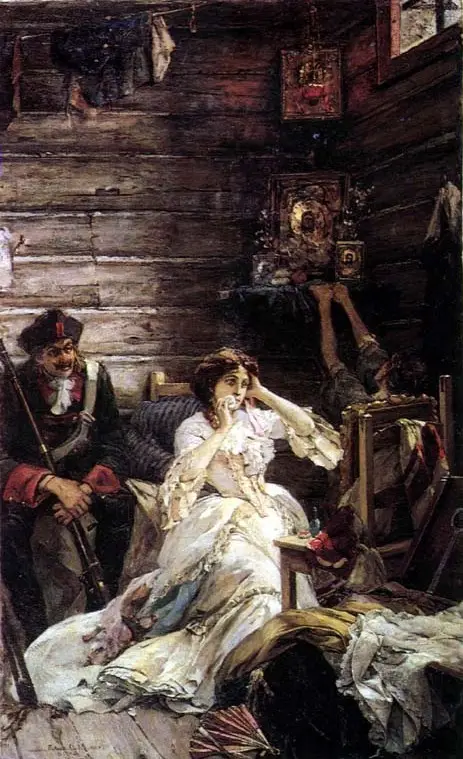
A frightened Mary Hamilton contemplates her imminent
execution in this 1904
painting by Pavel Svedomsky.